JOURNAL OF FOREST SCIENCE, 50, 2004 (1): 31–37
The paper employs the terminology of Czech typology school using the data from forest management records, and compares the targetand present tree species composi-tion in all existing Czech Forest Natural Regions.
The Czech typology system is based on the idea of “geo-biocene”, which represents the unity of live and inanimate nature. The live nature is represented by altitudinal vegeta-tion zones that are named after dominant tree species in the particular zone:
1. Oak 2. Beech-oak 3. Oak-beech 4. Beech 5. Fir-beech 6. Spruce-beech 7. Beech-spruce 8. Spruce
9. Carpathian pine.
The inanimate nature is divided into 8 ecological series in which the dominant attribute is the soil:
– Extreme – Acid – Fertile
– Horizon enriched with litter – Horizon enriched with water – Pseudogley
– Gley – Peat.
These ecological series are subdivided into 24 edaphic categories describing the soil conditions in detail. Vegeta-tion zones and edaphic categories form a net and their crossing points are called forest type groups. Management
sets of forest site types include several groups of forest type groups.
The following terms, common in Czech forestry, are used in the paper: Forest Natural Region, target species composition and natural tree species composition. Ac-cording to Regional Plan of Forest Development (2000) Forest Natural Regions are territorial units demarcated according to the Czech forest typology – 41 Forest Natu-ral Regions are determined in the Czech Republic on the basis of geomorphology, hydrography, climate, geology, pedology and genetic resources of trees (Fig. 1). Target tree species composition means economically, function-ally and biologicfunction-ally optimised tree species composition at the rotation age corresponding to natural conditions (according to Decree No. 83/1996). Natural tree species composition is reconstructed by various authors and their methodology. On the basis of the above-mentioned com-parison, the author divides Forest Natural Regions into four groups:
1. Forest Natural Regions with the largest differences between target and actual tree species composition 2. Forest Natural Regions with large differences between
target and actual tree species composition
3. Forest Natural Regions with medium differences be-tween target and actual tree species composition 4. Forest Natural Regions with negligible differences
between target and actual tree species composition. Nowadays it is often said (by environmentalists, and some foresters as well) that the spruce stands are ecologi-cally unstable and prone to abiotic or biotic disasters and for this reason the yield of wood is insecure. This idea is reflected in Forest Act No. 289/1995, so called “new
Evaluation of changes in the tree species composition
of Czech forests
I. T
OMÁŠKOVÁMendel University of Agriculture and Forestry, Faculty of Forestry and Wood Technology,
Brno, Czech Republic
ABSTRACT: The tree species composition of forests in the Czech Republic has changed due to the human impact over the time. Nowadays, the idea of reducing the area with spruce stands and of increasing the area with broadleaved stands is widely discussed. The paper compares the target species composition with the presentone and creates four groups of areas with the largest and/or negligible differences between the target and the actual tree species composition using the Czech typology school.
Forest Act”, which sets down, among other objectives, that every target management set of stands must have a defined proportion of soil improving tree species (mostly broadleaved trees). Sometimes the result of this regulation is that beech and other broadleaves are frequently used for reforestation in a schematic proportion without concep-tion, even at places less suitable for beech.
Therefore, the crucial question is: Is it really necessary to reduce the area of spruce stands in all Forest Natural Regions?
At present, the proportion of Norwayspruce as the main commercial tree species is 54% of the total forest area, and this proportion is planned to be reduced to 36% in about
[image:2.595.62.495.57.575.2]100 years (MZe ČR 2000). In the same time period, the proportion of broadleaved trees in the total forest area should rise from 22% to 36% or 44%. (The percentage varies according to individual authors.) The necessity of changes in tree species composition is motivated by a risk of insect outbreaks and wind disasters; and/or by the global climate changes that presents jeopardy especially for existing young spruce plantations at lower regions. But this change in tree species composition sharply contrasts with requirements of the wood processing industry. This discrepancy could lead to problems in the forest sector in future when customers could search for appropriate wood assortments abroad and inland forestry would lose Fig. 1. Map of the Forest Natural Regions
1 Krušné hory
2a Podkrušnohorské pánve Chebská a Sokolovská pánev 2b Podkrušnohorské pánve Mostecká a Žatecká pánev 3 Karlovarská vrchovina
4 Doupovské hory 5 České středohoří 6 Západočeská pahorkatina 7 Brdská vrchovina 8 Křivoklátsko a Český les
9 Rakovnicko-kladenská pahorkatina 10 Středočeská pahorkatina
11 Český les
12 Předhoří Šumavy a Novohradských hor 13 Šumava
14 Novohradské hory
15a Jihočeské pánve Budějovická pánev 15b Jihočeské pánve Třeboňská pánev 16 Českomoravská vrchovina 17 Polabí
18 Severočeská pískovcová plošina Český ráj 19 Lužická pískovcová vrchovina
20 Lužická pahorkatina
21 Jizerské hory a Ještěd 22 Krkonoše
23 Podkrkonoší 24 Sudetské mezihoří 25 Orlické hory
26 Předhoří Orlických hor 27 Hrubý Jeseník
28 Předhoří Hrubého Jeseníku 29 Nízký Jeseník
30 Drahanská vrchovina 31 Českomoravské mezihoří 32 Slezská nížina
33 Předhoří Českomoravské vrchoviny 34 Hornomoravský úval
35 Jihomoravské úvaly 36 Středomoravské Karpaty 37 Kelečská pahorkatina
the main source of income from selling wood, which is essential for financing and preserving the environmental functions of forests.
The aim of this paper is to compare the target tree spe-cies composition with the present one in all Forest Natural Regions, to evaluate the differences between them, and to calculate the present surplus or deficient area under the main tree species.
MATERIAL AND METHODOLOGY
The data used in this paper originate from the database of forest management plans archived in the Forest Man-agement Institute. The terms such as target tree species and proportion of soil-improving tree species, as defined in Forest Act No. 289/1995, are used in this paper. Target tree species composition and proportion of soil-improv-ing tree species belong to the basic principles of Czech forest policy because they determine the fundamentals of forest management. The basic unit of forest management planning is Forest Natural Region. Its components are management sets of forest site types in which the target tree species compositions were prescribed by PLÍVAand
ŽLÁBEK (1989) and which include optimal economic,
biological and function properties at rotation age. Every Forest Natural Region has a certain number of target sets of stands of the known area. For every target set of forest site types there is a model of target tree species compo-sition and actual tree species compocompo-sition. The present relative surplus or deficiency of every tree species can be deduced (proportion in %).
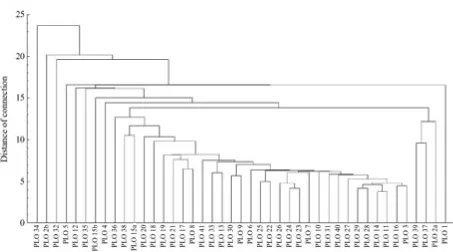
Cluster Analysis, belonging to Multivariate Explora-tory Techniques, was used for statistical processing. The target areas of all tree species in all Forest Natural Regions were compared with the actual areas. The Statistica software computed differences between the target and actual area of all tree species in all For-est Natural Regions, and subsequently I created four
groups of Natural Forest Areas according to hierarchi-cal clustering which indicate the proximity of the ac-tual tree species composition to the target tree species composition.
RESULTS AND DISCUSSION
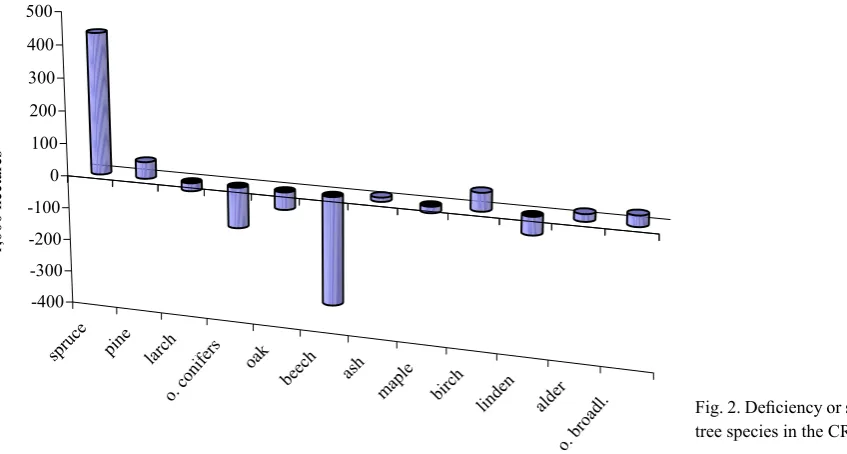
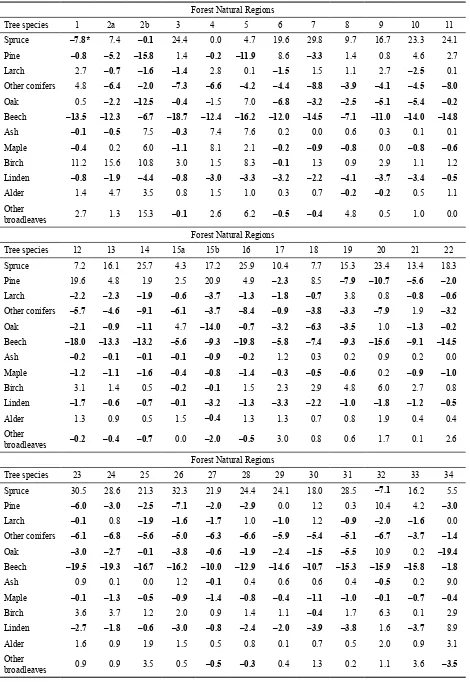
No Forest Natural Region actually shows a tree species composition as it should be according to the prescribed target tree species composition (Table 1). The most sur-plus tree species is Norway spruce – on the other hand, beech is the most deficient cut tree species. The necessity of reduction of coniferous trees is evident in the case of Norway spruce and Scots pine. Larch and other conif-erous trees occupy a smaller acreage than they should according to the target tree species composition. In the Czech Republic, the area of the coniferous trees is about 330,000 ha larger than is appropriate for the prescribed target tree species composition, and this area should be replaced by beech. The graph also shows a deficiency of the area of oak, maple and linden (Fig. 2). On the contrary, the proportion of birch is larger than it should be. The reason is that birch and other broadleaves take the place of Norway spruce in air polluted areas. The shortage of other coniferous tree species is especially due to fir absence in forest stands and absence of linden can be caused by complications in plant production in forest nurseries.
Statistical measurements showed that the first group of Forest Natural Regions with the largest differences between the target and actual tree species composition includes Forest Natural Regions: 3, 11, 14, 16, 23, 24, 26, 28 and 29. In these areas, broadleaved trees should replace the mature coniferous stands.
The second group with large differences between the target and actual tree species composition includes Forest Natural Regions: 6, 7, 8, 9, 10, 13, 17, 18, 19, 21, 22, 25, 27, 30, 31, 33, 37, 39, 40 and 41.
Fig.3. Shortage or abundance of tree species in CR
spruce pine larch o.con
ifer. oak
beech ash
[image:3.595.73.497.532.759.2]maple birch linden alder o.broa dl. -400 -300 -200 -100 0 100 200 300 400 500 1 00 0 he ct ar s
Fig. 2. Deficiency or surplus of tree species in the CR
1,000 hectares
o. conifers
Table 1. Surplus or deficiency of tree species in Forest Natural Regions in relation to target tree species composition (data in %)
Forest Natural Regions
Tree species 1 2a 2b 3 4 5 6 7 8 9 10 11
Spruce –7.8* 7.4 –0.1 24.4 0.0 4.7 19.6 29.8 9.7 16.7 23.3 24.1
Pine –0.8 –5.2 –15.8 1.4 –0.2 –11.9 8.6 –3.3 1.4 0.8 4.6 2.7
Larch 2.7 –0.7 –1.6 –1.4 2.8 0.1 –1.5 1.5 1.1 2.7 –2.5 0.1
Other conifers 4.8 –6.4 –2.0 –7.3 –6.6 –4.2 –4.4 –8.8 –3.9 –4.1 –4.5 –8.0
Oak 0.5 –2.2 –12.5 –0.4 –1.5 7.0 –6.8 –3.2 –2.5 –5.1 –5.4 –0.2
Beech –13.5 –12.3 –6.7 –18.7 –12.4 –16.2 –12.0 –14.5 –7.1 –11.0 –14.0 –14.8
Ash –0.1 –0.5 7.5 –0.3 7.4 7.6 0.2 0.0 0.6 0.3 0.1 0.1
Maple –0.4 0.2 6.0 –1.1 8.1 2.1 –0.2 –0.9 –0.8 0.0 –0.8 –0.6
Birch 11.2 15.6 10.8 3.0 1.5 8.3 –0.1 1.3 0.9 2.9 1.1 1.2
Linden –0.8 –1.9 –4.4 –0.8 –3.0 –3.3 –3.2 –2.2 –4.1 –3.7 –3.4 –0.5
Alder 1.4 4.7 3.5 0.8 1.5 1.0 0.3 0.7 –0.2 –0.2 0.5 1.1
Other
broadleaves 2.7 1.3 15.3 –0.1 2.6 6.2 –0.5 –0.4 4.8 0.5 1.0 0.0
Forest Natural Regions
Tree species 12 13 14 15a 15b 16 17 18 19 20 21 22
Spruce 7.2 16.1 25.7 4.3 17.2 25.9 10.4 7.7 15.3 23.4 13.4 18.3
Pine 19.6 4.8 1.9 2.5 20.9 4.9 –2.3 8.5 –7.9 –10.7 –5.6 –2.0
Larch –2.2 –2.3 –1.9 –0.6 –3.7 –1.3 –1.8 –0.7 3.8 0.8 –0.8 –0.6
Other conifers –5.7 –4.6 –9.1 –6.1 –3.7 –8.4 –0.9 –3.8 –3.3 –7.9 1.9 –3.2
Oak –2.1 –0.9 –1.1 4.7 –14.0 –0.7 –3.2 –6.3 –3.5 1.0 –1.3 –0.2
Beech –18.0 –13.3 –13.2 –5.6 –9.3 –19.8 –5.8 –7.4 –9.3 –15.6 –9.1 –14.5
Ash –0.2 –0.1 –0.1 –0.1 –0.9 –0.2 1.2 0.3 0.2 0.9 0.2 0.0
Maple –1.2 –1.1 –1.6 –0.4 –0.8 –1.4 –0.3 –0.5 –0.6 0.2 –0.9 –1.0
Birch 3.1 1.4 0.5 –0.2 –0.1 1.5 2.3 2.9 4.8 6.0 2.7 0.8
Linden –1.7 –0.6 –0.7 –0.1 –3.2 –1.3 –3.3 –2.2 –1.0 –1.8 –1.2 –0.5
Alder 1.3 0.9 0.5 1.5 –0.4 1.3 1.3 0.7 0.8 1.9 0.4 0.4
Other
broadleaves –0.2 –0.4 –0.7 0.0 –2.0 –0.5 3.0 0.8 0.6 1.7 0.1 2.6
Forest Natural Regions
Tree species 23 24 25 26 27 28 29 30 31 32 33 34
Spruce 30.5 28.6 21.3 32.3 21.9 24.4 24.1 18.0 28.5 –7.1 16.2 5.5
Pine –6.0 –3.0 –2.5 –7.1 –2.0 –2.9 0.0 1.2 0.3 10.4 4.2 –3.0
Larch –0.1 0.8 –1.9 –1.6 –1.7 1.0 –1.0 1.2 –0.9 –2.0 –1.6 0.0
Other conifers –6.1 –6.8 –5.6 –5.0 –6.3 –6.6 –5.9 –5.4 –5.1 –6.7 –3.7 –1.4
Oak –3.0 –2.7 –0.1 –3.8 –0.6 –1.9 –2.4 –1.5 –5.5 10.9 0.2 –19.4
Beech –19.5 –19.3 –16.7 –16.2 –10.0 –12.9 –14.6 –10.7 –15.3 –15.9 –15.8 –1.8
Ash 0.9 0.1 0.0 1.2 –0.1 0.4 0.6 0.6 0.4 –0.5 0.2 9.0
Maple –0.1 –1.3 –0.5 –0.9 –1.4 –0.8 –0.4 –1.1 –1.0 –0.1 –0.7 –0.4
Birch 3.6 3.7 1.2 2.0 0.9 1.4 1.1 –0.4 1.7 6.3 0.1 2.9
Linden –2.7 –1.8 –0.6 –3.0 –0.8 –2.4 –2.0 –3.9 –3.8 1.6 –3.7 8.9
Alder 1.6 0.9 1.9 1.5 0.5 0.8 0.1 0.7 0.5 2.0 0.9 3.1
Other
The third group with medium differences between the target and actual tree species composition includes Forest Natural Regions 2a, 4, 15a, 20, 36 and 38.
The fourth group with negligible differences between the target and actual tree species composition includes Forest Natural Regions: 1, 2b, 5, 12, 15b, 32, 34 and 35. Generally, no considerable modifications of tree species composition are necessary in these areas (Fig. 3).
CONCLUSION
[image:5.595.63.531.75.299.2]The first two groups have the higher proportion of spruce instead of beech and the changes in them are urgent. The most numerous group is the second one characterised by large differences between the target and present tree species composition and it needs changes as well. Generally it is true that there is a surplus of spruce in
Table 1 to be continued
Forest Natural Regions
Tree species 35 36 37 38 39 40 41
Spruce –0.3 –8.1 2.2 –0.2 3.3 24.1 15.6
Pine –2.1 –1.6 –2.6 4.9 –1.9 –0.9 1.6
Larch –3.5 –0.8 1.3 –2.4 –3.4 –4.5 –4.3
Other conifers –1.2 –5.8 –6.3 –4.6 –5.7 –6.6 –2.4
Oak –5.6 2.0 –2.4 1.0 –1.1 –1.2 –1.1
Beech –5.3 2.3 –13.0 –0.1 –12.4 –6.2 –8.1
Ash 4.9 0.7 2.6 0.7 2.9 –0.1 0.1
Maple 0.0 –1.3 –0.8 –1.4 1.7 –2.7 –1.9
Birch 0.1 4.5 9.4 0.9 4.7 0.7 1.2
Linden –2.6 –2.6 3.2 –3.7 5.4 –2.1 –2.9
Alder 1.1 0.4 0.8 0.5 5.0 –0.5 0.3
Other
broadleaves 14.6 9.9 5.7 4.3 1.8 0.2 1.9
*minus before the number indicates a deficiency of the tree species in %
[image:5.595.71.525.486.738.2]the Czech Republic and a deficiency of beech. The second “shortage” group is “other conifers” with fir and Douglas fir. With respect to this fact it is hard to say that there is a surplus of conifers in the Czech Republic.
But it is possible to interpret the result as a demonstra-tion of high heterogeneity not only in the framework of the Czech Republic but also on the local level. Research in this field showed that universal recommendations, such as increase in beech or decrease in spruce are not valid in the whole Czech Republic. Forest types and site requirements of trees must be an operative background for reforestation. However, the economic effect of tree species composition cannot be omitted at the same time. The mission of the target tree species composition is not
to achive the natural tree species composition (referring to the 6th or 10th century), but to create ecologically stable
and economically viable forests.
References
PLÍVA K., ŽLÁBEK I., 1989. Provozní systémy v lesním plá-nování. Praha, SZN: 208.
Ústav pro hospodářskou úpravu lesa, 2000. Oblastní plány roz-voje lesů. Kostelec n. Č. lesy, Lesn. Práce: 100.
MZe ČR, 2000. Zpráva o stavu lesa a lesního hospodářství ČR k 1. 12. 1999. Praha, Triangl: 140.
Received for publication July 9, 2003 Accepted after corrections December 10, 2003
Hodnocení změn v druhové skladbě lesů v ČR
I. TOMÁŠKOVÁ
Mendelova zemědělská a lesnická univerzita, Lesnická a dřevařská fakulta, Brno, Česká republika
ABSTRAKT: Druhová skladba lesů v České republice se vlivem působení člověka značně změnila, a proto se současná dře-vinná skladba liší od původní. Příspěvek hodnotí na základě české typologické školy cílovou a současnou dřevinnou skladbu v jednotlivých hospodářských souborech v přírodních lesních oblastech. Využitím statistické metody shlukové analýzy vytváří čtyři skupiny přírodních lesních oblastí podle míry odlišnosti cílové a současné dřevinné skladby. V České republice existují jak přírodní lesní oblasti, ve kterých se současná dřevinná skladba téměř shoduje s cílovou, tak oblasti vyžadující výrazné úpravy.
Klíčová slova: přírodní lesní oblast; cílový hospodářský soubor; jehličnaté dřeviny; listnaté dřeviny; druhová skladba; původní druhová skladba; cílová druhová skladba
Přírodní lesní oblasti (dále jen PLO) mají různou dřevinnou skladbu v závislosti na přírodních podmínkách. Smrk jako hlavní hospodářská dřevina má v současné době zastoupení 54 %, které by se mělo snížit během následujících 100 let na 36 %. Množství listnatých porostů by se naopak mělo zvýšit na 36 %, resp. na 44 %. Nutnost druhových změn ve prospěch listnáčů vyvolaná opaku-jícími se kalamitami a globálními klimatickými jevy, které ohrožují smrkové porosty v nižších polohách, je v ostrém rozporu s požadavky dřevozpracujícího průmyslu. Ten byl až dosud zvyklý zpracovávat převážně smrk a borovici a dodávky jiných dřevin jsou zejména pro celulózopapíren-ský průmysl komplikované. Vyšší zastoupení jehličnanů je z hlediska stability a vlivů na půdu nežádoucí, ale z hlediska samofinancování lesního hospodářství je nadále nepostradatelné.
PLO představuje jednotku členění lesa. Její součástí jsou hospodářské soubory (dále jen HS) zastoupené v dané oblasti, pro které PLÍVA a ŽLÁBEK (1989) stanovili
tzv. cílovou druhovou skladbu, což je ekonomicky, biologicky a funkčně optimalizované zastoupení dřevin v mýtním věku.
Data k analýze byla převzata z Oblastních plánů roz-voje lesů (OPRL). Tento materiál je zakotven legislativně v zákoně 289/95 Sb. a je to nástroj lesnické politiky, neboť doporučuje zásady hospodaření. Tvorba lesních hospodářských osnov (LHO) a lesních hospodářských plánů (LHP) rovněž vychází z OPRL. Základní jednotkou plánů je PLO. Každá PLO má několik HS s dřevinami, jejichž rozloha je známa. Jejich plocha byla konfron-tována s cílovou skladbou a procentuální zastoupení přepočteno podle výměry dané PLO.
– chybí na ploše odpovídající 329 954 ha, v menší míře chybí v porostech dub, javor a lípa. Zastoupení břízy je dokonce na ploše, která přesahuje téměř o 60 000 ha plo-chu v cílové skladbě. Je to dané suplováním smrku nebo jiných dřevin na imisních holinách, čímž se vysvětluje
i vyšší zastoupení ostatních listnatých dřevin oproti cílové skladbě. Postupné snižování podílu smrku v obnovních cílech a zvyšování podílu buku povede ke stabilizaci lesních porostů a druhovou skladbu v ČR bude možné považovat za vyhovující.
Corresponding author:
Ing. IVANA TOMÁŠKOVÁ, Mendelova zemědělská a lesnická univerzita, Lesnická a dřevařská fakulta, Ústav lesnické a dřevařské techniky, Lesnická 37, 603 00 Brno, Česká republika