Effect of Freezing rate and Comminution
on Dielectric Properties of Pork
James G. LYNG
1, Lu ZHANG
2, Francesco MARRA
3and Nigel P. BRUNTON
41School of Agriculture, Food Science and Veterinary Medicine, University College Dublin (UCD),
Dublin, Belfield, Ireland; 2Fonterra Research Centre, Fonterra Co-operative Group Limited, Palmerston North, New Zealand; 3Department of Industrial Engineering, University of Salerno,
Fisciano, Italy; 4Teagasc Food Research Centre, Ashtown, Dublin, Ireland
Abstract
Lyng J.G., Zhang L., Marra F., Brunton N.P. (2013): Effect of freezing rate and comminution on dielectric properties of pork. Czech J. Food Sci., 31: 413–418.
The impact of comminution and the freezing rate on the dielectric properties (ε' and ε'') of meats measured at frequen-cies used for cooking, i.e. radio frequency, RF (27.12 MHz), and microwave, MW (915 and 2450 MHz), were evaluated. The temperature rises (ΔT) were also measured following standardised RF or MW cooking protocols (90 s at 450 W). A factorially designed experiment was conducted and the results suggested that ε' and ε'' were generally, though not always, significantly lower in more highly comminuted samples. At MW frequencies in meats with added ingredients, the frozen products generally had lower ε' and higher ε'' values, while slowly frozen meats with no added ingredients had higher ε' values at MW frequencies. Overall, the impact of comminution and freezing rate on ΔT was relatively minor.
Keywords: radio-frequency heating; microwave heating; meat properties; meat batter
Radio frequency (RF) heating offers a more rapid heating method than conventional heating but as yet has not received much commercial success in terms of cooking meat products. In the likely event of this technology being taken up commercially food technologists and engineers will require detailed knowledge of the effects of factors such as the meat type, temperature, recipe, freezing, and comminu-tion on the dielectric properties (i.e. the dielectric constant ε' and the dielectric loss factor ε'') of meats which are the properties affecting the interaction between the electromagnetic radiation and food. A improved understanding of the impact of the afore-mentioned factors on dielectric properties is also desirable for microwave (MW) processing, especially when procedures for controlling local heating have to be designed (Marra et al. 2010; Pace et al. 2011). Previously, the authors of the current paper have examined the impact of factors such as the meat
type (species, fat vs. lean) and dry ingredient type (Lyng et al. 2005), temperature (from 5°C to 85°C) (Zhang et al. 2004), added water, fat and salt, and protein denaturation during heating (Brunton et al. 2006) on the dielectric properties, as well as the use of RF heating for meat thawing (Farag et al. 2010). However, little information is available on the impact of comminution and freezing rate on the dielectric properties of meat and the subsequent interaction between meat and RF or MW radiation. Freezing and size reduction operations can have marked effects on the structure of foods at a cel-lular level (Zaritzky 2000). During both of these operations the potential magnitude of cellular disruption varies from a low to a high level. For example under slow freezing conditions, there is a tendency for a small number of relatively large ice crystals to form in the extracellular space. These large crystals have a major disruptive effect on the
cellular structure particularly in plant foods. Fast freezing on the other hand leads to the formation of a large number of relatively small ice crystals, which form within and between cells. These small crystals have a much less disruptive effect on the cellular structure of foods.
As to comminution, the freezing rate affects on the cellular structure of meat: these effects in turn could influence the dielectric properties of meat and the subsequent interaction between meat and RF or MW radiation. For example, while the relatively flexible myofibrillar structure of the meat products means they are less susceptible to freezing damage (compared to more rigid plant cells) and for this reason the meat processors have found that slow freezing does not have as dramatic an impact on the quality of the meat products. However, the impact, if any, of this form of freezing on the dielectric properties (which in turn affect RF or MW cooking) is not really understood. Therefore, the principle objective of the present study was to examine how the unit operations such as comminution and freezing rate affect the dielectric properties and penetration depth (dp) of RF and MW radiation into meat and a typical meat product, and also to investigate the effect of temperature rise in samples following a standardised MW or RF cooking cycle.
MATERIAL AND METHODS
Preparation of comminuted meats and meat batters.Lean pork was obtained from a local sup-plier (Galtee Meats, Cork, Ireland). Three products (C1–C3) were prepared with no ingredients added to the coarsely (C1) or finely comminuted (C2) pork while ingredients were added to the third product (a meat batter – C3). All were prepared using the
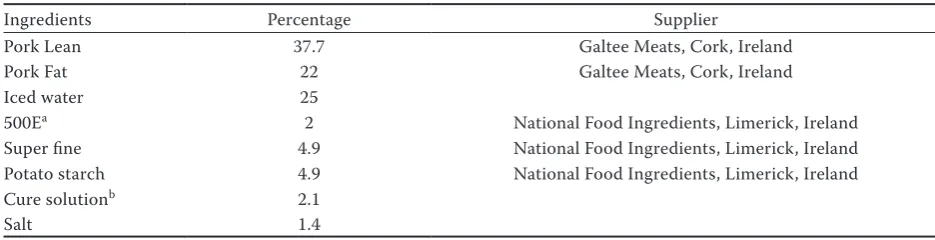
manufacturing protocols described in Table 1. For product C3, the ingredient quantities and suppliers are given in Table 2. Mincing was carried out using a La Minerva Mincer Type C/E 670N (La Minerva, Bologna, Italy) while fine comminution of C2 and C3 was achieved using a Braun household blender Model No. 4259 Verbraucherrefera (Braun, Kron-berg, Germany) fitted with a double blade slicer. Each product was prepared in 600 g lots which were subdivided into five 120 g portions with each portion placed in a plastic cups (maximum volume 142 ml; King Ireland, Dublin, Ireland) with the fit-ted lid. The samples were packed tightly into each cup which was filled until the sample was ~1.0 cm from the top. The 5 cups were randomly assigned as follows: 2 for MW dielectric property measurement and subsequent MW heating, 2 for RF dielectric property measurement and subsequent RF heating, and 1 for proximate analysis.
[image:2.595.305.531.127.264.2]Freezing rate and unfrozen controls. For each product type (i.e. C1–C3) two 600 g lots of unfrozen
Table 1. Manufacturing protocols used in the preparation of coarsely comminuted (C1), finely comminuted (C2) and meat batter samples (C3)
Manufacturing step C1 C2 C3 Lean meat minced through a 3.5 mm plate • • •
Lean meat placed in a household blender • •
Fat placed in a household blender •
500E1, ½ of water2 and cure solution added •
Blend at knife speed 1 for 30 s • •
Blend at knife speed 1 for 60 s • •
Superfine rusk, potato starch ½ of water added2 •
Blend at knife speed 1 for 30 s • •
Blend at knife speed 2 for 90 s • •
1500E – soya protein concentrate (binder); 2water was added
as 25% of total formulation in two stages (12.5% in stage 1 and 12.5% in stage 2)
Table 2. Ingredients and suppliers used in the manufacture of the model meat batter (C3)
Ingredients Percentage Supplier
Pork Lean 37.7 Galtee Meats, Cork, Ireland
Pork Fat 22 Galtee Meats, Cork, Ireland
Iced water 25
500Ea 2 National Food Ingredients, Limerick, Ireland
Super fine 4.9 National Food Ingredients, Limerick, Ireland Potato starch 4.9 National Food Ingredients, Limerick, Ireland Cure solutionb 2.1
Salt 1.4
[image:2.595.62.530.620.740.2]controls were prepared. In order to examine the effect of the freezing rate on the dielectric proper-ties of the C1, C2, and C3 products, samples were prepared that were either frozen slowly by placing in a cold storage room at –18°C or rapidly frozen by immersion in liquid nitrogen.
Measurement of dielectric properties.Prior to the measurement of the dielectric properties, the samples were defrosted (where relevant) in a refrigerator at 4°C and subsequently equilibrated in an air conditioned laboratory (23°C). ε' and ε'' at RF frequencies (27.12 MHz) were measured using a custom made open-ended co-axial probe (Capenhurst Technologies, Chester, UK) connected to a Hewlett Packard 8714ET Network Analyser (Agilent Technologies, Palo Alto, USA). The cali-bration of the probe at 27.12 MHz was carried out prior to analysis by the sequential attachment of a 50 W load and a shorting block. The samples were placed on a plastic laboratory jack (Lennox Laboratory Supplies, Dublin, Ireland) and raised to place the surface of the meat batter in contact with the probe so as not to effect the calibration. ε' and ε'' were calculated by inputting the real and imaginary impedance values from the Smith chart displayed on the network analyser into a previously configured Excel worksheet (Capen-Hurst Technologies, Chester, UK). The real and imaginary impedance values for air and water at 25°C were also required for the calculation. The measurements at MW frequencies were carried out in an identical manner to those at RF frequencies apart from the following exceptions. An Agilent Technologies open-ended co-axial probe (Model No. 85070C) with a frequency range of 0.3–3.0 GHz was used for the dielectric measurements, and the calculations of ε' and ε'' at 915 and 2450 MHz were carried out with the aid of the 85070C software package (Version C1-02; Agilent Technologies, Palo Alto, USA).
At both RF and MW frequencies a total of seven measurements were taken per sample. The calcula-tion of dp was carried using the equation listed in Zhang et al. (2004) and in Gaurdeño et al. (2009).
RF and MW cooking of meat batters
Sample preparation prior to cooking.Following the measurement of their dielectric properties, the samples were transferred to 100 ml glass beakers using the method described by Lyng et al. (2005). The beaker was then covered with cellophane and returned to a chill (4°C) for the measurement the following day. The following day each beaker was taken straight from the chill and its temperature the recorded using a Digitron 2046 T temperature probe (Eurotec Instrumentation, Dundalk, Louth, Ireland). The cellophane was then removed and a glass plate (3 mm thick) was placed on top of the beaker. This was used to prevent arcing dur-ing cookdur-ing.
Cooking procedures. The RF oven and proce-dure used for cooking are described in Lyng et al. (2005). The procedure and MW oven used are described in detail in Lyng et al. (2005).
Temperature measurement following MW and RF cooking, The thermocouple-jig method used was described by Lyng et al. (2005).
Experimental design and statistical analysis. In total 90 cups were prepared. Of these 30 were unfrozen (2 batches × 3 product types (C1–C3) × 1 freezing treatment (unfrozen control) × 5 cups per treatment) and 60 were frozen (2 batches × 3 product types (C1–C3) × 2 freezing treatments (cold store vs. liquid nitrogen) × 5 cups per treat-ment). The results were analysed by using PROC GLM procedure (SAS Version 8.2 software; SAS Institute Inc., Cary, USA).
RESULTS AND DISCUSSION
C1 and C2 differed in composition from C3 (Ta-ble 3) due to the addition of non-meat ingredients to C3 which gave C3 a higher average salt, fat, car-bohydrate, and ash contents. The marked influence of non-meat ingredients such as salt on dielectric properties has been previously discussed (Zhang
[image:3.595.63.536.693.738.2]et al. 2004; Lyng et al. 2005). Therefore C1 and C2
Table 3. Proximate analysis results of products manufactured in the current study
Products Moisture (%) Protein (%) Fat (%) Ash (%) Salt (%) Carbohydrate (%)1
C1 and C2 73.9 20.1 4.4 1.13 0.08 0.47
C3 61.11 11.03 17.1 2.31 1.79 8.45
which had no added ingredients were analysed sepa-rately from C3 which contained added ingredients.
Effect of comminution (i.e. C1 vs. C2)
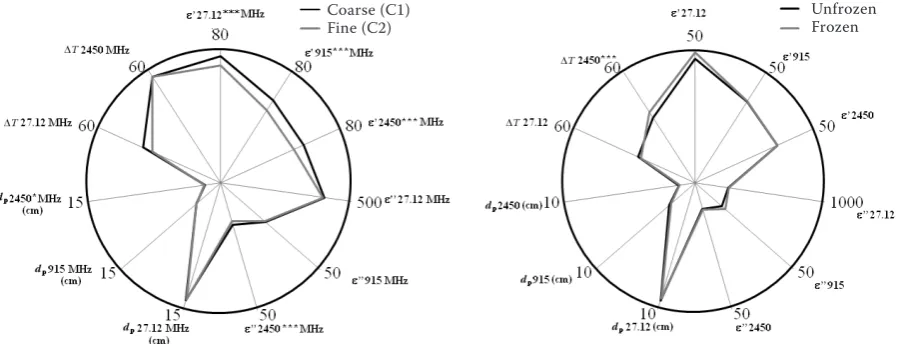
Dielectric properties, ε' and ε'', values were on average lower in the highly comminuted samples (Figure 1) (i.e. C2) though for ε'' this effect was not significant at 27.12 and 915 MHz. The higher ε'' of coarsely comminuted samples at 2450 MHz manifested itself in a significantly lower dp at this frequency (P < 0.05). No significant differ-ence (P < 0.05) in the temperature rise (ΔT) was noted between C1 and C2 samples cooked by RF (27.12 MHz). Although a higher ΔT was expected in C1 samples at 2450 MHz, where ε'' was signifi-cantly higher (P < 0.001), no effect was observed, though it must be noted that the magnitude of the difference in ε'' was relatively small. A pos-sible explanation for the differences in behaviour between C1 and C2 could also be related to the level of cellular disruption (with the resultant release of the cell contents). The size reduction of coarsely comminuted products (such as C1) leads to particle aggregates composed of reasonably intact individual cells (Girard 1992). However, fine comminution (as in C2) always results in the restructuring, and consequently the cohesion of all kinds of components, protein, fat, water, and air. Overall, while comminution may have a slight influence on dielectric properties, the magnitude of the change in these properties is not sufficient to have any major effect on ΔT.
Effect of freezing
It is widely accepted that the ice crystal forma-tion during freezing disrupts cellular structures (particularly in plant cells) and the extent of this disruption is influenced by the freezing rate with fast freezing producing smaller crystals and less disruption while slower freezing produces larger ice crystals and more disruption. Muscle cells are less rigid than plant cells due to the lack of the cell wall and the following results show the impact of freezing on dielectric properties and ΔT of samples cooked in RF or MW ovens.
Meat with no added ingredients (C1 and C2). With the exception of ε' values at 2450 MHz, at both RF and MW frequencies, the ε’ and ε'' values of the unfrozen (fresh) samples were on average slightly lower than those of the frozen samples (Figure 2) though none of these differences in the dielectric properties was statistically significant (P ≥ 0.05). No significant difference (P ≥ 0.05) was found in ΔT of the samples cooked in RF oven, but ΔT of fresh samples cooked in MW oven were significantly lower (P < 0.001) than those of frozen samples, which again most likely relates to the slightly increased ε'' at 2450 MHz, possibly due to free water and ion elevation caused by freezing and thawing.
[image:4.595.67.518.539.711.2]Meat with added ingredients (C3). At 915 and 2450 MHz, ε’ values of the unfrozen samples (C3) were significant higher (P < 0.01) than those of the frozen C3 samples (Figure 3), while at the same frequencies ε'' values were conversely lower though only ε'' at 915 MHz showed a significant difference (P < 0.05).
Figure 2. The effect of freezing on C1 and C2 dielectric properties (ε', ε'', dp at 27, 915, and 2450 MHz) and tem-perature rises (ΔT at 27 and 2450 MHz)
Figure 1. The effect of comminution on meat dielectric properties (ε', ε'' dp at 27, 915, and 2450 MHz) and tem-perature rises (ΔT at 27 and 2450 MHz)
Unfrozen Frozen Coarse (C1)
Furthermore, the dp of the unfrozen samplesat MW frequencies was significant higher than that of the frozen samples. Surprisingly, no significant differ-ence (P < 0.05) was found in ΔT at 2450 MHz. At 27.12 MHz, freezing did not significantly affect the dielectric properties or ΔT (P ≥ 0.05). In terms of the composition, C3 is a much more complex system than C1 and C2 as it contains added dry ingredi-ents including fat, water, soya protein concentrate (500 E), superfine rusk, salt, starch, sodium nitrite, and sodium nitrate. The dielectric properties of these ingredients at 23°C have been previously reported (Lyng et al. 2005). However, attempting to explain differences in the behaviour of C3 (vs. C1 and C2) due to the presence of these ingredients goes beyond the scope of this section of the present study which is focused on the impact of freezing on cooking and based on ΔT results this influence appears to be minimal in C3 samples.
Effect of freezing rate
Meat with no added ingredients (C1 and C2). The effect of the freezing rate on the dielectric properties of comminuted samples (both C1 and C2) is shown in Figure 4. No significant difference in ε'' (P ≥ 0.05) was found between the slow and fast frozen samples. However, the ε' values at 915 and 2450 MHz of the slowly frozen samples were significantly higher (P < 0.05) than those of the fast frozen samples. Many authors have theoreti-cally described the difference between fast and slow freezing methods on vegetables and fruits
[image:5.595.70.295.82.258.2](Fellows 1988; Zaritzky 2000). However, these descriptions are not directly applicable to the present study as in raw meat most of the water is contained within the cells, rather being spread throughout the cell, cell walls, and intracellular spaces. When meat freezes slowly, ice crystals form and break up the muscle structure in a manner analogous to the freezing damage in plant tissue (Hall et al. 1994). Fast freezing will freeze the water where it is, and many small ice crystals will be produced within the muscle cells and on subsequent thawing the majority of this water will be re-absorbed by the cells. Slow freezing encour-ages the growth of extracellular ice crystals, which become concentrated leading to dehydration of cells by forcing water to move out. Because ice crystals have a lower water vapour pressure than
[image:5.595.81.522.83.259.2]Figure 4. The effect of freezing rate on C1 and C2 dielec-tric properties (ε', ε'', dp at 27, 915, and 2450 MHz) and temperature rises (ΔT at 27 and 2450 MHz)
Figure 3. The effect of freezing on C3 dielectric properties (ε', ε'', dp at 27, 915, and 2450 MHz) and temperature rises (ΔT at 27 and 2450 MHz)
Unfrozen
[image:5.595.307.525.546.713.2]Frozen Slow frozenFast frozen
Figure 5. The effect of freezing rate on C3 dielectric prop-erties (ε' ε'', dp at 27, 915, and 2450 MHz) and temperature rises (ΔT at 27 and 2450 MHz)
the regions within the cells, water therefore moves from the cells to the growing crystals. On thawing, the cells of slowly frozen samples are permanently damaged and the cellular material leaks out from the ruptured cells. From this point of view, it could be concluded that the thawed samples which had been frozen slowly are likely to have slightly more free water than that of thawed samples which were initially rapidly frozen. Dipole movements are more active in electromagnetic fields at MW vs. RF frequencies, so that higher ε' values at 915 and 2450 MHz for slowly frozen samples are most likely a reflection of this increased free water content.
Meat with added ingredients (C3). Although the freezing rate had an effect on the C1 and C2 samples, no significant effect of the freezing rate (P ≥ 0.05) on the dielectric properties of C3 samples was observed (Figure 5). However, similar to trends in C1 and C2 samples, average ε' values for slowly frozen samples are slightly higher than for fast frozen ones at 915 and 2450 MHz. As mentioned in previous text there are many possible reasons for these differences which are outside the scope of the present study.
CONCLUSION
Dielectric properties would appear to have a cer-tain amount of potential as methods for detecting physical differences in pork meat batters induced by the comminution and freezing rate though it would seem that these differences were relatively minor and had a minimal effect on the temperature rises during cooking of samples. The samples coarsely comminuted by mincer showed a general tendency towards having higher dielectric properties values than those of minced and blended samples though further work would be needed to verify this across a broader range of chopping regimes. Freezing rate (due to its influence on the growth and size of ice crystals and resultant tissue damage) had small effects on the dielectric properties though these effects varied depending upon the product type. Overall, while the factors examined had some significant effects on temperatures following RF and MW cooking, the magnitude of these differences on average was small.
References
Brunton N.P., Lyng J.G., Zhang L. (2006): The use of die-lectric properties and other physical analyses for assessing protein denaturation in beef biceps femoris muscle dur-ing cookdur-ing from 5 to 85°C. Meat Science, 72: 236–244. Farag K., Marra F., Lyng J.G., Morgan D.J., Cronin D.A.
(2010): Temperature changes and power consumption during radio frequency tempering of beef lean/fat for-mulations. Food and Bioprocess Technology, 3: 732–740. Fellows P. (1988): Food Processing Technology – Principles and Practice. Ellis Horwood Ltd., Chichester: 418–139. Girard J.P. (1992): Technology of Meat and Meat Products.
Ellis Horwood Ltd., Chichester: 206–262.
Guardeño L.M., Hernández-Carrión M., Catala-Civera J.M., Plaza P., Pérez-Munuera L., Hernando I. (2009): Improving microwave heating using polysac-charides as thickeners. Czech Journal of Food Sciences,
27 (Special Issue): S342–S345.
Hall M., Zhuo L., Gabriel C. (1994): Spectroscopic In-vestigation of the Dielectric Properties of Some Foods and Food Components. Ministry of Agriculture Fisheries and Food Publications, London SE99 7TP.
Lyng J.G., Zhang L., Brunton N.P. (2005): A survey of the dielectric properties of meats and ingredients used in meat product manufacture. Meat Science, 69: 589–602. Marra F., De Bonis M.V., Ruocco G. (2010): Combined
microwaves and forced convection heating: a conjugate approach. Journal of Food Engineering, 97: 31–39. Pace M., De Bonis M.V., Marra F., Ruocco G. (2011):
Characterization of a combination oven prototype: Ef-fects of microwave exposure and enhanced convection to local temperature rise in a moist substrate. International Communications in Heat and Mass Transfer, 38: 557–564. Zaritzky N.E. (2000): Factors affecting the stability of
frozen foods. In: Kennedy C.J. (ed.): Managing Frozen Foods.Woodhead Published Ltd and CRC Press LLC, Cambridge: 111–133.
Zhang L., Lyng J.G., Brunton N.P., Morgan D., McKen- na B. (2004): Dielectric and thermophysical properties of meat batters over a temperature range of 5–85 °C. Meat Science, 68: 173–184.
Received for publication September 5, 2012 Accepted after corrections May 2, 2013
Corresponding author: