ISSN Online: 2160-0384 ISSN Print: 2160-0368
DOI: 10.4236/apm.2019.93011 Mar. 29, 2019 228 Advances in Pure Mathematics
Can the Physics of Time Be Helpful in Solving
the Differential Eigenequations Characteristic
for the Quantum Theory?
Stanis
ł
aw Olszewski
Institute of Physical Chemistry, Polish Academy of Sciences, Warsaw, Poland
Abstract
The main differential equations of quantum theory are the eigenequations based on the energy operator; they have the energy as eigenvalues and the wave functions as eigenfunctions. A usual complexity of these equations makes their accurate solutions accessible easily only for very few physical cases. One of the methods giving the approximate solutions is the Schrödin-ger perturbation theory in which both the energies and wave functions of a more complicated eigenproblem are approached with the aid of similar pa-rameters characteristic for a less complicated eigenproblem. No time para-meter is necessary to be involved in these calculations. The present paper shows that the Schrödinger perturbation method for non-degenerate statio-nary quantum states, i.e. the states being independent of time, can be sub-stantially simplified by applying a circular scale of time separately for each order of the perturbation theory. The arrangement of the time points on the scale, combined with the points contractions, gives almost immediately the series of terms necessary to express the stationary perturbation energy of a given eigenproblem. The Schrödinger’s method is compared with the Born-Heisenberg-Jordan perturbation approach.
Keywords
Differential Eigenequations in Quantum Theory, Perturbation Method, Circular Scale of Time
1. Introduction
There exists a multitude of the mathematical methods which help the people in science, engineering and everyday life. The aim of the present paper is to dem-onstrate a reversed example, namely that physical ideas on time can be helpful in
How to cite this paper: Olszewski, S. (2019) Can the Physics of Time Be Helpful in Solving the Differential Eigenequations Characteristic for the Quantum Theory? Advances in Pure Mathematics, 9, 228-241.
https://doi.org/10.4236/apm.2019.93011
Received: January 8, 2019 Accepted: March 26, 2019 Published: March 29, 2019
Copyright © 2019 by author(s) and Scientific Research Publishing Inc. This work is licensed under the Creative Commons Attribution International License (CC BY 4.0).
http://creativecommons.org/licenses/by/4.0/
DOI: 10.4236/apm.2019.93011 229 Advances in Pure Mathematics
the treatment of the mathematics connected with solving of the differential ei-genequations.
In general a differential equation is represented by a mutual dependence be-tween some unknown function, its derivative or derivatives, and one or more independent variables. Evidently the mathematics has its methods to solve such equations. In some special cases the solutions can be analytic in their form, but in general there exist the numerical methods which can provide us systematically with the required results.
In the modern non-relativistic quantum theory, began by Schrödinger in the middle of 1920’s, the differential eigenequations played an important role [1][2] [3][4]. This comes from the postulate that the stationary states of the energy of a physical system, say an atom or an atomic ensemble, should be given by the ei-genvalues of the Hamiltonian energy operator composed usually from the kinet-ic differential part and a multiplkinet-icative part acting together on the wave function representing the examined electron system. In effect the operators of a mixed character—partly differential and partly multiplicative—can enter into play giv-ing usually a complicated mathematical problem.
In case of the presence of many electrons the resulted eigenproblem can be much too complicated to be attacked with the aid of conventional methods ap-plied to the differential equations. An example can be the accurate differential equation describing the electron wave function in a metal. The equation should be necessarily transformed into a more simple form due to an analysis of the physical conditions governing the behaviour of electrons near the nuclei of the metal atoms on the one side, and in the areas rather distant from the nuclei on the other side; see e.g. [5]. The effect of a simplification of such kind can be the equations which occur to be satisfactory in calculating many of the physical properties concerning metals. But this is only one advantage due to the use of a simplified solution. Another advantage—raised especially by Wigner—is that a successful simplification of the necessary mathematical equations allows us for a better insight and understanding of the physics entering the problem [6]. Such insight can be easily smoothed out by a powerful computer whose task was to present only the effective numerical data for the physical parameters characte-rizing the examined piece of matter, but the calculations do not give a look into the play of forces which are responsible for the observed phenomena and results. In the present paper we discuss the use of a specific time notion and time scale suitable in solving a kind of the differential eigenequations entering the quantum mechanics.
2. Schrödinger’s Quantum Mechanics of the Unperturbed
and Perturbed Differential Eigenequations
DOI: 10.4236/apm.2019.93011 230 Advances in Pure Mathematics
oscillator or hydrogen atom, could be successfully attacked by the quantum theory from before of 1925. Already the spectrum of the helium atom, the next atom in the periodic table after the hydrogen, could not be presented by that theory. However, by the use of the idea of the de Broglie waves of matter, Schrödinger could formulate his second-order differential equations suitable to be applied to the electron spectrum of any atom. Moreover, the appropriate Schrödinger equations, called sometimes the wave-mechanical equations, could be applied to molecules and solids. In practice the equations could be easily founded—but not solved—for any multi-electron problem because of our know-ledge of the electrostatic forces which govern any many-electron system: The forces dictated by the Coulomb law act between the electrons and atomic nuclei, as well as—separately—between the purely multi-electron and many-nuclear ensembles.
The idea of construction of the differential eigenequation suitable for each case was based on the classical Hamilton expression for the energy possessed separately by any particle entering the system increased by the interaction ener-gy between different particles. For example any single electron particle, say in an atom, has its kinetic energy represented by the expression (m is the electron mass):
(
2 2 2)
kin 21 x y z ,
E p p p
m
= + + (1)
where px, py and pz are the Cartesian coordinates of the particle
momen-tum, increased by the potential energy due to the electrostatic interaction be-tween an electron and the atomic nucleus:
2
pot .
i
Ze E
r
= − (2)
Here ri is a distance between the ith electron having charge −e and the nucleus
having Ze as its electrostatic charge.
The collective electrostatic energy between the electrons is represented by the Coulomb interaction energy term equal to
2 int 12 i j ,
ij i j
e E
r
≠
=
∑∑
(3)where rij is a distance between the electrons i and j.
Usually the nucleus is assumed to be at rest, so its kinetic energy is neglected. In effect the total classical Hamiltonian for an atom is a sum of (1), (2) and (3) extended respectively over the number of the electron particles. An exclusion of the self-interaction energy of electrons should be done by eliminating the terms corresponding to i= j from the sum entering (3).
The next step—suggested by the de Broglie waves—was to change px, py
and pz in (1) into the differential operators:
ˆ , ˆ , ˆ .
x x y y z z
p i p p i p p i p
x y z
∂ ∂ ∂
→ − = → − = → − =
DOI: 10.4236/apm.2019.93011 231 Advances in Pure Mathematics
The Planck constant h divided by 2π is usually entering (4); in the present case this constant term is put equal to 1.
Therefore instead of the classical Ekin in (1) we obtain the kinetic-energy
operator
(
2 2 2)
2 2 2 2kin 2 2 2
1 1 1
ˆ ˆ ˆ ˆ .
2 x y z 2 2
E p p p
m m x y z m
∂ ∂ ∂
= + + = − + + = − ∇
∂ ∂ ∂
(5)
The operators Epot and Eint—because they depend solely on the electron
position—remain of a multiplicative character given in (2) and (3), therefore
pot pot
ˆ
,
E
=
E
(6)int int
ˆ .
E =E (7)
In effect the quantum problem of the atomic electron energy postulated to be solved becomes
( ) ( )
(
)
tot kin pot int tot
ˆ ˆ ˆi ˆi ˆ ,
i
Hψ =E ψ = E +E +E ψ =E ψ
∑
(8)or more briefly
tot tot
ˆ ,
E ψ =E ψ (9)
where Etot on the right of (9) is a number. The sum in (8) is extended over the
number of electron particles labelled by i. Because of
kin kin ˆ
E ≠E (10)
the problem becomes mathematically a differential eigenequation for the elec-tron wave functions
(
)
(
)
(
)
1 1 1 2 2 2 3 3 3
1 1 1 2 2 2 3 3 3
1 1 1 2 2 2 3 3 3 , , , , , , , , , , , , , , , , , , , , , , , , , , , , , ,
x y z x y z x y z x y z x y z x y z x y z x y z x y z
α β γ ψ ψ ψ (11)
and electron eigenenergies
( ) ( ) ( )
tot tot
,
tot,
tot,
E
=
E
αE
βE
γ
(12)Because of the equality of the operators
tot
ˆ ˆ
E =H (13)
the operator Hˆ in (13) is called the Hamiltonian, or energy operator.
3. Classification of the Wave Functions and Energies into
Non-Degenerate and Degenerate States
Any wave function
(
x y z x y z1, , , , , ,1 1 2 2 2)
ψ ψ= (14)
defines some electron distribution called the electron density
* . ψ ψ =
DOI: 10.4236/apm.2019.93011 232 Advances in Pure Mathematics
In general there can exist an infinite number of solutions
ψ
and Etot of theeigenequation (9):
, , ,
α β γ
ψ ψ ψ ψ= (16)
(see (11)) and
tot
E (17)
given in (12). In case when all eigenvalues (12) are different, the eigenproblem is called non-degenerate, but in case some of solutions (12) are found to be equal, the eigenproblem is called degenerate. Examples of the solutions (16) and (17) are given in [7] and [8].
4. Difficulty in Solving the Schrödinger Equations and
Application of the Perturbation Method
The problem, noticed already by Schrödinger [3], is that the solution of his equ-ation (8)-(9) becomes, in general, an extremely complicated task. Only very few physical systems provide us with simple expressions for
ψ
and Etot. In replyto this difficulty Schrödinger proposed to solve many eigenproblems by consi-dering them similar to the solved problems in the sense that the operator
(unsolved) (solved) per
pot pot
ˆ ˆ ˆ
E −E =V (18)
is of a small size and, for the sake of convenience, dependent solely on the posi-tion vector, or vectors, of the kind of r. Therefore, for a single set of the Carte-sian coordinates x, y, z, we have
p p
ˆ =
er er( ),
V
V
r
(19)so Vper remains of a multiplicative character. The essence of the perturbation
method becomes to calculate per
tot
E and ψper—the perturbed eigenenergies and
eigenfunctions due to the eigenproblem
(
per)
per per pertot
ˆ
H+λV ψ =E ψ (20)
with the aid of Etot and
ψ
obtained due to solving the unperturbed problem.The
λ
entering (20) is assumed to be a small number. It makes that forλ =
0
we have the unperturbed problem, whereasλ =
1
gives a full perturbed prob-lem to be solved.If we focus our attention only on the energy—which is usually a more seeked parameter than the wave function—we obtain
per 2
tot tot 1 2 .
E =E + ∆ +λ E λ ∆ +E (21) For
λ =
0
the first term on the right of (21) is equal to one of the unper-turbed energies in (12). The other terms, labelled by2 3
1, 2, 3,
E E E
λ∆ λ ∆ λ ∆ (22)
are for
λ =
1
equal to the full perturbation corrections of some unperturbed energyE
tot( )i belonging respectively to the perturbation orders:1, 2, 3, .
DOI: 10.4236/apm.2019.93011 233 Advances in Pure Mathematics
In general the corrections (22) can be constructed from the matrix elements
per
V
α β
ψ
ψ
(24)where ψα and ψβ are the unperturbed wave functions, and from the
unper-turbed energy differences
( ) ( ) ( ) ( ) ( ) ( )
toti tot
,
toti tot,
toti tot,
E
−
E
αE
−
E
βE
−
E
γ
(25) where evidently, , , i,
α β γ ≠ (26)
if the unperturbed energy state
E
( )toti is taken into the perturbation process.According to [9] and [10] any ∆EN is composed of SN different kinds of
the perturbation terms built up of (24) and (25). Excepting for the case of
1
N
=
, any of the SN terms(
)
(
)
2 2 ! ! 1 !N
N S
N N
− =
− (27)
taken for
N
>
1
is represented by an infinite sum of the expressions containing (24) and (25). For example forN
=
2
we have a single perturbation term be-cause(
)
2
2 2 2 ! 1 2!1!
S = × − = (28)
which has the form
( ) ( )
per
2 .
per
i j
j i
i V j j V i
E
E E
≠
∆ =
−
∑
(29)It should be noted that SN can attain large numbers already for rather low N:
1 1, 2 1, 3 2, 4 5, 5 14, 6 42, 7 132, 8 429,
S = S = S = S = S = S = S = S = (30)
But for example for
N
=
20
we have9 20 1.767 10 .
S ≅ × (30a)
5. Construction of the Energy Perturbation Terms
Δ
E
NBelonging to Different
N
and the Problem of Time
Schrödinger did not use the notion of time in solving his perturbation eigenequ-ations [3]. In principle the unperturbed and perturbed Schrödinger eigenequa-tions did not contain the time as an independent variable. Also in course of solving his eigenequations he followed a purely mathematical procedure. But time was included in the perturbation process for energy, and corresponding
diagrams, by Feynman [11] [12]. By using the scale of time known from the
everyday experience, the time parameter t can be extended from the minus to plus infinity, viz.
t
−∞ < < ∞
. (31)In this case, it became possible to calculate the SN perturbation terms
DOI: 10.4236/apm.2019.93011 234 Advances in Pure Mathematics
(
1 !)
N
P = N− (32)
terms corresponding to the Feynman diagrams. For large N the number PN
heavily exceeds SN. For example for
N
=
20
we have 17 20 19! 1.216 10P = ≅ × (32a)
which makes the ratio
(
)
820 20 1.216 1.767 10
P S = × (33)
equal to a very large number. In effect the calculation of numerous individual
20
S terms done with the aid of the P20 terms can be a very complicated task.
But an evident simplification of the access to the Schrödinger perturbation terms can be afforded by a suitable choice of the scale of time which labels the collisions of a quantum system with the perturbation potential Vper [13]-[18].
The scale is assumed to be of a circular character remaining similar for any N. This means that for any N points of time considered on the scale, only
N
−
1
points of time, viz.1,2,3,4, , N−1, (34)
are active in the collision done on a circular way with Vper. The Nth point is
considered to be a beginning-end point of the scale and has no participation in the collisions process.
But a travel of a quantum system along the set of points given in (34) gives only one of the SN terms of the perturbation energy belonging to N. Such
situ-ation, when SN is reduced to a single term, holds for the case of
(
)
1 1 1 .
S = N= (35)
The time scale corresponding to
N
=
1
is given in Figure 1. Evidently the scale possesses solely a single time point which is the beginning-end point of the scale.For
N
=
2
we have a situation represented by Figure 2. Here againFigure 1. Time scale for the perturbation order N = 1. Only one time point—the begin-ning-end point of the scale—is indicated.
DOI: 10.4236/apm.2019.93011 235 Advances in Pure Mathematics
2 1 1 1
S = × =S S (36)
gives a single diagram, but beyond of the beginning-end point we have still one time point 1 present on the scale.
The energy term due to Figure 1 is
per 1
E i V i V
∆ = ≡ (37)
assuming that the energy of an unperturbed state i is perturbed, whereas the perturbed energy term due to Figure 2 is that given in (29). An abbreviated formula for ∆E2 is:
2
E VPV
∆ = (38)
since
( )i 1 ( )j .
P
E E
=
− (39)
The presence of a single P implies a single summation within the expression (38) over index j, evidently with exclusion of the index i; see (29).
For
N
>
2
we have SN >1; see (30). The remaining terms SN are obtainedfrom contractions of the time points which are free on the circular scale; see Sec-tion 6.
6. Time-Point Contractions on a Circular Scale and Their
Contribution to the Perturbation Energy
We limit our further calculations to the orders N=3,4 and 5, giving
respec-tively the number of the perturbation terms equal to
3 2, 4 5
S = S = (40)
and
5 14;
S = (41)
see (30). The number of free points of time remaining on the scale is respectively
3 1 2, 4 1 3, 5 1 4− = − = − = (42)
for N=3,4 and 5.
The points (42), when they are remaining free, are arranged successively on the main loop of time characteristic for a given N. The main loop of time means that it contains the beginning-end point of the time scale. When no time-point contractions on the main loop are present, the perturbation terms due to the loop—in the notation presented earlier in Section 5 for
N
=
1
andN
=
2
—are:VPVPV (43) for the loop corresponding to
N
=
3
,DOI: 10.4236/apm.2019.93011 236 Advances in Pure Mathematics VPVPVPVPV (45) for the loop corresponding to
N
=
5
. The loop corresponding toN
=
3
is presented in Figure 3.We see that the number of symbols P entering the formulae (43)-(45) is equal to
N
−
1
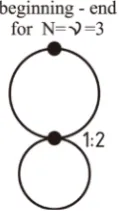
, whereas the number of V is equal to N.In the next step the contractions of the time points whose number is given in (42) should be taken into account. The contractions provide us with the side loops touching the main loop of time. In the first case of (42) (
N
=
3
) we have only two free points of time labelled by 1 and 2. They can give only a single con-traction1: 2; (46) the diagram connected with contraction in (46) is given in Figure 4. We see that the side loop due to (46) is identical with the loop of time characteristic for
1
N
=
. Therefore the energy contribution due to contraction (46) should be the termper .
i V i = V (47)
But the merging of the time points given in (46) provides us with the merging of two P separated by V in (43). In effect the contribution to the perturbation energy due to (46) is represented by the formula
2
VP V (48)
[image:9.595.340.404.481.556.2]A general rule is that the total number of V and P in the energy formulae be-longing to a given N does not change, so for
N
=
3
it should contain three terms V and two terms P; see (43). This implies that the total second perturba-tion term forN
=
3
isFigure 3. Time scale for the perturbation order N = 3 having no contraction of the free time points 1 and 2.
[image:9.595.345.405.599.705.2]DOI: 10.4236/apm.2019.93011 237 Advances in Pure Mathematics
2 2
1 .
V VP V E VP V
− = −∆ (49)
The minus sign in front of (49) is dictated by the fact that an even number of terms enter the product representing the whole term (49). In case we have an odd number of terms entering the product, the sign before the whole perturba-tion term should be positive.
It is easy to study the contractions of the free time points presented in (42) for
4
N
=
(in this Section) andN
=
5
(in Section 7).The three time points (1, 2 and 3) present in the case of
N
=
4
give four kinds of contractions:1: 2, 1: 3, 2 : 3 and 1: 2 : 3. (50) Together with the formula (44) the contractions in (50) give
4 5
S = (51)
perturbation terms belonging to
N
=
4
. We obtain2 2
1
1: 2→ − VP VPV V = − VP VPV E∆ , (52)
2 2
2
1: 3→ − VP V VPV = − VP V E∆ , (53) because the side loop of time due to contraction
1: 3
has a free point 2 on it which makes the loop identical to that characteristic for ∆E2,2 2
1
2 : 3→ − VPVP V V = − VPVP V E∆ (54)
is symmetrical to (52), and
(
)
22 2
1
1: 2 : 3→ VP V V V = VP V ∆E , (55)
because three points of time merge together and they give two side loops of time each representing the energy contribution characteristic for
N
=
1
. A general rule for contractions of the time points is that the loops created by them should not cross; see e.g. [13].7. Time Points, Their Contractions and the Perturbation
Energy Terms Belonging to the Order
N
= 5
The time points being free on the main loop of time representing the perturba-tion order
N
=
5
are1,2,3, and 4. (56) (Point 5 becomes the beginning-end point of time on the loop.) The energy term due to the free time points in (56) is presented in the formula (45). But since for
5
N
=
we have the number5 14
S = (57)
of the Schrödinger perturbation terms, the remainder of
14 1 13
− =
terms should be calculated. They come respectively from the following contractions of the time points in (56):DOI: 10.4236/apm.2019.93011 238 Advances in Pure Mathematics 2 : 4, 2 : 3 : 4, (59)
3: 4.
(60) In case of (60) there remain still points 1 and 2 as free. They can contract to-gether giving a combined contraction1: 2 3 : 4. (61) In fact the presence of point 4 considered alone as free does not stop the con-tractions of the time points 1, 2, and 3 which are:
1: 2, 1: 3, 1: 2 : 3 and 2 : 3. (62) The above contractions (58)-(61) give the following energy terms:
(
)
2 3 3 1 2 3 2 1 3 4 11: 4 ,
1: 2 : 4 ,
1: 3: 4 ,
1: 2 : 3: 4 ,
E VP V E E VP V E E VP V
E VP V
→ −∆ → ∆ ∆ → ∆ ∆ → − ∆
(
)
(
)
2 2 2 3 1 2 12 2 2
1
2 : 4 ,
2 : 3: 4 ,
3: 4 ,
1: 2 3: 4 .
E VPVP V E VPVP V E VPVPVP V
E VP VP V
→ −∆ → ∆ → −∆ → ∆ (63)
The presence of the free points 1, 2, 3 before 4 yields the term
1,2,3→ VPVPVPVPV (45a) given already in (45), but contractions listed in (62) provide us with the terms:
(
)
2 1 2 2 2 3 1 2 11: 2 ,
1: 3 ,
1: 2 : 3 ,
2 : 3 .
VP VPVPV E VP VPV E
VP VPV E
VPVP VPV E
→ − ∆
→ − ∆
→ ∆
→ − ∆
(64)
The first contraction in (58) provides us with a factor having the perturbation
energy ∆E3 which implies two Schrödinger terms, any of the remainder 11
contractions in (58)-(62) provide us with one Schrödinger perturbation term, so in total we obtain
2 11 13
+ =
energy terms which—together with the term in (45) or (45a)—complete the calculation of 14 terms entering ∆E5.8. Comparison of the Born-Heisenberg-Jordan (BHJ)
Perturbation Approach with That Given by Schrödinger
The BHJ perturbation approach to a quantum system [19] was proposed almost simultaneously with that due to Schrödinger [3]. In a review of the quantum
theory presented by Van der Waerden [20] the author considers the BHJ
DOI: 10.4236/apm.2019.93011 239 Advances in Pure Mathematics
by BHJ—but absent in the Schrödinger case—is a conversion of the Hamiltonian
( )
ˆ ˆ ˆ
,
H p q
of a non-degenerate perturbed system into a diagonal matrix form( )
(
)
10 0
ˆ
ˆ
ˆ
ˆ ˆ
,
ˆ
ˆ ˆ
,
ˆ
,
H p q
=
SH p q S
−=
W
(65)so the commutation properties of pˆ0 and qˆ0 as well pˆ and qˆ remain
un-changed. The next step—also absent in the Schrödinger theory—is to undertake a principal axes transformation of the Hermitian form given in (66) below into a sum of squares:
( )
* *, k l m m m.
k lH kl x x mW y y
=
∑
∑
(66)The aim is to find the solution of the equation
( )
0k l
l
Wx −
∑
H kl x = (67)for some special W W= n with the aid of the substitutions
( )
( )0 ( )1( )
2 ( )2( )
kl l
H kl =
δ
W +λ
H kl +λ
H kl + (68)( )0 ( )1 2 ( )2
W W= +λW +λ W + (69)
and
( )0 ( )1 2 ( )2
k k k k
x
=
x
+
λ
x
+
λ
x
+
(70)This leads to a sequence of results [19]:
( )1 ( )1
( )
,W =H nn (71)
( ) ( )
( )
( ) ( )( )
1 1 2 2 0 , nl ln l H HW H nn
hν nl
′
= +
∑
(72)and ( ) ( )
( )
( ) ( ) ( ) ( )( )
( ) ( ) ( )( ) ( )
( ) ( ) ( )( )
1 2 2 1 1 1 1
3 3
2 ,
0 0 0
1 1 1
2 2 0
nl ln nl nl nl lk kn
l l k
nl ln
nn l
H H H H H H H
W H nn
h nl h nl kn
H H H
h nl
ν ν ν
ν + ′ ′ = + + ′ −
∑
∑
∑
(73)where ν αβ0
( )
is the frequency of transition between the levelsα
and β .The perturbation expansion of the matrix elements H kl
( )
in (68) is absent in the Schrödinger perturbation theory, also expansion (70) is absent there. In effect only the term on the right of (71), the second term on the right of (72), and two last terms on the right of (73)—all containing the perturbed matrix elements of order one—are identical with the results obtained by Schrödinger.9. Discussion
or-DOI: 10.4236/apm.2019.93011 240 Advances in Pure Mathematics
ders N.
We obtain here an example of the “action” of time as an ordering parameter which facilitates the calculations—in an agreement with the Leibniz idea of time as an arrangement parameter [21][22].
The paper considers the solution of the Schrödinger differential eigenequation for energy being basic in the quantum theory. Usually to obtain such solution the well-known prescriptions concerning the differential equations have to be satisfied. But the Schrödinger’s idea, and that of his followers, was to construct the eigenvalues of energy and perturbed eigenfunctions based on the ready solu-tions of a less complicated eigenequation. In fact such construction—making a systematic reference between the perturbed eigenequation and unperturbed
one—became a very tedious task, especially for large perturbation orders N
which can be important for the accuracy of the solution.
The advantage of the applied time scale is that the formulae for the terms of the perturbation energy can be calculated almost immediately on the basis of an analysis of the results provided by the scale.
Conflicts of Interest
The author declares no conflicts of interest regarding the publication of this pa-per.
References
[1] Schrödinger, E. (1926) Quantisierung als Eigenwertproblem (erste Mitteilung). An-nalen der Physik, 79, 361-376.https://doi.org/10.1002/andp.19263840404
[2] Schrödinger, E. (1926) Quantisierung als Eigenwertproblem II. Annalen der Physik, 79, 489-527.https://doi.org/10.1002/andp.19263840602
[3] Schrödinger, E. (1926) Quantisierung als Eigenwertproblem Ill. Annalen der Physik, 80, 437-490.https://doi.org/10.1002/andp.19263851302
[4] Schrödinger, E. (1926) Quantisierung als Eigenwertproblem (vierte Mitteilung).
Annalen der Physik, 81, 109-139.https://doi.org/10.1002/andp.19263861802
[5] Seitz, F. (1940) Modern Theory of Solids. McGraw-Hill, New York.
[6] Seitz, F. and Turnbull, D. (Eds.) (1955) E. P. Wigner in Solid State Physics Vol. 1. Academic Press, New York.
[7] Slater, J.C. (1960) Quantum Theory of the Atomic Structure. Vol. 1 and 2, McGraw-Hill, New York.
[8] Schiff, L.I. (1968) Quantum Mechanics. 3rd Edition, McGraw-Hill, New York. [9] Huby, R. (1961) Formulae for Non-Degenerate Rayleigh-Schrödinger Perturbation
Theory in Any Order. Proceedings of the Physical Society (London), 78, 529. [10] Tong, B.Y. (1962) On Huby’s Rules for Non-Degenerate Rayleigh-Schrödinger
Per-turbation Theory in any Order. Proceedings of the Physical Society (London), 80, 1101.
[11] Feynman, R.P. (1966) The Development of the Space-Time View of Quantum Elec-trodynamics. Science, 153, 699-708.
DOI: 10.4236/apm.2019.93011 241 Advances in Pure Mathematics
[13] Olszewski, S. (1991) Time Scale and Its Application in Perturbation Theory. Zeit-schrift fuer Naturforschung, 46A, 313.
[14] Olszewski, S. and Kwiatkowski, T. (1998) A Topological Approach to Evaluation of Non-Degenerate Schrödinger Perturbation Energy Based on a Circular Scale of Time. Computers in Chemistry, 22, 445-461.
https://doi.org/10.1016/S0097-8485(98)00023-0
[15] Olszewski, S. (2003) Two Pathways of the Time Parameter Characteristic for the Perturbation Problem in Quantum Chemistry. Trends in Physical Chemistry, 9, 69. [16] Olszewski, S. (2013) A Look on the Scale of Time Useful in the Non-Relativistic
Quantum Mechanics. Quantum Matter, 2, 481.
[17] Olszewski, S. (2004) Kołowa skala czasu z punktu widzenia mechaniki kwantowej w ujęciu Schrödingera. Studia Philosophiae Christianae, 40, 57-81.
[18] Olszewski, S. (2017) Circular Scale of Time and Energy of a Quantum State Calcu-lated from the Schrödinger Perturbation Theory. Journal of Modern Physics, 5, 1502.
[19] Born, M., Heisenberg, W. and Jordan, P. (1926) Zur Quantenmechanik. II. Zeit-schrift fuer Physik, 35, 557-615.https://doi.org/10.1007/BF01379806
[20] Van der Waerden, B.L. (1968) Sources of Quantum Mechanics. Dover Publications, New York.
[21] Leibniz, G.W. (1924) Hauptschriften zur Grundlagen der Philosophie. Vol. 1, Leip-zig.
[22] Rescher, N. (2013) On Leibniz. University of Pittsburgh Press, Pittsburgh.