doi:10.4236/snl.2011.12008 Published Online April 2011 (http://www.SciRP.org/journal/snl)
The Synthesis of Solvent-Free TiO
2
Nanofluids
through Surface Modification
Peiying Yu, Yaping Zheng, Lan Lan
Department of Applied Chemistry, School of Natural and Applied Science, Northwestern Polytechnical University, Xi’an, China. Email:[email protected]
Received December 30th, 2010; revised March 1st, 2011; accepted March 8th, 2011.
ABSTRACT
TiO2 nanoparticles with surface hydroxyl groups are treated by trimethoxysilane (CH3O)3Si(CH2)3O(CH2CH2O)6–9CH3
and a inorganic core/organic shell hybridmaterials, which shows itself a yellow viscous fluid, is obtained. We call it solvent-free TiO2 nanofliuds. Transmission electron microscopy (TEM), Fourier transform infrared spectrum (FTIR),
differential scanning calorimetry (DSC), thermogravimetric analysis (TGA) and rheometer are adopted to characterize the product. As a result, the content of TiO2 nanoparticles in the nanofliuds is about 5.5wt%, the functionalized TiO2
nanoparticles possess better dispersion, very low viscosity and an obvious liquid-like behavior at room temperature in absence of solvent.
Keywords: Solvent-Free, Nanofulids, TiO2 Nanoparticles, Liquid-Like Behave
1. Introduction
Nanoparticles have many unique mechanical, magnetic, thermal, optical, catalytic properties, but its agglomera-tion due to high surface energy and surface activity hin-ders their application [1,2].
A method for solving this problem is to disperse nanoparticles in a base fluid, known as nanofluids, is studied for many years. The nanofluids is composed of two parts, including solvents and nanoparticles. The sol-vents of nanofluids are always water, oil, acetone, decene and ethylene glycol, and the nanoparticles used are usu-ally metallic particles [3,4], metallic and nonmetallic oxides [5-7], carbon nanotube [8], etc. These conven-tional nanofluids improve the dispersion of nanoparticles to a certain extent, but the system is a kind of suspension and unstable, nanoparticles in the nanofluids may aggre-gate and settle down [9]. The factors influencing the sta-bility and properties of nanofluids include the nanoparti-cle’s concentration, dispersant, viscosityof system [10], moreover, the variety, diameter [11,12], density of nano- particle and ultrasonic vibration are not be ignored [13].
Recently, some researchers synthesize a new series of nanofluids which can flow at low temperature in absence of solvent (liquid) by surface modification. These sol-vent-free nanofluids involve SiO2 [14,15], TiO2 [16],
CaCO3, C60 [17], ZnO [18], carbon naotube [19-21], etc.
By the chemical reactions between active groups on the nanoparticles’ surface (always hydroxyl groups) and the organic modifier, an organic soft shell forms on the sur-face of nanoparticles, it can not only reduce the agglom-eration of nanoparticles, but also impart new properties to them.
Actually, another method is to introduce the nanopar-ticle into block copolymer nanostructures. Prof. Rucken-stein and co-worker have been identified it [22,23].
In this paper, we select the organic reagent (CH3O)3
Si(CH2)3O(CH2CH2O)6–9CH3 to modify TiO2
nanoparti-cles, which is synthesized by sol-gel method. The silanol groups in the modifier can interact with hydroxyl groups on the surface of nanostructures, after a long reaction process, TiO2 nanoparticles are coated by a mass of
or-ganic molecular and a core-shell structure forms. The new system possesses much better dispersion and can flow at the room temperature.
2. Materials and Methods
2.1. Raw Materials
Tetra-n-butyl titanate was purchased from TianJing Ke- Miou Chemical Company. Methanol (CH3OH, 99.5%),
agents from Fuchen Chemical Ind., Ltd., and used with-out further purification. Deionized water was made in lab. (CH3O)3Si(CH2)3N+(CH3)(C10H21)2Cl−in methanol (40%)
was from Gelest. C9H19-C6H4-(OCH2-CH2)20(CH2)3SO3
K+
was from Sigma-aldrich.
2.2. Synthesis of TiO2 Nanoparticles
TiO2 nanoparticles were prepared by a sol-gel method
through Tetrabutyl titanate hydrolysis. 17mL of Tetra- butyl titanate was mixed with 15mL of ethanol. The mixture was called as solution A. Solution B was pre-pared by mixing 15mL of ethanol, 2 mL of 5.5 mol/L hydrochloric acid solution, and1mL of deionized water. Then trickled solution B slowly to solution A with stiring constantly, and stop the experiment after the formation of gel. The gel was aged for 6 h at room temperature and carefully grinded after drying at 65˚C.
2.3. Synthesis of TiO2 Nanofluids
For the TiO2 nanofluids, 0.5 g of TiO2 powder was
dis-persed in 10mL of ammonia (pH 10), the suspension was treated with ultrasonic for 30 min, then 2.5 g (CH3O)3
Si(CH2)3O(CH2CH2O)6–9CH3 was added. The mixture
was placed in a sealed single-mouth flask and treated at 70˚C for 24 h. The final solution was extracted with toluene three times, the aqueous layer was collected and dried at 65˚C. The dried material was dispersed in 20mL of deionized water and extracted with toluene three times again. After collecting the aqueous layer, the solution was dried at 65˚C. Subsequently, the material was dis-persed in 20 mL of the acetone, after centrifugation, the transparent sol was dried at 65˚C. The product is a yel-low transparent liquid.
2.4. Characterizations
The structure of the TiO2 nanofluids was investigated by
Fourier transform-infrared (FTIR) spectrometer analysis (WQF-310, Beijing Second Optical Instruments Factory) using KBr pellets. Transmission electron microscope (TEM) images were obtained on a Hitachi H-800 instru- ment at an accelerating voltage of 200 kV, placing a few drops of the dispersion on a copper grid, and evaporating them prior to observation. The thermogravimeric analysis (TGA) measurements were taken under N2 flow by using
TA TGAQ50 instrument. Differential scanning calo- rimetry (DSC) traces were recorded collected on a TA Q1000 Instruments, heating rate of 10˚C/min, from −60˚C to 60˚C. Rheological properties were studied by using the rheometer of TA AR-G2 instrument, heating rate of 5˚C/min.
The FTIR spectra of the TiO2 nanofluids are presented in
Figure 1. The figure shows that they all have peak(s) at 450 cm−1 - 700 cm−1 which is the location of
characteris-tic peaks of titania. The TiO2 nanofluids also have many
new absorption peaks of organic groups compared with pure TiO2 nanoparticles. In theory, the reaction between
TiO2 nanoparticles and (CH3O)3Si(CH2)3O(CH2CH2O)6–9
CH3 can yield Ti-O-Si, Si-O-Si bonds, from the spectra,
their peaks are found at 944 cm-1 and 1110 cm-1
respec-tively [24]. In addition, the peak of stretching vibration of polyoxyethene is also observed at 1110 cm-1
overlap-ping with Si-O-Si. The strong peak at 3459 cm-1 is
attrib-uted to the presence of remaining hydroxyl groups on the TiO2 nanoparticles. The results prove that the modifier
has been grafted on the surface of TiO2 nanoparticles.
The microstructure of the pure TiO2 nanoparticals and
TiO2 nanofluids could be clearly observed from the TEM
images (Figure 2). As shown in Figure 2, the pure TiO2
nanoparticals have serious phenomenon of agglomeration, its dispersion is significantly improved after modification. The modifier protects TiO2 nanoparticles from
[image:2.595.311.534.519.690.2]agglom-eration and probably can improve its compatibility with organic materials.
Figure 3 is the DSC curve of the modifier (CH3O)3
Si(CH2)3O(CH2CH2O)6–9CH3 and the TiO2 nanofluids. In
the heating process, both the modifier and TiO2
nanoflu-ids show a second order transition at −50˚C, correspond-ing to the glass transition temperature (Tg). The first
or-der transition of the modifier occurs at −0.4˚C, corre-sponding to the melting temperature (Tm). Differently,
the TiO2 nanofluids has two first order transition at −27˚C
and −3.6˚C, this may be the result of oligomeric siloxane of different molecular weight produced during the modi-fication [22]. The two possess the same Tg (−50˚C), the
Figure 1. The FTIR spectra of (a) TiO2-ionic liquid nano-
(a) (b)
Figure 2. The TEM photos of (a) pure TiO2 nanoparticals and (b) TiO2 nanofluids.
[image:3.595.73.528.312.497.2](a) (b)
Figure 3. The DSC curve of (a) modifier (CH3O)3Si(CH2)3O(CH2CH2O)6–9CH3 and (b) TiO2 nanofluid.
similar Tm (−0.4˚C, −3.6˚C), this indicated that the
modi-fier is coated on the surface of nanoparticles.
The organic canopy content of the TiO2 nanofluid
influence the properties of inorganic-organic hybridmate-rial. The TGA was carried out to confirm the thermal stability (see Figure 4). The decomposition temperature is above 200˚C and the weight loss is only 29 wt% at 357˚C, these results indicate that the product has a good heat-resistance property. In addition, the content of the TiO2 nanoparticles and the modifier can be obtained from
the curve, they are 5.5 wt% and 94.5 wt%, respectively. The low inorganic content may be improved by reducing the quantity of the modifier during the modification process.
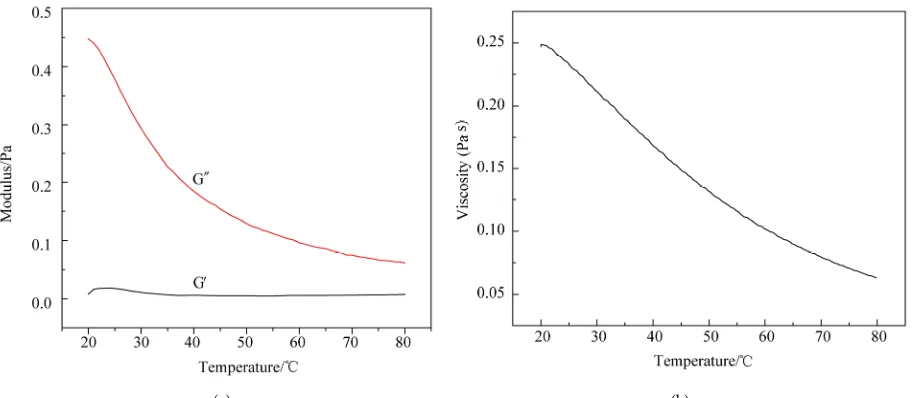
In the rheological theory, the loss shear modulus G''
[image:3.595.312.533.531.701.2](a) (b)
Figure 5. The rheological behavior of TiO2 nanofluid.
materials, and the storage shear modulus G′ embodies the energy storage for reversible deformations of materials. When G'' is higher than G', the material has a charac- teristic of a fluid. The rheological behavior of the TiO2
nanofluids is presented in Figure 5(a).
It is clear that the G'', which decreases with the tem-perature increasing, is higher than the G'.
At the measurement stage, G' is almost constant. The result indicates obviously that the TiO2 nanofluids has a
typical liquid-like behavior. Actually, the product can flow at room temperature without any solvent. In the Figure 5(b), the viscosity of TiO2 nanofluids decreases
with the increasing temperature and becomes 0.06 Pa·s at
80˚C.
4. Conclusion
The TiO2 nanofluids was prepared successfully by using
the modifier (CH3O)3Si(CH2)3O-(CH2CH2O)6–9CH3. The
product shows itself a yellow viscous liquid and can flow at room temperature in absence of solvent. TiO2
nanopar-ticles are coated by organic canopy and have better dis-persion after modification. The content of TiO2
nanopar-ticles in the nanofluids is about 5.5wt%. This kind of inorganic-organic hybridmaterials which probably pos-sess better compatibility with organic materials will have potential application in nano-composite materials.
5. Acknowledgements
We greatly acknowledge the fund supported by National Natural Science Fundation (51073129), Aeronautical Science Foundation of China (2010ZF53060), and NPU Foundation for Fundamental Research (NPU-FFR-w018 105).
REFERENCES
[1] Z. X. Yan, J. Deng and Z. M. Luo, “A Comparison Study of the Agglomeration Mechanism of Nano and Microme-ter Aluminum Particles,” Materials Characterization, Vol.
61, No. 2, 2010, pp. 198-205. doi:10.1016/j.matchar.2009.11.010
[2] S. L. Kuo, Y. C. Chen, M. D. Ger and W. H. Hwu, “Nano-Particles Dispersion Effect on Ni/Al2O3 Compos-ite Coatings,” Materials Chemistry and Physics, Vol. 86,
No. 1, 2004, pp. 5-10.
doi:10.1016/j.matchemphys.2003.11.040
[3] C. Y. Tsai, H. T. Chien, P. P. Ding, B. Chan, T. Y. Luh and P. H. Chen, “Effect of Structural Character of Gold Nanoparticles in Nanofluid on Heat Pipe Thermal Per-formance,” Material Letters, Vol 58, No. 9, 2004, pp.
1461-1465. doi:10.1016/j.matlet.2003.10.009
[4] D. W. Zhou, “Heat Transfer Enhancement of Copper Nanofluid with Acoustic Cavitation,” International
Jour-nal of Heat and Mass Transfer, Vol. 47, No. 14-16, 2004,
pp. 3109-3117.
doi:10.1016/j.ijheatmasstransfer.2004.02.018
[5] W. Yu, H. Q. Xie, L. F. Chen and Y. Li, “Investigation of Thermal Conductivity and Viscosity of Ethylene Glycol Based Zno Nanofluid,” Thermochimica Acta, Vol 491, No. 1-2, 2009, pp. 92-96. doi:10.1016/j.tca.2009.03.007 [6] C. T. Nguyen, G. Roy, C. Gauthier and N. Galanis, “Heat
Transfer Enhancement Using Al2O3–Water Nanofluid for
an Electronic Liquid Cooling System,” Applied Thermal
Engineering,Vol. 27, No. 8-9, 2007, pp. 1501-1506.
doi:10.1016/j.applthermaleng.2006.09.028
[7] D. Milanova and R. Kumar, “Heat Transfer Behavior of Silica Nanoparticles in Pool Boiling Experiment,”
Jour-nal of Heat Transfer, Vol. 130, No. 4, 2008, pp. 042401-
042407. doi:10.1115/1.2787020
Am-rollahi, M. Tabasi and H. S. Kalal, “The Role of Different Parameters on The Stability and Thermal Conductivity of Carbon Nanotube/Water Nanofluids,” International
Communications in Heat and Mass Transfer, Vol. 37, No.
3, 2010, pp. 319-323.
doi:10.1016/j.icheatmasstransfer.2009.10.004
[9] W. T. Jiang, G. L. Ding, H. Peng and H. T. Hu, “Model-ing of Nanoparticles’ Aggregation and Sedimentation in Nanofluid,” Current Applied Physics, Vol. 10, No. 3,
2010, pp. 934-941. doi:10.1016/j.cap.2009.11.076 [10] A. N. Eiyad, “Effects of variable viscosity and thermal
conductivity of Al2O3–water nanofluid on heat transfer
enhancement in natural convection,” Inernational Journal
of Heat Fluid Flow, Vol. 30, No. 4, 2009, pp. 679-690.
[11] T. P. Teng, Y. H. Hung, T. C. Teng, H. E. Mo and H. G. Hsu, “The Effect of Alumina/Water Nanofluid Particle Size on Thermal Conductivity,” Applied Thermal
Engi-neering, Vol. 30, No. 14-15, 2010, pp. 2213-2218.
doi:10.1016/j.applthermaleng.2010.05.036
[12] K. B. Anoop, T. Sundararajan and S. K. Das, “Effect of Particle Size on the Convective Heat Transfer in Nanofluid in the Developing Region,” International
Jour-nal of Heat and Mass Transfer, Vol. 52, No. 9-10, 2009,
pp. 2189-2195.
doi:10.1016/j.ijheatmasstransfer.2007.11.063
[13] Y. J. Li, J. E. Zhou, S. Tung and E. Schneider, S. Q. Xi, “A Review on Development of Nanofluid Preparation and Characterization,” Powder Technology, Vol. 196, No. 2, 2009, pp. 89-101. doi:10.1016/j.powtec.2009.07.025 [14] A. B. Bourlinos, S. R. Chowdhury, D. D. Jiang and Q.
Zhang, “Weakly Solvated PEG-Functionalized Silica Nanoparticles with Liquid-Like Behavior,” Journal of
Materials Science, Vol. 40, No. 18, 2005, pp. 5095-5097.
doi:10.1007/s10853-005-1301-8
[15] A. B. Bourlinos, R. Herrera, N. Chalkias, D. D. Jiang, Q. Zhang, L. A. Archer and E. P. Giannelis, “Surface-Func- Tionalized Nanoparticals with Liquid-Like Behavior,”
Advanced Materials, Vol. 17, No. 2, 2005, pp. 234-237.
doi:10.1002/adma.200401060
[16] A. B. Bourlinos, S. R. Chowdhury, R. Herrera, D. D. Jiang, Q. Zhang, L. A. Archer and E. P. Giannelis,
“Func-tionalized Nanostructures with Liquid-Like Behavior: Expanding the Gallery of Available Nanostructures,”
Advanced Functional Materials, Vol. 15, No. 8, 2005, pp.
1285-1290. doi:10.1002/adfm.200500076
[17] T. Michinobu, T. Nakanishi, J. P. Hill, M. Funahashi and K. Ariga, “Room Temperature Liquid Fullerenes: An Uncommon Morphology of C60 Derivatives,” Journal of
the American Chemical Society, Vol. 128, No. 32, 2006,
pp. 10384-10385. doi:10.1021/ja063866z
[18] A. B. Bourlinos, A. Stassinopoulos, D. Anglos, R. Herrera, S. H. Anastasiadis, D. Petridis and E. P. Gian-nelis, “Functionalized Zno Nanoparticals with Liquidlike Behavior and Their Photoluminescence Properties,” Small.
Vol. 2, 2006, p. 513. doi:10.1002/smll.200500411 [19] J. X. Zhang, Y. P. Zheng, P. Y. Yu, S. Mo and R. M.
Wang, “Modified Carbon Nanotubes with Liquid-Like Behavior At 45˚C,” Carbon. Vol. 47, No. 12, 2009, p. 2776. doi:10.1016/j.carbon.2009.05.036
[20] J. X. Zhang, Y. P. Zheng, P. Y. Yu, S. Mo and R. M. Wang, “The Synthesis of Functionalized Carbon Nano-tubes by Hyperbranched Poly (Amine-Ester) with Liq-uid-Like Behavior at Room Temperature,” Polymer. Vol. 50, No. 13, 2009, p. 2953.
doi:10.1016/j.polymer.2009.04.042
[21] J. X. Zhang, Y. P. Zheng, L. Lan, S. Mo, P. Y. Yu, W. Shi and R. M. Wang, “Direct Synthesis of Solvent-Free Multiwall Carbon Nanotubes/Silica Nonionic Nanofluid Hybrid Material,” Acs Nano,Vol. 3, No. 8, 2009, p. 2185. doi:10.1021/nn900557y
[22] H. Y. Chen and E. Ruckenstein, “Structure and Particle Aggregation in Block Copolymer-Binary Nanoparticle Com- Posites,” Polymer, Vol. 51, No. 24, 2010, p. 5869. doi:10.1016/j.polymer.2010.10.011
[23] H. Y. Chen and E. Ruckenstein, “Nanoparticle aggrega-tion in the presence of a block copolymer,” Journal of Chemical Physics, Vol. 131, No. 24, 2009, article ID 244904. doi:10.1063/1.3280064
![Figure 3 is the DSC curve of the modifier (CHing to the glass transition temperature (the heating process, both the modifier and TiOder transition of the modifier occurs at Si(CHand of different molecular weight produced during the modi-fication [22]](https://thumb-us.123doks.com/thumbv2/123dok_us/9034711.399868/2.595.311.534.519.690/modifier-transition-temperature-modifier-transition-different-molecular-fication.webp)