ISSN Online: 2475-7349 ISSN Print: 2475-7330
DOI: 10.4236/ym.2019.33022 Jun. 28, 2019 225 Yangtze Medicine
Application Progress of Modified Early Warning
Score in General Departments
Rong Tang, Fanxin Xuan, Xiaowei Qin, Lanping Shi*
Department of Medicine, Yangtze University, jingzhou, China
Abstract
Modified Early Warning Score system can help medical staff to identify pa-tients with “potential critical illness” at an early stage and effectively reduce the death rate. In 2001 the NHS recommended MEWS for general practice assessment. However, there are few studies on MEWS in general depart-ments, and the specific application effect is still being explored. Therefore, this paper summarizes the application advantages, application methods and application effects of MEWS in general departments at home and abroad, so as to provide some theoretical basis for the development of MEWS in general departments. After summary, it was found that although MEWS evaluation indicators are simple and easy to obtain, and can facilitate the communica-tion of medical condicommunica-tions, MEWS has a poor ability to identify “potential critically ill patients” in general departments. The role of predicting the prognosis of patients in general departments remains to be explored. A large number of multi-center, large-sample and large-range studies are needed to provide a basis for the application of MEWS in general departments.
Keywords
Modified Early Warning Score, General Departments, Potential Critical Illness Patients
1. Introduction
“Potential critical illness” refers to patients who do not have any obvious ma-nifestation of organ failure on the surface, but without timely and effective in-tervention and treatment, their condition may rapidly deteriorate within a few hours or days, or even lose their lives [1]. Modified Early Warning Score (MEWS) was developed and improved by Subbe CP on the basis of EWS [2] [3]. Studies have shown that MEWS can effectively help medical staff to identify pa-How to cite this paper: Tang, R., Xuan,
F.X., Qin, X.W. and Shi, L.P. (2019) Appli-cation Progress of Modified Early Warning Score in General Departments. Yangtze Medicine, 3, 225-234.
https://doi.org/10.4236/ym.2019.33022
Received: April 18, 2019 Accepted: June 25, 2019 Published: June 28, 2019
Copyright © 2019 by author(s) and Scientific Research Publishing Inc. This work is licensed under the Creative Commons Attribution International License (CC BY 4.0).
DOI: 10.4236/ym.2019.33022 226 Yangtze Medicine
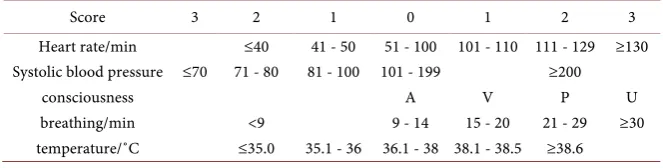
tients with “potential critical illness” in an early, accurate and objective manner. It not only promotes the early implementation of relevant medical measures, but also reduces the death rate [4] (see Table 1). In 2001, the National Health Ser-vice (NHS) recommended it as one of the methods for the assessment and communication of medical staff in medical institutions, and recommended MEWS in the emergency department, Intensive Care Unit (ICU) and general departments. However, compared with the research on MEWS in emergency department and ICU, the application of MEWS in general departments lacks big data support, and the application effect is still being explored [5]. There-fore, the application of MEWS in general departments at home and abroad was reviewed, so as to provide a basis for the development of MEWS in general de-partments.
2. Application Background and Potential Analysis of MEWS
in General Departments
2.1. Application Background of MEWS in General Departments The application of MEWS in emergency department and ICU provides expe-rience for general departments to develop MEWS [6]. Some studies have pointed out that among 254 emergency departments in UK, 87% of hospitals use MEWS to evaluate and predict patients’ conditions, and 93% of hospitals give recogni-tion and support to this tool, and point out that MEWS can effectively predict whether emergency patients need to be admitted to general departments or transferred to ICU [7]. For ICU patients, effective condition assessment is the first step to save patients. The most authoritative and most widely used assess-ment scale is the Acute Physiology and Chronic Health Evaluation (APACHE II), which can predict the severity of patients with 90% accuracy. Some studies have pointed out that MEWS can also reach the same level, both of which have good clinical resolution [8]. Therefore, it is of practical significance to promote the application of MEWS in general departments based on its experience in emergency department and intensive care unit.
2.2. Advantage Analysis of MEWS Application in General Departments
[image:2.595.208.540.644.728.2]2.2.1. MEWS Evaluation Indicators Are Easy to Be Collected and Calculated MEWS includes body temperature, heart rate, respiration, systolic blood pres-sure and consciousness. The consciousness with A (Alert), V (Reacting to voice),
Table 1. Modified Early Warning Score (MEWS).
Score 3 2 1 0 1 2 3
Heart rate/min ≤40 41 - 50 51 - 100 101 - 110 111 - 129 ≥130 Systolic blood pressure ≤70 71 - 80 81 - 100 101 - 199 ≥200
consciousness A V P U
breathing/min <9 9 - 14 15 - 20 21 - 29 ≥30
DOI: 10.4236/ym.2019.33022 227 Yangtze Medicine
P (Reacting to pain), U (Unresponsive) score [9]. The other four indexes set several parameter intervals, and each parameter interval corresponds to a dif-ferent score. During the evaluation, the corresponding parameter interval and score were determined according to the actual value of each index of the patient. Finally, the score values of the 5 items were added to obtain the total score. The higher the score is, the worse the patient’s current condition is. The score 0 - 4 is classified as mild disease, 5 - 8 as severe disease, and 9 as critical disease [4]. The vital signs of patients in general departments are the data that nurses must col-lect every day. MEWS can refcol-lect the severity of this patient’s condition instantly by simple calculation, which is feasible without additional manpower and ma-terial resources. Dalton’s study also points out that nurses in general depart-ments are willing to evaluate patients’ MEWS on time and report abnormal con-ditions to nurse practitioners or doctors, which indicates that the implementa-tion of MEWS in general departments is feasible [10] [11] [12].
2.2.2. Increase Effective Communication among Medical Staff
Patients with “potential critical illness” often show abnormal physiological indi-cators, such as: change in consciousness, abnormal blood pressure, shortness of breath, arrhythmia, decreased oxygen saturation (SpO2), or decreased urine vo-lume, in a few hours or days before the condition changes, which are also known as “warning information” [11] [12]. However, in the medical work, it is difficult for nurses to judge whether the positive signs of patients indicate serious changes from the overall perspective. There is often a delay in reporting a pa-tient’s positive signs to a doctor or a failure to do so. Secondly, nurses tend to judge patients’ conditions based on clinical experience and intuition, resulting in “wrong judgment” or “omission” of patients’ conditions [10], and then miss the best treatment time, leading to irreversible consequences. Combined with vital signs and consciousness, MEWS covers the respiratory, circulatory and nervous systems, and reflects the overall condition of the patient with the most simple and direct score. MEWS can help the other party to grasp the patient’s condition faster and more effectively [13].
3. Application of MEWS in General Departments
3.1. Specific Departments Applicable to MEWS
DOI: 10.4236/ym.2019.33022 228 Yangtze Medicine
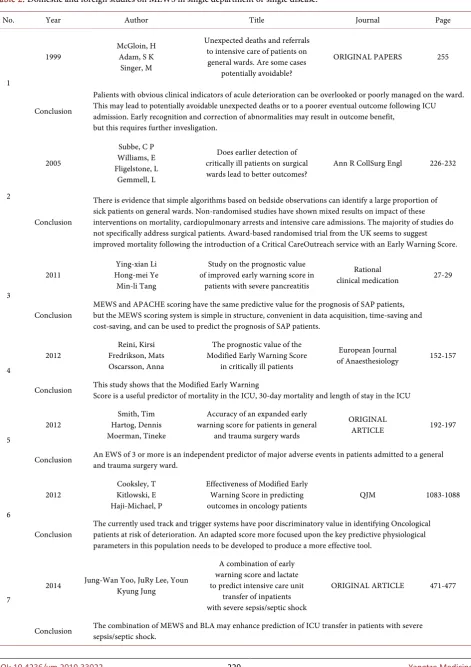
[18] [19] or single disease [20] [21], such as the use of MEWS in cardiology, and the application value of MEWS in cardiac arrest patients, etc. At present, the specific departments applicable to MEWS are still not clear. The literature was summarized in Table 2.
3.2. Dynamic MEWS Can Better Reflect Patients’ Conditions
Dynamic MEWS score can better reflect patients’ conditions in real time [8]. Nishjima once evaluated the MEWS once a day for all patients in the general department, the corresponding physiological indicators recorded into the nurs-ing system, by the system automatically calculate the MEWS score, when reached 7 points, the system automatically alarm, ward nurses need to report the attending doctor, for the treatment of patients, during which continue to eva-luate three times a day, if discover the patients need a higher level of medical care facilities, are immediately turned to ICU, unless the patient give up treat-ment agreetreat-ment (Do Not Resuscitate, DNR) [17]. Most domestic studies have studied the degree of prediction of disease changes in patients with a certain static MEWS score, with the most related studies on single score at admission
[22]. Su Yanhong evaluated 200 patients in the department of cardiothoracic surgery once a shift when they were admitted to the hospital and did not use ECG monitoring after surgery. When abnormal vital signs were found, it was necessary to report to the doctor at any time until the single score < 2 or the total score < 4, but the treatment process was not described in detail [23].
3.3. Specific Application Process of MEWS
Penglingli applied MEWS in the general department of the hospital in 2014, and formed a relatively perfect application process: MEWS should be evaluated when patients are admitted to the hospital, returned to the ward after surgery, re-turned to the ward after surgery for 6 h, and transferred to the hospital. If single item > 2 or total score ≥ 4, the nurse should evaluate once per shift, and report the patient’s abnormal vital signs and the most urgent problems to the doctor in time until the score is reduced to normal. When the total score of MEWS is greater than 5, the nurse should increase the number of monitoring, follow the doctor’s advice for ECG monitoring if necessary, inform the superior doctor and
[1] remind the “seriously ill” doctor’s advice; When the total score of MEWS is greater than 6, in addition to the above three points, it is also necessary to pre-pare for rescue, including opening the vein access, preparing rescue materials, and helping doctors contact ICU nurses [1].
4. Limitations of MEWS Application in General Departments
DOI: 10.4236/ym.2019.33022 229 Yangtze Medicine Table 2. Domestic and foreign studies on MEWS in single department or single disease.
No. Year Author Title Journal Page
1
1999 McGloin, H Adam, S K Singer, M
Unexpected deaths and referrals to intensive care of patients on general wards. Are some cases
potentially avoidable?
ORIGINAL PAPERS 255
Conclusion
Palients with obvious clinical indicators of acule deterioration can be overlooked or poorly managed on the ward. This may lead to potentially avoidable unexpected deaths or to a poorer eventual outcome following ICU admission. Early recognition and correction of abnormalities may result in outcome benefit,
but this requires further invesligation.
2
2005
Subbe, C P Williams, E Fligelstone, L
Gemmell, L
Does earlier detection of critically ill patients on surgical
wards lead to better outcomes? Ann R CollSurg Engl 226-232
Conclusion
There is evidence that simple algorithms based on bedside observations can identify a large proportion of sick patients on general wards. Non-randomised studies have shown mixed results on impact of these interventions on mortality, cardiopulmonary arrests and intensive care admissions. The majority of studies do not specifically address surgical patients. Award-based randomised trial from the UK seems to suggest improved mortality following the introduction of a Critical CareOutreach service with an Early Warning Score.
3
2011
Ying-xian Li Hong-mei Ye
Min-li Tang
Study on the prognostic value of improved early warning score in
patients with severe pancreatitis
Rational
clinical medication 27-29
Conclusion MEWS and APACHE scoring have the same predictive value for the prognosis of SAP patients, but the MEWS scoring system is simple in structure, convenient in data acquisition, time-saving and cost-saving, and can be used to predict the prognosis of SAP patients.
4
2012
Reini, Kirsi Fredrikson, Mats Oscarsson, Anna
The prognostic value of the Modified Early Warning Score
in critically ill patients
European Journal
of Anaesthesiology 152-157
Conclusion This study shows that the Modified Early Warning Score is a useful predictor of mortality in the ICU, 30-day mortality and length of stay in the ICU
5
2012
Smith, Tim Hartog, Dennis Moerman, Tineke
Accuracy of an expanded early warning score for patients in general
and trauma surgery wards
ORIGINAL
ARTICLE 192-197
Conclusion An EWS of 3 or more is an independent predictor of major adverse events in patients admitted to a general and trauma surgery ward.
6
2012 Cooksley, T Kitlowski, E Haji-Michael, P
Effectiveness of Modified Early Warning Score in predicting outcomes in oncology patients
QJM 1083-1088
Conclusion
The currently used track and trigger systems have poor discriminatory value in identifying Oncological patients at risk of deterioration. An adapted score more focused upon the key predictive physiological parameters in this population needs to be developed to produce a more effective tool.
7
2014 Jung-Wan Yoo, JuRy Lee, Youn Kyung Jung
A combination of early warning score and lactate to predict intensive care unit
transfer of inpatients with severe sepsis/septic shock
ORIGINAL ARTICLE 471-477
DOI: 10.4236/ym.2019.33022 230 Yangtze Medicine Continued 8 2014 Xiao-min Lu Zheng-li Yang Yang-linGu
Application of early warning score in identifying “potential critical illness” in
surgical wards
Nursing practice and
research 58-59
Conclusion EWS can identify patients with “potential critical illness” in the surgical ward. The earlier it is identified, the more opportunities for early medical intervention and the higher survival rate of patients.EWS can also determine the prognosis of critically ill patients, especially in elderly patients with significant correlation.
9 2015 Li-li Wang Jie-fu Du Wei Chen Li-jingJia Hai-yan Zhu
Comparison of the improved early warning score and the national
early warning score in the assessment of the condition of
elderly emergency patients
Methodological
research 1680-1684
Conclusion
NEWS can reflect the actual situation of respiration and heart rate of elderly emergency patients more accurately and effectively. Compared with MEWS score, NEWS is more suitable for assessing the outcome and prognosis of elderly emergency patients.
10 2016 Li Yang Yong-mei Zhang Fei Chen Mei-lin Lu Ting-mei Zhou Ai Liu
Application of modified early warning score in disease risk management of elderly inpatients
in digestive surgery department
Nursing research 1633-1635
Conclusion Early use of MEWS score to provide early warning for hospitalized elderly patients with digestive surgery is conducive to medical staff's early detection and improvement of their conditions Timely treatment measures, effectively reduce the risk of deterioration.
11
2016
Yan-hong Su Lun-fang Huang
Lu-si Yu
Application analysis of the improved early warning scoring system in the nursing of “potential critical patients” in cardiothoracic surgery
Contemporary nurse 57-59
Conclusion
For patients with cardiothoracic surgery, the improved early warning scoring system is adopted for disease observation, which is conducive to the evaluation of the condition change of “potential critical patients” in cardiothoracic surgery, and can timely detect the condition change of patients, give corresponding nursing measures, and carry out intervention, effectively avoiding the disease of patients. In order to reduce the incidence of accidents and the rate of re-referral to the ICU of cardiothoracic surgery, and improve the satisfaction rate of patient satisfaction survey.
12
2016 Shouhei Oyadomari Isao Nishijima
Use of a modified early warning score system to reduce the rate
of in-hospital cardiac arrest Journal of intensive Care 1-6
Conclusion
The Chubu Tokushukai Hospital-customized MEWS was applied to all inpatients, and the rate of IHCA decreased owing to the introduction of the system, as the system enables early interventions for patients who have the possibility of acute deterioration.
DOI: 10.4236/ym.2019.33022 231 Yangtze Medicine
with specialized indicators, and determined that when the optimal cut-off point was 2.5, the maximum AUC of the score was 0.81, suggesting that it could help pediatric nurses to identify children with deteriorating conditions in the early stage [27], indicating that MEWS combined with specialized indicators was more effective in general departments.
5. Effects of MEWS in General Departments
5.1. The Ability of MEWS to Predict the Prognosis of Patients in General Departments Remains to Be Explored
The ability of MEWS to determine the prognosis of patients in general depart-ments remains to be explored [28] [29]. Tirotta collected demographic data of 31 patients with continuous sepsis infection in the medical ward, the rate of transfer to the ICU, and MEWS, and found that MEWS had little risk value in predicting the in-hospital death of sepsis patients in the medical ward [30]. More systemat-ic evaluation directly points out that: MEWS is not good at identifying and pre-dicting the prognosis of patients with “potential critical illness” in general de-partments [31] [32]. However, some studies suggest that MEWS is suitable for general departments. Lu xiaomin has analyzed the EWS score of 88 patients who were unplanned transferred to ICU in the surgical ward within 24 hours before the transfer, and found that EWS can identify patients with “potential critical illness” and help to determine the prognosis of patients [33]. Wenting Huang compared the NEWS, the BAP-65 scores, Chronic Respiratiory Early Score (CREW) three Score to predict the prognosis of patients with acute exacerbation of Chronic obstructive pulmonary disease period. It was found that the AUC of death predicted by NEWS was 0.878, and that of ICU admission was 0.826, in-dicating high performance [34].
5.2. Poor Ability of MEWS in Identifying Patients with “Potential Critical Illness” in General Departments
Some studies have pointed out that although MEWS is recommended as an evaluation tool for many departments, it is not based on a large number of clini-cal studies, so its effectiveness cannot be guaranteed [5], which is consistent with the views of many researchers in systematic evaluation [16] [35] [36]. Cooksley has retrospectively collected the MEWS scores of 840 patients in the oncology department to explore its ability to predict ICU transfer and death within 30 days, and found that MEWS has poor ability to identify cancer patients at risk of deterioration [9]. Therefore, in order to effectively promote MEWS at home and abroad, a large number of multi-center, large-sample and large-range clinical studies need to be improved [28].
6. Summary
DOI: 10.4236/ym.2019.33022 232 Yangtze Medicine
illness” and early implementation of relevant intervention and nursing can effec-tively reduce the death rate and improve the prognosis of patients [2] [3]. The main reason is that MEWS evaluation indicators are easy to collect and calculate. The simple score can reflect the overall condition of patients and facilitate communication between medical staff. However, due to the lack of unified ap-plication mode and apap-plication timing of MEWS, there are different opinions about the application effect of MEWS in general departments at home and abroad. According to the authors, the application of MEWS in general depart-ments needs a unified application process, and only by adding specialist indica-tors and increasing the ability of MEWS to identify patients with “potential crit-ical illness” can it be implemented in general departments.
Conflicts of Interest
The authors declare no conflicts of interest regarding the publication of this paper.
References
[1] Peng, L., Li, Y., He, A., et al. (2014) Establish Disease Early Warning Workflow to Ensure Patient Safety. China Nursing Management, No. 12, 1250-1254.
[2] Franklin, C. and Mathew, J. (1994) Developing Strategies to Prevent Inhospital Car-diac Arrest: Analyzing Responses of Physicians and Nurses in the Hours before the Event. Critical Care Medicine, 22, 244-247.
https://doi.org/10.1097/00003246-199402000-00014
[3] Mcgloin, H., Adam, S.K. and Singer, M. (1999) Unexpected Deaths and Referrals to Intensive Care of Patients on General Wards. Are Some Cases Potentially Avoida-ble? Journal of the Royal College of Physicians of London, 33, 255.
[4] Chen, Z. (2014) Calibration of Improved Early Warning Score for Clinical Use in Surgical High-Dependence Wards. Tianjin Medical University, Tianjin.
[5] McGaughey, J., et al. (2007) Outreach and Early Warning Systems (EWS) for the Prevention of Intensive Care Admission and Death of Critically Ill Adult Patients on General Hospital Wards. Cochrane Database of Systematic Reviews, No. 3, CD005529. http://www.thecochranelibrary.com
[6] Sun, P. and Li, F. (2016) Clinical Application of Improved Early Warning Score in Emergency Patients at Home and Abroad. Journal of Nursing, No. 3, 36-39. [7] Griffiths, J.R. and Kidney, E.M. (2011) Current Use of Early Warning Scores in UK
Emergency Departments. Emergency Medicine Journal, 29, 65-66. https://doi.org/10.1136/emermed-2011-200508
[8] Meng, X. (2008) Critical Score—Evaluation, Prediction and Treatment. People’s Health Publishing House, Beijing.
[9] Cooksley, T., Kitlowski, E. and Haji-Michael, P. (2012) Effectiveness of Modified Early Warning Score in Predicting Outcomes in Oncology Patients. QJM, 105, 1083-1088. https://doi.org/10.1093/qjmed/hcs138
[10] Dalton, M., Harrison, J., Malin, A., et al. (2018) Factors That Influence Nurses’ As-sessment of Patient Acuity and Response to Acute Deterioration. British Journal of Nursing, 27, 212-218.https://doi.org/10.12968/bjon.2018.27.4.212
Scor-DOI: 10.4236/ym.2019.33022 233 Yangtze Medicine ing (MEWS): Evaluating the Evidence for Tool Inclusion of Sepsis Screening Crite-ria and Impact on Mortality and Failure to Rescue. Journal of Clinical Nursing, 24, 3343-3354.https://doi.org/10.1111/jocn.12952
[12] Wang, A., Fang, C., Chen, S., et al. (2016) Periarrest Modified Early Warning Score (MEWS) Predicts the Outcome of In-Hospital Cardiac Arrest. Journal of the For-mosan Medical Association, 115, 76-82.https://doi.org/10.1016/j.jfma.2015.10.016
[13] Kruisselbrink, R., Kwizera, A., Crowther, M., et al. (2016) Modified Early Warning Score (MEWS) Identifies Critical Illness among Ward Patients in a Resource Re-stricted Setting in Kampala, Uganda: A Prospective Observational Study. PLoS ONE, 11, e0151408.https://doi.org/10.1177/1062860612450459
[14] Kavanaugh, M.J., So, J.D., Park, P.J., et al. (2017) Validation of the Intensive Care Unit Early Warning Dashboard: Quality Improvement Utilizing a Retrospective Case-Control Evaluation. Telemedicine and e-Health, 23, 88-95.
https://doi.org/10.1089/tmj.2016.0073
[15] Urban, R.W., Mumba, M., Martin, S.D., et al. (2015) Modified Early Warning Sys-tem as a Predictor for Hospital Admissions and Previous Visits in Emergency De-partments. Advanced Emergency Nursing Journal, 37, 281-289.
https://doi.org/10.1097/TME.0000000000000076
[16] NannanPanday, R.S., Minderhoud, T.C., Alam, N., et al. (2017) Prognostic Value of Early Warning Scores in the Emergency Department (ED) and Acute Medical Unit (AMU): A Narrative Review. European Journal of Internal Medicine, 45, 20-31. https://doi.org/10.1016/j.ejim.2017.09.027
[17] Nishijima, I., Oyadomari, S., Maedomari, S., et al. (2016) Use of a Modified Early Warning Score System to Reduce the Rate of In-Hospital Cardiac Arrest. Journal of Intensive Care, 4, 12.https://doi.org/10.1186/s40560-016-0134-7
[18] Wang, L., Du, J., Chen, W., et al. (2015) Application Analysis of the Improved Early Warning Scoring System in the Nursing of “Potential Critical Patients” in Cardio-thoracic Surgery. Chinese General Medicine, No. 14, 1680-1683.
[19] Yang, L., Zhang, Y., Chen, F., et al. (2016) Application of Modified Early Warning Score in Disease Risk Management of Elderly Inpatients in Digestive Surgery De-partment. Nursing Research, No. 13, 1633-1635.
[20] Mei, L., Chen, W. and Li, C. (2016) Study on the Evaluation Value of Improved Early Warning Score for the Severity and Prognosis of In-Patients with Coronary Heart Disease. Journal of Nursing, 23, 50-53.
[21] Li, Y., Ye, H., Tang, M., et al. (2011) Study on the Prognostic Value of Improved Early Warning Score in Patients with Severe Pancreatitis. Journal of Clinical Ra-tional Drug Use, No. 2, 27-28.
[22] Zhao, T. and Qin, L. (2018) The Evaluation Value of MEWS Score on Admission for Prognosis of Patients in Emergency Intensive Care Unit. Henan Medical Re-search, No. 2, 205-208.
[23] Su, Y., Huang, L. and Yu, L. (2016) Application Analysis of the Improved Early Warning Scoring System in the Nursing of “Potential Critical Patients” in Cardio-thoracic Surgery. Contemporary Nurse, No. 4, 57-59.
[24] Sandroni, C., Nolan, J., Cavallaro, F., et al. (2007) In-Hospital Cardiac Arrest: Inci-dence, Prognosis and Possible Measures to Improve Survival. Intensive Care Medi-cine, 33, 237-245.https://doi.org/10.1007/s00134-006-0326-z
DOI: 10.4236/ym.2019.33022 234 Yangtze Medicine Mortality, and Length of Stay. Journal of Community Hospital Internal Medicine Perspectives, 6, 31456.https://doi.org/10.3402/jchimp.v6.31456
[26] Ye, J., Zhao, Y., Ju, J., et al. (2017) Building and Verifying a Severity Prediction Model of Acute Pancreatitis (AP) Based on BISAP, MEWS and Routine Test Index-es. Clinics and Research in Hepatology and Gastroenterology, 41, 585-591. https://doi.org/10.1016/j.clinre.2016.11.013
[27] Skaletzky, S.M., Raszynski, A. and Totapally, B.R. (2011) Validation of a Modified Pediatric Early Warning System Score. Clinical Pediatrics, 51, 431-435.
https://doi.org/10.1177/0009922811430342
[28] Ludikhuize, J., Smorenburg, S.M., de Rooij, S.E., et al. (2012) Identification of Dete-riorating Patients on General Wards; Measurement of Vital Parameters and Poten-tial Effectiveness of the Modified Early Warning Score. Journal of Critical Care, 27, 424-427. https://doi.org/10.1016/j.jcrc.2012.01.003
[29] Subbe, C.P., et al. (2001) Validation of a Modified Early Warning Score in Medical Admissions. QJM, 94, 521-526.
[30] Tirotta, D., Gambacorta, M., La Regina, M., et al. (2017) Evaluation of the Thre-shold Value for the Modified Early Warning Score (MEWS) in Medical Septic Pa-tients: A Secondary Analysis of an Italian Multicentric Prospective Cohort (SNOOPII Study). QJM: An International Journal of Medicine, 110, 369-373. https://doi.org/10.1093/qjmed/hcw229
[31] Gerry, S., Birks, J., Bonnici, T., et al. (2017) Early Warning Scores for Detecting De-terioration in Adult Hospital Patients: A Systematic Review Protocol. BMJ Open, 7, e019268.https://doi.org/10.1136/bmjopen-2017-019268
[32] Green, M., Lander, H., Snyder, A., et al. (2018) Comparison of the between the Flags Calling Criteria to the MEWS, NEWS and the Electronic Cardiac Arrest Risk Triage (eCART) Score for the Identification of Deteriorating ward Patients. Resus-citation, 123, 86-91.https://doi.org/10.1016/j.resuscitation.2017.10.028
[33] Lu, X., Yang, Z. and Gu, Y. (2014) Application of Early Warning Score in Identify-ing “Potential Critical Illness” in Surgical Wards. Nursing Practice and Research, No. 11, 58-59.
[34] Huang, W., Cui, M., Jiang, Y., et al. (2016) UK National Early Warning Scale and Its Clinical Application Research Progress. Journal of Nursing, No. 6, 101-104.
[35] Wuytack, F., Meskell, P., Conway, A., et al. (2017) The Effectiveness of Physiologi-cally Based Early Warning or Track and Trigger Systems after Triage in Adult Pa-tients Presenting to Emergency Departments: A Systematic Review. BMC Emer-gency Medicine, 17, 38. https://doi.org/10.1186/s12873-017-0148-z