ISSN Online: 2151-4771 ISSN Print: 2151-4755
DOI: 10.4236/ce.2019.107106 Jul. 11, 2019 1444 Creative Education
Project-Based Learning as a Tool for Sounding
Perception and Developing Socio-Emotional
Skills in 4th-Grade Students
Angélica M. M. Freitas, Bianca C. Rossi, Sandra G. Pereira, Marcos Roberto Dos Santos,
Carlos A. M. Dos Santos, Marco Antonio C. Pereira
Programa de Pós-graduação em Projetos Educacionais de Ciências (PPGPE), Escola de Engenharia de Lorena (EEL), Universidade de São Paulo (USP), Lorena, SP, Brazil
Abstract
This reports an analysis of the application of Project-Based Learning (PBL) methodology with a group of 17 students of the 4th grade of an elementary school at Taubaté town, São Paulo State, Brazil. The objective was to teach concepts related to noise pollution in order to educate kids committed to the environment. The project was developed with teams using eight stages ap-plied between April and June of 2018. The social-emotional skills were ob-served at all stages, which contributed to the development of the concept of pollution. Although some students had shown difficulties to work in teams, they finished their activities and recognized their needs to improve collabora-tion. In addition, they also understood the dangers of noise pollution and the importance of changing habits in their daily lives.
Keywords
Elementary School, Environment, Sound Perception
1. Introduction
Due to the disorderly advances of the cities, human beings have generated a great environmental imbalance due to the exploitation of natural resources to meet their needs, changing the nature landscape considerably, resulting in many problems (Rampazzo, 1996), such as production of garbage, damage to other species, and pollution (Grün, 1996).
Among all these aggressions to the environment, noise pollution can be hig-hlighted, since it is considered the third largest environmental pollution and has How to cite this paper: Freitas, A. M. M.,
Rossi, B. C., Pereira, S. G., Dos Santos, M. R., Dos Santos, C. A. M., & Pereira, M. A. C. (2019). Project-Based Learning as a Tool for Sounding Perception and Developing Socio-Emotional Skills in 4th-Grade Stu-dents. Creative Education, 10, 1444-1455. https://doi.org/10.4236/ce.2019.107106
Received: May 13, 2019 Accepted: July 8, 2019 Published: July 11, 2019
Copyright © 2019 by author(s) and Scientific Research Publishing Inc. This work is licensed under the Creative Commons Attribution International License (CC BY 4.0).
DOI: 10.4236/ce.2019.107106 1445 Creative Education an influence on the people’s live without leaving visible traces of their effect on the environment (Lima et al., 2014). Furthermore, it directly affects the popula-tion quality of life, since excessive levels of noise are capable of producing dis-comfort and causing health harm to the ear and possibly brain disturbs (Ma-chado, 2004).
According to the World Health Organization, the allowed noise level is 50 dB, with 55 dB already considered causing disturbances, as it may cause difficulty for the communication and damage to health (Zajarkiewicch, 2010), as well as causing disturbances during sleeping, and other effects, such as irritability, fati-gue, high levels of stress, and difficulty of concentration (Rios, 2003).
Even with all the problems caused by the noise, it should be noted that it is always present in the landscape sound. The landscape sound is the composition of all the sounds present in a certain place, taking into account the sum of all sound level, people’s perception of the sound, the unpleasant and pleasant sounds, and the spatial factors (Schafer, 2009), such as influence of trees and buildings.
Nowadays, in all parts of the world, the landscape sound is changing, as sounds are increasing fast, producing a noisier environment. There is growing evidence that modern civilization may be deafening because of noise (Schafer, 2001). These high levels of noise can be caused by the agglomerations of people, vehicles, houses, night bars, advertising cars, recreation, among others (Eniz, 2004).
In order to change the current scenario on noise pollution, it is important to develop a practical educational project, based upon current conceptions of teaching and learning in music, focusing on a sound experience, individual and collective creation, in order to develop a new sounding composition in the so-ciety (Schafer, 1991).
Additionally, the development of practical projects with students of the Ele-mentary School, in an interdisciplinary way, contributes to the cognitive, socia-lization, and citizenship development of the children, since they learn, even from early ages, that they need to take care and preserve Mother Nature (Medeiros et al., 2011).
In such a way, the main objective of the present project is to teach 4th-grade students on concepts related to the noise pollution, using the Project-Based Learning (PBL) methodology. Besides that, the project proves to develop so-cial-emotional skills of the students as well as educate them to be committed with future of the planet.
2. Socio-Emotional Skills and Team Working
The basic aspect of the PBL is the work in teams. To do so, it is necessary to ex-ercise students’ emotional skills, since the presence or lack of them will have a significant influence on the work of small or large teams.
DOI: 10.4236/ce.2019.107106 1446 Creative Education the cognitive development along with socio-emotional skills, and resumes the formation of the students, allowing the development of both conceptions simul-taneously (Morin, 1990).
A project that shares tasks promotes the soft skills of each student, as it de-velops the self-esteem and the integration of the children in school and other places. The activities work out in the project should be stimulating and include constructions, readings, oral presentations, written expositions, games, and spontaneous creations, since they are important soft skills to learn.
Under the same way each project starts in a planned manner, it should be evaluated in terms of its scope and efficiency. Thus, it is important that teachers have different instruments to evaluate the development of the students and the project. This type of pedagogical action requires teachers to be mediators of the activities, favoring the students’ active learning (Perrenoud, 2001).
Furthermore, this pedagogical work supports the construction of a pleasant and intelligent school environment, before the arrival of the students and they’re staying in the school, as well as during the work of the teacher and the school management team (Libâneo, 1998).
By thinking in the teachers in their school environment, it is easy to notice the discrepancies they are submitted from day to day. If, on one hand, it is discussed and encouraged to have a critical view of the school environment, on the other hand, teacher’s routine disfavors that (Libâneo, 1998).
Aware of these difficulties on the teacher’s daily life, Active Learning Metho-dologies are useful to overcome them. One of them is the Project-Based Learn-ing (BPL), which is addressed in this report.
3. Project-Based Learning (PBL)
An effective teaching-learning strategy to develop both socio-emotional skills and students committed to the environment seems to be the PBL methodology. Under this educational context, students are allowed to confront issues of their daily life, seeking solutions to those issues, preferably in teams (Masson et al., 2012).
PBL requires commitment and greater responsibility, not only from the stu-dents, but also from the teachers. This methodology helps to reflect that the teaching-learning activity should not be based upon the traditional teaching practice, in which teacher is a couch of learning. Students become active and primarily responsible for their own learning, and must understand that the knowledge obtained by their own personal efforts will have much more mea-ningful (Markham et al., 2008).
DOI: 10.4236/ce.2019.107106 1447 Creative Education should be a result of the whole process overcame by the students during the project (Helle et al., 2006).
According to Markham et al. (2008), the main characteristics of interdiscipli-nary projects based upon PBL, aiming to guarantee the success of student’s learning, are:
1) Recognizing the impulse to learn, placing students at the center of the learning process;
2) Involving students in the central theme of the project, 3) Highlighting provocative and important issues, 4) Developing skills to manage the projects,
5) Presentation of the information obtained through search and reasoning, 6) Developing products in which students learn through experience, 7) Developing skills and knowledge based upon challenges, and 8) Stimulating teamwork through collaboration.
However, prior to the execution of the project, in which above listed features must be present, it is necessary to rethink upon some criteria for its elaboration.
Thus, it is fundamental to reflect on how the development of the project will be carried out in the daily life of the students who will perform it, giving an au-thentic characteristic to the whole process. Furthermore, one must think about the development of the soft skills that, while difficult to measure, are of great importance for the personal student’s development.
Finally, as a conclusion of the whole process, the evaluation of the practice (Markham et al., 2008), which requires self-reflection, reflection on teamwork, and reflection on the conduction of the project, is as one of the most difficult step to obtain good results because of the subjectivity (Helle et al., 2006).
4. Context of Study
4.1. Project, School, and Subject of Study
The present work was carried out in a class of 17 students of the 4th grade of Elementary School at the Taubaté town, São Paulo State, Brazil, between April and June of 2018. Initially, the class had 16 students engaged, but after the sixth stage, another student became part of it.
The spaces available in the school were suitable for learning, since they in-cluded computer rooms, science labs, toy library, English environment room, specialized educational service room, and multi-sport courts.
The student group had different personality profiles, but with a wide interest in several fields of knowledge, especially in the biological science.
DOI: 10.4236/ce.2019.107106 1448 Creative Education in Portuguese for Brazilian language of signals) and psycho-pedagogy. She has worked in the area of Education for about 12 years and has worked as a peda-gogical coordinator in this and other schools. For the class referred to this work, the regent teacher gives classes on Portuguese, Mathematics, Science, Geogra-phy, History, and Philosophy subjects.
Keeping in mind the developing of both socio-emotional skills and the con-cepts related to the harmful effects of noise pollution, an educational project was carried out with the students. The main objective was to discuss concepts related to noise pollution in order to develop citizens committed to the environmental preservation. To do so, it was identified what students already knew about the subject and after that, some activities of investigation, auditory acuity, and pres-entation of works were performed.
4.2. The Application Routine
The project was developed in eight stages carried out between April and June of 2018. Each stage lasted approximately one hour and forty minutes. Records were made at the end of each stage in order to register the most relevant data. A de-scription of each of the stage is given below.
Stage 1—First evaluation:
This stage was intended to find out what the students know about the term “Pollution” through a written evaluation. Each student received a paper sheet containing two questions. The first one had pictures of pollution, in which stu-dents were asked to list the items that showed pollution in the environment. The second question, which had a discursive character, was composed of the follow-ing question: “What do you mean by pollution?” In that question, students should give detailed information on their previous knowledge on the subject.
Stage 2—Investigative activity:
Students were divided into four teams with four students each. The division was made based upon the socio-emotional skills of each student according to the regent teacher’s perception, in order to assure different profiles in the same team. Then, the four teams went to the school’s computer lab to search the in-ternet about the types of pollution that exist and to take note of the information found to prepare a talk to be presented to the class at the end of the activities of this stage.
Stage 3—Home to School trip:
DOI: 10.4236/ce.2019.107106 1449 Creative Education Stage 4—“Cleaning the Ears” activity:
Because of the excess of noise, in general, individuals have difficulty distin-guishing noises from pleasant sounds. For the development of this perception, it is necessary to perform a “Cleaning the Ears”, which is a sequence of activities to train auditory acuity (Schafer, 1991: p. 66).
Two activities were carried out during this stage:
1) Students were led by the musical teacher to perceive the production of noise after a period of silence. Everyone should pay attention to the sounds they would hear during a minute and classify them as natural, human being, and technological sounds. Then, they received an explanation about the parameters of sound: a) duration (continuous, repetitive, or unique); b) intensity (loud and weak sounds); and c) timbre (bass or treble), and were assigned again to classify the sounds within the patterns discussed; and
2) In order to demonstrate the importance of silence in activities involving at-tention, students received the task of memorizing a sequence of six pictures shown by the regent teacher, with sound interference (sounds of rattles and musical sounds) and should record the sequence as they remembered. Then, the teacher showed six new pictures, but in silence, and the students should take note again on their observations for comparison with the first record.
This stage was applied by the regent teacher along with two other teachers, one related to the music subject and another biological science subject.
Stage 5—Forest in the classroom:
After the activity “Cleaning the Ears”, students joined the initial teams and received a virtual reality glasses with the mobile applicative “VR Adventure”, which contained 3D videos regarding natural environment. After all the students watched the video, the music teacher, positioned in the center of the classroom, played various sounds of the forest, including sounds of flora and fauna, with the help of another mobile applicative called “Sounds of Nature”, which has acoustic sounds of the natural environments. Then, each team received a paper sheet, in which they had to express, in drawing form, the pictures they have visualized in the video while hearing all the sounds played during the activity.
Stage 6—Finding sound measures in the school spaces:
The unit of measurement that allows estimating the sounds of an environ-ment, the decibel (dB), was presented to the students during this stage. The stu-dents, in their respective teams, selected four environments to measure noise using and Sound Meter applicative available in smartphones, which was charac-terized as an instrument for measuring the sound level. The students compared their results.
At this stage, another student joined the class. Stage 7—Prototype—“Sonorous landscape”:
The prototype, in the PBL, is a product, service or process that represents all the concepts approached during the project process (Plattner, Meinel, & Leifer, 2011).
col-DOI: 10.4236/ce.2019.107106 1450 Creative Education lected reusable materials and created a musical wind instrument that should take into account the perception of noise and sound parameters. The students called this instrument as “hidrofone”. Thus, they were able to contextualize the infor-mation about the sound parameters: duration, intensity, and timbre.
The elaboration of this “Sonorous landscape” carried out by means of an un-conventional music sheet, which directed the execution of the musical piece. In-itially, each team created its sound sequence. Then, the notes and arrangements were made by the teams in order to produce a unique musical piece, which was played by all in a single group.
Stage 8—Evaluation, Self-evaluation, Team evaluation, and Project evalua-tion:
This stage was divided into four distinct activities.
The first one consisted of meeting students in their teams to answer collec-tively the same questions discussed in the first stage.
The second was an individual self-evaluation, in which each student assigned the conceptions of responsibility, collaboration, and interpersonal relationship.
Then, the same items were used to evaluate each member by the team. The team evaluated each member collectively.
Finally, the project evaluation was based upon a quiz with four questions, which were answered using the Likert scale (Likert, 1932).
5. Results and Discussion
5.1. Conceptual Evaluation
According to the results of the first evaluation, it was noticed that in the first question 12 students were able to identify correctly all the pictures about noise pollution, 2 students identified two pictures, 1 student noticed 1 picture, and 1 student was not able to identify any picture. Regarding the discursive question, it was observed that 11 students cited noise pollution in their answers and 5 stu-dents did not record this type of pollution.
Although some students included the term “sound pollution” in their discur-sive answers, they were not able to associate it with the pictures that showed ex-cessive sound. Another relevant aspect was the fact that some students recog-nized noise as a “pollutant element”, but in the discursive question, they did not use the term “pollution”.
This same evaluation was applied in stage 8 to be answered by each of the teams in a collective way. At the end of the project, it was observed that all the teams identified properly both “sound pollution” expression and pictures that portrayed it.
5.2. Working with Noises and Sounds
DOI: 10.4236/ce.2019.107106 1451 Creative Education the deafening of modern civilization (Schafer, 1991).
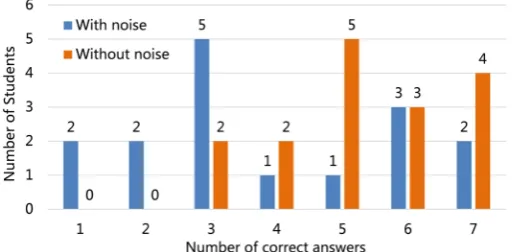
[image:8.595.246.504.567.693.2]In Stage 4, during the activity of memorizing the pictures under sound in-terference, it was verified difficulties for the students to correct identify the pictures. Most of them (9 students) identified up to two pictures and only 2 students were able to correct identify the sequence of all pictures. Then, in the silent memorization, an improvement on the results was clearly observed. 5 stu-dents correctly identified the sequence of 4 pictures; 3 stustu-dents identified 5 pic-tures, and 4 students identified the sequence of all pictures in their proper order. Figure 1 shows a comparison between the results obtained with noise and with the class in silence.
In Stage 5, in which the teams should report the visual and sound elements watched and listened through drawings, it was verified that the Team 1 pre-sented the drawing with a great number of details and developed all the tasks without any personal conflict, but with little collaborative interaction between the members. Team 2 was able to report a reasonable number of elements, but there was no interaction between the students, and only one of them was in charge of all the work. In Team 3, there was disagreement between the students and only half of them made the final work with a considerable number of ele-ments portrayed. Finally, Team 4 was the only one that showed the best perfor-mance in the collective work by sharing the tasks among its members, although it was not the one that most portrayed the elements. The interesting thing about this activity was the difficulty that the students presented in working under harmonious way in the teams. One possible explanation for this may be the fact that they are children and is difficult to establish and keep a leader for the team.
The sixth stage provided students with a discussion about noise in the school environments. They analyzed and measured the noise in the computer lab, library, sports court, and a hall during the break time. The quieter environ-ment was the library, as they predicted, and the louder place was the sports court. Table 1 shows the noise measured in the four school environments.
At that level, students were already familiar with the concept of “noise pollu-tion” and its harmful effects, and highlighted the issue of environmental preser-vation, especially with regard to sound landscape.
DOI: 10.4236/ce.2019.107106 1452 Creative Education Table 1. Measurement of noise in different school environments.
Local Noise level (dB)
Library 25
Computer lab 42
Hall 42
Sports court 43
Source: Authors.
In Stage 7, the students used the musical instrument “Hidrofone” to exercise the parameters of sounding through the elaboration of a musical piece. By this, they were able to reflect on the characteristics of noise and sound, as well as the sound classification (Wisnik, 1989). They realized that the instrument made out only emitted noise. However, when organized, it produced a pleasant sound ef-fect. It was also highlighted that the preparation of the instrument gave the stu-dents a reflection about the reuse of materials considered disposable.
5.3. Socio-Emotional Skills and Work in Teams
Social-emotional skills were present at all stages and served as a basis for devel-oping the concept of “pollution”. In order to discuss these skills, the data about self-evaluation and evaluation of the members of each team were recorded and analyzed.
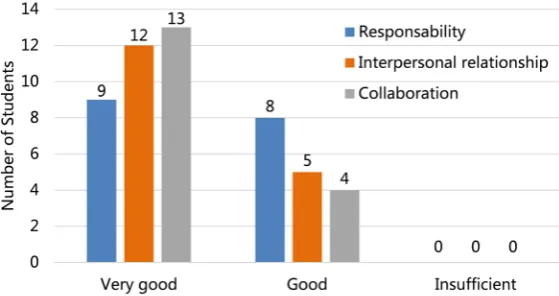
For the analysis of the self-evaluation were considered the following soft skill: responsibility, interpersonal relationship, and collaboration. The assignment of concepts was given by importance: 1 (insufficient), 2 (good), and 3 (very good). The results obtained are shown in Figure 2.
[image:9.595.232.512.559.707.2]The results show that most of the students evaluated themselves as very good in the three soft skills. Interesting is the fact that no student considered him/herself insufficient in any of the skills.
Table 2 reports the evaluation of the social-emotional skills. The students in their own teams evaluated these skills. During the evaluation of each component of the team, the same skills and assignment of concepts were established.
DOI: 10.4236/ce.2019.107106 1453 Creative Education It is noted that the student’s perception of the collaboration is one in which their colleagues performed better. This result suggests an active positioning of most of the components of the team in front of the project stages. Despite this result, the average observed in responsibility reveals that the teams expected their components not only to collaborate but also to engage in the tasks. The da-ta reported in Table 2 show that students had perception between good or very good, which suggest developments of their socio-emotional skills during the ex-ecution of the project reported here. These observations do not completely agree to the perceptions reported in stage 5.
Table 2. Evaluation of the socio-emotional skills by the teams. 1, 2, and 3 indicate, re-spectively, insufficient, good, and very good.
Team Collaboration Responsibility Interpersonal relationship
1 2.6 ± 0.3 2.0 ± 0.7 2.4 ± 0.5
2 2.5 ± 0.5 2.0 ± 0.8 2.5 ± 1.0
3 2.3 ± 0.2 2.3 ± 0.5 2.3 ± 0.5
4 3.0 ± 0.1 2.5 ± 0.6 2.5 ± 0.6
Source: Authors.
5.4. Project Evaluation
The project evaluation was done using the “Likert” scale with a 3-point mea-surement, as “I totally agree” (A), “partially agree” (B), and “do not agree” (C). The results are shown in Table 3.
In general, it was observed by students that the project contributed to in-creasing the knowledge of the types of pollution. They also emphasized that the project helped them in changing their posture regarding the harm of sound pol-lution, as well as helped to understand the importance of preserving the nature environments. These considerations allow us to verify that PBL is, in fact, an ac-tive learning methodology that provides participants, even children, with action and reflection on the subjects to be learned.
Table 3. Evaluation of the project. A, B and C indicate, respectively, “I totally agree”, “I partially agree”, and “I do not agree”.
Issue A B C
The project contributed to increasing my knowledge about pollution 14 3 0 The project has helped me to be aware of the types of noise 9 7 1 The project contributed to preserving natural environments 9 7 1 Because of the project, I began to enjoy sounds of natural environments 9 4 4 Source: Authors.
6. Final Remarks
[image:10.595.208.539.250.338.2]DOI: 10.4236/ce.2019.107106 1454 Creative Education between sounds and the environment. When this relationship is not balanced, there exists noise pollution. This subject is very important in the contemporary life and cannot be ignored, because people are living exposed to excessive noisy environments, which constitute a real threat to our hearing and health. Based upon such conceptual aspects, this report described an application of PBL that aimed not only on the development of technical competences, but also at the so-cio-emotional skills.
Social-emotional skills were present at all stages and served as background for the development of the concept of “pollution” in a more general way. It was ob-served several times that the students needed balance in dealing with other members of their team and assisting them in understanding the central concept of the project. It was also noticed that, in most of the classes, there was a change of posture, as expected in the project. Another important point was the student´s perception about themselves and about their peers in the team, which was clear in the evaluations and self-evaluations.
Finally, it was noticed that the project, by providing that the students were the most important agent in their own learning, allowed a reflection on the noise as a polluting element. On this context, the role of each one in the preservation of the environment was highlighted corroborating to the integral education.
Conflicts of Interest
The authors declare no conflicts of interest regarding the publication of this pa-per.
References
Eniz, A. O. (2004). Poluição Sonora em Escolas do Distrito Federal (p. 111). Dissertação de Mestrado, Brasilia: Universidade Católica de Brasília.
Grün, M. (1996). Ética e educação ambiental: A conexão necessária. São Paulo: Papirus. Helle, L., Tynjälä, P., & Olkinuora, E. (2006). Project-Based Learning in Post-Secondary
Education—Theory, Practice and Rubber Sling Shots. Higher Education, 51, 287-314. https://doi.org/10.1007/s10734-004-6386-5
Libâneo, J. C. (1998). Pedagogia e pedagogos, para quê? São Paulo: Cortez.
Lima, P. A., Judice, M. G., & Reys, P. (2014). Comparação dos Níveis de Poluição Sonora em Diferentes Ambientes da Universidade de Rio Verde—GO (p. 10). Monografia de Graduação, Rio Verde: Universidade de Rio Verde.
Likert, R. (1932). A Technique for the Measurement of Attitudes. Archives of Psychology, 22, 44-53.
Machado, A. A. (2004). Poluição sonora como crime ambiental (No. 327). Teresina: Re-vista Jus Navigandi.
Markham, T., Larmer, J., & Ravitz, J. (2008). Aprendizagem baseada em projetos: Guia para professores de ensino fundamental e médio (2nd ed.). Porto Alegre: Artmed. Masson, T. J., Miranda, L. F., Munhoz Jr., A. H., & Castanheira, A. M. P. (2012).
Meto-dologia de Ensino: Aprendizagem Baseada em Projetos (PBL). Belém: Congresso Bra-sileiro de Educação em Engenharia.
Im-DOI: 10.4236/ce.2019.107106 1455 Creative Education
portância da educação ambiental na escola nas séries iniciais. Revista Faculdade Montes Belos, 4, 1-17.
Morin, E. (1990). Introdução ao pensamento complexo (2nd ed.). Tradução Dulce Matos, Lisboa: Instituto Piaget.
Perrenoud, P. (2001). A Pedagogia na Escola das Diferenças. Artmed Editora. Plattner, H., Meinel, C., & Leifer, L. (2011). Design Thinking. Berlin: Springer.
https://doi.org/10.1007/978-3-642-21643-5
Rampazzo, S. E. (1996). A questão ambiental no contexto do desenvolvimento econômi-co. Redes, Santa Cruz do Sul, 1, 197-222.
Rios, A. N. (2003). Efeito do Ruído Tardio na Audição e na Qualidade do Sono em In-divíduos Expostos a Níveis Elevados. Dissertação (Mestrado), Ribeirão Preto: Facul-dade de Medicina da USP.
Schafer, R. (2009). Murray. Educação Sonora. Educação Musical (Trad. Fonterrada, M.). Melhoramentos.
Schafer, R. (2001). A afinação do Mundo (Trad. Fonterrada, M.). São Paulo: UNESP. Schafer, R. (1991). O Ouvido Pensante: Música e Ensino (Trad. Fonterrada, M.). São
Paulo: UNESP.
Zajarkiewicch, D. F. B. (2010). Poluição Sonora Urbana: Principais Fontes—Aspectos Jurídicos e técnicos. São Paulo.