The Model of Mobile Knowledge Services System
in the Management of Complex Cluster Project
Liu Yong, Liu Bingxin
School of Business Administration, South China University of Technology Guangzhou, Guangzhou, China Email: [email protected], [email protected]
Received August 19th, 2010; revised October 25th, 2010; accepted November 3rd, 2010.
ABSTRACT
Cluster projects are projects of large-scale or with huge investment, such as Beijing 2008 Olympic Games and Shang-hai 2010 Expo. A lot of on-site management works are involved in the process of cluster project management, espe-cially the treatment of sudden accidents which would produce plenty of knowledge and experience. As cluster project on-site management spots change frequently, knowledge produced by mobile workers in the process of on-site man-agement is hard to be saved into the knowledge repository on time. It may cause a knowledge distortion or even missing. On the other hand, in the process of cluster project management, a lot of knowledge is required by on-site workers to deal with on-site activities. However, due to lack of effective mechanisms for knowledge communion, they often face the risk of making wrong decisions. To solve the problems of knowledge management and acquisition in the process of cluster project on-site management, this paper presents a system model for mobile knowledge service.
Keywords: Cluster Project Management, Mobile Knowledge Services, Knowledge Service Model
1. Introduction
Cluster projects are projects of large-scale or with huge investment, such as Beijing 2008 Olympic Games and Shanghai 2010 Expo [1]. In order to manage these complex cluster projects, large amounts of on-site managers who we call mobile workers are requires. On one hand, in the process of project implementation, a lot of knowledge would be needed as a support and a lot of experience and knowledge are produced as well. If lack-ing of effective mechanisms for information access and knowledge communion, there would be a risk of making wrong decisions. On the other hand, various experience and knowledge are held by on-site mobile workers[2], but it is difficult for them to record the information and experience produced in the business process into the enterprise’s database or repository in real-time. It may result in a distortion of enterprise’s information and knowledge, or even missing [3]. The mobile knowledge service system not only can provide the required knowledge for cluster project on-site workers at anytime and anyplace, but also can save the experience and knowledge produced in the process of cluster project on-site management effectively. As a result, the efficiency
of on-site management and the accuracy of decision- making would be greatly improved.
At present, there are not systemic researches on the mobile knowledge services for cluster project manage-ment at home or abroad. Some related researches are focused on the mobile services of library, information field, mobile communications, mobile learning, and knowledge services. These researches do not connect knowledge service with mobile environment. Generally speaking, mobile knowledge service is a process of pro-viding knowledge service to knowledge users in mobile environment. It can supply individual knowledge ser-vices to users at anytime and anyplace by using mobile equipments.
Knowledge produced in the process of project imple-mentation effectively and providing knowledge required by mobile workers accurately have an important practical significance to carry out and manage cluster projects. On one hand, the method to deal with an issue of one project might be also applied to another project or even another cluster project that face the same problem. However, each subproject often works independently and the communion between each other is very little. The ref-erence of the experience and knowledge between dif-ferent clusters projects is even less. So it resulted in the
repetition of similar problems and a serious waste of re-sources. On the other hand, if these experience and knowledge could be collected and used by all the sub-projects’ workers through a simple and convenient way, the efficiency of implementing complex clusters would be greatly improved.
In order to help mobile workers to record experience and knowledge produced in the process of project im-plementation as well as to acquire the knowledge that they need in mobile environment; this paper presents a system model based on mobile knowledge services.
2. Design of Mobile Knowledge Services
System
2.1. The Description of the System Model
To supply the required services to mobile workers of complex cluster projects at anytime and anywhere, mo-bile terminals should be chosen firstly. Momo-bile terminals such as mobile phone, PDA, notebook computers are commonly used now. However, the volume of notebook computers is large and not very convenient to be car-ried-on. Mobile phone also has some disadvantages such as small memory, slow rate of data transmission, small screen which caused inconvenient operation. Compared with them, PDA (Personal Digital Assistant) has been widely used in systems based on mobile services because it is not only easy to be carried and operated, but also has advantages of good display of LCD screen and the capa-bility of wireless communication[4]. As the operating system of PDA is designed to face users directly and is similar to traditional computer operation, so it can be easily mastered by mobile workers. At the same time, PDA can provide various wireless technologies and we can go through internet and get the required information through the built-in Modem or optional wireless inter-
net groupware. So, we choose PDA as our mobile ter-minal.
To achieve the real-time linkage between client and system in mobile environment, the appropriate wireless access technology is also needed besides mobile equip-ments. There are two ways of wireless access that can be used by Internet mobile users: dial-up or through a wire-less network card to log on to wirewire-less private network. Although a higher data transfer rate could be achieved by the way of dial-up, it would be enslaved by environment and not convenient to be used by mobile workers at any-time and anyplace. Wireless Private Network is the mainstream in the future, with which we can easily ac-cess the Internet anytime. At present, the popular wire-less access technologies include GSM, CDMA, GPRS, CDPD and LMDS. Compared with other technologies, CDPD access technology which takes a method of packet data is an open system architecture based on TCP/IP. It combines the functions of open interface, high transmis-sion speed, user unit determination, air link encryption, air data encryption, and compressed data error correction, and wireless access by using the world standard IP ad-dress mode. It also provides the seamless connectivity of the same network layer and multi-protocol network ser-vices. So it is widely recognized as the best wireless pub-lic network data communication protocol[5]. Therefore, we choose CDPD access technology to achieve wireless access of mobile equipments in this paper.
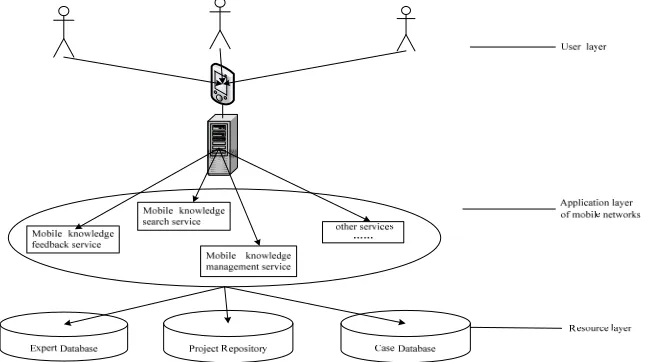
With mobile equipments and access technology, the probability of using mobile knowledge services system is assured in theory. In the following, we define a system model of mobile knowledge services used in the process of complex cluster project management. Figure 1 is a schematic figure of the model structure.
[image:2.595.134.457.521.702.2]From Figure 1 we can see that the system is divided into three levels: user layer, application layer of mobile
networks and resource layer. The on-site workers of complex cluster project, who are users of the system, can use PDA as mobile equipments to select services that they need. The mobile network application layer is mainly used for receiving users’ request and sending the information that they need. The request sponsored by the client program is sent out after business is selected through the built-in browser of a mobile terminal [6]. All the information needed in the process of system operat-ing are provided by the resource layer includoperat-ing knowl-edge repository, experts database and case database of the project and the relevant information uploaded by us-ers are also stored in the corresponding database.
2.2. The Function Model of Mobile Knowledge Services System
Mobile Knowledge services of complex cluster project can be mainly divided into mobile knowledge man-agement and mobile knowledge acquisition. The former service pattern mainly accomplishes the function of col-lecting and saving project management knowledge. The latter pattern mainly accomplishes the function of pro-viding knowledge to required workers through the ways of information search, knowledge quiz, hot information feedback, WAP access, information discussion platform, tracking knowledge services.
1) Mobile Knowledge Management:
Each subproject of complex cluster project can be re-garded as a separate project, including feasibility study, project establishment, project planning, project imple-mentation, acceptance and check items etc. Mobile workers can use PDA to login the knowledge services system of cluster project, and record problems they meet with.
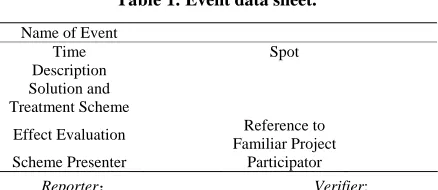
Most of those who need to use the mobile knowledge services system to upload experience data are on-site management workers at the stage of project implementa-tion. Therefore, we divide the problems happened in project implementation phase into two categories: daily management and emergency. On-site management workers use event data sheet which is set in the system already to record the problems they meet with and the solutions of problems after choosing the respective cate-gories. Then, they can save the contents and upload them to the system. The event data sheet is shown in Table 1. Through the record of each event, the problems occurred in the implementation phase of each subproject and the solutions can be saved effectively. On one hand, it can help their team members and leaders know the general situation of the subproject better. On the other hand, it is also convenient for participants of other subprojects to realize and learn from them.
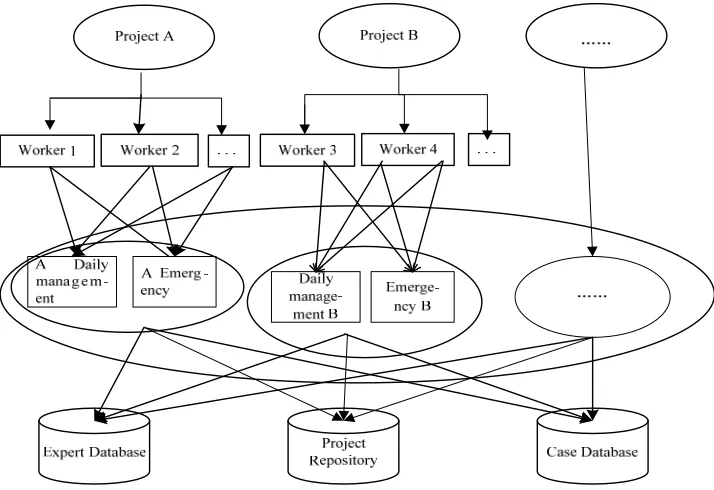
[image:3.595.315.534.92.187.2]Figure 2 shows that how on-site workers of cluster
Table 1. Event data sheet.
Name of Event
Time Spot
Description Solution and
Treatment Scheme
Effect Evaluation Familiar Project Reference to
Scheme Presenter Participator Reporter: Verifier:
project use PDA and mobile knowledge services sys-tem to record events.
It indicates that worker 1,2,3,4 etc. of each subproject use mobile knowledge services system to upload prob-lems and solutions happened in the implementation phase of project through PDA. They save the information under respective categories.
2) Mobile Knowledge Acquisition
Mobile knowledge acquisition services can be divided into ordinary knowledge services pattern and tracking knowledge services pattern. Ordinary knowledge ser-vices pattern still can be divided into five ways: informa-tion search, knowledge quiz, hot informainforma-tion feedback, WAP access, and information discussion platform. Ordi-nary knowledge services pattern mainly deals with clear or vague demanded information from mobile workers who have a simple understanding and a strong purpose about what type of services they need before choosing this service. Tracking mobile knowledge services pattern asks knowledge providers to supply follow-up services. It not only can deal with mobile workers’ clean or vague demanded information, but also supply guidelines for potential demand.
a) Information Search
Figure 2. The sketch map of uploading events by mobile workers by using system.
back function, if a worker is unable to find the corre-sponding knowledge, he can use the feedback function to submit the issue to system. System maintenance workers would carry out these problems regularly and put new solutions into the project database.
b) Knowledge Quiz
If mobile workers don’t have enough time to search for information by themselves, they can use the function of knowledge quiz. They only need to input the informa-tion about their requirement into problem table setting in the system. The system will return the matching answers to users automatically. As the multimedia mail system can achieve the interoperability with Internet and provide the function of sending messages between mobile termi-nals and Internet[7], therefore, after the completed prob-lem table is sent to the mobile knowledge service system, the answer will return to the mobile worker’s PDA in the form of multimedia mail through background processing. The contents of the mail can include text, sound, picture, and video and so on. Using multimedia mail, we can transmit plentiful information to ensure the quality of the solution. If a mobile worker’s requirement cannot be matched in project database, the system will automati-cally reply no matching knowledge to him. At the same time, the problem table will be stored in a particular po-sition waiting for expert to solve it. After solving the problems, the results would be saved in the database. So, the database can be enriched continuously.
c) Hot Information Feedback
System can regularly send the latest information that
mobile workers concern in the form of multimedia mails by recording demand information that each mo-bile worker often send. So the momo-bile workers could see the latest developments in their concerned fields without searching by themselves. In this way, it can reduce the time to search information and avoid the geographic or tool’s limited. This kind of service is called hot information feedback.
d) WAP Access
Through classifying the knowledge, mobile knowl-edge services system maintenance workers show them out in the form of ordinary website and put related links to the web page in order to achieve resource sharing. Mobile workers use PDA to login the system, then they can visit the website and download the data that they need. All information about cluster project will be re-leased on the web timely. As a result, mobile workers can realize the progress of the project at anytime and anyplace. Through arranging data and analyzing browsed information regularly, website maintenance workers would expand data which are often browsed and downloaded to update the web timely.
e) Information Discussion Platform
can ensure the exchange of knowledge and the re-source-sharing freely.
Mobile knowledge services system also provides a platform for mobile workers to communicate with ex-perts. They can discuss with experts on this platform at anytime and anyplace. Experts will give their opinions to questioners and mobile workers also can discuss the ul-timate solutions according their own actual situation with experts. In the process, experts can transfer mobile workers’ tacit knowledge such as experience into the explicit knowledge. Then they put the new explicit knowledge into the database. As a result, the aim of knowledge innovation and value-added is achieved.
f) Tracking Mobile Knowledge Service
The pattern of tracking mobile knowledge services is applicable to the mobile workers who have a lot of re-quirement or the problems can’t be completed after a short time guidance and need long-term service. Through tracking mobile knowledge services, we can know ex-perts’ opinions at anytime and anyplace which ensure to finish the work smoothly. After choosing this service, we can choose a knowledge service worker according to the required fields. Then we send our requirement to him/her through multimedia mail. It is a one-to-one communica-tion. Mobile workers also can choose to discuss with experts by information discussion platform timely.
In the whole process of solving problems, knowledge service workers are required to integrate into the deci-sion-making process with mobile workers to establish a harmonious “user - service worker” relationship as fea-turing lawyer. The service duty system pointing to spe-cific mobile workers should be established, and then they can do integrative services from knowledge collection, disjunction, reorganization, innovation, integration to application [8]. Knowledge service workers not only should integrate into the process of solving problems to solve the mobile workers’ existing problems, but also should help them to grasp the whole problems from ma-croscopic side. Based on the detailed understanding of mobile workers’ working environment and requirement, knowledge service workers may realize their potential demand and provide diversiform services.
3) Mobile Knowledge Acquisition
In addition to the existing two mobile services modes of mobile knowledge management and mobile knowl-edge acquisition, we also can use the statistical results, which extract from the information submitted by the mo-bile workers to develop two new functions.
a) Reward Management
In order to encourage mobile workers to upload in-formation through system, we can set up a function of reward management within the system. That is, in a cer-tain period of time, the system automatically counts the
total number of information uploaded by all mobile workers in the cluster project or that of each subproject and shows these numbers out in the form of statistical tables according to the requirement. The workers who upload a mass of information can be given encourage-ment in the form of bonuses. The system also shows award out in statistical table. By this way, we can inspire the enthusiasm of mobile workers to save explicit and tacit knowledge produced at the stage of project imple-mentation as many as possible.
b) Statistics Analysis
According to the categories of events uploaded by mobile workers, the system automatically counts and shows the number about some related issues or problems occurring frequently at some stages of the project. It can make leaders realize which problems often occur in the process of project implementation or which problems are easy to happen in a subproject or other questions only through using the system. All the information can intui-tively get from statistical data. It is easy to make leaders understand the problems of the whole cluster project completely and the overall progress of the project.
The development of two new functions can further improve the system’s efficiency and make the range of system’s users expand to project senior managers from normal mobile workers. It not only can make the system collect and provide knowledge, but also can provide de-cision support for the project dede-cision-makers.
Through the definition of the system and functions above, we can conclude the function diagram of complex cluster project mobile services system. It is shown in
Figure 3.
3. Case Study
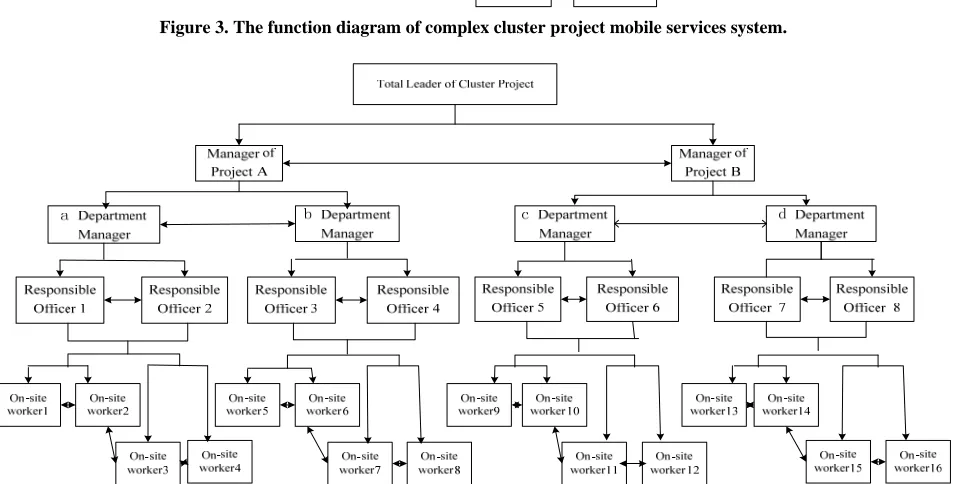
The mode of mobile knowledge services system has been applied into the actual cluster projects. Figure 4 shows how knowledge flow inside one cluster project before mobile knowledge service system is used.
Figure 3. The function diagram of complex cluster project mobile services system.
Figure 4. The function diagram of complex cluster project mobile services system.
people should have two-way arrows connection. But in fact, there is little communication among the different subprojects or the same project with different levels. If experience and knowledge generated in the process of cluster project implementation can be used by all par-ticipants, the efficiency would be greatly improved and the probability of making mistakes would be reduced.
Using mobile knowledge services system can solve these two problems well. First of all, workers in any level of the project can use the system to get a comprehensive understanding of events that are happened in the process of project implementation. Especially for project manag-ers and total leader, they can know about the situation at work site anytime and anywhere without going there. Secondly, for all on-site mobile workers, knowledge ser-vice system can tell them about problems that other peo-ple have encountered and their solutions. So they can learn from each other. It is an effective method to solve the problem of communicating inconveniently between
mobile workers and the difficulty to learn experience from different cluster projects. Due to the system every-body can make detailed and comprehensive communica-tion without meeting each other.
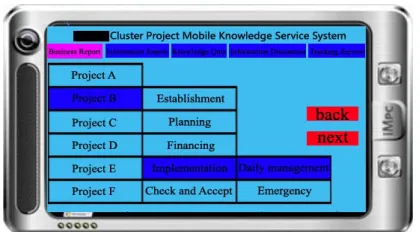
In order to use PDA to upload events, the first thing that mobile workers should do is to login the system and choose the function of business report. In view of the confidentiality requirement, we cover the important in-formation of the operation system to form the following diagram shown in Figure 5.
[image:6.595.61.541.217.459.2]Figure 6 is the page for recording event. The upper left corner shows the operation order we have done: Business Report - Project B - implementation. If mobile workers do false operation, he can click the “Quit” but-ton to return to the previous page. If the operation is cor-rect, he can continue to fill the blank. Clicking a space on the blank, the system would enter into a special page for mobile workers to complete the description. After com-pleting a description, click “Finish” to return to Figure 6
and go on filling other blanks. If all blanks are completed, click the button of “Upload” to upload it into the system. Then other workers can view it. If there is an interruption, we can click “Save”. So the information is saved in sys-tem for a while and would not be uploaded until we complete the fillings in the next time.
Other functions of this system are also applied in the process of cluster project management. It can solve the problems of knowledge management and acquisition of on-site management well. To sum up, it is convenient to provide appropriate knowledge services for on-site mo-bile workers of the cluster project management team.
4. Conclusions
This paper presents a system model that can be applied to the management of complex cluster projects. It is made up of three layers: user layer, application layer of mobile networks and resource layer. In this paper, mobile know-
[image:7.595.64.278.577.700.2]Figure 5. the operation page of choosing function of busi-ness report.
Figure 6. The operation page of event data sheet.
ledge services of complex cluster project is summarized into two service modes which include mobile knowledge management and mobile knowledge acquisition. The service of mobile knowledge management is mainly to complete the collection of mobile workers’ experience and knowledge. The service of mobile knowledge acqui-sition comprehensively meet the knowledge requirement of mobile workers through six ways which are informa-tion search, knowledge quiz, hot informainforma-tion feedback, WAP access, information discussion platform, and tra- cking mobile knowledge services. Through the applica-tion in the process of complex cluster project manage-ment, this system model can meet the demand of knowl-edge services for mobile workers in the team of complex cluster project management.
REFERENCES
[1] Y. Cheng and H. Y. Liu, “The PSO Analysis of Large Clusters Project - the Research of Expo Project,” Architecture Software, Vol. 2, No. 27, 2005, pp. 53-56.
[2] B. Skattor, “Design of Mobile Services Supporting Knowledge Processes on Building Sites,” Management of e-Business, Eighth World Congress , 11-13 July 2007, p.
10. doi:10.1109/WCMEB.2007.6
[3] K. J. Liao and Q. H. Liu, “An Architecture of Mobile Knowledge Service Based on Document Knowledge Base & Its Application. Management of e-Commerce and e-Government,” International Conference, 16-19 September 2009, pp. 404-407.
[4] C. W. Li and D. Li, “A System Model Based on Mobile Service. Network and Communication,” Vol. 26, No. 2-3, 2010, pp. 127-128.
[5] H. G. Cui, “The Research and Implementation on Knowledge Management Technology in Mobile E-Government Systems,” Guangdong University of Technology, China, 2002, pp. 12-14.
[6] X. Q. Zhang and F. C. Yang, “A Model of Mobile Business Operation Service Based on the Network,” Journal of Beijing University of Posts and Telecommunications, Vol. 29, 2006, pp. 189-193.
[7] Y. X. Yangm and J. X. Wang, “Research on the Mobile Learning Mode Based on 3G Technology,” Network Education and Modern Long-distance Education, Vol. 8, 2005, pp. 37-39.
[8] J. Q. Li, “The Research on the Characteristics and Pattern of Knowledge Service,” Information and Documentation Services, Vol. 2, 2004, pp. 16-19.
[9] K. J. Liao, Q. H. Liu and X. L. Zhao, “Ontology-Based Model of Mobile Knowledge Service for the Inspection of Construction Project,” Management and Service Science, 2009, MASS ’09 International Conference, 20-22 September 2009, pp. 1-5.
[11] N. H. Kuang, Q. Y. Hu and R. Du, “A Type of Management Pattern of ‘Direct – Services-Prompting’ in Knowledge-Based Enterprises,” Journal of Management Sciences in China, 2004.
[12] H. Evanschitzky and D. Ahlert, “Knowledge Manage-ment in Knowledge-Intensive Service Networks,” Man-agement Decision, Vol. 45, 2006, pp. 265-283.