International Journal of Astronomy and Astrophysics, 2011, 1, 67-72
doi:10.4236/ijaa.2011.12010 Published Online June 2011 (http://www.scirp.org/journal/ijaa)
An Approximation Algorithm for the Solution of
Astrophysics Equations Using Rational Scaled
Generalized Laguerre Function Collocation
Method Based on Transformed Hermite-Gauss Nodes
Ali Pirkhedri1*, Parisa Daneshjoo1, Hamid Haj Seyyed Javadi2, Hamid Navidi2, Salem Khodamoradi3, Kamal Ghaderi3
1Department of Computer Engineering, Islamic Azad University, Science and Research Branch, Tehran, Iran 2Department of Applied Mathematics And Computer Sciences, Shahed University, Tehran, Iran
3Department of Science, Islamic Azad University, Branch of Marivan, Marivan, Iran E-mail: alipirkhedri @ gmail.com
Received March 12, 2011; revised April 28, 2011; accepted May 5, 2011
Abstract
In this paper we propose a collocation method for solving Lane-Emden type equation which is nonlinear or-dinary differential equation on the semi-infinite domain. This equation is categorized as singular initial value problems. We solve this equation by the generalized Laguerre polynomial collocation method based on Hermite-Gauss nodes. This method solves the problem on the semi-infinite domain without truncating it to a finite domain and transforming domain of the problem to a finite domain. In addition, this method reduces solution of the problem to solution of a system of algebraic equations.
Keywords: Lane-Emden Equation, Generalized Laguerre Functions, Collocation Method, Hermite-Gauss Nodes, Nonlinear ODE, Semi-Infinite
1. Introduction
There are many problems in science and engineering arising in unbounded domains.
Spectral methods are famous ways to solve these kinds of problems. The most common approach on spectral methods, that is used in this paper too, is through the use of functions that are orthogonal over unbounded domains, such as the Hermite and the Laguerre functions [1-8].
The second approach is reformulating the original problem in the semi-infinite domain to a singular prob-lem in a bounded domain by variable transformation and then using the Jacobi polynomials to approximate the resulting singular problem [9-11]. A third approach of spectral method is based on rational orthogonal functions, for example, Christov [12] and Boyd [13,14] developed some spectral methods on unbounded intervals by using mutually orthogonal systems of rational functions. Boyd [14] defined a new spectral basis, named rational Che-byshev functions on the semi-infinite interval, by map-ping it to the Chebyshev polynomials. Guo et al. [15] proposed and analyzed a set of Legendre rational func-
tions which are mutually orthogonal in L 2
0,
witha non-uniform weight function
x = x1
2. A forth approach is replacing the semi-infinite domain withinterval by choosing L, sufficiently large, this method is named as the domain truncation [16].
[0, ]L
2. The Lane-Emden Equation
This equation is one of the basic equations in the theory of stellar structure and has been the focus of many stud-ies [17-21]. This equation describes the temperature variation of a spherical gas cloud under the mutual attrac-tion of its molecules and subject to the laws of classical thermodynamics. The polytropic theory of stars essen-tially follows out of thermodynamic considerations, that deal with the issue of energy transport, through the trans-fer of material between diftrans-ferent levels of the star. We simply begin with the Poisson equation and the condition for hydrostatic equilibrium:
2
d = d
GM r P
r r , (1)
2d
= 4 , d
M r
r
r (2) where is the gravitational constant, is the pres-sure, M rG
is the mass of a star at a certain radius , P andr
is the density, at a distance from the center of a spherical star. Combination of these equations yields the following equation, which as should be noted, is an equivalent form of the Poisson Equation.
r
2 2
1 d d
= 4π . d d
r P
G
r r
r
(3) From these equations one can obtain the Lane-Emden equation through the simple supposition that the density is simply related to the density, while remaining inde-pendent of the temperature. We already know that in the case of a degenerate electron gas that the pressure and
density are 3 5 P
, assuming that such a relation exists for other states of the star we are led to consider a rela-tion of the following form:
1 1
= m
P K , (4) where K and m are constants, at this point it is important to note that m is the polytropic index which is related to the ratio of specific heats of the gas comprising the star. Based upon these assumptions we can insert this relation into our first equation for the hydrostatic equilibrium condition and from this rewrite equation to:
11 2
2
1 1 d d =
4 d d
m m
K m r y
G r r r
y , (5) where the additional alteration to the expression for den-sity has been inserted with representing the central density of the star and that of a related dimensionless quantity that are both related to
y
through the
follow-= ym.
(6) Additionally, if place this
tio
(7) result into the Poisson equa-n, we obtain a differential equation for the mass, with a dependance upon the polytropic index m. Though the differential equation is seemingly difficult to solve, this problem can be partially alleviated by the introduction of an additional dimensionless variable x, given by the fol-lowing:
= ,
r ax
1 12 11
= .
4
m
K m a
G
(8) Inserting these relations into our previous relations we obtain the famous form of the Lane-Emden equation, given below:
2 2
1 d d = . d d
m
y
x y
x x
x
(9) Taking this simple relation we will have the Lane- Emden equation:
2 m= 0, > 0.
y y y x
x
(10)
At this point it is also important to introduce the bo
(11)
As a result an additional condition must b in
undary conditions, which are based upon the following boundary conditions for hydrostatic equilibrium, and nor- malization consideration of the newly introduced quanti-ties x and y. What follows for r0 is:
= 0 = 0, = 0 =
r x y 1
e introduced order to maintain the condition of Equation (11) si-multaneously:
0 = 0.y (12)
In other words, the boundary conditions are as follow:
0 = 1,
0 = 0.y y (13)
Physically interesting value of m li 5]
r is arranged as : in Section 3, we ex-pl
last section.
e in the interval [0, . Exact soloution for Equation (??) are known only for
= 0,1
m and 5. For other value of m the Lane-Emden is to be integrated numerically. In this paper, we solve it for m= 1.5,2,2.5,3and 4.
This pape follows equation
A. PIRKHEDRI ET AL. 69
ials and Hermite Functions
Th evoted to the introduction of the basic otions and working tools concerning orthogonal rational
Rational Scaled Generalized Laguerre Polynomials
polynomial) is the th ction of the Sturm-Liouville problem [2,22,
3. Rational Scaled Generalized Laguerre
Polynom
Properties
is section is d n
scaled generalized Laguerre polynomials and later we present some properties of Hermite function and Her-mite-Gauss nodes.
3.1. Properties of
nL igenfun
x (generalized Laguerre n 23]: e
2
2 1 d = 0,
d n n n
d d
x L x x L x nL x
x x
0,
, = 0,1, 2,...x n ( 4)
The generalized Laguerre with the following recurrence
1
polynomials are defined formula:
0 = 1, 1 = 1 ,
L x L x x
= 2 1
1
1
,n n
nL x n
x L x n
Ln 2 x
2, > 1
n (1 With the normalizing condition:
5)
0 = .n n L n
(16)
Let denotes a non-ne
valued functiow x( ) n over the interval gative, integrable, real-
0,
, we define
2 = : 0, v is measur d < ,
w w
L v R able an v
(1 ) where
7
12 2
0
= | | d
w
v
v x w x x , (18)Is the norm induced by the inner prod ,
These are orthogonal polynomials for tion
uct of the space
2
w
L
< , > =u v
u x v x w x xd . (19) 0w
the weight
func-
= xw x x e where nm is the Kronecker delta
function.
0 1 n aL = .
!
n x L x w xm n nm
Let N1 be an integer and we define xj N, , j = 0,…,N-1 to be zeroes of N
d L dx
and the po 0. It
can be show th
int x =
n that xj N, > 0, j = 0,…,N-1 and e cor-responding weights are:
2
0,
1 1 1 !
= N N w N 1
1, = ! , d 1 ,
= 1, 2,...,
,
j N j N N j N
d
x L x
N x j N
The following ormula is known:
1.
N
N
w L
quadrature f 1
=0
N
d =
, ,0 N j N j N
j
f x w x x
f x w
(N ! 2N1! f2 1
N ) N , 0 < <
(20)
In particular term on the right ha
vanishes when f nomial of degree at most
, the second is a poly
nd side
2N2. For convenience, we shall set xj N, =xj and
, =
j N j
w w .
ospectral approximations in unbou ains
Pseud nded dom
by Laguerre polynom ad to ill-conditioned algo-rit
ials le
hms and [24] introduced a scaling function and appro-priate numerical procedures in order to limit these un-pleasant phenomena.
We define scaled Laguerre functions
n asfol-lows:
0 ; = 1, ; = / /
,= 1, 2,...
n n n
x k x k S x k L x
n
k
(21)
where k> 0 d is gen Laguerre polynom
is a constant an
ials for
1n
L x eralized
= 1
and S xn
is defined(22)
We denote scal functions with (SLF). Boyd [26] offer es for optimizing the map
pa From
Eq as follo
10 = 1, S x
ws:
x = n 1 n ed laguerre ed guidelin
=11 / 4 ,
= 1, 2,....
n n
t
S x t
n
rameter k where k> 0 is the scaling parameter. uations (21) and (22), for = 1, we obtain the fol-lowing formula:
1 1
0 1
4 2 ; = 1, k
x k x k; = ,
2 4 x x k
1 1 1
; = [ 2 / ;
1 4
n n
4 / n
x k n x k x k
k
n n x
2
1 2
4 1
4 n
k ; ], 2,
4 /
n
x k n
n x
(23)
This system is an al basis with weight
func-
tion
/ 2 = / x k N xe w xkS x k
[24].
generalized Laguerre-Gauss-type interpolation were in-ced by [24,25]. It is nt to define the weights of
Some of the relations of scaled Laguerre functions and
trodu convenie
;n x k
as follows:
0 0, 2 2 2 = = ! 0 N N N w w N N S
, = 2 =
j j N
N j
w w
S x
1 1 1 1 2 =1 4( 2) d 1 ,
d 4
4 ( !)
N j
N j N j
m j
N j
N x
N x x
x m x
N N x
(24) where we noted that, for= 1,2,..., 1.
j N
2
n
1
1 1 = 0,
1 1
=1
d [ ] = [ ] 1 ,
d 4
N
N N
m j
S x S x x I
x m x
3.2. Properties of Hermite Functions
The Hermite function is defined for all xR and can be written in recursive formula as follows [27-29]:
1 = 1 1 1 , 1
n x n H xn n Hn x
2 n
H x n
2 2
2 2
0 = e , 1 = 2 e
x x
H x H x x (25)
Hn is an orthogonal system in
2 R L , i.e.,
d = , , (26)n m n m
H x H x x
where n m, is the Kronecker delta n. Using t ce relation of Hermite po ials an
functio he
recurre lynom d the
above formula leads to n
= 2 1
n n n
H x nH x xH x
n1
1
1 2 n 2
n n
H x
H x
Let us define
2 2
= : = ,
x
N N
P u u e v v P
(27)
where PN at mo
sociated
is the set of all Hermite polynomials of de-gree st We now introduce
ture as N with the Hermite functio
. the Gauss quadra-ns approach. Let
N=0
j j
x be H
2
= , 0 .
1
j
n j
w j N
n H x
(28) Then we have:
= 0
d = N j j,
j
p x x
p x w p P2N1.
R 4.
ane-Emden Equation
To apply rational scaled generalized Laguerre colloca-on method to the standard Lane-Emden Equaticolloca-on in-itions Eq-ation (13), we define
residual function by substituting
Solving the L
ti
troduced in Equation (10) with boundary cond u
=0
= N ; .
N j j
j
y x c x k
(29)And we construct the
y x by Ny x
in the Lane-Emden Equation (10):
d22 N
dx N
N
x(30)
d d
= 2 .
Res x x y x y x x y x
To find the unknown coefficients
m
=0N j j
c 's, we equ- alize Res x
to zero at N1 Hermite-Gauss Nodes
xj j2
N
=0
and we equalize boundary conditions in E tio
qua- n (13) too, therefore we have:
= 0, 0 2Res xj j= N
0 = 1,
0 = 0. dNy Ny
x
d (31)
But as mentioned before Lane-Emden equations are defined on the interval
0,
deri
and we know properties of Hermite functions are ved in the infinite domain
,
str
. Also we know approximations can be
con-ct
ucted for infinite, semi-infinite and finite intervals. One of the approaches to constru Hermite-Gauss nodes on the interval
0,
which is used in the current paper, is apping, that is a change of variable of the form:
to use a m2
= = ln x 1 xj
j j j
z x e e
(32) Where is the inverse map of
1
= = ln sinh
j j j
x z z
Finally to find the unknown coefficients
(33)
N=0j j
c 's, we have:
j = 0, = 0 2Res z j N (34)
0 = 1, d
0 = 0Ny Ny
35)
dx ( where zj is transformed root of
the Hermite-Gauss nodes which can be N + 1
A. PIRKHEDRI ET AL. 71
and (35) gives N + 1 nonlinear algebrai can be solved for the unknown coefficients
c equations which
j
c
th
by using the well known Newton's method by
ming and we use
Maple
program-= 0, = 0 1
j
c j N
as starting points to obtain convergence of e method, consequently, y x
given in Equation (10) can be cal-culated.The resulting graph of Lane-Emden ned by present method for m= 1.5,2,2.5,3equation obtaiand 4 is shown in Figure 1.
Tables 1 shows the comparison of the first zero of
Ny x
, between Padé approximation used by [17] and the present method for = 1 and m= 1.5,2,2.5,3 and 4 respectively.
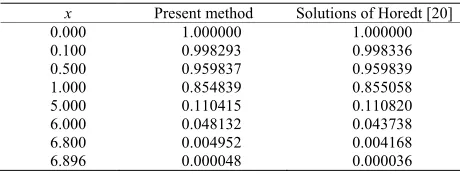
Tables 2 and 3 show the approximations of Ny x
fo the ratio
[image:5.595.310.538.119.178.2]r standard Lane-Emden with m= 2.5,3 obtained by nal scaled generalized Laguerre collocation me-thod for = 1 and tho ained b
Table 4 shows the coefficients of rationase obt aled
gen-er method
various
equation hich is defined in the semi-infinite
d. B approxi-ate unknown function in Lane-Emd
col-y Horedt [2 l sc
de
interval and has sin-ut to
en equation by 0].
alized Laguerre functions obtained by present for the Lane-Emden equation with m.
5. Summary and Conclusions
A set of rational scaled generalized laguerre orthogonal functions are proposed to solve Lane-Em n
w
gularity at x = 0, by collocation metho m
location method we must equalize Res x
to zero at suitable points in
0,
interval. Since Hermite func-tions are derived in the infinite domain
,
, we can't apply Hermite-Gauss nodes for equalizing Res x
to zero, therefore we transform this nodes from
,
to [image:5.595.308.538.326.413.2]
0,
interval by a mapping
x = ln
ex 1e2x
.Figure 1. Lane-Emden equation graph obtained y present method for various m.
Table 1. Comp arison th e fi rst z ero of y(x), be tween P adé
approximation used by [17] a nd the rational scaled gener-alized Laguerre collocation method for various m and a = 1.
m N k Present method Bender[17] Exact value [20] 1.5 4 0.83200 3.653710928 - 3.65375374
2 4 0.52990 4.352761605 4.3603 4.35287460 2.5 4 0.39101 5.355236655 - 5.35527546 3 6 0.29354 6.896951110 7.0521 6.89684862 4 5 0.10022 1497174961 17.967 14.9715463
Table 2. Approximation of y(x) obtained by present method
and solutions of Horedt [20] for m = 2.5 and a = 1, N = 4.
x Present method Solutions of Horedt [20] 0.000 1.000000 1.000000
b
0.100 0.998749 0.998335 0.500 0.960372 0.959978 1.000 0.851467 0.851944 5.000 0.024267 0.029019 5.355 0.000005 0.000021
Table 3. Approximation of o nd l
tions ]
y(x) obtained by present m
H o a
eth-d a so utions of oreeth-dt [20] f r m 3 and= = 1, N = 6.
x Present method Solu of Horedt [20 0.000 1.000000 1.000000
0.10 0
0 0
1.000 0.854839 0.855058
96
0 0.998293 .998336
0.5 0 0.959837 .959839
5.000 0.110415 0.110820 6.000 0.048132 0.043738 6.800 0.004952 0.004168 6.8 0.000048 0.000036
Tabl efficients ional scaled d Lag-
uerr s of th den equatio s m.
ci
e 4. Co of the rat generalize
e function e Lane-Em n for variou
I
m = 5 m = = 4
m = 1.5 2 m = 2. 3 m
0 0.5552687 0.7618023 0.8553158 0.9108075 0.9786309 1 0.7098163 0.5800179 0.3986864 0.2657800 0.0483911 2 0.5796016 0.2517954 0.2748482 0.2308814 0.0525097 3 1.4222221 0.2455873 0.0468485 0.0164809 0.0455987 4 0.577 54 0.155 5
5
-6 - 069
53 5624 0.067694 0.0448774 0.0152142 0.0032424 968
- - 0.0048
- - - 0.0103
Through the compar ong the exact solutions of Horedt and the appro lutions of B d the
curren , it has be has
provid re exact s ne-Emd ions.
[1] D. Funaro and O. Kavian pproximation of Some Dif-Evol qua Unbounded Domains by
s t .
1 p.
0 57
isons am
ximate so ender an t work en shown that the present work ed mo olutions for La en equat
6. References
, “A fusion ution E tions in
Hermite Functions,” Mathematic of Compu ation, Vol 57, No. 96, 1991, p 597-619.
doi:10.1 90/S0025- 18-1991-1094949-X
[2] O. Coul
tral Approximation of Elliptic
a ar
-o
-m s,” Comp er Metho in Appli Mec
ud, D. Fun o and O. K Pr
avian, “Laguerre Spec blems in Exterior Do
[image:5.595.61.285.513.693.2]Engineering, Vol. 80, No. 1-3, 1990, pp. 451-458.
doi:10.1016/0045-7825(90)90050-V
[3] D. Funaro, “Computational Aspects of Pseudospectral La- guerre Approximations,” Applied Numerical Mathematics, Vol. 6, No. 6, 1990, pp. 447-457.
doi:10.1016/0168-9274(90)90003-X
[4] B. Y. Guo, “Err for Nonlinear P
or Estimation of Hermite Spectral Method artial Differential Equations,” Mathemat-ics of Computation, Vol. 68, No. 227, 1999, pp. 1067-1078.doi:10.1090/S0025-5718-99-01059-5
[5] B. Y. Guo and J. Shen, “Laguerre-Galerkin Method for Nonlinear Partial Differential Equations on a Semi-Infi-nite Interval,” Numerische Mathematik, Vo
2000, pp. 635-654.doi:10.1007/PL00005413l. 86, No. 4,
ral Methods in Un-[6] Y. Maday, B. Pernaud-Thomas and H. Vandeven, “Re-appraisal of Laguerre Type Spectral Methods,” La Re-cherche Aerospatiale, Vol. 6, 1985, pp. 13-35.
[7] J. Shen, “Stable and Efficient Spect
bounded Domains Using Laguerre Functions,” SIAM Jou- rnal on Numerical Analysis, Vol. 38, No. 4, 2000, pp. 1113-1133.doi:10.1137/S0036142999362936
[8] H. I. Siyyam, “Laguerre Tau Methods for Solving Higher Order Ordinary Differential Equations,” Journal of Com- putational Analysis and Applications, Vol. 3, No. 2, 2001, pp. 173-182.doi:10.1023/A:1010141309991
[9] B. Y. Guo, “Gegenbauer Approximation and Its Applica-tions to Differential EquaApplica-tions on the Whole Line,” Jour- nal of Mathematical Analysis and Applications,Vol. 226, No. 1, 1998, pp. 180-206.
doi:10.1006/jmaa.1998.6025
[10] B. Y. Guo, “Jacobi Spectral Approximation and Its Ap-plications to Differential Equations on the Half Line,”
Journal of Computational Mathematics, Vol. 18, 2000, pp. 95-112.
[11] B. Y. Guo, “Jacobi Approximations in Certain Hilbert Spaces and Their Applications to Singular Differential Equations,” Journal of Mathematical Analysis and Appli-cations,Vol. 243, No. 2, 2000, pp. 373-408.
doi:10.1006/jmaa.1999.6677
[12] C. I. Christov, “A Complete Orthogonal System of Func-tions in L2 (−∞, ∞) Space,” SIAM Journal on Numerical Analysis,Vol. 42, No. 6, 1982, pp. 1337-1344.
158-6
[13] J. P. Boyd, “Spectral Methods Using Rational Basis Func-tions on an Infinite Interval,” Journal of Computational Physics, Vol. 69, No. 1, 1987, pp. 112-142.
doi:10.1016/0021-9991(87)90
[14] J. P. Boyd, “Orthogonal Rational Functions on a Semi- I nfinite Interval,” Journal of Computational Physics, Vol. 70, No. 1, 1987, pp. 63-88.
doi:10.1016/0021-9991(87)90002-7
[15] B. Y. Guo, J. Shen and Z. Q. Wang, “A Rational Ap-proximation and Its Applications to Differential Equa-tions on the Half Line,” Journal of Scientific Computing,
Vol. 15, No. 2, 2000, pp. 117-147.
doi:10.1023/A:1007698525506
[16] J. P. Boyd, “Chebyshev and Fourier Spectral Methods,” 2nd Edition, Dover, New York, 2000.
[17] C. M. Bender, K. A. Milton, S. S. Pinsky, Jr. a Simmons, “A New Perturbative Ap
nd L. M. proach to Nonlinear Problems,” Journal of Mathematical Physics,Vol. 30, No. 7, 1989, pp. 1447-1455. doi:10.1063/1.528326
[18] D. C. Biles, M. P. Robinson and J. S. Spraker, “A Gener-alization of the Lane-Emden Equation,” Journal of Mathe- matical Analysis and Applications, Vol. 273, No. 2, 2002, pp. 654-666. doi:10.1016/S0022-247X(02)00296-2
[19] G. Bluman, A. F. Cheviakov and M. Senthilvelan, “Solu-tion and Asymptotic/Blow-up Beh
Nonlinear Dissipative Systems,”Journal of Mathematical aviour of a Class of Analysis and Applications, Vol. 339, No. 2, 2008, pp. 1199-1209.doi:10.1016/j.jmaa.2007.06.076
n Method [20] G. P. Horedt, “Polytropes Applications in Astrophysics and Related Fields,” Klawer Academic Publishers, Dor-drecht, 2004.
[21] K. Parand and A. Pirkhedri, “Sinc-Collocatio
for Solving Astrophysics Equations,” New Astronomy, Vol. 15, No. 6, 2010, pp. 533-537.
doi:10.1016/j.newast.2010.01.001
[22] S. S. Bayin, “Mathematical Methods in Science and En-gineering,” John Wiley & Sons, New York, 2006. doi:10.1002/0470047429
[23] G. Szegao, “Orthogonal Polynomils,” AMS, New York, 1939.
[24] D. Funaro, “Polynomial Approximation of Differential Equations,” Springer-Verlag, Berlin, 1992.
[25] V. Iranzo and A. Falques, “Some Spectral Approximations for Differential Equations in Un-Bounded Domains,” Com- puter Methods in Applied Mechanics and Engineering,Vol. 98, No. 1, 1992, pp. 105-126.
doi:10.1016/0045-7825(92)90171-F
of the hod with Laguerre Series and
hysics, Vol. 188, No. 1, 2003, pp. 56-74. [26] J. P. Boyd, C. Rangan and P. H. Bucksbaum,
“Pseu-dospectral Methods on a Semi-Infinite Interval with Ap-plication to the Hydrogen Atom: A Comparison Mapped Fourier-Sine Met
Rational Chebyshev Expansions,” Journal of Computa-tional P
doi:10.1016/S0021-9991(03)00127-X
[27] J. Shen and L. Wang, “Some Recent Advances on
Spec-r NumeSpec-rical Methods and Beijing, 2005. tral Methods for Unbounded Domains,” Communications in Computational Physics, Vol. 5, No. 2, 2009, pp. 195- 241.
[28] J. Shen, T. Tang, “High Orde Algorithms,” Chinese Science Press,