ISSN Online: 2152-7199 ISSN Print: 2152-7180
DOI: 10.4236/psych.2019.107064 Jun. 21, 2019 977 Psychology
Teachers Learning about Teaching Practice in a
Modify Lesson Study
Nisakorn Boonsena
1, Maitree Inprasitha
2, Narumon Changsri
2, Gabriel Matney
31Doctoral Program in Mathematics Education, Faculty of Education, Khon Kaen University, Khon Kaen, Thailand 2Center for Research in Mathematics Education, Khon Kaen University, Khon Kaen, Thailand
3Bowling Green State University, Bowling Green, OH, USA
Abstract
Developing innovations in teaching and learning mathematics by focusing on the process of developing and sharing good practices was more important than importing good practice from other places (Inprasitha, Isoda, Wang-Iverson, & Yeap, 2015b). Similarly, the Lesson Study project in Khon Kaen University and the (CO)2MP Elementary project in the United States seek to engage
practicing teachers in developing their instruction of mathematics through Lesson Study incorporating Open Approach (Inprasitha, 2010) rather than giving them prescribed sets of curriculum to teach. The study examines the teaching practices and learning of teachers in Thailand and the United States as they participated in a modify Lesson Study within their respective schools. Participants included teachers in the Lesson Study Project conducted by Center for Research in Mathematics Education, Khon Kaen University, Thailand and teachers in the Lesson Study Project conducted through the (CO)2MP Elementary grant, Bowling Green State University, the United
States. Method: a qualitative research design was used in this study. Data were collected by observations, interviews developed by Changsri (2012). Analysis: interviews were recorded and transcribed. The text from the observation notes and the interviews were considered together and coded for components of teaching practice and teachers learning about teaching practice. These codes were divided into evidence about teaching practice, lesson study sys-tems, or evidence about teachers learning about the effect of lesson study based on Changsri (2012), Inprasitha (2010), and Matney (2014). The results reveal that 1) the components of teaching practice in a modify Lesson Study in Khon Kaen, Thailand and Ohio, United States were found to be similar and consisted of a lesson study team, teaching practices, and support, despite large differences in context and set up. The preparation and adaptation of each component in each context are very important, 2) teachers in Thailand
How to cite this paper: Boonsena, N., Inprasitha, M., Changsri, N., & Matney, G. (2019). Teachers Learning about Teaching Practice in a Modify Lesson Study. Psy-chology, 10, 977-988.
https://doi.org/10.4236/psych.2019.107064
Received: May 10, 2019 Accepted: June 18, 2019 Published: June 21, 2019
Copyright © 2019 by author(s) and Scientific Research Publishing Inc. This work is licensed under the Creative Commons Attribution International License (CC BY 4.0).
DOI: 10.4236/psych.2019.107064 978 Psychology
and the United States who participated in a modify Lesson Study had many changes in their learning.
Keywords
Lesson Study, Teachers Learning, Teaching Practice, Qualitative Research, Observation, Interview
1. Introduction
The purpose of professional development is not only to help teachers gain knowledge and understanding for teaching but also support them in acquiring proficiency in applying all knowledge and understanding in their classrooms
(Takahashi, 2015). It is clear that most valued teaching and learning take place implicitly in the classroom (Bishop, 2015). Unfortunately, in most countries around the globe, school teachers have been ignored to do practices undesirable or without any useful instead of encouraging them to participate in a community of practice that useful for them and their students (Inprasitha, 2015c). Most teacher professional development programs are short term, lack innovation, outside of school training, and had disconnections between theory and class-room practice (Inprasitha, 2006, 2017a; Takahashi, 2015). Traditional classroom teaching practice might be improved by professional development consisting of short course training focused on training for improvement of mathematics con-tents (Inprasitha, 2015c). However, Lesson Study as envisioned by the teaching professions in Japan and developed more than 140 years ago, is differenced in their focus and professional development methods. Lesson Study focuses on stu-dent learning in the classroom, live classroom, teaching and observation, teacher learning, and school-based development (Inprasitha, 2017b). Lesson Study was accepted as a main method of professional development for Japanese teachers
DOI: 10.4236/psych.2019.107064 979 Psychology
2. A Modify Lesson Study
Stigler and Hiebert (1999) explained that in lesson study, group of teachers meet regularly over long periods of time (ranging from several months to a year). Steps in the Japanese lesson study process are as follows: 1) Defining the prob-lem, 2) Planning the lesson, 3) Teaching the lesson, 4) Evaluating the Lesson and Reflecting on its effect, 5) Revising the lesson, 6) Teaching the revised lesson, 7) Evaluating the and Reflecting again, and 8) Sharing the results. Furthermore, there are several educators and researchers across the globe that study and de-scribe Lesson Study. For instance; Baba (2007) described Lesson Study as the process in which teachers work together to improve their own teaching practic-es. Lesson Study includes preparation, teaching in a class with students, and re-view/reflection of the teaching event. Isoda (2015) explained the Lesson Study Cycle as having three parts: Plan (preparation of the lesson), Do (teaching and observation: Open Class), and See (Post open class discussion and reflection with perspectives from others). Moreover, Lewis (2002, 2016) described the Les-son Study Cycle in four steps: 1) study curriculum and teaching materials, con-sider long-term goals for students; 2) plan a research lesson/unit and anticipate student thinking; 3) teach the research lesson and collect data; and 4) reflect on lesson data and implications for teaching-learning. Fujii (2016) explained that the Lesson Study cycle had five steps: 1) Goal setting: consider long-term goals for student learning and development; 2) Identify the research theme: Lesson planning; collaboratively plan a “research lesson” designed to address the goals. Prepare a lesson plan that describes the research theme, content goals, antic-ipated student thinking, data collection; 3) Research lesson: one team member teaches the research lesson while the other members of the planning team, staff members from across the school, and, usually, an outside knowledgeable other observe and collect data; 4) Post-lesson discussion: in a formal lesson collo-quium, observers share data from the lesson to illuminate student learning, dis-ciplinary content, lesson and unit design, and broader issues in teaching and learning; 5) Reflection: document the cycle to consolidate and carry forward learnings, as well as new questions for the next cycle of Lesson Study.
DOI: 10.4236/psych.2019.107064 980 Psychology
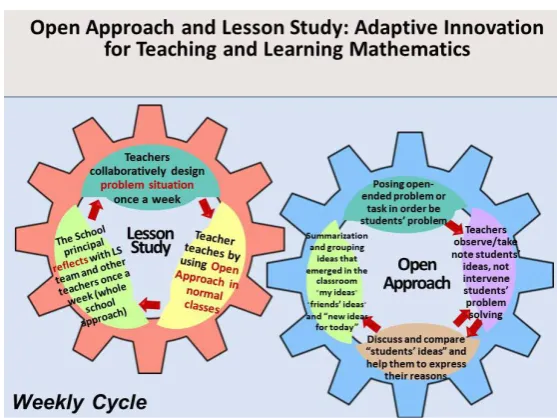
Open Approach. An Open Approach was a teaching approach that had four steps according to Inprasitha (2003, 2006, 2010, 2015b, 2017c, 2018): 1) Posing an open-ended problem such as a tasks or problem situation that was within the students’ real world context; 2) A time of students’ self-learning through solving the problem for themselves while the teacher observed and took notes about stu-dents’ ideas or ways of thinking; 3) Teacher orchestrated students to do whole-class discussion and comparing students’ representations, reasoning, and connections; and 4) Teacher facilitated summarizing student’s ideas that emerged during in-struction focusing on mathematical ideas such as generalization and extension. The teacher encouraged the students to take notes as “my ideas”, “friends” ideas”, and “new ideas for today” (Figure 1).
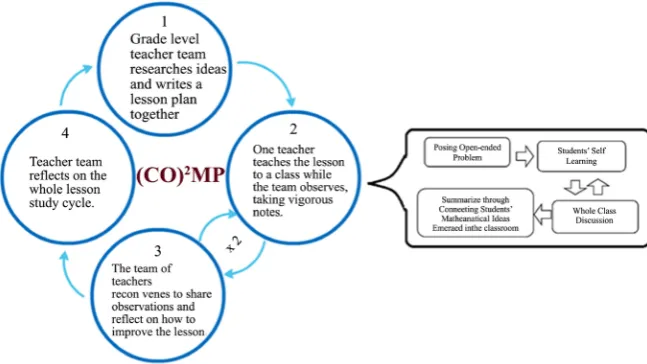
In addition, Matney (2014) and Matney & Lane (2016) implemented Open Approach Lesson Study in Ohio, the United States included four steps: 1) Grade level teacher team researches ideas and writes a lesson plan together, 2) One teacher teaches the lesson to a class while the team observes, taking vigorous notes, 3) The team of teachers reconvenes to share observations and reflect on how to improve the lesson, and 4) Teacher team reflects on the whole lesson study cycle (Figure 2).
[image:4.595.232.511.485.694.2]Beginning to do lesson study in a school was not an easy task. One of the ma-jor issues that accounts for a Lesson Study program to be sustainable for intro-ducing new ideas or new innovations was proper preparation (Inprasitha, 2015a). Furthermore, as Takahashi (2015) mentioned teachers need to learn new ideas and knowledge to improve teaching and learning. At the same time teach-ers also need to have opportunities to try those ideas and use new knowledge in their classrooms and reflect upon how the ideas and knowledge contribute to the quality of students learning experience. Lesson study provides teachers with op-portunities to try new ideas in their own classroom. In additional, teacher learning
DOI: 10.4236/psych.2019.107064 981 Psychology Figure 2. Lesson study process (Matney, 2014; Matney & Lane, 2016).
as the member of the professional learning community different from learning through the short course training because the new learning is from teachers’ awareness about their improvements of classroom teaching practices from the empirical evidences of their students’ thinking and learning in the classroom
(Inprasitha, 2017b). Therefore, teacher learning in the two modify lesson study contexts are of interest.
3. Context of Study
There is an APEC-Lesson Study project that proposed by Office of the Higher Education Commission, Ministry of Education, Thailand and Ministry of Edu-cation, Culture, Sports, Science and Technology, Japan and organized by Khon Kaen University, Thailand and University of Tsukuba, Japan sine 2006 until present. The project aims to develop innovations in teaching and learning mathe-matics by focusing on the process of developing and sharing good practices instead of importing good practice from other places (Inprasitha, Isoda, Wang-Iverson, & Yeap, 2015b). Similarly, the (CO)2MP Elementary project in the United States
seeks to engage practicing teachers in developing their instruction of mathemat-ics through Open Approach Lesson Study rather than giving them prescribed sets of curriculum to teach. Teachers in the project are prompted to make-sense of their beliefs, their students’ learning and their curriculums by engaging in a professional learning community meant to improve and share ideas with the larger teaching community. The similar nature of these projects, in the context of two difference countries makes exploration of the teaching and practice and teacher beliefs a unit of interest for research.
4. Methodology
DOI: 10.4236/psych.2019.107064 982 Psychology
Participants are the teachers in the Lesson Study Project conducted by Center for Research in Mathematics Education, Khon Kaen University, Thailand and teachers in the Lesson Study Project conducted through the (CO)2MP
Elemen-tary grant, Bowling Green State University, the United States.
Participants Thailand The United States
Context of the school This school is a suburban school and participated in Lesson Study project since 2007
These 4 schools are urban school which students are low median income and high poverty Grade level of a lesson
study team a first grade lesson study team a first grade lesson study team
A lesson study team’ s members
1) a school principal who takes a leadership of implementing Lesson Study in this school. He is a leader of the reflection
1) 6 first grade teachers from 4 schools who have 10 - 27 years teaching experiences and participated in the project for 4 years
2) a first grade teacher who has 20 years teaching experience and participated in the project for 4 years
2) an experienced educator who has more than 30 years teaching experience and participated in the project for 4 years. 3) a seventh grade teacher who take a
role as an observer for first grade classroom and participated in the project for 4 years
4) a school coordinator who is a doctoral student of Mathematics Education program, Faculty of Education, Khon Kaen University. She participated in this lesson study team for 3 years
5) a student teacher who taught mathematics for first grade and participated in this lesson study team for a whole year.
Method: the qualitative research design was used in this study. Data were col-lected by observations and, interviews protocols developed by Changsri (2012).
Observations: Occurred during the steps of Lesson Study including planning, teaching, and reflecting. The focusing points were who participated in each step, what they did, and what evidences that happened. The observation in Thailand was in 2010-2012 and in the United States was in 2016-2017.
Interviews: The interviewees were the teachers in first grade lesson study teams. The questions were asked in various issues. For example what kind of classroom teaching practices in traditional teaching approach and in the context of Lesson Study, and what changes occur among the teachers and students after implementing lesson study in schools (Teachers and students’ mathematics be-havior and knowledge, process/skills, and attitude).
compo-DOI: 10.4236/psych.2019.107064 983 Psychology
nents of teaching practice and teachers’ learning about teaching practice. These codes were divided into evidence about teaching practice, lesson study systems or evidence about teachers’ learning effect of lesson study based on Changsri (2012),
Inprasitha (2003, 2006, 2010, 2015a), Matney (2014) and Matney & Lane (2016).
5. Results
5.1. Lesson Study Process
In Thailand, the team conducts Lesson Study by using a weekly cycle according with Inprasitha’s idea (Changsri, 2012). The Lesson Study team consists of one first grade teacher (teacher/observer), and two first grade and second grade stu-dent teachers (teacher/observer). They work together every day. For other ob-servers who are teachers in the school and school principal, they participate in lesson study team at least one day per week. Moreover, a graduate student from Khon Kaen University who works as a school coordinator, works with the lesson study team two to four days per week. Supervisors from Khon Kaen University work with a lesson study team one to two times per semester. The Lesson Study process follows a weekly cycle as follows (Changsri, 2012):
1) Collaboratively design are search lesson (Plan), lesson study team in each grade level plan the classroom lessons for whole week together on every Tuesday in the last period. They work to understand the textbook which had been trans-lated from Japanese textbook into Thai. Using this textbook the teachers try to create a problem situation.
2) Collaboratively observing research lesson (Do), lesson study team teaches and observes the first grade mathematics classroom four times per week.
3) Collaboratively doing post-discussion or reflection on teaching practice (See), the school principal is the leader of the meeting. All lesson study teams re-flect together from first grade team to the eighth grade team. The rere-flection by each team begins with student teachers, first grade teacher, observers, school coordinator, and school principal. This meeting is on every Thursday in the last period.
Moreover, there are one to two professional development workshops for teachers in each semester. Teachers also have opportunities to participate in the Open Class and APEC-ICER international conference.
In the United States, the Lesson Study team enacts the study over 2-days, 1 cycle per semester according to Matney (2014)and Matney & Lane (2016). Les-son Study team consists of six first grade teachers from four schools, and one experienced educator. They work together for 2-days, 1 cycle per semester. For Supervisors from Bowling Green State University, they work with lesson study team one time per semester.
Lesson Study process follows a cycle per semester as following:
DOI: 10.4236/psych.2019.107064 984 Psychology
2) One teacher teaches the lesson to a class while the team observes, taking vigorous notes about students’ thinking. Before teaching, lesson study team has a review meeting. They talk about the lesson plan and make any last adap-tion to it based on feedback from a knowledgeable other. Then the first class-room begins.
3) The team of teachers reconvenes to share observations and reflect on how to improve the lesson. After teaching and observation in the first classroom, the lesson study team reflects on the lesson plan and students’ ideas and then revises the lesson plan. Then the second or third classroom begins.
4) Teacher team reflects on the whole lesson study cycle. After two or three classes finish. Lesson study team reflects for the whole process.
In addition, there is one professional development workshop for teachers in every summer. Teachers also have opportunities to participate in many confe-rences to share their teaching practices through lesson study.
5.2. Components of Lesson Study
Components Thailand (Changsri, 2012) The United States
Lesson study team
• at least 2 persons; teacher and observer
• in-service teacher or student teacher
• could be include school principal, school coordinator, researcher, and expert from the university
• at least 3 persons; teacher, observer, and experienced educator
• could be include expert from the university
• no student teacher, school principal, school coordinator, and researcher
Teaching practices
• Weekly, 16 cycles per semester
• plans taught & revised each day of the week
• lesson not retaught until next year
• 2-days, 1 cycle per semester
• plans revised several times on LS day
• lessons are revised and retaught on same day
Support • School & CRME supports materials and financial costs • (CO)materials and financial costs2MP Elementary grant supports
University support
• assign school coordinator and researcher
• observing and supervision from expert from university; assign student teachers
• support school to attend the educational activities
• assign experience educator
• give suggestion from expert from university
• support teacher team to attend the educational activities
5.3. Teachers Learning about Teaching Practice
After the first four years of doing a modify lesson study in Khon Kaen, Thailand and in Ohio, United States, teachers learning about teaching practice are as some examples from the open-ended questions as following:
Thai teachers learning
Mathematics Teaching:
Teacher: “Before attend the project, I like to have the quiet class. Students should listen to me. However, after join the lesson study project, I usually listen to students; give them an opportunity to explain their ideas”.
DOI: 10.4236/psych.2019.107064 985 Psychology
Mathematics Learning:
Teacher: “Before this, my students are always quiet and only listen to me. But now, they can participate in the classroom. They discuss with the reasons and work as a team”.
Teacher: “Students change to proud of their works, respect to their friends’ ideas. They are happy for learning mathematics. They want to learn mathemat-ics”.
Social Context:
Teacher: “At the first year, I do not want to allow anybody to observe my class. I am very nervous. Now, I can talk with other teachers about my teaching. I can teach and have some teachers observed my class”.
Teacher: “I take a lot of time to plan the lesson and prepare materials”. US teachers learning
Mathematics Teaching:
Teacher: “We realized that we need to let the students struggle to figure things out. We need to dig deeper rather than do more problems. We became better math teachers by practicing and watching our peers, and making changes to the lesson”.
Teacher: “Open to more ways to solve problems”.
Mathematics Learning:
Teacher: “The students enjoyed solving math problems. They are able to ex-plain their thinking and ask questions of other students when they do not agree. Their mathematical thinking improved”.
Teacher: “More interesting in learning, Could see them working ‘harder’ to master material, Loved their math ‘voice’”.
Social Context:
Teacher: “I really like we got to work together. I really like able to observe other teacher teach the lesson and then meet, talk about the changes, and then go back and have someone teach”.
Teacher: “I think back to the first year, it was really new. We were nervous. Now, I feel confidence about teaching math. I think probably a lot things that make me feel confidence were going to the session with supervisors to learn more about why I was doing. Because I had just learn as a kid, I never really, I was one of those people who always get the right answers, how teacher might told me how to do it but I maybe do not know why. So, I think even coming better understanding about math by myself will help me”.
6. Concluding Remarks
The components of teaching practice in a modified Lesson Study in Thailand and the United States were found to be similar and consisted of a lesson study team, teaching practices, and support, despite large differences in context and set up. The preparation and adaptation of each component in each context are very important.
les-DOI: 10.4236/psych.2019.107064 986 Psychology
son study team is at least 2 persons: teacher and observer. These are a basic rule for doing lesson study (Changsri, 2012). Teachers do Lesson Study in their own school. It is very convenient for teachers to work together. Moreover, Khon Kaen University can send student teacher to the school. There are student teachers participating in the lesson study team to work with in-service teachers. In addi-tion, in the first few years of beginning lesson study in school, Khon Kaen Univer-sity sends a graduate student to do lesson study with lesson study team as school coordinator. It is beneficial for both graduate students and lesson study teams, because they can learn various perspectives of doing lesson study from each oth-er. Lesson Study team, in the United States, teachers do lesson study among four schools for first grade lesson study team. There are six first grade teachers, and one experienced educator. They work together for 2-days, 1 cycle per semester. They re-teach in the same day. It provides the opportunity for teachers to learn from how to improve their instruction and planning for teaching.
Teaching practice, both teachers in Thailand and the United States focus on problem solving approaches to learning mathematics. Teachers in Thailand fol-low the steps of Open Approach, however, there are some parts that the lesson study team needs to understand and improve their teaching. For instance how to prepare the problem situation that is real world for students, how to connect students’ thinking/ideas to mathematical way (Inprasitha, 2017c). On the other hand, teachers in the United States try to understand Open Approach. Now, they teach by focusing on problem solving. They would like to learn more about how to use Open Approach as a teaching approach.
Supporting is very important. Lesson Study is practicable because of the col-laboration between school and university. The kind of supporting can be differ-ence depend on context. However, the idea of working together is the main part. Lesson Study creates the community of practice for everyone(Changsri, 2012).
Teachers in Thailand and the United States who participated in the modified Lesson Study had many changes in their learning. The similarities include teachers spending more time to allow student understanding of the problem sit-uation, the majority of time in the lesson was giving for student’s problem solv-ing, teachers found that students were confident and happy in learnsolv-ing, teachers felt confident and beneficial when they have the observers observe their class-room.
Acknowledgements
This research was supported by Research and Technology Transfer Affairs, Khon Kaen University. Funding for this research was provided in part by the Ohio Department of Education (Grant # 016437). Any opinions, findings, con-clusions, or recommendations expressed by the authors do not necessarily reflect the views of the Ohio Department of Education.
Conflicts of Interest
DOI: 10.4236/psych.2019.107064 987 Psychology
References
Baba, T. (2007). How Is Lesson Study Implemented? Japanese Lesson Study in Mathe-matics Its Impact, Diversity and Potential for Educational Improvement. Singapore: World Scientific Publishing.https://doi.org/10.1142/9789812707475_0001
Bishop, A. (2015). Mathematics Education for the Knowledge-Based Society. In M. In-prasitha, M. Isoda, P. Wang-Iverson, & B. H. Yeap (Eds.), Lesson Study: Challenges in Mathematics Education (pp. 3-10). Singapore: World Scientific.
Changsri, N. (2012). Teacher’s Perceived Beliefs about Teaching Practice in Teacher Pro-fessional Development Based on Lesson Study and Open Approach Context. Doctoral Dissertation, Khon Kaen: Khon Kaen University. (In Thai)
Fujii, T. (2016). Designing and Adapting Tasks in Lesson Planning: A Critical Process of Lesson Study. ZDM Mathematics Education, 48, 411-423.
https://doi.org/10.1007/s11858-016-0770-3
Inprasitha, M. (2003). Reforming of the Learning Process in School Mathematics: Em-phasizing on Mathematical Processes. Khon Kaen: Khon Kaen Karnpim. (In Thai) Inprasitha, M. (2006). Open-Ended Approach and Teacher Education. Tsukuba Journal
of Educational Study in Mathematics, 25, 169-177.
Inprasitha, M. (2010). One Feature of Adaptive Lesson Study in Thailand—Designing Learning Unit. In Proceedings of the 45th Korean National Meeting of Mathematics Education (pp. 193-206). Seoul: Korean Society of Mathematics Education.
Inprasitha, M. (2015a). Preparing Ground for the Introduction of Lesson Study in Thail-and. In M. Inprasitha, M. Isoda, P. Wang-Iverson, & B. H. Yeap (Eds.), Lesson Study: Challenges in Mathematics Education (pp. 109-117). Singapore: World Scientific. Inprasitha, M. (2015c). Lesson Study Incorporating Open Approach: Two Practices in
Community of Practices to Improve Quality of Classroom. In World Association of Lesson Studies International Conference (pp. 1-81). Khon Kaen: Faculty of Education, Khon Kaen University.
Inprasitha, M. (2017a). Teacher Training System. In National Legislative Assembly (pp. 1-33). Bangkok: The National Legislative Assembly. (In Thai)
Inprasitha, M. (2017b). Booklet of the Workshop for Educational Personnel under the Project of Development of Students’ Mathematics Higher-Order Thinking at North East of Thailand. Khon Kaen: Anna Offset. (In Thai)
Inprasitha, M. (2017c). Open Approach Lesson Study: An Innovation for Teaching Ma-thematics to Support STEM. In International STEM Education Conference (pp. 1-50). Chiang Mai: International STEM Education Conference.
Inprasitha, M. (2018). The Current Issues and Challenges in Teacher Education and Pro-fessional Development. In International Conference of the Korean Society of Mathe-matics Education (pp. 1-19). Seoul: International Conference of the Korean Society of Mathematics Education.
Inprasitha, M., Isoda, M., Wang-Iverson, P., & Yeap, B. (2015b). Lesson Study: Chal-lenges in Mathematics Education. Singapore: World Scientific.
https://doi.org/10.1142/9789812835420_others01
Isoda, M. (2015). The Science of Lesson Study in the Problem Solving Approach. In M. Inprasitha, M. Isoda, P. Wang-Iverson, & B. H. Yeap (Eds.), Lesson Study: Challenges in Mathematics Education (pp. 81-108). Singapore: World Scientific.
https://doi.org/10.1142/9789812835420_0006
DOI: 10.4236/psych.2019.107064 988 Psychology Lewis, C. (2016). How Does Lesson Study Improve Mathematics Instruction? ZDM
Ma-thematics Education, 48, 571-580.https://doi.org/10.1007/s11858-016-0792-x
Matney, G. (2014). Lesson Study Model. In Workshop for Teachers in the (CO)2 MP Elementary Grant (pp.1-4). Ohio: Bowling Green State University.
Matney, G., & Lane, S. (2016). Lesson Study by Open Approach in the USA: A Compari-son of Students’ Mathematical Knowledge. In World Association of Lesson Study Conference (pp. 15-16). Exeter: The World Association of Lesson Studies (WALS). Shimizu, S. (2006). Professional Development through Lesson Study: A Japanese Case. In
APEC International Symposium on Innovation and Good Practices for Teaching and Learning Mathematics through Lesson Study. Khon Kaen: Center for Research in Ma-thematics Education.
Shimizu, S., & Chino, K. (2015). History of Lesson Study to Develop Good Practices in Japan. In M. Inprasitha, M. Isoda, P. Wang-Iverson, & B. H. Yeap (Eds.), Lesson Study: Challenges in Mathematics Education (pp. 123-140). Singapore: World Scientific.
https://doi.org/10.1142/9789812835420_0008
Stigler, J. W., & Hiebert, J. (1999). The Teaching Gap: Best Ideas from the World’s Teachers for Improving Education in the Classroom. New York: Free Press.
Takahashi, A. (2015). Lesson Study: An Essential Process for Improving Mathematics Teaching and Learning. In M. Inprasitha, M. Isoda, P. Wang-Iverson, & B. H. Yeap (Eds.), Lesson Study: Challenges in Mathematics Education (pp. 51-58). Singapore: World Scientific.
Takahashi, A., & McDougal, T. (2016). Collaborative Lesson Research: Maximizing the Impact of Lesson Study. ZDM Mathematics Education, 48, 513-526.