ACCREDITATION OF BUSINESS SCHOOLS:
AN EXPLANATORY MULTIPLE-CASE STUDY OF THEIR
MOTIVATIONS
A thesis
submitted in fulfilment
of the requirements for
the Degree of
Master of Commerce in Management
in the
University of Canterbury
by
Toni A Hodge
University of Canterbury
Table of Contents
Table of Contents ... 2
Acknowledgments ... 4
Abstract ... 6
Glossary... 7
1. Introduction ... 9
1.1 Research Goals ... 9
1.2 Study Justification ... 9
1.3 Accreditation and the Author ... 10
1.4 Thesis Overview ... 11
2. Literature Review ... 12
2.1 Introduction to Literature Review ... 12
2.2 Accreditation in Context ... 12
2.3 Theoretical Overview ... 18
2.4 Institutional Theory and Institutionalisation ... 20
2.5 Institutional Isomorphism ... 21
2.6 Bandwagons ... 25
2.7 Information Asymmetry ... 27
2.8 A Proposed Accreditation Model ... 29
2.9 Conclusion ... 30
3. Research Method ... 32
3.1 Introduction ... 32
3.2 Research Method ... 32
3.2.1 Number and Selection of Participants ... 33
3.2.2 Nature of Participants ... 34
3.3 Conducting of Interviews ... 39
3.3.1 Interview Process and Timeline ... 39
3.4 Analysis of Interviews ... 40
3.5 Ethical Considerations ... 41
3.6 Limitations of this Study ... 42
3.7 Conclusion ... 42
4. Findings ... 44
4.1 New Zealand Business Schools – Early Adopters ... 44
4.1.1 Motivation ... 44
4.1.2 The Education Environment ... 45
4.1.3 The Market ... 47
4.1.4 Internal Functioning... 48
4.2 New Zealand Business Schools – Late Adopters ... 49
4.2.2 The Education Environment ... 51
4.2.3 The Market ... 53
4.2.4 Internal Functioning... 54
4.3 European Business Schools ... 55
4.3.1 Motivation ... 55
4.3.2 The Education Environment ... 56
4.3.3 The Market ... 58
4.3.4 Internal Functioning... 60
4.4 USA Business Schools ... 61
4.4.1 Motivation ... 62
4.4.2 The Education Environment ... 64
4.4.3 The Market ... 66
4.4.4 Internal Functioning... 67
5. Discussion ... 70
5.1 Similarities and Differences ... 70
5.1.1 Motivation ... 70
5.1.2 Education Environment ... 73
5.1.3 The Market ... 76
5.1.4 Internal Functioning... 78
5.2 Fit with Accreditation Model ... 79
5.2.1 European Schools ... 80
5.2.2 US Schools ... 82
5.2.3 New Zealand Schools ... 83
5.2.4 A Footnote – Loss Aversion ... 85
6. Conclusion ... 86
6.1 Directions for Future Research ... 87
Appendices ... 89
Appendix A: Information Sheet ... 89
Appendix B: Consent Form ... 90
Appendix C: Interview Sheet ... 91
Appendix D: Interview Schedule ... 93
Appendix E: Summary of Responses from New Zealand Schools ... 96
Appendix F: Summary of Responses from United States Schools ... 103
Appendix G: Summary of Responses from European Schools ... 109
Appendix H: Summary of All Responses ... 116
Acknowledgments
This has been a significant project, involving an extended period away to conduct interviews across Europe, the United States of America (US) and New Zealand. As such it would not have been possible without the support and encouragement of various key players, who I’d like to acknowledge.
Firstly, the College of Business and Economics at the University of Canterbury and, in particular, Pro-Vice-Chancellor Professor Nigel Healey. His encouragement and support of the completion of this thesis and of my application for the Peter Karmel International Travel Grant was typical of one who recognises the value of developing professional staff despite the minor inconvenience caused by the resulting absences.
The Association for Tertiary Education Management (ATEM), have been outstanding in their support of professional staff in higher education and I was honoured to be their 2008
recipient of the Peter Karmel International Travel Grant. ATEM awards the grant “in
recognition of achievement in educational administration and outstanding contribution to ATEM. It carries with it a value of AUD10,000 and is designed to facilitate comparative or
cross-cultural studies of professional administrative activity. Without the grant this thesis
would simply have been a multiple case study of New Zealand business schools and would have lacked the depth and interest that has resulted by being able to compare the perspectives of deans across Europe and the US. ATEM makes these opportunities available to all members for the benefit of the profession and one of the best ways that all members can show their support of ATEM’s efforts in this regard is to apply for the grants and awards on offer.
I appreciated the willingness of the deans and associated staff from across New Zealand, Europe and the US to be interviewed for this project. They gave freely of their time and thoughts and without their enthusiasm and interest this thesis would not have been possible. I can only hope I have done justice to their comments and musings.
something every day. I didn’t quite achieve that goal, but I did at least think about the project every day, and some days more than others. Michael challenged me right to the end and provided a fresh perspective at a time when I couldn’t see the wood for the trees.
Finally, but by no means least, to my fiancé Pete who kept the home fires burning and Coco the cat fed, and happy, for the days I was away conducting interviews, analyzing data and writing. Without his support, tolerance and good humour this would not have been possible.
Abstract
The commitment required of a university or business school to gain international accreditation is significant, both in dollar terms and staff time.
This thesis seeks to explain the motivations for business schools to seek accreditation with three major accrediting bodies, AACSB International, EFMD and AMBA, using a multiple case study methodology underpinned by the frameworks of institutional isomorphism, bandwagon pressures and information asymmetry.
Interviews were carried out with 17 business school deans; five deans of accredited schools in Europe, five deans of accredited schools in the United States of America and seven business school deans in New Zealand. All the New Zealand schools were either accredited, formally in the process of seeking accreditation or about to enter the application stage.
The results provide supporting evidence for the notion that business schools are seeking accreditation in order to achieve legitimacy benefits rather than performance benefits, and that intangible benefits are seen as having more importance than the costs involved with achieving accreditation. It was also found that where the focus is at an international level, accreditation is found to be underpinned by information asymmetries whereby schools are seeking to gain legitimacy by providing signals to the market regarding their quality. At a regional or national level information regarding quality is more well known and, instead, isomorphic and bandwagon pressures become evident as the pathway towards legitimacy.
Glossary
AACSB. (AACSB International) Association to Advance Collegiate Schools of Business. American-based association of educational institutions, businesses and other organizations devoted to the advancement of higher education in management education. Its primary activity is the accreditation of business schools and accounting programmes worldwide.
AMBA. Association for MBAs (Masters of Business Administration).
Committee on University Academic Programmes (CUAP). Established by the New Zealand Vice-Chancellors’ Committee to approve major new programmes and qualifications of universities in New Zealand via a peer review process.
AQ/PQ. An AACSB term referring to the status of being academically qualified (AQ) or professionally qualified (PQ). AACSB standards expect schools to maintain a certain percentage of their faculty resources as AQ or PQ. This status is determined via a combination of the individual’s initial qualification and subsequent professional or academic activity that maintains their currency in the discipline in which they are teaching.
Dean. Operational head of the school and the person primarily involved in the study. In different countries and different institutions the dean may have a different title, for instance Pro Vice Chancellor or Director.
EFMD. European Foundation for Management Development. European-based body devoted to the continuous improvement of management development. Membership includes business schools from around the world as well as companies, public sector organisations and consultancies.
EFTS. Equivalent Full Time Student. A unit of measure used in the New Zealand tertiary education sector. 1 EFTS is equivalent to one student being enrolled for a standard full time programme of study over 1 year.
Faculty. Members of staff who are employed to teach in business school programmes and undertake research in their field of expertise. In New Zealand faculty are commonly referred to as “academic staff” or “academics”.
School
Triple Crown. A term used to describe having the three major global business accreditations; AACSB, EQUIS and AMBA. It is currently estimated that only 1% of business schools worldwide hold this distinction. (BEM Bordeaux Management School, 2010)
1. Introduction
1.1 Research Goals
This thesis seeks to explain the motivations for business schools in the tertiary education sector to seek international accreditation. It will do this using the perspectives of organisational and economic theories by conducting an in-depth multiple case study of the eight New Zealand universities, plus five schools of business in Europe and five in the United States. Through this the aim is to provide a comprehensive qualitative analysis of the motivation for seeking international accreditation.
1.2 Study Justification
Business schools within the New Zealand university sector have taken an unprecedented interest in international accreditation over the past 10 years. Seven of New Zealand’s eight universities are either currently accredited or are actively working towards accreditation with two major agencies: The Association for the Advancement of Collegiate Schools of Business (AACSB) International and the European Foundation for Management Development (EFMD), both of whom specialise in quality assuring business degree programmes. In addition, MBA programmes offered by five universities in New Zealand are accredited by the London-based Association for MBAs (AMBA).
authorise their respective tertiary education institutions and impose their own quality assurance and accreditation standards. Given the significant costs involved and the existing national level quality assurance processes in place this study seeks to explain why tertiary business schools worldwide are going to such lengths to obtain additional accreditation. Is accreditation primarily seen as an external signalling strategy, to protect market share, enabling each institution to continue attracting students and quality staff? Or is it actually a quality improvement strategy, an internal holistic approach which provides a basis from which to ensure research outputs are of value and teaching is of good quality?
1.3 Accreditation and the Author
I am the accreditation manager for the College of Business and Economics at the University of Canterbury. The college’s MBA programme is accredited by AMBA and the college itself is in the process of gaining accreditation with AACSB and is also aiming for eventual accreditation with EFMD.
In this role I have experienced firsthand the questions from some staff within the college regarding the cost of the exercise and the likely benefits to be gained from the process. Quite reasonably, people wonder whether the benefits outweigh the costs involved. These questions have had no simple answer and colleagues and deans I interact with have similarly been unable to provide hard data to support the path their institutions have or are following. Anecdotally the response has always been based on a “feeling” or knowledge of what their peers are doing.
As the person responsible, then, for moving the college towards its accreditation goals, I see this study as invaluable in providing an in-depth understanding of the overall motivations evident and being able to communicate that to colleagues within my own college so that they may understand the process a little better.
remove any potential biases I may have felt or preconceived ideas as to the motivators in play amongst the subject schools. In situations where I may have anticipated an answer I put to one side my own anticipation and was careful to ask the question in a neutral manner so as to ensure the interviewee was not being led towards a particular response. This was more important with the New Zealand schools, but not so problematic with the European and US schools. That was because I was less familiar with their particular circumstances and was therefore able to approach the interviews with a genuine curiosity and with no preconceived ideas.
1.4 Thesis Overview
This thesis outlines the journey undertaken to identify the reasons behind business schools seeking international accreditation. It does that by reviewing the literature on institutional theory and, in particular, institutional isomorphism and bandwagons, as well as information asymmetry. From there a model is proposed to explain the forces at work that influence schools to seek accreditation. The chosen research method is then discussed and an in-depth account of the data gathering exercise is provided, outlining the ethical considerations and acknowledging the limitations of the research.
2. Literature Review
2.1 Introduction to Literature Review
In this section accreditation is introduced as a concept and its various forms are described, together with their application to the tertiary education environment. The relevant literature is then outlined, describing the origins of institutional theory, institutional isomorphism, bandwagons and information asymmetry.
2.2 Accreditation in Context
The word “accreditation” is a 17th Century derivative of the French word accréditer, from
the phrase metre à credit, to put to (
In the New Zealand tertiary education sector universities must be accredited to award degrees and this is legislated for by the New Zealand Education Act 1989. The same act charges the New Zealand Vice-Chancellors’ Committee (NZVCC) with the responsibility of approval and quality assurance of degrees awarded by New Zealand universities. This function is carried out via a peer review process by the Committee on University Academic Programmes (CUAP), a standing committee of NZVCC.
Oxford English Dictionary, 1989) In current usage it refers to the process of giving recognition to, authorising, or sanctioning. Accreditation can be compulsory or voluntary.
to ensure the quality of tertiary education being offered in New Zealand is of a truly high standard.
This lack of accountability is, however, changing and a new landscape for tertiary education in New Zealand is emerging. The Ministry of Education’s 2010-15 Tertiary Education Strategy builds on previous decisions to move tertiary education funding away from an EFTS-based model that relied only on the volume of student enrolments. The model was straightforward, designed to increase participation rates and was very successful (Tertiary Education Commission, 2008). It had the effect, however, of providing the government with little control over its own expenditure and concerns were inevitably raised in the media about the quality of some programmes offered in parts of the sector. One high profile case in particular turned the spotlight on the funding model, and the quality of education being paid for by taxpayer funds, when it was revealed that a New Zealand polytechnic had received government funding for 18,500 enrolments in a computing course that could subsequently provide no evidence of the students engaging in learning (Tertiary Education Commission, 2004b). While the commission’s review into the case found that, technically, the polytechnic had done no wrong, it did highlight the basic problem of a volume-based funding model with no accountability. This provided the catalyst for the government to make its investment in higher education more strategic and to align “… planning, funding and quality assurance and monitoring to achieve … strategic investment decisions.” (Tertiary Education Commission, 2007. p. 2).
education organisation. This has provided a platform for international accreditation to become an external validator of business schools.
The quality of research produced by New Zealand universities has also been the subject of intense scrutiny over the past decade. In 1999 the New Zealand Labour party released its education manifesto outlining a vision of strengthened research and a greater degree of accountability of research funding (Tertiary Education Commission, 2004a). This vision was realised with the introduction of the Performance Based Research Fund (PBRF) in 2002 and was heralded as representing “…a landmark in the development of New Zealand’s tertiary education sector” (Tertiary Education Commission, 2004, p 9). The PBRF is based on the British research assessment exercise (RAE) and is designed to measure the quality of research being undertaken by staff employed in the New Zealand tertiary education organisations (TEOs). A component of the TEOs’ funding is dependent on the results of the PBRF and this has made the market for academic staff very competitive. Universities have become highly motivated to improve or maintain their relative scoring and position in each PBRF round and their interpreted success in the PBRF is widely used in marketing campaigns. For instance the Universities of Auckland and Otago have both used the PBRF results to claim leading research status; “The University of Auckland is New Zealand’s pre-eminent research-led institution.” (University of Auckland, 2010) and “The University of Otago is New Zealand’s Top Ranked University for Research.” (University of Otago, 2010). Those universities that didn’t make it to the top of the PBRF list overall have still used the PBRF results wherever a positive slant can be found. For instance the University of Waikato’s management school proudly proclaims itself as “New Zealand’s No. 1 Research-led Business School” (University of Waikato, 2010).
under no compulsion to gain the additional accreditation. There may, however, be no market for a qualification that is not accredited and therefore it would effectively be considered essential, and compulsory.
Accreditation by AACSB, AMBA, and EFMD are all considered to be voluntary forms of accreditation. These organisations have established themselves as independent quality assurance bodies and institutions are free to join or leave as they wish. Joining these associations, and achieving accreditation, enables the institutions to signal their quality to the market and while it is equally up to the institution to leave any of those bodies, and relinquish their accredited status, such an action would need to be carefully handled in order to avoid sending the wrong signals to the market.
AACSB International is a US-based non-profit organisation formed in 1916 for the purposes of improving collegiate education for business. Its organisational focus was accreditation and sixteen business schools in the United States, including Columbia University, Dartmouth College and Harvard University became founding members. The first set of accreditation standards were adopted in 1919. In 1996 its accreditation services were made available to non-US schools and there are now 579 member institutions with AACSB business accreditation, of which 170 also have specialised accounting accreditation. Of those 579 accredited institutions, 110 are from outside the United States and they are distributed across 35 countries (AACSB International, 2010).
AACSB’s standards are mission-based and are designed to assure stakeholders that accredited business schools: manage resources to achieve a vibrant and relevant mission; advance business and management knowledge through faculty scholarship; provide high-calibre teaching of quality and current curricula; cultivate meaningful interaction between students and a qualified faculty; and produce graduates who have achieved specified learning goals.
public service and consultancy in more than 82 countries, providing benchmarking and networking opportunities between business schools and companies. EFMD runs a number of accreditation services, one of which is the European Quality Improvement System (EQUIS). EQUIS accreditation is held by 122 institutions from 34 countries (EFMD, 2010).
Institutions that hold EQUIS accreditation must demonstrate not only high general quality in all dimensions of their activities, but also a high degree of internationalisation. The standards also look for a balance between high academic quality and the professional relevance provided by close interaction with the corporate world. The EQUIS framework attached particular importance to the creation of an effective learning environment that favours the development of students’ managerial and entrepreneurial skills, and fosters their sense of global responsibility. It also looks for innovation in all respects, including programme design and pedagogy.
The Association of MBAs (AMBA) is an international body that accredits Masters of Business Administration, Doctors of Business Administration and Masters of Business Management programmes. It was established in 1967 as an association of business graduates and began its accreditation services in 1983. There are currently programmes accredited at 161 business schools across 72 countries (AMBA, 2010).
Published research relating to specialised business school accreditation is plentiful but tends to focus on the practical implications of obtaining and holding accreditation rather than undertaking a theoretical approach to understand or predict behaviour. There has also been little in the literature that has explored the initial motivations of business schools.
adopted to introduce curriculum changes (Cook, 1993; Stephens, & O’Hara, 2001; Hollister, & Koppel, 2008; Walker, 2009) to meet AACSB’s standards have also received a great deal of attention, as has the recent move by AACSB to introduce assurance of learning as a requirement (Brocker, 2007; Marshall, 2007; Beard, Schwieger, & Surendran, 2008; Murray, Perez, & Guimaraes, 2008; Greene & Bao, 2009). Faculty members also come under scrutiny with a number of studies looking at the impact of the standards on faculty qualifications, publishing rates and overall performance (Slone & LaCava, 1993; Ehie & Karathanos, 1994; Henninger, 1998; Martz, 2001; Sinning & Dykxhoorn, 2001; Orwig & Finney, 2007; Koys, 2008; McNair & Richards, 2008; Smith, Haight, & Rosenberg, 2009; Taylor & Stanton, 2009).
The costs of gaining accreditation have been difficult to accurately quantify and few authors have attempted to measure this given the wide range of direct and indirect costs involved, the size of the school and the extent to which they elect to allocate resources to the exercise. Roberts, Johnson, and Groesbeck (2004) suggested that even a small school could expect to exceed US$500,000 per year but there were a number of variables involved including to what extent faculty and staff were sent to conferences and seminars and the effect of hiring new faculty. There was, however, no study specifically designed to address the cost side of the cost-benefit paradigm until Heriot, Austin, and Franklin (2009) carried out an exploratory study, surveying 10 US business school deans to find out their initial AACSB accreditation costs. The results looked at one time costs as well as increased annual expenditure and demonstrated the difficulty with adequately identifying the true cost of accreditation to a school. Of the schools surveyed, their one-time costs ranged from US$10,000 through to US$112,000 while increases in annual expenditure ranged from US$170,000 through to US$985,000.
corporate controllers.” (p. 83). In contrast, Kim, Rhim, Henderson, Bizal, and Pitman (1996) found average starting salaries for accounting graduates of AACSB-accredited schools were significantly higher than those from non-accredited schools. Lindsay and Campbell (2003) attempted to determine whether or not AACSB accredited status could be used as an accounting program quality indicator, with mixed results, finding “an accounting faculty’s publication rate and size and the mean ACT scores of a school’s students were associated with accreditation while low student/faculty ratios, tuition rates and faculty salary levels were not” (p125). The impact of accreditation on student choice has also been examined with Daily, Farewell, and Kumar (2008) who concluded that AACSB accreditation is reported by students to be a significant factor in their choice of educational institution. They did, however, temper that with their finding that respondents misunderstand the meaning of AACSB accreditation.
One study that has succeeded in providing a concrete benefit looked at graduation and retention rates. Espiritu (2007) found “…that, on average, accredited institutions enjoy 23% higher graduation rate and about 15% higher full-time retention rate than non-accredited institutions” (p269).
There exists, then, an opportunity to examine the theoretical basis and forces in play surrounding a business school’s decision to commit to gaining international accreditation. Given the lack of concrete evidence available to support measurable benefits to a school being accredited it is necessary to look at organisational and economic theories to explain this phenomenon.
2.3 Theoretical Overview
examined in the New Zealand business schools context as, if all of those organisations are structured and operate in the same manner, a reduction in innovation and risk taking will occur. In addition the market will find it difficult to differentiate between institutions and this apparent duplication of effort could result in government funding being at risk.
There are three forces described by DiMaggio and Powell (1983) that drive institutionalisation: (1) coercive isomorphism which occurs as a result of political influence and the need for legitimacy, (2) mimetic isomorphism which results from standard responses to uncertainty, and (3) normative isomorphism associated with professionalisation. All three mechanisms can be witnessed to varying degrees in the exercise of accreditation. A tertiary education organisation’s desire for legitimacy in the global and national market of business qualifications could indicate that coercive isomorphism is occurring. Mimetic isomorphism drives the organisation when there are uncertainties in the level of demand for its products or when the government signals funding reviews and suggests consolidating degree offerings across New Zealand. Finally, an organisation’s intention to offer a degree programme which sets students up for a professional career in business, plus its own desire to operate in a professional manner, could indicate a tendency towards normative isomorphism.
involves the institution and prospective employee, and the information asymmetry can work in both directions. The institution generally has incomplete information about the merits of the candidate and, likewise, the candidate may have incomplete information about the merits of the institution. In this case an accredited institution will signal to the candidate its relative standing as well as indicating the presence of quality-assured processes and policies. For the institution, a candidate coming from a similarly accredited institution will provide reassurance that they will have performed under a similar operational model and will be familiar with the embedded approach to quality assurance.
The willingness of business schools to seek accreditation can be said to be caused by the bandwagon effect. Bandwagons are diffusion processes whereby organizations adopt an innovation, not because of their individual assessments of the innovation’s efficiency or returns, but because of the social and economic pressures caused by the sheer number of organizations that have already adopted this innovation (Abrahamson & Rosenkopf, 1993). A dean’s unwillingness to risk their school losing competitive advantage therefore provides a significant impetus to seek accreditation and thus provide support for the bandwagon theory.
2.4 Institutional Theory and Institutionalisation
The evolution of an organisation has been described as a process of institutionalisation (Tolbert & Zucker, 1994) which can be broken down into three stages. The first stage is habitualisation, where an organisation identifies a problem and establishes a new structure to address it. This is formalised by policy or procedure and is not often seen elsewhere, i.e. there is little imitation at this stage. Other organisations are likely to have little knowledge of the structure and it may only exist for a short time. The second stage, objectification, occurs when the structure becomes more widely known across organisations and is adopted by others. The structure will be accepted as having some value and its diffusion is likely to have come about as a result of competitors monitoring each other’s activities. This is the first stage of imitation, requiring fewer resources, and attempts to improve one’s competitiveness relative to another. Given that the structure can be found in one or more competitor organisations, its diffusion to other organisations will flow more easily as the benefits will be perceived to outweigh the costs. Finally, structures that are well established across organisations are described as semi-institutionalised. Diffusion of those structures becomes normative rather than simply imitation, and this reflects the developing theorization of the structure. At this point the form of the structures across organisations will show reduced variation.
The basis for determining structural similarity, however, has a large part to play in identifying the extent of institutionalisation in the context of accreditation.
2.5 Institutional Isomorphism
The seminal article on institutional isomorphism was published by DiMaggio and Powell (1983). They have described those who initially adopt innovations as being primarily motivated by the potential for performance enhancement. Once the structure is widely diffused, however, there comes a point where the benefits of adoption become primarily focused around legitimacy, rather than performance enhancement (Meyer & Rowan,
1977). DiMaggio and Powell provide a description of isomorphism as “a constraining
environmental conditions.” (p. 149) Three forms of isomorphic change can be described: coercive, mimetic and normative.
Coercive isomorphism occurs as a result of pressures exerted by cultural expectations and by organisations on which the subject organisation is reliant upon. Examples of this include states and foreign multinationals exerting coercive pressure on cross-national organisations (Guler, Guillen, & Macpherson, 2002).
Mimetic isomorphism is more commonly referred to as imitation. This usually occurs in situations of uncertainty and the ability to model an existing structure provides a cost effective solution. When there is uncertainty in the environment business schools will monitor the actions of the others and this comparative information is used to determine the basis of change. DiMaggio and Powell (1983) contend that organisations are likely to model themselves on organisations “…that they perceive to be more legitimate or
successful.” (p. 152) This perception is also likely to be of greater influence than any
evidence of likely improvements to efficiency. Uncertainty in the Canadian tertiary education environment has been described by McKee, Mills and Weatherbee (2005) as “an ideal climate for institutional mimetic behaviour…” (p. 293). They argue that market-like pressures mean that Canadian business schools are competing for domestic and international students and, as a result, many are seeking AACSB accreditation in an effort to copy the success of their American counterparts. This exercise serves not only to reinforce each institution’s legitimacy, but also reinforces the legitimacy and status of AACSB in the business education field.
Normative isomorphism stems primarily from professionalisation. DiMaggio and Powell
(1983) described two types of professionalisation which gives rise to isomorphism. The first type arises from formal education and the second from professional networks. They further contend that universities can become the source of normative pressures through the standardised formal training they provide to managers and staff and, as such, structures coming from that training can rapidly diffuse across organisations.
from being similar to other organisations. The issue of relative efficiency was discussed by Powell and DiMaggio (1991) and they argued that institutional forces do not necessarily result in inefficient businesses. It may, however, be difficult to quantify the benefits versus costs of implementing a legitimating strategy and, of course, it may also be inefficient to try.
DiMaggio and Powell (1983) further argued that those sectors with a professionally-trained labour force will be motivated by “status competition”. To those organisations, attracting high quality professionals is a key goal and being subject to isomorphic pressures will help them ensure they are providing the same employment conditions as their competitors. Government agencies have been found to be more flexible as a result of accreditation and other external reviews (Frumkin & Galaskiewicz, 2004). This is argued to be because they look for ways to accommodate such pressures rather than seeking ways to enhance their performance. Being subject to, and meeting the standards of, external validation exercises appear to be of more importance to the organisation than achieving efficiency gains.
The question of performance improvements in relation to Total Quality Management (TQM) systems was discussed by Westphal, Gulati, and Shortell (1997) and they provided a theoretical explanation as to why such systems do not generally yield improvements to performance. They contend that an organisation undergoing a TQM process is primarily motivated by legitimacy benefits, rather than performance benefits and those benefits are based on four foci: customers; continuous improvement and culture of looking to improve on standards; structured problem identification and problem solving process; and employee empowerment. The legitimacy benefits to be gained from these four areas are perceived to be at a higher level than an accountant’s view of the bottom line. This finding is supported in the accreditation context. Lindstrom (2005) examined the experiences of European business schools gaining EQUIS accreditation and found that external factors such as international benchmarking, recognition and competitive positioning were the primary motivators.
that at the initial stages, networks may help match innovations to the particular efficiency needs of the organisation. Later on in the process those networks act as conduits to facilitate information about adoption of innovations for legitimacy purposes. The adoption of administrative innovations in hospitals was investigated by DiMaggio and Powell (1983) and they proposed a theoretical framework on the adoption of Total Quality Management (TQM) processes and the influence of normative pressures. They found that improved performance is experienced by those who adopt an innovation earlier because the quality processes they introduce tend to take advantage of their particular strengths. Those who adopt later, on the other hand, will experience smaller performance gains as, due to the influence of isomorphic pressures, they are more likely to adopt an existing process which might not be as well-suited to their particular organisational structure. While the technical benefits may be reduced for those later adopters, it was found that there are still legitimacy benefits to be gained from an organisation adopting an existing innovation, and deciding to conform to normative quality practices and isomorphic pressures. It was therefore argued that the extent of efficiency or legitimacy benefits will depend on the time at which an innovation is adopted, as that determines the extent of conformity. Organisations electing to adopt practices that do not provide any competitive advantage can therefore be explained by a model that incorporates indicators of legitimacy and performance.
strategies of other organisations as being more legitimate than those that do not exhibit normal behaviour. Furthermore, it was found that accreditation provided some protection from environmental factors, such as internal budget cuts. McKee, Mills, and Weatherbee (2005) also acknowledged the disadvantages of accreditation. Factors against the process include cost, the resultant level of homogenisation, stratification of universities into professional versus academic, reduced control over the curriculum, curriculum predominantly becoming US-focused, and a lack of competitive edge against other accredited schools.
2.6 Bandwagons
Mimetic isomorphism is also referred to bandwagon effects. Bandwagon effects are diffusion processes whereby organisations adopt an innovation, not because of their individual assessments of the innovation’s efficiency or returns, but because of a bandwagon pressure caused by the sheer number of organisations that have already adopted this innovation (Abrahamson & Rosenkopf, 1993; Tolbert & Zucker, 1994). As the number of adopters increases, the bandwagon pressure increases, causing a further rise in the number of adopters (Tolbert & Zucker, 1994), and creating a positive feedback loop (Rosenkopf & Abrahamson, 1999). Bandwagons are especially evident in situations where the benefits of an innovation cannot easily be quantified.
Bandwagon theorists refer to organisations as being part of a collectivity. These are competitor groupings “…where each competitor knows when others in the group have adopted an innovation.” (Abrahamson & Rosenkopf, 1993, p. 493)
though, did prompt Tolbert and Zucker (1994) to ask whether bandwagons are economically harmful. They noted that the popular press are quick to point out examples of bandwagons that could be viewed in a negative light. Rosenkopf and Abrahamson (1999) also pointed to examples of unprofitable innovations, and Sunstein (2001) noted that bandwagons can cause error and confusion. However it has also been contended that bandwagon pressures can jolt individual organisations out of complacency and try new, albeit unproven, innovations. On an individual basis, then, bandwagon pressures can encourage creativity and the exploration of new ideas (Sunstein, 2001). In this situation bandwagon pressures can be seen to imitate the process of natural evolution, whereby genetics sometimes throws out defects that ultimately do not survive. The successful genetic combinations, however, end up strengthening the population. Similarly, generations have ensured their survival through the ability of individuals to imitate others and learn from others’ mistakes (Bikhchandani, Hirshleifer, & Welch, 1998). Across a collectivity, however, bandwagons lead to isomorphic structures and a high level of homogeneity.
The increase in bandwagon pressures can be explained by a number of fad theories (Abrahamson & Rosenkopf, 1999). One such theory cites pressure arising from the potential loss of legitimacy. As more and more organisations adopt an innovation, the more it appears that the innovation is legitimate and there becomes a perception that non adopters are less legitimate (Abrahamson & Rosenkopf, 1993; Rosenkopf & Abrahamson, 1999; Tolbert & Zucker, 1994). Another theory attributes the increase of bandwagon pressure arising from the potential loss of competitive advantage. Non-adopters will perceive that they will fall behind the collectivity in terms of performance and will therefore adopt in order to reduce this risk (Abrahamson, 1991; Abrahamson & Rosenkopf, 1993; Comacchio & Scapolan, 2004).
counter the problems of information asymmetry in the market, which is discussed in the following section.
2.7 Information Asymmetry
Arrow (1963) first discussed the problems relating to information asymmetry in relation to the uncertainty surrounding medical care (i.e. uncertainty regarding the efficacy of treatment and the difficulty in predicting the outcome of treatment). Arrow’s theory describes transactions where one party (usually the seller) has more information about the product being sold than the other party.
Asymmetric information creates incentives for the party with more information to cheat the party with less information. As a result, a number of market structures have developed, which enable markets with asymmetric information to function. Those structures include: guarantees or warranties ((Akerlof, 1970; Arrow, 1963); brand name goods (Akerlof, 1970); and third party authentication (Arrow, 1963). Licensing (Arrow, 1963) and accreditation are examples of third party authentication which provide the market some measure of assurance of the quality of the product and the institution.
Signallers will not invest in acquiring signalling reputations if they are present in relatively large numbers and rarely in the market (Spence, 1973). Reputation is expected to develop over time and being in the market only infrequently makes it difficult to develop reputation. Extrapolating Spence’s model, then, if a university is in the education market repeatedly, both students and the university will consider it likely that the university would invest in its future ability to communicate its quality. Should an education provider not be in the market frequently they would not be expected to invest in acquiring signalling reputations. Investment in accreditation, therefore, signals to potential students that the institution is committed to providing a high quality education and is committed to remaining in the market long term. This is a clear indication of the institution’s desire to enhance its reputation in the marketplace.
Research into information asymmetry has focused on various markets including job markets (Spence, 1973), the automobile market (Akerlof, 1970) and the healthcare market (Arrow, 1963). There has, however, been little published that links information asymmetry with the tertiary education market, or identifies accreditation as being useful to counteract information asymmetry. In fact Cavico and Mujtaba (2010) question whether AACSB accreditation is necessary, arguing that “the marketplace is the best accreditor” (p110). Furthermore, two studies to test whether or not AACSB accredited status is a valid indicator of programme quality have provided conflicting and therefore inconclusive results (Kim, et al 1996; Lindsay, & Campbell, 2003).
AACSB (Durand & McGuire, 2005), the strategy followed to reduce the effects of information asymmetry has resulted in legitimacy. A model to test this proposition is outlined in the next section.
2.8 A Proposed Accreditation Model
In this chapter a model is introduced, derived from amalgamating the literature from institutional and economic theories, which could be used to explain the motivation for seeking accreditation. The data collected will be tested against this model to establish whether or not it is an accurate descriptor of the process.
In the previous section institutional economic theory has been discussed, with a summary of the literature surrounding institutional isomorphism and bandwagons, as well as information asymmetry. Those models have been applied to the accreditation environment, providing a basis for explaining the phenomenon of accreditation in the context of the New Zealand and global business tertiary education market. These two broad theories can be synthesised into a model which explains accreditation with respect to the environmental conditions, the organisational response to those conditions and the resulting output.
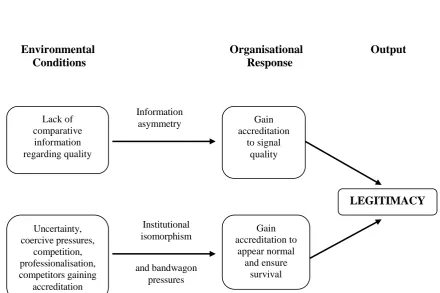
Within the institutional theory framework business schools may face uncertainty, competition and other organisations that are accredited. Uncertainty may occur when the university’s funding is under pressure, or the government may elect to change the way in which it funds universities in general. Competition may occur when there are two universities offering the same programmes within the same region, or the same country (as evidenced by universities establishing marketing activities or additional campuses within the vicinity of other universities). Competition and uncertainty are described by institutional theory and cause isomorphic pressures (DiMaggio & Powell, 1983). Under these conditions, the organisation will respond by seeking accreditation in order to appear normal and to ensure its survival. Similarly, increasing numbers of institutions gaining accreditation will result in increasing bandwagon pressures, increasing the pressure on the institution to also gain accreditation.
The institutional and economic theoretical perspectives provide alternative reasons for gaining accreditation, according to specific environmental conditions and the resulting organisational response. Both the frameworks view the goal of accreditation as gaining legitimacy. The organisation ultimately seeks to be seen as acceptable in the marketplace and, whether they take the signalling (economic) approach or the normative (institutional) approach, the desired output of legitimacy is the same. The model is shown as Figure 1.
2.9 Conclusion
The profile of international accreditation in tertiary sector business schools has increased since EFMD, AACSB and AMBA opened up their accreditation systems to the worldwide market. This level of interest, however, appears to have occurred in the absence of any hard data confirming tangible benefits to the organisation. It is also occurring in addition to the existing accreditation requirements and quality assurance processes in each country.
and gaining legitimacy, which is therefore a stronger motivator than performance or financial benefits. A model has been proposed to describe this behaviour and the next section outlines the methodology by which the model will be tested.
Figure 1: Proposed Accreditation Model
Environmental Organisational Output Conditions Response
LEGITIMACY
Lack of comparative
information regarding quality
Gain accreditation
to signal quality
Uncertainty, coercive pressures,
competition, professionalisation, competitors gaining
accreditation
Gain accreditation to
appear normal and ensure
survival Institutional
isomorphism Information
asymmetry
3. Research Method
3.1 Introduction
In this section the research method is outlined with a summary of the advantages of the selected method over an alternative methodology, a survey, which was rejected. There is an overview of the schools that were selected to take part, and the process for obtaining their participation, as well as a summary of their key descriptive statistics which provides an overall profile. An outline is then provided of the nature of the interviews, the timeline and the process for analysing the data. This section concludes with a discussion on the ethical considerations and limitations of the study.
3.2 Research Method
The research method involved a multiple case study analysis of interviews carried out with business school deans from New Zealand, the United States of America (US) and across Europe.
Undertaking personal interviews with deans was chosen on the basis of Yin’s (2003) assertion that a case study methodology permits more of an explanatory approach. It was also considered that interviewing people in their own environment improves the quality of their answers. It allowed the interviewees to reflect on their experiences and decisions and provided the opportunity to explore ideas in more depth. A qualitative, rather than quantitative, approach was therefore preferred and a survey methodology was accordingly rejected.
comparison of the European and US experiences with the data collected from the New Zealand interviews.
Each of the deans was visited in their school environment and interviewed using a predetermined set of questions (Appendix C). The questions were designed to examine the motivations for each school to seek accreditation, explore the competitive environment each school is operating in, the level of uncertainty they face and any changes to the culture, process and structures experienced during the accreditation process. The motivations and experiences were then compared across the three groups to identify any similarities and differences. Finally the data would be tested against the proposed accreditation model to establish its value in explaining the phenomenon of accreditation.
3.2.1 Number and Selection of Participants
The relatively small number of universities in New Zealand and the ease of travel across the country meant that it was desirable, and possible, to include all of the New Zealand universities. As a result all eight business schools were invited to take part; University of Auckland, Auckland University of Technology (AUT), Waikato University, Massey University, Victoria University of Wellington, University of Canterbury, Lincoln University and Otago University. Of those, all agreed to participate with the exception of the University of Auckland. The associate dean, academic programmes, at the University of
Auckland Business School cited a “…serious conflict of interest…” (S. Laurenson, personal
communication, 3 October, 2008) due to her developing a research proposal for a doctorate at that time.
For the Europe and US groups, five schools in each were chosen. This size was chosen to enhance the robustness of the data and provide a broad sample in each geographical grouping that allowed for trends to be identified and generalisations to be made across each set. This size also remained manageable within the available travel budget.
was also preferred that the schools be AACSB-accredited as well, and the five selected did each have both accreditations. I also determined that there should be only one school from each country. The reason for this was to ensure as broad a cross section across Europe as possible in order to gain a European-based perspective rather than a country-based perspective. Schools
The US schools were chosen on the basis of their initial AACSB accreditation. All schools had received their first accreditation from AACSB during 2007. The advantage of interviewing newly accredited schools was that it was more likely the dean involved had also been involved in the full process, including the initial decision-making process. An initial shortlist was drawn up of all the US schools that had received initial accreditation in 2007, totalling seven. Of those, five had been announced by AACSB in an April 2007 press release and these were chosen to be part of the initial group. A further two schools were announced in press releases later in 2007 and would have been approached had any of the initial five been unable or unwilling to take part.
were also selected in adjoining countries across Europe in order to more efficiently make use of rail travel across the continent.
3.2.2 Nature of Participants
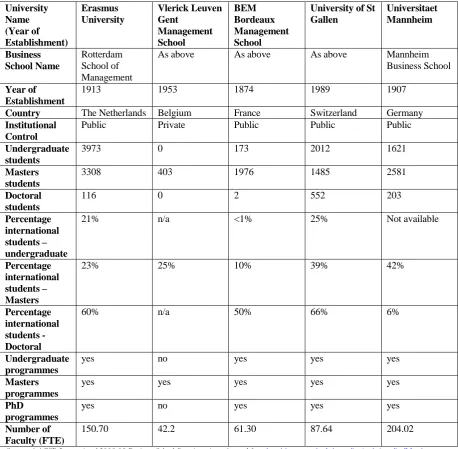
All of the European schools can be classified as early adopters of EQUIS and AACSB accreditation. One school had received AACSB accreditation as recently as 2009 but is still one of relatively few in its country. All except one school were triple accredited with AACSB, EQUIS and AMBA. The group included mostly publicly-funded schools, with one privately funded, and a cross section of sizes, ranging from 27 to 250 faculty. They also offered a cross section of programmes with one school offering programmes only at masters level. The rest offered programmes at all levels and all schools had a diverse student body that included international students. A summary of the schools included is shown in Table 1.
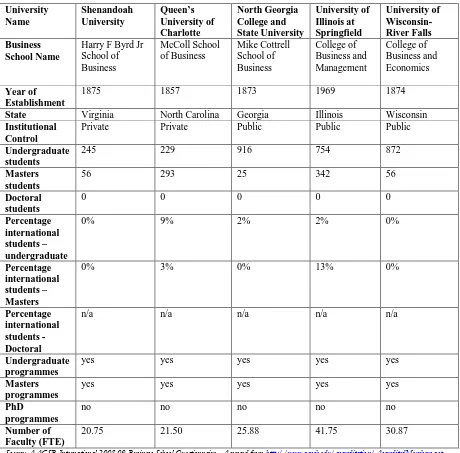
about this group was that they had few, if any, international students. A summary of the schools from the US group is shown in Table 2.
The New Zealand schools were a mixture of early and late adopters. The first group, the “early adopters” are those who are already accredited by both AACSB International and EFMD (Waikato and Otago universities). The University of Waikato and the University of Otago, along with the University of Auckland, had all achieved initial AACSB accreditation by the middle of 2006. The next school to gain AACSB accreditation was Massey University in mid-2009, after the interviews for this study took place. This three year gap provided a natural division between the two groups and Massey was therefore retained in the
group of late adopters. The second group, the “late adopters” (AUT1
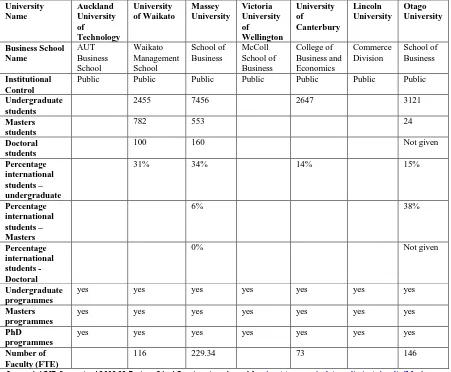
A summary of the New Zealand schools is shown in Table 3. The data is sourced from summary data published by AACSB on its website and comprises information voluntarily provided by the schools. As a result not all information has been provided by the New Zealand schools and the table has some blank entries. It does, however, confirm that all of the schools are publicly controlled and, while vary slightly in size, offer very similar programmes across the country. Their key differentiator is their location.
, Massey, Victoria and Canterbury universities) are therefore those who were going through the process of seeking accreditation at the time of the interviews. Lincoln University has not yet formally entered the accreditation exercise but is a member of AACSB International and is anticipating entering the accreditation process in due course. On the basis that it intends to seek accreditation, it has been included with the group of “late adopters”.
Table 1: Summary Statistics of the European Schools
University Name (Year of Establishment)
Erasmus University
Vlerick Leuven Gent
Management School
BEM Bordeaux Management School
University of St Gallen
Universitaet Mannheim
Business School Name
Rotterdam School of Management
As above As above As above Mannheim
Business School
Year of Establishment
1913 1953 1874 1989 1907
Country The Netherlands Belgium France Switzerland Germany
Institutional Control
Public Private Public Public Public
Undergraduate students
3973 0 173 2012 1621
Masters students
3308 403 1976 1485 2581
Doctoral students
116 0 2 552 203
Percentage international students – undergraduate
21% n/a <1% 25% Not available
Percentage international students – Masters
23% 25% 10% 39% 42%
Percentage international students - Doctoral
60% n/a 50% 66% 6%
Undergraduate programmes
yes no yes yes yes
Masters programmes
yes yes yes yes yes
PhD
programmes
yes no yes yes yes
Number of Faculty (FTE)
150.70 42.2 61.30 87.64 204.02
Source: AACSB International 2008-09 Business School Questionnaire. Accessed from
Table 2: Summary Statistics of the US Schools.
University Name
Shenandoah University
Queen’s University of Charlotte
North Georgia College and State University
University of Illinois at Springfield
University of Wisconsin-River Falls Business
School Name
Harry F Byrd Jr School of Business
McColl School of Business
Mike Cottrell School of Business
College of Business and Management
College of Business and Economics
Year of Establishment
1875 1857 1873 1969 1874
State Virginia North Carolina Georgia Illinois Wisconsin
Institutional Control
Private Private Public Public Public
Undergraduate students
245 229 916 754 872
Masters students
56 293 25 342 56
Doctoral students
0 0 0 0 0
Percentage international students – undergraduate
0% 9% 2% 2% 0%
Percentage international students – Masters
0% 3% 0% 13% 0%
Percentage international students - Doctoral
n/a n/a n/a n/a n/a
Undergraduate programmes
yes yes yes yes yes
Masters programmes
yes yes yes yes yes
PhD
programmes
no no no no no
Number of Faculty (FTE)
20.75 21.50 25.88 41.75 30.87
Source: AACSB International 2008-09 Business School Questionnaire. Accessed from
Table 3: Summary Statistics of the New Zealand Schools
University Name
Auckland University of
Technology
University of Waikato
Massey University
Victoria University of
Wellington
University of
Canterbury
Lincoln University
Otago University
Business School Name
AUT Business School
Waikato Management School
School of Business
McColl School of Business
College of Business and Economics
Commerce Division
School of Business
Institutional Control
Public Public Public Public Public Public Public
Undergraduate students
2455 7456 2647 3121
Masters students
782 553 24
Doctoral students
100 160 Not given
Percentage international students – undergraduate
31% 34% 14% 15%
Percentage international students – Masters
6% 38%
Percentage international students - Doctoral
0% Not given
Undergraduate programmes
yes yes yes yes yes yes yes
Masters programmes
yes yes yes yes yes yes yes
PhD programmes
yes yes yes yes yes yes yes
Number of Faculty (FTE)
116 229.34 73 146
Source: AACSB International 2008-09 Business School Questionnaire. Accessed from
on 5 January 2010.
3.3 Conducting of Interviews
Each interview followed the same basic set of questions but allowed for further probing to clarify and establish linkages between information provided. Each interview took between 40 minutes and 2 hours 20 minutes, however most were completed in, on average, 1 hour. The differences in time varied simply due to the extent of reflection and number of examples provided by the interviewee to illustrate answers given.
Interviews were recorded using a dictaphone and transcribed verbatim by the author. Each transcribed interview was identified by a letter so that later analysis would retain the anonymity of the responder. The only identification possible, therefore, are the New Zealand early/New Zealand late/European/US groupings and School A, School B, etc within
those groups.
3.3.1 Interview Process and Timeline
The dean of each New Zealand university business school was emailed in August 2008. The email outlined the proposed purpose of the project and invited their participation. Interviews of the New Zealand deans were carried out during October and early November 2008. During that period the opportunity also arose to interview the former dean of the School of Business at Otago University and that interview was carried out in December 2008. In some instances the dean recommended an alternative person to be interviewed. In all cases this person was a deputy or associate dean, or in a similar position, who was directly responsible for the school’s accreditation exercise.
At the beginning of each interview I briefly summarised again the purpose of the study and provided each interviewee with an information sheet (Appendix A). The information sheet outlined the name of the project, the purpose of the interview and explained that the subject had the right to withdraw at any stage. It also confirmed the confidentiality of the data and contained the assurance that quotes that may identify the individual or institution would not be used without the participant’s consent. Each participant was also then provided with a consent form (Appendix B) which they signed and gave back to me.
Transcribing of the New Zealand interviews took place over the months of January through to April 2009. The European and US interviews were transcribed during July and August 2009.
During September/October 2009 analysis of the interviews was undertaken and writing of the thesis commenced in November 2009.
3.4 Analysis of Interviews
A qualitative approach was taken, using explanatory, multiple-case study methodology (Yin, 1994). By interviewing multiple deans in the two groups I was able to increase the generalisability of findings from each group, minimising the chances of any particular result being idiosyncratic (Miles and Huberman 1984). Because of the possibility of comments from the interviews being of a sensitive nature care was taken to ensure that identifiers (e.g. Dean A, Dean B etc) were used to minimise the risk of readers being able to attribute comments to individuals.
European schools is within Appendix G. From those tables I identified the general trends from each group and summarized them in a second summary table. The summary table had the same questions set out in rows but the columns were this time headed “NZ – Early Adopters”, “NZ – Late Adopters”, “Europe” and “USA (Appendix H). In this table I combined the responses and, for the questions relating to motivation, analyses, benefits, challenges, uncertainty, competition and benchmarking, coded them according to the following traits.
Trait Code
Information Asymmetry INAS
Mimetic Isomorphism MISO
Coercive Isomorphism CISO
Normative Isomorphism NORM
Bandwagon Pressures BAND
At the bottom of each section the number of traits was summarized and the dominant trait was identified for each group. Once the dominant traits had been established these could be tested for fit against the proposed accreditation model. Responses that involved factors that didn’t align to the traits were left non-coded so that they could be examined separately for any unintended or unexpected factors.
3.5 Ethical Considerations
or stress, and does not involve gathering personal information of a sensitive nature about or from individuals.
At the beginning of each interview participants were provided an information sheet which outlined the purpose of the research, the required level of involvement required and the intended use of the information. Participants were informed that their responses would be kept confidential and that any quotes used in the thesis would be used in such a way as to not be attributable to an individual or a school. Each participant was also asked to sign a consent form which acknowledged the individual’s right to withdraw from the project at any time.
3.6 Limitations of this Study
The primary limitation of this project was that it was not always possible to interview the deans who were actually involved with the initial accreditation process. Some schools had been accredited for several years and therefore the dean being interviewed had not been involved or was not responsible for the original decision. Some responses were therefore impressions of what the dean or school was thinking at the time. This limitation was mitigated by the selection of deans in the US group who had only recently earned their accreditation. Of those, only one dean had commenced their tenure after the accreditation had been awarded. That person, however, had been closely involved with the school’s journey through the accreditation process and was therefore well placed to provide a good outline of the motivations involved at that time.
3.7 Conclusion
reflective answers. Seventeen interviews in total were carried out, five each in Europe and the US and seven across New Zealand, providing a cross section of information from which it is expected that common themes will emerge which will explain the actions and motivations of schools entering the accreditation process. The interviewees were assured of their anonymity in order to encourage full and frank discussions of their experiences, and care has been taken to ensure responses quoted in this thesis do not identify individuals.
4. Findings
4.1 New Zealand Business Schools – Early Adopters
This group comprised the University of Otago and Waikato University.
4.1.1 Motivation
The first section of the interviews explored the motivation of the schools to initially seek accreditation. The interviewees were asked to outline the reasons the school decided to enter the process, any analyses undertaken to support the decision and the benefits they expected to gain from the process.
A number of reasons were given for seeking accreditation. The consistent message coming
through was the desire to be seen as a business school of international standing (“…it was
his vision to be an internationally recognized school…”). In order to be internationally recognized it was considered necessary to be members of the accreditation “clubs” and that those clubs would help with networking and setting up international partnerships.
As early adopters, these schools also intended to establish a point of difference from the other New Zealand schools. However, this desire was not as important as the competitive desire to keep up with the University of Auckland, which was also seeking accreditation (“At the time we knew that Auckland University was also seeking accreditation to all the accreditation agencies and we wanted to be able to make the same claim.”).
Despite the initial and ongoing costs of accreditation neither of the business schools was able to confirm that any formal analysis had been undertaken prior to making the decision to seek accreditation. While it was possible that some estimate of costs may have been made in one or two instances, it was clear that this was a strategic rather than a financial decision based
Both schools in this group anticipated gaining a number of benefits out of the process. In addition to the improved standing in the international community the deans in this group saw themselves as being able to use the process as an external driver to implement improvements and change in the school. It was very much seen as a tool to improve the business school as a whole.
“Having accreditation doesn’t make you a better school. It makes the steps to being a better school easier because it forces your attention on certain things.”
4.1.2 The Education Environment
In this section of the interviews the deans were asked to consider their outlook on the education environment and the particular challenges they are facing. They were also asked whether or not they felt that being accredited helped protect them from those challenges.
The most significant challenge being experienced by this group is improving their standard of research. Closely related to this is the issue of attracting and retaining good quality academic staff. The New Zealand government’s Performance Based Research Fund (PBRF) has made the market for academic staff very competitive and universities have become highly motivated to improve or maintain their relative scoring and position in each PBRF round.
The effect of accreditation on dealing with those challenges appeared to be limited by the stronger effect being felt by the PBRF pressures.
“…other parts of the university are much more research focused than we are already, it is still a bit of a quantum leap for this school. I think we’ve got quite a ways to go.”