Unbiased Diffusion to Escape through Small Windows:
Assessing the Applicability of the Reduction to Effective
One-Dimension Description in a Spherical Cavity
Marco-Vinicio Vázquez1, Leonardo Dagdug1,2
1Departamento de Física, Universidad Autónoma Metropolitana-Iztapalapa, México 2Mathematical and Statistical Computing Laboratory, Division of Computational Bioscience,
Center for Information Technology, National Institutes of Health, Bethesda, USA. E-mail: [email protected], [email protected]
Received January 21, 2011; revised March 1, 2011; accepted March 6, 2011
Abstract
This study is devoted to unbiased motion of a point Brownian particle that escapes from a spherical cavity through a round hole. Effective one-dimensional description in terms of the generalized Fick-Jacobs equation is used to derive a formula which gives the mean first-passage time as a function of the geometric parameters for any value of a, where a is the hole’s radius. This is our main result and is given in Equation (19). This result is a generalization of the Hill’s formula, which is restricted to small values of a.
Keywords:Diffusion, Brownian Particle, Fick-Jacobs Equation, Narrow-Escape Time
1. Introduction
The first-passage time, namely, the probability that a diffusing particle or a random-walk first reaches a speci-fied site (or set of sites) at a specispeci-fied time, is known to underlie a wide range of stochastic processes of practical interest [1]. Indeed, chemical and bio-chemical reactions [2,3], animals searching for food [4], the spread of sexu-ally transmitted diseases in a human social network or of viruses through the world wide web [5], and trafficking receptors on biological membranes [6], are often con-trolled by first encounter events [7]. Studying the narrow scape time (NET), the mean time which a Brownian par-ticle spends before to be trapped in an opening window to exit a cavity for the first time, has particular impor-tance. The applications goes from cellular biology to biochemical reactions in cellular micro-domains as den-dritic spines, synapses and micro-vesicles, among others [6,8]. For those cases where the particles first must exit the domain in order to live up to their biological function, the narrow scape time is the limiting quantity and the first step in the modeling of such processes [7].
Experimentally, high-resolution crystallography of bacterial porins and other large channels demonstrates that their pores can be envisaged as tunnels whose cross sections change signiÞcantly along the channel axis. For
some of them, variation in cross-section area exceeds an order of magnitude [9,10]. This leads to the so-called entropic walls and barriers in theoretical description of transport through such structures. In addition to biologi-cal systems, diffusion in confined geometries are also important for understanding transport in synthetic nanopores [11-13], transport in zeolites [14], controlled drugs release [15], and nanostructures of complex ge-ometries [16], among others.
Theoretically, the transport in systems of varying ge-ometry has been deeply studied in recent years since these systems are ubiquitous in nature and technology [18-23]. Diffusion in two and three dimension, has been formulated as a one dimension problem in terms of the effective one-dimensional concentration of diffusing molecules. If one assumes that the distribution of the solute in any cross section of the tube is uniform as it is at equilibrium, directing the x-axis along the center line of a tube, one can write an approximate one-dimensional effective diffusion equation as
, ,
= ,
,
c x t c x t
D x A x
t x x A x t
(1)
where D x
=M.-V. VÁZQUEZ ET AL. 285
one-dimensional concentration of the diffusing particles at a given x. This equation was derived by Jacobs in 1967 [17]. is related to the three-dimensional concentration
by,
c x t C x
c x t
U x
, , ,y z t
, =
A xC
x y z t y z, , , d d .
(2)As Zwanzig pointed out [18], (1) can be considered as the Smoluchowski equation for diffusion in the entropy potential defined as,
= B ln
C
,
A x
U x k T (3)
A x
where kB is the Boltzmann constant and T the absolute
temperature, and U x
at x=xC is taken to be zero,.
U xC = 0
Equation (1) with position-independent diffusion coef-ficient, , is known as the Fick-Jacobs (FJ) equation [17]. To improve FJ’s reduction, Zwanzig (Zw) derived one-dimension diffusion equation assuming that the tube radius is a slowly varying function,
=D x D
r x
1r x [18]. He showed that
satisfies the probability conservation equation
,
c x t
,
,=
c x t j x t
t x
(4) where the flux, j x
, is given by,
,t
, =
j x t A x D x c x
x A x
(5) The expression for derived by Zwanzing is as follows [18],
D x
2 =1 2.
D
D x
r x
Zw
D x
(6)Later, in the same spirit of amending the FJ's reduc-tion, Reguera and Rub (RR) proposed the following ex-pression for [19],
2 2 1 = 1 2 1 RR D .D r x
r x
D x (7)
In order to determine what the explicit form of D x
should be used in a given geometry (and its associated boundary conditions), we can exploit that the Mean First-Passage Time (MFPT), , is a quantity often ob-tained by means of computer simulations. Then the MFPT, defined as the time a random walker spends to reach a specified place for the first time, averaged over all the trajectories or realizations of a random walk, is found to satisfy a backwards equation [20],
0 0
0
0 0
d d
e e =
d d 1,
U x D x x x U x (8)
where = 1
k TB
(kB and retain their usualmeaning), and the potential , defined in (3), is due to the change in the cross-sectional area along the axial length of the tubes. Then (8) is solved for the ap-propriate boundary conditions to obtain an algebraic ex-pression that relates
T
0U x
with and geometrical parameters of the system.
D x
In the present paper we derive a formula which gives the mean first-passage time as function of the geometri-cal parameters using the effective one-dimension de-scription for a sphere with absorbing spots. This formula will be proved to reproduce the data obtained by Monte-carlo simulations for any value of the hole radius, a, when (7) is used.
2. Results and Discussion
Back to the narrow escape problem, in 2002 I. V. Grigo-riev et al. studied the time dependence of the survival probability of a Brownian particle that escapes from a cavity through a round hole [24]. Two main results were reported: 1) an algebraic proof that for small holes the decay is exponential, based on the spectral representation of the survival probability, and 2) the expression for the rate constant in terms of the problem parameters (the diffusion constant D of the particles, the hole radius a, and the cavity volume V) is given by,
4 = Da =
k V
1
(9)
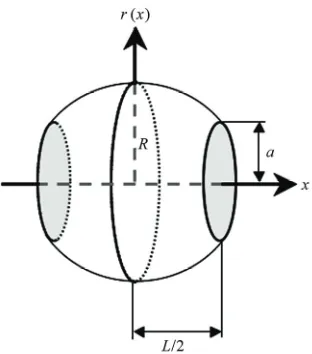
In their work they also ran Brownian dynamics simu-lations to calculate the survival probability in spherical and cubic cavities for different values of the absorb-ing-window’s radius. They also founded that when the spot radius is small enough (a R0.1 for a spherical cavity, R is the radius of the sphere), the decay is expo-nential and the rate constants found in simulations are in a good agreement with those predicted by (9). For the means first-passage time predicted by Hill’s formula for a sphere with two absorbent holes, the following volume has to be introduced in (9), see Figure 1,
3 2
2 2 2 2
sph
4π 2π
= 2
3 3
R
V R R a R R a (10)
obtaining,
Hill 3 2 2 2 2 2
sph =12Da 2R R R a ) (2R R a
(11) Equation (11) is just applicable when a R> 0.1. In the following lines we will obtain an expression for any value of a.
Figure 1. Sphere of radius R with two absorbing windows of radii a (shaded inthe picture, while the remaining surface is reflective). Its height is given by r x
= R2x2. Theenclosed volume is changed as one varies a because of
2 2
2 =
L R a .
defined as,
2
1 2 2
2 2
π
e = = =
0 π 0
U x A x r x R x
A r R
(12)
where A x
0 is the cross-sectional area, and
20 R x
2 0 =
r x is the height of the sphere. In these
calculations x0 denotes the initial position of each tra-jectory of a Brownian particle. Then, using DRR
x0 as given by
2 2 0
0 RR 0 2
0
= = =
1
R x D
D x D x D
R r x
(13)
we replace D x
0 and 0 in (8) to yield,U x
e
2 2
2 2 2 2
0
0 0
2
0 0
d d =
d d
R x
R x R x
D
x R R x
R2
(14)
which happens to be a separable ordinary differential equation. Integrating twice we obtain,
0 3 2 20
2 2 2
0 2 2
0 3
0
1 2
2 2 2
0 1 = 3 R x
D R x
R R x
D R x
x R
C C
D R R x
R
(15)
The equation above have two integration constants, namely, and , which can be fixed by using
ap-propriate boundary conditions. Since we have absorbing windows in the positions
1
C C2
0= 2
x L , and x0=L 2, we can state this type of boundary conditions as follows,
L 2 =
L 2 = 0
(16) with these conditions in (15), we found, C1= 0 and
3 2 2 = 3 3 R aR C
Da D. Thus we have an expression of as a
function of the initial position x0,
3 2 2 30 2 2 0
0
2 1 2
=
3 3 3
R R R
x R x
D R x D Da
3 aR D (17) If we also want the solution when the initial positions of the particles are distributed uniformly in the cavity, we have to consider the average over all the accessible initial positions in the interval L 2x0L 2 given by
2 0 0 2 1= L d
L x x.
L
(18)Substituting
x0 from (17), in the above definition allows one to obtain an expression for ,
3 2 2RR
2 2 3
= 4 arcsin
6
sph
R a a R a
a
Da R R a R
2.
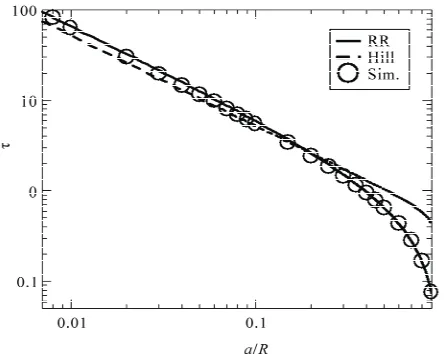
(19) Equation (19) along with (17) are the main results of this work. Equation (19) depends only on the geometrical parameters R and a, and the bulk diffusion constant D. The comparison of this expression with the data obtained by Montecarlo simulations shows and excellent agree-ment for any value of a, see Figure 2. Additionally, in the limit a0, the ratio RR Hill goes to the con-stant value 4 .
The results obtained here can be extended to any num-ber of spots—provided these spots are far enough to not interact with each other, dividing Equation (19) by two, times the number of holes. The procedure outlined in this work can be used to obtain the mean first-passage time for any geometry when DRR
x is applicable.3. Computational Details
The problem is to find the survival time of a Brownian particle escaping from a domain of size V, whose bound-ary is reflective, except for a small absorbing window of circular shape and radius a. In simulations we obtain the mean time to absorption , a mean first-passage time.
[image:3.595.85.242.586.690.2]M.-V. VÁZQUEZ ET AL. 287
Figure 2. Narrow escape time for the sphere with two holes (in Figure 1), in a Log-Log scale to emphasize the differ-ences between theoretical curves and simulated data. Hill's formula (11) (dashed line) shows a poor agreement with simulated data (circles) in the range a > 0.1, while (19) (solid line) fits better the data for all a in 0.008 ≤ a ≤ 0.9.
time step t= 106, so that 3 0
2D t = 2 10 1. The actual particle’s position, n , is given by
0 ran, where 0 is the former position, and ran is a vector of pseudo random numbers generated with a Gaussian distribution (
r =
n
r r r r r
= 0
, = 2D t0 ). Each MFPT is obtained by averaging the first-passage times of
trajectories whose starting positions are uni-formly distributed inside the cavity.
4 2.5 10
The system under study is shown in Figure 1, a sphere of radius R with two round holes of the same size. The length L between the two absorbing holes is related to the sizes of the sphere, R, and the hole, a, by the relation,
2 2 2 =
L R a (20) Equation (20) implies that the volume of the domain is a function of the length L 2, so the former shrinks as a
increases (and L 2 decreases). The height of the sphere as a function of the axial coordinate x is r x
= R2x2. The present methodology can be applied, nonetheless to any geometry, provided it is radially symmetric.Figure 2 shows the comparison between Narrow Es-cape Times computed from Brownian dynamics simula-tions (circles) and those predicted by Hill’s formula (dashed line), Equation (11), and our result (solid line), Equation (19). The simulated data ranges from
to . Equation (11) falls far from the computed narrow escape times in the range while (19) fits for all a in a broader range.
= 0.007
a
= 0.900
a
> 0.1
a
4. Acknowledgements
We are grateful to C. Reynaud for her useful comments
on the manuscript.
5. References
[1] S. Redner, “A Guide to First Passage Time Processes,” Cambridge University Press, 2001.
doi:10.1017/CBO9780511606014
[2] P. Hänggi, P. Talkner and M. Borkovec, “Reaction-rate Theory: Fifty Years after Kramers,” Reviews of Modern Physics, Vol. 62, No. 2, 1990, pp. 251-341.
[3] M. Coppey, O. Bénichou, R. Voituriez and M. Moreau, “Kinetics of Target Site Localization of a Protein on DNA: A Stochastic Approach,” Biophysical Journal, Vol. 87, No. 3, 2004, pp. 1640-1649.
[4] O. Bénichou, M. Coppey, M. Moreau, P. H. Suet and R. Voituriez, “Optimal Search Strategies for Hidden Tar-gets,” Physical Review Letters, Vol. 94, No. 19, 2005, pp. 198101 (1-4).
[5] L. Gallos, C. Song, S. Havlin and H. A. Makse, “Scaling Theory of Transport in Complex Biological Networks,” Proceedings of the National Academy of Sciences U. S. A., Vol. 104, No. 19, 2007, pp. 7746-7751.
[6] D. Holcman and Z. Schuss, “Escape Through a Small Opening: Receptor Trafficking in a Synaptic Membrane,” Journal of Statistical Physics, Vol. 117, No. 5-6, 2004, pp. 975-1014.
[7] O. Bénichou, and R. Voituriez, “Narrow-Escape Time Problem: Time Needed for a Particle to Exit a Confining Domain through a Small Window,” Physical Review Let-ters, Vol. 100, 2008, pp. 168105(1-4).
[8] Z. Schuss, A. Singer and D. Holcman, “The Narrow Es-cape Problem for Diffusion in Cellular Microdomains,” Proceedings of the National Academy of Sciences U. S. A., Vol. 104, No. 41, 2007, pp. 16098-16103.
[9] S. W. Cowan, T. Schirmer, G. Rummel, M. Steiert, R. Ghosh, R. A. Pauptit, J. N. Jansonius, and J. P. Rosen-busch, Nature, Vol. 358, 2002, pp. 727.
doi:10.1038/358727a0
[10] L. Z. Song, M. R. Hobaugh, C. Shustak, S. Cheley, H. Bayley and J. E. Gouaux, Science, Vol. 274, 1996, pp. 1859. doi:10.1126/science.274.5294.1859
[11] M. Gershow and J. A. Golovchenko, “Recapturing and Trapping Single Molecules with a Solid-state Nanopore,” Nature Nanotechnology, Vol. 2, 2007, pp. 775-779. doi:10.1038/nnano.2007.381
[12] L. T. Sexton, L. P. Horne, S. A. Sherrill, G. W. Bishop, L. A. Baker and C. R. Martin, “Resistive-Pulse Studies of Proteins and Protein/Antibody Complexes Using a Coni-cal Nanotube Sensor,” Journal of the American Chemical Society, Vol. 129, No. 43, 2007, pp. 13144-13152. [13] I. D. Kosinska, I. Goychuk, M. Kostur, G. Schmidt and P.
Hänggi, “Rectification in Synthetic Conical Nanopores: A One-dimensional Poisson-Nernst-Planck Model,” Physical Review E, Vol. 77, No. 3, 2008, pp. 031131. [14] J. Kärger and D. M. Ruthven, “Diffusion in Zeolites and
[15] R. A. Siegel, “Theoretical Analysis of Inward Hemi-spheric Release above and below Drug Solubility,” Jour-nal of Controlled Release, Vol. 69, No. 1, 1992, pp. 109- 126.
[16] N. F. Sheppard, D. J. Mears, and S. W. Straka, “Micro-machined Silicon Structures for Modelling Polymer Ma-trix Controlled Release Systems ,” Journal of Controlled Release, Vol. 42, No. 1, 1996, pp. 15-24.
[17] M. H. Jacobs, “Diffusion Processes,” Springer, New York, 1967.
[18] R. Zwanzig, “Diffusion past an Entropy Barrier,” Journal of Physical Chemistry, Vol. 96, No. 10, 1992, pp. 3926- 3930.
[19] D. Reguera and J. M. Rubí, “Kinetic Equations for Diffu-sion in the Presence of Entropic Barriers,” Physical Re-view E, Vol. 64, No. 6, 2001, pp. 061106(1-8).
[20] A. M. Berezhkovskii, M. A. Pustovoit and S. M. Bezru-kov, “Diffusion in a Tube of Varying Cross Section:
Nu-merical Study of Reduction to Effective One-Dimensional Description,” Journal of Chemical Physics, Vol. 126, No. 13, 2007, pp. 134706(1-5).
[21] P. Kalinay, “Mapping of Forced Diffusion in Quasi-One- Dimensional Systems,” Physical Review E, Vol. 80, No. 3, 2001, pp. 031106(1-10).
[22] R. M. Bradley, “Diffusion in a Two-Dimensional Chan-nel with Curved Midline and Varying Width: Reduction to an Effective One-Dimensional Description,” Physical Review E, Vol. 80, No. 6, 2009, pp. 061142(1-7). [23] P. S. Burada and G. Schmid, “Steering the Potential
Bar-riers: Entropic to Energetic,” Physical Review E, Vol. 82, No. 5, 2010, pp. 051128(1-6).