ISSN Online: 2333-9721 ISSN Print: 2333-9705
DOI: 10.4236/oalib.1105661 Aug. 26, 2019 1 Open Access Library Journal
Determining the Radius of the Magnetic
Vortex Core of YBCO123 and Bi2212
A. Mukubwa1, Fred Masinde2
1Department of Science, Technology and Engineering, Kibabii University, Bungoma, Kenya 2Department of Physical Sciences, South Eastern Kenya University, Kitui, Kenya
Abstract
A plasma has been defined as a quasi-neutral gas of charged particles showing collective behaviour. Plasmas can support waves depending on the local con-ditions, the presence of external electric and magnetic fields. A characteristic property of plasmas is their ability to transfer momentum and energy via col-lective motion. An example in this case, is the Langmuir waves where plasma electrons oscillate against a stationary ion background. In a superconductor, two plasma electrons arise one that is made up of normal electrons and the other that is made up of super-electrons. In this study, we consider a system of super-electrons forming a super-particle. The motion of the plasma su-per-particles around a magnetic vortex core has been studied in the YBCO123 and Bi2212 systems. The results reveal an assemblage of super-particles that contain the magnetic flux within the vortex core of radius
(
)
118 2 0
1
1.728 10
3 Å
r ≅ × − .
Subject Areas
Applied Physics, Industrial Engineering, Mechanical Engineering
Keywords
Plasma, Magnetic Flux, Magnetic Vortex Core, Super-Particles, Diamagnetism
1. Introduction
Ginzburg-Landau (GL) theory gives a good account of interactions between magnetic field and electric field in a type II superconductor [1]. The theory agrees well with the BCS theory. However, the BCS theory is not sufficient to
How to cite this paper: Mukubwa, A. and Masinde, F. (2019) Determining the Radius of the Magnetic Vortex Core of YBCO123 and Bi2212. Open Access Library Journal, 6: e5661.
https://doi.org/10.4236/oalib.1105661
Received: August 5, 2019 Accepted: August 23, 2019 Published: August 26, 2019
Copyright © 2019 by author(s) and Open Access Library Inc.
This work is licensed under the Creative Commons Attribution International License (CC BY 4.0).
http://creativecommons.org/licenses/by/4.0/
DOI: 10.4236/oalib.1105661 2 Open Access Library Journal
explain the high energy pairing in the High-Tc superconductors. While the
lower and the upper critical fields of a superconductor have been determined using the GL theory, finding the radius of the magnetic vortex core theoretically has been a challenge. Therefore, there is need for a new approach in studying the motion of charged particles in an electromagnetic field, especially in high-superconductor systems. In this study, we consider assemblage of charged particles, each moving independently in prescribed electromagnetic fields which constitute a plasma [2]. The plasma of charged particles responds inertially to electric field perturbations by oscillating at the electron plasma frequency. Exter-nally imposed electric fields will induce perturbations in the plasma that are com-binations of the time dependence of the externally imposed field and the electron plasma oscillations. The response of charged particles to the electric field force is limited by the inertial force d
d
ma m t
= v, and is inversely proportional to the
mass of the charged particle. Thus, the lighter electrons will give the primary in-ertial response to an electric field perturbation in a plasma [2]. Consequently, the electrons give the dominant contribution to the plasma polarization. In the Langmuir waves, plasma electrons oscillate against a stationary ion background in a normal state of a material [3]. The force experienced by an ith particle in
motion is given by
d
d i
i m
t
= v
F (1)
where d
d i i
x t
=
v is the velocity of the ith particle. The equation of motion of a
charged particle in a magnetic field (B) due to an electric field (E) is given by [4],
(
)
d d
i q
t =m + ×
v
E v B (2)
where d
d i i
x t
=
v is the velocity of the ith particle, q is the particle charge and
(
)
i i
F =q E+ ×v B is the Lorentz force on the ith particle. The charge and
cur-rent densities respectively are obtained by integrating the distribution function over velocity space and summing over species
( )
3(
)
, i d i , ,
i
x t =
∑
q∫
v f x v t⋅ρ (3)
And
( )
3(
)
, i d i , ,
i
x t =
∑ ∫
q v⋅ f x v tJ v (4)
where f =f x v t
(
, ,)
is the microscopic distribution function whose timederiv-ative is given by
( )
(
)
(
( )
)
1d
d
N
i i
i i
i x
f f f f
x x t t
t t t x t = δ δ
∂ ∂ ∂ ∂ ∂
= + + − − ∂ ∂ ∂ ∂ ∂
∑
v
v v
DOI: 10.4236/oalib.1105661 3 Open Access Library Journal
here, v= v Putting Equation (2) into Equation (5) yields the Klimontovich
equation given as
(
)
( )
d d
f f f q f
C f
t t x m v
∂ ∂ ∂
= + ⋅ + + × ⋅ =
∂ v ∂ E v B ∂ (6)
This is the plasma kinetic energy. The term C f
( )
is known as the Coulomb collision operator on the average distribution function f =f x v t(
, ,)
. The newform of Equation (6) becomes
(
)
( )
f q
f f C f
t x v m
∂ + ∂ ⋅ + ∂ ⋅ + × =
∂ ∂ v ∂ E v B (7)
For a plasma of particles, Coulomb collision effects over short time scales are negligible. Thus, for such plasma processes,
(
)
0f q
vf f
t x v m
∂ + ∂ ⋅ + ∂ ⋅ + × =
∂ ∂ ∂ E v B (8)
The solution to this equation is
(
1, 2, 3, , N)
f = f c c c c (9)
where ci is the constant of motion. The distribution is kinetically stable when
the energy is the constant of motion and the equilibrium constant of distri-bution depends on it. Fluid moments are obtained by integrating low order powers of the product of velocity and the distribution function over velocity space in the laboratory frame, that is
3
dv i⋅f i: =0,1, 2,
∫
v (10)Theoretical Formulation
For a material in a superconducting state, two particles arise: normal particles that consist of normal electrons and the super-particles made up of su-per-electrons. The motion of the plasma super-particles around a magnetic vor-tex core contains the magnetic flux within the vorvor-tex core.
Some of the velocity moments of the distribution function f are listed below Density of states:
3
d
N=
∫
vf (11)Flow velocity:
3 1
d
V v f
N
=
∫
v⋅ (12)Average Kinetic energy (meV):
2 2
3 d
3 2
r r
mv mv
N v f
= =
∫
(13)
Pressure (NM−2):
2 3 d
3 r
mv
DOI: 10.4236/oalib.1105661 4 Open Access Library Journal
( )
3d v m r rf p π p π
=
∫
= + = +P v v Ι (15)
A system of interacting super-particles consists of a number (n) of electrons each carrying a charge e. The total charge of the super-particle will be denoted by Q. Physical properties of plasma such as energy can be generated from the velocity moment of the plasma kinetic equation of the super-particles that is ex-pressed as
( )
(
)
3
d v g f f Q f 0
t x m
∂ + ∂ ⋅ + ∂ ⋅ + × = ∂ ∂
∂
∫
v v E v Bv (16)
where, g v
( )
is the velocity function for the particles. To find the density moment, g=1 is used while for the momentum moment, g=mv is used as avelocity function. The momentum equation for the plasma super-particles is
(
)
3
dvm f f Q f 0
t x m
∂ + ∂ ⋅ + ∂ ⋅ + × = ∂ ∂
∂
∫
v v E v Bv (17)
Each part is tackled separately using the commutation property before com-bining the solutions:
3 3 d
d d
d
f v
vm v fm mN
t t t
∂ ∂
= =
∂ ∂
∫
v∫
v (18)(
)
3 3
d vm f d v fm p
x x π
∂ ∂
⋅ = = ∇ ⋅ +
∂ ∂
∫
v v∫
vv (19)(
)
(
)
(
)
3
3 d
d d d
q
vm f
m
Q
v f m Nq
m
∂ ⋅ + ×
∂
= + × = − + ×
∫
∫
v E v B
v
v E v B E v B
v
(20)
Substituting the solutions back to Equation (17) we have
(
)
mN NQ p
t π
∂ = + × − ∇ ⋅ − ∇ ⋅
∂
v
E v B (21)
To determine the perpendicular guiding center (radius) drifts, the perpendi-cular flow responses are obtained by taking the cross product of the momentum equation with the magnetic field B. Thus, Equation (21) becomes
(
)
(
)
mN NQ p
t
∂ × = × + × × − ×∇ ⋅
∂ B v B E B v B B (22)
Performing the product yields
(
)
(
)
(
)
0mN NQ NQ V p
t
∂
× − × + ⋅ + ×∇ ⋅ =
∂ B v B E B B B (23)
Dividing Equation (23) by NqB2 we have
(
)
(
)
(
)
(
)
2 2 2 2
1 1 1
0
m
V p
t
QB B B NQB
∂
× + × + ⋅ + ×∇ ⋅ =
∂ B v B E B B B (24)
Equation (24) gives the total flow velocity of the system 2
⊥ ∧
= + +
DOI: 10.4236/oalib.1105661 5 Open Access Library Journal
The indicates the ordering of the various flow components while
(
)
2 1 ˆ
V V
B
= = ⋅
V‖ ‖b B B (26)
(
)
(
)
2 2
1 1
p
B NQB
∧ = × + ×∇ ⋅
V E B B (27)
(
)
2
m
t qB
⊥
∂
= ×
∂
V B v (28)
In this case, V∧ is the cross flow velocity, V‖ is the parallel flow velocity and V⊥ is the perpendicular flow velocity. The directions, here, are relative to
the direction of the magnetic flux, which is in the z-direction. Of importance, here, is the is the cross flow velocity given as
(
)
(
)
2 2
1 1
p
B NQB
∧ = × + ×
V E B B ∇ (29)
where,
(
)
2 1
d p
NQB
= ×
V B ∇ (30)
(
)
2 1 E
B
= ×
V E B (31)
d
V represents the diamagnetic flow velocity while VE represents the
inte-raction between the fields. This study revolves around the diamagnetic flow ve-locity, Vd that describes the motion of super-electrons while exerting pressure
p on the magnetic flux. This pressure contains the flux along cylindrical vortices. The quantity B is the diamagnetisation of the super-particles. To work out the
various components of the ∇B tensor, a local Cartesian coordinate system
with coordinates eˆx, eˆy and eˆz is used such that eˆz is aligned along bˆ at ˆ
b and eˆx pointing towards the centre of the vortex core and perpendicular to ˆ
b. The y-axis of the local co-ordinate, eˆy = ×bˆ eˆx becomes tangential to the
surface of the vortex core (interface between the flux and the plasma-su- per-particles’ flow). Thus, the unit vectors characterizing this local coordinate system will be eˆx, eˆz =bˆ and eˆy = ×bˆ eˆx. Equation (31) can be evaluated as
follows:
(
)
2 1
d p
NQB
= ×
V B ∇ (32)
Note that ∇p is one-dimensional in the eˆx-direction i.e. towards the centre
of the cylindrical vortex.
(
)
2
1 1 1 d
0 0
d d
0 0
ˆ
d
ˆ ˆ
ˆ
x y z
y
p
p B
NQB NQB x
NQB
x e e e
p
e
× = =
DOI: 10.4236/oalib.1105661 6 Open Access Library Journal
Recall that p≅N, so that 1
p=
, where is the kinetic energy of the su-per-particles, at absolute zero temperature and Ek is the excitation energy of the
quasi particles. Therefore, equation becomes
1 d d ˆ
d y
p
Q p x
e e B =
V (34)
The quantity 1 1 d
d
p
p
L = − p x is known as the pressure-gradient scale length
and is proportional to the radius, r of the vortex core, i.e.
1 1 d
d
p
p r
L p x
= = − (35)
The vector eˆy shows that plasma superfluid moves tangentially to the
inter-face as the flux concentrates about the centre of the vortex. These interactions form a cylindrical vortex core of radius 1
p r
L
= at diamagnetisation B and flux
H. The diamagnetisation B is proportional to the 2 0 1
0 e c H H c H H H µ − +
.
There-fore, 1 2 0 0 e c H H c H H B H ηµ − + =
(36)
where η a constant that depends on the material of the superconductor is, H is the applied external field, Hc1 is the lower critical field, Hc2 is the upper
crit-ical field, µ0 is the permeability of free space and 2 c
H b
H = is the reduced magnetic field [5]. Considering all these cases, Equation (34) becomes
1 2 0 0 1 e c H H d c
H H Q
r e H ηµ = − +
V (37)
When the external magnetic field H is increased, the resulting magnetic flux (ф) mounts more pressure on the superelectrons and weakens the diamagnetisation. This results into an increase in the radius, r, of the core. At
2 c
H=H , the supe-particles are so weak that the magnetic flux permeates the whole spectrum of the super-particles causing the superconductivity of the ma-terial to breakdown and r→ ∞. It is important to note that the values of
are in meV. Consequently,
1 2 0 0 1 e c H H d c
H H Q
r e H µ η − = +
DOI: 10.4236/oalib.1105661 7 Open Access Library Journal
At absolute zero temperature, the thermal velocity of the super electrons is zero and therefore, Equation (38) relies on the acoustic velocity. Hence, for a super-electron at absolute zero temperature,
d p m
=
V (39)
Hence, using Equations (39) into (38) we get
1 2 0 0 1 e c H H c p Q e H H r H m η µ − = − +
(40)
From Equation (40), it should be noted that for a three-electron system,
(
)
7 8
0 3 12.57 10 27.3 1031 7.608 10
e m µ − − = × = × ×
(41) Substituting 41 into 40, we have
1
9
2 0
1
e 1.314 10
c H
H
c
Q e
H H r
H η − = − × × +
(42)
If we make an assumption that the boundaries of the vortex core are clear when B=B0 and H =H0. Therefore, the radius r=r0 is experimentally
de-termined at this point and
1 0 2 0 0 0 0 e c H H c H H B B H ηµ − + = =
(43)
At
1 0 0 0e
c H
H
B B µ
−
= = , r=r0, H=H0 and
0
2 0
c
H
H H
η=
+
. Consequently,
at B=B0, Equation (42) becomes
(
)
10
1 18 2 0
1
1.728 10 e
c H H Q e r − = − ×
(44)
2. Results and Discussion
The average kinetic energy ( ) of super-particle consisting of three su-per-electrons in a YBCO123 system, by calculation, is found to be 24 meV while that of Bi2212 is 25.1 meV. Msass of the model mp =3me. Equations (36) and
(43) has been used to generate the graphs of diamagnetisation, B as a function
of the external applied magnetic field H . Figure 1 shows a graph of
diamagnetisation, B as a function of the external applied magnetic field H
over varied ranges of the applied external magnetic field for both YBCO123 and Bi2212 systems.
DOI: 10.4236/oalib.1105661 8 Open Access Library Journal
dotted line represents the experimental results. Similar shapes have been ob-tained through experimental procedures for Type II superconductors. In Figure 1(a), the peak for both the experimental and theoretical occur at the lower criti-cal field. Analysis of Figure 1(b) shows some interesting feature that emanates from the assumption in Equation (43). At B=B0, the theoretical estimation
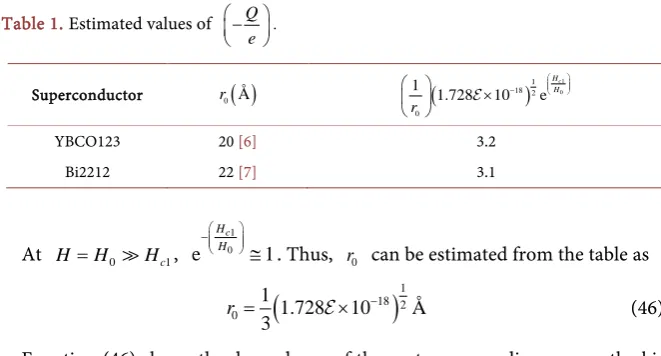
puts the external applied field, at which the vortex core boundaries are clear, at 6T which agrees fully with the experimental procedure that gives 6T. The curve finally ends while it is very close the x-axis where the upper critical field of 120T. Table 1 shows the estimated values of the ratio Q
e
−
from Equation
(44) based on experimental values of r0.
The results from Table 1 have shown that
(
)
10 1 18 2
0 1
1.728 10 e 3
c H H
r
−
× ≈
(45)
(a)
DOI: 10.4236/oalib.1105661 9 Open Access Library Journal
[image:9.595.210.539.61.257.2](c)
Figure 1. Graph of diamagnetisation as a function of applied external magnetic field over the range (a) 0≤H<0.6 T (b) 1 T<H<8 T (c) 0≤H≤Hc2.
Table 1. Estimated values of Q
e
−
.
Superconductor r0
( )
Å(
)
1 0 1 18 2 0
1
1.728 10 e
c
H
H
r
−
×
YBCO123 20 [6] 3.2
Bi2212 22 [7] 3.1
At H=H0 Hc1, 1 0
e 1
c
H H
−
≅ . Thus, 0
r can be estimated from the table as
(
)
118 2 0
1
1.728 10
3 Å
r = × − (46)
Equation (46) shows the dependence of the vortex core radius, r0, on the
netic energy and the diamagnetisation of the super-electrons. Increase in the ki-netic energy increases the centrifugal force on the super-particles and a conse-quent increase in the radius of the vortex core.
3. Conclusion
It has been shown through the working that the radius of the magnetic vortex core, when the boundary is clear, increases with the kinetic energy () of the super-particles.
Conflicts of Interest
The authors declare no conflicts of interest regarding the publication of this paper.
References
[image:9.595.206.537.307.485.2]DOI: 10.4236/oalib.1105661 10 Open Access Library Journal Ginzburg-Landau Equations for an Anisotropic Superconductor. Journal of
Expe-rimental and Theoretical Physics, 45, 1493-1498.
[2] Goldstone, R.J. and Rutherford, P.H. (1995) Introduction to Plasma Physics. Insti-tute of Physics Publishing Ltd., Bristol and Philadelphia.
https://doi.org/10.1201/9781439822074
[3] Gobbon, P. (2017) Introduction to Plasma Physics. arXiv:1705.10529v1 [4] Callen, D.J. (2006) Fundamentals of Plasma Physics.
https://www.scribd.com/document/85976601/fundamentals-of-plasma-physics-200 6
[5] Sonier, J.E. (1999) Investigations of the Core Structure of Magnetic Vortices in Type-II Superconductors by μSR. arXiv.org/pdf/cond-matt/0404115
[6] Mourachine (2004) Determination of the Coherence Length and the Cooper-Pair Size in Unconventional Superconductors by Tunnelling Spectroscopy.
arXiv.org/abs/cond-matt/0405602v1
[7] Sonier, J.E., Brewer, J.H. and Kiefl, R.F. (2000) μSR Studies of the Vortex State in Type-II Superconductors. Reviews of Modern Physics,72, 769.