ISSN Print: 2160-083X
DOI: 10.4236/sm.2019.93010 May 21, 2019 135 Sociology Mind
Ethics as a Game? Towards a Framework for
Game Design
Yuan Yuan
1, Kun Fu
2, Barend Pieter Venter
1*, Thomas Hainey
31Division of Culture and Creativity, Beijing Normal University-Hong Kong Baptist University United International College,
Zhuhai, China
2Digital Media Art Department, Xiamen Academy of Arts and Design, Fuzhou University, Xiamen, China
3School of Engineering and Computing, University of the West of Scotland, Paisley, UK
Abstract
Citizen morality reflects civilization and is significant to society. Ethics edu-cation for improving morality, especially in China, may fail because of its re-liance on lecture-based teaching. Game-based learning presents an innovative approach to ethics education. This paper identifies problems in tertiary ethics education and reviews relevant game design principles before establishing a framework for designing educational games that may assist in ethics educa-tion. It then proposes a game design model for teaching ethics.
Keywords
Games for Learning, Framework, Ethics Teaching, Pedagogy, Game Design
1. Introduction
Even though China’s economy is developing rapidly, its social systems are still relatively lagging behind. Social problems are increasing, in many cases driven by narrow individual interests such as greed. As such, China is facing growing challenges in dealing with social ethical issues, and is facing a situation whereby it begins to suffer costs in terms of its social and economic spheres (Shang, Liu, & Cao, 2019). Since universities and colleges present ideal opportunities for teaching ethics, it is necessary to enhance ethics education at the tertiary level, since students are on the threshold of stepping into society, where they will be required to make ethical decisions. Should they lack moral sensitivity, students may lose their faith in morality, ending up with distorted values and even con-fused ambitions. These will not only impact negatively on their lives, but also on
How to cite this paper: Yuan, Y., Fu, K., Venter, B. P., & Hainey, T. (2019). Ethics as a Game? Towards a Framework for Game Design. Sociology Mind, 9, 135-150. https://doi.org/10.4236/sm.2019.93010
Received: April 23, 2019 Accepted: May 18, 2019 Published: May 21, 2019
Copyright © 2019 by author(s) and Scientific Research Publishing Inc. This work is licensed under the Creative Commons Attribution International License (CC BY 4.0).
DOI:10.4236/sm.2019.93010 136 Sociology Mind
society at large. There is, therefore, a need for tertiary educational institutions to integrate ethics into their study plans and syllabi. Martinkovičová & Benčiková (2017) show the need for this based on their argument that the professional world requires students with ethical competences.
Through observing the model of moral and ethical courses, it was found that the mode of teaching ethics courses is still very much based on the lectur-er-centred mode of delivery. This linear educational mode basically teaches stu-dents about ethical concepts and explains them in certain contexts. However, it lacks reflective and dynamic thinking in a practical setting. Notwithstanding this, some lecturers endeavour to enrich class activities by adopting diverse me-thods, including case analysis (Kalaitzidis & Schmitz, 2012), group discussion
(Dinc & Görgülü, 2002), and role play (Gropelli, 2010; Tuxbury, McCauley, & Lement, 2012; Vanlaere, Coucke, & Gastmans, 2010) to improve students’ un-derstanding of ethical concepts and moral decisions. Through situational analy-sis, students learn how to make decisions when facing ethical dilemmas. How-ever, the lecturer-centred teaching mode cannot fully satisfy students who grew up in an advanced technological and entertaining environment.
2. Methodology
In order to establish the attitudes of students towards the lecturer-centred teaching mode, the authors conducted a pilot study among college students, as well as their teachers, to investigate their perceived attitudes towards an existing ethics course using mainly lectures as its pedagogical approach. The course is entitled “Applied Ethics”.
2.1. Students
A total of 88 students, who have completed this course, were recruited to partic-ipate in this study by means of a purposive sampling method between November and December 2018. The college is small and only has two cohorts of students with small-size classes. In the end, 63 valid questionnaires were returned. The 13-question survey included five questions on individual experiences in lec-ture-based teaching settings and asked respondents to self-report on perceived advantages and disadvantages of lecture-based teaching approaches as well as their expectations of game-based learning. In addition, other questions probed general information about academic background, duration of playing games, and media preferences for receiving education material about ethics.
2.2. Lecturers
DOI: 10.4236/sm.2019.93010 137 Sociology Mind
3. Results
The results of these investigations were interesting, to say the least. Notwith-standing criticism against it as discussed earlier, the lecture-based teaching mode has its positive aspects. A summary of some responses is provided in Table 1.
When discussing the game-based learning approach, respondents had a varie-ty of opinions. They felt that this approach would be interesting and vivid, and that they would be more involved in learning, while learning more from playing games. On the whole, they felt that games would help them absorb knowledge during play, and that its high degree of participation would enhance their un-derstanding and memory. Indeed, it would be easier to focus on learning while playing games, and that time will fly, since they will be more motivated. In sum, respondents felt that learning in a good and happy mood will improve their learning efficiency, and that games would stimulate their curiosity and encour-age learning.
It seems that students and lecturers hold similar opinions regarding the dif-ferent teaching approaches and their effects. Lecturers acknowledged, based on the self-reporting from respondents, that there are problems with the lectur-er-centred approach, and that there is still space to improve existing teaching approaches for this particular ethics course. The positive opinions held by stu-dents regarding game-based learning are supported by the lecturers who teach the ethics course at the selected college. They noted that, in particular, students who are exposed to “exciting” practical subjects such as 3D Animation, Interac-tive Design, Drawing, and Painting (to name a few) will find it hard to be stimu-lated by having to learn theory-oriented courses (such as ethics). Even though the lecturers tried to enrich their teaching approaches, they strongly welcome a supplementary approach which could generate higher levels of motivation in learning ethics.
Interestingly, no matter whether at business schools, medical schools, finance departments, or schools of media and communication, computer-based educa-tional programs have long been used on a large scale to teach discipline-specific skills, for example finance and cashier software. These kinds of software have been very successful in training individual capabilities by replicating real-world professional practice. Just as interestingly, computer programs are seldom (if ever) employed to cultivate philosophical skills such as ethical sensitivity, thinking about issues from divergent viewpoints, resolving ethical conflicts and other similar “soft” skills. Most certainly, computer games have not yet entered this realm.
Table 1. Summary of responses.
Advantages of lecture-centric delivery Disadvantages of lecture-centric delivery
• Provides clear learning objectives • Helps students reach key points directly • Has a clear structure and logic
• Guides students to learn and understand more theories
• Subject matter is too boring to learn • Students lose ability of self-reflection and
thinking
• Students are unable to focus • It is easy to forget the knowledge
DOI:10.4236/sm.2019.93010 138 Sociology Mind
4. Next Phase of Research
Considering the results of the research reported above, a second phase of re-search will be introduced in the next part of this paper: Developing principles governing game design for ethics teaching.
Based on the observation of ethics education in China, it is overwhelmingly the case that the lecture is the principal teaching mode used to develop an ethical awareness among students. It is clear that an engaging and innovative technique for teaching ethics would yield welcome results. It certainly seems that the tech-nological approach would be a necessity in our modern, high-tech society.
It is for this reason that a prototype of a computer game is proposed in order to strengthen ethics education in China, and that is the purpose of this study. In order to examine this proposal more closely, the following broad objectives were identified:
• To describe existing design principles in developing a serious game; and • To define the design approach for developing a serious game for ethics
edu-cation at the college level.
5. Research Context
This paper is based on empirical work conducted by the authors as part of the project “Design and Evaluate Serious Game Application for Teaching Media Courses”, funded by the university that the first and third authors serve. The project is a collaboration between developers in a game company and consul-tants drawn from lecturers at the University of the West of Scotland. The project aims to identify existing empirical evidence associated with the application of computer games in facilitating teaching theoretical courses in the media- and arts-related disciplines, as well as to provide guidelines for designing an appro-priate serious game by producing a design framework and comparing this ap-proach to traditional teaching apap-proaches. By collaborating with the students in the researchers’ college, the project will produce knowledge about teaching and learning with the aid of serious games. However, more empirically, this project aims to:
• develop a game used to facilitate teaching;
• provide an original contribution to knowledge by proposing and validating a
developing framework for serious game environment; and
• identify the effectiveness of the serious game approach and traditional
teach-ing approaches through quantitative experiments.
In order to achieve these aims, a review will be carried out of existing theory as far as design principles and extant theory guiding this field are concerned.
6. Theoretically Informed Design Approach
DOI: 10.4236/sm.2019.93010 139 Sociology Mind
learning. This paper will review the general design principles of developing games for learning, and then aim to construct the design model for constructing instructional games for ethical courses by focusing on dimensionality analysis.
The design-based research approach is used in this study to design serious games applied in theoretical courses in media- and arts-related courses. A review of existing design principles of game-based learning shows that game designers take various elements into account when developing a game for learning. Such elements include behaviorist elements, cognitivist elements, constructivist ele-ments, and combinations of them (Plass, Homer, & Kinzer, 2015). However, there is currently no consensus on the design principles of games for learning.
The educational design framework for learning in this study is based on pe-dagogy, game design principles, and engagement in order to design serious games:
• for learning by considering authenticity; • for learning for pedagogical purposes; • in terms of its narrative; and
• in terms of learner engagement.
A synthesis of literature on previous design principles has been conducted to produce a new design framework for developing a serious game for an ethics course in the media- and arts-related disciplines and is reported below.
7. Literature Review
Four different dimensions (authenticity, pedagogy, narrative, and engagement) were highlighted as seminal to the study and its ultimate aims. Literature was therefore sourced using these dimensions as guides. The discussion of the litera-ture follows below and uses these dimensions as its guiding light.
7.1. Authenticity
Game-based learning plays an important role in education and training, and authenticity plays a key role in this learning context. In fact, authenticity is a crucial factor when designing a motivating game or training device (Anthony, Heiser, & Chandler, 2013). Authenticity is defined as that which is bona fide, real, or actual (Gorman & Hunt, 2000). Fidelity is often used to describe authen-ticity. It is important to note that authenticity in games needs to accurately match the learning expectations of learners in the real world, but does not nec-essarily need to reproduce reality (Gonçalves, Croset, Ney, Balacheff, & Bosson, 2010).
The authentic learning environment in higher education provides real-world experiences. In games, instructional and game developers set up learning goals, values, and expectations. While playing games, students learn knowledge in a meaningful context from which critical thinking and reflection are cultivated
(Kirkwood & Beavers, 2013).
Her-DOI:10.4236/sm.2019.93010 140 Sociology Mind rington (2006) proposed that a high-quality authentic environment is the result of a compromise between “cognitive authenticity” and “physical authenticity”. Functional authenticity should be counted into the subcategories of authenticity
(Anthony et al., 2013). In their work, fidelity is employed instead of authenticity when categorizing the term. Physical fidelity refers to “the look and feel of the environment” (Anthony et al., 2013: p. 123). Functional fidelity is defined as the function or behaviour of the environment and/or its associated components (ib-id). They believe that functional fidelity is part of physical fidelity. Cognitive fi-delity is “how the learner or player must think when successfully navigating the environment and performing the required learning tasks” (ibid). Researchers investigate the associations between physical fidelity and cognitive fidelity. High fidelity does not always lead to better performance in learning (Scerbo & Daw-son, 2007). It may result in cognitive overload and ineffective training (Clark, 2008; Romiszowski, 1993; Smode, 1971). Therefore, it is necessary to consider human perception and information processing (Scerbo & Dawson, 2007).
Gonçalves et al. (2010) discuss three subcategories of authenticity: internal authenticity, external authenticity, and didactical authenticity. Internal authen-ticity refers to the game remains consistent with a logical sequence of real events (ibid). External authenticity is the perceived likeness with real life reference (ib-id). Didactical authenticity is related to appropriation (ib(ib-id). The learners are looking for their own solutions and can apply them to other situations in order to achieve the effect of drawing inferences from one example.
The literature is clear that, no matter how authenticity is categorized, there are three major principles linked to authenticity: Firstly, the game per se should feature as the physical world, secondly, it should follow the logic of real events, and, thirdly, learners can reach certain levels in terms of cognition.
7.2. Pedagogy
Games in computer-based learning can be described as “applications using the characteristics of video and computer games to create engaging and immersive experiences for delivering specified learning goals, outcomes and experiences”
(de Freitas, 2006: p. 9). A growing body of research shows that game-based learning adheres to the constructivist learning mode(Gee, 2003; Schrier, 2006; Dickey, 2005; Good & Robertson, 2004; Dondlinger, 2007). Constructivism seeks to answer the question of how people acquire knowledge and learn (Bada, 2015). The process of learning is not a stimulus-response reaction, but rather an active process in knowledge construction (Bruning, Schraw, Norby, & Ronning, 2004). Knowledge is developed based on the own experiences and reflections of learn-ers (Bereiter, 1994).
DOI: 10.4236/sm.2019.93010 141 Sociology Mind
choices, their knowledge is constructed. In this perspective, the way in which knowledge is constructed in the process of active learning, the process of trial and error is crucial in knowledge construction. Since games for learning are supposed to be designed to simulate real life as a constructivist learning envi-ronment, learners could apply this knowledge in their daily lives. Students might be attracted to come back to keep learning if they find this learning useful.
Games developed for pedagogical purposes must obey certain rules, so that learners in the system engage in an artificial conflict, defined by rules, that re-sults in quantifiable outcomes (Salen & Zimmerman, 2003: p. 300). Oxland (2004) states that computer games need rules, feedback, an interface for the game world, goals, challenges, and a game environment to function effectively. Such games combine possible information technologies to enable gameplay in a virtual environment(Tang, Hanneghan, & El Rhalibi, 2009). Game-based learn-ing is the integration of serious learnlearn-ing and interactive entertainment into a newly emerging, highly engaging, and exciting teaching and learning approach.
Rollings and Adams (2003) declare that the computer game is a subset of a game that deals with an interactive application for entertainment purposes. Therefore, the design principles for game-based learning should comprise two components: pedagogic principles and game design elements.
Pedagogic purposes and game elements both construct the criteria for the de-sign framework of game-based learning. When dede-signing games for learning, game designers borrows certain gaming principles and use them in real-life set-tings that engage players (Trybus, 2015). Principles of game-based learning cov-er five aspects:
1) Intrinsic motivation: playing is by and large voluntary and self-driven; 2) Learning through intense enjoyment and “fun”;
3) Authenticity: contextualized, goal oriented instead of abstract learning; 4) Self-reliance and autonomy: passions and interests that lead to a will to
spe-cialize; and
5) Experiential learning: learning by doing (Perrotta, Featherstone, Aston, & Houghton, 2013).
The mechanism of game-based learning is fairly intricate. It should follow, at least, simple and binary rules (if/then) or may require more complex deci-sion-making. Game-based learning should also provide clear but challenging goals within a fictional setting of “fantasy”, while providing progressively more difficult levels. In addition, it should provide interaction and a high degree of student control, while delivering immediate and constructive feedback. All or these are bonded together by a social element that allows people to share expe-riences and build relationships.
DOI:10.4236/sm.2019.93010 142 Sociology Mind
way. While engaging with the games, students are introduced to concepts and are instructed by making decisions (among others) and eventually reach the in-tended learning outcome. Games based learning is therefore supportive (if done correctly) of the pedagogic requirements of the academic environment.
7.3. Game Narratives
Narrative (story-telling) is a powerful tool when applied in the simulation and game-based training arena (Masse, Pounds, Church, Waters, & Souders, 2015). The narrative framework of game world includes the story world, characters, emotions, narrative interface, and micro-narratives. The narrative arc cultivates players’ ability of in-game research and trial and error. The story elements pro-vide certain context for players to take the challenge and solve problems. Three elements of game narrative, 1) the story, 2) the presentation of discourse, which is the game world as presented by the characteristics of game interactivity and nonlinear plot, and 3) interaction with the game world need to be considered. Interaction with the game world generates the story and constructs the know-ledge which is supposed to be obtained. In this regard, “what happened” is a crucial experience which is generated from both the pre-scripted parts by game designers and creative parts by game players (Dansky & Kane, 2006). Thus, the learner becomes an active partner in learning.
7.3.1. Narrative and Learning
Both instructional designers and game designers need to ensure a balance be-tween story and instruction. Stories play an important role in human beings’ life. Storytelling is a reflective, transformative, and experimental teaching and learn-ing method. It is an effective way to share experiences, pass down history, cul-tural belief and traditions, and imagine the future (Masse et al., 2015). Storytel-ling as a teaching pedagogy has been reinforced by a number of grounded learning theories (Masse et al., 2015). Research supported by the U.S. Depart-ment of Education proved that students with low motivation and weak academic skills intend to study hard in the context of storytelling. Story embedded into the teaching process results in learners recalling content, developing language (Ska-la, 2003), learning mathematics (Butterworth & Lo Cicero, 2001), understanding science concepts (Kukaswadia, 2013), and improving problem-solving skills
(Koenig & Zorn, 2002). Indeed, Egan (1986: p. 459) reminds us that storytelling “encourages us to think of the curriculum as a collection of the greatest stories of our culture”.
DOI: 10.4236/sm.2019.93010 143 Sociology Mind
players can control the objectives on the lowest level. On the next level, players need to accomplish the designer-driven goals. The highest level explains the mo-tivation of the actors. All the stories involved in this type of story are driven by the designer. However, the player-driven approach basically depends on the ex-ploration of players from which players can achieve their own goals (ibid).
Each course, based on the syllabus, comprises a vital part called intended learning outcome (ILO). Learning outcomes (LOs) are the implementation tools for objectives (Greensted & Hommel, 2014). LOs describe what students are able to demonstrate or do upon completion of a unit of study, the course, and the program as a whole. ILOs offered in universities are pre-set by academic com-mittees and field experts. Students are supposed to achieve all of the course in-tended learning outcomes. They do not have much free space to establish their own learning objectives. Notwithstanding a lack of such space, serious games support learning the effect because of the goal-driven characteristics and realistic environment (Qin, 2009). In this sense, the designer-driven approach matches the pedagogical purposes in teaching courses in higher education. Instructional designers and game designers need to work together and integrate game ele-ments and pedagogical purposes.
7.3.2. Adding Value
Technology has always been deemed as an immensely powerful force for change in society. It is effective, innovative, and efficient. Technology not only facilitates life and work, but also promotes the values of society and culture. Computer games, as a special kind of technology, function as a promotional tool to spread social and cultural values. Flanagan and Nissenbaum (2007) articulated a game design methodology called Values at Play (VAP). The preliminary idea is that ethical ideals or human values should be embedded in game design. These values include liberty, justice, inclusion, equality, privacy, security, creativity, trust, and personal autonomy (ibid). In the creation of games and the teaching of game de-sign, creating socially conscious games can be applied to the design of educa-tional games (ibid). The values addressed in Flanagan and Nissenbaum’s work coincides with the main topics of the course Applied Ethics in Media and Cul-tural industries. Therefore, it could be considered as one of the design aspects in developing games for the ethical course.
7.4. Game Engagement
One of the potentially pedagogically powerful aspects of game-based learning is its ability to engage learners actively in the process of learning. Game engage-ment particularly serves to motivate and immerse learners in the learning process.
7.4.1. Motivation
corre-DOI:10.4236/sm.2019.93010 144 Sociology Mind
lated with learning in game-based techniques (Gee, 2007; Prensky, 2005; Squire, 2011; Rowe, Shores, Mott, & Lester, 2011). One of the most frequently cited rea-sons to consider games for learning is that games can affect students learning motivation and engagement (Sabourin & Lester, 2014). A growing body of re-search shows that interest is one of the critical factors influencing students’ en-gagement with educational software (Muldner, Burleson, Sand, & Vanlehn, 2010; Baker, Corbett, Koedinger, & Wagner, 2004; Beal, Qu, & Lee, 2006). That is because the mechanics in games encompassing rules, clear objectives, assessa-ble goals, as well as cooperation and competition encourage an interactive expe-rience which further generate a sense of achievement. Learners are often moti-vated by the hands-on learning opportunities which may pull them back to learn more. Kapp (2012) argues that, because of its game-like features and environ-ments, educational games positively influence learners’ affect, engagement, and motivation. In this regard, the subjective experiences of players are the core rea-sons explaining engagement in games (Kiili, de Freitas, Arnab, & Lainema, 2012).
7.4.2. Immersion
The majority of research regarding games accounts for the following topics: flow, immersion, presence, and cognitive absorption (Agarwal & Karahanna, 2000; Brown & Cairns, 2004; McMahan, 2003; Witmer & Singer, 1998). A widely used term, immersion, is a crucial element in consideration of game enjoyment
(Brown & Cairns, 2004; Nacke & Lindley, 2008; Jennett, Cox, Cairns, Dhoparee, Epps, Tijs, & Walton, 2008; Jennett, Cox & Cairns, 2009; Hooi & Cho, 2012). Immersion can be defined as “the sensation of being surrounded by a completely other reality […] that takes over all of our attention, our whole perceptual appa-ratus” (Murray, 1997: p. 98).
Computer games provide immersive sense for players(Nordin, Ali, Anima-shaun, Asch, Adams, & Cairns, 2013; Brown & Cairns, 2004; Thompson, Nor-din, & Cairns, 2012). Playing games result in lack of awareness of the real world
(Sweetser & Wyeth, 2005; Jennett et al., 2008; Qin, Rau, & Salvendy, 2010; Hooi & Cho, 2012). Because of the rigid rules, specific goals, and difficult levels, the player is immersed while interacting with the game. Sweetser and Wyeth (2005)
DOI: 10.4236/sm.2019.93010 145 Sociology Mind
8. Proposed Design Model
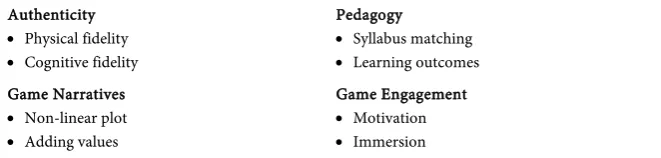
Based on the above reviewed design principles and elements, the research team proposed a model that combined pedagogy as well as other identified game de-sign principles, which is reflected in Figure 1 on the next page. The preliminary goal is to establish an educational game design model for teaching ethical courses. The model combines four dimensions: authenticity, pedagogy, game narratives, and game engagement. Under authenticity, physical fidelity and cog-nitive fidelity will be the focus. Both dimensions are important in designing game for learning. Through the special virtual learning environment, the cogni-tive effect is enhanced. As for the pedagogical dimension, the focal point is on the degree to which the game will achieve the intended learning outcomes. For this objective, the game will be designed based on selected themes covered in the course of “Applied Ethics”. Upon completion of the gameplay, students will be simultaneously obtaining the assessments in which assess their learning effect.
This model, as a supplementary teaching and learning approach, is designed both for self-learning and traditional lecture-based teaching. Therefore, a com-puter game will be used either during lecture time or after class activity. Game narrative will be the reference point for game designers to design non-linear plot and adding social and cultural value into the games. The fourth dimension, game engagement, is to be applied to evaluate the students’ motivation and im-mersion compared to traditional lecture-based lessons.
9. Conclusion
Scholars have proposed varied game design models and developed several real educational games for pedagogical purposes. Their attractiveness and positive effects have been proved by a number of empirical research projects. The model proposed in this paper intends to add more knowledge to ethics course games design. It calls for future investigation of the improvement in game-based learn-ing in ethics. These game design principles for ethics education will be devel-oped based on the proposed model. The subsequent experiment will test:
1) the differences between the traditional lecture-based teaching approach and game-based learning;
2) the degree of students’ motivation and engagement; and
3) the effectiveness of obtaining knowledge matching the intended learning outcomes.
Authenticity • Physical fidelity • Cognitive fidelity
Pedagogy
• Syllabus matching • Learning outcomes Game Narratives
• Non-linear plot • Adding values
[image:11.595.206.537.627.706.2]Game Engagement • Motivation • Immersion
DOI:10.4236/sm.2019.93010 146 Sociology Mind
The on-going research will provide some insight into games design for teach-ing and learnteach-ing ethics and, in doteach-ing so, contribute to the improvement of social morality.
Conflicts of Interest
The authors declare no conflicts of interest regarding the publication of this pa-per.
References
Agarwal, R., & Karahanna, E. (2000). Time Flies When You’re Having Fun: Cognitive
Absorption and Beliefs about Information Technology Usage. MIS Quarterly, 24,
665-694.https://doi.org/10.2307/3250951
Anthony, M., Heiser, E., & Chandler, T. (2013). Authenticity in Learning Games. In T. S. Hussain, & S. L. Coleman (Eds.), Design and Development of Training Games: Practic-al guidelines from a Multidisciplinary Perspective (pp. 121-145). Cambridge:
Cam-bridge University Press. https://doi.org/10.1017/CBO9781107280137.006
Bada, S. O. (2015). Constructivism Learning Theory: A Paradigm for Teaching and Learning. JournalofResearch& Method in Education, 5, 66-70.
Baker, R. S., Corbett, A. T., Koedinger, K. R., & Wagner, A. (2004). Off Task Behavior in
the Cognitive Tutor Classroom: When Students Game the System. In Proceedings of
SIGCHI Conference Human Factors in Computing Systems (pp. 383-390). New York:
ACM.https://doi.org/10.1145/985692.985741
Beal, C. R., Qu, L., & Lee, H. (2006). Classifying Learner Engagement through Integration of Multiple Data Sources. In Proceedings of Conference Artificial Intelligence (pp. 151-156). Menlo Park, CA: AAAI Press.
Bereiter, C. (1994). Constructivism, Socioculturalism, and Popper’s World 3. Educational Researcher, 23, 21-23. https://doi.org/10.3102/0013189X023007021
Brown, E., & Cairns, P. (2004). AGroundedInvestigationofGameImmersion. In CHI 2004, ACM Conference on Human Factors in Computing (pp. 1297-1300). New York:
ACM Press.https://doi.org/10.1145/985921.986048
Bruning, R., Schraw, G., Norby, M., & Ronning, R. (2004). CognitivePsychologyand In-struction. Upper Saddle River, NJ: Prentice Hall.
Butterworth, S., & Lo Cicero, A. M. (2001). Storytelling: Building a Mathematics Curri-culum from the Culture of the Child. Teaching Children Mathematics, 7, 396-399. Clark, R. D. (2008). Building Expertise: Cognitive Methods for Training and Performance
Improvement (A Publication of the International Society for Performance Improve-ment). San Francisco, CA: Pfeiffer.
Dansky, R., & Kane, B. (2006). Book Excerpt and Review—Game Writing: Narrative
SkillsforVideogames.
https://www.gamasutra.com/view/feature/130255/book_excerpt_and_review__game_.
php?page=15
De Freitas, S. (2006). LearninginImmersiveWorlds. London: Joint Information Systems Committee.
Dickey, M. D. (2005). Engaging by Design: How Engagement Strategies in Popular
Computer and Video Games Can Inform Instructional Design. Educational
Technolo-gyResearchandDevelopment, 53, 67-83.https://doi.org/10.1007/BF02504866
DOI: 10.4236/sm.2019.93010 147 Sociology Mind https://doi.org/10.1177/096973300200900305
Dondlinger, M. J. (2007). Educational Video Game Design: A Review of the Literature.
JournalofAppliedEducationalTechnology, 4, 21-31.
Egan, K. (1986). Teachingas StoryTelling: AnAlternativeApproach toTeaching and
CurriculumintheElementarySchool. Chicago: University of Chicago Press.
Ermi, L., & Mayra, F. (2005). Fundamental Components of the Gameplay Experience: Analyzing Immersion. In S. Castell, & J. Jenson (Eds.), Changing Views: Worlds in Play, Selected Papers of the 2005 Digital Games Research Association’s Second Inter-national Conference (pp. 15-27). Vancouver: Digital Games Research Association & Simon Fraser University.
Flanagan, M., & Nissenbaum, H. (2007). A Game Design Methodology to Incorporate
Social Activist Themes. In Proceedings of the SIGCHI Conference on Human Factors
in Computing Systems (pp. 181-190). New York: ACM.
https://doi.org/10.1145/1240624.1240654
Gee, J. P. (2007). GoodVideo Gamesand GoodLearning: Collected Essays onVideo
Games,LearningandLiteracy (2nd ed.). New York: P. Lang.
https://doi.org/10.3726/978-1-4539-1162-4
Gee. J. P. (2003). WhatVideoGamesHavetoTeachUsaboutLearningandLiteracy. New York: Palgrave Macmillan. https://doi.org/10.1145/950566.950595
Gerling, K. M., Birk, M. M., Regan, L., & Doucette, A. (2013) The Effects of Graphical
Fi-delity on Player Experience. In ProceedingsofInternational ConferenceonMaking
SenseofConvergingMedia (p. 229). New York: ACM.
https://doi.org/10.1145/2523429.2523473
Gonçalves, C., Croset, M. C., Ney, M., Balacheff, N., & Bosson, J. L. (2010) Authenticity in Learning Game: How It Is Designed and Perceived. In M. Wolpers, P. A. Kirschner, M. Scheffel, S. Lindstaedt, & V. Dimitrova (Eds.), Sustaining TEL:From Innovationto LearningandPractice (pp. 109-122). Berlin: Springer.
https://doi.org/10.1007/978-3-642-16020-2_8
Good, J., & Robertson, J. (2004). Computer Games Authored by Children: A Mul-ti-Perspective Evaluation. InProceedings of the 2004 Conference on Interaction Design and Children: Building a Community (pp. 123-124). New York: ACM.
https://doi.org/10.1145/1017833.1017852
Gorman & Hunt (2000). 19 S.W.3d 662 (Ky).
Greensted, C., & Hommel, U. (2014). Intended Learning Outcomes—Friend or Foe?
EFMDGlobal Focus, 8, 20-25.
Gropelli, T. M. (2010). Using Active Simulation to Enhance Learning of Nursing Ethics.
The Journal of Continuing Education in Nursing, 41, 104-105.
https://doi.org/10.3928/00220124-20100224-09
Herrington, T., & Herrington, J. (2006). AuthenticLearning Environments in Higher Education. Hershey, PA: Information Science Publishing.
https://doi.org/10.4018/978-1-59140-594-8
Hooi, R., & Cho, H. (2012). Being Immersed: Avatar Similarity and Self-Awareness. In
Proceedings of the 24th Australian Computer-Human Interaction Conference (pp.
232-240). New York: ACM.https://doi.org/10.1145/2414536.2414576
Jennett, C., Cox, A. L., & Cairns, P. (2009). Investigating Computer Game Immersion and
the Component Real World Dissociation. In CHI’09 Extended Abstracts on Human
Factors in Computing Systems (pp. 3407-3412). New York: ACM.
DOI:10.4236/sm.2019.93010 148 Sociology Mind Jennett, C., Cox, A. L., Cairns, P., Dhoparee, S., Epps, A., Tijs, T., & Walton, A. (2008).
Measuring and Defining the Experience of Immersion in Games. InternationalJournal
ofHuman-Computer Studies, 66, 641-661.https://doi.org/10.1016/j.ijhcs.2008.04.004
Kalaitzidis, E., & Schmitz, K. (2012). A Study of an Ethics Education Topic for Under-graduate Nursing Students. NurseEducationToday, 32, 111-115.
https://doi.org/10.1016/j.nedt.2011.02.006
Kapp, K. (2012). TheGamification ofLearningandInstruction:Game-Based Methods
andStrategiesforTrainingandEducation. San Francisco, CA: Pfeiffer.
https://doi.org/10.1145/2207270.2211316
Kiili, K., de Freitas, S., Arnab, S., & Lainema, T. (2012). The Design Principles for Flow Experience in Educational Games. ProcediaComputer Science, 15, 78-91.
https://doi.org/10.1016/j.procs.2012.10.060
Kirkwood, D., & Beavers, E. (2013). Create an Authentic, Inclusive Early Childhood
Learning Environment for Teacher Candidates. Dimensions ofEarlyChildhood, 41,
3-9.
Koenig, J., & Zorn, C. (2002). Using Storytelling as an Approach to Teaching and Learn-ing with Diverse Students. JournalofNursingEducation, 41, 393-399.
Kukaswadia, A. (2013). Science and Storytelling: The Use of Stories in Science Education.
https://blogs.plos.org/scied/2013/06/24/science-and-storytelling-the-use-of-stories-in-s
cience-education
Martinkovičová, M., & Benčiková, D. (2017). The Ethical Competence of Graduates as
Part of Their Professional Competence. Scientific Papers of Silesian University of
Technology: Organization and Management, No. 110, 139-150.
https://doi.org/10.29119/1641-3466.2017.110.13
Masse, C. Pounds, K., Church, E., Waters, R. E., & Souders, V. (2015). Story for Learning
and Gaming. In T. S. Hussain, & S. L. Coleman (Eds.), DesignandDevelopmentof
Training Games: Practical Guidelines from a Multidisciplinary Perspective (pp. 93-120). Cambridge: Cambridge University Press.
https://doi.org/10.1017/CBO9781107280137.005
McMahan, A. (2003). Immersion, Engagement, and Presence: A Method for Analyzing
3-D Video Games. In M. J. P. Wolf, & B. Perron (Eds.), The Video Game Theory
Reader (pp. 67-86). Abingdon-on-Thames: Routledge, Taylor & Francis Group. Muldner, K., Burleson, W., Van de Sand, B., & VanLehn, K. (2010). An Analysis of
Gam-ing Behaviors in an Intelligent TutorGam-ing System. In V. Aleven, J. Kay, & J. Mostow (Eds.), Intelligent Tutoring Systems (pp. 184-193). Lecture Notes in Computer Science, Vol. 6094, Heidelberg: Springer.https://doi.org/10.1007/978-3-642-13388-6_23
Murray, J. H. (1997). HamletontheHolodeck:TheFutureofNarrativeinCyberspace.
Cambridge, MA: The MIT Press.
Nacke, L., & Lindley, C. A. (2008). Flow and Immersion in First-Person Shooters:
Mea-suring the Player’s Gameplay Experience. In Proceedings of the 2008 Conference on
Future Play: Research, Play, Share (pp. 81-88). New York: ACM.
https://doi.org/10.1145/1496984.1496998
Nordin, A. I., Ali, J., Animashaun, A., Asch, J., Adams, J., & Cairins, P. (2013). Attention,
Time Perception and Immersion in Games. In Progress CHI 2013 Changing
Perspec-tives on Human Factors in Computing Systems (pp. 1089-1094). New York: ACM.
https://doi.org/10.1145/2468356.2468551
Oxland, K. (2004). GameplayandDesign. Boston, MA: Addison Wesley.
DOI: 10.4236/sm.2019.93010 149 Sociology Mind
LatestEvidenceandFutureDirections. Slough: NFER.
Plass, J. L., Homer, B. D., & Kinzer, C. K. (2015). Foundations of Game-Based Learning.
EducationalPsychologist, 50, 258-283.https://doi.org/10.1080/00461520.2015.1122533
Prensky, M. (2005). Computer Games and Learning: Digital Game-Based Learning. In J. Raessens, & J. Goldstein (Eds.), Handbook ofComputerGameStudies (Vol. 18, pp. 97-122). Cambridge, MA: MIT Press.
Qin, H. (2009). StudyonPlayerImmersionandDifficultyintheComputerGame
Narra-tive. Doctoral Thesis, Beijing: Tsinghua University.
https://doi.org/10.1080/10447310802546732
Qin, H., Rau, P. L. P., & Salvendy, G. (2009). Measuring Player Immersion in the
Com-puter Game Narrative. International Journal of Human-Computer Interaction, 25,
107-133.https://doi.org/10.1080/10447310802546732
Qin, H., Rau, P. L. P., & Salvendy, G. (2010). Effects of Different Scenarios of Game Dif-ficulty on Player Immersion. InteractingwithComputers, 22, 230-239.
https://doi.org/10.1016/j.intcom.2009.12.004
Rollings, A., & Adams, E. (2003). AndrewRollingandErnestAdamsonGameDesign. New Riders.
Romiszowski, A. J. (1993). Psychomotor Principles. In M. Fleming, & W. H. Levie (Eds.),
InstructionalMessageDesign:Principles fromtheBehavioralandCognitiveSciences
(2nd ed.).Englewood Cliffs, NJ: Educational Technology Pubns.
Rowe, J. P., Shores, L. R., Mott, B. W., & Lester, J. C. (2011). Integrating Learning,
Prob-lem Solving, and Engagement in Narrative-Centered Learning Environments.
Interna-tional Journal of Artificial Intelligence in Education, 21, 115-133.
Sabourin, J. L., & Lester, J. C. (2014). Affect and Engagement in Game-Based Learning Environments. IEEETransactionsonAffectiveComputing, 5, 45-56.
https://doi.org/10.1109/T-AFFC.2013.27
Salen, K., & Zimmerman, E. (2003). Rules ofPlay:GameDesign Fundamentals. Cam-bridge, MA: The MIT Press.
Scerbo, M. W., & Dawson, S. (2007). High Fidelity, High Performance? Simulation in Healthcare, 2, 224-230.https://doi.org/10.1097/SIH.0b013e31815c25f1
Schrier, K. (2006). Using Augmented Reality Games to Teach 21st Century Skills. In
ACM SIGGRAPH 2006 Educators Program (p. 15). New York: ACM.
https://doi.org/10.1145/1179295.1179311
Shang, D., Liu, G., & Cao, S. (2019). Why Are Chinese Ethics Declining? Time & Society, 28, 438-453.https://doi.org/10.1177/0961463X16658803
Skala, C. (2003). OptimizingBasicFrenchSkillsUtilizingMultipleTeachingTechniques
(p. 31). ERIC Accession No. 479988, Unpublished Master’s Thesis, Chicago, IL: St. Xavier University.
Smode, A. F. (1971). HumanFactorsInputstotheTrainingDeviceDesignProcess. Squire, K. (2011). VideoGamesandLearning:TeachingandParticipatoryCultureinthe
Digital Age. Technology, Education—Connections (The TEC Series), New York: Teachers College Press.
Sweetser, P., & Wyeth, P. (2005). GameFlow: A Model for Evaluating Player Enjoyment in Games. Computersin Entertainment (CIE), 3, 1-24.
https://doi.org/10.1145/1077246.1077253
Inter-DOI:10.4236/sm.2019.93010 150 Sociology Mind
faces (pp. 1-17). New York: IGI Global.
https://doi.org/10.4018/978-1-60566-360-9.ch001
Thompson, M., Nordin, I., & Cairns, P. (2012). Effectof Touch-ScreenSizeonGame Immersion. In Proceedings of the 26th Annual BCS Interaction Specialist Group Con-ference on People and Computers (pp. 280-285). Swindon: BCS Learning & Develop-ment Ltd.
Trybus, J. (2015). Game-Based Learning: What It Is, Why It Works, and Where It’s
Going. Miami: New Media Institute.
http://www.newmedia.org/game-based-learning--what-it-is-why-it-works-and-where-i
ts-going.html
Tuxbury, J. S., McCauley, P. M., & Lement, W. (2012). Wall McCauley PM and Lement W. Nursing and Theatre Collaborate: An End-of-Life Simulation Using Forum Thea-tre. Journal of Nursing Education, 51, 462-465.
https://doi.org/10.3928/01484834-20120615-02
Vanlaere, L., Coucke, T., & Gastmans, C. (2010). Experiential Learning of Empathy in a Care-Ethics Lab. Nursing Ethics, 17, 325-336.
https://doi.org/10.1177/0969733010361440
Witmer, B. G., & Singer, M. J. (1998). Measuring Presence in Virtual Environments: A
Presence Questionnaire. Presence, Teleoperators and Virtual Environments, 7,