CONSUMER PERCEPTION TOWARDS CONSUMER LOANS WITH REFERENCE TO NBFC’s IN
*Soumya Steephan
Department of Management Studies, Karpagam College of Engineering, Myleripalayam, Coimbatore
ARTICLE INFO ABSTRACT
The Consumer finance in India has experiences extraordinary change in it’s
Non –Banking financial entities all over India. And it aims to study the various factors that influence the decision of the consumer for taking consumer loan
offered by NBFC’S’s
economic factors have significant impact on consumers’ attitudes towards consumer loans
Copyright © 2015 Soumya Steephan and John William.
unrestricted use, distribution, and reproduction in any medium, provided the original work is properly cited.
INTRODUCTION
A Non-Banking Finance Company (NBFC’S) is a company registered under the Indian Companies Act of 1956 and is engaged in the business of loans and advances, acquisition of shares/stocks/bonds/debentures/securities issued by government or local authority, leasing, hire
insurance business, and chit business. The NBFC’Ss such as a equipment leasing company, a hire-purchase company, a loan company, investment company, or residuary non
company, are registered with RBI. To obviat
certain categories of NBFC’Ss, which are regulated by other regulators, are exempt from the requirement of registration with the Reserve Bank of India (RBI). These include venture capital funds, merchant banking companies, stock broking companies registered with Securities and Exchange Board of India (SEBI), insurance company holding a valid Certificate of Registration issued by Insurance Regulation and Development Authority (IRDA), nidhi companies as notified under Section 620A of the Companies Act, 1956, chit companies as defined in clause (b) of section 2 of the Chit Funds Act, 1982 or
*Corresponding author: Soumya Steephan,
Department of Management Studies, Karpagam College of Engineering, Myleripalayam, Coimbatore-641032, Tamil
ISSN: 0975-833X
Article History:
Received 06th May, 2015
Received in revised form 10th June, 2015
Accepted 03rd July, 2015
Published online 21st August,2015
Key words:
NBFC’S, Consumer loan, Consumer Attitude, Demographic factors.
Citation: Soumya Steephan and John William, A.
Coimbatore District”, International Journal of Current Research
REVIEW ARTICLE
CONSUMER PERCEPTION TOWARDS CONSUMER LOANS WITH REFERENCE TO NBFC’s IN
COIMBATORE DISTRICT
Soumya Steephan and John William, A.
Department of Management Studies, Karpagam College of Engineering, Myleripalayam, Coimbatore
Tamil Nadu, India
ABSTRACT
The Consumer finance in India has experiences extraordinary change in it’s
Banking financial entities all over India. And it aims to study the various factors that influence the decision of the consumer for taking consumer loan. This paper focuses on the Consumer loan offered by NBFC’S’s. Further the Results of the study revealed that basic demographic and socio economic factors have significant impact on consumers’ attitudes towards consumer loans
. This is an open access article distributed under the Creative Commons Att use, distribution, and reproduction in any medium, provided the original work is properly cited.
Banking Finance Company (NBFC’S) is a company registered under the Indian Companies Act of 1956
and is engaged in the business of loans and advances, acquisition of shares/stocks/bonds/debentures/securities issued cal authority, leasing, hire-purchase, insurance business, and chit business. The NBFC’Ss such as a purchase company, a loan company, investment company, or residuary non-banking company, are registered with RBI. To obviate dual regulation, certain categories of NBFC’Ss, which are regulated by other regulators, are exempt from the requirement of registration with the Reserve Bank of India (RBI). These include venture capital funds, merchant banking companies, stock broking companies registered with Securities and Exchange Board of India (SEBI), insurance company holding a valid Certificate of Registration issued by Insurance Regulation and Development Authority (IRDA), nidhi companies as notified under Section mpanies Act, 1956, chit companies as defined in clause (b) of section 2 of the Chit Funds Act, 1982 or
Department of Management Studies, Karpagam College of
641032, Tamil Nadu, India.
housing finance companies regulated by National Housing Bank. Though they are doing functions akin to that of banks, they cannot accept demand deposits, and cannot be a part of the payment and settlement system.
Company profile
Bajaj finserv
Bajaj Finserv was formed in April 2007 as a result of its demerger from Bajaj Auto Limited to further the Group’s interests in financial services. This demerger enabled Bajaj Finserv to independently run the core businesses of Lending, Insurance and Wealth Advisory. Bajaj Finserv Limited is the holding company for the financial services businesses of the Bajaj Group. Its insurance joint ventures with Allianz SE, Germany namely Bajaj Allianz Life Insurance Company Limited and Bajaj Allianz General I
Limited are engaged in life and general insurance business respectively. Its subsidiary Bajaj Finance Limited is a Non Banking Finance Company engaged in consumer finance, SME finance and commercial lending. Bajaj Financial Solutions Limited, a wholly owned subsidiary of Bajaj Finserv Limited, is engaged in wealth advisory business. At Bajaj Finserv, we operate with a simple philosophy of never settling for good, and always aiming for great. Our wide and growing
International Journal of Current Research
Vol. 7, Issue, 08, pp.19246-19253, August, 2015
INTERNATIONAL
a Steephan and John William, A. 2015. “Consumer perception towards consumer loans with reference to NBFC’
International Journal of Current Research, 7, (8), 19246-19253.
CONSUMER PERCEPTION TOWARDS CONSUMER LOANS WITH REFERENCE TO NBFC’s IN
Department of Management Studies, Karpagam College of Engineering, Myleripalayam, Coimbatore-641032,
The Consumer finance in India has experiences extraordinary change in it’s with a large number of Banking financial entities all over India. And it aims to study the various factors that influence This paper focuses on the Consumer loan of the study revealed that basic demographic and socio-economic factors have significant impact on consumers’ attitudes towards consumer loans
nder the Creative Commons Attribution License, which permits
housing finance companies regulated by National Housing Bank. Though they are doing functions akin to that of banks, they cannot accept demand deposits, and cannot be a part of the payment and settlement system.
Bajaj Finserv was formed in April 2007 as a result of its demerger from Bajaj Auto Limited to further the Group’s interests in financial services. This demerger enabled Bajaj Finserv to independently run the core businesses of Lending, nd Wealth Advisory. Bajaj Finserv Limited is the holding company for the financial services businesses of the Bajaj Group. Its insurance joint ventures with Allianz SE, Germany namely Bajaj Allianz Life Insurance Company Limited and Bajaj Allianz General Insurance Company Limited are engaged in life and general insurance business respectively. Its subsidiary Bajaj Finance Limited is a Non-Banking Finance Company engaged in consumer finance, SME finance and commercial lending. Bajaj Financial ed, a wholly owned subsidiary of Bajaj Finserv Limited, is engaged in wealth advisory business. At Bajaj Finserv, we operate with a simple philosophy of never settling for good, and always aiming for great. Our wide and growing INTERNATIONAL JOURNAL OF CURRENT RESEARCH
portfolio of products across lending, insurance and wealth advisory bears testimony to this belief.
TCI finance limited
TCI Finance Limited is a financial company which operates as a nonbanking finance institution principally in India. The company was incorporated in 1973. The registered headquarters of the company is located in Secunderabad, India. The company is publicly traded on the Bombay Stock Exchange under the ticker symbol TCIFINANCE TCI Finance provides financial services such as leasing, investments, corporate finance and bills discounting, merchant banking, and hire purchase. The company has branch offices situated in Pune, Bangalore, Coimbatore, Chennai, Ernakulum, Guwahati, Indore, Ahmadabad, Kolkata, Jaipur, Mumbai, and New Delhi. TCI Finance aims to: carry on the business of financing and hire purchase in all its branches and in any movable and immovable goods and property of any description and to carry on business as mortgage brokers, financial agent and to do all sorts of financing and guaranteeing business including hire purchase business; carry on the business of capitalists, financiers, concessionaires for merchants, importers and exporters, commercial traders, commercial agents and for purchasing selling business; carry on the business of investment company and invest and acquire, hold, sell and otherwise deal in shares, debenture stock, bonds, obligations and securities issued or guaranteed by any company or by any government, state, public body or authority, whether in India or elsewhere; and deal with and invest the moneys of the company in such manner and upon such securities as shall, from time to time, be thought necessary or fit for the benefit of the company, and to lend, advance or deposit money, securities and property, with or without charge, interest or security.
Mahindra financial services
Mahindra and Mahindra Financial Services is one of India’s premier non-banking finance companies (NBFC) and the largest NBFC operating in rural India. We have offices in the areas we serve so that we can provide our customers with personalized finance solutions, and we employ over 16,000 people who truly understand our customers. By providing loans to our customers based on their future earnings, we help people open businesses when they couldn’t get started otherwise. We understand that it takes money to make money. We fund utility vehicles, tractors, and cars, construction equipment, personal loans, and homes for over three million customers, and we offer low-risk fixed deposit banking and advise customers on investments in mutual funds. Our goal is not only to build a better financial services company, but to enable India’s future growth.
Muthoot finance limited
“Desire is the key to motivation, but it’s determination and commitment to an unrelenting pursuit of your goal — a commitment to excellence — that will enable you to attain the success you seek.” — Mario Andretti
Growth and money cannot sustain an organization for as long as uniqueness and excellence can. We at Muthoot Finance Limited are harbingers of this belief since our inception. Moreover, being a part of the rapidly growing family, Muthoot Group, fosters in our culture, profound values of integrity, honesty and humility. The focus of the company is on creating liquidity with an asset class, namely gold, that has the largest consumer market in India. We see it as one of the pre-eminent ways of creating wealth in the economy. With over 6 million loan accounts in its loan portfolio, Muthoot Finance is recognized as a pioneer in gold financing. Undoubtedly, gold funding is our niche; nonetheless our lendings are not restricted to gold loans. An assorted asset portfolio impels us on the road to pioneer a competent financial market. At Muthoot Finance, we understand the responsibility that rests on our shoulders. Being a company with an increasing asset base, we take upon ourselves the onus of ensuring smoother processes of monetary transactions, whether they are money transfer, gold loans or gold bonds.
Review of Literature
Gudadhe 2013 discussed about the customer perception towards products and services of State Bank of India. The author has focused on research by taking into account branches of Yavatma district. The article discussed about the SBI Bank Group wise perception and satisfaction level of customers, the availability and use of products and services given by the bank. The author concluded by stating that the customer expect higher quality services from banks which, if fulfilled, could result in significantly improved customer satisfaction levels. 99.27% customers expressed their satisfaction towards the services.
Rao 2013 discussed about the perception and problems of home loan takers in Andhra Pradesh. The author has focused on research by taking into account HDFC and SBI bank. The paper discussed about the Housing Policy frame work, trends and progress in Housing Finance, the operational performance of HDFC and SBI with regard to providing housing finance to individuals, perception and problems of home loan takers in the State of Andhra Pradesh. The author concluded by stating that the Housing Finance in India faced a number of set-back in decades but the designing of a shelter policy, the organization of the housing finance market, the introduction of fiscal incentives have bought about a number of changes in the housing finance. The services and product innovations are the key tools for success.
customers and their choice of a particular type of bank were independent of each other.
Tiwari 2014 discussed about the trends, developments and issues in financing home ownership in India. The paper discusses about the resources involved in housing finance in India, an overview of the pricing of housing finance and the funding of the government during the planning periods. The paper also focuses on the housing finance aspects for the urban poor.
Kumara Swami and Nayan 2014 discussed about the importance of housing finance and the institutions providing housing finance. A detailed discussion of the marketing strategies adopted by financing institutions have been discussed by taking into account the loan criteria eligibility, loan amount, interest rate, security, loan tenure, margin and processing fee. Finally the paper highlights the performance of the housing sector, major findings and suggestions to improve the effective marketing of housing finance for both public and private sector banks.
Gupta and Jain 2012focused on the various practices adopted by cooperative banks in India and made a comparison of the cooperative banks with respect to their efficiency with respect to lending practices. The major findings of the study showed that majority (32% as per the study) of the respondent were having housing loan for the bank under study, most (64% as per the study) of the people prefer to take long term loan which is more than 3 years, there is a very simple procedure followed by bank for loan, easy repayment and less formalities are the main factors determining customer’s selection of loans, quality of services provided by the staff is satisfactory because bank is catering to a small segment only and the customers are properly dealt with, customers are satisfied with the mode of repayment of installments, average time for the processing of loan is less i.e. approx 7 days. The authors also suggested measures to improve the efficiency of the Cooperative banks.
Ghosh 2012 in his study mainly focused on the guidelines followed by commercial banks in India regarding the appraisal process of housing loans with specific reference to Indian Overseas Bank.
Hingorani and Tiwari 2013in the paper evaluated the present issues and challenges in the Indian urban housing market and gave suggestions for tools and approaches that can guide movement towards a more holistic approach.
Mishra 2011discussed about the overall resources invested by housing finance company in India since their incorporation and identified the area where efficiency can be improved and cost reduction is possible for optimum and effective utilization of resources.
Sridharan 2014 in the paper made an analysis of the Indian demographics and how, correspondingly, the housing finance sector has evolved. According to the author “Although there are various Government of India initiatives as well as schemes of institutions like World Bank and its members like the International Finance Corporation (IFC), there still exists a
challenge at the ground level: the simple availability or production of affordable housing projects.”
Doddaraju 2013 presented a study on customer satisfaction towards public and private sector banking services with special reference to the Anantpur District of Andhra Pradesh concluded that satisfaction level with regard to public sector units courtesy shown by bank staff at the counter is very low. Therefore, the banks should pay special attention to “Human Resource Development” by giving timely training to the employees
Raman and Gayatri 2004 have observed the customers’ awareness towards non banking companies. They found that 53% of the respondents belong to the age group below 30, 24% to the age group 31-40, 2% belong to the age group of 41-50 and the rest of the respondents belong tothe group of ‘above 50’.
Mushtaq A Bhat 2005 concluded in their empirical study that non banking finance fall much below the perceptions of their customers on all the five dimensions of service quality, where as in case of foreign banks, these banks are exceeding the perceptions of their customers on two dimensions of service quality namely; tangibility and reliability. In case of foreign banks perceptions and expectations of the customers about service quality offered by the banks do not have a big gap.
Linda Mary Simon 2012 A study on customer perception towards services provided by Public sector bank and Private sector bank in Coimbatore region reveals that private bank is providing better services to its customers than the public sector bank. It is evident that public sector banks have a strong presence in the market, but in recent times they are facing stiff competition from private sector banks in the range and quality of services offered.
Surbhi Singh and Renu Arora 2011 presented a paper on a comparative study of banking services and customer satisfaction in public, private and foreign banks of Delhi and this study shows that the customers of nationalized banks were not satisfied with the employee behavior and infrastructure, while respondents of private and foreign banks were not satisfied with high charges, accessibility and communication
Statement of the problem
Non banking finance company need to prepare customized solutions to different consumers as per their needs and requirement
Rate of interest is the most preferred option by the consumers r in consumer loans
Installment are the major factor that had influenced by the respondents
Trust on institution act as a major influencing factors when consumer selecting the NBFC’s
Objectives of the study
To study the factors influencing consumer perception.
To study the service offered by the NBFC’s they select
To know that what kind of people maximum using the consumer loan service from non banking finance companies
To know the expectations from the consumers to develop that non banking finance companies services
Sample design
In the consumer market research there is a problem of selecting a sample of few hundred respondents from a vast population. The reason for sampling is that it is not possible to cover the entire population in the field research.
Sampling Method
This study is based on probability sampling method. Each sampling unit in the defined target population has a known, non-zero probability of being selected for the sample. In probability sampling simple random sampling is being used. This appears very easy to do when there is a relatively small number of people to pick from randomly.
Sampling Size
The number of elements of the population to be sampled is chosen a sample size is 135.
Determination of sample size
Formula to be used:
X2 NP (1-P) S= ______________
d2 (N-1) + X2P(1-P)
Where,
S=Sample size
X=Z value (e.g.: 1.96 for 95% confidence level)
N=Population size (Study population)
P=Population proportion (assume 0.88)
d =Degree of accuracy i.e. (error rate 5% as given) expressed as proportion as (0.05).
Calculation of sample size
(1.96)2 * 800 * (0.88) (1-0.88)
S =
(0.005)2 * (800-1) * (1.96)2 * (0.88) (1-0.88)
3073.28 * 0.10561
S= _____________________
1.9975 + 0.405672
324.538368
S= _____________________
2.403172 S = 135
[image:4.595.310.556.102.382.2]Analysis and interpretation
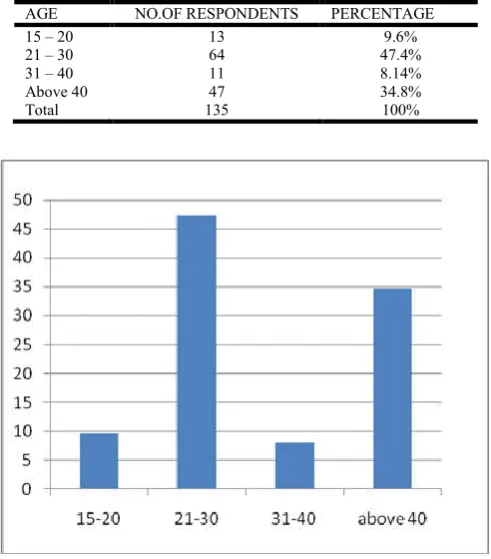
Table 1. Chart showing age group of the respondents
AGE NO.OF RESPONDENTS PERCENTAGE
15 – 20 13 9.6%
21 – 30 64 47.4%
31 – 40 11 8.14%
Above 40 47 34.8%
Total 135 100%
Table 3. Chart showing education of the respondents
Education No. of Respondets Percentage
SSLC 34 25.1%
PG 54 40%
UG 42 31.1%
Doctorate 5 3.7%
[image:4.595.309.560.409.631.2]Total 142 100%
Table 2. Chart showing gender of the respondents
Gender No.of respondents Percentage
Male 50 37.03%
Female 85 62.9%
[image:4.595.312.553.673.736.2]Chi square analysis
Monthly income and how often they pay
H0=There is norelationship between annual income of the respondents and how often they pay the consumer loans.
H1=There is a relationship between annual income of the respondents and how often they pay the consumer loans.
How often They pay
Monthly Income
weekly Quarterly monthly Annually Total
10,000-20,000 7 2 2 3 14
21,000-30,000 18 8 10 16 52
31,000-40,000 7 12 10 8 37
Above 40,000 6 10 8 8 32
Total 38 32 30 35 135
Calculation
O E (O-E) (O-E)2 (O-E)
2
E
7 3.9 3.1 9.61 2.4
2 14.6 -12.6 158.7 10.8
2 10.4 -8.4 70.56 6.7
3 9.0 -6 36 4
18 3.3 14.7 216.09 65.4
8 12.3 -4.3 18.49 1.50
10 8.7 1.3 1.69 0.19
16 7.5 8.5 72.25 9.6
7 3.1 3.9 15.21 4.9
12 11.5 0.5 0.25 0.02
10 8.2 1.8 3.24 0.39
8 7.1 0.9 0.81 0.11
6 3.6 2.4 5.76 1.6
10 13.4 -3.4 11.56 0.86
8 9.5 -1.5 2.25 0.23
8 8.2 -0.2 0.04 0.04
108.7
Degrees of freedom: DOF=(r-1)*(c-1)=(4-1)*(4-1) = 9
[image:5.595.37.287.272.334.2]Interpretation: From the table it is noted that the calculated value (108.7) is greater tabulated than value (16.919) so, Alternate hypothesis (H1) is accepted.
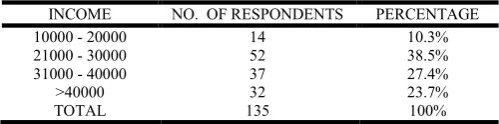
Table 4. Chart showing income of the respondents
INCOME NO. OF RESPONDENTS PERCENTAGE
10000 - 20000 14 10.3%
21000 - 30000 52 38.5%
31000 - 40000 37 27.4%
>40000 32 23.7%
Service offered to consumers and brand –NBFC they choose
H0=There is norelationship between preferred NBFC’s by the respondents and customer service they like in that NBFC’s
H1=There is a relationship between preferred NBFC’s by the respondents and customer service they like in that NBFC’s
Service Offered To Consumers
Brand –Nbfc They Choose
Rate of interest Installment system Credit cards Quick credit Total
Muthoot fincorp 5 15 8 7 35
Bajaj fincorp 11 16 9 4 40
Tci finance 10 2 5 11 28
Mahindra 16 3 12 1 32
Total 42 36 34 23 135
Calculation
O E (O-E) (O-E)2 (O-E)
2
E
5 10.8 -5.8 33.64 3.11
15 12.4 2.6 6.76 0.54
8 8.7 -0.7 0.49 0.05
7 9.9 2.9 8.41 0.84
11 9.3 1.7 2.89 0.31
16 10.6 5.4 29.16 2.75
9 7.4 1.6 2.56 0.34
4 8.5 -4.5 20.25 2.38
10 8.8 1.2 1.44 0.16
2 10.0 -8 64 6.4
5 7.0 -2 4 0.5
11 8.0 3 9 1.1
16 5.9 10.1 102.01 17.2
3 6.8 -3.8 14.44 2.12
12 4.7 7.3 53.29 11.3
1 5.4 -4.4 19.3 3.5
52.6
Degrees of freedom:
DOF=(r-1)*(c-1) =(4-1)*(4-1) = 9
Interpretation: From the table it is noted that the calculated value (52.6) is greater than tabulated value (16.919) so, Alternate hypothesis (H1) is accepted.
Annual income of the respondents and schedule of payments
H0=There is norelationship between annual income of the respondents and schedule of payments for consumer loans
H1=There is a relationship between annual income of the respondents and schedule of payments for consumer loans
Schedule of payments
Annual Income
Weekly Quarterly Monthly Annually Total
10,000-20,000 3 2 2 7 14
21,000-30,000 16 8 10 18 52
31,000-40,000 8 12 10 7 37
Above 40,000 8 10 8 6 32
Total 35 32 30 38 135
Calculation
O E (O-E) (O-E)2 (O-E)
2
E
3 3.6 -0.6 0.36 0.1
2 13.4 -11.4 129.9 9.6
2 9.5 -7.5 56.25 5.9
7 9.07 -2.07 4.28 0.4
16 3.3 12.7 161.2 48.3
8 12.3 -4.3 18.2 1.4
10 8.7 1.3 1.69 0.19
18 7.5 10.5 110.25 14.7
8 3.1 4.9 24.01 7.7
12 11.5 0.5 0.25 0.02
10 8.2 1.8 3.24 0.3
7 7.1 -0.1 0.01 0.14
8 3.9 4.1 16.81 4.3
10 14.6 -4.6 21.1 1.4
8 10.4 -2.4 5.76 0.55
7 9.0 -2 4 0.4
96.4
Degrees of freedom:
DOF = (r-1)*(c-1) = (4-1)*(4-1)= 9
Findings
The demographic factors such as income, age, education and family size influence so consumers to go to NBFC’s.
The factors such as brand, service and schedule or payments are perceptual factors which is highly influencing
From the study I was found that the brand, service and schedule of payments have significally relationship
There is a relationship between income and schedule of the payment
There is a relationship between customer service and brand
There is a relationship between brand and factors influencing perception
Suggestions
The interest rates and the indirect charges such as penalty, documentation charges have to be clearly taught to the consumer
Late payment or delay payments have to be informed by the financial providers
The period for credit and the type of interest charging have to be informed periodically if it lay down under floating rate of interest
Conclusion
From the study it was found that the consumer perception on NBFC’S nowadays are higher that other financial providers
since all the consumer need or wants an fulfilled as convenient basis as per the standard of living by them further the growth of NBFC’S’S predominant in the recent day. The paper highlights the perceptual factors such as brand, service, schedule in payments adding to this research paper will be helpful for the future researches to go ahead in the field of consumer behavior towards NBFC’S.
REFERENCES
Doddaraju, M.E. 2013. Richard J. Rosen, and Gregory F. Udell 2001. “The Effect of Market Size
Ghosh, S. 2014. Housing Finance in India and Appraisal Process of Home Loans with Specific reference to Indian Overseas Bank, International Journal of Science and
Research, Vol 3 (8), August, 129-135
Gudadhe, P.S. 2013. Customer perception towards products and services of State Bank of India with Special Reference to Yavatmal District, (M.S.) India‟, IRACST-International Journal of Commerce, Business and Management
(IJCBM), ISSN: 2319-2828. Vol. 2, No.4, August, 1-8
Gupta, J. and Jain, S. 2012. A Study on Cooperative Banks in India with special reference to Lending Practices‟,
International Journal of Scientific and Research
Publications, Volume 2(10), October, 1-6
Hingorani, P. and Tiwari, P. 2013. Housing and basic infrastructure services for all: A conceptual framework for urban India‟, 1-29
Brand and factors influencing consumer perception
H0=There is norelationship between preferred NBFC’s’s by respondents and what factors that influence to trust in that particular NBFC’s
H1=There is a relationship between preferred NBFC’s by respondents and what factors that influence to trust in that particular NBFC’s
Factors
Brand Value of money Availability of offers Interest rates Discount coupons Total
Muthoot fincorp 8 15 5 7 35
Bajaj fincorp 9 16 11 4 40
Tci finance 5 2 10 11 28
Mahindra 12 3 16 1 32
Total 34 36 42 23 135
Calculation
O E (O-E) (O-E)2 (O-E)
2
E
8 8.8 -0.8 0.64 0.07
15 10.0 4.9 24.0 2.3
5 7.0 -2 4 0.5
7 8.0 -1 1 0.12
9 9.3 -0.3 0.09 0.09
6 10.6 -4.6 21.1 1.9
11 7.4 3.6 12.9 1.7
4 8.5 -4.5 20.2 2.3
5 10.8 -5.8 33.6 3.1
2 12.4 -10.4 108.1 8.3
10 8.7 1.3 1.69 0.19
11 9.9 1.1 1.21 0.12
12 5.9 6.1 37.2 6.3
3 6.8 -3.8 14.4 2.12
16 4.7 11.3 127.6 27.1
1 5.4 -4.4 19.3 3.5
Total 59.71
Degrees of freedom: DOF= (r-1)*(c-1) = (4-1)*(4-1)
= 9
Kumara Swami, M. and Nayan, J. 2014. Marketing of Housing Finance- A Comparative Study of Public and Private Sector Banks‟, Global Research Analysis, Vol 2 (3), March, 116- 120
Mishra, A.K. 2011. Growth of Housing Requirements and Housing Finance in India‟, Annals of Management
Research, Vol 1(1), September-October, 38-50
Mittal, S. 2014. Influence of the demographic variable on the customer’s choice and preferences for a particular type of bank‟, International Journal of Latest Research in Sciences
and Technology, Volume 3, Issue 1, Jan-Feb, 2014, 88 –
90.
MS Linda Mary Simon, 2012. Berger, Allen N., Joseph M. Scalise, and Anil K. Kashyap, 1995. “The Transformation of the U.S. Banking Industry: What a Long, Strange Trip It’s Been,” Brookings Papers on Economic Activity, 2, 55-218.
Mushtaq A Bhat, 2005. Berger, Allen N., Anthony Saunders, Joseph M. Scalise, and Gregory F. Udell 1998. “The Effects of Bank Mergers and Acquisitions on Small Business Lending,” Journal of Financial Economics, 50, 187-229.
Raman and Gayatri, 2004. Asymmetrically to Crude Oil Price Changes?” Quarterly Journal of Economics 112, 305-39. Rao, T.S. 2013. A study on comprehensive problems of HDFC
& SBI loan takers in Andhra Pradesh State‟, Innovative
Journal of Business and Management, September –
October (2013) 123-127.
Sridhar A. S. 2013. Structure on Competition: The Case of Small Business Lending,” FEDS working paper2001-63, Board of Governors of the Federal Reserve System. Surabhi and renu arora 2011. Borenstein, Severin, A. Colin
Cameron, and Richard Gilbert 1997. “Do Gasoline Prices Respond
Tiwari, P. 2014. Developments in Housing Finance in India‟, Housing Finance International, 37-46