ISSN Print: 2327-4352
DOI: 10.4236/jamp.2018.69160 Sep. 20, 2018 1886 Journal of Applied Mathematics and Physics
Analysis of Electrical Dipoles Interaction Forces
as a Function of the Distance and of the Form of
Electrical Force Law
Ioan Has
1, Simona Miclaus
1, Aurelian Has
21Land Forces Academy, Sibiu, Rm. Valcea, Romania 2Independent Researcher, Rm. Valcea, Romania
Abstract
Here, we initially introduced and demonstrated two principles: orientation OR principle and attraction AT principle of electrical dipoles. The OR prin-ciple stipulates that any two electrical dipoles P1A, P1B, from two bodies A
and B, at any distance in the free state each, will be reciprocally oriented pa-rallel and in the same sense if the electrical interaction forces F between them are of decreasing type with distance r. If the electrical interaction forces F are of increasing type with distance, the two dipoles will be reciprocally oriented parallel but on the opposite sense. The AT principle stipulate that any two electrical dipoles P1A, P1B, at any distance in the free state each, will present always a reciprocal force of attraction FD in both cases of orientation accor-dingly to OR principle in case of any type of electrical force F decreasing or increasing with distance. These findings may complete our previous work where we found that FD force, between two electrical dipoles P1A, P1B consi-dered at atomic and nuclear level, is in fact the actual gravitation Newton force FN. The paper must be considered together with this work for more consistency.
Keywords
Electrical Forces, Completed Coulomb’s Law, Electric Dipoles Interactions, Torsion Moment of Orientation, Attraction Force between Two Dipoles Is Gravitation
1. Observations about Actual Explanation for the Absence of
Electrical Interactions at Long Distances
Today, it is largely admitted that at long distances, at astronomical scales, at
How to cite this paper: Has, I., Miclaus, S. and Has, A. (2018) Analysis of Electrical Dipoles Interaction Forces as a Function of the Distance and of the Form of Electrical Force Law. Journal of Applied Mathematics and Physics, 6, 1886-1895.
https://doi.org/10.4236/jamp.2018.69160
Received: August 20, 2018 Accepted: September 17, 2018 Published: September 20, 2018
Copyright © 2018 by authors and Scientific Research Publishing Inc. This work is licensed under the Creative Commons Attribution International License (CC BY 4.0).
http://creativecommons.org/licenses/by/4.0/
DOI: 10.4236/jamp.2018.69160 1887 Journal of Applied Mathematics and Physics planetary scale and even at building scales, the electrical forces FC given by clas-sical Coulomb’s law of electrical forces:
1 2 1 2
2 2
0
4π
C q q kq q
F
r r
ε
= = ; with k = 1/4πε0; (1), (1’)
between two neutral bodies are negligible and should not be taken into account, as it happens today.
The only forces considered today at such long distances are the gravitational forces FN given by classical Newton’s law.
2
N Mm
F G
r
= − (2)
This affirmation excludes the electromagnetic phenomena which consist of more complex combinations of electric and magnetic forces originated at atomic scales.
But it is unlikely that the interaction forces acting between two electrical charges q1, q2 may be perfectly described by mathematical simple laws as in (1), at any distances r, and of any scales, in the micro and macro universe.
At this point of our analysis, the above affirmation is justified by the reality complexity or its infinity and also by discrepancies between calculus results of actual simple laws from (1), (2) and some experimental measurements and ob-servations concerning these forces, reported in the past.
Discrepancies concerning the Coulomb’s law are confirmed by modern expe-riments, which allow scientists to conclude that in the case of very short dis-tances (such as between molecules, atoms, nuclei, particles) the law (1) is not precisely correct [1], but also it has not yet been proven in the case of long dis-tances [2]. In such circumstances, we can conclude that the Coulomb’s law in the current form (1) is not perfect and that it can be improved.
For a more accurate description of the infinite reality, including ether pres-ence which will be considered throughout this paper, as we previously demon-strated [3] [4] [5] [6], the most appropriate (but not singular mathematical) mode of electrical forces description, will be probable, a long or infinite series of successive powers of the 1/r distance.
In the present, it is accepted that macroscopic bodies have a random distribu-tion of +q and –q charges, which will generate a random distribution of dipoles in any direction, and all coefficients ki from (3) are canceled [7].
0 1 2
2 3
0 0 0
M kr kr kr
φ
ε ε ε
= + + + (3)
DOI: 10.4236/jamp.2018.69160 1888 Journal of Applied Mathematics and Physics
2. Our New Hypothesis and Principles, Concerning the
Dipole Interactions at Long Distances
2.1. Justification of Introducing the Two New Principles of Electric
Dipoles Interaction, OR and AT
Despite the fact that bodies A, B…, are neutral, the +q and –q charges are in fact always separated in space at atomic and nuclear scale, and consequently every charge +q or –q will exert its electrical interaction force FC to infinite distance according to (1) or to a corrected Coulomb law as in [8][9][10][11].
So in nature practically all the matter must be regarded as being organized al-ways as electrical dipoles P1, P2, P3… as result of Coulomb law action even at smallest scales.
We will show next, that neglecting electrical forces and their potential even for distant bodies is not correct because we can admit and demonstrate the follow-ing two principles:
a) OR principle of the reciprocal orientation of distant dipoles.
b) AT principle of the permanent attraction of oriented distant dipoles.
2.2. Presentation and Justification of OR Principle
In order to demonstrate the OR principle, we can calculate the torsion moments
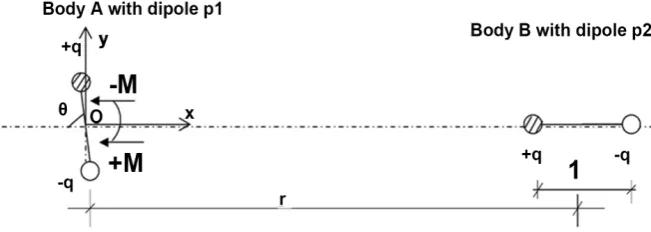
+M (clockwise) and −M (counterclockwise) created by an oriented dipole P2 from body B upon an un-oriented dipole P1 (disposed at 90˚ in body A).
In this situation (Figure 1) we can distinguish two cases, depending on the variation mode with distance r, of interaction Coulomb’s forces F (reference frame xOy is attached to A body).
Case 1a). of decreasing F forces. Firstly, for this calculus, we suppose the inte-raction forces Fa (attraction for +q/−q charges when Fa<0, according to (1)) and
Fr (rejection for +q/+q or –q/−q charges, Fr>0, according to (1)) between elec-trical charges +q and –q as being some vectors F of central orientation de-creasing with the increasing distance r l , between body A and body B ac-cording to the law of the general type (4), generalizing (1), with n a natural number:
1 2 0
4π n A Bn
q q kq q
F
r r
ε
= = (4)
including the simple case n = 1:
A B kq q F
r
= (4a)
Product qA.qB from (4), (4a) comprises for simplicity, also coefficients k/4πε0. Utilizing (4a), we obtained from Figure 1 the clockwise torsion moment +M and counterclockwise −M moment, given upon P1 dipole, by forces F from P2 di-pole, as follows:
(
)
2l A B
DOI: 10.4236/jamp.2018.69160 1889 Journal of Applied Mathematics and Physics
Figure 1. Situation of two distant dipoles P1 and P2 from bodies A and B, which manifest a reciprocal orientation with xOy frame attached to A body.
where function m represents the components of total M moments, given by var-ious pairs of q charges.
(
) (
)
22 2
1 . 1 .
2 2 2 2
2 .
2 2 2
A B A B l l
M m q q m q q kq
r l r l
l l
kq kq
r l r l
+ − − −
+ = + = +
+ +
= =
+ +
(6)
(
) (
)
22 2
1 . 1 .
2 2 2 2
2 .
2 2 2
A B A B l l
M m q q m q q kq
r l r l
l l
kq kq
r l r l
+ + − +
− = + = +
− −
= =
− −
(7)
The ratio rMof the two moments results from (6) and (7):
2
2 2 1;2 ;
M
l kq
M r l r r l
r l M M
M kq r l
r l r
+ + −
= = = < →→ − > +
− +
−
(8)
This result of M moments ratio rM indicates that the orientation of dipole P1 will be in the same sense/direction as dipole P2, in this case of the decreasing
positive forces F.
Case 1b). of decreasing F forces and sign change. We now must calculate what happens in the hypothetical case when the forces F from (4) and (4a) will change the sign from positive +F to negative −F forces, including the simple case n = 1:
A B kq q F
r
= − (9)
In this modified Case 1b), we admit hypothetically, an inversion of the actual physical rule (attraction force –Fa between +q and –q charges), becoming repul-sion force +Fr between +q and –q charges and attraction force –Fa between +q and +q or between –q and –q charges.
DOI: 10.4236/jamp.2018.69160 1890 Journal of Applied Mathematics and Physics
(
) (
)
22 2
1 . 1 .
2 2 2 2
2
2 2 2
A B A B l l
M m q q m q q kq
r l r l
l l
kq kq
r l r l
+ + − + + = + = − + − − − = − ⋅ = − − − (10)
(
) (
)
22 2
1 . 1 .
2 2 2 2
2 .
2 2 2
A B A B l l
M m q q m q q kq
r l r l
l l
kq kq
r l r l
+ − − − − = + = − + − + + = − = − + + (11)
The ratio rMof the two moments results:
2
2 2 1;2 ;
M
l kq
M r l r r l
r l M M
M kq r l
r l r
−
+ + −
= = = < →→ − > +
− − +
−
(12)
This result of the M moments ratio rM indicates that the orientation of dipole
P1 is in the same sense/direction as dipole P2, also in the case of inverse sign of
decreasing forces F (as in Case 1a). of decreasing actual forces F).
So we conclude that changing the sign of F force, have no influence upon the orientation rule of dipoles P1 and P2.
Case 2a). of increasing F forces. Secondly, for this calculus, we suppose the in-teraction force Fa (attraction) and Fr (rejection) between electrical charges q as being some vectors of central orientation increasing with the distance r l ,
according to the laws of the general type (13), with n a natural number:
1 A B n
F k q q r= ⋅ ⋅ (13)
including the simple case n = 1 or the limit power case of lnr,in both cases F
force increasing with r:
1 A B or 1 A Bln
F k q q r= ⋅ F k q q= ⋅ r (13a),(13b) Utilizing (13b) we obtain from Figure 1:
(
) (
)
21
2 2
1 1
2 2 2 2
2
2 2 2
A B A B l l l l
M m q q m q q k q r r
l l l
k q r k q r l
+ − − − + = + = + ⋅ + + ⋅ = + ⋅ = + ⋅ (14)
(
) (
)
21
2 2
1 1
2 2 2 2
2
2 2 2
A B A B l l l l
M m q q m q q k q r r
l l l
k q r k q r l
+ + − + − = + = − ⋅ + − ⋅ = − ⋅ = − ⋅ (15)
The ratio rMof the two moments results:
2 1
2 1
2 2 1; ;
2 2
M
l l
k q r l r
M
r l M M
l
M k q r l r
+ ⋅ +
+
= = = > →→ + > −
− − ⋅ −
DOI: 10.4236/jamp.2018.69160 1891 Journal of Applied Mathematics and Physics This result of M moments ratio rM indicates that the orientation of dipole P1 is in the opposite sense/direction as dipole P2, in case of increasingpositive forces.
In Case 2b), of increasing F forces and sign change, when the force F is also as increasing with r type, but of reversed sign, is similar to the Case 1b). And hence the result of the calculus of rM ratio will be similar: indicating that the orienta-tion of dipole P1 is in the opposite sense/direction as dipole P2. (as in Case 1b). in this case of increasing positive forces F.
And so at points Case 1) and Case 2), the OR principle was demonstrated. The OR principle stipulate that in case of decreasing electrical forces F with r
the orientation of dipole P1 is in the same sense/direction as dipole P2 irrespec-tive of sign of F.
But in case of increasing electrical forces F with r, the orientation of dipole P1 is in the opposite sense/direction as dipole P2irrespective of sign of F.
2.3. Presentation and Justification of AT Principle
In order to demonstrate the AT principle, will be calculated forwards the resul-tant force R, appearing between two oriented dipoles, P1A and P1B, according to OR principle, given by forces of attraction Fa and by forces of repulsion Fr exist-ing between +q and –q charges, as in actual FC or completed F, Coulomb’s law.
It must determine if the force R is the attraction or repulsion force, as a function of the form of the electric force law F.
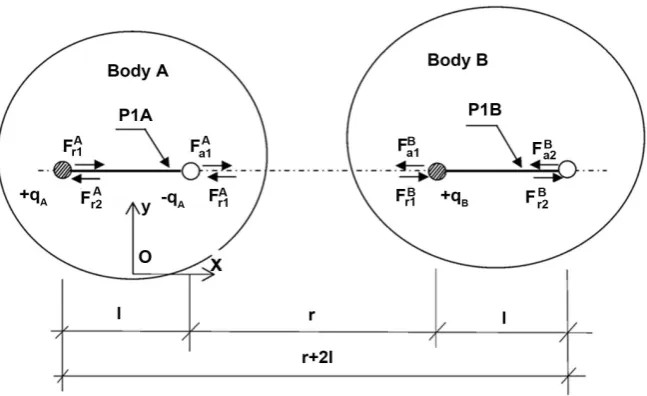
The situation of two dipoles P1A and P1B originated in A body and in B body respectively, identically oriented and equal to each other, with polar moment value r = q∙l, is presented in Figure 2. The two possible cases of the F force vari-ation with the distance r between two electric charges will be analyzed below: Case 1) the decreasing variation and Case 2) the increasing variation of F force with r.
But we must remind that first calculus concerning the attraction force Fa and the rejection force Fr between two farther electrical dipoles was performed by us in [8] [11], but without presenting there the significance of the result of that calculus, consisting in the sign of resultant force R.
Also there in [8][11], was made a simplification of calculus by introducing a substitution: α = kqAqB.
But here we will emphases that such result, will conduct at a new important principle, the AT principle of permanent attraction of electric dipole, described firstly here below.
In order to better understand the origin of AT principle we will resume here without the above substitution, the calculus of forces Fa and of Fr from [8][11] performed in the two cases, Case 1 and Case 2, of the F force variation with the distance r.
DOI: 10.4236/jamp.2018.69160 1892 Journal of Applied Mathematics and Physics
Figure 2. Forces F acting between a pair of identical oriented dipoles P1A and P1B con-sidered at atomic and nuclear level, from A and B bodies with xOy frame attached to A body.
From Figure 2, we now can calculate directly by simple algebra, utilizing Eq-uation (4b), the total force upon each dipole, exerted by the other dipole. Here in calculus, we consider the + sign for force values having the sense of real force as
in Figure 2, which corresponds to the attraction force Fa (Fa< 0) and to
repul-sion force Fr (Fr> 0), forces exerted by the charges +q, −q, as in Coulomb law (4).
From Figure 2 notating –qA→qA− and having
A B A B
q q− +=q q+ −, we consider first, the forces exerted upon P1A dipole by a P1B dipole. Utilizing the simple case (4b) the resultant forces Faand Frvalues results as follows:
(
)
1 2 2 2 22
A A A B A B
A a a kq q kq q A B r l
F F F kq q
r r l r r l
− + + −
− + +
= + = + =
+ + (17)
(
)
1 2 2 1
A A A B A B
R r r kq q kq q A B
F F F kq q
r l r l r l
− − + +
− −
= + = + =
+ + + (18)
If we rewrite the expression from the denominator from (17), one obtains:
(
2) (
)
2 2r r+ l = r l+ −l (19)
From (19) and admitting r l it results:
(
) (
)
22
r r+ l < r l+ (20) Introducing (20) in (17) and comparing with (18) it results:
(
)
(
)
22 2 2 2
2
a A B r l A B r l r
F kq q kq q F
r r l r l
+ − + − − +
= > =
+ + (21)
a r
great-DOI: 10.4236/jamp.2018.69160 1893 Journal of Applied Mathematics and Physics er than the repulsion force Fr and finally an attraction force Ra= Fa− Fr > 0 be-tween the two identically oriented dipoles P1A, P1B results. This result is correct even if the power of r is any n > 1, as can easily be demonstrated.
Case 2) of increasing F forces. Let’s suppose the force Fincreases with the dis-tance r, including a law of the form (13b).
1 A Bln
F k q q= ⋅ r (23) with coefficient k1 being similar with coefficient k from Equation (4a) but having the appropriate measure units considering that the term lnr must be adimen-sional.
Again from Figure 2, for identically oriented dipoles P1A, P1B (Figure 2), the total forces upon P1A dipole utilizing (23) will be:
(
)
(
)
1 2 1 ln 1 ln 2 1 ln 2
A A
a a a A B A B A B
F =F +F =k q q− + r k q q+ + − r+ l =k q q− + r r+ l
(24)
(
)
(
)
(
)
21A 2A 1 ln 1 ln 1 ln
r r r A B A B A B
F =F +F =k q q− − r l+ +k q q+ + r l+ =k q q− − r l+ (25)
Comparing F and Fr from Equations (24) and (25), and considering Equation (20) it results:
(
)
(
)
21 ln 2 1 ln
a A B A B r
F = k q q− + r r+ l < k q q− − r l+ = F
(26)
a r
F < F (27)
From (27) it results that in the case of increasingF forces of the type from (23), the repulsion force Fr between two identically oriented dipoles P1A, P1B, will be greater than the attractive force Fa and the resultant force Rr= Fr− Fa > 0, will be a repulsion force. This result is correct even if the increasing variation has the general form F = α'rn with n > 1, as it can easily be demonstrated.
But in this Case 2 of increasingF forces (23), the natural orientation of two dipoles becomes reverted compared with those from Figure 2, according to the OR principle from Section 2.2., and the interaction force between the two di-poles P1A and P1B will be again an attraction force Ra= Fr− Fa < 0 as for
de-creasing forces.
So, the AT principle stipulate that in case of decreasing electrical forces F with
r an attraction force Ra between the two identically naturally oriented dipoles
P1A, P1B results.
Also in case of increasing electrical forces F with r, because the two dipoles
P1A, P1B will be naturally inverse oriented accordingly to OR principle, AT principle stipulate that again an attraction force Rabetween the two dipoles P1A,
P1B results.
And so, the simultaneous action of OR principle and of AT principle, will give birth of a permanent attraction between two any electrical dipoles irrespective of
F force type.
The above analytical calculus and its results, yields the above OR principle and AT principle, whose result must be real.
DOI: 10.4236/jamp.2018.69160 1894 Journal of Applied Mathematics and Physics about 2 cm radius, which being separated initially, they will tend permanently to gather together as a clew, at a final natural free equilibrium position. Indeed they not separate or move away in space towards an alternate natural equilibrium po-sition in our laboratory scale. Such magnets mi may constitute a correct intuitive physical model of atomic or nuclear electric dipoles.
3. Conclusions and Consequences
This article is intended to complete our previous series of articles and conference presentations, concerning the gravitation and ether [8][9][10][11][12].
Consequently, this paper analysis considered the interactions of electrical charges from the matter, which may really appear at very long distances as terre-strial or astronomical ones, in fact in the range of common gravitational forces. These were logical and in accordance with Coulomb’s law (actual or corrected as in [11]) that in the presence of the electrical distinct +q/−q charges acting at an infinite distance, anywhere in space will have some interactions between ever distinct electrical +q/−q charges because always electrical +q/−q charges will be grouped as electrical dipoles P1, P2, P3…
Based also on the above observations from Section 1, we have demonstrated in the current article that no matter the form of electrical force law F, and accor-dingly to OR principle and to AT principle, an attraction dipole force FD will act always between any two distant dipoles, which we have proved in [11] to be even the so-called gravitation Newton force FN.
Conflicts of Interest
The authors declare no conflicts of interest regarding the publication of this pa-per.
References
[1] Israelachvili, J. (1991) Intermolecular and Surface Forces. Academic Press, London 7-260.
[2] Luca, E., Ciubotariu, C., Maftei, G., Zet, G., Jeflea, A. and Pasnicu, C. (1996) Fizica, Vol. 2. Editura Stiintifica, Bucharest, 65-70. (In Romanian)
[3] Has, I. (2000) The Analysis of an Alternative Light Path in Michelson’s Experiment. Romanian Reports in Physics, 52, 775-789.
[4] Has, I., Miclaus, S. and Has, A. (2010) An Alternative Light Path Analysis in Mi-chelson’s Interferometer Experiment. Physics Essays, 23, 248-257.
https://doi.org/10.4006/1.3357572
[5] Has, I., Miclaus, S. and Has, A. (2014) A Reanalysis of the Theory of Interferometer Experiment Demonstrating That Michelson’s Analysis Contains an Error, Including the Boat Model Analysis, So Readmitting the Ether Presence. Optics, 3, 25-32. https://doi.org/10.11648/j.optics.20140304.11
Interna-DOI: 10.4236/jamp.2018.69160 1895 Journal of Applied Mathematics and Physics tional Conference on Chemistry & Physics, Athens, 20-23 July 2015.
[7] Purcell, E.M. (1972)Electricity and Magnetism. Berkeley physics Course. McGraw-Hill, New York, 59, 318, 328.
[8] Has, I., Miclaus, S. and Has, A. (2008) Analysis of a Possible Correlation between Electrical and Gravitational Forces. Physics Essays, 21, 303-312.
https://doi.org/10.4006/1.3038751
[9] Has, I., Miclaus, S. and Has, A. (2011) A Theoretical Confirmation of the Gravita-tion New Origin, Having a Special Electrical Nature. FQMT11 Conference on Phys-ics, Prague, 26-29 July 2011.
[10] Has, I., Miclaus, S. and Has, A. (2017) Theoretical Confirmation of the Gravitation New Origin Having a Dipolar Electrical Nature with Coulomb’s Law Corrected. 2nd International Conference on Physics, Brussels, 28-30 August 2017.
[11] Has, I., Miclaus, S. and Has, A. (2015) A Theoretical Confirmation of the Gravita-tion New Origin Having a Dipolar Electrical Nature with Coulomb Law. American Journal of Modern Physics, 4, 97-108. https://doi.org/10.11648/j.ajmp.20150403.11 [12] Has, I. and Miclaus, S. (2017) An Initial Model of Ether Describing Electromagnetic