ISSN Online: 2327-4379 ISSN Print: 2327-4352
DOI: 10.4236/jamp.2018.611196 Nov. 22, 2018 2343 Journal of Applied Mathematics and Physics
Multiple Ionization Cross Sections of Ne and CO
Induced by Very High-
q
Fast Projectiles (
q
/
v
> 1)
Man Zhou, Zhenye Wang, Sufen Li, Peng Xu, Haoxin Zhou
Rocket Force University of Engineering, Xi’an, China
Abstract
In this paper, we extend our previous work of classical over barrier ionization (COBI) model to study the multiple ionization cross section of Ne and CO molecule collided by very high-q fast projectiles(q/v > 1). The model gives similar results to the independent-electron-approximation calculation and is in good agreement with experimental data. The very small computational time required makes it a good candidate for studying the multiple ionization of complex molecules under high linear energy transfers.
Keywords
Multiple Ionization, High-q Projectiles, Strong Coupling Regime, Model Calculation
1. Introduction
Multiple ionization of multi-electron atoms and molecules impacted by high-q
fast projectiles has been investigated widely. The underlying physics is of major importance not only for basic research in astrophysics, plasma physics, and chemical physics, but also for technological applications such as in material science [1] [2] [3] [4].
Numerous theoretical works for multiple ionization of atoms and molecules impacted by ions have been reported recently. The most widely used approach is the eikonal-classical trajectory Monto Carlo (CTMC) method [5], in which the ion trajectories are simulated and the initial momentum distribution of the tar-get electron is assumed. Then, the whole system is evaluated numerically. This method provides a good description of multiple ionization. However, its appli-cation to more complex molecules is limited by its consuming. In a perturbative regime, the first-order semi-classical approximation (SCA) model [6] and statis-tical energy deposition (SED) model [7] [8] can give a reasonable description of How to cite this paper: Zhou, M., Wang,
Z.Y., Li, S.F., Xu, P. and Zhou, H.X. (2018) Multiple Ionization Cross Sections of Ne and CO Induced by Very High-q Fast Pro-jectiles (q/v > 1). Journal of Applied Ma-thematics and Physics, 6, 2343-2351. https://doi.org/10.4236/jamp.2018.611196
DOI: 10.4236/jamp.2018.611196 2344 Journal of Applied Mathematics and Physics multiple ionization mechanism. However, when it comes to a strong coupling regime (q/v > 1), remarkable deviations from the first-order results have been found. Lately, a method using the independent-particle model (IPM) is sug-gested for estimating multiple ionization cross sections of heavy atoms colliding with highly charged ions [9], but some of the theoretical explanation is insuffi-cient. In recent years, the calculation by using non-perturbative quantum me-chanical approach shows good agreement with experimental results over a wide range of energy from 20 keV to several MeV in proton–water collision [10] [11]. However, a non-parameter model for the multiple ionization of atoms and mo-lecules induced by very high-q and fast projectiles (q/v > 1) is extremely scarce.
In previous work, we used the classical over barrier ionization (COBI) model [12] [13] [14] [15] [16] to interpret the relative multiple ionization cross sections of Ar impacted by He+ ions at energies from 10 to 800 keV/u, and by 34 MeV Clq+. Now, we extend our previous work of COBI model to the multi-electron systems, and calculate the multiple ionization of Ne and CO molecule collided by very high-q fast projectiles in a strong coupling regime.
The paper is organized as follows: the COBI model is presented in Section 2. Calculation results of the relative multiple ionization cross sections each as a function of projectile energy and projectile charge q for Ne are presented and compared with the experimental data in Section 3. Then, the scenarios of mul-tiple ionization of CO molecules by very high-q fast projectiles are discussed. Finally some conclusions are drawn from the present study in Section 4. Atomic units are used throughout, unless otherwise specified.
2. Model
The present model used to calculate multiple ionization cross sections of com-plex targets is based on our previous work of COBI model and also on Bohr’s over barrier (OB) model [17]. Based on Bohr’s classical over barrier model (COBM), ionization is introduced in COBI to describe the double-ionization process in the strong coupling regime. According to COBM, the release distance is given as Rr = Z+2I qZ , where Z and q are charges of the projectile and the
target core, and I is the electron’s binding energy. The capture distance is
2
2 c q R
v
= , where v is the velocity of projectile. If release occurs within the capture
distance Rc electrons will be captured; if release occurs outside the capture dis-tance, electrons will not be ionized until they obtain enough kinetic energies to escape. When the projectile approaches the distance RI, the Stark energy trans-ferred to the kinetic energy of the released electron is larger than its ionization energy of quasi-molecular state, the ionization will occur. So, the ionization dis-tance RI satisfy the equation
I r
q I q
DOI: 10.4236/jamp.2018.611196 2345 Journal of Applied Mathematics and Physics The electrons released within the capture distance Rc will be captured; others released outside the capture distance will not be ionized until the ion enters the ionization distance of RI. Then, one-electron release, capture and ionization probability for each impact parameter b are given as
2 2
r r
2 R b P
vT −
=
(2)
2 2
c c
2 R b P
vT −
=
(3)
(
2 2 2 2)
I r c 2 r c
P P P R b R b
vT
= − = − − −
(4)
where v is the collision velocity, and T = 2πn3/Z2 is the orbital period of the tar-get electron, n is principal quantum number. Equations (2)-(4) are the obtained single electron ionization and capture probabilities PI and Pc for a given atomic orbit.
It is important to note that, the projectile charge is very high in the present model, the ionization distance RI is of one to two orders of magnitude larger than the molecular dimension. Thus, atoms of the molecule can be seen as being at the origin of the coordinate. To improve the calculation efficiency and main-tain the accuracy, when apply PI of atomic orbital to CO, we neglect the orienta-tion effect of molecules. The existing literature [18] [19] also indicates that the orientation effect will not exceed a few percent even in the highly charged cases for the collisions in a strong coupling regime. For the same reason, in the strong coupling regime the ionization distance RI is far larger than molecular size, the fine structure of molecular electron cloud will not play an important role. Therefore, our calculation of molecular orbitals is not rigorous solution but sev-eral atomic orbitals instead. In addition, the multi-electron probabilities are ex-tracted from the one-electron probabilities by using the method of independent event model (IEVM) [20] [21], which have been proved more adequate than IPM for multi-electron targets.
[image:3.595.295.536.137.233.2]In summary, in present work, atoms of the molecule are all located at the ori-gin of coordinate, out shell electrons are staying at their orbitals with the ioniza-tion energy Ii and the period Ti = π·n/Ii. The ionization energy Ii presented in Table 1 is obtained by employing the quantum chemical Molpro program [22] [23] [24]. Then, with the statistical method of multinomial distribution, the re-levant q-fold ionization probability can be obtained as
(
)
I I I I I c
, , , , , 1
q
i j n s s
i j n s i n
P + P P P P P
≠
=
∑
∏
− −
(5)
Table 1. Calculated values of ionization energy (in eV) for CO molecule and molecular ions for different states of ionization.
1 2 3 4 5 6 7 8
[image:3.595.206.542.689.728.2]DOI: 10.4236/jamp.2018.611196 2346 Journal of Applied Mathematics and Physics The cross sections are obtained by integrating the probability PIq+
( )
bover-all impact parameters as
I ( ) 2π d
q P bq b b
σ + +∞ +
−∞
=
∫
⋅ (6) [image:4.595.218.528.451.681.2]3. Results and Discussion
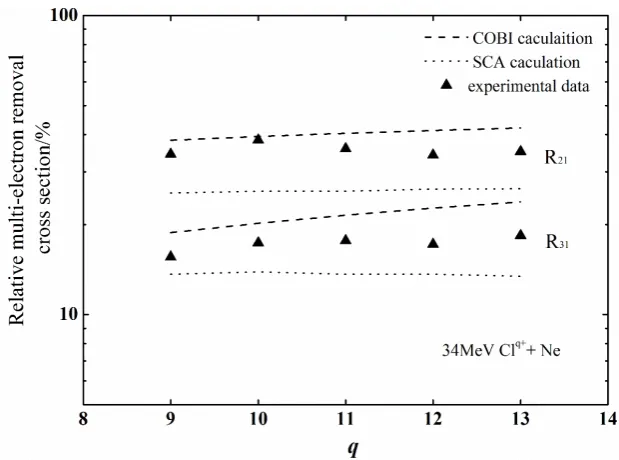
Figure 1 shows the ratios of multiple to single ionization of Ne impacted by 34 MeV Clq+, each as a function of projectile charge q. They are compared with the SCA calculation results [6] and the available experimental data (uncertainty is about 25%) [25]. It can be seen that both calculation results are in good agree-ment with the experiagree-mental data. On the whole, the results of SCA model are underestimated, and the COBI model is overestimated. Compared with the SCA, the results of COBI model are closer to the experimental data. For different val-ues of projectile charge, the ratios Rq1 = σq/σ1 (q = 2, 3) are of the same order of magnitude. The ratios are found to increase slightly with projectile charge in-creasing.
In Figure 2 we report on the calculated relative multiple ionization cross sec-tions each as a function of projectile energy for the Cl12+ + Ne collisions. It also includes the SCA calculation results of Ref. [6] and the experimental data of Ref. [25]. The overall agreement is excellent. Double, triple ionization cross sections are about 40%, 20% of the single ionization cross section respectively. For dif-ferent values of projectile energy, the ratios Rq1 = σq/σ1 (q = 2, 3) are also of the same order of magnitude. The ratios are found to decrease very slowly with pro-jectile energy increasing.
The relative multiple ionization cross sections present a weak dependence on
Figure 1. Relative multiple ionization cross sections each as a function of projectile charge for 34MeV Clq+ + Ne. The lines represent the model results, and symbols denote
DOI: 10.4236/jamp.2018.611196 2347 Journal of Applied Mathematics and Physics Figure 2. Relative multiple ionization cross sections each as a function of projectile ener-gy for Cl12+ + Ne. The lines represent the model results, and symbols denote the
experi-mental data.
projectiles energy E and charge q. We can give a reasonable interpretation to the behavior. For the very high-q projectiles, the release and ionization distance both reach the same asymptotic form of
I 1 2 2 r
2
q Z qZ q Z
R R
I Z q I
>>
= → =
+
indicating that
r
I r 2R q
P P
vT E
= ≈ ∝
Therefore the ionization probability is determined by the single release proba-bility. Since the single release probability is proportional to (q/E)0.5, which is in-sensitive to q and E, and with the complementary role of PI and 1 − PI in the multinomial distribution, the very weak q and E dependence of multiple ioniza-tion probabilities is expected.
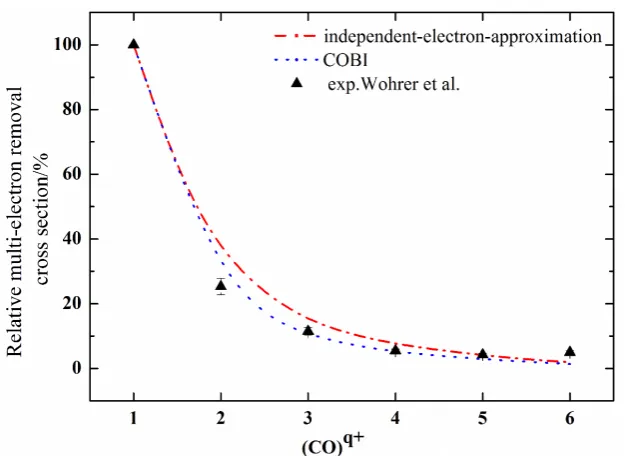
DOI: 10.4236/jamp.2018.611196 2348 Journal of Applied Mathematics and Physics The calculated results of CO molecules impacted respectively by 2.4 MeV/u Ar14+ ions are compared with the experimental data in Figure 4. As can be ob-served, between the two molecular descriptions COBI model gives the better agreement between experiments and theory. From Table 2, we find that highly charged recoiled ions are copiously produced, multi-electron removal is about 30% of the ionizing events. Note that the slopes of the curves do not increase
Figure 3. Relative multiple ionization cross sections of Ne for 2.4 MeV/u Ar14+ ion
im-pact. The dot line and dash dot line represent the COBI model results and independent- electron-approximation calculations respectively, symbols denote the experimental data.
Figure 4. Relative multiple ionization cross sections of CO for 2.4 MeV/u Ar14+ ion
[image:6.595.218.531.455.683.2]DOI: 10.4236/jamp.2018.611196 2349 Journal of Applied Mathematics and Physics Table 2. Absolute cross sections (in 10−15 cm2) for multiple ionization of Ne and CO by
2.4 MeV/u Ar14+ ion impact.
σ1 σ2 σ3 σ4 σ5 σ6
Ne 8.55 2.06 0.77 0.39 0.24 0.13
CO 14.4 3.27 1.34 0.72 0.40 0.20
rapidly with the increase of the recoiled ion charge states. The COBI model is on the assumption that single electron release probability is an important parameter in determining the multiple ionization cross sections induced by very high-q and fast projectiles. According to Equations (1)-(4), the single electron release prob-ability is proportional to (q/E)0.5. This is quite different from the data and the calculation results in the perturbation regime, where the slope increases quickly with ionization degree increasing. Moreover, one can see that the data of Ar14+ + Ne and Ar14+ + CO collisions do not exhibit a significant difference. The frac-tions of double and triple ionization cross section are some 20% and 10% re-spectively; for the 6th fold ionization, the relative cross section is about 1%. Moreover, the data of 2.4 MeV/u Ar14+ +CO and 6.7 MeV/u Xe44+ +CO collisions [14] are very similar. The results show that the multiple ionization of atoms and simple molecules is related to the number and ionization energy of outer elec-tron, and has nothing to do with the type of projectiles in a strong coupling re-gime (q/v > 1).
4. Conclusions
In this paper, our previous work of COBI model is extended to the descriptions of the multiple ionization cross section of Ne and CO induced by very high-q
fast projectiles (q/v > 1). By using the IEVM and the multinomial distribution, the COBI model results are in excellent agreement with available experimental data of atoms and molecules. The measurement and model both show that the relative multiple ionization cross sections present a rather weak dependence on
q and E, which is quite different from the data and the calculation results in the perturbation regime. The COBI model assumes that multiple ionization is di-rectly proportional to the single electron release probability Pr is proportional to (q/E)0.5, which is insensitive to q and E, with the complementary effect of Pr and 1 − Pr in multinomial distribution, the relative multiple ionization cross sections will show weak dependence on q and E.
From a series of studies, we think that multiple ionizations of atoms and mo-lecules impacted by very high-q fast projectiles (q/v > 1) probably can be seen as sequential release processes occurring at large distances rather than violent bi-nary encounters between projectile and target electrons.
DOI: 10.4236/jamp.2018.611196 2350 Journal of Applied Mathematics and Physics happens in radiobiology.
Conflicts of Interest
The authors declare no conflicts of interest regarding the publication of this pa-per.
References
[1] Indriolo, N., Fields, B.D. and Mccall, B.J. (2009) The Implications of a High Cos-mic-Ray Ionization Rate in Diffuse Interstellar Clouds. AJP, 694, 257-267.
[2] Kowalewicz, R., Boggasch, E., Hoffmann, D.H.H., et al. (1996) Enhanced Energy Loss of Heavy Ions Passing a Fully Ionized Hydrogen Plasma. Laser Part. Beams., 14, 599-604. https://doi.org/10.1017/S0263034600010314
[3] Olivera, G.H., Caraby, C., Jardin, P., et al. (1998) Multiple Ionization in the Earlier Stages of Water Radiolysis. Phys. Med. Biol., 43, 2347-2360.
https://doi.org/10.1088/0031-9155/43/8/025
[4] Zeng, L.X., Xu, Z.F., Zhao, Y.T., et al. (2012) Contribution from Recoiling Atoms in Secondary Electron Emission Induced by Slow Highly Charged Ions from Tungsten Surface. Laser Part. Beams., 30, 707-711.
https://doi.org/10.1017/S026303461200064X
[5] Olson, R.E., Ullrich, J. and Schmidt-Bocking, H. (1989) Multiple-Ionization Colli-sion Dynamics. Phys. Rev. A., 39, 5572-5583.
https://doi.org/10.1103/PhysRevA.39.5572
[6] Ben-Itzhak, I., Gray, T.J., Legg, J.C., et al. (1988) Inclusive and Exclusive Cross Sec-tions for Multiple Ionization by Fast, Highly Charged Ions in the Indepen-dent-Electron Approximation. Phys. Rev. A., 37, 3685-3691.
https://doi.org/10.1103/PhysRevA.37.3685
[7] Kabachnik, N.M., Kondratyev, V.N., Roller-Lutz, Z., et al. (1997) Multiple Ioniza-tion of Atoms and Molecules in Collisions with Fast Ions: Ion-Atom Collisions. Phys. Rev. A., 56, 2848-2854. https://doi.org/10.1103/PhysRevA.56.2848
[8] Kabachnik, N.M., Kondratyev, V.N., Roller-Lutz, Z., et al. (1998) Multiple Ioniza-tion of Atoms and Molecules in Collisions with Fast Ions. II. Ion-Molecule Colli-sions. Phys. Rev. A., 57, 990-996. https://doi.org/10.1103/PhysRevA.57.990
[9] Tolstikhina Inga, Yu. and Shevelko, V.P. (2015) Multiple Ionization of Atoms by Highly Charged Ions. Phys. Scr., 90, Article ID: 074033.
https://doi.org/10.1088/0031-8949/90/7/074033
[10]Ludde, H.J., Spranger, T., Horbatsch, M., et al. (2009) Nonperturbative, Quan-tum-Mechanical Approach to Ion Collisions from Molecular Targets. Phys. Rev.A., 80, 60702. https://doi.org/10.1103/PhysRevA.80.060702
[11]Murakami, M., Kirchner, T., Horbatsch, M. and Ludde, H.J. (2012) Single and Mul-tiple Electron Removal Processes in Proton-Water-Molecule Collisions. Phys. Rev. A., 85, Article ID: 052704.
[12]Shao, J.X., Chen, X.M., Liu, Z.Y., et al. (2008) Multi-Ionization of Helium by Slow Highly Charged Ions. Phys. Rev. A., 77, Article ID: 042711.
https://doi.org/10.1103/PhysRevA.77.042711
DOI: 10.4236/jamp.2018.611196 2351 Journal of Applied Mathematics and Physics [14]Zhou, M., Zou, X.R., Wang, S.Y., et al. (2013) Classical Calculation of Mul-tiple-Ionization Cross-Sections of Noble Gases near Bragg Peak Energies. Laser Part. Beams., 31, 561-565. https://doi.org/10.1017/S0263034613000475
[15]Zhou, M., Zou, X.R., Zhao, L., et al. (2013) Multiple Ionization of Atoms and Mole-cules Impacted by Very High-q Fast Projectiles in the Strong Coupling Regime (𝑞𝑞/𝑣𝑣 > 1). Chin. Phys. B., 22, 103402.
https://doi.org/10.1088/1674-1056/22/10/103402
[16]Zhou, M., Zou, X.R., Wang, S.Y., et al. (2014) Absolute Multiple Ionization Cross Sections of Water and Carbon Monoxide Molecules Induced by Very High-q Fast Projectiles (q/v > 1). International Journal of Mass Spectrometry, 357, 45-50.
https://doi.org/10.1016/j.ijms.2013.09.009
[17]Bohr, N. and Lindhard, J. (1954) Electron Capture and Loss by Heavy Ions Pene-trating through Matter. Dan. Mat. Fys. Medd., 28, 1-31.
[18]Adoui, L., Caraby, C., Cassimi, A., et al. (1999) Fast ion-Induced CO Molecule Fragmentation in the Strong Interaction Regime. J. Phys. B: At. Mol. Opt. Phys., 32, 631-647. https://doi.org/10.1088/0953-4075/32/3/008
[19]Lekadir, H., Abbas, I., Champion, C., et al. (2009) Single-Electron-Loss Cross Sec-tions of DNA and RNA Bases Impacted by Energetic Multi Charged Ions: A Classic-al Monte Carlo Approximation. Phys. Rev. A., 79, Article ID: 062710.
https://doi.org/10.1103/PhysRevA.79.062710
[20]Illescas, C., Errea, L.F., Mendez, L., et al. (2011) Classical Treatment of Ion-H2O
Collisions with a Three-Center Model Potential. Phys. Rev. A., 83, Article ID: 052704. https://doi.org/10.1103/PhysRevA.83.052704
[21]Bradley, J., Lee, R.J.S., McCartney, M., et al. (2004) Mult-Ionization of Helium and Lithium using the Independent Electron and Independent Event Models with In-trinsic CDW. J. Phys.B: At. Mol. Opt. Phys., 37, 3723-3734.
https://doi.org/10.1088/0953-4075/37/18/012
[22]Werner, H.J., Knowles, P.J., Knizia, G., et al. MOLPRO. Version 2010.1, a Package of Ab Initio Programs. http://www.molpro.net
[23]Knowles, P.J., Hampel, C. and Werner, H.J. (1993) Coupled Cluster Theory for High Spin, Open Shell Reference Wave Functions. J. Chem. Phys., 99, 5219.
https://doi.org/10.1063/1.465990
[24]Knowles, P.J., Hampel, C. and Werner, H.J. (2000) Erratum: “Coupled Cluster Theory for High Spin, Open Shell Reference Wave Functions” [J. Chem. Phys. 99, 5219 (1993)]. J. Chem. Phys., 112, 3106. https://doi.org/10.1063/1.480886
[25]Cocke, C.L. (1979) Production of Highly Charged Low-Velocity Recoil Ions by Heavy-Ion Bombardment of Rare-Gas Targets. Phys. Rev. A., 20, 749-758.
https://doi.org/10.1103/PhysRevA.20.749
[26]Wohrer, K., Sampoll, G., Watson, R.L., et al. (1996) Dissociation of Multi Charged CO Molecular Ions Produced in Collisions with 97-MeV Ar14+: Dissociation
Frac-tions and Branching Ratios. Phys. Rev. A., 46, 3929-3934.
![Table 1 is obtained by employing the quantum chemical Molpro program [22]](https://thumb-us.123doks.com/thumbv2/123dok_us/9249972.413201/3.595.206.542.689.728/table-obtained-employing-quantum-chemical-molpro-program.webp)