PREPARATION OF CALCIUM-DENSE CAULIFLOWER LEAF POWDER BY DIFFERENT METHODS &
SELECTION OF THE MOST SUITABLE METHOD
*Sagarika Chakraborty, Arpita Mandal, Kinka Mo
Department of Home Science, University of Calcutta, 20B, Judges Court Road,
Kolkata 700027, West Bengal, India
ARTICLE INFO ABSTRACT
Calcium
essential for maintaining several physiological functions. However, most Indians usually consume low-calcium diet. There is evidence of widespread osteoporosis
and reduced bone mass, particularly in post calcium
content varies as the pro
collected, washed, weighed and dried in five different ways namely sun microwave
again. All the drying methods produced good quality CLP but the total yields ( calcium contents (
varies.Roasting is the best method for the preparation of C
disadvantages of five processing methods used. It is suggested that roasted CLP can be used as vegetable calcium supplement which can easily be incorporated into the many recipes commonly used in the day
reducing the prevalence of calcium deficiency disorder.
Copyright ©2015 Sagarika Chakraborty et al. This is an open access article distributed under the Creative Commons Att unrestricted use, distribution, and reproduction in any medium, provided the original work is properly cited.
INTRODUCTION
Daily intake of adequate calcium is essential for human beings. Calcium makes up between 1.5-2% of the body weight, of which almost 99% calcium is found in the bones and teeth and rest is distributed in the blood, muscles, liver and heart (Srilakshmi, 2006). The skeletal and non
(Ca2+) are in equilibrium. The calcium can be drawn upon from
bones to make up the deficiency of blood calcium and when the deficit is made up calcium is again re-deposited in bones (Pravina et al., 2013). Blood calcium level is maintained within narrow range with the interplay of vitamin D and several hormones by controlling absorption, excretion and bone turnover (ICMR, 2009). Formation and maturity of the bones and teeth is the primary function of the calcium whereas non skeletal calcium plays an essential role in the maintenance of neuromuscular excitement, blood coagulation, membrane permeability etc. Adults require calcium to replace the calcium drainage from the body through urine, stools, bile and sweat. The daily calcium loss is around 700mg in an adult.
*Corresponding author: Sagarika Chakraborty,
Department of Home Science, University of Calcutta, 20B, Judges Court Road, Kolkata 700027, West Bengal, India
ISSN: 0975-833X
Article History:
Received 19th June, 2015 Received in revised form 25th July, 2015
Accepted 19th August, 2015
Published online 30th September,2015
Key words:
Calcium, calcium deficiency, Cauliflower leaves, Cauliflower leaf Powder, Calcium supplement, Sun-drying, Shade-drying, Microwave-drying, Oven-drying and roasting.
Citation: Sagarika Chakraborty, Arpita Mandal, Kinka Mondal and Santa Datta (De), 2015. “Preparation of calcium
powder by different methods & selection of the most suitable method
RESEARCH ARTICLE
DENSE CAULIFLOWER LEAF POWDER BY DIFFERENT METHODS &
SELECTION OF THE MOST SUITABLE METHOD
raborty, Arpita Mandal, Kinka Mondal and Santa Datta (De)
Department of Home Science, University of Calcutta, 20B, Judges Court Road,
Kolkata 700027, West Bengal, India
ABSTRACT
Calcium is an integral component of bones and teeth. Being present in minute amounts, calcium is essential for maintaining several physiological functions. However, most Indians usually consume calcium diet. There is evidence of widespread osteoporosis, bone fractures, osteopenia, bone pain and reduced bone mass, particularly in post-menopausal women. Cauliflower green is a low calcium-rich (626mg/100g) leafy vegetable which can be dried by various methods but the calcium content varies as the processing method varies. In the present study, fresh cauliflower leaves were collected, washed, weighed and dried in five different ways namely sun
microwave-drying, oven-drying and roasting methods and then grinded into powder and weig again. All the drying methods produced good quality CLP but the total yields (
calcium contents (578-762mg/100g of fresh leaves) of CLP samples varied as the processing method .Roasting is the best method for the preparation of CLP, considering all the advantages and disadvantages of five processing methods used. It is suggested that roasted CLP can be used as vegetable calcium supplement which can easily be incorporated into the many recipes commonly used in the day-to-day menu of the people. Regular consumption of CLP may be helpful for preventing and reducing the prevalence of calcium deficiency disorder.
is an open access article distributed under the Creative Commons Att use, distribution, and reproduction in any medium, provided the original work is properly cited.
essential for human beings. 2% of the body weight, of which almost 99% calcium is found in the bones and teeth and muscles, liver and heart The skeletal and non-skeletal calcium are in equilibrium. The calcium can be drawn upon from bones to make up the deficiency of blood calcium and when the deposited in bones Blood calcium level is maintained within narrow range with the interplay of vitamin D and several hormones by controlling absorption, excretion and bone Formation and maturity of the bones and teeth is the primary function of the calcium whereas
non-the maintenance of neuromuscular excitement, blood coagulation, membrane permeability etc. Adults require calcium to replace the calcium drainage from the body through urine, stools, bile and sweat.
g in an adult.
Department of Home Science, University of Calcutta, 20B, Judges Court Road,
Additional calcium is required during growth periods skeletal development and maturation), lactation (for supplying calcium in milk secreted) and old age (for preventing excessive bone resorption). Total calcium intake includes the consumption of both dietary calcium as well as calcium supplements. Milk and other dairy products are rich in calcium whereas cereals provide only moderate amount of it.
green leafy vegetables are also good sources of calcium. Grains, legumes, fruits, meat, poultry, fish and eggs also supply certain amounts of calcium. In developing countries,
intake of dairy products is substantially low and most dietary calcium comes from cereals which is responsible for regular dietary inadequacy of calcium in most Indians, particularly those from lower and middle socio
evidence of widespread calcium depletion, as indicated by bone density measurements, particularly in women after repeated pregnancy and lactation. Attaining peak bone densities is essential to prevent osteoporotic fractures later
from low income group are exposed to a greater risk of developing bone abnormalities due to long
particularly dietary calcium deficiency.
International Journal of Current Research Vol. 7, Issue, 09, pp.20462-20468, September, 2015
INTERNATIONAL
OF CURRENT RESEARCH
Sagarika Chakraborty, Arpita Mandal, Kinka Mondal and Santa Datta (De), 2015. “Preparation of calcium powder by different methods & selection of the most suitable method”,International Journal of Current Research
DENSE CAULIFLOWER LEAF POWDER BY DIFFERENT METHODS &
ndal and Santa Datta (De)
Department of Home Science, University of Calcutta, 20B, Judges Court Road,
bones and teeth. Being present in minute amounts, calcium is essential for maintaining several physiological functions. However, most Indians usually consume , bone fractures, osteopenia, bone pain menopausal women. Cauliflower green is a low-cost, rich (626mg/100g) leafy vegetable which can be dried by various methods but the calcium cessing method varies. In the present study, fresh cauliflower leaves were collected, washed, weighed and dried in five different ways namely sun-drying, shade-drying, drying and roasting methods and then grinded into powder and weighed again. All the drying methods produced good quality CLP but the total yields (15.12-20.76%) and of CLP samples varied as the processing method LP, considering all the advantages and disadvantages of five processing methods used. It is suggested that roasted CLP can be used as vegetable calcium supplement which can easily be incorporated into the many recipes commonly used f the people. Regular consumption of CLP may be helpful for preventing and
is an open access article distributed under the Creative Commons Attribution License, which permits
Additional calcium is required during growth periods (for skeletal development and maturation), lactation (for supplying calcium in milk secreted) and old age (for preventing excessive Total calcium intake includes the consumption of both dietary calcium as well as calcium and other dairy products are rich in calcium whereas cereals provide only moderate amount of it. Ragi and green leafy vegetables are also good sources of calcium. Grains, legumes, fruits, meat, poultry, fish and eggs also supply In developing countries, like India, intake of dairy products is substantially low and most dietary calcium comes from cereals which is responsible for regular dietary inadequacy of calcium in most Indians, particularly those from lower and middle socio-economic classes. There is evidence of widespread calcium depletion, as indicated by bone particularly in women after repeated pregnancy and lactation. Attaining peak bone densities is essential to prevent osteoporotic fractures later in life. Women from low income group are exposed to a greater risk of developing bone abnormalities due to long-term poor nutrition, particularly dietary calcium deficiency.
INTERNATIONAL JOURNAL OF CURRENT RESEARCH
Sagarika Chakraborty, Arpita Mandal, Kinka Mondal and Santa Datta (De), 2015. “Preparation of calcium-dense cauliflower leaf
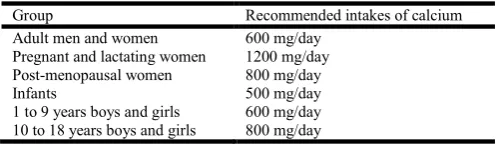
According to the Indian Council of Medical Research the recommended dietary allowances (RDA) for calcium is as follows
Table 1. RDA for calcium
Group Recommended intakes of calcium
Adult men and women 600 mg/day
Pregnant and lactating women 1200 mg/day
Post-menopausal women 800 mg/day
Infants 500 mg/day
1 to 9 years boys and girls 600 mg/day
10 to 18 years boys and girls 800 mg/day
Deficiency of calcium is responsible for developing many symptoms like
1. Muscle cramping in legs, particularly at night, is one of the
first signs of calcium deficiency.
2. Joint pains, cardiac palpitations, increased cholesterol
levels, slow pulse rates, insomnia, impaired growth, excessive irritability, dry skin, brittle nails, yellowish teeth etc. are the symptoms of moderate calcium deficiency.
3. Osteoporosis and frequent bone fractures results from
chronic calcium deficiency (Pravina et al., 2013).
Osteoporosis is the most common type of bone disorder in adults, primarily affecting middle-aged and elderly people, 80% of them women, mostly post-menopausal women(Guyton, 2006). It affects the entire skeletal system, causing shrinkage of vertebrae, height loss, hunched backs, bone pain and frequent fractures (Tortora, 2009). Osteoporosis affects around 40% women and 14% men over 50 years of age (Eastell, 2002). Repeated bone fractures as well as poor and slow recovery from it, causes pain and invites movement disability which is a major problem of old age. Osteoporosis-related morbidity and mortality, as well as health care costs, have significant public health concern (Institute of Medicine, 2011). Regular intake of a balanced diet, containing adequate amount of calcium, magnesium, potassium and vitamin D throughout the life is essential for maintaining good skeletal health (Tucker, 2009; Miggiano et al., 2005). In our country, a large section of the population remains below the poverty line. They mainly subsist on inadequate intake of poor quality cereal based vegetable diet, devoid of milk. It is usually not possible for them to incorporate substantial amount of milk in their daily diet. As a result of dietary calcium inadequacy, skeletal problems are frequently observed among them.
In this scenario, if it is possible to develop a low-cost, calcium-rich vegetable supplementary powder and distribute it among the poverty-stricken people, it may be helpful to ensure adequate calcium intake according to the prescribed guidelines. In general, green leafy vegetables (GLVs) are good source of calcium. Hence, nutritious underutilized seasonally available GLV can be explored to prepare calcium-rich supplementary leaf powder.
Cauliflower (Brassica oleraceae var. Botrytis) is one of the most frequently consumed vegetable in India but their leaves are rarely consumed by the common people. Fresh cauliflower leaf is a seasonal, nutritious, calcium rich (626mg/100g),
tasteful green leafy vegetable but it contain around 80% moisture which makes it highly perishable (Gopalan et al., 2004) As the fresh cauliflower leaves are usually considered as a waste in the vegetable market, it can easily be collected at zero cost. If it is possible to dry the fresh leaves into cauliflower leaf powder (CLP), it may be used as a calcium rich, low cost supplement that can be incorporated into many recipes of our daily menu. So, to utilize the high calcium potential of the cauliflower greens, it is needed to be dried and processed.
Cauliflower leaves were dried by various methods by many scientists but the calcium content of CLP samples varies depending on the drying method used. Wani et al. (2011) prepared CLP by collecting cauliflower leaves from the local market of Jammu city, India. These leaves were then washed with water, blanched for10-15 seconds, and were dried at room temperature for 1-2 hours, followed by drying in hot air oven at
400C for 4-6 hours and then ground to fine powder. The dried
CLP contained only 2.41% moisture. According to Mogra et al. (2012), CLP was developed by drying leaves at 40°C temperature for 22 hours using mechanical drier. 100g of this CLP contains 3600mg calcium. Singh, et al. (2005) evaluated the nutritive value of products prepared from dried powder of cauliflower leaves. The leaves of cauliflower (Brassica
oleracea) were dried, powdered and used for preparing
namakpara, kurmura, biscuit and cake. These studies showed that cauliflower leaves can be dried using various processing methods.
Various researchers dried and cooked many underutilized green leafy vegetables using various methods and estimated their calcium contents which showed that processing methods largely determined the yield and calcium level in the processed leaves. Lyimo et al. (2010) suggested that there is a need to choose the appropriate processing methods having minimum nutrient losses. Sakhale, et al. (2007), dried the curry leaves by sun drying, shade drying and tray drying methods. The yield of shade dried curry leaves was highest compared to other methods.
Oladele and Aborisade (2009) studied the influence of sun-drying, shade drying and oven drying methods on the mineral contents of Indian spinach which showed that calcium was well retained in the dried leaves but calcium contents were varied from sample to sample. The study of Umoh and Iwe (2014) on the effects of processing on the nutrient composition of false yam (Icacinatrichantha) flour indicated that there was significant differences in calcium content of steeped sun-dried and oven-dried as well as blanched sun-dried and oven-dried
flour samples. Kiremire et al. (2010) estimated the calcium retention of traditionally sun dried, solar dried and
oven dried Amaranthushybridus, Amaranthusblitum and
Amaranthuscruentus samples which indicated that calcium was
well retained in the dried leaves but the percentage of retention varied depending on the drying methods. According to the study of Lyimo, et al. (2010) in Tanzania, processing of sweet potato varieties by boiling, roasting and sun drying caused no significant (p>0.05) effect on calcium content. In another study Mepba et al. (2007) studied the effects of processing treatments on the nutritive composition of eight leafy vegetables. In this study the calcium contents of raw, sundried, blanched and cooked vegetable samples were estimated which showed that the calcium level remain almost same in both raw and sundried leafy vegetable sample but it varies slightly depending on the sample and the processing methods used.
Abioye, et al. (2014) studied the effects of different drying methods on the nutritional attributes of baobab leaves (Adansoniadigitata) in Nigeria. They dried the baobab leaves by sun drying, shade drying, cabinet drying and solar drying methods and analyzed the nutrient contents in both the fresh and processed leaves. This study showed that fresh baobab leaves are good sources of calcium (90mg/100g) and the calcium level increased during all types of processing of leaves. This study also showed that there is significant difference in proximate components, ascorbic acid and mineral contents between the leaves undergoes through different drying methods.
Previous studies indicated that the cauliflower leaf is a neglected calcium-rich green leafy vegetable, which can be dried by several methods and converted into powdered form. Cauliflower Leaf Powder (CLP) can be incorporated into different recipes to improve their calcium content. Calcium is usually well retained in the dried green leafy vegetables but the extent of calcium retention largely depends on the drying method used.
Aims and Objectives
The aims and objectives of the present study include
1. To prepare cauliflower leaf powder (CLP) from freshly
collected cauliflower leaves by using different home-based processing methods namely sun-drying, shade drying, microwave-drying, oven-drying and roasting methods.
2. To assess the total yields of the cauliflower leaf powder
from 100g of fresh leaves.
3. To estimate and compare the calcium content of the fresh
cauliflower leaves as well as five types of dry CLP samples.
4. To select the most suitable processing method for drying
the fresh cauliflower leaves.
MATERIALS AND METHODS
Preparation of dry cauliflower leaf powder (CLP) in five different methods
1. Collection of raw material: Fresh cauliflower leaves were
collected from the local market of the south Kolkata, West Bengal at zero cost.
2. Sorting, washing and weighing of fresh leaves: Only the
good quality leaves were considered as a raw material and they were washed thoroughly with clean, running tap water to remove all the dirt, and other non-edible matters. Then the excess water was removed from clean leaves by spreading them on a dry, clean cloth.
3. Drying of fresh leaves in 5 different ways to prepare five
types of CLPs: Five sets of weighed fresh leaves were taken for further processing in following methods
a) Preparation of sun dried CLP: Weighed amount of raw
materials were kept in single layer in a tray under the sun for 3 days and dried until the crisp, brittle dry leaves were obtained. The dry leaves were then grinded into a fine powder using a grinder, minutely collected, accurately weighed and subsequently stored in air tight plastic container in a cool and dry place.
b) Preparation of shade dried CLP: The fresh cauliflower
leaves were weighed and spread over a dry, clean cloth and kept in a well-ventilated, clean room for about 4 days at room temperature and dried adequately. Then the dry leaves were powdered by using a grinder, weighed and kept in air tight container.
c) Preparation of microwave dried CLP: The fresh
cauliflower leaves were weighed and dried in the
microwave oven at 1400C for 18 minutes, powdered,
weighed again and stored.
d) Preparation of oven dried CLP: The weighed, fresh leaves
were dried in the oven dryer at 1000C for 4 hours, grinded
into powder, weighed, kept in air tight container and stored.
e) Preparation of roasted CLP: Weighed amount of fresh
All the five sets of fresh leaves were optimally dried to obtain a crispy textured dried leaves which can easily be converted into uniform fine powder.
Estimation of total yield of dry CLP from 100g of fresh leaves
Five sets of 100g fresh cauliflower leaves were separately and accurately weighed, processed in five different ways and converted into cauliflower leaf powder (CLP), and weighed again (Raghuramulu, 2003).
Preparation of ash extract for Calcium estimation
5g of the sample was weighed accurately into a porcelain crucible, completely charred over flame, heated at 600°C for 4 hours in muffle furnace, cooled in a desiccator & weighed again. To ensure completion of ash preparation, the crucible was again heated in the muffle furnace for 4 hours. This was repeated till two consecutive weights were the same.
Ash content (g/100g sample) = (Wt. of the ash/Wt. of the sample taken) x 100
5ml of N/2 HCL was poured into the ash and was heated on
flame. Then it was again washed with 5ml N/2 HCL & the
process was repeated for 3-4 times. Now the solution was filtered with filter paper in a 100ml volumetric flask and the volume was make up with distilled water.
The above method was applied for the all samples (Raghuramulu, 2003).
Estimation of calcium content of five 5 differently processed CLP samples by EDTA titrimetric method (Das, 2006 and Nielsen, 2010).
Principles
Determination of a metal ion by titration with strongly chelating ligands using metal ion indicator is called complexometric titration. Usually sodium salt of EDTA is used as chelating ligands due to its commercial availability, satisfaction of coordination number in a single step formation of a soluble complex without any precipitate, fast reaction rate and formation of highly stable complex than the usual metal ion indicator which helps the reaction to be quantitative. EDTA is the disodium salt of ethylene diamine tetra acetic acid
denoted as Na2H2EDTA.The solubility of EDTA complex
depends on the pH of the solution & the presence of the other chelating ligands. Depending on the pH, metal ion indicator is chosen. The metal ion indicators are chelating agent, which form colour complex with specific metals. The sharpness of the end point increases with increasing pH but magnesium and calcium precipitate as their hydroxides at pH 12. Hence, titration pH should not be more than 11 to ensure their solubility. Considering all factors, EDTA complex metric titration of calcium and magnesium is specified at pH 10 ± 0.1 using an ammonia buffer.
In the estimation of metal ion with EDTA in presence of EBT indicator colour change occur from wine red to blue at the
equivalent point. As ca++ ions form a relatively, stable complex with EDTA, but much less stable complex with EBT indicator, on sharp end point is observed in Ca++ ion only. For
this reason, to get sharp end point, a little of 0.1(m) Na2Mg
EDTA is to be added to Ca++ solution, before titration. As a
result more stable Na2CaEDTA will be obtained in the solution
releasing equivalent amount of Mg++. The released Mg++ then reacts with EBT indicator to form wine red Mg- In- & the colour change at the equivalent point will be from wine red to
blue in presence of NH4CL/NH4OH buffer of pH 10.0.
Procedure
a) Standardisation of EDTA solution:
10 ml of standard zinc acetate solution was taken in a 250ml conical flask and was diluted with 20ml of distilled water.1ml
of NH4CL/NH4OH buffer solution and 4-5 drops of EBT
indicator was added to the solution. The colour of the solution
turned wine red. The solution was titrated with Na2H2EDTA
solution, until wine red colour turned pure blue.
b) Estimation of Ca2+ ion in unknown solution:
10ml of the unknown Ca2+ solution was pipette out in a 250ml conical flask and diluted with 20ml distilled water. Then 1ml of
NH4CL/NH4OH buffer solution and 4-5 drops of EBT indicator
was added. The colour of the solution turned wine red. Now the
solution was titrated with Na2H2EDTA solution, until wine red
colour turned pure blue.
Calculation
Step1: Standardisation of EDTA solution:
V1=Volume of zinc acetate solution, S1= Strength of zinc
acetate solution
V2=Volume of Na2H2EDTAsolution consumed and S2=
Strength of Na2H2EDTA solution
V1S1=V2S2, or S2=V1S1/V2
Step2: Estimation of Ca2+ ion in unknown solution:
V1=Volume of unknown calcium solution, S1= Strength of
unknown calcium solution
V2=Volume of Na2H2EDTA solution consumed and S2 =
Strength of Na2H2EDTA solution
V1 S1= V2 S2, or S1= V2 S2/ V1
By using above formula, the strength of unknown calcium solution (mg/100ml) is calculated. Since, 100ml of unknown calcium solution is equivalent to 5g of food sample; the amount calcium present in 100g of food was then calculated.
RESULTS
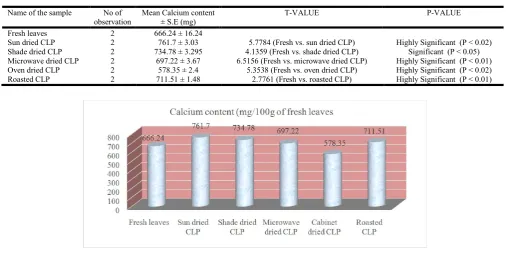
Calcium assessment of fresh leaves and differently processed cauliflower leaf powder samples showed that 100g fresh leaves contain 666mg calcium whereas that of processed samples varied from 578-762mg/100g of fresh leaves. Among the samples, oven dried CLP contain lowest amount of calcium whereas sun dried CLP contain highest amount of calcium. All the processed leaves have significantly higher calcium content.
DISCUSSION
In our country, dietary calcium inadequacy is frequently observed, particularly those from lower and middle socio-economic classes. Cauliflower leaf is a seasonal, rarely used, calcium-rich, highly perishable green leafy vegetable. In the present study, fresh cauliflower leaves were collected from the local market, washed thoroughly with clean water, weighed, and dried by five different processes namely sun-drying, shade-drying, microwave shade-drying, oven-drying and roasting methods.
Finally the differently processed leaves were grinded into powder, collected accurately, weighed again and kept separately in air-tight containers. Now the total yield of CLP and calcium content of 5 differently processed CLP samples were estimated by suitable methods.
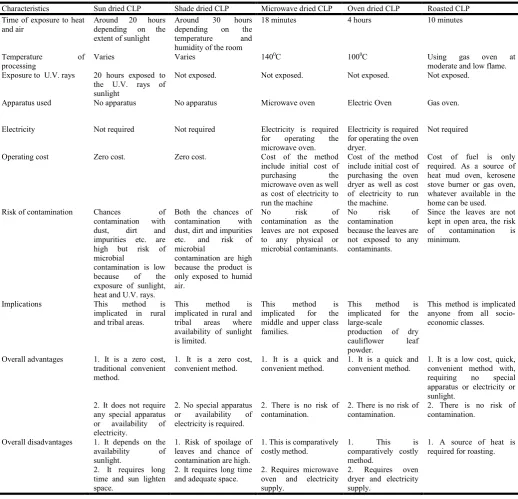
The similarities, dissimilarities, advantages and disadvantages of 5 processing methods are summarised in the following table (Table 3).
Estimation of total yields of CLP from fresh leaves varied from 15.12-20.76% depending on the drying method used. Variation in yields were basically due to variation in moisture contents and variation in the loss of volatile compounds of the respective samples.
[image:5.595.105.499.60.221.2]This may indicate that efficiency of removal of moisture is inversely related with the total yield of CLP.
[image:5.595.45.554.276.532.2]Fig. 1. Total yield of CLP from fresh leaves (g/100g of fresh leaves)
Table 2. Calcium content of the leaf samples (mg/100g of fresh leaves)
Name of the sample No of
observation
Mean Calcium content ± S.E (mg)
T-VALUE P-VALUE
Fresh leaves 2 666.24 ± 16.24
Sun dried CLP 2 761.7 ± 3.03 5.7784 (Fresh vs. sun dried CLP) Highly Significant (P < 0.02)
Shade dried CLP 2 734.78 ± 3.295 4.1359 (Fresh vs. shade dried CLP) Significant (P < 0.05)
Microwave dried CLP 2 697.22 ± 3.67 6.5156 (Fresh vs. microwave dried CLP) Highly Significant (P < 0.01)
Oven dried CLP 2 578.35 ± 2.4 5.3538 (Fresh vs. oven dried CLP) Highly Significant (P < 0.02)
Roasted CLP 2 711.51 ± 1.48 2.7761 (Fresh vs. roasted CLP) Highly Significant (P < 0.01)
Calcium assessment of fresh leaves and cauliflower leaf powders showed that 100g fresh leaves contain 666mg calcium whereas that of processed cauliflower leaf powder samples varied from 578-762mg/100g of fresh leaves. Similar trends were observed in the findings of a recent study conducted by Abioye et al. (2014) on the effects of different drying methods on the nutritional attributes of baobab leaves (Adansonia
digitata), which showed that fresh baobab leaves are good
sources of calcium (90mg/100g) and the calcium level increased during all types of processing of leaves. The present study suggested that both fresh cauliflower leaves as well as processed cauliflower leaf powder (CLP) can be utilized as a calcium-dense vegetable supplements which can effectively be used to enrich the daily diet of the common people.
[image:6.595.37.556.86.585.2]The present study indicated that among the five different processing methods applied, sun drying is the most traditional cheap and convenient method which is able to efficiently convert the fresh leaves into the dried CLP. But sun-drying process requires adequate sunlight, space and prolong period of time and there is increased risk of physical and biological contamination in this method. Shade-drying process also able to effectively retain the calcium contents but the risk of spoilage and contamination is highest in this method. Comparing all the advantages and disadvantages of the 5 processing techniques, roasting is considered as the most suitable and flexible method which may be adapted by the people from all socio-economic classes. It requires minimum time and exposure to heat and air. This process does not require
Table 3. Comparison of 5 methods of CLP preparation
Characteristics Sun dried CLP Shade dried CLP Microwave dried CLP Oven dried CLP Roasted CLP
Time of exposure to heat and air
Around 20 hours
depending on the
extent of sunlight
Around 30 hours
depending on the
temperature and
humidity of the room
18 minutes 4 hours 10 minutes
Temperature of
processing
Varies Varies 1400C 1000C Using gas oven at
moderate and low flame.
Exposure to U.V. rays 20 hours exposed to
the U.V. rays of sunlight
Not exposed. Not exposed. Not exposed. Not exposed.
Apparatus used No apparatus No apparatus Microwave oven Electric Oven Gas oven.
Electricity Not required Not required Electricity is required
for operating the
microwave oven.
Electricity is required for operating the oven dryer.
Not required
Operating cost Zero cost. Zero cost. Cost of the method
include initial cost of
purchasing the
microwave oven as well as cost of electricity to run the machine
Cost of the method include initial cost of purchasing the oven dryer as well as cost of electricity to run the machine.
Cost of fuel is only required. As a source of heat mud oven, kerosene stove burner or gas oven, whatever available in the home can be used.
Risk of contamination Chances of
contamination with
dust, dirt and
impurities etc. are
high but risk of
microbial
contamination is low
because of the
exposure of sunlight, heat and U.V. rays.
Both the chances of
contamination with
dust, dirt and impurities
etc. and risk of
microbial
contamination are high because the product is only exposed to humid air.
No risk of
contamination as the leaves are not exposed to any physical or microbial contaminants.
No risk of
contamination because the leaves are not exposed to any contaminants.
Since the leaves are not kept in open area, the risk
of contamination is
minimum.
Implications This method is
implicated in rural and tribal areas.
This method is
implicated in rural and
tribal areas where
availability of sunlight is limited.
This method is
implicated for the
middle and upper class families.
This method is
implicated for the large-scale
production of dry
cauliflower leaf
powder.
This method is implicated anyone from all socio-economic classes.
Overall advantages
1. It is a zero cost, traditional convenient method.
2. It does not require any special apparatus
or availability of
electricity.
1. It is a zero cost, convenient method.
2. No special apparatus
or availability of
electricity is required.
1. It is a quick and convenient method.
2. There is no risk of contamination.
1. It is a quick and convenient method.
2. There is no risk of contamination.
1. It is a low cost, quick, convenient method with,
requiring no special
apparatus or electricity or sunlight.
2. There is no risk of contamination.
Overall disadvantages
1. It depends on the
availability of
sunlight.
2. It requires long time and sun lighten space.
1. Risk of spoilage of leaves and chance of contamination are high. 2. It requires long time and adequate space.
1. This is comparatively costly method.
2. Requires microwave oven and electricity supply.
1. This is
comparatively costly method.
2. Requires oven
dryer and electricity supply.
any special equipment or electricity or availability of sunlight. As the leaves are not kept in an open place for long time, the risk of physical and microbial contamination as well as chance of spoilage is minimum. This is a very low cost method as the cost only includes the cost of fuel required for the roasting process. The total yield and calcium retention is satisfactory for this method.
Conclusion
It may be concluded that both fresh cauliflower leaves as well as CLP are rich sources of calcium. Fresh leaves can be dried by many methods and all the methods well retained the calcium content of leaves. But the calcium content varies as the method of processing varies. Roasting is the best method for the preparation of CLP, considering all the advantages and disadvantages of five processing methods used. It is suggested that roasted dry CLP can be used as vegetable calcium supplement which can easily be incorporated into the many recipes commonly used in the day-to-day menu of the people. Regular consumption of CLP may be helpful for preventing and reducing the prevalence of calcium deficiency disorders.
REFERENCES
A Report of the Expert Group of the Indian Council of Medical Research, 2009. Nutrient Requirements and Recommended Dietary Allowances for Indians. Hyderabad, India: National Institute of Nutrition.
Abioye, V.F., Adejuyitan, J.A. and Idowu, C.F. 2014. Effects of different drying methods on the nutritional and quality
attributes of baobab leaves (Adansonia
digitata). Agriculture and Biology Journal of North
America, 5 (3), 104-108.
Das, S.C. 2006. Advance Practical Chemistry. Kolkata. Eastell, R. and Lambert, H. 2002. Strategies for skeletal health
in the elderly. The Proceedings of the Nutrition Society. 61 (2), pp.173-80.
Gopalon, C., Ramasastri, B.V., Balasubramanian, S.C. 2004.
Nutritive Value of Indian Foods, Hyderabad, National
Institute of Nutrition, Indian Council of Medical Research. Guyton, A.C and Hall, J.E. 2006. Textbook in Medical
Physiology. 11th ed. Philadelphia: Elsevier Saunders. Institute of Medicine (U.S.) Committee to Review Dietary
Reference Intakes for Vitamin D and Calcium. 2011. Overview of Calcium'. In: Ross, A.C., Taylor, C.L., Yaktine, A.L., et al. (ed), Dietary Reference Intakes for Vitamin D and Calcium. Washington (DC): National Academies Press (US). pp.35-74.
Joshi, P. and Mathu B. 2010. Preparation of value added products from the leaf powders of dehydrated less utilized green leafy vegetables. Journal of Horticulture and
Forestry, 2 (9), pp. 223–228.
Kiremire et al. 2010. Effects of vegetable drying techniques on nutrient content: a case study of South-Western Uganda. African Journal of Food Agriculture Nutrition and
Development, 10 (5), 2587-2600.
Lyimo, M.E., gimbi, D. M. and Kihinga, T. 2010. Effect of processing methods on nutrient contents of six sweet potato varieties grown in Lake Zone of Tanzania. Tanzania
Journal of Agricultural Sciences, 10 (1), 55-61.
Mepba, H.D., Eboh, L. and banigo, D.E.B. 2007. Effects of processing treatments on the nutritive composition and consumer acceptance of some Nigerian edible leafy vegetables. African Journal of Food Agriculture Nutrition
and Development, 7 (1), 1-18.
Miggiano, G.A. and Gagliardi, L. 2005. Diet, nutrition and bone health. Clin Ter. 156 (1-2), pp.47-56
Mogra, R., Banga, J. and Rathi, P. 2012. Nutrient composition of cauliflower (Brassica oleracea var. Botrytis) leaf powder and its acceptability in fast food snacks. Food
Science Research Journal,3 (2):167-171.
Nielsen, S.S. 2010. FoodAnalysis, 4th ed. New York,
USA: Springer.
Oladele, O.O and Aborisade, A.T. 2009. Influence of different drying methods and storage on the quality of Indian spinach (Basellarubra L). American Journal of Food
Technology, 4 (2), 66-70.
Pravina, P., Sayaji, D. and Avinash, M. 2013. Calcium and its Role in Human Body. International Journal of Research in
Pharmaceutical and Biomedical Sciences, 4 (2),
pp.659-668.
Raghuramulu, N., Nair, K. and Kalyanasundarum, S. 2003. A Manual of Laboratory Techniques. 2nd ed. National Institute of Nutrition, Hyderabad, India.
Sakhale et al. 2007. Studies on dehydration of curry leaves. ADIT J of Engg., 4 (1), 62-64.
Singh, G., Kawatra, A., Sehgal, S. 2005. Development and nutritional evaluation of products prepared from dried powder of cauliflower leaves. Journal of Food Science and
Technology, 42 (2):137–139
Srilakshmi, B. 2006. Nutrition Science. 2nd ed. New Delhi, India: New Age International Publishers.
Tortora, G.J. and Derrickson, B. 2009. Principles of Anatomy and Physiology. 12th ed. United States of America: John Wiley & Sons, Inc.
Tucker, K.L. 2009. Osteoporosis prevention and
nutrition. Current osteoporosis reports. 7 (4), pp.111-7. Umoh, E.O &Iwe, M.O. 2014. Effects of processing on the
nutrient composition of false yam (Icacina trichantha) flour. Nigerian Food Journal, 32 (2), 1-7.
Wani, T.A. and Sood, M. 2014. Effect of incorporation of cauliflower leaf powder on sensory and nutritional composition of malted wheat biscuits. African Journal of
Biotechnology, 13 (9), pp. 1019-1026.
Wani, T.A., Sood, M. and Kaul, R.K. 2011. Nutritional and sensory properties of roasted wheat noodles supplemented with cauliflower leaf powder. Annals Food Science and
Technology, 12 (2):102-107.