AN EXPERIMENTAL METHOD TO DETERMINE THE AUGMENTATION OF HEAT TRANSFER
COEFFICIENT BY C
*
Dr. Prakash
Department of Thermal Power Engineering, VTU PG Centre, Mysuru
ARTICLE INFO ABSTRACT
Nanofluid is colloidal suspension of nanosized solid particles in a liquid. Generally nanoparticles are made of metals, oxides, carbides, while base liquids may be water, ethylene glycol or oil. Having suspended tiny particles in the base liquid improves t
heat transfer performance is expected. the0heat
demonstrates the increases in convectiv adding CuO nano sized particles of 10
liquid. Nanofluid with different volume fraction of CuO nano sized matter between 0.025
used in this current work. The test setup consists of a test section that includes copper pipe of 1000 mm length, inner diameter 10mm and a heater. To minimize the heat loss in test section, insulation layer is covered. Thermocouples are utilized in test sect
solid volume fraction, nanofluid flow rate and the inlet temperature on heat transfer performance of the nanofluid is examined in this current work. The results show an increment in heat transfer with raising
Copyright © 2015 Dr. Prakash and Kiran Ningappa Kotin
permits unrestricted use, distribution, and reproduction in any medium, provided the original work is properly cited.
INTRODUCTION
Nanofluid is a fluid in which it contains nanometer particles is suspended in base fluid. The base fluids are the conventional heat transfer basic fluids. The conventional heat transfer fluids, including oil, water, and ethylene glycol mixture. The conventional fluids are poor heat transfer rate, since the thermal conductivity of these fluids play important role on the heat transfer coefficient between the heat transfer medium and the heat transfer surface. Therefore numerous methods have been taken to improve the thermal conductivity of these fluids by suspending nano/micro or larger particle materials in fluids. Since the solid nanoparticles with typical length scales of 1–100 nm with high thermal conductivity are suspended in the base fluid, h
to enhance effective thermal conductivity and the convective heat transfer coefficient of the base fluid. Nanofluids have the potential to reduce such thermal resistances, and the industrial groups that would benefit from such improved heat
fluids are quite varied. They include transportation, electronics, medical, food, and manufacturing of many types.
*Corresponding author: Dr. Prakash, S.B.
Department of Thermal Power Engineering, VTU PG Centre, Mysuru
ISSN: 0975-833X
Article History:
Received 06th July, 2015
Received in revised form 20th August, 2015
Accepted 17th September, 2015
Published online 31st October,2015
Key words: Metaphysics, Existence, Charms, Philosophy, Relevance.
Citation: Dr. Prakash, S.B. and Kiran Ningappa Kotin
coefficient by cuo - water nanofluid”, International Journal of Current Research
RESEARCH ARTICLE
AN EXPERIMENTAL METHOD TO DETERMINE THE AUGMENTATION OF HEAT TRANSFER
COEFFICIENT BY CuO - WATER NANOFLUID
Dr. Prakash, S. B. and Kiran Ningappa Kotin
Department of Thermal Power Engineering, VTU PG Centre, Mysuru
ABSTRACT
Nanofluid is colloidal suspension of nanosized solid particles in a liquid. Generally nanoparticles are made of metals, oxides, carbides, while base liquids may be water, ethylene glycol or oil. Having suspended tiny particles in the base liquid improves the thermal conductivity and thus the increase in heat transfer performance is expected. A test study has been completed to examine heat0transfer0performance of water and CuO nanoparticles. This current experiment demonstrates the increases in convective heat transfer in nanofluid. The nanofluid developed by adding CuO nano sized particles of 10-20 nm in base liquid. Demineralized water is used as base liquid. Nanofluid with different volume fraction of CuO nano sized matter between 0.025
d in this current work. The test setup consists of a test section that includes copper pipe of 1000 mm length, inner diameter 10mm and a heater. To minimize the heat loss in test section, insulation layer is covered. Thermocouples are utilized in test section to measure the temperatures. The effect of solid volume fraction, nanofluid flow rate and the inlet temperature on heat transfer performance of the nanofluid is examined in this current work. The results show an increment in heat transfer with raising volume0fraction of CuO nanoparticles and increase in temperature.
Kiran Ningappa Kotin. This is an open access article distributed under the Creative Commons Attribution License, which distribution, and reproduction in any medium, provided the original work is properly cited.
Nanofluid is a fluid in which it contains nanometer-sized particles is suspended in base fluid. The base fluids are the conventional heat transfer basic fluids. The conventional heat transfer fluids, including oil, water, and ethylene glycol onventional fluids are poor heat transfer rate, since the thermal conductivity of these fluids play important role on the heat transfer coefficient between the heat transfer medium and the heat transfer surface. Therefore numerous o improve the thermal conductivity of these fluids by suspending nano/micro or larger-sized particle materials in fluids. Since the solid nanoparticles with 100 nm with high thermal conductivity are suspended in the base fluid, have been shown to enhance effective thermal conductivity and the convective heat transfer coefficient of the base fluid. Nanofluids have the potential to reduce such thermal resistances, and the industrial groups that would benefit from such improved heat transfer fluids are quite varied. They include transportation, electronics, medical, food, and manufacturing of many types.
Department of Thermal Power Engineering, VTU PG Centre, Mysuru
The purpose of this work is to obtain a deeper understanding into the convective heat transfer behavior of nanofluid. The overall heat transfer enhancement due to nanofluid has been investigated, and specialized tests have also been performed to observe the convective heat tr
section. Aqueous based nanofluid containing CuO of different volume fractions will be analyzed under constant heat flux boundary condition.
Preparation of Nanofluid
The preparation of nanofluid is that the first key step in experimental studies with nanofluid.
two step technique are generally used for preparing the nanofluid.
Single Step Technique
In the single step method, the nanoparticles
nanofluid preparation are done at the same time. nanoparticles are straightforwardly prepared by a physical vapor deposition technique or a liquid chemical method. single step technique, agglomeration of nanoparticles is reduced and the stability of the nanofluid is increased as Available online at http://www.journalcra.com
International Journal of Current Research
Vol. 7, Issue, 10, pp.21681-21685, October, 2015
INTERNATIONAL
Kiran Ningappa Kotin, 2015. “An experimental method to determine the augmentation of heat transfer
International Journal of Current Research, 7, (10), 21681-21685.
z
AN EXPERIMENTAL METHOD TO DETERMINE THE AUGMENTATION OF HEAT TRANSFER
Department of Thermal Power Engineering, VTU PG Centre, Mysuru
Nanofluid is colloidal suspension of nanosized solid particles in a liquid. Generally nanoparticles are made of metals, oxides, carbides, while base liquids may be water, ethylene glycol or oil. Having he thermal conductivity and thus the increase in A test study has been completed to examine performance of water and CuO nanoparticles. This current experiment e heat transfer in nanofluid. The nanofluid developed by 20 nm in base liquid. Demineralized water is used as base liquid. Nanofluid with different volume fraction of CuO nano sized matter between 0.025-0.5 percent d in this current work. The test setup consists of a test section that includes copper pipe of 1000 mm length, inner diameter 10mm and a heater. To minimize the heat loss in test section, insulation ion to measure the temperatures. The effect of solid volume fraction, nanofluid flow rate and the inlet temperature on heat transfer performance of the nanofluid is examined in this current work. The results show an increment in heat transfer with
fraction of CuO nanoparticles and increase in temperature.
. This is an open access article distributed under the Creative Commons Attribution License, which
work is to obtain a deeper understanding into the convective heat transfer behavior of nanofluid. The overall heat transfer enhancement due to nanofluid has been investigated, and specialized tests have also been performed to observe the convective heat transfer enhancement in the test section. Aqueous based nanofluid containing CuO of different volume fractions will be analyzed under constant heat flux
The preparation of nanofluid is that the first key step in
experimental studies with nanofluid. One step technique and
two step technique are generally used for preparing the
the nanoparticles synthesis and
nanofluid preparation are done at the same time. The
nanoparticles are straightforwardly prepared by a physical
vapor deposition technique or a liquid chemical method. In
single step technique, agglomeration of nanoparticles is e stability of the nanofluid is increased as INTERNATIONAL JOURNAL OF CURRENT RESEARCH
storage, transportation, drying and dispersion of nanoparticles are avoided. However, this method only applicable for small scale production and, at current stage, it is almost impossible to scale up to industrial scale.
Two Step Technique
In the two step technique, the nanoparticles synthesis and nanofluid preparation is separated. Firstly, dry nanoparticles are produced; after which, they are dispersed in a appropriate base fluid. This is simpler then single step metho
[image:2.595.79.247.332.434.2]easily buy readily obtainable nanoparticles in market and then disperse them in the base fluid. However, it is well know that nanoparticles have a high surface energy which, in turn, leads to aggregation and clustering of nanoparticles and afte time, the particles will clog and settle down at the bottom of container. Partial dispersion may occur in the suspension which cause lower heat transfer enhancement compare to single step method, and hence, high amount of nanoparticles volume fraction is required. This method works well for oxide particle and carbon nanotube; however, it is less successful for metal nanoparticles.
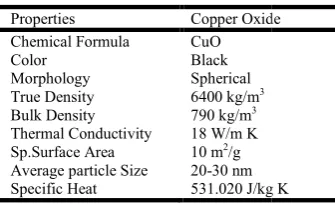
Table 1. Specifications of copper oxide (CuO) nanoparticles
Properties Copper Oxide
Chemical Formula CuO
Color Black
Morphology Spherical
True Density 6400 kg/m3
Bulk Density 790 kg/m3
Thermal Conductivity 18 W/m K
Sp.Surface Area 10 m2/g
Average particle Size 20-30 nm
Specific Heat 531.020 J/kg K
Experimental setup
Fig. 1. Schematic view of experimental
The above figure shows the experimental setup for “An experimental method to determine the augmentation of heat transfer coefficient by CuO – water nanofluid”. The setup mainly consists of the following components namely heating element, heat exchanger, reservoir and pump. Here in the heating element it consist a pipe, which is made up of copper and wounded by the nichrome wire. The ends of the nichrome wire are connected to the AC power supply.
storage, transportation, drying and dispersion of nanoparticles are avoided. However, this method only applicable for small scale production and, at current stage, it is almost impossible to
In the two step technique, the nanoparticles synthesis and Firstly, dry nanoparticles are produced; after which, they are dispersed in a appropriate base fluid. This is simpler then single step method as it can easily buy readily obtainable nanoparticles in market and then disperse them in the base fluid. However, it is well know that nanoparticles have a high surface energy which, in turn, leads to aggregation and clustering of nanoparticles and after some time, the particles will clog and settle down at the bottom of container. Partial dispersion may occur in the suspension which cause lower heat transfer enhancement compare to single step method, and hence, high amount of nanoparticles volume This method works well for oxide particle and carbon nanotube; however, it is less successful for metal
1. Specifications of copper oxide (CuO) nanoparticles
Copper Oxide
531.020 J/kg K
Schematic view of experimental setup
The above figure shows the experimental setup for “An experimental method to determine the augmentation of heat water nanofluid”. The setup mainly consists of the following components namely heating ger, reservoir and pump. Here in the heating element it consist a pipe, which is made up of copper and wounded by the nichrome wire. The ends of the nichrome
As the power supply to the nichrome wire, it generates
due to the resistance of current flow. The copper wire absorbs the generated heat and gets heated
considered in the heat exchanger
a galvanized iron (GI) and inner pipe made up of copper. the nanofluid made to flow in the inner copper tube and water to flow in the outer tube. The heat exchanger is equipped with valve it is ability to make to flow parallel and counter. The reservoir is made up of mild steel, which is coated with FCR coating to avoid corrosion. Here in reservoir nanofluid is stored which is supplied to the test section. The pump is used to supplied working fluid or nanofluid from reservoir to test section. The experimental setup with the above principle components also consist of measuring components such as flow meter having a maximum capacity 30 cc/sec to measure flow rate of working fluid supplied to the test section using the pump. It is fixed in between the reservoir output and entry section of the heating element. To measu
working fluid at different states of system the thermocouple are fixed at the different points along the flow of working fluid.
Data Analysis
1.Heat Absorption
Q= m C ∆T
2.Mass Flow Rate m = ρ × Flow Rate
3.Density
ρ = (1-ϕ) ρ + ϕρ
4.Specific Heat
(ρC )nf = (1-ϕ) (ρC )bf + ϕ (ρC
5.Heat Transfer Coefficient
h = ( )×ᴨ× ×
6.Heat Transfer Rate For Hot Fluid
Q =m × C × (T − T )
For Cold Fluid
Qc=mc x Cpc x (Tci – Tc0)
7.Average Heat Transfer Rate
Q =
8.Surface Area
A = ᴫ × d × L
9.Logarithmic Mean Temperature Difference (LMTD)
LMTD = ( ( ) ( )
10.Overall Heat Transfer Coefficient
U=
×
Q = m × C × (T − T )
As the power supply to the nichrome wire, it generates the heat due to the resistance of current flow. The copper wire absorbs
the generated heat and gets heated. Concentric tube is
considered in the heat exchanger. The outer pipe is made up of
a galvanized iron (GI) and inner pipe made up of copper. Here e nanofluid made to flow in the inner copper tube and water . The heat exchanger is equipped with valve it is ability to make to flow parallel and counter. The reservoir is made up of mild steel, which is coated with FCR avoid corrosion. Here in reservoir nanofluid is stored which is supplied to the test section. The pump is used to supplied working fluid or nanofluid from reservoir to test The experimental setup with the above principle f measuring components such as flow meter having a maximum capacity 30 cc/sec to measure flow rate of working fluid supplied to the test section using the It is fixed in between the reservoir output and entry section of the heating element. To measure the temperature of working fluid at different states of system the thermocouple are fixed at the different points along the flow of working fluid.
)p
Logarithmic Mean Temperature Difference (LMTD)
)
[image:2.595.40.285.461.619.2]RESULTS AND DISCUSSION
[image:3.595.324.537.112.243.2]Density of CuO - Water Nanofluid for Different Volume Fraction
[image:3.595.56.278.116.251.2]Fig. 2. Density of CuO - Water nanofluid for different volume fraction
Figure shows the variation of density of CuO - Water nanofluid with respect to the volume fraction of CuO nanoparticles. From the Fig., the density of nanofluid decreases by increasing the volume fraction nanoparticles in the fluid because the bulk density of nanoparticles in the fluid is less than the base fluid.
[image:3.595.321.543.324.470.2]
Specific Heat of CuO - Water Nanofluid for Different Volume Fraction
Fig. 3. Specific heat of CuO - Water nanofluid for different volume fraction
Figure shows the variation of specific heat of CuO – Water nanofluid with respect to the volume fraction of CuO nanoparticles. Form the Fig., the specific heat of nanofluid decreases by increasing the volume fraction of nanoparticles. Because the specific heat of CuO nanoparticles is less than the specific heat of base fluid.
Thermal Conductivity of CuO - Water Nanofluid for Different Volume Fraction
Figure shows the variation thermal conductivity of CuO – Water nanofluid with respect to the volume fraction of CuO nanoparticles. Form the Fig., the thermal conductivity of nanofluid increases by increasing the volume fraction of
nanoparticles. Because the thermal conductivity of CuO nanoparticles is higher than the thermal conductivity of base fluid.
Fig. 4. Thermal Conductivity of CuO - Water Nanofluid for Different Volume Fraction
Heat Absorption of CuO - Water Nanofluid for Different Volume Fraction
Fig. 5. Heat absorption of CuO - Water nanofluid for different volume fraction
Figure shows the variation heat absorption of CuO – Water nanofluid with respect to the volume fraction of CuO nanoparticles. Form the Fig., it is observed that heat absorption of nanofluid increases by increasing the volume fraction of nanoparticles. Since the thermal conductivity and heat transfer coefficient of CuO nanofluid is increases by increasing the volume fraction results in increases of heat absorption of nanofluid by increasing the volume fraction of CuO nanoparticles.
Heat Transfer Coefficient of CuO-Water Nanofluid for Different Volume Fraction
[image:3.595.54.276.412.555.2]nanofluid increases by increasing the volume fraction of CuO nanoparticles.
Fig. 6. Heat transfer coefficient of CuO-Water nanofluid for different volume fraction
[image:4.595.312.556.101.264.2]Heat Transfer of CuO - Water Nanofluid for Different Volume Fraction
Fig. 7. Heat transfer rate of CuO - Water nanofluid for different volume fraction
Figure shows the variation heat transfer of CuO – Water nanofluid with respect to the volume fraction of CuO nanoparticles. Form the Fig. it is observed that heat transfer of nanofluid increases by increasing the volume fraction of nanoparticles. Since the thermal conductivity and Heat transfer Coefficient of CuO nanofluid is increases by increasing the volume fraction results in increases of heat transfer of nanofluid to cold fluid (Water) by increasing the volume fraction of CuO nanoparticles
Overall Heat Transfer Coefficient of CuO - Water Nanofluid for Different Volume Fraction
Figure shows the variation of overall heat transfer coefficient of CuO – Water nanofluid and cold fluid with respect to the volume fraction of CuO nanoparticles. Form the Fig. it is observed that overall heat transfer coefficient of nanofluid increases by increasing the volume fraction of nanoparticles. Since the specific surface area of the dispersed CuO nanoparticles increases the available heat transfer area for the fluid and higher thermal conductivity of CuO nanoparticles
makes the overall heat transfer coefficient of the nanofluid and cold fluid increases by increasing the volume fraction of CuO nanoparticles.
Fig. 8. Overall heat transfer coefficient of CuO - Water nanofluid for different volume fraction
Conclusion
In this work by observing the experimental results for Thermo physical properties of nano fluids and experimental results for test section and heat exchanger the following conclusions can be made.
The homogeneous and stable nanofluid can be obtained by
making mechanical stirring.
Bulk density of nano particle is lesser than that of base fluid
therefore there is decrease in density of the nanofluid by increasing the volume fraction.
Viscosity of nanofluid increases by increasing the volume
fraction, because viscosity of nanofluid sis depends only on the volume fraction of nano particles.
Specific heat of nano particle is lesser than that of base
fluid, which results volume fraction increases in the fluid specific heat of nanofluid decreases.
Thermal conductivity of nanoparticles is higher than the
base fluid hence as volume fraction increases in the range of 0.025 – 0.5% the fluid thermal conductivity of nanofluid increases minimum of 8 % to maximum of 30 % compare to the base fluid.
Heat transfer coefficient of nanofluid in the test section
increases by increasing the volume fraction of
nanoparticles. Heat transfer coefficient of the nanofluid increases by increasing the volume fraction of CuO nanoparticles. In the range of 0.025 – 0.5% the fluid heat
transfer coefficient of nanofluid increases minimum of 6%
to maximum of 34% compare to the base fluid.
Overall heat transfer coefficient of nanofluid increases by increasing the volume fraction of nanoparticles. Overall heat transfer coefficient of the nanofluid and cold fluid increases by increasing the volume fraction of CuO nanoparticles. In the range of 0.025 – 0.5% the fluid heat
transfer coefficient of nanofluid increases minimum of 9%
[image:4.595.47.286.321.470.2]REFERENCES
Fei Duan, 2012. Thermal Property Measurement of Al2O3
-Water Nanofluids. Smart Nanoparticles Technology, 335-356
Kaufui V.Wong and Omar De Leon, 2009. Applications of Nanofluids: Current and Future, Hindawi Publishing Corporation Advances in Mechanical Engineering Volume 2010, Article ID 519659, 11 pages doi:10.1155/ 2010/519659
Lee, S. and Eastman, J.A. et al. 1999. Measuring Thermal
Conductivity of Fluid Containing a Oxide Nanoparticles. ASME Vol. 121, 280-289.
Ra Zvan Silviu Luciu1, Theodor Mateescu, Victoria Cotorobai And Thierry Mare,2009. Nusselt Number And Convection Heat Transfer Coefficient For A Coaxial Heat Exchanger
Using Al2O3–Water Ph=5 Nanofluid, Sectia, 71-80
Vincenzo Bianco, Oronzio Manca, Sergio Nardini, Kambiz Vafai, 2015. Heat Transfer Enhancement with Nanofluids, CRC Press Taylor and Francis Group, Boca Raton
Xinwei Wang and Xianfan Xu, Stephen U. S. Choi, 1999. Thermal Conductivity of Nanoparticle–Fluid Mixture,
Journal Of Thermophysics and Heat Transfer, Vol. 13,
No. 4.