THE PROCESS GROUP PRACTICE AND ITS IMPLICATION TO THE SUCCESS OF SOFTWARE
PROJECTS: A PRELIMINARY STUDY
*Amir Aslani Behnood, Shaiful Farith Bin Ahmad, Muhammad Azizi Bin
Faculty of Computer Science and Information Technology, Universiti Putra Malaysia, 43400,
ARTICLE INFO ABSTRACT
Project Management is an established discipline that is widely
team projects. Project Management has become the main support framework for the Malaysian government operations, yet there are some notable issues regarding the Project Management processes applied in software developme
discussion in this domain necessitates the need for a research to be conducted to improve the processes applied in software development in various government agencies in Malaysia, which will simultane
implementation of the 5 process groups. The 5 process groups are initiating, planning, executing, monitoring and control, and closing process. Therefore, the objecti
implication of the 5 process groups of project management in government agencies. This study is using a structured questionnaire with 21 questions to capture the practitioner of process group in project management applie
data of project management process is to compare using a set of scale namely strongly agree, agree, undecided, disagree, and strongly disagree. This study has gathered data from various
agencies such as ministry, State Government, Government Link Company (GLC) and higher learning institutions. Based on the results of this study, the participants reacted more positively towards the Project Management 5 Process Groups. Through th
management process groups are one of the contributing factors to the success of software projects.
Copyright © 2017, Amir Aslani Behnood et al. This unrestricted use, distribution, and reproduction in any medium,
INTRODUCTION
Nowadays project management is very well developed and is accepted as a very good realm to do academic researches and speeches, also for professional expertise to do their exercises. There are lots of materials and systems that have been mentioned in books and papers and journals of professional writers that can cover all aspects of projects management from the start to the end of a project. But there are still lots of projects that they failed to reach their objectives, like exceeding the budgets or passing the project deadlines, because the project management is a highly difficult effort. Many organisations in Malaysia were facing problems such as quality, late delivery, over budget and software product needing further improvement or modification (Fauziah Baharom, Aziz Deraman and Abdul Razak Hamdan).
*Corresponding author: Amir Aslani Behnood,
Faculty of Computer Science and Information Technology, Universiti Putra Malaysia, 43400, Serdang, Selangor, Malaysia
ISSN: 0975-833X
Vol.
Article History:
Received 10th September, 2017 Received in revised form 07th October, 2017
Accepted 24th November, 2017 Published online 27th December, 2017
Citation: Amir Aslani Behnood, Shaiful Farith Bin Ahmad, Muhammad Azizi Bin CheSulaiman and Yusmadi Yah Jusoh
practice and its implication to the success of software projects: a preliminary study
Key words: Project management, Process Group, Government Agency.
RESEARCH ARTICLE
THE PROCESS GROUP PRACTICE AND ITS IMPLICATION TO THE SUCCESS OF SOFTWARE
PROJECTS: A PRELIMINARY STUDY
Behnood, Shaiful Farith Bin Ahmad, Muhammad Azizi Bin
and Yusmadi Yah Jusoh
Faculty of Computer Science and Information Technology, Universiti Putra Malaysia, 43400,
Serdang, Selangor, Malaysia
ABSTRACT
Project Management is an established discipline that is widely accepted as the guide to be used in team projects. Project Management has become the main support framework for the Malaysian government operations, yet there are some notable issues regarding the Project Management processes applied in software development that is crucial to understand. The lack of study and discussion in this domain necessitates the need for a research to be conducted to improve the processes applied in software development in various government agencies in Malaysia, which will simultaneously improve the quality of the software created. This study was conducted to explore the implementation of the 5 process groups. The 5 process groups are initiating, planning, executing, monitoring and control, and closing process. Therefore, the objecti
implication of the 5 process groups of project management in government agencies. This study is using a structured questionnaire with 21 questions to capture the practitioner of process group in project management applied in Government Agencies of Malaysia and method used in analyzing the data of project management process is to compare using a set of scale namely strongly agree, agree, undecided, disagree, and strongly disagree. This study has gathered data from various
agencies such as ministry, State Government, Government Link Company (GLC) and higher learning institutions. Based on the results of this study, the participants reacted more positively towards the Project Management 5 Process Groups. Through this study, we can conclude that the project management process groups are one of the contributing factors to the success of software projects.
is an open access article distributed under the Creative Commons medium, provided the original work is properly cited.
Nowadays project management is very well developed and is accepted as a very good realm to do academic researches and speeches, also for professional expertise to do their exercises. There are lots of materials and systems that have been and papers and journals of professional writers that can cover all aspects of projects management from the start to the end of a project. But there are still lots of projects that they failed to reach their objectives, like g the project deadlines, because the project management is a highly difficult effort. Many organisations in Malaysia were facing problems such as quality, late delivery, over budget and software product needing further improvement or modification (Fauziah
Hamdan).
Faculty of Computer Science and Information Technology, Universiti Putra Malaysia, 43400, Serdang, Selangor, Malaysia.
The main factors that led to these discussed by ICT practitioner in Malaysia.
show the importance and implications of the 5 basic process groups of PMBOK in project management that are being practiced in Government Agencies of Malaysia. It report the results of a recently conducted survey that was designed to get the opinion of government agencies that have been involved in a project that applied PMBOK 5 process group in their organization to determine howuseful and effective are these 5 process groups techniques and methods are, and how they felt about them. This paper organized as follows: The following section summarizes the relevant literature of project management processes. The recent related works are describe in section 3. The research
described in section 4. Results and findings are presented in section 5. This is followed by the discussion of the results. Finally we conclude this study for practice and research and some highlights for further research.
International Journal of Current Research
Vol. 9, Issue, 12, pp.62305-62312, December, 2017
Bin Ahmad, Muhammad Azizi Bin CheSulaiman and Yusmadi Yah Jusoh
practice and its implication to the success of software projects: a preliminary study”, International Journal of Current Research Available online at http://www.journalcra.com
z
THE PROCESS GROUP PRACTICE AND ITS IMPLICATION TO THE SUCCESS OF SOFTWARE
Behnood, Shaiful Farith Bin Ahmad, Muhammad Azizi Bin CheSulaiman
Faculty of Computer Science and Information Technology, Universiti Putra Malaysia, 43400,
accepted as the guide to be used in team projects. Project Management has become the main support framework for the Malaysian government operations, yet there are some notable issues regarding the Project Management nt that is crucial to understand. The lack of study and discussion in this domain necessitates the need for a research to be conducted to improve the processes applied in software development in various government agencies in Malaysia, which will ously improve the quality of the software created. This study was conducted to explore the implementation of the 5 process groups. The 5 process groups are initiating, planning, executing, monitoring and control, and closing process. Therefore, the objective of this study is to indicate the implication of the 5 process groups of project management in government agencies. This study is using a structured questionnaire with 21 questions to capture the practitioner of process group in d in Government Agencies of Malaysia and method used in analyzing the data of project management process is to compare using a set of scale namely strongly agree, agree, undecided, disagree, and strongly disagree. This study has gathered data from various government agencies such as ministry, State Government, Government Link Company (GLC) and higher learning institutions. Based on the results of this study, the participants reacted more positively towards the is study, we can conclude that the project management process groups are one of the contributing factors to the success of software projects.
Commons Attribution License, which permits
The main factors that led to these problems are still being discussed by ICT practitioner in Malaysia. This study aims to show the importance and implications of the 5 basic process groups of PMBOK in project management that are being practiced in Government Agencies of Malaysia. It reports on the results of a recently conducted survey that was designed to get the opinion of government agencies that have been involved in a project that applied PMBOK 5 process group in their organization to determine howuseful and effective are ss groups techniques and methods are, and how This paper organized as follows: The following section summarizes the relevant literature of project management processes. The recent related works are describe in section 3. The research design and methodology are described in section 4. Results and findings are presented in section 5. This is followed by the discussion of the results. Finally we conclude this study for practice and research and some highlights for further research.
INTERNATIONAL JOURNAL OF CURRENT RESEARCH
Project Management
There are many definitions of project all around the world but for sure one of the best describes of the meaning of project has been offered by Tuman (1983), he said: “A project is an organization of people dedicated to a specific purpose or objective. Projects generally involve large, expensive, unique, or high risk undertakings which have to be completed by a certain date, for a certain amount of money, with some expected level of performance. At a minimum, all projects need to have well defined objectives and sufficient resources to
carry out all the required tasks.”
Turner (1999) another leading writer also said about project:
“A project is an endeavor in which human, financial and
material resources are organized in a novel way to undertake a unique scope of work, of given specification, within constraints of cost and time, so as to achieve beneficial change
defined by quantitative and qualitative objectives.”
Project Management as defined by some leading writers: "Project Management as knowledge field is both an art and a
science" (Bredillet, 2004 a&b)". Project management involves
applying knowledge, skills, tools, and techniques to project activities in order to meet or exceed stakeholder needs and expectations. It is the art of directing and coordinating human and material resources throughout the life of a project to achieve project objectives within specified constraints. (PMI, 1994). According to Seymour et al. (1992), project management is a central strategy in the changes that many organizations are undergoing as they adapt from a stable, machine like model to a more dynamic one in face of environmental turbulence and change. Project managers face difficult task of both fostering flexibility, adaptability and the acceptance of change as a permanent state, and providing support for team members to enable them to live with a process they may experience as stressful and disorientating.
[image:2.595.61.258.529.687.2]“Project management reduces risks, cuts costs and improves the success rates of projects dramatically” (PMI. 2010).
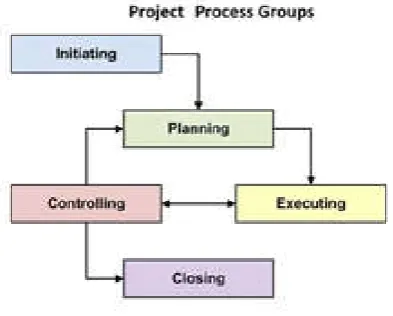
Figure 1. Project Process Groups
Project Management Process Groups
Project management processes can be organized into five groups of one or more processes such as Initiating Process Group, Planning Process Group, Executing Process Group, Monitoring and controlling Process Group and the last one is Closing Process Group.
Initiating Process
According toPMBOK Guide, in Initiating Process Group, these processes performed to define a new project or a new phase of an existing project by obtaining authorization to start the project or phase. Within the initiating processes, the initial scope is defined and initial financial resources are committed. Internal and external stakeholders who will interact and influence the overall outcome of the project are identified. If not already assigned, the project manager will be selected. This information is captured in the project charter and stakeholder register. When the project charter is approved, the project becomes officially authorized. Although the project management team may help write the project charter, approval and funding are handled external to the project boundaries.
Planning Process
For the Planning Process Group, it required the processes to establish the scope of the project, refine the objectives, and define the course of action required to attain the objectives that the project was undertaken to achieve. The planning processes develop the project management plan and the project documents that will be used to carry out the project. The multi-dimensional nature of project management creates repeated feedback loops for additional analysis. As more project information or characteristics are gathered and understood, additional planning may be required. Significant changes occurring throughout the project life cycle trigger a need to revisit one or more of the planning processes and, possibly, some of the initiating processes. This progressive detailing of the project management plan is often called “rolling wave planning,” indicating that planning and documentation are iterative and ongoing processes. The project management plan and project documents developed as outputs from the Planning Process Group will explore all aspects of the scope, time, costs, quality, communication, risk, and procurements.
Executing Process
For the Executing Process Group, it performed to complete the work defined in the project management plan to satisfy the project specifications. In This Process Group involves coordinating people and resources, as well as integrating and performing the activities of the project in accordance with the project management plan. During project execution, results may require planning updates and re-baselining. This can include changes to expected activity durations, changes in resource productivity and availability, and unanticipated risks. Such variances may affect the project management plan or project documents and may require detailed analysis and development of appropriate project management responses. The results of the analysis can trigger change requests that, if approved, may modify the project management plan or other project documents and possibly require establishing new baselines.
Monitoring and Controlling Process
In the Monitoring and Controlling Process Group, these processes required to track, review, and regulate the progress and performance of the project; identify any areas in which changes to the plan are required; and initiate the corresponding changes. The key benefit of this Process Group is that project performance is observed and measured regularly and
consistently to identify variances from the project management plan. The Monitoring and Controlling Process Group also includes controlling changes and recommending preventive action in anticipation of possible problems, monitoring the ongoing project activities against the project management plan and the project performance baseline, and influencing the factors that could circumvent integrated change control so only approved changes are implemented.
Closing Process
For the last process, Closing Process Group performed to finalize all activities across all Process Groups to formally close the project or phase. This Process Group, when completed, verifies that the defined processes are completed within all the Process Groups to close the project or a project phase, as appropriate, and formally establishes that the project or project phase is complete. At project or phase closure, the following may occur such as obtain acceptance by the customer or sponsor, conduct post-project or phase-end review, record impacts of tailoring to any process, document lessons learned, apply appropriate updates to organizational process assets, archive all relevant project.
Related Work
There are many quantitative research conducted in the software development methodology area. However, only few related studies have been conducted in Malaysia organization (Yazrina et al, 2002) and South East Asia region. Most of the studies were conducted in Western country such United Kingdom (UK), United State (US) and Europe (Wheeler &Duggins, 1998; Cusumano et al, 2003). Santos et al studied the perception of software practitioners on the agile practices with the quality of software through an online survey participated by respondents from various countries such as Brazil and US. The findings from that study shows that agile management can lead to a higher software quality. Same goes with Cusumano, MacCromack, Kemerer and Crandall (2003), conducted a global survey of software development practices in 2003. They took almost 2 years to complete the study to compare the software development projects between India, Japan, Europe and the US. Yazrina et al (2002) have done a study on the use of system development methodology in Malaysia. The method used to carry out the study is using questionnaire. The result of the survey have been analyzed using basic statistical measures such as mean comparison, frequency, cross tabulations, correlation and variance analyses. Finding showed that there were some respondents who did not use any methodology while developing an information system due to lack of expertise and too many deliverables that need to be delivered from the methodology. However, 43.3% of the respondents in the research agreed that the use of methodologies are helpful in the development of an information system because it involved certain type of tools such as CASE tools, word processing, spreadsheets, graphic and presentation software. Tools ease the information system development and the development could be completed on schedule or time. Fauziah et al (2006) conducted a study regarding effectiveness of the practices software development process in Malaysia. The method used to carry out the study is using questionnaire. The data was analyzed by using basic statistical techniques such as frequency and cross-tabulation. Finding showed that lack of awareness in using good software development practices could be a key factor that contributes to the occurrence of quality
problem in the organizations. C.D. Manawadu et al (2013foundout how the evaluation of software development methodology took place in Sri Lanka and current methodologies adopted by software developer in Sri Lanka. Finding showed many organizations and developers in the current context use agile methodologies for the software development. Currently they are satisfied with its attributes and further many of them recommend its effectiveness for future use as well. Md. Mahbubur Rahimet al(1998) examined the method adoption pattern of the public and private sector organizations in Brunei Darussalam. Out of 100 organizations, 36 (36%) participated in the survey. There are 67% of the participating organizations reported adoption of a systematic approach to software development by embracing a method. Analysis reveals that method use is dependent on the type of organization varied between matured and novice organizations.
Papke-Shields, K. E. and Boyer-Wright, K. M. (2017) studied about strategic planning characteristics applied to project. Findings indicate that project management is capturedby varying degrees of a rational adaptive approach, which is positively correlated with project management success and use of project management tools/techniques. These resultssuggest that strategic planning characteristics can be effectively incorporated into a generalized project management framework, yielding potentially useful insightsregarding the relationship of project management behaviors to eventual project success.
MATERIALS AND METHODS
This study was using a structured questionnaire with 21 questions to capture the practitioner of process group in project management applyin Government Agencies of Malaysia. The questionnaire comprised with mixture questions approach; 1 open question, 5 questions of multiple choice, and 15 questions of scale.
The questionnaire is a web based survey and was sent through emails of practitioners who have experience working in project management in Government Agencies of Malaysia. Selection of respondents is based on the involvement in project management, particularly in systems development projects. The respondent consists of various levels of agencies such as the Ministries, Departments, Public Higher Education, and the State Government.
The questionnaire was organized into three sections, which include:
Respondent Background: This section covers the general
information of respondent such as year of experience and role in software development which he/she is involved.
Organizational Profile: This section covers the general
information regarding number of IT professionals are engaged in software development.
Project Management Process: This section covers the general
information regarding project management practices applied in the project related project management process which is Project Initiate, Project Planning, Project Execution, Project Monitoring and Control, and Project Closing.
The method used in analyzing the data of project management process is to compare according to a set of scale namely strongly agree, agree, undecided, disagree, and strongly disagree. Every project management process hasthree questions.
RESULTS AND FINDINGS
This data isgathered from reports on the results of a recently conducted survey that was designed to get the opinion from various government agencies such as ministry, state government, and government link company (GLC) and higher learning education. Totalnumber of respondent
Respondents Background
[image:4.595.316.551.133.263.2]There are 1.56% respondents are Project manager and lecturer, 4.69%respondents as software tester and while 3.13% respondents are network administrators, 9.38% respondents are working as project management officer, 14.06% respondents as project leaders, and 20.31% respondents as software developers,most our respondents. There are 4.69% respondents that their job is others (Figure 2).
[image:4.595.44.283.329.493.2]Figure 2. Respondent current position
[image:4.595.318.549.356.503.2]Figure 3 indicates respondent’s working experience and there are 25% respondents who was involved in governments projecthave less than 3 years working experience, 70.31% respondents between 3 to 10 years, and 4.69% of respondents have working experience for more than a decade.
Figure 3. Working experience
Organization background
In Figure 4, it shows the man power of the team or organization that was involved in the project management of
62308 Amir Aslani Behnood et al.The process group practice and its implication to the success of software projects: a preliminary study
The method used in analyzing the data of project management process is to compare according to a set of scale namely e, agree, undecided, disagree, and strongly disagree. Every project management process hasthree
from reports on the results of a recently conducted survey that was designed to get the opinion from various government agencies such as ministry, state government, and government link company (GLC) and higher learning education. Totalnumber of respondents is 64 people.
There are 1.56% respondents are Project manager and lecturer, 4.69%respondents as software tester and while 3.13% respondents are network administrators, 9.38% respondents are 14.06% respondents as project leaders, and 20.31% respondents as software developers,most our respondents. There are 4.69% respondents
[image:4.595.43.282.583.739.2]Respondent current position
Figure 3 indicates respondent’s working experience and there are 25% respondents who was involved in governments projecthave less than 3 years working experience, 70.31% respondents between 3 to 10 years, and 4.69% of respondents
or more than a decade.
Working experience
In Figure 4, it shows the man power of the team or organization that was involved in the project management of
the software development for government agencies. There are 3.13% respondents who are working in an agency of less than 50 people, 20.31% respondents working in an agency with 51 to 150 people working in it and 76.56% people who are working in bigger teams that contain more than 150 people inside them.
Figure 4. Number of employee in the agency
There was 18.75% of respondents said they have less than 10 IT professionals in their agency, there are also18.75% of respondents have between 10 to 20 IT
majority of 62.50% respondents indicates that they have more than 20 IT professionals in their agencies (Figure 5).
Figure 5. Number of IT professional
Managing software development must follow some standard to ensure the quality of system be achieved. Figure 6shows the most standard an organization use for managing software development.56.1% respondent follow organization standard during software development. ISO 9000 is a set of international standards on quality management and q assurance to be implemented to maintain an efficient quality system. There are 31.7% respondent follow ISO 9000 standard. Respondent also follow other standard like IEEE (24.4%), PRINCE2 (19.5%), and PMBOK (17.1%). 9.8% respondent not using standard during software development.
Figure 6. Most standard an organization use fo software development
he process group practice and its implication to the success of software projects: a preliminary study
the software development for government agencies. There are 3.13% respondents who are working in an agency of less than 50 people, 20.31% respondents working in an agency with 51 to 150 people working in it and 76.56% people who are that contain more than 150 people
Number of employee in the agency
There was 18.75% of respondents said they have less than 10 IT professionals in their agency, there are also18.75% of respondents have between 10 to 20 IT professional and the majority of 62.50% respondents indicates that they have more than 20 IT professionals in their agencies (Figure 5).
Number of IT professional
Managing software development must follow some standard to of system be achieved. Figure 6shows the most standard an organization use for managing software development.56.1% respondent follow organization standard during software development. ISO 9000 is a set of international standards on quality management and quality assurance to be implemented to maintain an efficient quality system. There are 31.7% respondent follow ISO 9000 standard. Respondent also follow other standard like IEEE (24.4%), PRINCE2 (19.5%), and PMBOK (17.1%). 9.8%
during software development.
Most standard an organization use for managing software development
[image:4.595.312.557.657.775.2]Table 1 show themethodology used by respondent during software development. Regularly methodology used by respondent are Waterfall (41.5%) and Prototype (39.0%). 41.5% respondent is sometime used Rapid Application Development. Meanwhile 31.7% and 34.1% of respondent used agile methodology and Object Oriented Programming (OOP). 36.6% respondent used Reused oriented as methodology in software development. Table 2 showsthe percentage effort of employing software development activities. 34.1% respondent chosen more than 50% effort related in planning, meanwhile 43.9% respondent chosen more than 50% effort related in development. There are 26.8% respondent chosen effort range of 41% to 50 % are related in analysis, design, testing, deployment, and maintenance.
Figure 7. Duration of time the current project from inc an operational system
Figure 7 shows the duration of time the current project from inception to an operational system. 51.2% project need between 1 to 3 years to finish. 43.9% project can be completed
Table 1. Mostly software deve
Table 2. Percentage effort of employing 62309 International Journal of Current Research,
used by respondent during software development. Regularly methodology used by respondent are Waterfall (41.5%) and Prototype (39.0%). 41.5% respondent is sometime used Rapid Application Development. Meanwhile 31.7% and 34.1% of respondent dology and Object Oriented Programming (OOP). 36.6% respondent used Reused oriented as Table 2 showsthe employing software development activities. 34.1% respondent chosen more than 50% effort d in planning, meanwhile 43.9% respondent chosen more than 50% effort related in development. There are 26.8% respondent chosen effort range of 41% to 50 % are related in analysis, design, testing, deployment, and maintenance.
me the current project from inception to
shows the duration of time the current project from inception to an operational system. 51.2% project need between 1 to 3 years to finish. 43.9% project can be completed
under 1 year project. 4.9% project need more than 3 years to closing their project.
Project Management Process group
Project Initiating
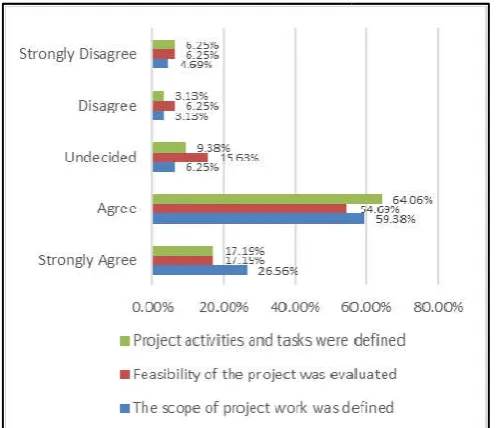
Figure 8 discusses the scope of their project weather the projectwas clearly defined from the start or not. There are 4.69% of respondents who strongly disagree that the scope was defined from the start of project, 3.13% respondents disagree about it, 6.25% of respondents are voting undecided, 53.38% ofrespondents agree that the scope was defined and 26.56% respondentsstrongly agree about it.
the respondents experience about the evaluation of the feasibility of this project. There are 6.25% of respondents who strongly disagree that it was evaluate
disagree about it, 15.63% of respondents are voting undecided, 54.69% of respondents agree that the feasibility was evaluated before start and 17.19% respondents strongly agree about it. Figure 8 managed to get respondents experience o
management and indicates respondents feedback about the project activities and tasks were defined before the project start. There are 6.25% respondents who strongly disagree on this part, 3.13% of respondents disagree, 9.38% of respondents are undecided and 64.06% respondents agree that the activities and tasks were defined and the remaining 17.19% of respondents strongly agree about it.
Project Planning
Respondents feedback about project resources was planned are 9.38% respondents who strongly
Mostly software development methodologies have used
Percentage effort of employing software development activities International Journal of Current Research, Vol. 9, Issue, 12, pp.62305-62312, December
under 1 year project. 4.9% project need more than 3 years to
Project Management Process group
Figure 8 discusses the scope of their project weather the clearly defined from the start or not. There are 4.69% of respondents who strongly disagree that the scope was defined from the start of project, 3.13% respondents disagree about it, 6.25% of respondents are voting undecided, 53.38% at the scope was defined and 26.56% respondentsstrongly agree about it. This figure also indicates the respondents experience about the evaluation of the feasibility of this project. There are 6.25% of respondents who strongly disagree that it was evaluated, 6.25% respondents disagree about it, 15.63% of respondents are voting undecided, 54.69% of respondents agree that the feasibility was evaluated before start and 17.19% respondents strongly agree about it. Figure 8 managed to get respondents experience on project management and indicates respondents feedback about the project activities and tasks were defined before the project start. There are 6.25% respondents who strongly disagree on this part, 3.13% of respondents disagree, 9.38% of respondents decided and 64.06% respondents agree that the activities and tasks were defined and the remaining 17.19% of respondents strongly agree about it.
Respondents feedback about project resources was planned are 9.38% respondents who strongly disagree about this, and
4.69% respondents who disagree that the resources were planned, there are 9.38% respondents who are undecided, 57.81% respondents agree and 18.75% of respondents strongly agree that the resources were planned before the project started.
Figure 8. Project Initiating
[image:6.595.306.564.204.395.2]There are 10.94% of respondents who strongly disagree that the stakeholders involvement in the project was planned, and there is also 10.94% of respondents who disagree about it, 18.75% respondents are undecided about this, 48.44% of respondents agree that the involvement of stakeholders were planned and 15.63% respondents strongly agree about stakeholder involvement was planned. The experience of participants towards the software development project plan as shown in Figure 9established. There are 10.94% respondents who strongly disagree about this, 3.13% of respondents disagree that the plan of the project was established, there are 9.38% respondents who are undecided, majority of 62.5% of respondents agree and 14.06% of respondents strongly agree that project plan was well stablished.
Figure 9. Project Planning
Project Execution
Respondent feedback on software development project whether the project requirements were agreed onare showed in
62310 Amir Aslani Behnood et al.The process group practice and its implication to the success of software projects: a preliminary study
4.69% respondents who disagree that the resources were planned, there are 9.38% respondents who are undecided, 57.81% respondents agree and 18.75% of respondents strongly agree that the resources were planned before the project
There are 10.94% of respondents who strongly disagree that the stakeholders involvement in the project was planned, and there is also 10.94% of respondents who disagree about it, ut this, 48.44% of respondents agree that the involvement of stakeholders were planned and 15.63% respondents strongly agree about The experience of participants towards the software development project plan as Figure 9established. There are 10.94% respondents who strongly disagree about this, 3.13% of respondents disagree that the plan of the project was established, there are 9.38% respondents who are undecided, majority of 62.5% of % of respondents strongly agree
Respondent feedback on software development project whether the project requirements were agreed onare showed in
Figure 10.There are 9.38% respondents who strongly disagree, 4.69respondents disagree, 16.06% respondents are undecided and 56.25% respondents agree that the requirement were agreed on before the project starts and the remaining 15.63%respondents are strongly agree on this ma
experience of participants about project planshowed that there are 7.81% respondentswho strongly disagree that the project plan was implemented, 9.38% (disagree), 12.50% (undecided), 54.69%(agree), and 15.63% respondents strongly agree. status of change requests for the project was trackedshows that strongly disagree (9.38%),
(15.63%), agree (53.13%) and strongly agree (12.50%).
Figure 10. Project Execution
Project Control
Theparticipants feedbackon the
wasmonitored or not shows that strongly disagree (10.94%), only 9.38% respondents disagree, undecided(21.88%), agree (43.75%) and strongly agree (14.06%) respondentsindicate that project risks were monitored.The project progress was monitored, there are 9.38% respondents strongly disagree, 7.81% disagree, 6.25% respondents are undecided, 56.25% respondentsare agreed and 20.31% respondents strongly agree.The participants experience onsoftware development project whether the issues in the pr
There are 10.94% (strongly disagree), 7.81%
[image:6.595.40.287.544.729.2]10.94% (undecided), 54.69% (agree) and 15.63% of respondents strongly agree (Figure 11).
Figure 11. Project Control
he process group practice and its implication to the success of software projects: a preliminary study
9.38% respondents who strongly disagree, 4.69respondents disagree, 16.06% respondents are undecided and 56.25% respondents agree that the requirement were agreed on before the project starts and the remaining 15.63%respondents are strongly agree on this matter. The experience of participants about project planshowed that there are 7.81% respondentswho strongly disagree that the project plan was implemented, 9.38% (disagree), 12.50% (undecided), 54.69%(agree), and 15.63% respondents strongly agree. The s of change requests for the project was trackedshows that disagree (9.38%), undecided (15.63%), agree (53.13%) and strongly agree (12.50%).
Project Execution
Theparticipants feedbackon theproject risks whether it shows that strongly disagree (10.94%), only 9.38% respondents disagree, undecided(21.88%), agree (43.75%) and strongly agree (14.06%) respondentsindicate that project risks were monitored.The project progress was ored, there are 9.38% respondents strongly disagree, 7.81% disagree, 6.25% respondents are undecided, 56.25% respondentsare agreed and 20.31% respondents strongly agree.The participants experience onsoftware development project whether the issues in the project were analyzed or not. There are 10.94% (strongly disagree), 7.81% (disagree), 10.94% (undecided), 54.69% (agree) and 15.63% of respondents strongly agree (Figure 11).
Project Control
[image:6.595.312.554.607.782.2]Project Closing
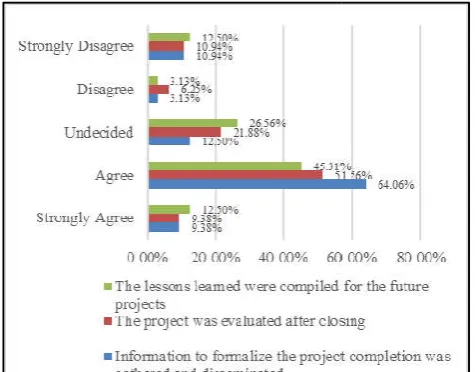
Figure 12shows the feedback of participants about information to formalize the project completion was gathered and disseminated. There are 10.94% ofrespondents strongly disagree that information to formalize the project completion was gathered and disseminated and 3.13% respondents are disagree about it, 12.50% of respondentsreplied undecided about this matter, 64.06%respondents agree and the balance of9.38% of respondents strongly agree about it. participants experience about the project whether itwas evaluated after closing or not. There are 10.94% of respondents who strongly disagree,6.25% respondents disagree about it, 21.88% respondentsreplied undecided, 51.56% of respondents agree that the project was evaluated after closing and 9.38% of respondentsstrongly agree about it. participants feedback about the lessons learned were compiled for the future projects. There are 12.50% respondentswho strongly disagree about this, and 3.13% of respondents disagree that the lessons learned were compiled for
projects, there are 25.56% respondents who are undecided about this, 45.31% of respondents agree and 12.50% respondents strongly agree that the lessons learned were compiled for the future projects (Figure 12).
Figure 12. Project Closing
DISCUSSIONS
The results of this study show that participants were more positive to the Project Management 5 Process Groups than being negative.The survey on the initiationprocess shows that 70.31% of the participants strongly agree that initiating process is important and they are using it in government projects but 4.69% are strongly disagree that it is not important or it is not useful in government projects. Participants evaluation on the planning process shows 60.94% are strongly agree that they are using planning process in government projects as a very important phase although there are 9.38% participants that they believe this phase is irrelevant or it is not being used in government projects. The analysis on the execution process, 54.69% of the participants strongly agree that this phase is useful and they are using it in government projects but still 9.38% of participants strongly disagree that it is irrelevant or it is not being used in projects. Based on the participant’s feedback onmonitoring and control process, it shows that 54.69% of participants strongly agree that this phase is very
62311 International Journal of Current Research,
Figure 12shows the feedback of participants about information to formalize the project completion was gathered and disseminated. There are 10.94% ofrespondents strongly disagree that information to formalize the project completion ated and 3.13% respondents are disagree about it, 12.50% of respondentsreplied undecided about this matter, 64.06%respondents agree and the balance of9.38% of respondents strongly agree about it. The participants experience about the project whether itwas evaluated after closing or not. There are 10.94% of respondents who strongly disagree,6.25% respondents disagree about it, 21.88% respondentsreplied undecided, 51.56% of respondents agree that the project was evaluated after closing sstrongly agree about it. The the lessons learned were compiled . There are 12.50% respondentswho strongly disagree about this, and 3.13% of respondents the lessons learned were compiled for the future , there are 25.56% respondents who are undecided about this, 45.31% of respondents agree and 12.50% the lessons learned were
The results of this study show that participants were more positive to the Project Management 5 Process Groups than being negative.The survey on the initiationprocess shows that 70.31% of the participants strongly agree that initiating process s important and they are using it in government projects but 4.69% are strongly disagree that it is not important or it is not useful in government projects. Participants evaluation on the planning process shows 60.94% are strongly agree that they g planning process in government projects as a very important phase although there are 9.38% participants that they believe this phase is irrelevant or it is not being used in government projects. The analysis on the execution process, ipants strongly agree that this phase is useful and they are using it in government projects but still 9.38% of participants strongly disagree that it is irrelevant or it Based on the participant’s ontrol process, it shows that 54.69% of participants strongly agree that this phase is very
important and useful in government projects but 15.63% are strongly disagree about this phase and they believe that this phase is not useful or it is not getting do
government projects. The feedback on the closing process indicates that 45.31% of participants strongly agree that this phase is important in government projects and 12.50% strongly disagree about the importance of this phase in governm projects.
Conclusion
Project Management is very well developed and accepted as a very good guide to use in team projects in government agencies. In order to implement the project management inside a team project, organizationcanimplement
groups, which is, Initiating process, Planning process, Executing process, Monitoring and Control process and Closing process. This five process groups are very important in project management to make sure to achievethe main objective of project management triangle that is cost, time and quality and make the project cheaper, faster and better.
applied a structured questionnaire with 21 questions to capture the practitioner of process group in project management apply in Government Agencies of Malaysia.This study data hasgathered from various government agencies such as ministry, State Government, and Government Link Company (GLC) and higher learning institution. Total respondents are 64 people. From the results gathered, participant
positive to the Project Management 5 Process Groups. Generally, we conclude that using the project management and 5 process group can be one of the methods to use in team projects to ensure the success of the project.This study recommends future works to understand and find the reasons to why some of the respondents strongly disagree with the 5 Process Group. Another future work is to conduct a study about the success rate of the project of respondents who strongly agree on process groups.
REFERENCES
Baharorn, F., Deraman, A., &Hamdan, A. R. 2006.
on the current practices of software development process in Malaysia. Journal of ICT, 4, 57
Bredillet C. 2004b. Understanding the very nature of Project Management: a praxeological approa
Conference, London.
Bredillet, C. 2004a. Project management governance: A situational approach. EURAM conference. Munich, Germany.
Cusumano, M., MacCormack, A., Kemerer, F. C. & Crandall, W. 2003. A Global Survey of Software Development Practices. IEEE Software.
Manawadu, C. D., Johar, M. G. M., &Perera, S. S. N. 2013. An Evaluation of Software Development Methodology Adoption by Software Developer in Sri Lanka.Editorial Committees, 84.
Papke-Shields, K. E. and Boyer
Strategic planning characteristics applied to project management. International Journal of Project
Management, 35(2), 169-179.
PMI 1994. A guide to the Project Management Body of Knowledge. Newtown Square, PA: Project Management Institute.
PMI. (2010, May 22). The Value of Project Management. Retrieved 05 23, 2015, from PMI:
International Journal of Current Research, Vol. 9, Issue, 12, pp.62305-62312, December
important and useful in government projects but 15.63% are strongly disagree about this phase and they believe that this phase is not useful or it is not getting done the right way in government projects. The feedback on the closing process indicates that 45.31% of participants strongly agree that this phase is important in government projects and 12.50% strongly disagree about the importance of this phase in government
Project Management is very well developed and accepted as a very good guide to use in team projects in government agencies. In order to implement the project management inside organizationcanimplement the 5 process groups, which is, Initiating process, Planning process, Executing process, Monitoring and Control process and This five process groups are very important in project management to make sure to achievethe main objective ject management triangle that is cost, time and quality and make the project cheaper, faster and better. This study applied a structured questionnaire with 21 questions to capture the practitioner of process group in project management apply Agencies of Malaysia.This study data hasgathered from various government agencies such as ministry, State Government, and Government Link Company (GLC) and higher learning institution. Total respondents are 64 people. From the results gathered, participants were more positive to the Project Management 5 Process Groups. we conclude that using the project management and 5 process group can be one of the methods to use in team projects to ensure the success of the project.This study e works to understand and find the reasons to why some of the respondents strongly disagree with the 5 Process Group. Another future work is to conduct a study about the success rate of the project of respondents who strongly agree on process groups.
Baharorn, F., Deraman, A., &Hamdan, A. R. 2006. A survey on the current practices of software development process in
, 4, 57-76.
2004b. Understanding the very nature of Project Management: a praxeological approach. PMI Research
. Project management governance: A situational approach. EURAM conference. Munich,
Cusumano, M., MacCormack, A., Kemerer, F. C. & Crandall, A Global Survey of Software Development
Manawadu, C. D., Johar, M. G. M., &Perera, S. S. N. 2013. An Evaluation of Software Development Methodology Adoption by Software Developer in Sri Lanka.Editorial
Boyer-Wright, K. M. (2017). Strategic planning characteristics applied to project
International Journal of Project
179.
A guide to the Project Management Body of Knowledge. Newtown Square, PA: Project Management
22). The Value of Project Management. Retrieved 05 23, 2015, from PMI:
Rahim, M. M., Seyal, A. H. and Rahman, M. N. A. 1998. Use of software systems development methods An empirical study in Brunei Darussalam. Information and Software
technology, 39(14), 949-963.
Seymour, D.E., Hoare, D.J. and Itau, L. 1992. Project Management Leadership Styles: Problems of resolving the continuity-change dilemma, 11th INTERNET World Congress on Project Management, Florence: Italy.
Tuman, G.J. 1983. Development and implementation of effective project management information and control systems, in Cleland, D.I. & King, W.R. (eds.) Project management handbook. New York: Van Nostrand Reinhold Co., 495-532.
Turner, J.R. 1999. The handbook of project-based management: improving the processes for achieving strategic objectives. 2nd ed. London: McGraw-Hill
White, D. and Fortune, J. 2002.Current practice in project management - an empirical study. International Journal of
project management, 20(1), 1-11.
Yasrina, Y. 2002. The Use of Information System Development Methodology in Malaysia. Jurnal Antarabangsa (Teknologi Maklumat), 2, 2002. 15-34.