NURSING STUDENTS' PERCEPTION REGARDING PRACTICAL LEARNING
1,2,*
Elham Youssef Elhanafy
1
Assistant Professor of Nursing Administration, Faculty of Nursing Damanhur University, Egypt
2Associated Professor of Nursing Administration, Faculty of
3
Assistant Professor of Medical Surgical Nursing,
ARTICLE INFO ABSTRACT
The nursing profession contains two main parts, the first is the theoretical part, which reflects the knowledge that is rec
enhancement of the students’ skills in the clinical area.
evaluate the theoretical learning Gap perceived by Nursing students, bu
one. The present study represents a descriptive design, includes 300 nursing students enrolled in Nursing College, Taibah university, Saudi Arabia (half of them of age ranging from 18 to 23 years and the other half have pre
from 0.65α to 0.86α, which is acceptable. In addition, the results showed that the instrument is reliable, all the subscales were a statically significant at P
supports the need of reconsideration in the practical skills training in nursing education, as well as emphasized to observe gap in the knowledge and the practicing among nursing students.
Copyright©2016, Elham Youssef Elhanafy and Marwa R. Moustafa
which permits unrestricted use, distribution and reproduction in any medium, provided the original work is properly cited.
INTRODUCTION
For many decades there has been ongoing argumentation about what it means to be a competent nurse and how clinical competence develops and is assessed (Sally,
providing nursing care with high quality is a requirement which count on the nursing competency. So Clinical nursing competency is qualification and competence in the areas of psycho-physical, clinical skills, critical thinking, cognitive, problem solving and power to promote education through academic learning and clinical experience, leading, eventually,
to standards and safe care (Sally et al., 2014
2010). The last thirty years converge on dynamic nursing teaching from hospitals to the colleges. Other
width that nursing is a practice discipline and the students’ clinical practice is considered to be the essence of nursing
teaching (Jonsén et al., 2013) It was put that theory as being
complementary to practice and they anticipate more concentration on taught in the practical area
This opinion was originated from the ability of clinical education to provide students with real life events that enable them to develop apply and evaluate their own understanding of concepts being studied (Ranse and Grealish, 2007).
*Corresponding author: 1,2Elham Youssef Elhanafy,
1Assistant Professor of Nursing Administration, Faculty of Nursing Damanhur
University, Egypt, 2Associated Professor of Nursing Administration, Faculty
of Nursing, Taibah University, KSA
ISSN: 0975-833X
Article History:
Received 28th August, 2016
Received in revised form 15th September, 2016
Accepted 23rd October, 2016
Published online 30th November,2016
Key words:
Practical learning, Theory- practice gap, Nursing educator, Teaching methods.
Citation: Elham Youssef Elhanafy and Marwa R. Moustafa, International Journal of Current Research, 8, (11), 41199
RESEARCH ARTICLE
NURSING STUDENTS' PERCEPTION REGARDING PRACTICAL LEARNING
AND THEORY-PRACTICE GAP
Elham Youssef Elhanafy and
2,3Marwa R. Moustafa
of Nursing Administration, Faculty of Nursing Damanhur University, Egypt
of Nursing Administration, Faculty of Nursing, Taibah University, KSA
of Medical Surgical Nursing, Faculty of Nursing Benha University, Egypt
ABSTRACT
The nursing profession contains two main parts, the first is the theoretical part, which reflects the knowledge that is received in the classroom; while the second is the practical part, which focus on the enhancement of the students’ skills in the clinical area. The aim of the present study
evaluate the theoretical learning Gap perceived by Nursing students, bu
The present study represents a descriptive design, includes 300 nursing students enrolled in Nursing College, Taibah university, Saudi Arabia (half of them of age ranging from 18 to 23 years and the other half have previous qualification). The results indicate that
from 0.65α to 0.86α, which is acceptable. In addition, the results showed that the instrument is reliable, all the subscales were a statically significant at P≤0.05. It could
supports the need of reconsideration in the practical skills training in nursing education, as well as emphasized to observe gap in the knowledge and the practicing among nursing students.
Elhanafy and Marwa R. Moustafa. This is an open access article distributez under the Creative Commons Att and reproduction in any medium, provided the original work is properly cited.
For many decades there has been ongoing argumentation about what it means to be a competent nurse and how clinical , 2014). Currently, providing nursing care with high quality is a requirement count on the nursing competency. So Clinical nursing competency is qualification and competence in the areas of physical, clinical skills, critical thinking, cognitive, problem solving and power to promote education through nical experience, leading, eventually,
2014; Safadi et al.,
2010). The last thirty years converge on dynamic nursing rom hospitals to the colleges. Other point of view idth that nursing is a practice discipline and the students’ clinical practice is considered to be the essence of nursing ., 2013) It was put that theory as being complementary to practice and they anticipate more aught in the practical area (Landers, 2015). was originated from the ability of clinical education to provide students with real life events that enable them to develop apply and evaluate their own understanding
anse and Grealish, 2007).
Assistant Professor of Nursing Administration, Faculty of Nursing Damanhur Associated Professor of Nursing Administration, Faculty
However, another author did not eliminate the importance of theory in nursing education (Stockhausen, 2005). They emphasize that theory provides students with the chance to structure a zone of powerful examples that acquired from trail
(Ahmad Saifan et al., 2015).
profession is composed of two main parts: first one; the theoretical part which reflects the knowledge that is received in the faculty, which defined as a set of principles devised to elucidate a lot of fact or phenomena, particularly one that has been repeatedly examined or is generally recognized and can be used to make predictions about naturalistic phenomena. This part should provide the basis for understanding the reality
of nursing (Nabolsi et al., 2012). In faculty, nursing students
are educated the theoretical basis for all procedures, diseases, interpersonal skills and requirements to be a nurse. The second part; practical part which focus on enhancing skills in the clinical setting, that defined as act of doing s
performance or action (Mnal, 2014). Likewise, the practical part equips nursing students with a mechanism to extend classroom learning into the nursing practice environments (McKenna and Willard, 2009). Both of these are part improving nursing and health care system. The relationship between theory and clinical practice, both internationally and nationally, has always been a concern in nursing education. Many authors have s proposed that education in the clinical environment participates in molding the professional
Available online at http://www.journalcra.com
International Journal of Current Research
Vol. 8, Issue, 11, pp.41199-41206, November, 2016
INTERNATIONAL
Elham Youssef Elhanafy and Marwa R. Moustafa, 2016. “Nursing students' perception regarding practical learning and theory 41199-41206.
NURSING STUDENTS' PERCEPTION REGARDING PRACTICAL LEARNING
Marwa R. Moustafa
of Nursing Administration, Faculty of Nursing Damanhur University, Egypt
Nursing, Taibah University, KSA
Nursing Benha University, Egypt
The nursing profession contains two main parts, the first is the theoretical part, which reflects the eived in the classroom; while the second is the practical part, which focus on the The aim of the present study is not only to evaluate the theoretical learning Gap perceived by Nursing students, but also to evaluate the practical The present study represents a descriptive design, includes 300 nursing students enrolled in Nursing College, Taibah university, Saudi Arabia (half of them of age ranging from 18 to 23 years and The results indicate that the Cronbach’s alpha value ranged from 0.65α to 0.86α, which is acceptable. In addition, the results showed that the instrument is It could be concluded that this study supports the need of reconsideration in the practical skills training in nursing education, as well as emphasized to observe gap in the knowledge and the practicing among nursing students.
under the Creative Commons Attribution License,
However, another author did not eliminate the importance of theory in nursing education (Stockhausen, 2005). They emphasize that theory provides students with the chance to structure a zone of powerful examples that acquired from trail
. On other hand, The nursing profession is composed of two main parts: first one; the theoretical part which reflects the knowledge that is received in the faculty, which defined as a set of principles devised to of fact or phenomena, particularly one that has been repeatedly examined or is generally recognized and can s about naturalistic phenomena. This part should provide the basis for understanding the reality ., 2012). In faculty, nursing students are educated the theoretical basis for all procedures, diseases, interpersonal skills and requirements to be a nurse. The second part; practical part which focus on enhancing skills in the ned as act of doing something; (Mnal, 2014). Likewise, the practical part equips nursing students with a mechanism to extend classroom learning into the nursing practice environments Willard, 2009). Both of these are part of improving nursing and health care system. The relationship between theory and clinical practice, both internationally and nationally, has always been a concern in nursing education. Many authors have s proposed that education in the clinical t participates in molding the professional
INTERNATIONAL JOURNAL OF CURRENT RESEARCH
development of student nurses (Budgen and Garmoth, 2008). But, many studies have pointed out the discrepancies between theory and practice (Ehrenberg and Haggle, 2007). Furthermore, the literature show there is a gap between the theory and training components of teaching nursing (Allan, 2011; Chan, 2013; Landers, 2000; McKenna and Willard, 2009). sundry reasons for this gap, 1) using abstract meanings to clarify some procedures in the clinical setting students found it; 2) difficult to connect what they learned in the classroom with the facts they faced in the complex clinical setting, 3) the
complexity and the continuous change in the clinical area
(Nabolsi et al., 2012; Chan, 2013), 4) The development in
nursing education and the move across higher education also increased the gap (Fairbrother and Ford, 1998; McKenna and Willard, 2009) and 5) The clinical instructor’s behavior during the practical learning may either support or block the learning and practice of student nurses (Clark and Holmes, 2007;
Maben et al., 2006; Sedgwick and Yonge, 2008).
As well, from the student perspective the theory practice gap has been noted as; 1) demanding and sometimes left them confused and uncertain about their roles and practice (Ousey and Gallagher, 2007), 2) the clinical instructors were not qualified enough to meet their needs, 3) The instructors did not know how to deal with students and how to be supportive for them and 4) the laboratories on models was totally different from the real complex clinical setting. Moreover, student perceptions of link between skills taught at faculty and those used in clinical practice are important in ensuring that students are adequately willing for clinical placement and that consistency exists to ensure safe practice (Ajani and Moez, 2011). Thus, it could be argued that even very effective theoretical education in the academic context can be of little use when the student facing the complexities of the clinical
situation (Smith et al., 2007). Whyte et al. 2009, suggests that
cognitive mechanisms and skills required for excellent and expert level rendering gained through deliberate practice, for this reason, the researchers conducted this study to explore the nursing students' perception related to practical learning and the existence of theory practice gap in their education.
Significant of study
Prior literature found an evident gap between theory and
practice in nursing teaching and training (Hartigan et al.,
2009). That phenomenon was substantive as a gap between what is educated’ and skilled’ in nursing”, where the theory focuses on what the best for patient care, however the clinical teaching concentrate on the actuality of nursing action.
Subjects and methods
Aim of the study
The aim of the present study is not only to evaluate the theoretical learning Gap perceived by Nursing students, but also to evaluate the practical one.
Research questions
1. Is there a positive relationship between theory and practical?
2. Is a demonstration the most teaching strategy used by clinical teacher?
Subjects and methods
Study design and setting
Descriptive design was utilized in this study. The study was conducted in Nursing College at Taibah University (Saudi Arabia).
Subjects of the study
The subjects of the present study included nursing students enrolled in Nursing College - Taibah University . The actual number of nursing students 300 from 500 from four, sixth and eighth levels' because courses with clinical practice included in the curriculum of these academic years.
Exclusion criteria
Nursing students (matinee and bridge) at first and second level because courses with clinical practice were not included in the curriculum of the mentioned academic levels.
Tool of the study
The questionnaire that utilized in this study adapted from (Nxumalo 2011)
(1)Responses on demographic profile which contained
socio-demographic data of nursing students included their age, social status and previous qualification.
(2)Responses on practical learning which comprised
information that reflecting perception of nursing students to practical learning, clinical practice experience and availability of sufficient resources during clinical practice (18 items).
(3)Responses on learning strategies preferences, which
consisted of perception of nursing students toward their preferred learning strategies (14items).
(4)Responses on assessment, which screened perception of
nursing students toward formative and summative assessments as well as barriers, encountered during assessment (11 items).
(5)Responses on theory practice gap which covered
perception of nursing students to aspects inducing theory-practice gap as differences between the simulated skills and the actual clinical procedures in the wards, teaching strategies used by the nurse educator and discussion between nursing students and nursing educator and preceptor about the application of theoretical subjects on the practical training (15 items).
Scoring System
Section (1): frequencies, percentage.
Section (2): It is a likrt like scale with two options of
yes (2 marks) or no (1 mark).
Section (3): It is a likert like scale with two options of
yes (2 marks) or no (1 mark).
Section (4): It is also a likert like scale with two options
of yes (2 marks) or no (1 mark).
Section (5): It is a likert like scale with five options; all
Methods of data collection
The approval to conduct the study will be obtained from Dean
of Nursing College in Taibah University(Saudi Arabia). after
clarifying the aim of the study to help in the study conduction and facilitate data collection. The sample will be notified about the purpose of the study and about the right to accept or refuse to participate. Complete confidentiality of any obtained information will be ensured. They further handed with the study instrument and a full explanation provided on how to fill the instrument. 2-Development of the tools after review of literatures.
Validity
The developed instrument tested for its content validity through five expert’s who revised the tools for clarity, relevance, applicability, comprehensiveness, understanding, and ease for implementation and according to their opinion minor modifications was applied.
Ethical consideration
Written consent was obtained from students’ to agree to participate in the present study.
Pilot study
A pilot study conducted in (10 %) of the total sample size, who were selected randomly, in order to test the relevance; language clarity and applicability of the study tool; and to estimate time needed to complete the initial tool. Based on the pilot study, the modifications were applied as translate the questionnaire into Arabic. The change needed well done.
Data collection
The duration of data collection was four year starting January 2016-April 2016.
Statistical design
Data were collected and fed to statistical package of social sciences (SPSS) version 20 at the survey was checked and entered into a database on a personal computer. Descriptive statistics including frequency, percentage, mean and standard deviation were used to describe different characteristics such
as the reliability analysis for internal consistency of
questionnaire “The Cronbach's alpha value", the univariate
[image:3.595.101.495.390.513.2]analyses including: ANOVA test was used to test the significance of results of quantitative variables and the significance of the results was at the 5% level of significance.
Table 1. Socio-demographic characteristics
Items No % X2 P value
Age 18-23 150 50.0 60.6 .000*
24-29 109 36.3 >30 41 13.7
Total 300 100
Marital status Married 107 35.7 164.5 .000* Single 187 62.3
Divorce 6 2.0
Total 300 100
Previous qualification Yes 150 50.0 0 MCP=1.000 (insignificant)
No 150 50.0
Total 300 100.
X2: Chi-Square test MCP: Monte Carlo corrected P-value *significant at P≤0.05
As the table shown that; half of the sample was in age group 18-23 years old (50.0%) with significant differences (X2=60.6,P=.000*), more than two third of
the sample was single (62.3%) with significant differences (X2=164.5,P=.000*), also the table shows that 50% of the sample had previous qualification with
insignificant differences (X2=0, MCP=1.000).
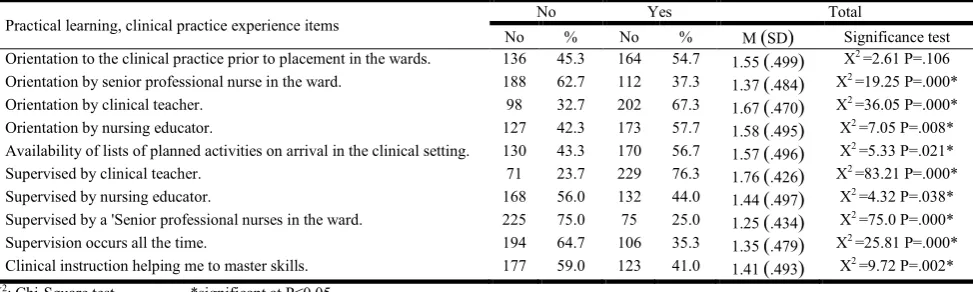
Table 2. Responses of nursing students on clinical practice experience
Practical learning, clinical practice experience items No Yes Total
No % No % M (SD) Significance test Orientation to the clinical practice prior to placement in the wards. 136 45.3 164 54.7 1.55 (.499) X2 =2.61 P=.106
Orientation by senior professional nurse in the ward. 188 62.7 112 37.3 1.37 (.484) X2 =19.25 P=.000*
Orientation by clinical teacher. 98 32.7 202 67.3 1.67 (.470) X2 =36.05 P=.000*
Orientation by nursing educator. 127 42.3 173 57.7 1.58 (.495) X2 =7.05 P=.008*
Availability of lists of planned activities on arrival in the clinical setting. 130 43.3 170 56.7 1.57 (.496) X2 =5.33 P=.021* Supervised by clinical teacher. 71 23.7 229 76.3 1.76 (.426) X2 =83.21 P=.000*
Supervised by nursing educator. 168 56.0 132 44.0 1.44 (.497) X2 =4.32 P=.038*
Supervised by a 'Senior professional nurses in the ward. 225 75.0 75 25.0 1.25 (.434) X2 =75.0 P=.000*
Supervision occurs all the time. 194 64.7 106 35.3 1.35 (.479) X2 =25.81 P=.000*
Clinical instruction helping me to master skills. 177 59.0 123 41.0 1.41 (.493) X2 =9.72 P=.002*
X2: Chi-Square test *significant at P≤0.05
The table revealed that the responses on “Supervised by clinical teacher “had the highest mean (Mean=1.76, SD=0.42) with 76.3% of the sample answered Yes, with significant differences(X2=83.21,P=.000*). Whilst the responses on “Supervised by a 'senior professional nurses in the ward” had the lowest mean
[image:3.595.55.542.590.736.2]Table 3. Responses of nursing students on availability of resources during clinical practice
Availability of sufficient resources items No Yes Total
No % No % M (SD) Significance test Availability of adequately prepared simulation laboratory. 248 82.7 52 17.3 1.17 (.379) X2 =128.0 P=.000*
Models for simulated learning experiences. 222 74.0 78 26.0 1.26 (.439) X2 =69.12 P=.000*
Monitors. 258 86.0 42 14.0 1.14 (.348) X2 =155.5 P=.000*
Availability of instruments or written procedures to follow during simulation sessions.
268 89.3 32 10.7 1.11 (.309) X2 =185.6 P=.000*
Other resources. 96 32.0 204 68.0 1.68 (.467) X2 =38.88 P=.000*
Insufficient provision of nursing educators. 170 56.7 130 43.3 1.43 (.496) X2 =5.33 P=.021*
Insufficient provision of clinical teacher. 252 84.0 48 16.0 1.16 (.367) X2 =138.7 P=.000*
X2: Chi-Square test *significant at P≤0.05
The table illustrates that the Responses on “Other” resources.” Had the highest mean (Mean=1.68, SD=0.46) with 68% of the sample answered Yes with significant differences (X2=38.8, P=.000*), Responses on “Availability of instruments or written procedures to follow during simulation sessions.”
Had the lowest mean (Mean=1.11, SD=0.30) with 89.3% of the sample answered No with significant differences (X2=185.6,P=.000*). Also the table
[image:4.595.58.520.291.425.2]appears that all the Responses of nursing students on availability of resources during clinical practice were statistically significant at P≤0.05.
Table 4. Responses of nursing students on formative and summative assessment
Formative & summative assessments items No Yes Total
No % No % M (SD) Significance test The use of formative assessments. 95 31.9 203 68.1 1.68 (.467) X2=39.14 P=.000*
In formative assessments, skills demonstrated on patients. 245 81.7 55 18.3 1.18 (.388) X2=120.3 P=.000*
In formative assessments, skills demonstrated by simulation. 197 65.7 103 34.3 1.34 (.476) X2=29.4 P=.000*
It provided feedback on my progress. 240 80.0 60 20.0 1.20 (.401) X2=108.0 P=.000*
It re-enforced my learning. 176 58.7 124 41.3 1.41 (.493) X2=9.01 P=.000*
I did not know what to expect. 153 51.0 147 49.0 1.49 (.501) X2=0.120 P=.729
I experienced a lot of stress during assessments. 82 27.5 216 72.5 1.72 (.447) X2=60.25 P=.000* At the end of a course. 138 46.0 162 54.0 1.54 (.499) X2=1.92 P=.166
To test my comprehension of the subject field. 160 53.3 140 46.7 1.47 (.500) X2=1.33 P=.248
I was prepared for the examination. 171 57.0 129 43.0 1.43 (.496) X2=5.88 P=.015*
My level of competence was assessed. 172 57.3 128 42.7 1.43 (.495) X2=6.45 P=.011* X2: Chi-Square test *significant at P≤0.05
The table demonstrates that the responses on “I experienced a lot of stress during assessments.” Had the highest mean (Mean=1.72, SD=0.44), with 72.5% of the sample answered Yes, with significant differences(X2=60.25,P=.000*). Whilst the responses on” In formative assessments, skills
demonstrated on patients.” had the lowest mean (Mean=1.18, SD=0.38), with 81.7% of the sample answered No, with significant differences (X2=120.3, P=.000*). As the table shown that; responses on “I did not know what to expect.” At the end of a course” , and “To test my comprehension
of the subject field.” Were statistically insignificant differences (P>0.05).
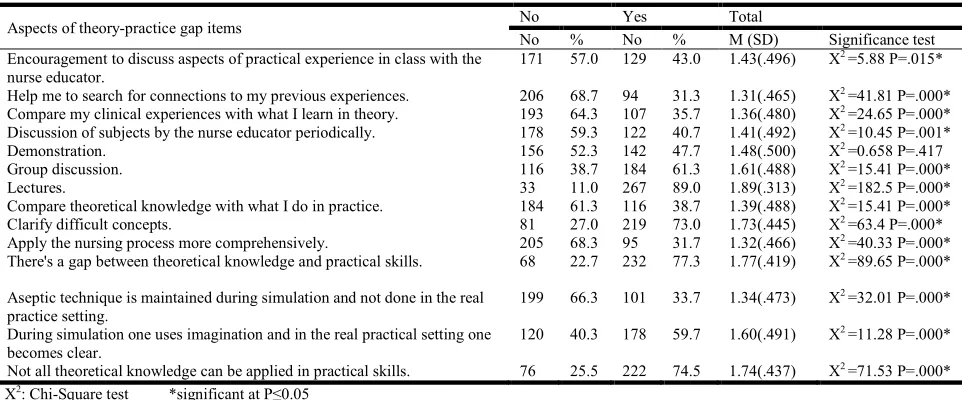
Table 2. Responses of differences between the stimulated skills & the actual clinical procedures, teaching strategies used by the nurse educator & the application of theoretical subjects on the practical training
Aspects of theory-practice gap items No Yes Total
No % No % M (SD) Significance test Encouragement to discuss aspects of practical experience in class with the
nurse educator.
171 57.0 129 43.0 1.43(.496) X2 =5.88 P=.015*
Help me to search for connections to my previous experiences. 206 68.7 94 31.3 1.31(.465) X2 =41.81 P=.000*
Compare my clinical experiences with what I learn in theory. 193 64.3 107 35.7 1.36(.480) X2 =24.65 P=.000*
Discussion of subjects by the nurse educator periodically. 178 59.3 122 40.7 1.41(.492) X2 =10.45 P=.001*
Demonstration. 156 52.3 142 47.7 1.48(.500) X2 =0.658 P=.417
Group discussion. 116 38.7 184 61.3 1.61(.488) X2 =15.41 P=.000*
Lectures. 33 11.0 267 89.0 1.89(.313) X2 =182.5 P=.000*
Compare theoretical knowledge with what I do in practice. 184 61.3 116 38.7 1.39(.488) X2 =15.41 P=.000* Clarify difficult concepts. 81 27.0 219 73.0 1.73(.445) X2 =63.4 P=.000*
Apply the nursing process more comprehensively. 205 68.3 95 31.7 1.32(.466) X2 =40.33 P=.000*
There's a gap between theoretical knowledge and practical skills. 68 22.7 232 77.3 1.77(.419) X2 =89.65 P=.000*
Aseptic technique is maintained during simulation and not done in the real practice setting.
199 66.3 101 33.7 1.34(.473) X2 =32.01 P=.000*
During simulation one uses imagination and in the real practical setting one becomes clear.
120 40.3 178 59.7 1.60(.491) X2 =11.28 P=.000*
Not all theoretical knowledge can be applied in practical skills. 76 25.5 222 74.5 1.74(.437) X2 =71.53 P=.000* X2: Chi-Square test *significant at P≤0.05
The table shows that the responses on “Lectures.” Had the highest mean (Mean=1.89, SD=0.31), with 89% of the sample answered Yes, with significant differences (X2=182.5, P=.000*). Whereas, the responses on “Help me to search for connections to my previous experiences.” Had the
lowest mean (Mean=1.31, SD=0.46), with 68.7% of the sample answered No, with significant differences (X2=41.81, P=.000*). Also the table appears
[image:4.595.48.529.525.725.2]DISCUSSION
Nursing graduates expected to provide compassionate, safe, and effective care in multiple settings while keeping abreast of
rapid advances in healthcare (Benner et al., 2010). Nurses are
accountable for delivering high quality, evidence-based, patient-centered care to diverse populations of all ages ((IOM) 2010). Nursing care is determined by the way nurses use knowledge and skills to appreciate the uniqueness of the
person they are caring for (Warelow et al., 2008). The current
study conducted in Nursing College, Taibah University among three hundred of nursing students, which they were between 18 to 30 years old, The findings of the present study revealed that; half of the sample was in age group 18-23 years old, more than two third of the sample was single, also half of the sample had previous qualification.
Responses on clinical experience
The most (54.7%) of nursing students in this study indicated that they have been oriented to the clinical practice prior to clinical placement. These findings similar to results of the study conducted by Manal that her study found that; the majority of nursing students indicated that they have been oriented to the clinical practice prior to clinical placement (Manal, 2014). Also the results of current study consistent with the results in a study conducted by Nxumalo who found that student nurses are orientated prior to placement in the clinical areas (Nxumalo, 2011). While the results of this study indicated that the majority (67.3%) of nursing students oriented to the clinical setting and supervised by their clinical Teachers. These results in line with the findings of Manal study who found that nursing students oriented to the clinical
setting and supervised by their clinical preceptors (Manal 2014), whereas contradicted with the findings of Nxumalo who reported that many of the student nurses orientated by the senior professional nurses in the wards (Nxumalo, 2011). In addition, Carson and Carnwell found that orientation was undertaken by nurse educators (Carson, 2007).
Nursing students in this study noted that there were lists of planned activities on arrival in the clinical setting. These results opposed the results of Manal who found that there were no lists of planned activities on arrival in the clinical setting (Manal, 2014), whilst the results in this study similar to findings of Nxumalo who revealed that most of the respondent
given lists of planned activities (Nxumalo, 2011).
Respondents of this study further reported that had inadequate supervision from clinical preceptors because of the shortage in the college staff and each preceptor supervised many students; "64.7% Supervision not occurs all the time". The study of Manal and Nxumalo supported this result, in their studies; supervision reported as inadequate for guidance and support of student nurses (Manal 2014), (Nxumalo, 2011). Were, these results related to shortage in number of nursing educators and clinical preceptors compared to the number of the students and the job tasks assigned to them (Manal, 2014).
Responses on availability of resources
[image:5.595.42.559.88.234.2]Most of nursing students in the current study were of the opinion that there were insufficient resources during placement in the clinical practice as models for simulated learning experiences, equipment and instruments. These results in line with Nxumalo and Manal which they found the majority of the student nurses reported that there were insufficient resources
Table 3. Response of nursing students on practical learning
Perception of nursing students toward their preferred learning strategies N R IK ST A Total No (%) No (%) No (%) No (%) No (%) M (SD) Simulation laboratory found at the nursing college. 48(16.0) 60(20.0) 36(12.0) 93(31.0) 63(21.0) 3.21 (1.39) Availability of access to the simulation laboratory. 54(18.0) 84(28.0) 36(12.0) 80(26.7) 46(15.3) 2.93 (1.37) Nurse educator. 17(5.7) 47(15.7) 21(7.0) 91(30.3) 124(41.3) 3.86 (1.26) Clinical teacher. 8(2.7) 32(10.7) 27(9.0) 100(33.3) 133(44.3) 4.06 (1.09) Teaching strategies used by clinical teacher. 2(0.7) 2(0.7) 8(2.7) 44(14.7) 244(81.3) 4.75 (.60) Lectures. 24(8.0) 65(21.7) 2(0.7) 141(47.0) 68(22.7) 3.55 (1.27) Group discussions. 13(4.3) 69(23.0) 5(1.7) 137(45.7) 76(25.3) 3.65 (1.20) Demonstration. 25(8.3) 60(20.0) 24(8.0) 96(32.0) 95(31.7) 3.59 (1.33) Demonstration of skills by the supervisor. 47(15.8) 110(36.9) 10(3.4) 78(26.2) 53(17.8) 2.93 (1.40) Availability of opportunity to practice skills during simulation sessions. 78(26.0) 58(19.3) 40(13.3) 98(32.7) 26(8.7) 2.79 (1.36) Availability of feedback on performance after the Simulation sessions. 100(33.3) 50(16.7) 38(12.7) 75(25.0) 37(12.3) 2.66 (1.46) I gained more confidence to perform a skill. 54(18.0) 28(9.3) 45(15.0) 74(24.7) 99(33.0) 3.45 (1.47) Clinical accompaniment is beneficial to my professional growth. 68(22.7) 52(17.3) 17(5.7) 87(29.0) 76(25.3) 3.21 (1.39) N=Never, R=Rarely, IK=I Don’t Know, ST=Sometimes, A=Always
As the figure shown that; the responses on “Teaching strategies used by clinical teacher.” Had the highest mean (Mean=4.75, SD=.60) with 81.3% of the sample answered “ALWAYES”, whereas the responses on “Availability of feedback on performance after the Simulation sessions.” Had the lowest mean (Mean=2.66, SD=1.46) ) with 33.3% of the sample answered “NEVER”.
Table 4. Descriptive of Subscales (ANOVA & Reliability Tests)
Subscales N á Mean items Mean scale SD scale Significance test
1. Practical learning, clinical practice experience 10 .69 1.49 14.9 2.4 F=39.9 P=.000* 2. Availability of sufficient resources 7 .65 1.27 8.9 1.6 F=100.0 P=.000* 3. Formative & summative assessments 11 .65 1.44 15.9 2.4 F=44.5 P=.000* 4. Aspects of theory-practice gap items 14 .78 1.52 21.3 3.3 F=65.1 P=.000* 5. Perception of nursing students toward their preferred learning strategies 13 .86 3.4 44.6 10.4 F=85.7 P=.000* F: ANOVA test *significant at P≤0.05 α: Reliability (Alpha) N: number of items
[image:5.595.36.562.309.381.2]during placement in the clinical practice (Manal, 2014), (Nxumalo, 2011). Results of this study indicated shortage in human resources, mainly clinical preceptors and nursing educators and clinical preceptors were more available than nursing educators were, these results related to shortage in number of nursing educators and clinical preceptors compared to the number of the students and the job tasks assigned to them. The same results recorded in the study of Nxumalo. Findings of different researchers are not consistent with the above results as the nurse educators and clinical preceptors reported as not available due to large number of student nurses to supervise, lack of time and overload of academic work
(Carson, 2007), (Mabuda et al., 2008). However, Hennessy
et al. asserted that adequate staff and equipment in training
enhances the standard of clinical training (Hennessy et al.,
2006). In their study, Dee and Stanley found student nurses prefer human resources and print resources to electronic resources in clinical practice however, they suggest that talking to nurse educators and clinical preceptors can be the first step in highlighting these teachers awareness to interests in specific topics and subjects.
Responses on formative and summative assessments
Nursing students in the current study signified that formative assessment used in their clinical practice, these results supported by (Bartfay, 2004), Nxumalo and Manal who noted that Many of student nurses indicated skills demonstration on patients as the preferred strategies that used during formative assessment for clinical competencies (Manal, 2014), (Nxumalo, 2011). More than half of respondents were of the opinion that formative assessment re-enforced their learning while only 20% of them viewed it as providing feedback on their progress. These results almost similarity findings of Manal (Manal, 2014), whilst the results of current study disagreed by studies done by Quinn and Hughes and Nxumalo who viewed that the majority of the student nurses are of the opinion that formative assessments test their clinical and theoretical knowledge followed by provision of feedback on their progress (Nxumalo, 2011; Quinn, 2007). Regarding barriers encountered during formative assessments, the majority of respondents were of the opinion that they experienced a lot of stress during assessments while nearly half of them did not know what to expect, these findings in line with the study conducted by Manal (Manal 2014). On the other hand, the researches represented other barriers to formative assessments. While Nxumalo reported that many of the student nurses felt that, some assessors were stricter than the others were and that assessment done only periodically (Nxumalo 2011). Respecting summative assessment, more than two third of nursing students in this study noted that the summative assessment conducted at the end of the courses while more than half of them signified that it test their comprehension of the subject field. The results of this study nearly similarity the findings of Manal (Manal, 2014). Also, the current study results confirmed by Nxumalo as student nurses were of the opinion that summative assessments done at the end of the course to indicate whether they have passed or failed (Nxumalo, 2011). Concerning barriers of the summative assessment, nursing student were of the opinion that it did not assessed their level of competence and they were not prepared for the examination. The study by Manal supported these findings (Manal, 2014). While Nxumalo viewed that many of the student nurses revealed that not providing feedback after summative assessment as a major barrier (Nxumalo, 2011).
Responses on aspects inducing theory-practice gap
Based on results of the current study, more than half of respondents reported that they were not encouraged by nursing educator to discuss aspects of practical experience in class during theoretical instruction. These results contradicted the findings of Manal as the majority of respondents reported that they encouraged by nursing educator to discuss aspects of practical experience in class during theoretical instruction but in a long intervals (Manal, 2014). Regarding aspects that learned through the discussion with the nurse educators, only one third of respondents in this study specified that discussion assisted them to find a link between the theory and practical learning, whereas, in the study of Manal half of respondents specified that discussion assisted them to find a link between the theory and practical learning (Manal, 2014). In the study of Nxumalo, the majority of student nurses directed that discussions of the meaning of clinical experiences during theoretical instructions helped them to link theory with practice (Nxumalo, 2011). Nickitas mentioned that nurse educators must model moral courage for student nurses as well as ways to address problems directly rather than ignore them. “Sidestepping problems and broken systems can lead only to greater frustration and disappointment”, Speaking and listening to students for the express purpose of enhancing relationships is valuable (Nickitas 2008). Majority of respondents in this study identified lectures as the most commonly used teaching strategy by nursing educators followed by group discussion. These findings in line with results' study of Manal which she identified lectures as the most commonly used teaching strategy by nursing educators followed by demonstration and group discussion (Manal, 2014). While in the study of Nxumalo, many of the student nurses indicated group discussion followed by lectures as a teaching strategies used by nurse educators (Nxumalo, 2011). Flanagan and McCausland acknowledged that to think critically and function effectively in a complex and dynamic professions such as nursing, many learning skills are necessary for knowledge acquisition and
information processing. Teaching around the cycle
encompasses traditional lectures, active learning strategies, collaborative learning, and problem solving as a balanced and effective approach to teaching (Flanagan, 2007). Concerning encouragement by clinical preceptors during clinical experience to talk about theoretical learning experiences instruction; more than two third of the respondents in this study did not encouraged to compare theoretical knowledge with what they do in practice. In addition, they did not
encouraged applying the nursing process more
comprehensively. These results inconsistent with the findings of Manal that she found; about half of the respondents were encouraged to compare theoretical knowledge with what they do in practice also they were encouraged applying the nursing process more comprehensively (Manal, 2014).
McKenna et al. further explained a form of reflection is to
encourage student nurses to talk about their experiences in clinical practice, offer a more integrated approach to classroom theory and its application in practice. Majority of the nursing students in the current study revealed that there was a gap between the theoretical knowledge and the actual practice in
the clinical setting (McKenna et al., 2009). Morgan and Carson
theory-practice gap in nursing has been an issue of concern for many years as it shown to delay student learning. While the study of Essani and Ali (2013) viewed the gaps between knowledge and practice, as perceived by the candidates, were classified into five major categories: (1) medication (34%), (2) skills (28.3%), (3) knowledge (13.36%), (4) handling of code blue and intubations (12.6%), and (5) operating medical devices (11.58%).
Responses on practical learning
According to this study, most respondents indicated that “sometimes/ always" was the simulation laboratory located at the Nursing College and there were an availability of access to it. Manal and Nxumalo further confirmed this result (Manal 2014), (Nxumalo, 2011). The majority of respondents in this study further indicated that "sometimes/ always" were they accompanied by clinical preceptor to the simulation laboratory, while in the study of Nxumalo; the students accompanied by nurse educator alone or with the clinical preceptor (Nxumalo, 2011). Morgan viewed the responsibility of accompaniment of student to the simulation laboratory nurses as both the nurse educators and clinical preceptors (Morgan, 2006). Respondents of this study revealed that "sometimes/ always" was the teaching strategies used for practical learning were alternating between demonstrations, lectures and group discussion. The results provide strong support for utilization of both lecture notes and structured group discussion. While Nxumalo showed that the majority of the student nurses indicated demonstration as the most used teaching strategies utilized by the clinical accompanist (Nxumalo, 2011). Anderson and Kiger explained that demonstrations help maximize student nurses’ confidence in relation to social learning theory. A confidence building approach includes use of clinical demonstrations on models in simulation laboratories and accompanied by feedback, praise, humor, and mindfulness training. Sharing stories and experiences, as well as allowing students to practice during demonstrations leads to learning in a safe environment (Anderson, 2008). Pertaining to the results of the current study, most of respondents reported “Never/Rarely" that the demonstration of skills done by their supervisors in the simulation laboratory. These findings inconsistent results of the study conducted by Manal, who found most of the sample that the demonstration of skills done by their supervisors in the simulation laboratory (Manal, 2014). However, Jefferies and Rizzolo stated that qualified faculties who have trained in simulation assume the educator role during the simulated learning experience, clinical staff or staff specific to the patient simulation laboratory can play the educator role. In either case, it is important for the educator to have knowledge of the simulation and the material it covers (Jeffries, 2006). Hoffman
et al. added that students participating in the simulated learning experience must come into the simulated clinical environment prepared for the simulation with a basic knowledge of the material and dressed appropriately for the clinical experience. In this study, nursing students revealed that they obtained feedback from their supervisors after the simulation sessions (Hoffmann, 2007). According to Hanson and Stenvig, positive feedback can increase self-esteem whereas negative feedback can discourage and frustrate the students (Hanson, 2008). Results of this study further presented that less than half of the nursing students had opportunity to practice skills during simulation sessions. These results in line with study of Manal (Manal, 2014), nevertheless, Scully was of the opinion that, mastering a skill in the classroom can help facilitate closing the theory-practice gap when applying the same skill to the clinical
setting (Scully, 2011). The need for adequate practice time in a controlled setting in university laboratories is essential. These results were opposed to the findings of Nxumalo who revealed that the majority of student nurses had the opportunity to practice skills (Nxumalo, 2011). The simulated experience is not just a flat experience but also rather one rich with dimension (Lasater, 2007).
More than half of the nursing students in this study viewed that the clinical accompaniment was beneficial for them. While these results were incompatible with the previous study of Manalthat she found The majority of the nursing students in her study viewed clinical accompaniment had minimal benefits for them (Manal, 2014), whereas, the results of the current study similary to findings of Nxumalo who found the student nurses indicated that clinical accompaniment was beneficial towards professional growth (Nxumalo, 2011). In a study by Lasater it was found that the reaction of the students was favorable to the scenarios presented during simulation and students felt the simulation was a superior method to just reading about a particular disease or condition (Lasater, 2007).
Descriptive of Subscales (ANOVA & Reliability Tests)
The results illustrates that; The Cronbach’s alpha value ranged from (.65α to .86α) which are acceptable, the result showed that the instrument is reliable. Also the study shows that the age, marital status and all the subscales were a statically significant at P≤0.05.
Conclusion
From the above study, one can conclude that this study supports the need to reconsideration in the practical skills training in nursing education, as well as emphasize to observe gap in the knowledge and the practicing among nursing students. It is clear that all theme mentioned by the students play an important role in nursing education in general. Further, educators and clinical preceptors must display the knowledge and skills required to promote theory-practice integration, to enhance nursing students' education, which in turn optimizes high standards of patient care relevant to clinical practice. Clinical skills laboratories are essential to help students develop the collaborative skills required for a profession like nursing.
Recommendation
1. Conducting continuing education for the faculty in
principles of teaching & learning to enhance their teaching behavior & interpersonal skills.
2. Nursing education must reconsider current methods to
practical learning & quest to invent methods to better prepare future nurses.
3. Reduce anxiety in students and help them work more
effectively with the discrepancies.
4. Change in nursing practice should initiate with change
in the educational curriculum of the nursing programs.
5. Nursing faculty should initiate change in the curriculum
with a focus on changing and improving nursing practice as well as having a liaison between the education and the practice areas in the educational setting, as well as the clinical setting.
6. Improving collaboration between clinical areas and
7. Faculties of nursing need to be concerned about supplying students with adequately prepared simulation laboratory and other needed resources.
REFERENCES
Ahmad, Rajeh Saifan, Abu Safieh Haneen , Milbes Ruba and Shibly Rawan, 2015. "Suggestions to close the gap in
nursing education:Nursing students' perspectives."
International Journal of Advanced Nursing Studies, 62-68. Ajani, K. and Moez, S. 2011. "Gap between knowledge and
practice in nursing." Procedia Social and Behavioral
Sciences, 15:3927–3931.
Allan, H.T., Smith, P. and Driscoll, M. 2011. "Experiences of supernumerary status and the hidden curriculum in nursing:
a new twist in the theory–practice gap?." Journal of
Clinical Nursing, 20: 5-6.
Anderson, E. and Kiger, A. 2008. ""I felt like a real nurse"–
student nurses out on theirown." Nurse Education Today,
443-449.
Bartfay, W. J., Rombough, R., Howse, E. and LeBlanc, R. 2004."The OSCE approach in nursing education: Objective structured clinical examinations can be effective vehicles for nursing education and practice by promoting the mastery of clinical skills and decision-making in controlled
and safe learning environments. ." The Canadian Nurse,
18-25.
Benner, P., Sutphen, M., Leonard, V. and Day, L. 2010. "Educating nurses: A call for radical transformation" Stanford, CA: Jossey-Bass.
Budgen , G. and Gamroth, L. 2008. "An overview of practice education models. ." Nurse Education Today. 5 5,. http://dx.doi.org/10.1016/j.nedt.2007.05.005 (accessed 9 22, 2016).
Carson, A.and Carnwell, R. 2007. "Working in the theory–
practice gap: the lecture practitioner's story." Learning in
Health and Social Care, 220–230.
Chan, Z. 2013. "A systematic review of creative thinking/
creativity innursing education." Nurse Education Today,
33(11):1382-1387.
Dee et al, C. and Stanley, E.E. 2005. "Information-seeking behavior f nursing students and clinical nurses: implications
for health sciences librarians." Med Libr Assoc, 213-22.
Dolan. 2003. "Assessing student nurse clinical competency will
we ever get it right?" Clin Nurs, 132-41.
Ehrenberg, A.C. and Ha¨ggblom, M. 2007."Problem-based learning in clinical nursing education: Integrating theoryand
practice." Nurse Education in Practice,7:67–74.
Flanagan, N.A. and McCausland, L. 2007. "Teaching around the cycle: strategies for teaching theory to undergraduate
nursing students." Nurs Educ Perspect, 28(6):310-4.
Hanson, K.J. and Stenvig, T.E. 2008. "The good clinical nursing educator and the baccalaureate nursing clinical
experience:and praxis." J Nurs Educ, 38-42.
Hennessy et al, D., Hicks, C., Hilan, A. and Kawonal, Y. 2006.
"The training and development needs of nurses in
Indonesia:." Human Resources for Health., 4-10.
Hoffmann, R. O'Donnell, J. and Kim, Y. 2007. "The effects of human patient simulators on basic knowledge in critical care nursing with undergraduate senior baccalaureate
nursing students." Simulation in Healthcare, 110–114.
IOM, Institute of Medicine. Committee on the Robert Wood Johnson. Foundation Initiative on the Future of Nursing.
The future of nursing: Leading change, advancing health.
2010. www.iom.edu/Reports/2010/The-Future-of Nursing-Leading (accessed 9 22, 2016).
Jeffries, P. R. and Rizzolo, M. A. 2006. "Designing and implementing models for the innovative use of simulation to teach nursing care of ill adults and children: A national,multi-site, multi-method study." New York, NY: National League for Nursing.
Johnson, J.P. and Mighten, A. 2005. "A comparison of teaching strategies: lecture notes combined with structured group
discussion versus lecture only." Nurs Educ., 22-44.
Lasater, K. 2007." Clinical judgment development: Using
simulation to create a rubric." Journal of Nursing
Education, 496-503.
Mabuda, B.T. Potgieter, E. and Alberts, U. 2008. "Student nurses' experiences during clinical practice in the Limpopo Province." Curationis, 19-20.
Manal, Hamed. 2014. "Practical learning and theory-practice
gap as perceived by nursing students." International
Journal of Current Research, 5084-5093.
McKenna et al, L., Wray, N. and McCall, L. 2009. "Exploring
continuous clinical placement for undergraduate students."
Advances in Health Sciences Education, 327-335.
Moeti et al, M.R., van Niekerk, S.E. and van Velden, C.E.
2004. "Perceptions of the clinical competence of newly
registered nurses in the North West province." Curationis,
72-84.
Morgan, G. 2006. "Memory and Marginalization. Aboriginality
and Education in the Assimilation Era'l." Australian
Journal of Education, 40-49.
Murathi et al, L.A. DavhanaMaselesele, M. and Netshandama,
N.O. 2005."Clinical teaching of student nurses by unit managers of selected hospitals in Limpopo Province." Curationis, 13-20.
Nabolsi, M., Zumot, A., Wardam, L. and Abu-Moghli. 2012. "The Experience of Jordanian Nursing Students in their
Clinical Practice." Procedia - Social and Behavioral
Sciences, 46(0):5849-5857.
Nickitas, D.M. 2008. "Leadership and Management. In Hogan, Mary Ann, NCLEX Review." New Jersey. Prentice Hall., 37-53.
Nxumalo, S.J. 2011. "Factors that affecting theory-practice integration of student nurses at a selected campus of a Nursing College in the Limpopo Province." Master thesis.University of South Africa.
Quinn, F.M. and Hughes, S.J. 2007. "Quinn's principles and practice of nurse education." Fifth edition,: p.268.
ReOusey, K. and Gallagher, P. 2007. "The theory-practice
relationship in nursing: a debate." Nurse Educ Pract,
199-205.
Scully, N.J. 2011. "The theory-practice gap and skill acquisition: An issue for nursing education." Collegian, 93-98.
Smith, K., Clegg, S., Lawrence, E. and Todd, M. 2007."The challenges of reflection: students learning from work
placements." Innovations in Education and Teaching
International, 44(2):131-141.
Warelow, P., Edward, K. L. and Vinek, J. 2008. "Care: what
nurses say and what nurses do." Holist Nurs Pract, 146-53.
Whyte, J., Ward, P. and Eccles, D. W. 2009." The Relationship Between Knowledge and Clinical Performance in Novice and Experienced Critical Care Nurses." Heart Lung, 38:517-525.