ISSN Online: 2327-5960 ISSN Print: 2327-5952
DOI: 10.4236/jss.2018.611006 Nov. 12, 2018 85 Open Journal of Social Sciences
A Comparison Study about the Public
Perception on Neuroscience in China and Japan
Yisi Yang
Shanghai, China
Abstract
This dissertation attempts to describe the ways in which neuroscience is per-ceived by the public in China and Japan from media and individual perspec-tives. This research adopts triangulation methods, including the empirical data from literatures, media content analyses of newspapers, and two focus groups in China and Japan. Both content analyses and focus groups are guided by the literature review. The central findings are that there are some distinctions of the public perception of neuroscience between China and Ja-pan. On the media perspective, Chinese and Japanese media have different concentrations on neuroscience communication. Meanwhile, on the individ-ual perspective, the participants from China and Japan also present different understanding and attitudes to neuroscience, which further confirms the re-sults of content analyses.
Keywords
Neuroscience, Content Analysis, Focus Group, Public Perception
1. Introduction
Neuroscience is closely related to our life. With the emergency of neuroscientific technology such as fMRI, there is a growing awareness of neuroscience among the public. However, there have been few studies on the relationship of the pub-lic and neuroscience in Eastern countries, compared with the relatively complete neuroscience communication researches in Western context.
There are two perspectives used within this study to understand the percep-tion of neuroscience, the media and the public. This dissertapercep-tion attempts to de-scribe and identify how neuroscience is represented in Chinese and Japanese mainstream media and the understanding of individuals of the new technologies in the field. The purpose of this is to explore and delineate the differences of and
How to cite this paper: Yang, Y.S. (2018) A Comparison Study about the Public Perception on Neuroscience in China and Japan. Open Journal of Social Sciences, 6, 85-107.
https://doi.org/10.4236/jss.2018.611006 Received: October 10, 2018
Accepted: November 9, 2018 Published: November 12, 2018
Copyright © 2018 by author and Scientific Research Publishing Inc. This work is licensed under the Creative Commons Attribution International License (CC BY 4.0).
http://creativecommons.org/licenses/by/4.0/
DOI: 10.4236/jss.2018.611006 86 Open Journal of Social Sciences
the reasons behind the neuroscience understanding between the two cultural contexts. The central findings are that the media coverage and the individual understanding of neuroscience are different between China and Japan.
The current study attempts to identify the cultural uniqueness of groups and identify the individual ideas of each of the focused groups regarding neuros-cience. The implication of this dissertation is to provide suggestions for the process of spreading neuroscience information to the public. Specifically, these main differences in the communicative content can be presented as: 1) the Chi-nese public perception of neuroscience pays more attention to the neuroscientif-ic information in the field of medneuroscientif-icine and health; 2) the Japanese publneuroscientif-ic percep-tion prefers the neuroscientific knowledge related to economic value and daily life. In terms of communicative forms, the difference is that: 3) Chinese individ-uals distrust the neuroscience reports released by the government; 4) there is an information gap between Japanese individuals and scientists. This research tries to explain the reasons for these differences and provide the future suggestions based on the social psychology theory.
Research Questions
The research questions:
What are the public perceptions of neuroscience within Chinese and Japanese cultural contexts?
The sub-research questions will be:
1) What is the media perception of neuroscience in Chinese and Japanese cultural context?
2) What is the Chinese public’s perception of neuroscience based on the me-dia information?
3) What is the Japanese public’s perception of neuroscience based on the me-dia information?
4) What are the differences between the two cultural groups?
2. Literature Review
2.1. Introduction
DOI: 10.4236/jss.2018.611006 87 Open Journal of Social Sciences
2.2. The Origin and Development of Western Media Studies of
Neuroscience
2.2.1. The Beginning of the Public Understand of Neuroscience
Early research on neuroscientific issues can be traced back to 1980s. Changeux (1983) [1] redefined the relationship between humanities and neuroscience and called for a renewal of philosophy and the humanities (Changeux, 1983). Then, Churchland (1989) [2] put forward the philosophical interpretation of ‘neuros-cience’ with the foundation of her neuroscience survey.
2.2.2. The Developing Research Stage of Neuroscience
The public perception of neuroscience has a close relationship with technologi-cal development. Based on the support of technologies such as fMRI (Young & Saxe, 2008) [3] and deep brain stimulation (DBS) (Deep Brain Stimulation), Er-ic, Sarah, Jarett and Judy (2010) [4] conducted a small-scale research of neuros-cience focused on the print media. In the light of the various technologies, the description of “neuroscience” in this report highlighted the importance of the function of media forms and pointed out there was an information gap between neuroscientific knowledge and society. In other words, the neuroscience field faces unavoidable challenges during the communicative process necessary to achieve public understanding. In addition, in “fMRI in the Public Eye” Eric, Ofek and Judy (2006) [5], raised ethical arguments of neuroscience technologies, highlighting how the sophistication of Fmri makes it difficult for the public to comprehend every detail of neuroscientific areas, especially leading to technical deficiencies in understanding.
In addition to the neuroscience media research based on technical classifica-tions, there has been a trend of news article studies being written on topics such as health, the law, and politics. In the research conducted by van Atteveldt etal. (2014) [6] concluded the timing of newspaper publishes, the different topics of neuroscience, and the newspaper forms such as a special column and a press re-lease, in would influence the media attitude of neuroscience.
Rather than analyze the relationship between the available technologies, such as fMRI, PET, and EEG, and neuroscience, Scott (2010) [7] explored the media reports of the neuroscience from the perspectives of power and culture. Com-pared to Racine et al.’s (2006) [5] research on media studies of neuroscientific knowledge, Scott laid more emphasis on social and political explanations. Fur-thermore, in supplement to the content analysis of the print media conducted by Racine et al. which was classified by neuroscientific technologies, Grabowski (2014) [8] published a book about the media representation of neuroscience which included more kinds of media forms such as offline and online transmis-sion. In this study, Grabowski analysed a great deal of digital age neuroscience media communication based on cultural and social theories.
2.2.3. Controversies in Media Coverage of Neuroscience
1) Philosophical Explanations
ex-DOI: 10.4236/jss.2018.611006 88 Open Journal of Social Sciences
plaining neuroscience from the perspective of philosophy, laying the foundation of the neuro-philosophical debate. Volney (2009) [9] explored the philosophical relationship between neuroscience and religion such as the debate on whether human being is equal to a super computer. Slingerland (2008) [10] used reduc-tionism (Putnam, 1973) [11] to explain neuroscience, which means that com-prehend the nature of neuroscience by segmentation fields such as brain activi-ties. Also there was another interpretive style called humanism (Slingerland, 2008) [10] which implied that comprehending human being and society ass whole. The former one concentrated on the physical comprehension of neuros-cience and the latter one aimed at human-level. However, there were controver-sies between reductionalistic and humanistic interpretations, leading to the au-thor introducing the concept of dual consciousness to understand the neuros-cience issues.
In addition, Racine and his research group (2005) [12] referred to the discus-sion between “neuro-essentialism” and “neuro-realism” in the media coverage of the neuroscience as the main tendencies of reporting on new neuro-technologies, alongside neuro-policy. Neuro-essentialism preferred to define the brain as an independent and initiative subject equal to the soul (Racine et al., 2005) [12], while neuro-realism regarded the brain as an object which could be represented by the scientific data. Also the third explanation way of neuroscience informa-tion is neuro-policy, which placed emphasis on introducinforma-tion of neruoscentific influence and implication. Each method of conveying the neuroscientific infor-mation to the public is affected the media workers’ understandings of the neu-roscience, meaning the media cannot convey the entirety of the information ne-cessary.
2) Challenges in Communication of Neuroscience
In addition to the controversial nature of the explanations of brain science, there is a generational information gap between media reports and new neuro-scientific knowledge. Holman (2011) [13] discussed the problems of contempo-rary neuroscience information in the media, with a focus on newspapers, in which the use of neuroscience in a very general sense grossly oversimplifies complex phenomena was the key issue highlighted. As reported by Giridhard as (2008) [14], the usage of the brain scanning in the legal field is widely doubted, and a decision of the Indian police to use brain scanning technology to declare a suspect guilty caused great social discussion.
DOI: 10.4236/jss.2018.611006 89 Open Journal of Social Sciences
In conclusion, the role of the media is critical during the communication of neuroscience. This is because, as Beck (2010) [16] remarked, the bias of the me-dia coverage of neuroscience has the potential to misguide the public. Hence, media reports of neuroscience should remain objective, and, when dealing with neuroscience data, mis-and over-interpretation of the field should be avoided by the press and scientists. The problems with the media’s depiction of neuro-science runs the complete range from citing researches incorrectly, achieving grand, false conclusions from misinterpreted data, and appropriating neurosci-ence in the name of explaining phenomena beyond the field’s immediate pur-view.
2.3. Public Understanding of Science in China and Japan
Chinese and Japanese media studies on neuroscience are not as complete as in the Western cultural context. However, research about scientific communicative systems provides a solid foundation for the current research. Vitally, different groups of people from different countries have varying understanding of new science. Therefore, this dissertation aims to set up a coherent framework using a combination of theoretical systemic research of neuroscience media reporting in the Western cultural contexts and general science communicative studies in Chinese and Japanese cultural contexts.
2.3.1. Comparison Studies of Science Communication between Countries
Notably, comparative studies between different countries regarding societal and public perceptions of science communication are focused on specific and more popular scientific areas such as vaccinations and artificial intelligence (AI). Ac-cording to Lan’s (2009) [17] investigation of the public opinion of biotechnology in China and Europe, different countries have their own preferences for new science. For instance, the Chinese pay more attention to the usefulness and ap-plications of biotechnologies while Europeans were more likely to concentrate on understanding the technical risks. When it comes to highly controversial scientific issues, the study on media coverage of research on vaccinations by Ren
DOI: 10.4236/jss.2018.611006 90 Open Journal of Social Sciences
In 2002, the Japanese National Institute of Science and Technology Policy (NISTEP) had launched the survey about the public perceptions of the science. (Kawamoto etal., 2013) [20] Also, Kawamotoand his research group designed a large-scale investigation which aimed at the participants who were over 18 years old. This quantitative study was made up of three elements and four categories. They teased out the each connection between each factor such as the science ap-preciating factor has high and positive relationship with the social factor. Based on these findings, this group compared to the UK general scientific literacy re-ports to explore the differences.
2.3.2. The Chinese Government’s Domination of Science Communication
The current situation of scientific transmission in China is, therefore, not opti-mistic, especially due to the influence of the government which manifests in an over-politicization of science (Zhang, 2015) [21] and a one-way communication of the science information (Liu, 2014) [22]. Due to the cultural evolution policy1 (1966-1976) which almost destroyed the Chinese science communication tem, the Chinese government started to set up a scientific communication sys-tem in 2002 (China State Council, 2002), which was primarily aimed at inform-ing the public of scientific results rather than its progress. Therefore, utilitarian-ism is a problem in Chinese science communication (Liu, 2014) [22], with it be-ing delivered through a kind of top-down transmission.
While, in general, the Chinese science communication is developing rapidly, the problems caused in the scientific system by governmental and political fac-tors, have become barriers to science communication. Specifically, the informa-tion given to the Chinese public is represented by the government, causing people’s resistance to the political power. This is the main reason why Chinese people have credibility crisis of the science information in the media coverage especially the newspaper (Zhang, 2015) [21]. Therefore, on the grounds of the general media research of science communication, this research attempts to lay emphasis on the specific neurological realm of science to identify the under-standing and perceptions of the Chinese society about the field.
2.3.3. The Restricted Science Communication among Japanese Scientists
Japanese scientific communication studies show a lack of communicative con-sciousness is one of the most important problems for the Japanese society. In 2013, there was a report about the science communication conducted by the Japanese government. It was amazing to see that only 64% of the scientists under investigation had been communicated with the external communities such as the public, the academic seminar, the media agency (Koizumi et al., 2013) [23]. In an article published by Koizumi etal. (2013) about the situation amongst Japa-nese scientists, over half of the interviewees (scientists) had no interactive com-munication with the public. Therefore, the research group provided four
sugges-1The Cultural Revolution, formally the Great Proletarian Cultural Revolution, was a sociopolitical
DOI: 10.4236/jss.2018.611006 91 Open Journal of Social Sciences
tions to change this situation, including policies of encouragement policies. Moreover, Kornhauser (2015) [24] talked about the problem of Japanese science communication, claiming it was the cause of a lack of institutions and profes-sionals, and the media workers who reported on science information lack enough professional training. Hence, these factors cause an information gap between the Japanese public and the science media.
2.4. Conclusion
Overall, both the Chinese and Japanese are currently lacking in their science communication research, though there are movements to develop and improve this. While the majority of the research mentioned above only looks at general science communication studies, the basis of this dissertation is the theoretical foundation of science communication. With the high development of neuros-cience and AI, it is worth identifying public attitudes towards these new tech-nologies as they become more of a part of public life.
In addition, scientific and educational information has a close relationship with the mass media, as identified in Bauer etal.’s (2001) [25] study which ex-plored the media representation of biotechnology in the light of different coun-tries. They raised the concept of dramatization which means analyzed the media coverage of biotechnology according to the classic drama theoryto explain media studies of science communication and in doing so provided another perspective to analyze the science transmission to the public. Then they found that when readers (audience) reached the biotechnological information, their emotions were guided by the special passion prepared by the drama (biotechnological dis-seminator). Therefore, this dissertation plans to explore and explain the media representation of neuroscience from several perspectives including the media, the public, and scientists.
3. Methodology
3.1. Introduction
The main purpose of this research is to study the public perception of the neu-roscience in China and Japan and explore the differences between the two coun-tries. Therefore, this study plans to employ a mixed methodological method (both quantitative and qualitative) which includes the triangulation of various sources of information including two small-scale media content analyses of the mainstream newspapers and two focus groups. Firstly, the media content re-search offers basic media reports on neuroscience. Then, based on the media content analysis, the focus groups will reflect the ideas of individuals on new neuroscientific knowledge and support discussion one reasons for the differenc-es in perceptions. Furthermore, this dissertation gained informational support from the related literature from the Western context and fundamental research on Chinese and Japanese science communication.
DOI: 10.4236/jss.2018.611006 92 Open Journal of Social Sciences
choosing media content analysis as the key method of this dissertation. The sampling section will indicate the process of corpus construction. Then this chapter will move on to the focus group discussions used for the further analysis of neuroscientific communication.
3.2. Content Analysis
3.2.1. Dynamic ComparisonAs Runyard and French (1999) [26] said, the beginning of research should focus on the media. This is because the media represents a society’s attitude to specific issues. Because of this and the research questions of this dissertation, specifically the aim to explore the general understanding of neuroscience and find the dif-ferences of these attitudes between the two countries in question, content analy-sis of the media articles is suitable. This is because it is a method for the objec-tive, systematic, and quantitative description of the manifested content of com-munication (Berelson, 1952) [27].
Media content analysis is a research strategy which covers different times and spaces (Bauer & Gaskell, 2000) [28]. Specifically, content analysis can be used for the horizontal comparison among different periods in one country. Vitally, the contrast between China and Japan can be presented by content analysis. As such, this facilitates a dynamic comparison which will play a key role in this research on public perception, allowing exploration of issues across a long period to pre-sent a more accurate and convincing conclusion. This is convenient in finding the specific changes within the public understanding of neuroscience and the differences between China and Japan.
3.2.2. Objective and Narrative Analyzing Principles
Another reason for this dissertation to choose content analysis is because of its high degree of objectivity (Krippendorff, 2004) [29], which a general perception of neuroscience in society should be. As Bauer (Bauer & Gaskell, 2000) [28] said, content analysis is the bridge between the qualitative content and quantitative data as it turns qualitative materials into standardized codes. Moreover, a feature of media content analysis “noninvolvement” (Chen, 2007) [30] is an important factor in the choice of this method as it means there is no need for researchers to conduct a field investigation. In addition, the materials of media content analysis can be investigated more than one time. Overall, the research processes of media content analysis are able to guarantee objective and accurate findings.
DOI: 10.4236/jss.2018.611006 93 Open Journal of Social Sciences
3.3. Corpus Construction and Sampling-Stratified Sampling
The main source for this dissertation is Chinese and the Japanese mainstream newspapers. For both countries, the newspaper is the main media form by which the public is informed about the developments in and situation of new science. In other words, the main way for the Chinese and Japanese people to obtain in-formation on science and technology is reading newspaper, be they online or in print.
[image:9.595.248.502.540.697.2]A key word research of the top three news portals (Renmin, Xinhua, and Sina) in China and Japan (Asahi Shimbun, Nikkei Shimbunnews paper, and 2 Channel News Navigator) from inception in 2013 22 July 2013 to 22 July 2017 for all ar-ticles that which include the index terms “brain”, “mind”, or “soul” creates a corpus of 6000 articles. Among these articles, 2989 of them are from the Chinese context and 3000 are from the Japanese context. According to the principle- stratification of the sample choosing (Krippendorff, 2004) [29], the sampling is based on the different proportions of the periods. The first step of the sampling is to organize all the Chinese newspaper articles together, then ordering them. Then in the light of the chronologically order, these news articles are renum-bered. After this, the random sampling method is adopted to extract a sample article from every 50 articles to arrange the Chinese corpus. The same process is carried out on the Also the Japanese corpus is made by taking the same sampling methods in the Japanese context. Therefore, to gain This leaves a total corpus of 120 articles (60 from China and 60 from Japan) the to analyze the basic media representations of neuroscience from the two countries, specifically within the period of, the corpus to be analyzed is made up with 120 newspaper articles (100 from China and 100 from Japan) which appeared on the mainstream news office from 2013 to 2017. Table 1 and Table 2 indicate the numbers of articles present in both the Chinese and Japanese corpus and the collected sample which will be analyzed in this research. Also the comparison of the number of the newspaper reports including “neuroscience” or “mind” or “soul” between China and Japan can be seen in Figure 1.
Figure 1. Number of the newspaper reports including “neuroscience” or “mind” or
DOI: 10.4236/jss.2018.611006 94 Open Journal of Social Sciences
Table 1. Number of articles in corpus and sample (Underlined is the largest number; Bold is the least number).
Number of articles in corpus and sample in Chinese
Total Sample
Total 2013-2014 2014-2015 2015-2016 2016-2017 Total 2013-2014 2014-2015 2015-2016 2016-2017
Newspaper Title 639 558 813 979 2989 13 12 16 19 60
Renmin2 214 227 290 332 1063 5 5 5 7 22
Xinhua3 187 198 208 393 986 4 3 4 8 20
Sina4 238 133 315 254 940 5 3 6 5 19
639 558 813 979 2989 14 11 15 20 60
Table 2. Number of articles in corpus and sample (Underlined is the largest number; Bold is the least number).
Number of articles in corpus and sample in Japanese
Total Sample
Total 2013-2014 2014-2015 2015-2016 2016-2017 Total 2013-2014 2014-2015 2015-2016 2016-2017
Newspaper Title 650 731 589 843 2813 15 16 12 17 60
Asahi Shimbun5 275 400 266 344 1285 6 9 5 7 27
Nikkei newspaper6 239 198 145 315 897 5 3 3 7 18
2 Channel News
Navigator7 166 133 178 184 661 4 2 4 4 14
650 731 589 843 2813 15 16 12 17 60
3.4. Coding Framework
The final coding framework was made up of a total of 26 variables chosen after analyzing the newspaper materials.
First of all, each newspaper article is numbered by a unique code (01 - 60 for Chinese newspapers; 61 - 120 for Japanese newspapers) and each is analyzed as an independent unit. The first 30 articles from the Chinese corpus and the first 30 articles from the Japanese corpus are used to set up the themes and the va-riables. Then these steps are then repeated for the next 10 articles until the satu-ration of the variables have been achieved.
All articles in the two corpuses are narrative coverage of neuroscience infor-mation. Among these articles, there are 30 variables belonging to five themes: two related to the nature of the brain or mind (including what they are and what they do), “philosophical or existential implications”, “sociological implications”, and “practical implications”, which can be seen in Table 3.
The first component of code is about the basic information of these articles (N1 - N4) and includes the unique number, the publication outlet, the date of publication, the quotation information (be they scientists, physicians, patients
[image:10.595.57.539.240.381.2]DOI: 10.4236/jss.2018.611006 95 Open Journal of Social Sciences
[image:11.595.208.541.176.567.2]and their family members, journalists, politicians or, representatives from a pri-vate company) (Racine etal., 2010) (Table 4). Other variables are recoded in the same order (N5 - N30). The newspaper materials in the two corpuses were coded systematically in a binary manner, where each article, per variable, was given ei-ther a “1”, meaning the article could be categorized as said variable, or a “0”,
Table 3. The themes and the variables.
Themes Coders
What the brain and mind are
Brain tumour Cerebral injury Encephala trophy Cerebral apoplexy Brain health care Traditional Chinese medicine
Brain death
What the brain and mind do
Brain wave research Near-death experience Animal brain research Brain scans (i.e. fMRI)
Philosophical or existential implications
Self-consciousness based on the brain activities Doubt about consciousness after death
Doubt about the soul
Subjective experience (i.e. out of body experiences) Discussion about the afterlife world
Sociological implications
AI
Smart home (i.e. Intelligent home system) Military
Driverless car New media (i.e. virtual reality)
Medical care
Practical implications
Improvement of first aid Efficiency improvement (i.e. the disabled)
Sleeping insurance (i.e. the sleeping time of night shift workers) Suggested by advisor Chris Tennant.
Table 4. The basic information of the media samples.
No. Publishing agency publication Date of
Quoting information
1) Scientists with the university support 2) Patients and family members 3) Physicians and other medical workers 4) Business representatives
5) Staff from government 6) Athletes
[image:11.595.208.537.624.740.2]DOI: 10.4236/jss.2018.611006 96 Open Journal of Social Sciences
meaning it could not.
3.5. Focus Groups
The disadvantage of content analysis is that the results it provides are mostly col-lective-level data. This study will attempt to make up for this by using focus groups, an inter-personal level method which allows a study to find out individual opinions through discussion and sharing understanding within group work. There are two important parts of focus groups, the recording of the insight of the partic-ipants and the interaction among the particpartic-ipants during the focus group.
Due to the aim of this dissertation being to compare differences in public perception, it is important to gain public opinion on the topic, meaning the dis-cussion process and deep data collection are necessary. Specifically, the insight of individuals on neuroscientific information can be used as a representation of public attitudes.
The key purpose of the two focus groups was to have the participants discuss the following:
Their impressions of neuroscience such as brain activity and brain scans across the five themes identified in the coding
The differences of newspapers reporting on neuroscience between China and Japan;
The kind of neuroscience newspaper reporting the participants want to see.
4. Findings
4.1. Media Content Analysis
Results of Media Content Analysis1) Basic Information Analysis
In this research, 120 articles featuring neuroscience from 2012 to 2017 were identified. Among these articles, 60 originated from China and 60 are from Japan.
In the Chinese sample, 68.6% of Chinese newspaper articles in the sample are the publications with official support such as Renmin newspaper8 and Xinhua9, which both have a close relationship with the government. From the Japanese sample, the biggest newspaper agency, the Asahi Shimbun10, is a private enter-prise which supports the left-wing party, an operation mode also followed by the Nikkei Shinbun.
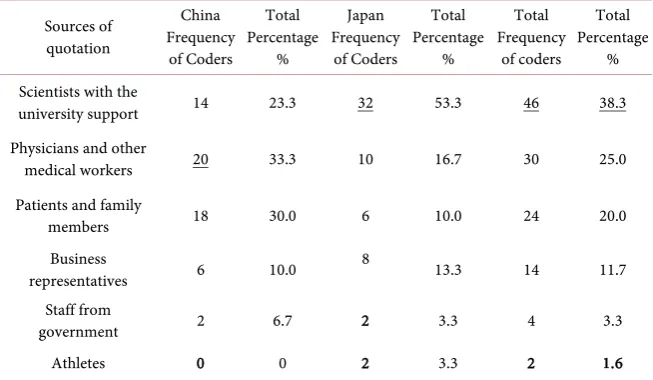
It can be seen in the Table 5 that almost 33% of newspaper articles in the total sample used the quotations from the scientists (N = 120). The second-mostcited source, at around 25%, is the opinions of the physicians and other medical workers. The third-most is information from patients and their family members in newspaper reports, which accounts for twenty percent of cited sources.
8Renmin newspaper is the biggest newspaper group in China. The paper is an official newspaper of
the Chinese Communist Party.
9Xinhua is the biggest and most influential media organizationin China and a ministry-level
institu-tion subordinate to the Chinese central government.
DOI: 10.4236/jss.2018.611006 97 Open Journal of Social Sciences
Table 5. Sources of quotation for articles about neuroscience (Underlined is the largest
number; Bold is the least number).
Sources of quotation
China Frequency
of Coders Total Percentage
%
Japan Frequency
of Coders
Total Percentage
%
Total Frequency
of coders
Total Percentage
% Scientists with the
university support 14 23.3 32 53.3 46 38.3
Physicians and other
medical workers 20 33.3 10 16.7 30 25.0
Patients and family
members 18 30.0 6 10.0 24 20.0
Business
representatives 6 10.0 8 13.3 14 11.7
Staff from
government 2 6.7 2 3.3 4 3.3
Athletes 0 0 2 3.3 2 1.6
The least cited sources overall are business representatives, government staff, and athletes. Specifically, in the Chinese sample, quotations from physicians, scientists, and patients were the most mentioned in the newspaper articles, while in the Japanese articles, scientists with university support were quoted most fre-quently, taking up just over53%, followed by hospital physicians and business representatives respectively.
2) Newspaper Content Analysis
Around 220 articles (25.4%) of the total sample reported on “What the brain and mind are”, which involves topics such as brain tumors, cerebral injuries, encephala trophy, and brain healthcare? (Table 3) The most frequently men-tioned codes were cerebral injury (26.1%), such as the permanent loss of brain cells, brain health care (23.4%), such as the protection of blood vessels in brains, and cerebral apoplexy (20.7%), such as intra-cerebral hemorrhages and ischemic strokes.
To give more detail, in the Chinese newspapers, cerebral injury was the most frequent code, accounting for 23.1%, followed by the frequency of encephala trophy, cerebral apoplexy, and brain healthcare (22.0%) as a virtual tie for second place. However, the information about brain tumors (1.1%), traditional Chinese medicine (2.2%), and brain death (7.7%) were the least mentioned in Chinese newspapers on neuroscience. Moreover, within the Japanese samples, the most frequently cited code was cerebral injury (40.0%), followed by brain healthcare (30.0%) and cerebral apoplexy (15.0%). However, the Japanese ar-ticles did not refer to brain tumors or traditional Chinese medicine. Overall, in the first theme of the discussion on what the brain and mind are, Chinese news-papers prefer to lay more emphasis on specific brain diseases and brain health problems than the Japanese articles.
DOI: 10.4236/jss.2018.611006 98 Open Journal of Social Sciences
fMRI, PET (Positron Emission Computed Tomography), and EEG (Electroen-cephalogram) (Racine, 2005). Second most frequent was brain wave research such as brain cell stimulation (39.4%). However, the frequency of near-death experiences (4.6%) and animal brain research (13.8%) was relatively low. Both Chinese and Japanese newspapers had similar proportions individually as the overall frequencies. It can be seen from Table 6 that brain scans and brain waves account for the largest proportion of this theme, with the Japanese articles in particular preferring to mention these topics.
Furthermore, in the sections on sociological and practical implications the frequency of codes were 128 (16.5%) and 122 (15.7%), respectively. In the for-mer theme, the most frequent coder was AI (48.4%) such as its uses in the treatment of Parkinson’s disease. Meanwhile, efficiency improvement (45.9%) such as how to create better life for the disabled takes up the greatest quantity. There is an adverse data indication between China and Japan. In the Chinese newspapers, information about the practical implication occupies more focus of the articles, at 63.9%, while Japanese articles place more concentration on socio-logical implications, at 62.5%.
As previously mentioned there are three tendencies in articles on neuroscien-tific technologies: neuro-essentialism, neuro-realism, and neuro-policy. There-fore, in discussion of the themes of philosophical or existential implications, the results will be shown based on these trends. Within the sample of this disserta-tion, neuro-essentialism is often mentioned in philosophical implications, espe-cially in the Chinese materials in which 97% support neuro-realism, with discus-sion such as “With the help of brain wave technology, we can describe a com-plete map for human brain activity” (01). However, around 57% of the sampled Japanese newspaper reporting conveys information in a neuro-essentialist man-ner: “The human brain is still one of the biggest secrets of science” (005).
4.2. Focus Group Findings
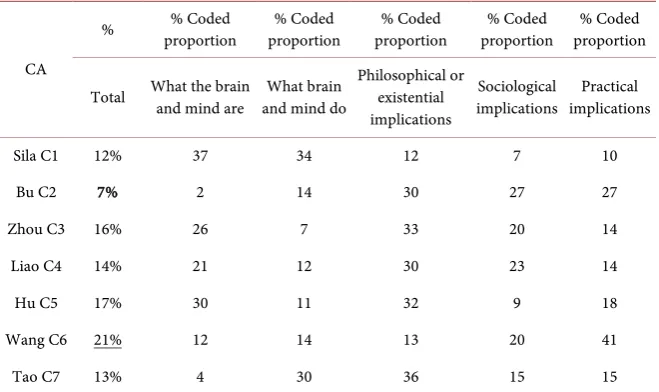
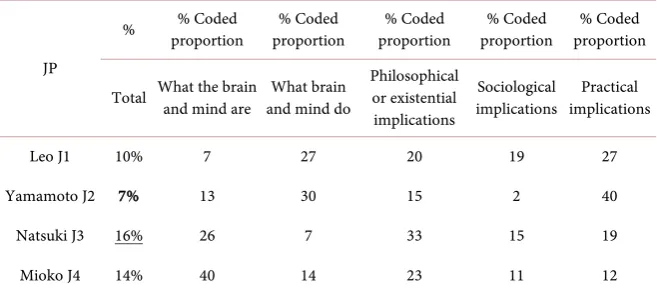
As the research questions of this study are about the public perception of the media representation of neuroscience, the focus group transcripts were coded in a frame of media newspapers, which can be seen in Table 5. Each transcript was coded by a unique number, those from the Chinese focus group had numbers beginning with C and those from the Japanese group all began with J, allowing each participant a unique identification number (Table 7).
4.2.1. Chinese Perception of Neuroscience
1) CA-Theme: What the brain and mind are
DOI: 10.4236/jss.2018.611006 99 Open Journal of Social Sciences
Table 6. Frequency/Percentage of five themes in newspaper coverage of neuroscience
(Underlined is the largest number; Bold is the least number).
Themes Coders Total (%) China (%) Japan (%)
What are brain and mind
Brain tumor 2 (0.7) 2 (1.1) 0 (0) Cerebral injury 58 (26.1) 42 (23) 16 (40) Encephala trophy 42 (18.9) 40 (22) 2 (5) Cerebral apoplexy 46 (21.0) 40 (22) 6 (15)
Brain health care 52 (23.4) 40 (22) 12 (30) Traditional Chinese medicine 4 (2) 4 (2.2) 0 (0)
Brain death 18 (8) 14 (8) 4 (10)
Total 222 (28.6) 182 (41.4) 40 (11.9)
What brain and mind do
Brain wave research 86 (39) 32 (35) 54 (42) Near-death experience 10 (5) 8 (9) 2 (2) Animals’ brain researches 30 (14) 14 (15) 16 (13)
Brain scan (i.e. fMRI) 92 (42) 38 (41) 54 (42)
Total 218 (28.1) 92 (20.9) 126 (37.5)
Philosophical or existential implications
Self-consciousness
based on the brain activities 46 (53) 22 (55) 24 (52) Doubt about the
consciousness after death 12 (14) 8 (20) 4 (8.7) Doubt about the soul 12 (14) 8 (20) 4 (8.7) Subjective experience (i.e. sprit is
out of body experience) 14 (16) 2 (5) 12 (26.1) Discussion about the after death world 2 (2) 0 (0) 2 (4.3)
Total 86 (11.1) 40 (9.1) 46 (13.7)
Sociological implications
AI 62 (48) 14 (29.2) 48 (60)
Smart home
(i.e. Intelligent home system) 10 (7.8) 4 (8.3) 6 (7.5) Military 6 (4.7) 6 (12.5) 0 (0) Driverless car 6 (4.7) 6 (12.5) 0 (0) New media (i.e. virtual reality) 20 (15.6) 8 (16.7) 12 (15)
Medical care 24 (18.8) 10 (20.8) 14 (17.5)
Total 128 (16.5) 48 (10.9) 80 (23.8)
Practical implications
Improvement of first aid 44 (36) 36 (46.2) 8 (18.2) Efficiency improvement
(i.e. the disabled) 56 (45) 24 (28.2) 32 (72.7)
Sleeping insurance (i.e. the sleeping
time of night shift workers) 22 (18) 18 (23.1) 4 (9.1)
Total 122 (15.7) 78 (17.8) 44 (13.1)
[image:15.595.203.534.102.736.2]DOI: 10.4236/jss.2018.611006 100 Open Journal of Social Sciences
Table 7. The focus group results of Chinese participants.
CA
% proportion % Coded proportion % Coded proportion % Coded proportion % Coded proportion % Coded
Total What the brain and mind are and mind do What brain Philosophical or existential implications
Sociological
implications implications Practical
Sila C1 12% 37 34 12 7 10
Bu C2 7% 2 14 30 27 27
Zhou C3 16% 26 7 33 20 14
Liao C4 14% 21 12 30 23 14
Hu C5 17% 30 11 32 9 18
Wang C6 21% 12 14 13 20 41
Tao C7 13% 4 30 36 15 15
% of participant speech which is counted by words, excluding facilitator
common topic for me” (C5). Almost half of the participants noted the main in-formation they had received about neuroscience is about medical research of the brain, with improvement of medical technologies related to the brain and the knowledge of brain healthcare being of particular focus.
Furthermore, media information was mentioned, with newspaper reports on neuroscience being the group’s main source of connection to this scientific area: “The Chinese media seems to prefer this kind of report” (C6). Moreover, the form of media communication would affect the credibility of neuroscientific in-formation for the participants: “I would notice the inin-formation from news media whether it was online or offline. However, for me, the more influential media are documentaries and books” (C4). The discussion about the credibility of neuros-cience newspaper would be further demonstrated in the themes of philosophical or existential implications.
2) CA-Theme: What brain and mind do
On the second global theme of discussion, what the brain and mind do,the participants in the Chinese focus group talked about brain scanning technology and brain wave research which were used to help the public understand brain activity. Interestingly, there were two opposing points on brain waves. Some participants thought they were just a way to visualize how the brain or mind works:
“TherewasanAmericanscholarwhotestedamonk’sbrainthroughscanning
technology. Theresultsofthistestwererecordedbybrainwaves. Theresearcher
foundthemonkwasoneofthehappiestpeopleinthisworld.” (C3)
While other participants supported that brain waves were the essence of our brain and mind. In other words, they generated feelings, minds, and emotions which C2 held to be experiences which are “alltheresultsofbrainwaves”.
DOI: 10.4236/jss.2018.611006 101 Open Journal of Social Sciences
There were two opinions among the participants in the Chinese focus group when they discussed philosophical or existential implications of neuroscience. Some claimed the brain and mind were independent, similar to the concept of neuro-essentialism reasoned by subjective experiences:
“I experience things such as predictive dreams. After having these strange
dreams, IwilllookupthestudiesofbothFreudandtheDukeofZhoutoexplain
them. Therearealotofsecretsofourbrainandmind” (C3)
“Ihavesubjectiveexperiences…suchasdreamsaboutmypastlife. Therefore,
Ibelieveourbrainandmindareseparated” (C1)
The other participants’ opinions of philosophical interpretation were more likely to support neuro-realism, considering the brain and mind to be integrated. In particular, they believed the brain and mind can be explored by neuroscien-tific technologies:”Ibelievetheknowledgeandinformationinourbrainscanbe
quantifiedasdata. Oursoulisalsotheproductionofthisdata.” (C6).
Here, the participants mentioned the conflict between neuroscience newspa-per information and their own values, showing there was a communicative gap between the media representation and the public: “Thenewspapers never
sup-port things which cannot be explained.” (C5). In addition to this, the
partici-pants worried about the utilitarian nature of the Chinese newspaper, particularly the controlling power of the government, stating: “Eventhoughthemainstream
mediagivesanexplanation, theyalwaysbasetheiransweronmaterialism, which
isgreatlyone-sidedinformation” (C7) and “thenewspaperinChinahasa
polit-icalpurpose” (C6).
4) CA-Theme: Sociological implications
In response to sociological implications, most participants mentioned the de-velopment of AI and medical applications based on the brains of human beings, including discussion of Chess AI and medical robots: “I have learntto
imple-mentneural networksusingmachinelearning. Thetoolswhich weused to
es-tablishthenetworkwasGoogleAlphaGo. Thisistheimplicationofthe neural
network method” (C6). Furthermore, they talked about the medical areas of
neuroscience:”Nowadays, medical robotics isvery developed, designed
accord-ingtoourhumanbrains” (C1).
5) CA-Theme: Practical implications
As for the theme of practical implications, the participants mentioned the importance of sleeping improvement based on neuroscience researches:”Iwould
relateneurosciencetosleepinghabits. BecauseChinadevelopstoofast, thereare
alotofpeoplewhohaveproblemssleeping. Therefore, manyneuroscientific
re-searchresultsaregearedtowardssolvingthisproblem” (C3). The second highest
frequency of the neuroscientific practical application was about the progress of first-aid.
4.2.2. Japanese Perception of Neuroscience
DOI: 10.4236/jss.2018.611006 102 Open Journal of Social Sciences
newspaper reports was focused on medical issues. However, they all mentioned the information about neuroscience was mainly about brain tumors: “Inoticed
neuroscienceinformationisusuallyaboutbraintumors” (J2) (Table 8).
As for the topic of brain activity, almost all participants mentioned the news-paper reporting of brain wave studies: “There arealot ofnewspapers
concen-trateonthedevelopmentofbrainwaveresearch” (J3).
When asked about their impression of neuroscience, the majority of Japanese participants were familiar with AI technology: “Forme, thenewspapersseemto
prefertoreportontheneuroscienceinformationofAI, suchaswearable
devic-es” (J1).
Generally, on the theme of philosophical and existential implications of neu-roscience, the Japanese participants supported neuro-essentialism: “Thereisno
clearandstraightforwardexplanationofsomeissuessuchaswhenthespritfrees
itselffromthebody” (J1).
There was distinction between the two focus groups on the themes of socio-logical and practical implications of neuroscience. The first reaction of the Japa-nese participants to this question was about neuroscientific knowledge related to life and business applications: “Neuroscienceisrelatedtomanyareas, especially
management and finance. I believe neuroscience even lays the foundation of
many scientific areas” (J3). In addition, they talked about the application of
neuroscientific knowledge in the sports field, and its effect on the efficiency of athletes: “Sportsmanagementiscloselyrelatedtoneuroscience” (J4).
4.3. Conclusion: Communicative Content and Form of
Neuroscience
[image:18.595.210.539.557.702.2]The results of media content analyses and focus groups indicate that there are notable distinctions about the media representation of neuroscience between China and Japan. All the differences of public perception of neuroscience be-tween China and Japan can be divided into two sections—communicative con-tent and form of neuroscience.
Table 8. The focus group results of Japanese participants.
JP
% proportion % Coded proportion % Coded proportion % Coded proportion % Coded proportion % Coded
Total What the brain and mind are and mind do What brain Philosophical or existential implications
Sociological
implications implications Practical
Leo J1 10% 7 27 20 19 27
Yamamoto J2 7% 13 30 15 2 40
Natsuki J3 16% 26 7 33 15 19
Mioko J4 14% 40 14 23 11 12
DOI: 10.4236/jss.2018.611006 103 Open Journal of Social Sciences 4.3.1. Communicative Content
More detailed, in the themes of the nature of brain or mind (what is brain and mind, and what brain and mind does), sociological implications and practical implications, it can be obviously deducted that the Chinese public lays more emphasis on medical field of neuroscience. The quotation sources of Chinese newspaper are supported by medical workers and patients. Even Chinese articles on the newspaper are more likely to report the medical information of neuros-cience, such as brain health care and cerebral apoplexy. Furthermore, as to the neuroscientific implications, Chinese media coverage also lays more emphasis on the improvement of first aid than Japan.
The results of the Chinese focus group also support this argument. The par-ticipants said in the CA: “theinformationaboutthebrainhealthcareisa
com-mon topic for me, such as the preventionof cerebral apoplexy.” (C3) On the
other hand, Japanese newspaper coverage of neuroscience mainly cites the evi-dence and the data support from scientists. The brain scanning technology is the core content in Japanese articles. It is worth mentioning that the future potential of sociology implication of neuroscience such as AI is another important re-search area in Japanese media coverage. Overall, the Japanese public perception of neuroscience mainly concentrates on the economic value and daily life. In the theme of philosophical or existential implications, the Chinese public perception of neuroscience tends to be more neuro-realistic than Japanese. Especially, the Chinese newspaper articles have presented more description of neuroscience.
4.3.2. Communicative Forms
When it comes to the communicative forms of neuroscience, the Chinese par-ticipants in the focus group commented that the articles about neuroscience on Chinese newspaper lacked credibility among the public, and especially the top-down media coverage of neuroscience had caused Chinese individuals’ con-fidence crisis to the government. The participants also talked about the utilita-rianism in the newspaper, which is another reason for their distrust.
Japanese scientists lack the communication between the public. More impor-tantly, they have no conscious to use the simple neuroscience language in their scientific results. Therefore, in the Japanese focus group, the participants reflect that there is an information gap between them and the scientists. It is really hard for them to fully understand what the scientists’ meaning in the newspapers. And this situation would lead to the indifference of the Japanese individual’s at-titude to the development of neuroscience.
5. Conclusions
DOI: 10.4236/jss.2018.611006 104 Open Journal of Social Sciences
Figure 2. The comparison figure of the five themes between China and Japan.
5.1. Communicative Content
More detailed, in the themes of the nature of brain or mind (what is brain and mind, and what brain and mind does), sociological implications and practical implications, it can be obviously deducted that the Chinese public lays more emphasis on medical field of neuroscience. The quotation sources of Chinese newspaper are supported by medical workers and patients. Even Chinese articles on the newspaper are more likely to report the medical information of neuros-cience, such as brain health care and cerebral apoplexy. Furthermore, as to the neuroscientific implications, Chinese media coverage also lays more emphasis on the improvement of first aid than Japan.
The results of the Chinese focus group also support this argument. The par-ticipants said in the CA: “theinformationaboutthebrainhealthcareisa
com-mon topic for me, such as the preventionof cerebral apoplexy.” (C3) On the
evi-DOI: 10.4236/jss.2018.611006 105 Open Journal of Social Sciences
dence and the data support from scientists. The brain scanning technology is the core content in Japanese articles. It is worth mentioning that the future potential of sociology implication of neuroscience such as AI is another important re-search area in Japanese media coverage. Overall, the Japanese public perception of neuroscience mainly concentrates on the economic value and daily life. In the theme of philosophical or existential implications, the Chinese public perception of neuroscience tends to be more neuro-realistic than Japanese. Especially, the Chinese newspaper articles have presented more description of neuroscience.
5.2. Communicative Forms
When it comes to the communicative forms of neuroscience, the Chinese par-ticipants in the focus group commented that the articles about neuroscience on Chinese newspaper lacked credibility among the public, and especially the top-down media coverage of neuroscience had caused Chinese individuals’ con-fidence crisis to the government. The participants also talked about the utilita-rianism in the newspaper, which is another reason for their distrust.
Japanese scientists lack the communication between the public. More impor-tantly, they have no conscious to use the simple neuroscience language in their scientific results. Therefore, in the Japanese focus group, the participants reflect that there is an information gap between them and the scientists. It is really hard for them to fully understand what the scientists’ meaning in the newspapers. And this situation would lead to the indifference of the Japanese individual’s at-titude to the development of neuroscience.
Conflicts of Interest
The author declares no conflicts of interest regarding the publication of this pa-per.
References
[1] Devillers-Thiéry, A., Giraudat, J., Bentaboulet, M. and Changeux, J.P. (1983) Com-plete mRNA Coding Sequence of the Acetylcholine Binding α-Subunit of Torpedo Marmorata Acetylcholine Receptor: A Model for the Transmembrane Organization of the Polypeptide Chain. Proceedings of the National Academy of Sciences of the USA, 80, 2067-2071. https://doi.org/10.1073/pnas.80.7.2067
[2] Churchland, P.S. (1989) Neurophilosophy: Toward a Unified Science of the Mind- Brain. MIT Press.
[3] Young, L. and Saxe, R. (2008) The Neural Basis of Belief Encoding and Integration in Moral Judgment. Neuroimage, 40, 1912-1920.
https://doi.org/10.1016/j.neuroimage.2008.01.057
[4] Racine, E., Waldman, S., Rosenberg, J. and Illes, J. (2010) Contemporary Neuros-cience in the Media. Social Science & Medicine, 71, 725-733.
https://doi.org/10.1016/j.socscimed.2010.05.017
[5] Racine, E., Bar-Ilan, O. and Illes, J. (2006) Brain Imaging: A Decade of Coverage in the Print Media. Science Communication, 28, 122-143.
DOI: 10.4236/jss.2018.611006 106 Open Journal of Social Sciences [6] van Atteveldt, N.M., van Aalderen-Smeets, S.I., Jacobi, C. and Ruigrok, N. (2014) Media Reporting of Neuroscience Depends on Timing, Topic and Newspaper Type.
PloS ONE, 9, e104780. https://doi.org/10.1371/journal.pone.0104780 [7] Vrecko, S. (2010) Neuroscience, Power and Culture: An Introduction.
[8] Grabowski, M., Ed. (2014) Neuroscience and Media: New Understandings and Re-presentations (Vol. 70). Routledge. https://doi.org/10.4324/9781315749235
[9] Gay, V.P., Ed. (2009) Neuroscience and Religion: Brain, Mind, Self, and Soul. Lex-ington Books.
[10] Slingerland, E. (2008) What Science Offers the Humanities: Integrating Body and Culture. Cambridge University Press. https://doi.org/10.1017/CBO9780511841163 [11] Putnam, H. (1973) Reductionism and the Nature of Psychology. Cognition, 2,
131-146. https://doi.org/10.1016/0010-0277(72)90033-9
[12] Racine, E., Bar-Ilan, O. and Illes, J. (2005) fMRI in the Public Eye. Nature Reviews.
Neuroscience, 6, 159. https://doi.org/10.1038/nrn1609
[13] Holman, K. (2011) Coverage of Neuroscience in the Popular Media. The New Psy-chobabble, Brain Blogger.
[14] Giridhardas, A. (2008) India’s Novel Use of Brain Scans in Courts Is Debated. The New York Times.
[15] Stokes, M. (2013) There’s a Lot More to Neuroscience than Media “Neuromania”.
The Guardian.
[16] Beck, D.M. (2010) The Appeal of the Brain in the Popular Press. Perspectives on Psychological Science, 5, 762-766.https://doi.org/10.1177/1745691610388779 [17] Lü, L. (2009) The Value of the Use of Biotechnology: Public Views in China and
Europe. Public Understanding of Science, 18, 481-492. https://doi.org/10.1177/0963662507082892
[18] Ren, J., Peters, H.P., Allgaier, J. and Lo, Y.Y. (2014) Similar Challenges but Different Responses: Media Coverage of Measles Vaccination in the UK and China. Public Understanding of Science, 23, 366-375.https://doi.org/10.1177/0963662512445012 [19] Raza, G., Kumar, P.V.S. and Singh, S. (2011) Public Understanding of Environment
and Bioenergy Resources. Journal of Science Communication, 10, A03. https://doi.org/10.22323/2.10030203
[20] Kawamoto, S., Nakayama, M. and Saijo, M. (2013) A Survey of Scientific Literacy to Provide a Foundation for Designing Science Communication in Japan. Public Un-derstanding of Science, 22, 674-690.https://doi.org/10.1177/0963662511418893 [21] Zhang, J.Y. (2015) The “Credibility Paradox” in China’s Science Communication:
Views from Scientific Practitioners. Public Understanding of Science, 24, 913-927. https://doi.org/10.1177/0963662515598249
[22] Jia, H. and Liu, L. (2014) Unbalanced Progress: The Hard Road from Science Popu-larisation to Public Engagement with Science in China. Public Understanding of Science, 23, 32-37.https://doi.org/10.1177/0963662513476404
[23] Koizumi, A., Morita, Y. and Kawamoto, S. (2013) Science Communication: Reward Research Outreach in Japan. Nature, 500, 29.https://doi.org/10.1038/500029a [24] Kornhauser, D. (2015) News Center. Okinawa Institute of Science and Technology
Graduate University.
https://www.oist.jp/news-center/news/2015/3/24/transforming-japanese-science-co
mmunication
Dramatisa-DOI: 10.4236/jss.2018.611006 107 Open Journal of Social Sciences tion of Biotechnology in Elite Mass Media.
[26] Sue, R. and Ylva, F. (1999) The Marketing and Public Relations Handbook for Mu-seums, Galleries and Heritage Attractions.
[27] Berelson, B. (1952) Content Analysis in Communications Research.
[28] Bauer, M.W. and Gaskell, G. (2000) Qualitative Researching with Text, Image and Sound: A Practical Handbook for Social Research. Sage, Thousand Oaks.
https://doi.org/10.4135/9781849209731
[29] Chen Krippendorff, K. (2004) Content Analysis: An Introduction to Its Methodol-ogy. Sage, Thousand Oaks.
[30] Chen, Y. (2000) The Application of Semiotics to Mass Communication. Interna-tional Press, 4, 46-50.
[31] Tennant, C. (2012) On the Threshold: A Social Psychological Study of Different Standpoints in the Climate Change Debate. Doctoral Dissertation, The London School of Economics and Political Science.
[32] Bauer, M.W. and Gaskell, G. (1999) Towards a Paradigm for Research on Social Representations. Journal for the Theory of Social Behaviour, 29, 163-186.