INTRODUCTION
The modulation of pectoralis power output in birds has only been investigated during aerial locomotion, yet birds are capable of a wide range of locomotor behaviors that involve flapping. Wing-assisted incline running (WAIR) occurs when a bird uses its hindlimbs to climb an inclined substrate and also flaps its wings to produce aerodynamic forces that accelerate its body upwards along the surface and provide partial weight support (Dial, 2003; Dial et al., 2008). The forces produced by the wings thereby assist the effort of the hindlimbs during climbing (Bundle and Dial, 2003; Tobalske and Dial, 2007). WAIR is exhibited by a wide taxonomic array of juvenile and adult birds (Dial et al., 2006). It represents a form of escape behavior exhibited by precocial ground birds early in their development when their wings are only partly developed and before they are able to fly (Jackson et al., 2009). In an ecological context, it is an alternative to flight used when exploiting a complex three-dimensional environment at the interface of the ground and the air. For example, adult rock doves (Columba livia Gmelin 1789; hereafter ‘pigeon’) use WAIR to control their body position and ascend cliff faces as well as equivalent human-constructed features (e.g. the façades of buildings and abutments of bridges; supplementary material Movie1).
The evolutionary origin of bird flight remains poorly understood, and debate surrounding this origin is particularly contentious. Because the development of external wing morphology in precocial ground birds shares a pattern with the hypothesized trajectory of wing evolution in the clade of theropod dinosaurs (Dial et al., 2006; Heers and Dial, 2010), WAIR has been proposed as a testable empirical model for the evolution of flight compared with trees-down or ground-up hypotheses for which extant models are lacking (ontogenetic-transitional wing hypothesis) (Dial, 2003; Dial et al., 2008; Jackson et al., 2009). The transitional wing hypothesis posits that WAIR offers incremental adaptive stages of locomotor performance during the transition from obligate bipedalism to powered flapping flight. For example, baby birds incapable of flight demonstrate incremental stages of wing morphology that correlate with increasing locomotor performance (Dial et al., 2006). Fundamental to the hypothesis, and previously untested, is the assumption that WAIR also provides adaptive functional stages for muscles transitioning from the low-power requirements of non-locomotor forelimbs to the substantial power required during flight. Flapping flight requires the highest power output of any form of vertebrate locomotion (Schmidt-Nielsen, 1972), and take-off and slow flight are particularly costly as described by the U-shaped The Journal of Experimental Biology 214, 2354-2361
© 2011. Published by The Company of Biologists Ltd doi:10.1242/jeb.052829
RESEARCH ARTICLE
The broad range of contractile behaviour of the avian pectoralis: functional and
evolutionary implications
Brandon E. Jackson*, Bret W. Tobalske and Kenneth P. Dial
Field Research Station at Fort Missoula, Division of Biological Sciences, University of Montana, Missoula, MT 59812, USA *Author for correspondence ([email protected])
Accepted 5 April 2011
SUMMARY
Wing-assisted incline running (WAIR) in birds combines the use of the wings and hindlimbs to ascend otherwise insurmountable obstacles. It is a means of escape in precocial birds before they are able to fly, and it is used by a variety of juvenile and adult birds as an alternative to flight for exploiting complex three-dimensional environments at the interface of the ground and air. WAIR and controlled flapping descent (CFD) are the bases of the ontogenetic-transitional wing hypothesis, wherein WAIR and CFD are proposed to be extant biomechanical analogs for incremental adaptive stages in the evolutionary origin of flight. A primary assumption of the hypothesis is that work and power requirements from the primary downstroke muscle, the pectoralis, incrementally increase from shallow- to steep-angled terrestrial locomotion, and between terrestrial and aerial locomotion. To test this assumption, we measured in vivoforce, electromyographic (EMG) activity and length change in the pectoralis of pigeons (Columba livia) as the birds engaged in shallow and steep WAIR (65 and 85deg, respectively) and in three modes of slow flight immediately following take-off: ascending at 80deg, level and descending at –60deg. Mean EMG amplitude, muscle stress, strain, work and power were minimal during shallow WAIR and increased stepwise from steep WAIR to descending flight and level flight to reach the highest levels during ascending flight. Relative to resting length of the pectoralis, fractional lengthening (maximum muscle strain) was similar among behaviors, but fractional shortening (minimum muscle strain) was absent during WAIR such that the pectoralis did not shorten to less than the resting length. These data dramatically extend the known range of in vivo
contractile behavior for the pectoralis in birds. We conclude that WAIR remains a useful extant model for the evolutionary transition from terrestrial to aerial locomotion in birds because work and power requirements from the pectoralis increase incrementally during WAIR and from WAIR to flight.
Supplementary material available online at http://jeb.biologists.org/cgi/content/full/214/14/2354/DC1
requirement for power as a function of flight speed (Pennycuick, 1975; Rayner, 1979; Hedrick et al., 2003; Tobalske et al., 2003). Therefore, if WAIR represents a transitional stage of locomotion between terrestrial and aerial, we predict that power demands upon the flight muscles should correlate with the angle of ascent in WAIR and be less in WAIR than in flight. Aerodynamic measurements appear consistent with this prediction. Adult chukar partridge (Alectoris chukar) use their wings to generate approximately 65% of their body weight during WAIR on a slope of 80deg, whereas average lift during ascending flight at the same angle either matches or slightly exceeds body weight (Tobalske and Dial, 2007). However, average force is only one component of work and power, and several other contractile properties of the avian pectoralis appear specialized for generating large amounts of work and power (Biewener and Roberts, 2000). The muscle undergoes large strain (≥40% in large birds), exhibits an asymmetrical strain trajectory (Dial and Biewener, 1993; Askew and Marsh, 1997; Biewener et al., 1998; Tobalske and Dial, 2000; Askew and Marsh, 2001; Hedrick et al., 2003; Tobalske et al., 2003; Jackson and Dial, 2011) and the onset of neural activation causes active lengthening (eccentric contraction) during late upstroke (Dial, 1992; Hedrick et al., 2003; Tobalske et al., 2003; Tobalske and Biewener, 2008).
We undertook the present study to evaluate the mechanical power output of the primary flight muscle (m. pectoralis, >20% body mass) over a wide range of flapping locomotor behaviors to evaluate the degree to which this proportionally massive muscle can modulate power output. This also provides a test as to whether the forelimb power requirements during WAIR are transitional between terrestrial and aerial flapping locomotion, and thus consistent with WAIR’s use as an analogous model for the evolutionary transition from terrestrial to aerial locomotion. Pigeons were ideal study subjects for this effort because they use WAIR in natural settings and much is already known about in vivomuscle function and wing motion during flight in this species (Brown, 1963; Dial, 1992; Dial and Biewener, 1993; Biewener et al., 1998; Soman et al., 2005; Berg and Biewener, 2008; Tobalske and Biewener, 2008).
MATERIALS AND METHODS Birds and experimental design
We measured muscle activity during WAIR and flight in three pigeons (mean body mass 452g; Table1). All housing and experimental protocols were approved by the University of Montana Institutional Animal Care and Use Committee. Birds were wild caught and housed in 4⫻4⫻15m outdoor aviaries with ad libitum access to food and water. For 3weeks prior to the experiments, the birds were trained to move toward a perch using WAIR to climb a ramp and using flapping flight. The surface of the ramp used for WAIR (200cm in length, 15cm in width) was covered with sandpaper (36grit) to aid the birds in gaining traction during climbing. The ramp was set at inclines of 65deg and 80–85deg (hereafter 85deg; Fig.1). Flights were initiated as the bird was being held in the hand and covered a 2m path that was level, ascending at ~80deg or descending at –60deg (supplementary material Movie2).
Experiments consisted of recording muscle activity from the pectoralis as the birds performed two or more bouts for a total of ≥10 wingbeats per bird for each locomotor behavior. To verify adequate performance, all muscle recordings were synchronized with high-speed video obtained using a Photron SA-3 camera (Photron Inc., San Diego, CA, USA; 1024⫻1024pixel resolution) with a sampling rate of 250Hz and a shutter speed of 1/2500s. The ramp and flight path was illuminated using two 650W halogen lights (Lowel Tota-light, Lowel-Light Manufacturing, Inc., Brooklyn, NY, USA). Following the recording sessions, each bird was killed with an overdose of sodium pentobarbital (100mgkg–1).
In vivomuscle recordings
We used previously reported methods for surgically implanting subcutaneous electrodes and transducers and for recording neuromuscular recruitment, muscle stress and strain (Biewener et al., 1998; Tobalske and Dial, 2000; Tobalske and Biewener, 2008). All surgical implantation was performed with the birds anesthetized using isoflurane inhalant (HME109, Highland Medical Equipment, Temecula, CA, USA; 5% to induce, 2–3% to maintain), and the birds were allowed to fully recover for 12–15h prior to the experiments. Analog signals were sampled at 2000Hz and imported to s PC computer using Axoscope (v.10.1, Molecular Devices, Sunnyvale, CA, USA) and an Axon Instruments Digitata 1322 16bit A/D converter (Union City, CA, USA). All subsequent analysis was accomplished using Igor Pro (v.6.1.2, WaveMetrics, Inc., Lake Oswego, OR, USA).
To measure electromyography (EMG) activity, we implanted a twisted pair of fine-wire silver electrodes into the mid-anterior sternobrachialis region of the pectoralis. The wires were 100m in diameter and 99.9% silver, with a 1mm inter-tip distance and 0.5mm insulation removed (California Fine Wire Co., Grover Beach, CA, USA). The EMG signals were amplified 1000⫻using a Grass P511 amplifier (Grass Technologies, West Warwick, RI, USA) with a 60Hz notch and 100–3000Hz band pass filter.
We measured muscle length by recording sonomicrometry signals using a Triton 120/2 amplifier (Triton Technology, Inc., San Diego, CA, USA). The sonomicrometry transducers featured 2.0mm crystals (Sonometrics, Inc., London, ON, Canada), and we implanted these in the mid-anterior sternobrachialis region of the pectoralis, 10–20mm apart and 4mm deep to the superficial fascia. The sonomicrometry measurements were corrected to represent the instantaneous mean length of the fascicles in the pectoralis; the measured distance between crystals was corrected for the conduction velocity of sound through muscle, the offset due to the epoxy lens and a 5ms phase delay, and then converted to fascicle length based on instantaneous measurements of resting length and the mean post mortem fascicle length described below (Tobalske and Biewener, 2008). Resting length (Lrest) was measured during perching, with the wings folded and the pectoralis inactive. Muscle strain was calculated as L/Lrest, where L is the difference between instantaneous fascicle length (L) and Lrest.
We measured muscle force using a strain gauge (FLE-1, Tokyo Sokki Kenkyujo, Ltd, Tokyo, Japan) implanted on the dorsal surface of the deltopectoral crest (DPC) of the humerus. Voltage signals from the quarter-bridge circuit were amplified 2000⫻using a Vishay 2120A amplifier and signal conditioner (Measurements Group, Inc., Raleigh, NC, USA).
[image:2.612.47.298.707.746.2]Following the death of each pigeon, the pectoralis muscle was exposed to verify the placement of EMG electrodes and sonomicrometry crystals. The strain-gauge voltages were calibrated to pectoralis force following Jackson and Dial (Jackson and Dial,
Table 1. Morphological measurements for three pigeons included in this study
Pigeon 1 Pigeon 2 Pigeon 3
Body mass (g) 420.5 432.1 471.6
2011). Briefly, after measuring the insertion orientation of the pectoralis fascicles on the DPC at the start, middle and end of downstroke wing positions, the humerus was removed with the strain gauge and backplug intact. The humerus was mounted in a custom articular vise and connected to a computer-controlled servo (CP-GV6, Gemini I/O module, Parker Compumotor, Rohnert Park, CA, USA) viaa steel cable (1/64inch diameter ⫻19strand brass plated, Nelson Hobby Specialties, Keller, TX, USA) that was adhered to the DPC immediately adjacent to the to scar of the pectoralis central tendon. While the motor pulled on the DPC at in vivo frequencies, we simultaneously recorded motor torque and bone strain to obtain strain-gauge calibration coefficients at each wing position. The coefficient at each position (start, middle and end of downstroke) was then regressed against muscle strain through the downstroke (maximum, resting and minimum from ascending flight, respectively). Thus, the actual strain-gauge calibration coefficient applied at any given time was dependent on wing position as estimated by muscle strain.
We determined mean fascicle length by taking 15 length measurements of varying regions each of the superficial and deep surfaces of the muscle. The mass of each pectoralis and each supracoracoideus was determined to 0.1g with an electronic balance. Muscle work (Wmus) for each wingbeat was determined using the work-loop technique (Josephson, 1985; Biewener et al., 1998). The start and end of each downstroke were defined by pectoralis
shortening and lengthening, respectively, as measured by sonomicrometry. The wingbeat period (Twb) was defined as the duration of a downstroke and subsequent upstroke. The integral of muscle force against muscle length represents the positive work performed for the duration of a downstroke (i.e. during shortening). Net positive work (total work minus any negative work during lengthening) is reported here. Muscle power (Pmus) was calculated as WmusTwb–1. We also determined peak and mean force and/or stress through the downstroke, fractional lengthening (muscle strain that increases length to be greater than Lrest, or maximum observed strain), fractional shortening (muscle shortening that decreases length to be less than below Lrest, or minimum observed strain) and mean EMG amplitude during the burst associated with each downstroke.
Statistical analyses
To test for differences in measured variables between behaviors while accounting for repeated measurements of individual birds, we used linear mixed-effects models with the variable recorded for each wingbeat as the dependent variable and flapping behavior as the independent variable [‘nlme’ package in R (R Development Core Team, 2009)]. Because each individual bird performed each behavior multiple times, and we used several wingbeats from each attempt, we also included a single random factor composed of behavior nested within individual birds. If the effect of behavior was significant in the model, we tested for significant differences between each behavior using Tukey contrasts in simultaneous tests (P-values presented in text and in figures, ‘multcomp’ package in R). Although the statistical tests indicate the effect of behavior across all individuals, and the values in the text are presented as means ± s.d. among individual means for each behavior, we graphically present the data separately for each individual to demonstrate the inter-individual variation. The relationship between mean muscle force and mean EMG amplitude for each downstroke was explored using linear regression among all wingbeats of each individual. Individual means ± s.d. and numbers of wingbeats for each variable and each behavior are presented in supplementary material TableS1.
RESULTS
Pigeons readily performed WAIR at 65 and 85deg as well as three different modes of short-distance flight (level, ascending at 80deg and descending at 60deg; Fig.1, supplementary material Movie2). Wing movements were similar between WAIR and flight during the latter half of upstroke and the first half of downstroke. In contrast, the total downstroke wing excursion during WAIR was arrested relative to the excursion during flight. As a result, the tips of the wings finished downstroke nearer to the mid-frontal plane of the body during WAIR than during flight (Fig.1, supplementary material Movie2).
We observed a burst of EMG activity in the pectoralis during all wingbeats of WAIR and flight, yet the amplitude of the EMG was nearly an order of magnitude lower during WAIR than during flight (Fig.2). Five wingbeats from 65deg WAIR were eliminated from EMG analysis because of difficulty in determining the onset and offset timings of the low-amplitude signals. Onset of EMG activity occurred as the pectoralis was lengthening at the end of upstroke (–14±4% of wingbeat cycle during level flight for all birds), and was not different between locomotor behaviors (P0.97; Table2). Offset of EMG activity was significantly affected by locomotor behavior (P0.003), ranging from 3±9% of the wingbeat cycle during 65deg WAIR to 27±5% during ascending flight (Figs2 and 3). As a result, total EMG burst duration was significantly shorter
Ascending flight 85 deg WAIR
B
A
during WAIR than flight (Table2). The onset of EMG activity preceded the onset of force development by 5–10% of the wingbeat cycle during WAIR, but occurred nearly coincidently during flight behaviors. During WAIR, the offset of EMG activity (3±9% for 65deg, 9±6% for 85deg) preceded peak force development in the muscle (29±2% for 65deg, 23±5% for 85deg) whereas the offset during all flight behaviors (26±7% for level flight) was approximately concurrent with peak force development (26±2%; Fig.3). Downstroke duration, defined using direction of change in muscle length measured using sonomicrometry, varied from 51±6% of the wingbeat cycle during WAIR at 65deg to 61±2% of the wingbeat cycle during both level and ascending flight.
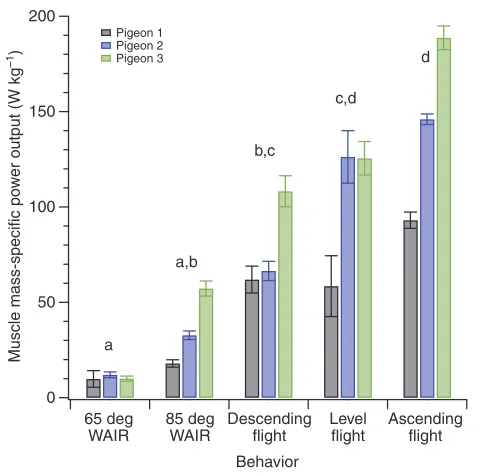
We observed a significant effect of locomotor behavior upon pectoralis mass-specific power output (P0.004; Table2, Fig.4), which varied from a minimum of 11±1Wkg–1 during WAIR at 65deg to a maximum of 142±48Wkg–1during slow ascending flight. The mean mass-specific power output during WAIR at 65deg was significantly less than the output during all flight behaviors (P<0.001 for all comparisons, Tukey contrasts); 85deg WAIR required significantly less power than level and ascending flight (P≤0.001 for both comparisons, Tukey contrasts) and marginally less power than descending flight (P0.088). We observed some differences in power output among birds. Two individuals exhibited a similar
pattern, with an increase in mass-specific power output occurring with each behavioral change from WAIR at 65deg to WAIR at 85deg, then to descending, level and ascending flight. In contrast, pigeon 1 exhibited similar mean mass-specific power during level flight compared with descending flight (Fig.4).
Several other variables, components of mechanical work and power, exhibited significant differences among modes of locomotion (Fig.5, Table2). Mean strain rate (Ls–1) was significantly different in each behavior except between descending and level flight, increasing from WAIR (2.1–3.0Ls–1) to flight (5.1–5.5Ls–1, P0.035 for level versus ascending flight, P<0.001 for all other Tukey contrasts; Fig.5A). Total muscle strain was significantly less during WAIR (16±2% at 65deg, 21±3% at 85deg) compared with all flight behaviors (35±5% in descending flight, 36±5% in level flight and 38±6 in ascending flight, P<0.001 for all Tukey contrasts; Fig.5B), but the differences were due to significant differences in fractional shortening (minimum strain) and not fractional lengthening (maximum strain; Table2). Regardless of style of locomotion, mean fractional lengthening varied from 23 to 27%. In contrast, the pectoralis did not shorten as much during WAIR as during flight; indeed, it did not shorten to even reach its normal resting length during WAIR at 65deg (6–15% among birds). Fractional shortening during WAIR at 85deg averaged –0.5% in one bird and longer than resting length (1 and
A
C
B
D
Time (s)
0.2 0 –0.2 Muscle strain
(ΔL/Lrest) 80 40 0
Muscle stress
(kPa)
–0.40 0.4 EMG (mV)
0.2 0 –0.2 Muscle strain
(ΔL/Lrest) 80 40 0
Muscle stress
(kPa)
–0.40 0.4 EMG (mV)
0.1 0.3 0.5 0.7 0.9
E
0.2 0 –0.2 Muscle strain
(ΔL/Lrest) 80 40 0
Muscle stress
(kPa)
–0.40 0.4 EMG (mV)
0.2 0 –0.2 Muscle strain
(ΔL/Lrest) 80 40 0
Muscle stress
(kPa)
–0.40 0.4 EMG (mV)
0.2 0 –0.2 Muscle strain
(ΔL/Lrest) 80 40 0
Muscle stress
(kPa)
–0.40 0.4 EMG (mV)
Fig.2. Example recordings, 1s in duration, of pectoralis stress, strain and
electromyographic (EMG) activity from pigeon 1 engaged in WAIR at (A) 65deg and (B) 85deg and three modes of flight: (C) 60deg descent, (D) level and (E) 80deg ascent. All scales are equal; an inset illustrates 10⫻EMG activity during WAIR at 65deg. Lrest, resting length of the
5%) in the other two individuals. Fractional shortening during flight varied from –9 to –15%, increasing slightly from descending to level to ascending flight. Peak muscle stress was also less during WAIR than during flight (Table2; Fig.2), with minimum values of 21±3kPa during WAIR at 65deg and maximum values of 83±26kPa during ascending flight.
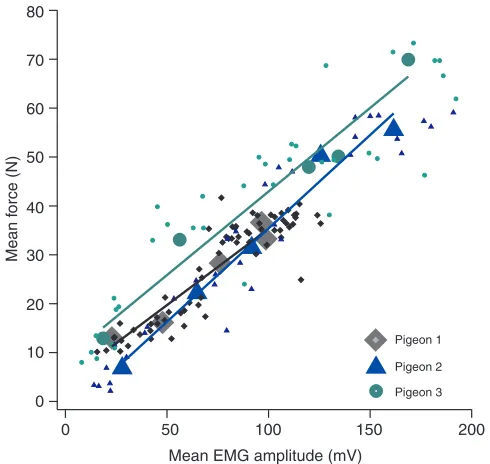
Similar to most of the other variables we measured, EMG amplitude from the pectoralis was less during WAIR than during flight (Figs2 and 6). Depending on the individual bird, the mean EMG amplitude increased at least three-fold from 65deg WAIR (28±20mV in pigeon 2) to level and ascending flight (162±20mV in pigeon 2). Additionally, within each individual bird average EMG amplitude was linearly related to average force among all wingbeats (e.g. pigeon 3: r20.81, F153.9, d.f.34, P<0.001; Fig.6, Table3). Dramatic differences were observed for work-loop shape and the magnitude of net positive mechanical work during WAIR compared with flight (Fig.7). Shape factor (observed area relative to the area
of a rectangle with the same range of stress and strain) (Hedrick et al., 2003) was 0.45±0.15 during WAIR at 65deg, 0.45±0.05 during WAIR at 85deg and increased to 0.49±0.04 in descending flight, 0.54±0.02 in level flight and 0.52±0.04 in ascending flight. Positive work per wingbeat was less during WAIR (63±24mJ during 65deg WAIR and 184±89mJ during 85deg WAIR) than during level and ascending flight (659±346 and 714±324mJ in level and ascending flight, respectively, P<0.001 for all Tukey contrasts). Work during descending flight (441±214mJ) was higher than WAIR at 65deg (P<0.001), marginally higher than that during WAIR at 85deg (P0.060) and significantly lower than that during ascending flight (P0.041).
These differences in work per wingbeat, coupled with changes in wingbeat frequency, led to previously described differences in mass-specific power among locomotor modes (Fig.4). Wingbeat frequency varied from 6.4±0.3Hz during 65deg WAIR to 8.9±0.4Hz during ascending flight, showing significant stepwise increases among behaviors (P≤0.001) except for descending and level flight (P0.46).
DISCUSSION
Our new empirical measures of mechanical work and power output from the pectoralis of pigeons during WAIR and flight extend the range of known functional variance for this muscle. We observed a >11-fold increase in power output whereas variance is reported as less than threefold among flight speeds (Tobalske et al., 2003; Morris and Askew, 2010) and flight modes (take-off, landing and ascending) (Dial and Biewener, 1993; Tobalske and Biewener, 2008). Pushing the range of locomotor behavior demanded of animals provides insight into the functional range of the muscle. Our results are also consistent with a key component of the ontogenetic-transitional wing hypothesis (Dial, 2003; Dial et al., 2008): WAIR requires a fraction of the muscular output compared
0 20 40 60 80 100
Percentage of wingbeat cycle
Downstroke EMG Muscle force
Peak force
65 deg WAIR
85 deg WAIR
Descending flight
Level flight
Ascending flight
Fig.3. Relative timing of contractile activity in the pectoralis of pigeon 1 as the bird engaged in WAIR at 65 and 85deg and three modes of flight (60deg descent, level and 80deg ascent). The downstroke phase of the wingbeat cycle (white) was determined using muscle strain. Gray, EMG activity in the pectoralis; black, muscle force as measured using a strain gauge implanted on the humerus; white circle, peak force. Data are means ± s.d. (N≥5 wingbeats per activity).
200
150
100
50
0
M
us
cle m
ass
-s
pecific po
w
er o
u
tp
u
t (W kg
–1
)
Behavior
a
a,b
b,c
c,d
d
Pigeon 1 Pigeon 2 Pigeon 3
65 deg WAIR
85 deg
WAIR
Descending
flight
Level flight
Ascending
flight
[image:5.612.322.563.64.302.2]Fig.4. Pectoralis mass-specific power output in three pigeons during WAIR at 65 and 85deg and three modes of flight (60deg descent, level and 80deg ascent). Letters distinguish among-bird means for which statistically significant differences (P<0.05) were observed. Bars represent within-bird means ± s.d. (N>5 wingbeats per activity).
Table 2. ANOVA results for mixed-effects linear models with flapping behavior as a fixed factor and behavior nested within
individual bird as a random factor
d.f. F P
Mass-specific power 129, 8 18.9 0.004 Mass-specific work 129, 8 15.4 0.008 Wingbeat frequency 129, 8 69.4 <0.0001
Mean stress 129, 8 16.0 0.007
Peak stress 129, 8 19.2 0.004
EMG duration 124, 8 6.4 0.013
EMG amplitude 124, 8 23.1 0.002 EMG onset timing 124, 8 0.1 0.968 EMG offset timing 124, 8 10.7 0.003 Total strain 129, 8 53.4 <0.001 Fractional lengthening 129, 8 1.9 0.209 Fractional shortening 129, 8 62.3 <0.0001 Strain rate 129, 8 100 <0.0001
[image:5.612.46.296.100.250.2] [image:5.612.48.299.497.667.2]with level flight and provides incremental benefits (increasing angles of WAIR) as muscle output increases (Figs3 and 4). The aerodynamic forelimb module develops ever-increasing power output when ascending shallow inclines, increasing slightly with steeper inclines and flapping to control descending flights, increasing during level flight and reaching maximal values during ascending flight. Thus, it seems reasonable that avian ancestors with proportionally smaller pectoralis muscles than those exhibited by modern flying birds might have employed WAIR coupled with controlled-flapping descents (CFDs) during the transition from terrestrial locomotion to self-powered flight in the air (Dial et al., 2008).
[image:6.612.50.279.60.493.2]The in vivo mass-specific power outputs we measured from pigeons are in the middle of the range previously reported for this species (Dial and Biewener, 1993; Biewener et al., 1998; Soman et al., 2005; Tobalske and Biewener, 2008). We used a new calibration method for our calibration of in vivoforce in the present study, and this provides an opportunity to compare methods and animal performance with results from these previous studies. Consider slow level flight, for which we measured an output of 124±65Wkg–1 (Fig.4). Dial and Biewener used strain gauges to measure muscle force but estimated muscle strain from kinematics; they reported an output of 51Wkg–1(Dial and Biewener, 1993). Studies including both strain gauge and sonomicrometry technology have reported values from a maximum of 207Wkg–1 (Soman et al., 2005) to between 70 and 90Wkg–1 (Biewener et al., 1998; Tobalske and Biewener, 2008). Compared with a prediction from an aerodynamic model, Tobalske and Biewener reported that 87Wkg–1is 44% of the aerodynamic power estimated to be required for slow flight in pigeons (Tobalske and Biewener, 2008). Our present measurement, based on a new strain gauge calibration technique (Jackson and Dial, 2011), is within 63% of the aerodynamic estimates of Tobalske and Biewener (Tobalske and Biewener, 2008).
Table 3. EMG regression results for mean burst EMG amplitude versusmean downstroke muscle stress in pigeons, with wingbeats
pooled among behaviors
R2 F P N
Pigeon 1 0.82 297.2 <0.0001 67 Pigeon 2 0.91 345.0 <0.0001 35 Pigeon 3 0.81 153.9 <0.0001 36 0.30
0.25
0.20
0.15
0.10
0.05
0
–0.05
–0.10
–0.15
Me
a
n m
us
cle
s
tr
a
in (
Δ
L
/
Lre
s
t
)
Resting
a a b b
length 6
5
4
3
2
1
0
S
tr
a
in r
a
te (
L
s
–1
)
a
b
c
c
d
A
B
ba a a a a
a b c c c
Behavior
Pigeon 1 Pigeon 2 Pigeon 3
65 deg WAIR
85 deg
WAIR
Descending
flight
Level flight
Ascending
flight
Fig.5. (A)Pectoralis strain rate and (B) mean muscle strain in three pigeons during WAIR at 65 and 85deg and three modes of flight (60deg descent, level and 80deg ascent). Letters distinguish among-bird means for which statistically significant differences (P<0.05) were observed. Letters in B above bars represent total pectoralis strain, those above the dashed line represent fractional lengthening and those below the dashed line represent fractional shortening. Bars represent within-bird means ± s.d. (N>5 wingbeats per activity).
80
70
60
50
40
30
20
10
0
Me
a
n f
orce (N)
200 150
100 50
0
Mean EMG amplitude (mV)
Pigeon 1
Pigeon 2
Pigeon 3
[image:6.612.319.564.67.299.2] [image:6.612.316.567.698.746.2]Wingbeat frequencies and total pectoralis strains were similar among studies (~8.6Hz and 32–38%). Thus, most of the difference among results from the different studies can be attributed to strain-gauge calibrations. For our new calibration method (Jackson and
Dial, 2011), we observed that the direction of force and the full range of deflection are crucial components of the calibration, and incorporating these elements produces a calibrated work loop that is steeper on the right side compared with previous work loops in pigeons (Biewener et al., 1998; Soman et al., 2005; Tobalske and Biewener, 2008) (Fig.7). As a result, the shape factor of the work loops (Hedrick et al., 2003) was reduced (0.54±0.02) compared with shape factors of ~0.73 from traditional pull calibrations (Tobalske and Biewener, 2008).
Aerodynamic forces are created by the animal’s flapping wings. Flapping, in turn, requires significant mechanical power that is supplied by the active lengthening–shortening cycle of pectoralis muscles. During WAIR and flight, pigeons consistently fully extended their wings high above their backs for maximal lengthening (Fig.1, Fig. 5B, supplementary material Movies1 and 2). In the downstroke, the degree of shortening varied between WAIR and flight; the downstroke during WAIR was so abbreviated that the pectoralis did not even shorten to resting length. Downstrokes marked by full active lengthening but abbreviated (if any) shortening beyond resting length have been observed in the last wingbeat prior to landing in pigeons (Tobalske and Biewener, 2008) and mallards (Anas platyrhynchos) (Williamson et al., 2001). In comparison, during take-off the pectoralis undergoes near maximal shortening in the first downstroke in pigeons (Tobalske and Biewener, 2008), mallards (Williamson et al., 2001) and passerines (corvids) (Jackson and Dial, 2011). Cockatiels (Nymphicus hollandicus) reduce total strain (Hedrick et al., 2003) and zebra finches (Taeniopygia guttata) vary both lengthening and shortening (Tobalske et al., 2005) to modulate pectoralis power output. Thus, the unique reduction of fractional shortening exhibited by pigeons, i.e. keeping their wings elevated, could offer insight into the biomechanical requirements of WAIR behavior.
The functional basis of this elevated wing posture with abbreviated muscle contraction may have several explanations that are not necessarily mutually exclusive. (1) Wing-tip protection: perhaps the wing is held upright and extended to avoid mechanically damaging feathers by hitting the substrate. In contrast to pigeons, during WAIR and in level flight chukars use consistent stroke amplitudes (120–140deg) (Dial et al., 2008) and pectoralis shortening (ca.–10 to –15%, B.E.J., B.W.T. and K.P.D., unpublished data) without apparent damage to their wings. Yet, the relatively shorter wings of chukars (~23cm compared with ~32–34cm in pigeons) may permit greater stroke amplitudes during WAIR. (2) Stability: by limiting flapping to the antero-dorsal side of the body, and thus locating the mean quasi-static flapping force above the center of mass, the birds may produce significant torques with minimal muscle forces in order to, for example, stabilize their body (Taylor and Thomas, 2002) and/or keep the body pitched towards the substrate to sustain traction and balance (Dial, 2003). (3) Length–tension: because less forelimb power is required during
11.4 W kg–1
141 ms
Shape: 0.40
52.7 W kg–1
141 ms
0.52
109 W kg–1
122 ms
0.51
125 W kg–1
123 ms
0.48
196 W kg–1
106 ms
0.57
E
Muscle strain (ΔL/Lrest) 0
20 40 60 80 100 120
D
0 20 40 60 80 100 120
–0.1 0 0.1 0.2 0.3
C
0 20 40 60 80 100 120
B
0 20 40 60 80 100 120
A
0 20 40 60 80 100 120
M
us
cle
s
tre
ss
(kP
a
)
Fig.7. Representative work loops from the pectoralis of pigeon 1 engaged in various modes of locomotion: (A) WAIR at 65deg, (B) WAIR at 85deg, (C) descending flight at 60deg, (D) level flight and (E) ascending flight at 80deg. Muscle-mass specific power, duration and shape factor are given for each work loop. The hatched areas indicate negative stress due to compression of the strain gauge used to measure pectoralis force; as this occurred during upstroke it was likely due to contraction of the
WAIR, the pectoralis can operate within a small range of the total length curve at the optimal region of the muscle’s force–length profile, thus producing sufficient force with minimal motor-unit recruitment. Although a classic in vitro-based isometric force–tension curve is unavailable for pigeon pectoralis, it is generally presumed that the muscle operates on the ascending leg of the curve (Burkholder and Lieber, 2001) because this provides stability and resistance to muscle failure (Hill, 1953). Thus, the maximal lengths observed are likely near the optimal lengths. In addition, the work loops (Fig.7) from flight indicate that peak force is produced at the highest muscle strains. Although this in vivo force–length relationship is likely confounded by force–velocity relationships, it provides further support that the muscle can produce maximal forces at or near the maximal strains experienced in WAIR and flight. Any of these scenarios may be driven by hindlimb–forelimb central-pattern integration. Landing birds stereotypically exhibit shallow wing strokes and outstretched legs (Williamson et al., 2001; Tobalske and Biewener, 2008) (present study). Thus, abbreviated downstrokes during WAIR may reflect a pattern generator active when flapping occurs simultaneously with hindlimb usage in some species.
EMG activity provides additional insight into the basis of motor control and recruitment of the pectoralis muscle among the various locomotor behaviors. Neural activity was minimal, in fact almost non-existent during 65deg WAIR; this corresponds with low force output and may reflect that only subregions of the pectoralis are active during specific locomotor activities (Boggs and Dial, 1993). Hedrick et al. also demonstrated a linear relationship between pectoralis EMG and force among a range of wind-tunnel speeds in cockatiels (Hedrick et al., 2003), yet the data herein extend the range of recorded muscle force and EMG amplitude to near zero. Not surprisingly, the EMG intensity also corresponded well with muscle strain, work and power outputs, and with the graduated degree of difficulty among the modes of locomotion. It is remarkable, and could be useful in future studies where strain gauge measurements are not possible, that total relative muscle forces can be so closely and linearly estimated by a single EMG implanted in the sternobrachialis region of the pectoralis.
Why flap-run if you are capable of flight? In extant birds, WAIR permits the weak, developing wings of juvenile birds (and exhausted adults) to escape up to an elevated refuge before they are able to fly (Dial et al., 2006; Tobalske and Dial, 2007; Jackson et al., 2009). Yet, flight-capable adult birds preferentially employ WAIR over flight when placed on an inclined obstacle (Bundle and Dial, 2003; Dial, 2003; Dial et al., 2006; Dial et al., 2008). The combined use of hindlimbs and forelimbs clearly reduces the demand on the pectoralis and may allow this power generator to be kept in reserve for even more critical and power-intensive activities (e.g. burst vertical flight to escape predators). Furthermore, although difficult to determine given the complex mechanics involved, WAIR may require less total energy than flight at a similar angle. WAIR may also be ubiquitous due to avian evolutionary history. Dial first suggested that WAIR might provide an escape advantage to bipedal cursors prior to true flight (Dial, 2003). The ontogenetic-transitional wing hypothesis posits that WAIR and CFD represent basal behaviours and locomotor activities during the transitional stages that lead to aerial flight in birds (Dial et al., 2008). Our results support this hypothesis, as both minimal muscle recruitment (i.e. low EMG activity) and low mechanical power output from the pectoralis during WAIR is sufficient to assist hindlimb function during WAIR and descending flight (Figs4 and 7). Similar minimal forelimb contributions may have been adequate amongst the extinct ancestors
of modern flying birds (Dial, 2003; Dial et al., 2006; Dial et al., 2008).
ACKNOWLEDGEMENTS
We thank Brett Klaassen, Laura Hoon-Hanks, Jema Rushe, Allie Van deMotter, Andrew McNair and Samantha Sprenger for their assistance with the experiments and data analysis and Rusty Hutto for assistance with bird training. Supported by NSF grants IOS-0923606 and IOS-0919799.
REFERENCES
Askew, G. and Marsh, R.(1997). The effects of length trajectory on the mechanical power output of mouse skeletal muscles. J. Exp. Biol.200, 3119-3131.
Askew, G. N. and Marsh, R. L.(2001). The mechanical power output of the pectoralis muscle of blue-breasted quail (Coturnix chinensis): the in vivo length cycle and its implications for muscle performance. J. Exp. Biol.204, 3587-3600.
Berg, A. M. and Biewener, A. A.(2008). Kinematics and power requirements of ascending and descending flight in the pigeon (Columba livia). J. Exp. Biol.211, 1120-1130.
Biewener, A. A. and Roberts, T. J.(2000). Muscle and tendon contributions to force, work, and elastic energy savings: a comparative perspective. Exerc. Sport Sci. Rev. 28, 99.
Biewener, A., Corning, W. and Tobalske, B.(1998). In vivo pectoralis muscle force-length behavior during level flight in pigeons (Columba livia). J. Exp. Biol.201, 3293-3307.
Boggs, D. F. and Dial, K. P.(1993). Neuromuscular organization and regional EMG activity of the pectoralis in the pigeon. J. Morphol.218, 43-57.
Brown, R. H. J.(1963). The flight of birds. Biol. Rev.38, 460-489.
Bundle, M. W. and Dial, K. P.(2003). Mechanics of wing-assisted incline running (WAIR). J. Exp. Biol.206, 4553-4564.
Burkholder, T. and Lieber, R.(2001). Sarcomere length operating range of vertebrate muscles during movement. J. Exp. Biol.204, 1529-1536.
Dial, K. P.(1992). Activity patterns of the wing muscles of the pigeon (Columba livia) during different modes of flight. J. Exp. Zool.262, 357-373.
Dial, K. P.(2003). Wing-assisted incline running and the evolution of flight. Science 299, 402-404.
Dial, K. P. and Biewener, A. A.(1993). Pectoralis muscle force and power output during different modes of flight in pigeons (Columba livia). J. Exp. Biol.176, 31-54. Dial, K. P., Randall, R. J. and Dial, T. R.(2006). What use is half a wing in the
ecology and evolution of birds? BioScience56, 437-445.
Dial, K. P., Jackson, B. E. and Segre, P.(2008). A fundamental avian wing-stroke provides a new perspective on the evolution of flight. Nature451, 985-989. Hedrick, T. L., Tobalske, B. W. and Biewener, A. A.(2003). How cockatiels
(Nymphicus hollandicus) modulate pectoralis power output across flight speeds. J. Exp. Biol.206, 1363-1378.
Heers, A. and Dial, K.(2010). From baby birds to feathered dinosaurs: incipient wings and the evolution of flight. J. Vert. Paleo.28, 104A.
Hill, A. V.(1953). The mechanics of active muscle. Proc. R. Soc. Lond. B141, 104-117.
Jackson, B. E. and Dial, K. P.(2011). Scaling of mechanical power output during burst escape flight in the Corvidae. J. Exp. Biol.214, 452-461.
Jackson, B. E., Segre, P. and Dial, K. P.(2009). Precocial development of locomotor performance in a ground-dwelling bird (Alectoris chukar): negotiating a three-dimensional terrestrial environment. Proc. R. Soc. Lond. B276, 3457-3466. Josephson, R. K.(1985). Mechanical power output from striated muscle during cyclic
contraction. J. Exp. Biol. 114, 493-512.
Morris, C. R. and Askew, G. N.(2010). The mechanical power output of the pectoralis muscle of cockatiel (Nymphicus hollandicus): the in vivo muscle length trajectory and activity patterns and their implications for power modulation. J. Exp. Biol.213, 2770-2780.
Pennycuick, C. J.(1975). Mechanics of flight. Avian Biol.5, 1-75.
R Development Core Team(2009). R: a language and environment for statistical computing. Vienna, Austria: R Foundation for Statistical Computing.
http://www.r-project.org
Rayner, J. M. V.(1979). A new approach to animal flight mechanics. J. Exp. Biol.80, 17-54.
Schmidt-Nielsen, K.(1972). Locomotion: energy cost of swimming, flying, and running. Science177, 222-228.
Soman, A., Hedrick, T. L. and Biewener, A. A.(2005). Regional patterns of pectoralis fascicle strain in the pigeon Columba livia during level flight. J. Exp. Biol. 208, 771-786.
Taylor, G. K. and Thomas, A. L. R.(2002). Animal flight dynamics II. longitudinal stability in flapping flight. J. Theor. Biol.214, 351-370.
Tobalske, B. W. and Biewener, A. A.(2008). Contractile properties of the pigeon supracoracoideus during different modes of flight. J. Exp. Biol.211, 170-179. Tobalske, B. W. and Dial, K. P.(2000). Effects of body size on take-off flight
performance in the Phasianidae (Aves). J. Exp. Biol.203, 3319-3332. Tobalske, B. W. and Dial, K. P.(2007). Aerodynamics of wing-assisted incline
running in birds. J. Exp. Biol.210, 1742-1751.
Tobalske, B. W., Hedrick, T. L., Dial, K. P. and Biewener, A. A.(2003). Comparative power curves in bird flight. Nature421, 363-366.
Tobalske, B. W., Puccinelli, L. A. and Sheridan, D. C.(2005). Contractile activity of the pectoralis in the zebra finch according to mode and velocity of flap-bounding flight. J. Exp. Biol.208, 2895-2901.