Original Article
High resolution melting method to detect single
nucleotide polymorphism of VKORC1 and CYP2C9
Chunxia Chen, Siyue Li, Xiaojun Lu, Bin Tan, Chunyan Huang, Li Qin
Department of Laboratory Medicine, West China Hospital, Sichuan University, Chengdu 610041, China Received March 20, 2014; Accepted April 10, 2014; Epub April 15, 2014; Published May 1, 2014
Abstract: Single nucleotide polymorphisms (SNPs) of VKORC (1173T/C, rs9934438) and CYP2C9 (1075A/C, rs1057910) are major contributory factors on the sensitivity of warfarin in Chinese. Analysis of the two genomic loci could help warfarin treatment individual from bleeding or thrombosis events. An assay with the advantages of sim-plicity, speed, high sensitivity and low cost for genotyping is calling for clinical laboratories. High resolution method (HRM) meets these callings, but no study with large sample tested its performance in genotyping of rs9934438
and rs1057910. In this study, we identified polymorphisms of rs9934438 and rs1057910 in 255 unrelated Chi -nese heart valve replacement patients of Han ethnic group from West China Hospital. The two genomic loci were genotyped by HRM using LightCycler® 480 High Resolution Melting Master on LightCycler® 480 Real-Time PCR
instruments (Roche Diagnostics), and all amplified PCR products were sent for direct DNA sequencing. The geno
-typing of rs1057910 between HRM and sequencing showed perfect 100% concordance. While the concordance of rs9934438 between HRM and sequencing was 99.2%. Unexpected mutation interfered genotyping results of HRM when genotyping rs9934438. HRM is a valuable technique for genotype detection of rs9934438 and rs1057910 to assess individual sensitivity to warfarin, where DNA sequencing is added inevitably sometimes.
Keywords: HRM, genotyping, warfarin, CYP2C9, VKORC
Introduction
Warfarin is the most widely used antithrombot-ic drug. Due to a narrow therapeutantithrombot-ic range and wide interindividual variability in drug sensi- tivity, poor warfarin control with risk of throm-bosis and bleeding events is highest during the first months of treatment [1-3]. The genetic polymorphisms of the vitamin K epoxide reduc-tase [VKORC1] and cytochrome P450 2C9 [CYP2C9] loci have been increasingly acknowl-edged as major contributory factors of enhan- ced warfarin sensitivity [4-6]. CYP2C9 encode the enzyme (cytochrome P450 2C9) primarily responsible for the metabolism of the more active S-enantiomer of warfarin, and VKORC1 encode the subunit 1 of the vitamin K epoxide reductase complex, the target of warfarin [7, 8]. Single nucleotide polymorphisms (SNPs) of rs9934438 and rs1057910 within genes VKORC1 and CYP2C9, respectively, had a sig-nificant impact on the sensitivity of warfarin among Chinese [9, 10]. Several small random-ized controlled trials (RCTs) have yielded
prom-ising results that patient receiving genotype-guided dosing required fewer and smaller dose adjustments, fewer INR determinations, and resulted in faster stable does acquirement and reduction in hospitalization [11, 12].
CYP2C9 gene tests, the demand for a fast, reli-able and low costing technique is high.
High-resolution melting curve (HRM) analysis is a potentially useful method for fast genotyping and high-throughput mutation scanning of dis-ease-related genes in genome diagnostics [17]. This technique uses a fluorescent DNA binding dye instead of costly labeled probes for geno-typing. In the presence of saturating concentra-tions of DNA binding dyes, fluorescence inten-sity decreases as the double stranded DNA becomes single stranded following the rise of temperature and the dye is released [18]. The melting profile of the PCR product depends on its GC content, length, sequence, and heterozy-gosity, and mutations in the sequence will give rise to heteroduplexes that change the shape of the melting curve when compared to the wild-type (wt) melt profile [17]. HRM is a tech-nique used for identifying genetic variations in nucleic acid sequences without the require-ment of any post-PCR handling.
However, more than one SNP nearing these two loci in 100 bp, as well as CYP2C9 having high
degree of sequence similarity with other genes make HRM in debate to apply in genotyping rs9934438 and rs1057910. In the present study, we evaluated the HRM technique to detect genotypes of two genomic loci rs993- 4438 and rs1057910 in Chinese populations on platform of 96-well LightCycler® 480 Real-Time PCR system. To validate the sensitivity and specificity, 255 samples were tested and all sequenced.
Materials and methods
Subjects and DNA samples
[image:2.612.88.520.70.337.2]received. Genomic DNA was extracted using a QIAamp® DNA Blood mini kit (Qiagen).
HRM assays and analysis
Amplification of rs9934438 and rs1057910 variants was carried out in a 96-well plate in the LightCycler® 480 Real-Time PCR System (Roche Diagnostics) under the same reaction system and conditions. The PCR reaction mix-ture was prepared in 20 μl total volume by add-ing 10 ng of genomic DNA, 10 μl Master Mix and 2.4 μl MgCl2 (High Resolution Melting Master, Roche), 5 pmol of forward and reverse primers and 4.8 μl dH2O. Thermocycling condi-tions for PCR included one cycle denaturation at 95°C for 10 min and 55 cycles consisted of denaturation at 95°C for 15 s, annealing at 63°C for 10 s and extension at 72°C for 10 s, and cooling at 40°C for 30 s. All primers were selected using the Primer5 software (CA, USA), synthesized by Introvogen (Shanghai, China). Primer sequences were as follows: VKORC-F, 5’-CCGAGAAAGGTGATTTCCAA-3’, VKORC-R, 5’- TGACATGGAATCCTGACGTG-3’, CYP2C9-F, 5’-CA- CGAGGTCCAGAGATAC-3’, CYP2C9-R, 5’-GGAAT- GAGATAGTTTCTGAATTTAAT-3’.
Determination of genotypes
Melting of the PCR products was monitored by plotting the changes in fluorescence that
occurred by gradual temperature-dependent releasing of a saturating double-strand DNA binding dye. Heterozygous DNA samples formed heteroduplexes, resulting in a different shape of the melting curve compared with a homozygous sample. Different genotypes of homozygous DNA samples, in contrast, were detected by a melting temperature (Tm) shift rather than an altered curve shape.
Direct DNA sequencing
To confirm the quality and accuracy of genotyp-ing data from HRM assay, sequencgenotyp-ing analyses were also carried out in the 255 samples. These amplicons form HRM were sent for direct DNA Sequence by a company (Introvogen Shanghai, China), who use the ABI 3130xl capil-lary sequencer (Applied Biosystems, Foster City, CA). The sequence detection was conduct-ed using Chromas program (Technelysium Pty. Ltd., Helensvale, Queensland, Australia). Results
Genotyping of rs9934438 and rs1057910
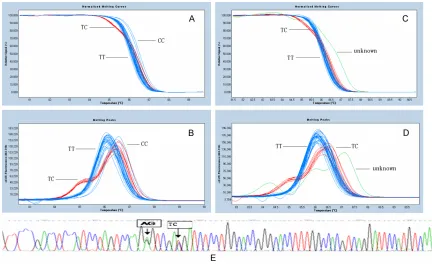
[image:3.612.90.520.72.290.2]homozygote TT (approximately 86.0°C) was shifted to the left compared to that of the homozygote CC (86.5°C), due to the presence of the GC base pair which had a higher melting temperature vs. the AT base pair. The tempera-ture-shifted (temp-shifted) melting peak of the heterozygote TC was between those of homozy-gote TT and CC. The heterozyhomozy-gote TC samples were unambiguously assigned because of dif-ferent melting curve shapes from the homozy-gote ones. Interestingly, in addition to the three groups of three genotypes for SNP rs9934438, we observed a fourth cluster different from these melting curves which were termed “unknown” (Figure 1C and 1D).
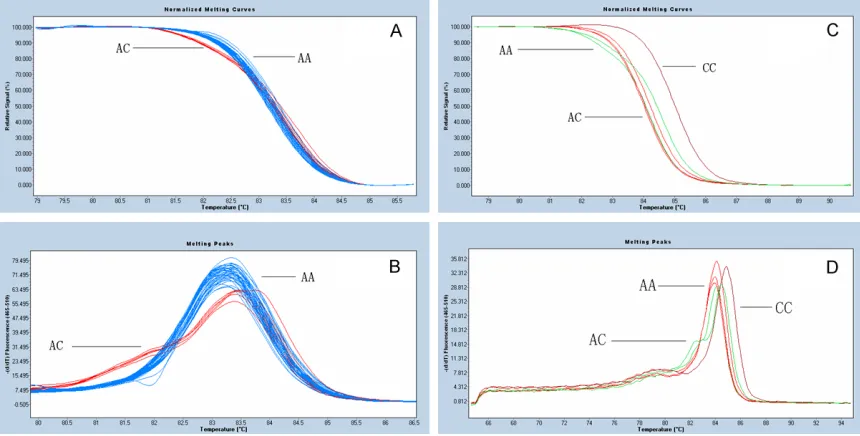
In the case of CYP2C9, it is necessary to dis-criminate the signals from those for the highly related subtypes CYP2C8 (cytochrome P450, family 2, subfamily C, polypeptide 8), CYP2C18 (cytochrome P450, family 2, subfamily C, poly-peptide 18), and CYP2C19 (cytochrome P450, family 2, subfamily C, polypeptide 19), because all 4 genes have a high degree of sequence similarity [19]. We engineered the folding prim-er to be the SNP-discrimination primprim-er, and its 3’ terminal nucleotide recognized both Wt and Mt alleles. The normalized melting curves of CYP2C9 rs1057910 clearly differentiated into two groups, homozygote AA and heterozygote AC, as shown in Figure 2A and 2B. There was no CC genotype in the 255 patients.
Validation of HRM
In the experiment, a total of 255 genomic DNA samples for each group of VKORC1 and CYP2C9 genes with genotypes obtained by melting curve analysis were sequenced. We compared the data obtained from HRM with those of direct DNA sequencing, which has been consid-ered the gold standard for genotyping, and the results indicate 100% concordance between DNA sequence analysis and HRM genotyping for CYP2C9, while the accuracy for VKORC1 was 99.2% by HRM genotyping.
Sequence results showed the two samples which were typed “unknown” by HRM genotyp-ing were heterozygote TC genotype of VKORC. In addition to the recognized rs9934438, we identified another heterozygote of rs1880- 90042 (T > C) in the amplicon. Actually, the “unknown” was TC genotype of rs188090042 and TC genotype of rs9934438 (shown in Figure 1E).
As no CC genotype of CYP2C9 was detected in the 255 patients, a confirmed CC genotype sample was got and validated homozygote CC and AA genotype can be differentiated by HRM. The Tm value of the homozygote AA (approxi-mately 83.5°C) was shifted to the left com-pared to that of the homozygote CC (84.5°C), shown in Figure 2C and 2D.
Allele frequencies of rs9934438 and rs1057910
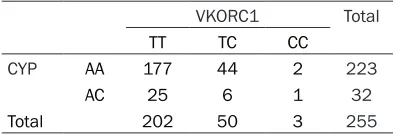
[image:4.612.89.291.96.163.2]The genotype distributions for the two SNPs in our study were all in Hardy–Weinberg equilibri-um (P > 0.05). The minor allele frequencies of rs9934438 and rs1057910 were 10.98% and 6.27% respectively for Chinese Han population (Table 1).
Discussion
Considering the well known contribution of rs9934438 in VKORC1 and rs1057910 in CYP2C9 to individual warfarin dose variants, the demand for diagnostic based genetic test-ing is on the rise and the availability of rapid, efficient, and reliable technologies for genetic based testing is therefore critical for clinical patient management [5]. With the benefits of simplicity, speed, high sensitivity and low cost, HRM meets these demands rightly. Although many laboratories use HRM for genotyping of common DNA variants and have shown suc-cessful clinical use [17, 20], few studies with application on HRM genotyping of rs9934438 and rs1057910 were reported [21, 22]. We pre-sented the first assessment study with 255 samples, all of which had sent for DNA sequencing.
In our study, using LightCycler® 480 Gene Scanning software v1.2 (Roche Diagnostics), heterozygote TC of VKORC was easily identified by the altered shape of the melting curves and homozygote TT or CC were distinguished by a Table 1. Frequency of CYP2C9 rs1057910
and VKORC rs9934438
VKORC1 Total
TT TC CC
CYP AA 177 44 2 223
AC 25 6 1 32
change in melting temperature (Tm) that dif-fered by approximately 0.50°C; heterozygote AC of CYP2C9 was easily distinguished with homozygote CC by the altered shape of the melting curves. And validating by sequence analysis, we demonstrated that HRM had high sensitivity and accuracy in genotyping of rs9934438 and rs1057910, above 99% con-cordance with DNA sequencing.
Though it is not 100% concordance with DNA sequencing when genotyping rs9934438 of VKORC with HRM, it was also proved to be sen-sitive in rs9934438 genotyping. A totally differ-ent melting curve was observed when unex-pected mutation showed up in one amplicon simultaneously. This is often unavoidable when variants are closely located [20]. Of the 255 samples, only two carried the other variant rs188090042 and the melting curves of the two samples were identified. Data from NCBI SNP database suggest the MAF (minor allele frequency) of these closing SNPs is no more than 0.3%. The potential risk of false genotyp-ing was extremely low.
The 100% concordance was observed in geno-typing rs1057910 of CYP2C9 with HRM when compared with DNA sequencing results. But the limitation of the study was that of the 255 genotypes obtained, no CC genotype of CYP2C9 was detected. Homozygote clusters can result in incorrect calls, if the differences between homozygote are small [23]. In our other stud-ies, of 260 more samples (data not shown), only one CC genotype were found, which made us can prove that CC genotype can be differen-tiated from AA genotype by HRM. Though more CC genotypes would be powerful to prove that HRM has high sensitivity to differentiate homo-zygote of CYP2C9, the frequency of CC geno-type was extremely low. In fact, the frequency of C allele was higher in our study than that in other studies of China (6.27% VS 3.61%) [24].
HRM as a diagnostic assay for genotyping rs9- 934438 and rs1057910 was at risk. However, applying HRM as a screening test and gene sequencing as back up method may realize the goal of economic, rapid, accurate detection. Estimated turnaround time, including time for DNA extraction and a run size of 45 specimens, was 3-4 hours in our study. And the cost of one specimen was no more than $10. If DNA sequencing is added, 6 more hours and $10 for
one specimen will need. While the cost of one specimen is $400-500 and the turn around time is 2-4 hours with US FDA cleared commer-cial warfarin genotyping kits [13, 25]. For devel-oping country, the cost burden may stop pa- tients benefiting from pharmacogenetic guided treatment.
When concerned about the extended turn-around time, we must notice that warfarin do not anticoagulate blood immediately. Instead, onset of its effect requires about a day before remaining active clotting factors have had time to naturally disappear in metabolism, and the duration of action of a single dose of warfarin is 2 to 5 days. So, additional 6 more hours would be kind of acceptable, when DNA sequencing was unavoidable for some rare unexpected mutations.
In summary, we provided new evidence for applying HRM method to detect genotype of CYP2C9 * 3 (1075A/C, rs1057910) and VKO- RC1 (1173T/C, rs9934438) in Chinese popula-tion and it is worth noting that HRM as an indi-rect genotyping method, other mutations on the amplicon may interfere with the detection of target SNP genotyping. Applying HRM as a screening test and gene sequencing as back up method to detect genotype of rs1057910 and rs9934438 may realize the goal of economic, rapid, and accurate detection.
Disclosure of conflict of interest
None.
Address correspondence to: Li Qin, Department of Laboratory Medicine, West China Hospital, Sic-
huan University, Chengdu 610041, Sichuan
Pro-vince, P.R China. E-mail: [email protected]
References
[1] Gomes T, Mamdani MM, Holbrook AM, Pater-son JM, Hellings C and Juurlink DN. Rates of hemorrhage during warfarin therapy for atrial
fibrillation. CMAJ 2013; 185: E121-127. [2] Ma C, Zhang Y, Xu Q, Yang J, Zhang Y, Gao L, Xu
B, Wang H, Li Y, Lu C and Yin T. Influence of
warfarin dose-associated genotypes on the risk of hemorrhagic complications in Chinese patients on warfarin. Int J Hematol 2012; 96: 719-728.
[3] Wieloch M, Sjalander A, Frykman V, Rosenqvist
ther-apeutic range, major bleeding, and thrombo-embolic complications from the national
quality registry AuriculA. Eur Heart J 2011; 32:
2282-2289.
[4] Skov J, Bladbjerg EM, Leppin A and Jespersen
J. The influence of VKORC1 and CYP2C9 gene sequence variants on the stability of mainte -nance phase warfarin treatment. Thromb Res 2013; 131: 125-129.
[5] Fung E, Patsopoulos NA, Belknap SM, O’Rourke DJ, Robb JF, Anderson JL, Shworak NW and
Moore JH. Effect of Genetic Variants, Especial-ly CYP2C9 and VKORC1, on the Pharmacology of Warfarin (vol 38, pg 893, 2012). Semin Thromb Hemost 2013; 39: 112-112.
[6] International Warfarin Pharmacogenetics Con-sortium, Klein TE, Altman RB, Eriksson N, Gage
BF, Kimmel SE, Lee MT, Limdi NA, Page D,
Roden DM, Wagner MJ, Caldwell MD, Johnson JA. Estimation of the Warfarin Dose with Clini-cal and Pharmacogenetic Data. New Engl J Med 2009; 360: 753-764.
[7] Rost S, Fregin A, Ivaskevicius V, Conzelmann E,
Hortnagel K, Pelz HJ, Lappegard K, Seifried E, Scharrer I, Tuddenham EGD, Muller CR, Strom TM and Oldenburg J. Mutations in VKORC1 cause warfarin resistance and multiple
coagu-lation factor deficiency type 2. Nature 2004;
427: 537-541.
[8] Rettie AE, Wienkers LC, Gonzalez FJ, Trager WF
and Korzekwa KR. Impaired (S)-warfarin me-tabolism catalysed by the R144C allelic variant of CYP2C9. Pharmacogenetics 1994; 4: 39-42.
[9] Tan SL, Li Z, Song GB, Liu LM, Zhang W, Peng J,
Zhang T, Jia FF, Zhou G, Zhou HH and Zhou XM.
Development and comparison of a new per-sonalized warfarin stable dose prediction algo-rithm in Chinese patients undergoing heart valve replacement. Pharmazie 2012; 67: 930-937.
[10] Miao L, Yang J, Huang C and Shen Z. Contribu-tion of age, body weight, and CYP2C9 and VKORC1 genotype to the anticoagulant re-sponse to warfarin: proposal for a new dosing regimen in Chinese patients. Eur J Clin Phar-macol 2007; 63: 1135-1141.
[11] Fung E, Patsopoulos NA, Belknap SM, O’Rourke DJ, Robb JF, Anderson JL, Shworak NW and
Moore JH. Effect of genetic variants, especially CYP2C9 and VKORC1, on the pharmacology of warfarin. Semin Thromb Hemost 2012; 38: 893-904.
[12] Wang M, Lang X, Cui S, Fei K, Zou L, Cao J,
Wang L, Zhang S, Wu X, Wang Y and Ji Q. Clini-cal application of pharmacogenetic-based warfarin-dosing algorithm in patients of Han nationality after rheumatic valve replacement: a randomized and controlled trial. Int J Med Sci 2012; 9: 472-479.
[13] Stack G. Pathology consultation on warfarin pharmacogenetic testing. Am J Clin Pathol 2011; 135: 13-19.
[14] You JHS, Wong RSM, Waye MMY, Mu Y, Lim CK, Choi KC and Cheng G. Warfarin dosing algo-rithm using clinical, demographic and pharma-cogenetic data from Chinese patients. J Thromb Thrombol 2011; 31: 113-118.
[15] Sconce EA, Khan TI, Wynne HA, Avery P, Monk-house L, King BP, Wood P, Kesteven P, Daly AK
and Kamali F. The impact of CYP2C9 and
VKORC1 genetic polymorphism and patient
characteristics upon warfarin dose require -ments: proposal for a new dosing regimen. Blood 2005; 106: 2329-2333.
[16] Huang Y, Yang JF, Qi XL, Wang YQ, Wang WZ and Chen B. [Association between genetic
polymorphisms of CYP2C19 and CYP2C9 and
phenytoin serum concentration]. Zhonghua Yi
Xue Za Zhi 2004; 84: 1686-1689.
[17] van der Stoep N, van Paridon CD, Janssens T, Krenkova P, Stambergova A, Macek M, Matthi-js G and Bakker E. Diagnostic guidelines for high-resolution melting curve (HRM) analysis: an interlaboratory validation of BRCA1 muta-tion scanning using the 96-well LightScanner. Hum Mutat 2009; 30: 899-909.
[18] Graham R, Liew M, Meadows C, Lyon E and Wittwer CT. Distinguishing different DNA het-erozygotes by high-resolution melting. Clin Chem 2005; 51: 1295-1298.
[19] Aomori T, Yamamoto K, Oguchi-Katayama A, Kawai Y, Ishidao T, Mitani Y, Kogo Y, Lezhava A,
Fujita Y, Obayashi K, Nakamura K, Kohnke H,
Wadelius M, Ekstrom L, Skogastierna C, Rane A, Kurabayashi M, Murakami M, Cizdziel PE, Hayashizaki Y and Horiuchi R. Rapid single-nucleotide polymorphism detection of cyto-chrome P450 (CYP2C9) and vitamin K epoxide reductase (VKORC1) genes for the warfarin
dose adjustment by the SMart-amplification
process version 2. Clin Chem 2009; 55: 804-812.
[20] Tindall EA, Petersen DC, Woodbridge P, Schi-pany K and Hayes VM. Assessing high-resolu-tion melt curve analysis for accurate detechigh-resolu-tion of gene variants in complex DNA fragments. Hum Mutat 2009; 30: 876-883.
[21] Cui GL, Ding H, Xu YJ, Chen C and Wang DW.
[Development of the high resolution melting
method for genotyping CYP2C9*3 (1075A/C, rs1057910) and VKORC1 (-1639A/G, rs9923-
231)]. Zhonghua Xin Xue Guan Bing Za Zhi
2012; 40: 477-481.
[22] Huang SW, Li Q, Zhu SY, Li L, Xiong F, Jia YK
and Xu XM. SYBR Green-based real-time PCR assay for detection of VKORC1 and CYP2C9 polymorphisms that modulate warfarin dose
requirement. Clin Chem Lab Med 2009; 47:
[23] Cui G, Zhang L, Xu Y, Cianflone K, Ding H and
Wang DW. Development of a high resolution melting method for genotyping of risk HLA-DQA1 and PLA2R1 alleles and ethnic distribu-tion of these risk alleles. Gene 2013; 514: 125-130.
[24] Liu Y, Zhong SL, Yang M, Tan HH, Fei HW, Chen JY, Yu XY and Lin SG. [Distribution of variant
alleles association with warfarin pharmacoki-netics and pharmacodynamics in the Han
pop-ulation in China]. Beijing Da Xue Xue Bao
2011; 43: 798-803.
[25] Patrick AR, Avorn J and Choudhry NK. Cost-ef-fectiveness of genotype-guided warfarin