Going
Ballistic
Dealing with guns, gangs and knives
Dr Bob Golding and Jonathan McClory
dited by Gavin Lockhart
£10.00 ISBN: 978-1-906097-29-5
Policy Exchange Clutha House 10 Storey’s Gate London SW1P 3AY
Murders involving knives and firearms never fail to grab the
headlines, yet they are relatively rare. Gun crime, for example,
represents only 0.4% of all recorded crime in England and
Wales. The public are often sceptical, however, when they read
figures such as this – and they have reason to be so. The
evidence collected for this report suggests that chaotic,
street-level firearms offences, often associated with young people,
have risen.
The research team, led by former Assistant Chief Constable Dr
Bob Golding, have built a report around primary research taken
from interviews and surveys with police constables and
sergeants, Youth Offending Team Managers, young offenders,
public polling and case studies in Manchester and Birmingham.
The report shows that the nature of the threat from gangs, guns
and knives is changing, and the Government must change its
approach if communities are to stem the tide of youth violence.
The research findings support four primary arguments: that
official crime figures do not reflect the experiences of many
communities in England and Wales; that information and
intelligence sharing between agencies is lacking; that early
intervention and prevention work needs to be targeted and
expanded and that the relevant legislation governing gun and
knife crime is a mess.
Going
Ballistic
Dr
Bob
Golding
and
Jona
than
McClory
Edited
by
Gavin
Lockhart
Policy
Exchange
Going Ballistic Cover HDS 11/7/08 10:23 Page 1
Going Ballistic
Dealing with guns, gangs and knives
Dr Bob Golding and Jonathan McClory
Edited by Gavin Lockhart
Policy Exchange is an independent think tank whose mission is to develop and promote new policy ideas which will foster a free society based on strong communities, personal freedom, limited government, national self-confidence and an enterprise culture. Registered charity no: 1096300.
Policy Exchange is committed to an evidence-based approach to policy development. We work in partnership with aca-demics and other experts and commission major studies involving thorough empirical research of alternative policy out-comes. We believe that the policy experience of other countries offers important lessons for government in the UK. We also believe that government has much to learn from business and the voluntary sector.
Trustees
About the authors
Dr Bob Golding
Associate lecturer in Criminal Justice Studies, University of Portsmouth; Consultant
Bob Golding was lately an Assistant Chief Constable with Warwickshire Police until his retirement in 2006. Additionally he held the Research and Development port-folio for the Association of Chief Police Officers (ACPO). Since retirement, he has been both Programme Manager in setting up the Home Office/ACPO National Ballistics Intelligence Programme; and programme consultant on ACPO's Criminal Use of Firearms Group, involv-ing a programme of projects relatinvolv-ing to gun crime based around intelligence, enforcement and prevention.
Jonathan McClory
Research Fellow for the Crime and Justice Unit at Policy Exchange
Jonathan joined Policy Exchange in 2006 and has specialised in policing and violent
crime. Jonathan graduated from the University of Michigan with a dual degree in economics and politics. In 2006 he completed an MSc in Public Policy at University College London. Jonathan has previously worked at the American Consulate in Hamburg, Germany and for the BBC at Television Centre in London. This is his fifth publication for Policy Exchange.
Gavin Lockhart
Head of Crime and Justice Unit, Policy Exchange
Gavin Lockhart has responsibility for crime and justice research at Policy Exchange. After graduating in 2002 with a first-class degree, Gavin worked as a management consultant before joining Policy Exchange in August 2006. He has also edited seven Policy Exchange reports including Measure
for Measure, Fitting the Bill and Unlocking the Prison Estate.
© Policy Exchange 2008
Published by
Policy Exchange, Clutha House, 10 Storey’s Gate, London SW1P 3AY
www.policyexchange.org.uk
ISBN: 978-1-906097-29-5
Printed by Heron, Dawson and Sawyer
Designed by John Schwartz, [email protected]
Contents
Acknowledgements 4
Executive Summary 5
1 Introduction 7
2 Gun Crime: Theory and Legislation 13 3 Knife Crime: Theory and Legislation 19 4 Gangs, Violent Crime and Prevention 26 5 Police Federation Survey 31 6 Youth Justice System and Youth Offender Teams 40
7 Manchester case study 50
8 Birmingham case study 58
9 Conclusion 66
Acknowledgements
Policy Exchange thanks the Hadley Trust, the Local Government Association, John Nash and George Robinson for their generous sup-port of this project. The authors would also like to thank those who contributed their time and expertise to this project including various YOTs, members of the Police Federation and the extremely helpful officers at Greater Manchester and West Midlands Police forces. A special thanks should go to those who helped organise our site visits and case studies.
Sharon Naughton, West Midlands Police
Carl Foulkes, West Midlands Police Tom Coughlan, West Midlands Police Kirk Dawes, West Midlands Mediation
Service
Paul Etchells, West Midlands Police Dave Keller, Greater Manchester Police Darren Shenton, Greater Manchester
Police
Jerrod Luck, Greater Manchester Police Marie O’Laughlin, Greater Manchester
Police
Chris Downey, Xcalibre Taskforce Andy Newsam, Youth Justice Board Ralph Corrigan, Manchester Multi
Agency Gangs Strategy
Enver Solomon, Centre for Crime and Justice Studies
Metin Enver, Police Federation Derek Barnett, Police Superintendents
Association
Erinma & Raymond Bell, Manchester Police Independent Advisory Group
Jim Dolan, Greater Manchester Police Shaun Donnellan, Xcalibre Taskforce Maureen Noble, Manchester CDRP Rob Hawksley, Greater Manchester
Police
Keith Bristow, Warwickshire Police John MacDonald, Association of Chief
Police Officers
Finally, the authors would like to thank Philippa Ingram, Richard Carter, Mike Morgan-Giles, Emily Dyer, Julian Chant, Natalie Evans, Ben Ullmann and all those who commented on drafts of this report.
Executive Summary
Murders involving knives and firearms, such as the cases of the headteacher Philip Lawrence, who was stabbed by a teenager while trying to protect a pupil, or seven-year-old Toni-Ann Byfield, shot in the back by a drug dealer in a North London bedsit, never fail to grab the headlines, yet they are relatively rare. Gun crime, repre-sents only 0.4% of all recorded crime in England and Wales.1,2
The public are often sceptical, however, when they read figures such as this – and they have reason to be so. Official police statistics and the annual British Crime Survey do not offer a complete picture of gun and knife crime because much of it – especially violence between criminals and offences by children under 16 – goes unre-ported. Organisations that could provide extra data to fill out the picture, such as the Ministry of Defence or hospital A&E departments, are often reluctant to do so. And the Government sometimes uses minor variations from one year to another to present a misleading picture of an improving situation. In other words, our crime figures do not reflect the experiences of many communities in England and Wales. This conflict between official statis-tics and public opinion forms the back-drop to this report.
The authors, Dr Bob Golding, a former assistant chief constable, and Jonathan McClory – have worked from the point of view of those closest to gun and knife crime – the public and frontline workers. They review the latest research on gangs and the illegal use of firearms and also draw on their own surveys of young offenders; police constables and sergeants; two detailed case studies consisting of interviews with senior police officers; managers of youth offending teams (YOTs); and specially commissioned pub-lic opinion polling. Secondary sources
taken from Youth Justice Board statistics, Home Office and British Crime Survey statistics and police strategy documents supplement this material.
The incomplete official picture of firearms crime and the timelag of up to two years in publishing crime figures make it difficult for the Government to identify or respond promptly to emerging trends. The evidence collected for this report sug-gests that chaotic, street-level firearm offences, often associated with young peo-ple, have risen:
Nearly three-quarters of police constables and sergeants believe that gang crime has become worse over the past five years;3
More than half of young offenders feel that the police are unable to protect them from violent crime in their area and eight out of ten of people in Britain think violent youth crime is worse now than it was five years ago;4
More than half of young offenders have had a gun or knife used against them or been threatened with a gun or knife in the past 12 months;5
More than 1 in 4 of those surveyed (27%) have either been the victim of a violent crime committed by children or young people, have had a gun or knife used against them, have been threat-ened with one or know a friend or rel-ative who has had a gun or knife used against them or who has been threat-ened with one in the past 12 months;6
1 in 5 people between the ages of 19 and 24 know a friend or family mem-ber who has had a gun or knife used against them or been threatened with a gun or knife in the past year.7
This perceived rise in violence among young people, frequently involving guns or other weapons and not linked to financial
1 Hales G, Lewis C and Silverstone D,Gun Crime: the market in and use of illegal firearms, Home Ofice Research Study 298, 2006
2 Coleman C, Hird C and Povey D,Violent Crime Overview, homicide and gun crime 2004/5, Home Office RDS, 2006
3 Policy Exchange polling
4 Policy Exchange polling
5 Policy Exchange polling
6 YouGov polling for Policy Exchange
7 YouGov polling for Policy Exchange
motives, has drawn attention to changes in the culture of gangs. These once stable groupings that existed to protect illegal commodities now seem to be more volatile; their members younger and high-ly territorial. There is anecdotal evidence from gang members themselves that young people in deprived areas deliberately join criminal gangs for personal protection. They want to be armed because they believe that others are armed.
The authors agree with the Home Office that the main threat from firearms at gang and street level is presented by legally purchased imitation and deactivat-ed weapons that are then illegally convert-ed to fire live ammunition. Some of these firearms sell for as little as £50 and a sin-gle firearm can circulate over many years within and between criminal groups. Although this trend has been apparent for some time, the necessary amendments to
existing gun laws have not yet been put into place.
Legislation is a mess. Laws governing offensive weapons are derived from at least six separate Acts, introduced piecemeal since 1968. There is no legal framework dealing with knives and offensive weapons as a whole, while wider measures such as the Criminal Justice and the Anti-Social Behaviour Acts 2003 also contain provisions relating to firearms. Every new provision inevitably increases the chance that the police will make mistakes that result in a failed prosecution – arresting a suspect under the wrong section of an Act, for example.
Golding and McClory make more than 20 recommendations, divided into four categories: information and funding; sup-ply; demand; and law reform. These will be developed and fully costed for the sec-ond book in this series, to be published in the autumn.
Going Ballistic
1
Introduction
According to official figures gun crime is rare, accounting for just 0.4% of all record-ed crime in England and Wales.8Indeed the
number of offences involving firearms fell by 13% in 2006-07 compared to the previ-ous year.9The British Crime Survey reports
that knife crime is “stable”, though it adds that “public perception is that incidents are increasing”, and that “more young people are now carrying knives due to fear of bully-ing or attack, because of a perception that all their peers carry knives”.10,11
It is against this backdrop of conflicting official statistics and public opinion that this report has been developed. We need to set out three contextual issues before we discuss our research findings and policy recommendations.
Crime Statistics
The first is the challenge of quantifying gun and knife crime. Sources of crime
figures range from official statistics (the British Crime Survey and police recorded crime), to less public sources (criminal intelligence maintained by law enforce-ment agencies). Published statistics need to be interpreted with care: non-report-ing and non-recordnon-report-ing of incidents mean that recorded crime figures do not and cannot include all crimes committed.12
Changes in police recording practices – notably to the counting rules in 1998 and the introduction of the national crime recording standard in 2002 – have led to artificial shifts in violent crime sta-tistics.13,14
The British Crime Survey (BCS) also has its limitations: it does not report vic-timisation for under-16s, and assessing criminality among young people is intrinsically difficult. This has not stopped the Home Office from using BCS figures to argue that violent crime has fallen.15
8 Coleman C, Hird C and Povey D, op cit
9 Home Office,Crime and vic-tims: gun crime, Home Office, 2008; see www.homeoffice.gov. uk/crime-victims/reducing-crime/ gun-crime/
10 Ibid
11 Home Office, “Memorandum submitted to the Select Committee on Home Affairs – knife crime” House of Commons: Hansard Archives Research, 2007
12 Hayden C, Hales G, Lewis S and Silverstone D, “Young men convicted of firearms offencs in England and Wales:an exploration of family and educational oppor-tunities for prevention",Policy Studies, 29:2, 163 –178, 2008
13 Simmons J, Legg C and Hoskins R,National Crime Recording Standard (NCRS): an analysis of the impact on recorded crime. Part One: the national picture, Home Office, online report 2003; see www.homeoffice.gov.uk/rds/pdfs 2/hors254.pdf
14 Coleman C, Hird C and Povey D, op cit, p 12
15 Coleman C, Hird C and Povey D, op cit, p 7
16 You Gov Polling for Policy Exchange Polling
17 You Gov Polling for Policy Exchange Polling More than 1 in 8 of those surveyed (13%) have been the victim of a violent crime committed by
children or young people, have had a gun or knife used against them, have been threatened with a gun or knife in or know a friend or relative who has had a gun or knife used against them or who has been threatened with a gun or knife in the past 12 months;16
1 in 5 people between the ages of 18 and 24 know a friend or family member who has had a gun or knife used against them or been threatened with a gun or knife in the past year;17
83% of adults in the Great Britain feel that violent youth crime is a more serious problem now than it was five years ago;
85% of adults living in London feel that violent youth crime is a more serious problem now than it was five years ago;
88% of adults living in the northwest of England feel that violent youth crime is a more serious problem now than it was five years ago.
Conclusions based on recorded crime figures and the BCS should be treated with a great deal of caution. The forth-coming research based on thousands of interviews with young people by the Centre for Criminal Justice Studies at King’s College London demonstrates this point in relation to the reality of youth crime.18
The most recent statistics on firearms offending show a long-term upward trend over the past ten years with a fall over the past two years. Firearms (excluding air weapons) were reported to have been used in 9,650 recorded crimes in 2006-07. This was a 13% decrease on the previous year, following a slight increase of 0.2% in 2004. The total number of firearm offences (including air weapons) fell from 21,527 in 2005-06 to 18,489 in 2006-07, or 14%.19 There were 2,517 offences
involving imitation weapons in 2006-07, a 23% reduction on the previous year, and handgun offences decreased by 11% to 4,175.20
Figures for gun-related homicides and attempted homicides are arguably more reliably reported than other crimes. In total, there were 750 in 1997-08 and 1,456 in 2004-05.21 After peaking they
fell but, at 818 for 2006-07, remain above their pre-1998 level.22 A 2005
study found that the people interviewed thought that while the most serious gun crime appeared to be falling in the short term, less serious incidents, such as street
robbery with a firearm, appeared to have increased.23Possible explanations are that
either people were more inclined to report incidents, or there was an increase in the use of “undischarged” firearms or replicas.24
Murders involving knives or other sharp instruments increased from 202 in 1997-08 to 258 in 2006-07, or 28%.25
Anecdotal evidence provided in the Police Federation submission to the Home Affairs Select Committee in 2007 backed this up: “The prevalence of knives on the streets has undoubtedly increased over the years. Police officers not only have to assist victims of knife crime but are all too often victims themselves: 28% of police officers have been threatened by a knife on at least one occasion in the last two years.”26
Despite official pronouncements of falling or stable gun and knife crime fig-ures based on official statistics, the long-term trend is upwards. There was a signifi-cant rise in recorded gun crime offences between 1997-08 and 2001-02, followed by a reduced rate of increase and then a slight fall in 2004-05.27 Overall, however,
recorded firearms offences nearly doubled from 1997-08 to 2006-07, from 4,903 to 9,650.28The Metropolitan Police
submis-sion to the Home Affairs Select Committee in 2007 reported that knife crime represents 1% of total crime in London, or 1,000 offences a month, and nearly 70 a year end in murder.
Going Ballistic
18 Centre for Criminal Justice StudiesYouth Crime (forthcom-ing 2008) cited in Leppard D "Tougher laws and more cash have no impact",Sunday Times, 18th May 2008
19 Kaiz P, "Homicides, recorded crimes involving firearms", in Povey D et al (eds),Homicides, Firearm Offences and Intimate Violence 2006/07
(Supplementary Volume 2 to Crime in England and Wales 2006/07), 31 January 2008, Home Office online report 03/08; see www.homeoffice.gov.uk /rds/pdfs08/hosb0308.pdf
20 Ibid
21 Hales G, Lewis C, Silverstone D,Gun Crime: the market in and use of illegal firearms, Home Ofice Research Study 298, pp 3-4, 2006
22 Kaiz P, op cit
23 Povey D and Kaiz P, "Recorded Crimes Involving Firearms", Chapter 2 in Povey D et al, op cit, p 39
24 Interview with ACPO Criminal Use of Firearms working group representative, May 2008
25 Coleman C, Hird C and Povey D, op cit
26 Police Federation, "Memorandum submitted to the Select Committee on Home Affairs – knife crime", House of Commons: Hansard Archives Research, 2007
27 Hales, G, Lewis C, Silverstone D, op cit, p 3
28 Kaiz P, op cit
90% of adults over the age of 55 in Britain feel that violent youth crime is a more serious prob-lem now than it was five years ago;
86% of C2DE adults in Great Britain feel that violent youth crime is a more serious problem now than it was five years ago;
Nearly 1 in 5 adults aged 18 to 24 know a friend or relative who has had a gun or knife used against them or who has been threatened with a gun or knife in the past 12 months;
More than 1 in 7 (15%) adults living in London know a friend or relative who has had a gun or knife used against them or who has been threatened with a gun or knife in the past 12 months.
The capture, collation and submission of gun crime data are far from satisfactory. In a report on guns, community and the police, HM Inspectorate of Constabulary admitted that recommended procedures for collating and collecting up-to-date sta-tistics had not been put in place effective-ly.29 Much data is collected at local police
force level but collated and published cen-trally by the Home Office, leading to duplication of work and long delays.30
Detailed crime statistics are available only nine months after the end of the reporting period and so the latest figures may be two-and-a-half-years-old. Sound policy cannot be developed on the basis of out-of-date statistics and intelligence.
Senior police officers interviewed for this study confirm that official statistics do not corroborate the reality experienced by communities and police forces in England and Wales: many incidents go unreported, especially gang crime and attacks by criminals on other criminals, where witnesses fear retribution or intim-idation.31
Non-police agencies that collect infor-mation that could be relevant to curbing violent crime often fail to share it. These include other law enforcement agencies, schools and hospital accident & emergency departments (if they treat patients with knife wounds, for example).32There may
be ethical or other reasons for this but, given the limitations of recorded crime data, improved data and intelligence
shar-ing between agencies is essential for better informed policies.33
Given all these reasons to doubt the accuracy, completeness and currency of the available data caution is needed before concluding from official figures that knife or gun crime is stable or decreasing.34The
long-term trends indicate the reverse is true.
Performance Targets
The second contextual issue relates to how gun and knife crime is reflected within the centralised police performance targets. These changed in April this year, when Assessments of Community Safety (APACS) replaced the Police Performance Assessment Framework. The new targets are intended to cover community safety (including terrorism, violence and protec-tive services) and shift the focus away from reducing volume crime to tackling violent crime and its causes.35
Specific knife and gun crime reduction targets were conspicuously absent under the previous framework, there being only a general target to reduce all crime by 15% from 2005 to 2008.36Under the new
tar-gets it would be possible for the
Introduction
29 Her Majesty’s Inspectorate of Constabulary, "Guns Community and Police. HMIC thematic inspection into the Criminal Use of Firearms", Home Office, 2004
30 Interview with ACPO Criminal Use of Firearms working group representative, May 2008
31 Interview with ACPO Criminal Use of Firearms working group representative, May 2008
32 Interview with ACPO Criminal Use of Firearms working group representative, May 2008
33 Squires P, Gun Crime:A review of evidence and policy, Centre for Crime and Justice Studies, London, 2008
34 Home Office, "Crime and vic-tims: gun crime", 2008; see www.homeoffice.gov.uk/crime- victims/reducing-crime/gun-crime/
35 Savage S and Golding R, "Leadershipand Performance Management" in Newburn T (ed) Handbook of Policing (2nd edi-tion) Willan Publishing, (forth-coming 2008)
36 Home Office, "Memorandum submitted to the Select Committee on Home Affairs – knife crime", House of Commons: Hansard Archives Research, 2007
“
A recommendation that deactivated firearms should be classed as imitation firearms under the Violent CrimeReduction Act 2007 is unlikely to be addressed until 2009
”
More than 1 in 10 Brits know a friend or relative who has had a gun or knife used against them or who has been threatened with a gun or knife in the past 12 months;
Almost 6 in 10 adults in Britain believe that carrying a weapon makes you more likely to be a victim of violent crime;
Only 2% of adults in Great Britain believe that carrying a weapon makes you less likely to be a victim of violent crime;
Only 32% of adults in Britain believe that carrying a weapon makes no difference on the likeli-hood of being a victim of violent crime.
Government to require local areas to take action on pressing issues, such as knife and gun crime, but this will depend upon the availability of reliable information.
Legislation and Government Initiatives
The third contextual issue concerns the Government’s approach to gun and knife crime – both through legislation and its strategy on violent crime. Chapters 2 and 3 provide an outline of legislative changes introduced over the last 10 years in response to gun and knife crime. Despite its many reforms, the legal framework still attracts criticism. Laws dealing with offen-sive weapons are covered in six different Acts.37 Criticisms of specific provisions
include the unclear definition of an offen-sive weapon; the arbitrary legality of blades that are three inches or under in length; the failure to restrict the sale of certain types tightly enough; and the failure to keep pace with more sophisticated weapons. The Police Federation believes that offensive weapons legislation needs modernisation.
Gun crime legislation suffers from simi-lar anomalies. A recommendation that deactivated firearms should be classed as imitation firearms under the Violent Crime Reduction Act 2007, or ownership prohibited without a firearms certificate, is unlikely to be addressed until 2009.38,39
The laws have been built up piecemeal, with sections repealed and superseded. Gaps remain in relation to deactivated, imitation and replica weapons, and shot-gun importation. The difficulty of dissem-inating legal changes should not be under-estimated either – 200 retailers were found to be unaware of the new requirements for imitation and replica firearms in the 2007 Act.40
The Government’s strategy for dealing with gun and knife crime falls under the umbrella of its violent crime action plan.41
A prime example is the brief Tackling
Gangs Action Programme (TGAP) launched by the Prime Minister in 2007 after a series of high-profile cases involving guns and gangs. It was applied in Liverpool, Manchester, Birmingham and London until early this year (the Manchester programme, Operation Xcalibre, is described later in this report). Since then the Government has developed a cross-departmental action plan for tack-ling violence until 2011.42 A number of
recommendations are reportedly based on existing best practice and include both government-run and not-for-profit proj-ects.43
Pre-existing work streams, from 2006, of the ACPO criminal use of firearms group – the national ballistics intelligence system, and the national firearms intelli-gence cell – are reflected as “actions” in the Home Office violent crime action plan. It states: “We will work with the police to develop state of the art imaging technolo-gy to provide information and intelligence on firearms used in crime”. But this is an initiative that had been developed over two years before the publication of the strategy and is due to go live in September 2008 regardless of the Government’s Violent Crime Action Plan.
The strategy is managed by the Violent Crime Unit based in the Home Office and, although its detailed plans are still being developed at the time of writing, some broad conclusions can be drawn. First, the Government intends to build on existing work or work that is under way, for example the lessons learned from tack-ling gangs in four cities. Secondly, there is an attempt to develop better co-ordina-tion between agencies, building on best practice, existing work programmes, poli-cies and research. Thirdly, the range of ini-tiatives is wider – from those supporting intelligence, enforcement and control (including legislation), to prevention through education, national communica-tion campaigns, intervencommunica-tions to change
Going Ballistic
37 Police Federation, "Memorandum submitted to the Select Committee on Home Affairs – knife crime", House of Commons: Hansard Archives Research, 2007
38 Interview with ACPO Criminal Use of Firearms working group representative, May 2008
39 Savage S and Golding R, op cit
40 Interview with ACPO Criminal Use of Firearms working group representative, May 2008
41 Home Office, "Crime and vic-tims: gun crime", 2008; see www.homeoffice.gov.uk/crime- victims/reducing-crime/gun-crime/
42 Ibid
43 Interview with ACPO Criminal Use of Firearms working group representative, May 2008
behaviour of offenders and specific inter-ventions targeted at rape and domestic violence. It concludes that “it is worth considering what is already known about family and school based programmes that focus on reducing violent and aggressive behaviour as part of the response to the growing problem”.44
Richard Garside, director of the Centre for Crime and Justice Studies, believes that success in tackling knife violence “will require a concerted strategy to deal with the causes of violence, of which the social antagonism caused by poverty and inequality are key.”45It remains to be seen
whether the Government’s new strategy will be sufficient to meet that test.
Primary Research
We gathered evidence from structured interviews with managers of youth offend-ing teams (YOTs), a survey of young offenders, a survey of police constables and sergeants, public polling and two case studies built from interviews with senior police officers. These primary sources were supplemented with secondary material from Youth Justice Board statistics, Home Office and British Crime Survey statistics and police strategy documents.
Police Federation Survey
In collaboration with the Police Federation, the professional organisation that represents constables, sergeants and inspectors, we sent an online question-naire to federation members in the Nottinghamshire, Greater Manchester, West Midlands, and Merseyside police forces. The survey had a total of 1,231 responses between 7th March and 10th April 2008.
The questionnaire was issued to all Basic Command Units in the above forces, not only the division responsible for policing Birmingham, Manchester, Liverpool or Nottingham (the Metropolitan Police were
asked to participate but, citing time and technological constraints, they declined). The survey is a reflection of police experi-ences of crime in forces with large metro-politan areas in England and Wales and not a reflection of national crime levels throughout England and Wales.
Structured YOT Interviews
Building on the experience of police on the frontline and on their perception of gun and knife crime, we interviewed 23 YOTs across England and Wales, with ten prede-termined questions on perception of crime trends, the service provided by the YOT and how it could be better delivered. Interviews were by telephone and each lasted approximately 30 minutes.
Of the 23 that responded (15% of the total), 13 were rural and 12 urban – a rep-resentative cross-section ranging from Islington to Bridge End. All were asked the same questions, in the same manner; their replies provided insights into how crime trends vary in different regions.
Young Offenders’ Survey
At the end of each interview, the YOT manager was asked if he or she would be willing to distribute a questionnaire with 12 multiple choice questions to young offenders referred to his or her YOT. The questions were designed to find out how often a young person may carry a weapon, come in contact with one and have one used against him. The survey also inquired about young offenders’ attitudes towards the police, their perceptions of safety and their thoughts on crime trends in their area. The responses for some questions paint a worrying picture, while others seem to reveal that the situation is not all bad. The survey respondents had an average age of 15 years 6 months, and the majority (60%) described themselves as white-British. The youngest was 9 years old and the oldest 18.
Public Polling
In order to understand the perceptions of
Introduction
44 Hayden C, Hales G, Lewis S, Silverstone D, "Young men con-victed of firearms offences in England and Wales:an explo-ration of family and educational opportunities for prevention", Policy Studies, 29:2, 163-78
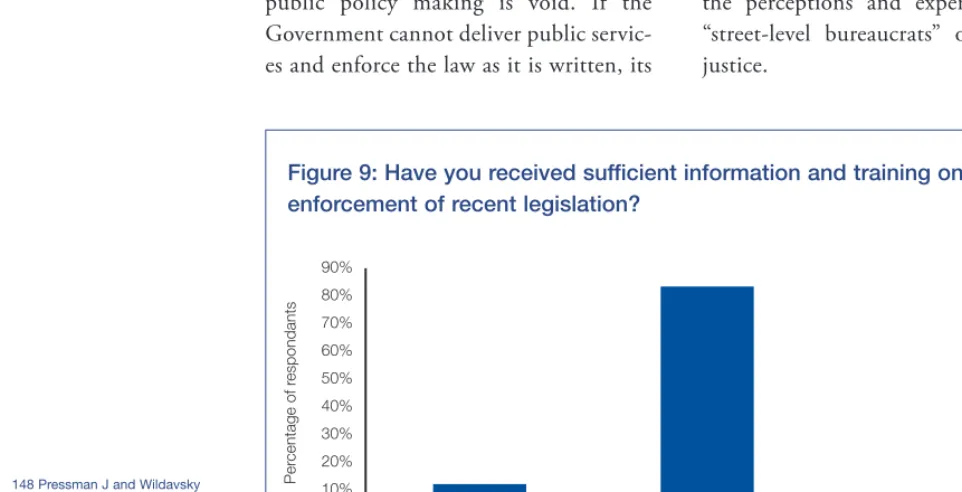
those at the frontline of enforcement and prevention of violent crime we commis-sioned a YouGov poll of a representative sample of 2,000 British adults. It was car-ried out in June 2008.
Case Studies
During April and May 2008, we visited police forces in Manchester and Birmingham and met police from senior officers to constables, representatives of crime and disorder reduction partnerships, community leaders, police independent advisory group members, police mediators and people working with gangs. The case studies were built around interviews, data and strategy documents given to us.
Report Layout
This report consists of nine chapters. After the introductory first chapter, the second discusses the academic literature
on gun crime and the history of the legis-lation that regulates firearms. Chapter 3 discusses the existing research on knife crime and looks at how recent legislation has approached the issue. The fourth chapter examines the effects of gangs on youth violence. It also sets out the public health approach to prevention, which treats violence involving weapons as a dis-ease, in line with the World Health Organisation’s classification of violence as a pandemic.
The chapters on our primary research look at violent crime from the perspectives of police (chapter 5), YOT managers and young offenders (chapter 6). Two case studies from Manchester and Birmingham follow in chapters 7 and 8; these highlight best practice and the barriers to efficiency that police still face. In the final chapter we set out the recommendations that will be developed further in the second of our reports.
Going Ballistic
2
Gun Crime:
Theory and Legislation
Summary
This chapter reviews the research on gun crime and discusses how access to weapons affects the nature of violent crime. We set out the history of legislation governing access to weapons and argue that a handful of shocking events has had more influence on the laws passed than carefully collected empirical evidence.
Theory
More Guns, More Crime
One must tread carefully when working through the existing research literature on guns. Many authors on both sides of the argument over gun control have pre-estab-lished positions, and employ bespoke research designs in order to support their ideological beliefs. Although research on the subject varies in scope and specificity, the ultimate question that students of the gun control debate are seeking to answer is: what effect does the availability of guns have on levels of crime?
Empirical work attempting to answer this question typically takes one of two approaches. In the first, researchers esti-mate the effect that changes in the total stock of guns have on national crime rates.46,47A more advanced approach
evalu-ates this relationship on different levels: regional, state, county or city.48,49
Both approaches have produced mixed results. The vast majority of studies report that higher gun ownership rates result in higher levels of violent crime, while a small number of studies report the opposite effect.
These types of studies have important limi-tations, evidenced in their conflicting find-ings. Studies that use time-series analyses, employing annual national level data, are limited because of the small number of observations they can use for estimating the relationship between gun ownership and crime.50 Similarly, studies looking at gun
ownership at local level and its effects on violent crime suffer from a critical lack of local gun ownership data (gun ownership data for the US is available only at the national level). Consequently, researchers are forced to use crude proxies to estimate levels of gun ownership on a local level.
In 2001, taking the above flaws into account, Mark Duggan produced the most comprehensive illustration to date of American gun ownership’s effect on violent crime levels.51Duggan accurately measured
gun ownership on a state level using National Rifle Association membership data, sales of the magazine Guns & Ammo, and the number of gun shows per capita. Duggan’s research concludes that an increase in the number of guns leads to a substantial increase in the number of homicides.52His findings contradict the
results of research by Lott and Mustard, who argue that American legislation allow-ing people to carry concealed weapons led to a significant decline in violent crime.53
Additional academic work has argued that a greater availability of firearms will lead to more crime, either by increasing the likelihood that any crime will result in a victim’s death,54or by increasing the
prob-ability that a domestic dispute will result in
46 Kleck G, “The relationship between Gun Ownership Levels and Rates of Violence in the United States”, in Kates D (ed) Firearms and Violence: Issues of Public Policy, Ballinger, 1984
47 Magaddino J and Medoff M, “An Empirical Analysis of Federal and State Firearm Control Laws” in Kates D (ed) Firearms and Violence: Issues of Public Policy, Ballinger, 1984
48 Cook P, “The Role of Firearms in Violent Crime”, in Wolfgang M et al (eds)Criminal Violence, Sage Publications, 1982
49 Keck G. and Patterson B, “The Impact of Gun Control and Gun Ownership Levels on Violence Rates”,Journal of Quantitative Criminology, vol 9, no 3, 1993, pp 249-87
50 Duggan M, “More Guns, More Crime”, Journal of Political Economy, vol 109, no 5, 2001, pp 1086-1114
51 Ibid
52 Ibid
53 Lott J and Mustard D, “Crime, Deterrence, and Right-to-Carry Concealed Handguns”, Legal Studies, vol 26, January 1997, pp 1-68
the death of one or more of the individu-als.55 In their work, Donohue and Levitt
developed a model in which firearms may reduce the predictability of outcomes of fights and consequently increase the num-ber of violent confrontations that occur.56
The majority of academic research on firearms legislation is concerned with the effect of gun availability on crime, but there is a lack of work on regulating the supply side of firearms. For over ten years, firearms legisla-tion in England and Wales has sought to reduce the supply of firearms by banning mil-itary-style weapons and handguns. However, as statistics show, the police have had difficul-ty clamping down on illegal markets that sup-ply criminals with banned handguns.
As Cukier and Sidel point out in their book, The Global Gun Epidemic, every ille-gal handgun started out somewhere as legal. Firearms commerce is composed of transactions made in the primary (legal) firearms market and in the largely unregu-lated secondary firearms market.57
The importance of theft and the second-ary market in supplying youths and crimi-nals has been documented by three American surveys: Wright and Rossi’s survey of prisoners,58the survey of state prisoners
reported by the Bureau of Justice Statistics,59
and Sheley and Wright’s 1995 survey of youths in juvenile correctional institutions.60
Their broad findings reveal that offenders acquire firearms both legally and illegally; the majority acquire guns through theft, family and friends or the black market.
Regulating incoming illegal firearms to England and Wales is a time-consuming and labour-intensive task, and anecdotal evidence shows it is simply not working.
The supply side approach to reducing gun crime seems futile if one accepts the com-mon view that “guns are everywhere”.61
However, England and Wales is uniquely positioned with very strong gun control laws to stamp out firearms crime almost completely. According to informal inter-views carried out at a London pupil referral unit, an illegal handgun can be purchased for as little as £250 if it has been implicat-ed in a previous homicide (ie is “dirty”).62
Efficient supply-side interventions would help to make illegal guns more expensive thereby increasing both the price and hassle of making a connection and buying an illegal firearm.63Ultimately, they
would reduce the number of guns available to criminals, and thus violent crime.
The bulk of research on gun crime con-cludes that more guns do indeed mean more crime, and that countries with high-er gun ownhigh-ership rates have highhigh-er rates of homicide, injury and suicide involving firearms. Previous work on the subject also points to the benefits of supply-side inter-vention and the promise of tighter firearm regulation. In terms of legislation alone, England and Wales has been prolific in its pursuit of curbing the availability of firearms, yet statistics from 1997 to 2007 show that legislation alone is not enough.
There is a strong appeal to supply-side intervention, and police forces in several areas have proved that if implemented well, results are positive. However, gun crime in Britain is too complicated a phenomenon to be controlled simply by reducing the num-ber of available guns. In the past, firearms crime traditionally occurred in private spaces, or in public spaces at times when there were relatively few people out. They were confined to a small number of profes-sional criminals, usually having substantial experience. These hired gunmen were a spe-cialist breed seldom seen by the public.
Contemporary shootings have shattered the traditional “rules” of gun crime. Increasingly firearms are discharged in
Going Ballistic
55 Kellerman A et al, “Suicide in the Home in Relation to Gun Ownership”,New England Journal of Medicine, vol 327, August 1992, pp 467-472
56 Donohue J. and Leavitt S, “Guns, Violence, and the Efficiency of Illegal Markets”, A.E.R.Papers and Proc, 88, May 1998, pp 463-67
57 Braga A et al, “The Illegal Supply of Firearms”,Crime and Justice, vol 29, 2002, pp 319-352
58 Wright J and Rossi P,Armed and Considered Dangerous: A Survey of Felons and their Firearms, 2nd edition, Aldine de Guyter
59 Bureau of Justice Statistics, Survey of State Prison Inmates 1991, US Department of Justice, Bureau of Justice Statistics, 1993
60 Sheley J and Wright J,Gun Acquisition and Possession in Selected Juvenile Samples, Research in Brief, US Department of Justice, National Institute of Justice, 1993
61 Braga A et al, “The Illegal Supply of Firearms”,Crime and Justice, vol 29, 2002, pp 319-352
62 Personal communication with LBA Staff, September 2007
63 Moore M,Buy and Bust: The Effective Regulation of an Illicit market in Heroin, Heath, 1976
“
According to informal interviews carried out at a London pupil referral unit, an illegal handgun can bepublic space in broad daylight when the general public are out of their homes. These shootings are often perpetrated by 16-24 year-old men in a reckless fashion; in some instances there is little to no provocation or motive.64Rather than firearms being used to
facilitate a specific crime (eg robbery), shootings are now acts of vengeance or the end result of an incident of perceived “disre-spect”. The most recent shootings reflect tit-for-tat reprisals and retaliation at the slight-est provocation.65
As the brazenness of gang shootings has escalated, they have attracted tabloid head-lines and pushed the issue into the centre of public attention. This has bred serious doubts about the ability of public authorities to manage violent crime and has made curb-ing the problem paramount to public safety.
Firearms Legislation in England and Wales
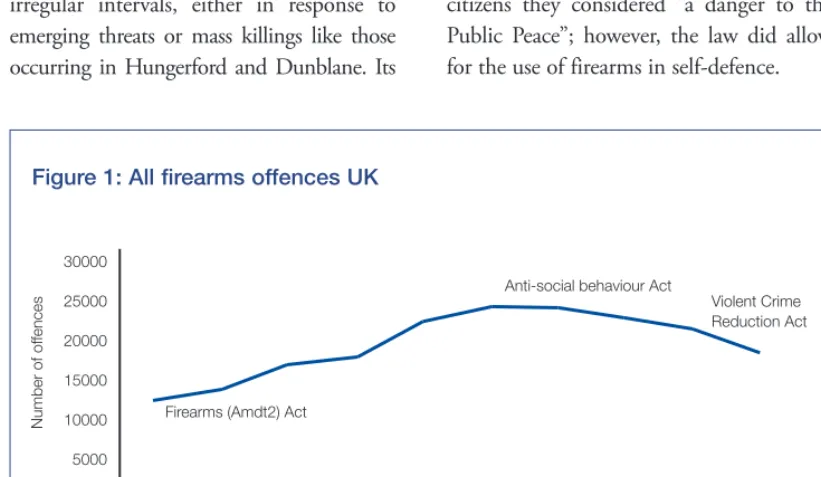
Firearms legislation was first consolidated in the Firearms Act 1968. Although this remains the principal law today, additional legislation has been introduced in piecemeal fashion at irregular intervals, either in response to emerging threats or mass killings like those occurring in Hungerford and Dunblane. Its
volume is considerable and not always easy to decipher. For example, experts have difficul-ties in deciding which weapons are “readily convertible” under 1982 legislation. Firearms law is also contained within general legisla-tion, such as the Criminal Justice and the Anti-Social Behaviour Acts 2003. While acknowledging the size of such a project, there seems to be a sound case for consolidating all the existing firearms legislation into one all encompassing Act, in the same way that the 1968 Act was introduced as a measure designed to consolidate previous legislation.
Early firearms legislation
In the United States the right to carry a gun is secured by the Second Amendment of the Constitution. No such right exists in England and Wales: Britain has a long tradi-tion of arms regulatradi-tion. As far back as the Game Act 1671 firearms have been regulat-ed. The 1671 Act restricted ownership of firearms and projectile weapons to owners of large tracts of land and remained in force until the beginning of the 19th century. The Seizure of Arms Act 1820 empowered jus-tices of the peace to confiscate arms from citizens they considered “a danger to the Public Peace”; however, the law did allow for the use of firearms in self-defence.
Gun crime: theory and legislation
64 Moore M,Buy and Bust: The Effective Regulation of an Illicit market in Heroin, Heath, 1976
65 Squires P,Gun Crime: A review of evidence and policy, Centre for Crime and Justice Studies, London, 2008
30000 25000 20000 15000 10000 5000 0
1997/98 1998/99 1999/00 2000/01 2001/02 20002/03 2003/04 2004/05 2005/06 2006/07 Firearms (Amdt2) Act
Anti-social behaviour Act
Violent Crime Reduction Act
Number
of
of
fences
[image:16.667.60.471.520.759.2]Year
Figure 1: All firearms offences UK
A modern legislative structure
The Pistols Act 1903 was a response to technological advances in firearms, creat-ing sensible gun control – the Act prohib-ited the sale of pistols to minors and to convicted felons. Additionally, the Act required that non-home owners seeking to buy a pistol had to purchase a 10 shilling licence from the Post Office. In 1920 the Firearms Control Act prohibited the carry-ing of firearms for the express purpose of self-defence and the “right” of citizens to bear arms became a “privilege”.66 Strict
controls on handguns following the 1920 Act undoubtedly played a part in keeping weapons out of the hands of those who might have criminal intent, giving the Government adequate leeway to deny firearms ownership to high-risk people.67
Further technological advances led to the Firearms Act 1937, which effectively banned fully automatic weapons from pri-vate ownership. About the same time, sim-ilar legislation was upheld by the US Supreme Court, signalling that certain types of firearms needed to be banned from the public domain.
The legal issue of firearms used in self-defence was transformed in the first half of the 20th century. In 1920, Home Office policy allowed citizens to keep firearms in their home for self-defence. By 1937, this had begun to change unofficially, until eventually it was no longer deemed accept-able for people to rely on firearms for the express purpose of self-defence. In 1954, the right to a gun for self-defence was ter-minated by a change in government policy. From 1950 to the late 1960s gun crime rose at an unprecedented rate: in the mid 1950s the proportion of robberies commit-ted with firearms was about 14%; by 1969 it had doubled. Likewise, the number of firearms fatalities rose throughout the 1960s. In response to increasing firearms offences, Parliament passed three Acts on gun control in relatively quick succession. The Firearms Act 1965 established a
num-ber of new firearm offences and increased the penalties for many existing offences. The Act was also an attempt to address a growing wave of concern that the impend-ing abolition of the death penalty would lead to an upsurge in violent crime.68
It is in the nature of firearms crime that offenders will use what is most readily available to them. The upsurge in firearms crime in the 1960s reflected the wide avail-ability of shotguns, which were usually converted to the illegal sawn-off form. After the shotgun murders of three police constables, Parliament passed the Firearms Act 1967, which extended the licensing system to incorporate shotgun sales.
The following year the Government sought to consolidate all existing legisla-tion in the Firearms Act 1968. This brought all existing gun legislation into one single statute, which formed the legal basis for British firearms control policy for the next two decades.69
In 1973 a progressive and intelligent Green Paper, The Control of Firearms in Great
Britain, laid out policy to rein in gun crime
further. It drew on empirical research show-ing that the best way to reduce the availabili-ty of guns to criminals is to reduce the total number of guns in society, and argued that society should make it as difficult as possible for criminals to acquire firearms. Despite its forward-thinking, no legislation followed on from the consultative document.
Event-driven legislation
With the exception of the Firearms Act 1982, which imposed greater control over imitation and readily convertible imitation firearms, legislation in Britain has been reactive, and driven by events.
Hungerford
On 19th August 1987, Michael Ryan, a 27-year-old “loner”, went on a rampage near his home in Hungerford, shooting dead 14 people and injuring a further 16.
Going Ballistic
66 The context of the Act has been debated; some revisionist historians regard this legislation as a reaction to the Bolshevik uprising in Russia. However the Firearms Control Act 1920 was less about controlling the prole-tariat and more about denying firearm licenses to anyone deemed unfit to be trusted with a gun
67 Squires P,Gun Culture or Gun Control?, Routledge, 2000
68 Ibid
69 Ibid
Gun crime: theory and legislation
70 Josephs J,Hungerford: One Man’s Massacre, Smith Gryphon Publishers, 1993
71 Squires P, op cit
72 Ibid
73 Professor Anthony Downs has referred to the phenomenon of public opinion waxing and waning around specific issues as the "issue attention cycle".
He was dressed in combat fatigues and car-ried an AK-47 assault rifle, a carbine and a Beretta semi-automatic handgun.70 His
random massacre had a threefold effect: it precipitated government legislation; changed public perception towards firearms and the gun lobby; and led to wider use of police weapon-carrying rapid response vehicles (ARVs).
In the wake of Hungerford, the Govern-ment rushed through the ill-conceived Firearms (Amendment) Act 1988, which banned military-style weapons and pump-action shotguns and restricted a shotgun’s breech or magazine capacity to two shots.71
The media’s focus on Ryan’s high-powered assault rifle allowed the Government to ignore the fact that most of his victims were killed or wounded by his semi-automatic handgun. The police were already aware of the growing availability of shotguns and argued that all higher-powered weapons should be reviewed for stricter controls. However, even though the Act drew heavily on the 1973 Green Paper, the most pressing issue – use of handguns – was glossed over. The pro-gun lobby in Britain never enjoyed the kind of support enjoyed by its counterpart in the US, but it successfully weathered the storm of Hungerford: rifles and handguns went unchecked. However, although the Firearms (Amendment) Act 1988 did not close the door on the pro-gun lobby, after Hungerford public opin-ion shifted permanently against the “shoot-ing and conservation” lobby in Britain.
Dunblane
On 13th March 1996, lone gunman Thomas Hamilton went on a shooting spree in a primary school in Dunblane, in Scotland, armed with four legally held guns: two semi-automatic pistols and two Smith and Wesson revolvers and 743 rounds of ammunition. He left 15 children and two adults dead. John Major, the Prime Minister, ordered a full judicial inquiry and began cross-party talks on gun
control. Meanwhile many of the bereaved parents of Dunblane formed the Snowdrop Campaign, for a total ban on handguns, and the media offered its full backing. Seldom have the media and special interest acted in concert so effectively. Because Major insisted on considering the full results of Lord Cullen’s inquiry before pass-ing any new law, he was constantly out-manoeuvred by the Opposition and the groundswell of public opinion. In the end he ignored Cullen’s recommendations and the Firearms Act 1997 banned all hand-guns over .22 calibre and prohibited small calibre handguns outside licensed pistol clubs.72 The Snowdrop Campaign called
this an “unacceptable compromise”. The Government also introduced an amnesty on illegal weapons, which led to the sur-render of 22,000 guns.
In 1997, the new Labour Government kept its manifesto promise and introduced the Firearms (Amendment) Act 1997. The legislation delivered what the public had demanded in the wake of Dunblane: “an Act to extend the class of prohibited weapons under the Firearms Act 1968 to include small calibre pistols”. At a stroke “all firearms with a barrel less than 30 cen-timetres or less than 60 cencen-timetres in total length” were prohibited. Nevertheless firearms offences rose steadily, though undramatically, in the next five years. The number of homicides caused by firearms increased by 63% and offences involving injuries from firearms rose from 864 to 1,877 from 1997 to 2002.
Letitia Shakespeare and Charlene Ellis shootings
On New Year’s Eve 2002 gun crime reclaimed the media spotlight when two teenage girls – Letitia Shakespeare and Charlene Ellis – died in the crossfire of a shoot-out in Aston, in Birmingham.
In the aftermath, media pressure for action to stem violent crime intensified.73
As well as extra provisions to the Anti-Social Behaviour and Criminal Justice Acts
2003, the Government organised another gun amnesty which netted more than 45,000 illegal firearms – twice as many as in 1996. The types of weapons surrendered (the cache included rocket launchers, AK-47s and hand grenades) revealed how seri-ous and systemic the problem was.
The 2003 legislation led to three important innovations:
A mandatory five-year minimum sen-tence for the illegal possession of a pro-hibited firearm;74
The creation of an offence for being in possession of an imitation firearm or air-gun in public;75
The sale, manufacture and import of guns containing gas cartridge systems became illegal.76
These measures were added to the two Acts as an afterthought; contrary to the Government’s claims, legislation against imitation firearms was weaker than in other countries such as the Netherlands, Sweden, France and Australia.
Going Ballistic
74 Criminal Justice Act 2003, sections 287-293
75 Anti-Social Behaviour Act 2003, section 37
76 Anti-Social Behaviour Act 2003, section 5 (1)
Changes to gun laws since Dunblane Massacre, 1996
Firearms Act (Amendment) 1997 (pre-election)
Banned most handguns: all handguns larger than .22 calibre banned (possession, carrying, buy-ing, transferring);
Exemptions: (i) slaughtering instruments, (ii) firearms used for human killing of animals, (iii) shot pistols used for shooting vermin, (iv) Races at athletic meetings, i.e. starters pistols, (v) tro-phies of war, (vi) firearms of historic interest. (Some airguns are exempt. Replicas and deactiva-tions are not considered firearms and are not therefore covered by the legislation);
National registry: required a central computer database of all certificate holders and all applicants; Increased police powers: granted police the power to revoke firearm or shotguns certificate if the holder is a danger to public safety; and revoke or partially revoke a firearm certificate if the hold-er is unfit to be entrusted with firearm (a shotgun chold-ertificate cannot be partially revoked);
Firearms Act (Amendment) 1997 (post election)
Banned all handguns regardless of calibre, with exemptions as above;
Anti-Social Behaviour Act 2003
Banned certain airguns: added some airguns that use self-contained gas cartridge system to the list of prohibited weapons, specifically targeting the Brocock model;
Restrictions on carrying: extended the ban on carrying firearms in a public place without reason-able excuse to cover imitation firearms;
Age limits: increased minimum age for acquiring or possessing air weapons unsupervised from 14 to 17;
Violent Crime Reduction Act 2006
Banned imitations: banned the manufacture and sale of realistic imitation firearms, with limited exemptions for theatre, historical re-enactment, etc;
Restrictions on air weapons: made it an offence for a person other than a registered dealer to sell air weapons and required the transfer to be on a face-to-face basis;
Age limits: raised minimum age for buying or hiring an airgun from 17 to 18 years;
Further restrictions on firing airguns beyond premises, ammunition and generally stricter penalties.
3
Knife Crime:
Theory and Legislation
Summary
Both knife-related homicide and overall knife crime have been rising for the past ten years. Our interviews with members of the Police Federation, YOTs and young offend-ers point to a trend of increased knife carry-ing out of fear and/or the need for personal protection. This chapter reviews existing research that has explored the extent of the problem, and the legislation introduced to deal with it. As in the case of firearms, the legislation is too complex and would bene-fit from a single framework Act. So far Government measures including tougher laws, education, amnesties and increased stop-and-search powers for police have had little effect on the propensity of young peo-ple to carry knives; it has not addressed the underlying social roots of the problem.
Definitions
Knife crime is a term that is tossed around in new policy initiatives and the media almost daily. But it is not always clear what actually constitutes knife crime or what is meant when the term is mentioned. The production of a knife during the course of a crime, such as assault, robbery, sexual assault, or homicide is indisputably knife crime.77However, there are instances when
a criminal act is committed while in pos-session of a knife that is never produced.78
Measures of knife crime
The number of homicides caused by a blade or sharp instrument is considerably
higher than the number of deaths caused by firearms. The total number of deaths slightly increased from 200 in 1997 to 212 in 2006 with a peak of 266 in 2002-03. Last year, deaths linked to knife crime rose by 18%, from 219 to 258.
The Home Office Offending, Crime and Justice Survey of 2007 estimates that at worst 60,000 young people aged 10 to 25 years, mostly male, may be stabbed and injured in England and Wales a year, or more than 160 victims a day.79At best,
the figure may be as low as 22,000 each year.80
Policymakers simply do not know how prevalent knife crime really is. A series of surveys by MORI for the Youth Justice Board reveal a steady rise in the propor-tion of youths carrying knives: in 2002, 20% of schoolchildren interviewed said they had carried a knife at some point dur-ing the previous 12 months; in 2005, it was 32%.81
Children who are excluded from school are more likely to carry a weapon than those who are not. In 2004 MORI found that 9% of children in school and 30% of excluded children said they had carried a flick knife; 5% of children in school and
77 Eades C, Grimshaw R, Silvestri A, Solomon E, Knife Crime: a review of evidence and policy, Centre for Crime and Justice Studies, London, 2nd edition, 2007
78 Ibid
79 Steele J, “The vagaries of UK knife crime statistics”,The Daily Telegraph, 20th March 2007
80 Estimates taken from the Government’s Offending, Crime and Justice Survey
81 Phillips A and Chaberlain C, "MORI Five-Year Report: An analysis of Youth Survey Data", London: Youth Justice Board, 2006
“
So far Government measures including tougher laws, education, amnesties and increased stop-and-searchpow-ers for police have had little effect on the propensity of
16% of excluded children had carried a kitchen knife; 25% of school children and 46% of excluded children had carried a penknife.82
Another study carried out by the Office of Criminal Justice Statistics in the Home Office researched the scale of knife carry-ing in England and Wales through inter-views with 5,000 people aged 10 to 25 liv-ing in private households. The interviews explored the level of involvement people had with different aspects of criminal behaviour. The survey found that 4% of all respondents had carried a knife in the pre-vious 12 months, and that carrying knives was most common among 16 to 17 year olds.83 An overwhelming majority (85%)
of respondents who admitted to carrying a knife cited their reason for doing so as “protection”. This is a very common theme, especially among young offenders who have been charged with a knife offence. However, policy aimed at curbing knife crime has yet to take this fact into account.
Scale of the problem
The Home Office only began recording knife crime separately from July 2008, so the
true scale of the problem is difficult to assess at the time of writing. Moreover, the Youth Justice Board and youth offender teams do not record knife offences separately.
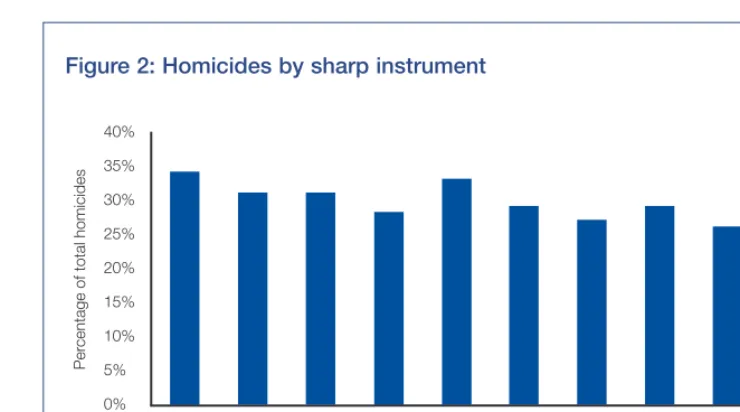
Data from the British Crime Survey, based on the experiences of 40,000 people each year, suggests that 8% of all violent incidents involve knives, a rate that has remained fixed for a decade or more, while the percentage of homicides involv-ing knives has fallen from a peak of 37% in 1995. Of the 820 homicides in England and Wales in 2005, 236, or 29%, were with a knife or other sharp instru-ment.
However, knife crimes are four times more common than gun crimes; and the risk of serious injury is more than double that for gun crime. The probability of serious injury is 4.5 times more likely when a knife is used to assist a crime. The risk of serious injury from knife-enabled crimes is more than twice that for gun-enabled crimes.
Attacks in which a knife was used in a successful mugging have risen from 25,500 in 2005 to 64,000 in the year to April 2007. The figures mean that last year there were, on average, 175 robberies at knifepoint in England and Wales a day – up from 110 the year before and from 69 in 2004-05.84
Going Ballistic
82 Phillips A and Chaberlain C, "MORI Five-Year Report: An analysis of Youth Survey Data", London: Youth Justice Board, 2006
83 Wilson D, Sharp C, Patterson A,Young People and Crime: Findings from the 2005 Offending, Crime and Justice Survey, Home Office, 2006
84 The study, by the CCJS, is based on Home Office statistics.
40% 35% 30% 25% 20% 15% 10% 5% 0%
1997/98 1998/99 1999/00 2000/01 2001/02 2002/03 2003/04 2004/05 2005/06 2006/07
P
e
rc
e
n
ta
g
e
o
f
to
ta
l
h
o
m
ic
id
e
s
Year
[image:21.667.170.540.85.291.2]Source: Home Office/BCS
Figure 2: Homicides by sharp instrument
Perceptions that knife carrying has increased are corroborated by at least two sta-tistical sources. One is a Home Office study published in 2004. It reported the findings of interviews with adult arrestees, including self-reported gang membership, and some of the questions related to their use of weapons. The proportion of past and present gang members who reported carrying guns was similar. However, current gang members were much more likely to report carrying weapons more generally and it is safe to assume that part (and possibly a large part) of this increase will have been accounted for by knives.
Usage, injuries and deaths from knives far outstrip those from firearms, not least because they are easier to acquire and, unlike some firearms, do not require a licence.
The trends for knife crime seemed to run in parallel with those for gun crime, suggest-ing that they may in some way be linked. Although many more individuals are involved in knife crime than in gun crime, some of them will be the same individuals; and those who are involved in gun crime do not start out carrying guns but other, more readily available weapons, including knives.85
There is also a wide lack of reporting of incidents of knife crime, as 51% of young victims do not report the crime to the
police and 45% do not even tell their par-ents.86This is supported by other
organisa-tions: Merseyside Ambulance Service esti-mates, for example, that 50% of stabbings never get reported to the police.87
Knife crime and young people
In London, youths particularly between 17 and 20, are the most likely to be victims of knife crime; 4% of 10 to 25 year-olds admitted to carrying knives in 2005 and 1,226 under-18s were found guilty in 2007 of carrying a blade.
Also notable is the increase in violent crimes committed by 15 and 16 year-olds. According to a survey compiled by the Youth Justice Board (YJB), violent offences com-mitted by 16 year-olds rose from 17% in 2004 to 25% in 2005, while those perpetrat-ed by 15 year-olds climbperpetrat-ed from 20% to 26%. One in five of those convicted for pos-sessing a knife were aged between 10 and 17 in 2006, according to Home Office statistics. Related to this is the increased number of young people arming themselves with knives. The YJB survey reported a 12% increase in the number of teenagers carry-ing knives since 2002; the proportion of girls carrying knives rose sharply from 15% in 2004 to 21% in 2005.88
Knife crime: theory and legislation
85 FitzGerald M, “Memorandum submitted to the Select Committee on Home Affairs – knife crime”, House of Commons: Hansard Archives Research, 2007
86Youth Survey 2002, Crimestoppers, 2002
87 Channel 4, Street Weapons Commission, 2008
88 Phillips A and Chaberlain C, "MORI Five-Year Report: An analysis of Youth Survey Data", London: Youth Justice Board, 2006
0 10 20 30 40 50 60 70
% of current % of past gang % of all gang ‘Type’ of gang members
Ever possessed a weapon during an offence Ever possessed a gun during an offence
P
e
rc
e
n
ta
g
e
o
f
tg
a
n
g
m
e
m
b
e
rs
c
a
rr
y
in
g
w
e
a
p
o
n
[image:22.667.57.526.519.764.2]s
Figure 3: Weapon carrying among gang members
Over the past decade, the number of convictions for carrying a knife has risen from 3,360 in 1997 to 6,314 in 2006. Of those convicted in 1997, 482 were teenagers, in 200689 the figure nearly
tre-bled at 1,256.90 Worse, in surveys about
one in five teenagers admits to carrying a knife.
David Wilson, professor of criminology at Birmingham City University, believes there are two reasons for youths carrying knives. One is that it makes them “feel grown up” or “manly”; the other is that they are “scared”. Wilson says young people have reacted to a world in which adults demonise young people outside their own families – “they are all chavs and hoodies” – and no longer trust adults to protect them.91
Strategies designed to reduce knife crime
Since 1997 it has been one of New Labour’s most urgent priorities to cut “youth crime”, but an audit of Labour’s youth justice poli-cies, published by the Centre for Crime and Justice Studies (CCJS) at King’s College London in May 2008, concluded that they have had “no measurable effect” on the rate
at which young people commit crimes. The uncomfortable reality is that the Govern-ment does not know how social or econom-ic poleconom-icy can be used to stop youngsters committing crimes.92
Strategies that have been used to tackle knife crime include:
tougher legislation; reducing demand; education; amnesties;
supply restrictions; stop and search by police.
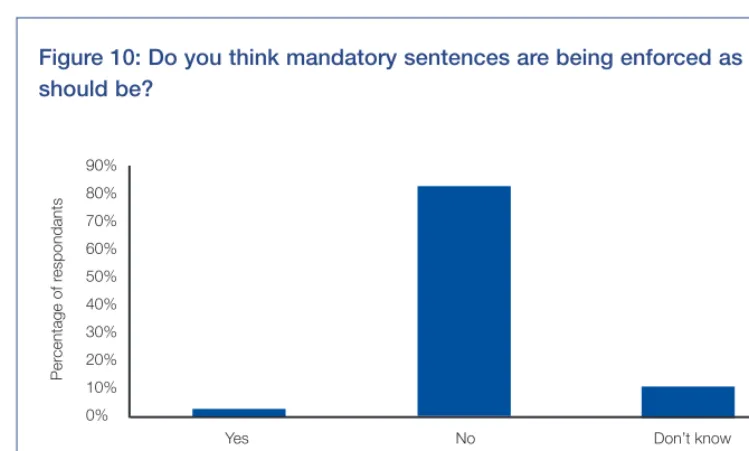
Given the rapid development of a teenage culture in which carrying a knife is seen as normal, not to say essential, for self-defence, it is understandable that there have been calls to toughen the law. The maximum jail sentence for knife carrying is two years, or four years if the knife is taken to school. But in 2006, only nine of the 6,314 people convicted of carrying a knife were given the maximum sentence.93 (Of
course, the impact of tougher sentences needs to be clearly communicated; knife crime is most common among children
Going Ballistic
89 Nicholas S, Kershaw C and Walker A,Crime in England and Wales 2006/07, Home Office, London, pp.33, 71, 2007
90 Eades C, Grimshaw R, Silvestri A, Solomon E,Knife Crime: a review of evidence and policy, Centre for Crime and Justice Studies, London, 2nd edition, 2007
91 Siddique H, "Knife Crime: desperately seeking solutions", The Guardian, 28th May 2008; see http://www.guardian.co.uk /uk/2008/may/28/knifecrime
92 Palmer A, “Jail is a blunt instrument to tackle knife crime but it works”,The Daily Telegraph, 25th May 2008; see www.telegraph.co.uk/opinion/ma in.jhtml?xml=/opinion/2008/05/2 5/do2509.xml
93 Pollard S, "A suggestion for fighting knife crime",The Times, 26th May 2008; seehttp://www.ti mesonline.co.uk/tol/comment/ columnists/guest_contributors/a rticle4003792.ece
Table 1: Proportion of young people claiming to have carried weapons in the past year
Young people in school Excluded young people
Base: all young people (4,715) (2,460) (2,225) (687) (502) (174)
% % % % % %
I have carried a weapon but never used it 21 31 11 47 52 31
I have used a weapon against another person 3 5 1 14 17 9
I have threatened another person with a 3 5 2 21 24 12
I have taken a weapon to school to 2 3 1 10 12 7
defend myself
I have taken a weapon to school to use 1 1 - 4 6 1
I have never used a weapon 62 47 78 24 17 46
against another pupil
and young people who are less likely to foresee the consequences of their actions than adults and less likely to appreciate cause and effect.)
The law governing offensive weapons is derived from a number of Acts: the Prevention of Crime Act 1953; the Restriction of Offensive Weapons Act 1959; the Criminal Justice Act 1988; the Offensive Weapons Act 1996; the Knives Act 1997; and most recently, in May 2004, amendments to the Criminal Justice Act 1988. Each was a response to a specific problem rather than an attempt to con-struct a legal framework that looked at the threat posed by knives and offensive weapons as a whole.94
The complexity of the law is a very real difficulty for police officers. With every new law the chance of mistakes being made – for instance arresting a sus-pect under the wrong section – inevitably increases. In common with the Police Federation we have concerns regarding:95
the unclear definition of offensive weap-ons (the Prevention of Crime Act 1953); the arbitrary legality of three inch (or
less) knives and implements;
the narrow definition of weapons for which marketing is outlawed (the Knives Act 1997);
the law’s failure to keep pace with the development of new, more sophisticat-ed weapons such as gravity, lock, but-terfly and disguised knives.
Reducing demand
In response to a number of high-profile stabbings, ministers have resorted primari-ly to criminal justice responses – in partic-ular the various measures in the Violent Crime Reduction Act 2006 – rather than developing prevention strategies to address the underlying social and economic roots of violence.
Enver Solomon, deputy director of the CCJS, says: “Since it’s extremely difficult if not impossible to limit the availability of knives, and knives are merely a tool used in violent crime, success in fighting knife crime will only come with success in deal-ing with the underlydeal-ing causes of violence, fear and insecurity.”96
The Government has spent more than £5 billion on its New Deal, which was designed to reduce crime by reducing the number of 16 to 19 year-olds “not in employment, education or training”, or NEETs. But the number of NEETs has actually increased over the decade since the New Deal was introduced.
The role of the family and good parent-ing cannot be overstated in the drive for prevention. Early engagement and support for vulnerable families and individuals, and information sharing between police protective services and other agencies are crucial to success. Faith-based and local support networks provide a rich vein of skilled people willing and able to help. Police forces should identify local faith leaders willing to assist and should encour-age their support and involvement in diversionary and preventive activity.97
Education
A Home Office report that