Brixton Prison
Black Self Development Programme
“A programme for change and rehabilitation”
Evaluation Report
August 2006
CONTENTS
Acknowledgements……….……….……….………4
Executive Summary………..………6
1) Introduction………..…………..………...…………12
2) Underlying rationale of the programme………..……….….12
2 a) Why an all Black group?...14
3) The programme in Brixton Prison ……….…….….…….…16
3 a) Characteristics of the programme………..…16
3 b) Funding and targets……….…16
3 c) Targeting and recruitment of prisoners……… 17
4) Characteristics of group members.………18
4 a) Black Self Development Questionnaire………18
4 b) CRIMEPICS………..………20
5) Results……….………..…………23
5 a) Programme recruitment and completion……...………..……….……23
5 b) Qualifications achieved………23
5 c) Employment on release………...…………24
5 d) Post programme measures……….…25
5 e) File reading………26
5 f) Evaluation of individual sessions………26
6) Feedback from group members……….28
7) Stakeholder feedback – defining success………...29
8) Emerging issues………32
8 a) Relationship between targets, recruitment and funding……….…32
8 b) Differences in ethos between voluntary and statutory organisations…...33
8 c) Closed, Black only groups……….…………..33
8 d) Staffing – recruitment and supervision ……….35
8 e) Running the programme within the prison………35
8 f) Aftercare………..37
9) Conclusions………...39
10) Recommendations………..………40
11) References……….…………..42
Appendix 1: Summary of Black Self Development Programme...44
ACKNOWLEDGEMENTS
Firstly thank you most of all to Job Centre Plus and the London Borough of Lambeth for funding the project.
We would also like to thank the following people for providing us with their views, advice and support in the writing of this report and those unnamed offenders from the project who provided questionnaire data and feedback. Our thanks are due to the 2 ex-group members who carried out group interviews with existing group members on our behalf. Thank you also to London Probation for allowing us to dedicate a considerable amount of their limited research resources to carrying out this evaluation.
John Trainor – Executive Director, London Action Trust
Karen Brooke – Director of Service Delivery, London Action Trust Katharine Hamilton – Head of Learning Skills, HMP Brixton Diedre Johnson – Project Manager, London Action Trust
Delphine Duff – Equality and Diversity Officer, London Probation
Rukaya Swaby – Course Tutor, Black Self Development Project, London Action Trust Femi Wete – Skills for Life Tutor, Black Self Development Project, London Action Trust
EXECUTIVE SUMMARY
This evaluation describes the underlying rationale of the Black Self Development Groupwork Programme currently being run in Brixton Prison by London Action Trust. It assesses how well the project has performed against targets and attempts to give some indication of the impact it has had on prisoners, staff and managers.
Underlying rationale of the programme
The current programme is adapted from earlier versions developed by London Probation staff and, subsequently, work with YOTs. The rationale underlying the group is based on the premise that exposure to the, sometimes subtle, effects of racism may lead Black people to feel alienated from, or marginal to, the larger society. If individuals internalise racist attitudes this can damage their perception of themselves and this may, in turn, have implications for their behaviour. The group, therefore, attempts to address offending behaviour by working through a process which starts with an examination of oppression related matters such as social exclusion and discrimination, then seeks to move individuals on to looking at how their own beliefs may relate to their general position in society, to their own behaviour and, in particular, to their offending behaviour.
The approach draws upon control theory which argues that factors such as the existence of meaningful roles and relationships, a sense of belonging and identity, goal orientation, the ability to tolerate frustration and a strong self-concept as a law abiding person predict non-offending behaviour far better than the presence of ‘criminogenic’ factors predict offending. The programme attempts to help participants develop a positive Black self-identity, a sense of responsibility to the larger group and provide positive images of Black achievement. All prisoners and staff are Black as this is believed to provide an environment within which participants can explore these sensitive areas of their lives. (Section 2)
The Programme in Brixton Prison (Section 3 a)
• Funded by Job Centre Plus. The London borough of Lambeth GetSet Fund also funded one worker.
• Run by London Action Trust staff with previous experience of running the programme in different venues.
• It is accredited by Open College Network London Region.
• Basic skills assessments on prisoners to determine whether assistance is required.
• Comprises16 sessions carried out over a period of 8 weeks.
Funding and targets (Sections 3 b and 3 c)
• 130 prisoners to be recruited over a 2 year period from January 2005
• 66 to get qualifications of 2 units or more
• 26 to get jobs on release (subsequently removed)
• Prisoners with 6 months or less of sentence to serve to be targeted
Characteristics of group members (Section 4)
Black Self Development Questionnaire (Section 4a)
A questionnaire looking at attitudes to race, self development and willingness and ability to change.
• Most had a positive view of being Black
• Most were receptive to the need for further education and training
• A very high percentage felt confident about being able to change in order to avoid reoffending
• Whilst most believed that racism impeded the development of Black people within society they appeared less likely to apply this thinking to themselves
• Most did not link their offending to being Black
CRIMEPICS II - a standardised attitude questionnaire and problem inventory (Section 4 b)
• Careers (68%) and money (65%) were seen as being their largest problems when assessed using CRIMEPICS II. The police (56%), housing (54%), relationships (51%) and boredom (51%) were the next most quoted problems. These are all issues covered in the programme.
• Self-esteem (16%), lack of confidence(14%) and depression (16%) were the least commonly reported problems.
• Racism was only seen as a problem by 21%.
These prisoners scored relatively highly on both the ‘evaluation of crime as worthwhile’ and ‘anticipation of reoffending’ scales of CRIMEPICS 11 suggesting they see themselves as likely to continue offending prior to the programme so inconsistencies exist. Given that the difficulties of changing offending behaviour appeared to be very much underestimated on the Black Self Development questionnaire this suggests a need for programme tutors to work with these contradictory perceptions. Unfortunately these questionnaires were not repeated at completion of the programme so there is no measure of change available. (Section 4 b)
RESULTS
Programme recruitment and completion (Section 5a)
• With 4 months still to go 114 of the target of 130 have already started the programme.
• 57 of the target of 66 have gained qualifications.
• Only 4% of prisoners who started the programme have left the programme voluntarily. The remaining non completers were either transferred to other prisons or released early.
These completion figures suggest that the programme is responsive to the needs of group members and that it will meet or exceed its targets.
Qualifications achieved
Employment upon release
• It was not possible to assess whether this target has been met due to difficulties in tracking offenders after release. In addition many prisoners on the programme had longer than 6 months to serve with obvious implications for the employment target. In acknowledgement of these issues, Job Centre Plus, subsequently removed the employment target. However not meeting the employment target continued to be an issue as this had been incorporated into a Service Level Agreement that remained in place. (Section 5 c)
Impact of attendance
• Responding to a standardised questionnaire the majority of prisoners who completed the group felt that attendance would impact upon their likelihood of offending in the future. (Section 5 d)
• Prisoners reported attaching great significance to their attendance on the programme and a high degree of satisfaction with it in relation to their initial expectations. (Section 5 d)
• When asked about their satisfaction with the individual sessions those most commonly rated ‘Excellent’ or ‘Very Good’ were Equal opportunities, Uniting Black families, Writing CVs and disclosure letters, Know your roots and Healthy relationships. These appear to reflect the breadth of the programme. (Section 5 f)
Feedback from group members (Section 6)
As part of the end of programme assessment group members were asked to say what they thought were 3 good things about the group and 3 things they would like to see improved.
• Feedback was very positive in terms of both the content and their experience of the groupwork process. Black history is the item most frequently mentioned.
• Group members report feeling more confident, motivated to learn more and as having greater self knowledge.
• Effects on the likelihood of reoffending were rarely mentioned. This may be of limited importance given that the theoretical model argues that pro social attitudes are better predictors of non-offending than anti social attitudes are of offending.
Stakeholder feedback on the success of the programme (Section 7)
Staff running the programme, their managers and the Head of Learning Skills from the prison were interviewed regarding their views of the success of the programme and any issues that had been raised.
• Prison staff viewed success as the meeting of targets though the importance of other outcomes was acknowledged, for example, prisoners completing some education when there had been no previous learning.
• LAT staff felt the enthusiasm of the participants was a measure of the success of the project. Current group members talking to other prisoners had resulted in a waiting list of prisoners wanting to go on the programme. Also prison officers asked for prisoners to be placed on the programme.
• Some ex group members had voluntarily contacted group leaders after release in order to update them on their progress. Staff saw this as another indicator of impact.
• When interviewed one group member expressed concern about prisoners who initially seemed to be doing well on release but who were subsequently appeared to be moving backwards
Emerging Issues
Some issues emerging from this project were specific to it whereas others would equally apply to similar projects. In this section we seek to draw out those learning points that we think organisations contemplating running future programmes might need to consider.
• Targets, recruitment, fundingand the nature of the programme
target thereby ensuring that the programme would meet the remaining targets.
• Differences in ethos between voluntary and statutory organisations
The strength of voluntary organisations is often seen as their ability to respond holistically to the needs of individuals whereas those of statutory bodies are often seen in terms of control of resources and universal provision, often assessed by means of targets met. These differences are strongly related to the targeting issues above. The implications of these different approaches need to be acknowledged and managed if paradoxical situations are to be avoided whereby voluntary bodies are recruited for their person centred approaches but because of these fail to meet the targets set. (Section 8 b)
• Closed, Black only groups (Section 8 c)
This appeared to generate a degree of anxiety and misunderstanding about the all Black nature of this programme. Prison staff did not appear to have a clear understanding of the course material and approach and prisoners felt there were misapprehensions amongst their fellow inmates regarding the content of the programme. There were concerns from prison staff about whether racism was being used to excuse offending behaviour rather than take responsibility for it. The all Black composition of the group could also be seen to be inherently racist. There were quality control issues as the prison authorities had no Black observers who could carry out the learning inspections required of all prison programmes. Whilst providing clear information might resolve some of these issues organisations may also need to get involved in discussions around race and racism, areas often found to be difficult.
• Staffing (Section 8 d)
Selection and training of staff is a crucial area as programmes of this nature require staff who have reached a stage in their own development which allows them to deal effectively with potentially highly emotive issues that may be raised; as Black people these may resonate with their own experience. Suitability may not always be obvious at the recruitment stage. When such programmes were run in house by organisation such as the Probation Service or YOT, staff subsequently found to be unsuitable could be redeployed elsewhere but this is not necessarily true of small, voluntary organisations where people are recruited for specific projects. Whereas here LAT had staff skilled in this type of work this may prove to be an issue for future similar projects. Additionally ongoing supervision is also required.
• Impact of running the programme in a prison setting (Section 8 e)
- The prison also had to provide resources to support the programme in terms of admin support, moving prisoners around and finding acceptable, secure accommodation.
- Having a captive audience of prisoners who may have reached a stage of wanting to change constitutes one advantage of running the programme in a prison. However, unmotivated prisoners may attend in order to get out of their cells with their attendance impacting on the group process.
- The project contributed substantially to Brixton Prison’s educational targets both through the units of qualification gained on the programme and by motivating group members to go on and take further courses within the prison education department. The partnership with the Central School of Speech and Drama was likely to add kudos to the education profile of the prison.
• Aftercare (Section 8 f)
Both staff and prisoners felt that there needed to be support after release if the advances made were to be sustained. There is an expectation that course tutors will maintain some degree of contact after release but more structured input might be advisable and establishing contact with community groups.
Conclusions (Section 9)
Despite the divergent preoccupations of the prison and LAT the programme has run to time and appears likely to meet or exceed its targets now that the employment target has been removed. Prison officers referring offenders to the group and word of mouth leading to a waiting list of prisoners suggest it is responsive to prisoners’ needs. Equally feedback from both group members and staff is uniformly positive. However, as this evaluation focuses on subjective views of impact it cannot, at this stage, say anything about impact upon actual behaviour.
Recommendations (Section 10)
The findings here suggest a range of issues that could usefully be addressed.
1) Provide clear information about the content and approach of the programme to all involved.
2) Provide a safe forum within which all parties involved can discuss issues around race and racism.
3) Maintain links with the Diversity Departments of host organisations. 4) Ensure that targets set are appropriate and measurable.
5) Consider whether outsourcing the work to external organisations may be the best way of ensuring the experienced staff base that is vital in running this programme.
6) Ensure staff have consistent supervision that can incorporate emotional demands as well as professional issues.
7) Consider aftercare, perhaps through further groupwork or links to community groups.
1 INTRODUCTION
This report aims to provide an understanding of the Black Self Development Programme currently being run in Brixton Prison by London Action Trust and give some indication of the impact it has had on participants. In addition it will raise points relating to issues surrounding running the programme within a prison environment and how these have impacted upon both staff and participants. It will draw on records kept by the programme staff, feedback and questionnaire data provided by prisoners on the programme and interviews with staff from the prison and LAT.
2 UNDERLYING RATIONALE OF THE PROGRAMME
‘Black empowerment involves the sharing of information (within groups) which encourages an understanding of the importance of we rather than I. Empowerment within a probation context is applied to enable participants to look at their own situation from their own perspective and, as a result, discover strategies to empower each other to improve their situation.’
(Frances-Spence, 1994; 112 in Mitchell-Clarke, 1998)
The rationale underlying this programme is based on the premise that exposure to the, sometimes subtle, effects of racism can lead many black people to feel alienated from, or marginal to, the larger society. If individuals internalise racist attitudes this can damage their perception of themselves and this may, in turn, have implications for their behaviour including leading them into offending behaviour. The Black Self Development Groupwork Programme attempts to address offending behaviour by working through a process which starts with an examination of oppression related matters such as social exclusion and discrimination, then seeks to move individuals on to looking at how their own beliefs may relate to their general position in society, to their own behaviour and, in particular, to their offending behaviour. The programme involves focusing upon the extent to which group participants may have internalised racist attitudes and the possible ways this may impact upon their own behaviour as a first step towards promoting a more positive view of the self.
The approach draws upon Cross’s conceptualisation of the staged development of a positive black self-identity. Briefly, Cross argues that many Black people living within predominately white populations will initially internalise predominant views and may tend to deny the existence of racism. Upon exposure to racial prejudice they may begin to search for a black identity and may glorify things black and denigrate things white as a means of shedding their old self. If the person then achieves a greater security within their new black identity, this anti-white stance will tend to decline until a stage is achieved where the person achieves a secure black identity and the positive self-esteem and greater ideological flexibility that goes with it (Robinson, 1995; 104). The work offenders undertake within this programme, therefore,
who they are and make decisions on the basis of who they are’ (interview with programme consultant).
Its scope, therefore, is broader than the majority of cognitive behavioural programmes currently being run within the Criminal Justice System, which tend to focus predominately on thinking skills.
A further theoretical underpinning of the programme is taken from Control Theory which argues that factors such as the existence of meaningful roles and relationships, a sense of belonging and identity, goal orientation, the ability to tolerate frustration and a strong self-concept as a law abiding person predict non-offending behaviour far better than the presence of ‘criminogenic’ factors predict offending. The programme aims to foster these positive attributes through helping an offender deal with the impact of racism on their own lives and develop a positive black self-identity, a sense of responsibility to the larger group and provide positive images of black achievement. In order to do this is it must:
‘…assist the individual in his/her understanding of the historical, social, economic and individual factors which have and will impact on the process of change, aid in the setting of realistic and achievable goals and assist in removing negative traits of behaviour. The individual must also be provided with an opportunity to identify strategies for coping with events that influence his/her lifestyle but for which he/she does not have ultimate control for change.’
(Duff; 2000)
Early versions of the current Black Self Development Groupwork Programme were initially developed and run within London Probation. In order to develop practical strategies whereby offenders could ’empower each other to improve their situation’ an education and employment element was added to the initial work on Black history and looking at racism within society as a means of fostering self development. A version more suited to the needs of young offenders was subsequently developed by London Action Trust for use in Young Offender Teams. The version currently being run within Brixton Prison combines elements from both the previous versions. When adapting the programme it was necessary to reduce the length of the programme in order to ensure that it fit within the prison environment.
‘In Black Self Development we look history, we look at offending, how do you feel about that offending? You relate the offending to how you see yourself. How much is it about finance? How much is it because you don’t think there is another way? Where did you get those messages from?’
The holistic approach helps prisoners bring together parts of their experience that they may previously have looked at in isolation from each other. Topics covered range from Black history, institutional racism, social skills, the family, sexual health, education, self presentation, issues around employment and decision making skills. A variety of approaches are used. For example, LAT has formed a partnership with the Central School of Speech and Drama who had received money from the Learning and Skills Council to work with disadvantaged groups as part of a knowledge transfer project. Their sessions on role play helps prisoners to work on their presentation skills in terms of voice and body language skills they can apply in interactions with people or for a job interview. Some offenders continue to work with the Central School of Speech and Drama and take certificates. The aim is to instil in the prisoners a sense of pride in themselves and, as this grows, to help them chip away at entrenched attitudes, attitudes that may be related to continued offending. It is hoped that a shift will be helped by analysing the skills attendees use in offending and getting them to see how these could be transferred to legitimate employment. Teaching group members about how to evaluate themselves and their skills and how to make changes will hopefully motivate them to seek employment or training on their release. An important feature of this programme is the gaining of qualifications, a tangible outcome and, for some attendees, their first ever. Overall, as the Basic Skills Tutor interviewed as part of the evaluation said ‘the primary objective with them is try and make them think more positively and then take responsibility for their lives’.
2 a) Why an all black group?
It has been argued that this very sensitive work focusing on black identity and experience can only take place within an all black group. Research findings suggest that effectiveness and positive anecdotal outcomes are best achieved if all members including facilitators are black (Mullender, 1991 in Mitchell-Clarke, 1998) as benefits are linked to a commonality of experience shared by group leaders and members. A mixed race group looking more generally at self-development could merely perpetuate existing inequalities. Black members of predominately white groups, instead of gaining support and strength and sharing common feelings and aspirations have reported finding themselves feeling isolated and exposed (Ahmad, 1990 in Mitchell-Clarke, 1998).
3) THE PROGRAMME IN BRIXTON PRISON
Information relating to the rationale underlying the Black Self Development Programme and a summary of the content is included as Appendix 1.
3 a) Characteristics of the programme
The programme as it is currently being run in Brixton Prison incorporates the following features:
• It is an accredited programme. In order to meet accreditation criteria the programme had to be linked to the Open College Network London Region (OCNLR). As developing social and life skills modules to accreditation standard would have eaten into the time available for running the programme, off the shelf programmes developed by OCNLR were selected in addition to basic skills units. Adopting this approach meant that the time involved for the accreditation process was kept to 6 months, an important consideration when funding is limited.
• Run by London Action Trust who brought skilled staff with a clear interest in this type of work and who had previous experience of running the programme in other organisations. The team is comprised of a project manager with 8 years experience of this programme having been involved in its early development within Probation, a basic skills tutor with 15 years experience of basic skills, an administrator who had been with the project for 3 years and a groupwork tutor with 2 years experience of running the programme.
• Good documentation of the theories underpinning the programme.
• Portfolios of offenders’ progress are kept.
• Regular assessments of the attendance, work achieved and attitudes of offenders.
• Basic skills assessments are completed on all offenders in order to provide a baseline and determine whether added support would be needed to complete the programme. One to one support is available for those with limited skills.
• Where necessary offenders are encouraged to take further courses once they have completed this one. This can include basic skills for those in need of this input.
• A degree of aftercare is built into the project. There is an expectation that course tutors will contact prisoners on the programme after release in order to provide ongoing interest and support.
3 b) Funding and targets
of funding arguably placed significant emphasis on the employment targets. Job Centre Plus initially specified the following targets
• 130 prisoners to be recruited to the programme over a period of 2 years from January 2005 to December 2006
• 60 to get qualifications of 2 units or more. On the removal of the employment target below, this was subsequently amended to 66.
• 26 to get jobs on release. This target was subsequently removed.
3 c) Targeting and recruitment of prisoners
Given the employment focus of the funding prisoners recruited to the programme were expected to have less than 6 months of their sentence left to serve. Offenders were recruited to the programme through:
• A personal approach by group leaders going on to the wings. This meant that inmates would be able to meet part of the team who would be delivering the programme. Equally this approach allowed group leaders to form some opinion as to who might benefit from the programme.
• Prison officers referring prisoners they feel might benefit from the input.
• In practice, word of mouth led to prisoners asking to go on the programme after discussing this with existing group members.
Participation on the programme is voluntary, with group leaders being clear that there should be no coercion as this might set up resistance.
4) CHARACTERISTICS OF GROUP MEMBERS
As was shown in the previous section of the report there is an underlying rationale to the programme that suggests that certain types of offender would be likely to benefit from the programme. Prior to starting the programme offenders were asked to fill in two questionnaires that allowed for their characteristics to be profiled in order to determine whether those attending were appropriately selected.
Two questionnaires were completed by offenders. The researchers received 46 questionnaires completed by prisoners who had started the programme. This comprises less than half of the total number of starters.
• A Black Self Development Questionnaire asked prisoners to respond on a 5 point scale from ‘Strongly Disagree’ to ‘Strongly Agree’ on a number of items that aimed to assess were they stood on issues surrounding race, their own development and willingness and ability to change.
• CRIMEPICS 11 is a questionnaire designed to assess attitudes towards offending and the extent to which individuals perceive themselves as having certain problems, problems which research has shown are related to the commission of crime.
4 a) Black Self Development Questionnaire
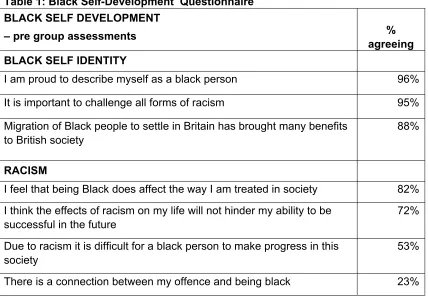
[image:19.595.86.514.456.753.2]The researchers received 46 questionnaires completed by prisoners who had started the programme. Table 1 provides a summary of the percentage of those offenders who either ‘Agreed’ or ‘Strongly Agreed’ with each of the items in the questionnaire.
Table 1: Black Self-Development Questionnaire BLACK SELF DEVELOPMENT
– pre group assessments %
agreeing BLACK SELF IDENTITY
I am proud to describe myself as a black person 96%
It is important to challenge all forms of racism 95%
Migration of Black people to settle in Britain has brought many benefits to British society
88%
RACISM
I feel that being Black does affect the way I am treated in society 82%
I think the effects of racism on my life will not hinder my ability to be successful in the future
72%
Due to racism it is difficult for a black person to make progress in this society
53%
NEED FOR FURTHER EDUCATION
It is important for me to take up training or pursue more educational qualifications
96%
As a Black person my education is not complete 91%
Knowledge of Black history provides you with stability for the future 84% My chances of not reoffending will be improved by knowing more about
education, training and employment opportunities
86%
ABILITY TO CHANGE
I am confident of my ability to alter things I want to change without reoffending
98%
Making changes can be a frightening experience but I am prepared to have a go
95%
I recognize that life is a challenge but that I can change others and myself
89%
SELF AWARENESS
I recognise that I do not have all the answers and that it’s OK to ask others for advice
98%
I am fully aware of my knowledge and skills that can be used to obtain a career
87%
I am able to communicate my views effectively without losing control 93% I am capable of achieving success if given the right opportunities 98%
STRATEGIES
I can identify strategies that will help improve the quality of the relationships I have with others
93%
I will set myself goals that I can achieve without offending 96%
I have important plans for the future 95%
I know how to deal with obstacles that get in the way of my plans 74%
PERSONAL RESPONSIBILITY
It is important to makes choices that do not cause harm to others or myself
83%
I have individual responsibility to make a difference to my future life 98%
I recognise the important benefits or exercising my rights in a positive fashion
95%
I can identify my legal rights and am fully aware of my social responsibilities
What the scale above shows is a group of men with a positive view of being Black and the contributions Black migrants have brought to British culture. Most do, however, firmly believe that the way people are treated in society is influenced by race and that this can affect the ability of Black people to succeed within the society. Interestingly, they do not apply this to themselves; 72% do NOT believe that the effects of racism will hinder their ability to be successful in the future. What is not present, however, is a general belief that their offending is related to being black. It does not appear, therefore, that this group of men are using racism as an excuse for their offending. It might, however, mean that group members have not yet made connections between their experiences within society and their offending behaviour.
The men here obviously recognise the advantages of further education and training and largely recognise that this could reduce their chances of reoffending. They are also very positive about their ability to change. However it has to be said that the high degree of agreement with most of the items relating to change, self awareness and strategies for change has to be cause for concern in a group of imprisoned men as it suggests a likelihood to underestimate the problems they are likely to face in bringing about change in their own lives. Had this questionnaire been repeated at the end of the programme it would be interesting to see whether agreement with items would have decreased in line with more realistic expectations.
4 b) CRIMEPICS 11
As stated earlier CRIMEPICS 11 is a questionnaire designed to assess both the criminal attitudes of offenders and the problems they perceive themselves as currently experiencing.
4 b i) Problem inventory
Chart 1 provides a summary of the percentage of group members who felt they had either ‘a problem’ or a ‘big problem in each area.
Chart 1: Problems reported by group members
• Careers and money are seen as the being the biggest problems experienced by group members (68% and 65% respectively). Also reported as a problem
0 10 20 30 40 50 60 70 M one y R e la tio nsh ips C a re er T em per N e ed fo r e xc item en t F am ily H e alth B ore dom H o using D rin k/D ru gs G am bling D e pres sio n S elf-e stee m Lac k o f c on fide nce Lot s of w or ries In flu en ce o f frie
nd s E du ca tion P
or a big problem by over half of the starters are the police (56%), housing (54%), relationships (51%) and boredom (51%).
• In keeping with results from the Black Self Development Questionnaire (Table 1) self-esteem (16%), lack of confidence (14%) and depression (16%) come a relatively long way down the list of problems.
• Racism (21%) is not seen as a large problem in comparison to the other domains.
Arguably this profile of perceived problems would suggest that the group members should be open to the education, training and employment aspects of the programme as these could provide a means of addressing those areas of need that they see as most pressing.
4 b ii) Attitudes to Offending
The other component of CRIMPEPICS 11 is a 20 item questionnaire that assesses an individual’s attitudes towards offending. As part of the development of CRIMEPICS 11 the questionnaire was administered to a large number of offenders on probation and their scores recorded. This makes it possible to put the results obtained from this group of prisoners into context and allows us to make some judgement of how they compare to similar offender groups. Items on the CRIMEPICS 11 questionnaire are clustered into four different dimensions, each of which reflects one aspect of attitudes to offending.
• General attitudes to offending – the profile of scores from this group of prisoners was very similar to those obtained from the probation group tested during the development of the questionnaire. It would appear, therefore, that the prisoners on the group do not have more pro-criminal attitudes than a roughly comparable group.
•
Anticipation of re-offending – the group members tended to score somewhat higher on this dimension of the questionnaire than those in the comparison group used during the development of the questionnaire. This suggests that they see themselves as likely to carry on offending. This goes against the very positive picture given by the Black Self Development questionnaire which appears to underplay problems the group members think they might encounter in trying to stop offending.•
Evaluation of crime as worthwhile - the members of this group scored higher on this scale than members of the comparison group. This may well mean that group leaders will have a relatively difficult task in persuading group members to give up what they see as a potentially lucrative way of earning a living.Looking at the results from these questionnaires overall it would appear that the prisoners attending the programme would be open to the type of input provided. They perceive themselves as having problems around careers and money and the need for further education, and with the police and relationships. These are all areas covered by the programme. They report themselves as being open to, and able to, change. In fact the scores were so high here as to suggest unrealistic optimism and an underestimation of the difficulties they might anticipate in trying to change. Alternatively it might, to some degree, reflect a stage of development where they feel themselves to have reached the end of the road with offending and genuinely desire a different way of life. Importantly, they acknowledge the existence and impact of racism but do not appear to use this as a way of explaining, or excusing, their offending behaviour.
5) RESULTS SECTION
The results covered in this section will draw upon figures surrounding programme recruitment and completion and other targets explicitly set by the funders. It will also cover feedback from prisoners completing the programme and from certain key stakeholders. Issues arising from these results will be outlined in the subsequent discussion section.
5 a) Programme recruitment and completion
One of the basic tenets of the effective practice agenda that drives work within the Criminal Justice System is ‘responsivity’: the capacity of a piece of work, in this case a programme, to respond to the needs of the offenders who attend it. One of the best measures of responsivity is programme completion, the extent to which individuals choose to continue.
• To date there have been 114 prisoners who have started the programme: this includes some 17 attendees currently attending a group. The programme only needs a further 16 individuals to start before the end of December 2006 for the recruitment target of 130 to be met or exceeded. Taking performance to date this should not constitute a problem.
• 97 prisoners have attended groups that have now run to the end. Of this 97, 57 have gained qualifications of two units or more (59% of the group). This means that only 9 more people will have to gain qualifications before the end of the year for the qualifications target of 66 to be met.
• Of the 40 who did not complete 16 (16%) were transferred to another prison, and 19 (20%) were released early.
• Only 4 of the 97 had left voluntarily. This constitutes a mere a 4% of the total number of people who have started programmes that have run to the end.
The overwhelming majority of those who did not complete the programme, therefore, left for reasons that were beyond their control. It is, obviously, not possible to know how many might have left voluntarily if they had been available for the full duration of the programme. However the number of voluntary drop outs is very small indeed and suggests that the programme is holding the attention of prisoners. In the terms defined above it would appear that the Black Self Development Groupwork Programme is very responsive to the needs of those who attend it. In order to put these results into context it would have been useful to compare these drop out rates with those for other programmes run within the Prison. Unfortunately these figures were not available as the database recording it was not yet fully populated with data.
5 b) Qualifications achieved
As stated earlier targets stated that 66 of the projected 130 group members (46%) should get 2 or more units of qualification.
• All 57 of the those who have already completed the programme have achieved at least 2 units of qualification, some have gone on to achieve 3 units and a few have achieved 4.
When the offenders on the current programme are included it would appear highly likely that this target for qualifications achieved will be easily met or exceeded. The fact that all completers have achieved the required 2 units is impressive. The system for setting targets changed as at the end of July 2006. Under the Offender Learning and Skills Service (OLASS), the Learning and Skills Council (LSC) and its providers will now be responsible for delivering learning and skills to offenders.
[image:25.595.83.506.306.382.2]Table 2 places the achievements of the Black Self Development Programme within the context of the basic skills and work skills targets set for Brixton Prison. This is not a straightforward comparison as the period covered by the the Programme extends beyond the financial year by a few months.
Table 2: Contribution of BSDP to Brixton Prison’s basic skills and work skills targets
Entry level units of qualification
Level 1 units of qualification
Level 2 units of qualification Brixton prison targets
for 2005 – 6 (1 year)
97 252 78
BSDP figures (over 18 months)
56 42 84
Even allowing for the difference in time periods it can be seen that:
• The Black Self Development Programme has contributed significantly at entry level.
• Prisoners on the Black Self Development programme achieve 84 units of qualification at this higher level, more than were achieved at either of the lower levels .
Whilst a broad range of educational projects have ensured that the basic skills targets set for Brixton Prison have been exceeded, it can be seen that the Black Self Development Programme has contributed significantly. It remains an open question as to whether it would have been possible to engage the men involved on the programme in other educational activities offered by the prison. Arguably by offering an ‘in’ that reflected their current interests these men have been stimulated to both become involved in learning and achieve at a relatively high level.
5 c) Employment on release
reasons for this will be explored at some length later in the report but, briefly, this broadening of the target group reflected both programme tutors’ and prison staff’s beliefs about who would benefit from the programme. In recognition that other aspects of the programme might be effective in moving prisoners down the road to employment Job Centre Plus agreed to remove the employment target altogether, a significant move by an organisation focused on getting people into employment. This changing of targets could, arguably, be conceptualised as a move towards accepting increased employability as an outcome rather than employment.
With the removal of the employment target it appears more than likely that this project will exceed the targets set for it at the outset and will have contributed significantly to the pre August 2006 targets for Brixton Prison.
5 d) Post Programme Measures
5 d i) Post Programme Questionnaires
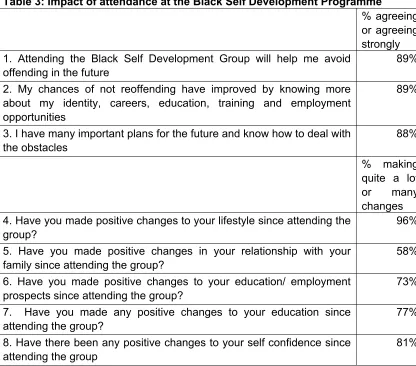
[image:26.595.87.503.375.741.2]Post programme questionnaires were available for 26 of the group members who had completed the programme. Part of the reason for this shortfall was that the report was being compiled whilst groups were still being run; others had simply not been completed.
Table 3: Impact of attendance at the Black Self Development Programme
% agreeing or agreeing strongly 1. Attending the Black Self Development Group will help me avoid
offending in the future
89%
2. My chances of not reoffending have improved by knowing more about my identity, careers, education, training and employment opportunities
89%
3. I have many important plans for the future and know how to deal with the obstacles
88%
% making quite a lot or many changes 4. Have you made positive changes to your lifestyle since attending the
group?
96%
5. Have you made positive changes in your relationship with your family since attending the group?
58%
6. Have you made positive changes to your education/ employment prospects since attending the group?
73%
7. Have you made any positive changes to your education since attending the group?
77%
8. Have there been any positive changes to your self confidence since attending the group
This questionnaire asked attendees to rate the extent to which they agreed with a number of statements about the programme and its impact upon them. The results in Table 3 show a positive response to most of the items on the questionnaire. It is, however, difficult to interpret those regarding employment and family relationships as these will mainly be realised on release. At this stage, therefore, it is possible that they only reflect intentions rather than any changes in actual behaviour.
5 d ii) Significance of the group to attendees
As a further measure of impact group members were also asked to rate how important attending the Black Self Development Group had been to them on a 1 (not at all important) to 10 (very important scale).
• Of the 26 group members who completed the post programme assessments no-one scored lower than 7 on this scale (12% scored 7; 15% scored 8; 19% scored 9; 54% scored 10).
It can be seen therefore that the programme figured significantly to those who completed it. Again this information was only available for 24 of those who completed.
5 d iii) Expectations of the programme
On a similar 10 point scale group members were asked to rate the extent to which their expectations of the group had been met.
• The spread of responses was greater than for the previous question (8% scored 1-2; 19% scored 4-5; 15% scored 6-8; 58% scored 9-10).
Despite this larger range over half of attendees who filled in the post programme questionnaire reported that their expectations had been met to a very high degree.
5 e) File reading
In an attempt to flesh out the questionnaires a sample of 15 prisoners files were examined. Of these, 8 offenders had achieved 3 units (53%), 4 offenders had achieved 2 units and 3 offenders had achieved 4 units. Eight of the 15 reported wanting to go back to college or continue with their studies in the next year and 10 out of the 15 wanted to achieve goals in relation to careers and employment. The regular reviews by tutors had 11 of the 14 offenders assessed in terms of good, very positive and fair to good. Three offenders had periods where attendance needed to be improved but who then went on and settled down to the course.
5 f) Evaluation of individual sessions
Completers were also asked to rate their satisfaction with individual sessions. Chart 2 collapses the scores into a) ‘Excellent or Very good’ b) ‘Good’ c) Fair No-one scored any of the sessions as ‘Poor’ (Chart 2). The results suggest a very high level of satisfaction with the content of the programme. Those most commonly rated ‘Very Good’ or ‘Excellent’ were:
• Uniting black families
• Writing CVs/disclosure letters
• Know your roots
• Healthy relationships
Chart 2: Evaluation of Programme sessions
The range of these responses is interesting in that it suggests that attendees are responding well to all aspects of the programme. The responses to the sessions relating to race are particularly interesting given that racism did not appear to be a major preoccupation in the pre programme questionnaire. These are findings that will be further explored in the next section which looks at feedback from group members. 0% 10% 20% 30% 40% 50% 60% 70% 80% 90% 100% In tro du ction K no w yo ur ro ots B la ck m
igra tio
n to U K U nitin g Bl ac
k fam ilies D ec is io n m a kin g D is co ve ring s kills a
nd kn ow le dge Ch an gin g b eh avio u S ellin g y ou rs elf E qu
al op p ortu nitie s R ec la im in
g co ntrol W ritin g CV /d is clo su res H ea lth y Re la tio ns hips S elf M
6) FEEDBACK FROM GROUP MEMBERS
Feedback from group members was assessed in two ways. Firstly one component of the post group questionnaire asked attendees to write what were 3 goods things about the group and what were 3 things they would like to be improved. For the two most recent groups, however, the evaluators trained two ex group members to conduct a structured group interview with those on the programme. It was felt that this would provide a way for these two men to augment their range of skills and thus to be in keeping with the empowerment focus of the programme. In addition it was felt that seeing ex group members exercising these skills would send a valuable message to the current group members. A more practical concern was that there were no Black evaluation staff available to conduct the interview. (Collated results are included as Appendix 2).
The questions asked by these 2 interviewers were exactly the same as those in the questionnaire, good things and improvements. The wording of these questions is important as they are completely open, do not suggest any line of response and therefore help to ensure that group participants respond with their own views. This approach does, therefore, flesh out the more direct questioning that had been included in the questionnaires. The results from this interview are included as Appendix 3. As can be seen there are striking similarities with those collated from the written questionnaires.
In keeping with findings when the group was run within London Probation (Durrance et al, 2001) the results were very positive. Group members found the sessions informative, particularly in relation to their improved understanding of history which appeared to feed into thoughts about identity. They appreciated being listened to and the supportive, all black, structure of the programme which allowed them to explore issues in safety. They reported that attendance gave them greater confidence and increased self knowledge and motivated them to learn more. For some there were practical considerations like improving grammar or interviewing skills. Interestingly only one person mentioned getting a qualification.
The likelihood of the programme reducing their chances of reoffending was rarely mentioned. Given the programme is aimed at moving individuals away from offending this could well be seen as problematic. However given that Control Theory argues that the presence of meaningful roles and relationships, feelings of belonging and a positive identity are predictors of non-offending we remain relatively unconcerned by the lack of references to offending as it appears that attendees may have moved to a place where they are focusing on the future rather than looking back at the past. Gove (1985) has argued that increasing comfort within social relations and an increased concern for others within the community rather than self absorption and increasing concern with issues regarding the meaning of life are linked to desistance from crime (Gove, 1985, in Maruna, 2000, p. 34). The items generated from these feedback sessions could be seen as reflecting this larger picture.
criticisms, one person found a degree of repetitiveness and another wanted more one to one support. There were also issues around group members being moved before they could finish the programme. But overwhelmingly group members wanted greater input in terms of a longer course, its availability both in other prisons and in the community. They would also like to have similar input available to them after release. Whilst group members appear to value the practical aspects of the programme, overall the impression is that it is the developmental aspects relating to themselves as black men that are particularly valued. Especially when combined with the very low rate of drop out not related to early release or being moved to another prison, this feedback suggests very strongly that the programme is meeting the needs of the group members.
7) STAKEHOLDER FEEDBACK - defining success
A range of staff involved in the project were interviewed in order to get a rounded view of the perceived success of the project and any issues that had arisen. These were the 2 programme tutors, the programme administrator and their manager from London Action Trust, two LAT directors and the Head of Learning Skills as Brixton Prison. Perhaps inevitably views regarding success tend to vary depending upon where one sits in relation to the project and the demands of the particular work role.
Inevitably the first concern has to be with meeting the targets set for the project. At the time of interview the Head of Learning Skills at Brixton Prison was concerned about the project not meeting its employment targets:
‘we have to define outcomes in terms of stats. It hasn’t met its employment targets which is a difficulty’
Without these figures she found it difficult to provide a view as to whether or not the programme had been successful. However as we have seen earlier this employment target was subsequently removed by the funders. Unfortunately this was not the end of the issue as the original target had been incorporated into a Service Level Agreement. As the Head of Learning Skills was not informed when this was removed the SLA was not changed and, so far as the prison was concerned, the target remained.
One of the LAT director also defined success in terms of targets. He stressed the timeliness of the project which had never been behind schedule, this being unusual as projects tended to fall behind in the initial start up period. Other LAT staff understandably saw the reaching of other targets as important indicators of success, a view also endorsed by the Head of Learning Skills :
‘if there has been no previous learning then completing is quite something’ (Head of Learning Skills)
information about the course amongst inmates. This was echoed by the course administrator:
‘I think it’s effective in terms of the enthusiasm people show when on the programme and the way they talk about it to other inmates...it shows the programme has an effect on the people and it’s almost like recommending it….the end of programme celebrations are an eye opener when people make their speeches because they recognise the empowerment and want to use it’
Equally an unexpected outcome for an LAT Director was the way the prisoners talked about wanting to share and pass on their learning to family, particularly children and how it seemed to inspire the prisoners to continue with their learning. There was a general feeling that the course had fired the imagination of those who had participated. The LAT Executive Director also spoke of a recent end of course presentation and how much the qualification had meant to someone who had never obtained a qualification before.
Particularly to LAT staff, concepts of success reflected their more holistic approach and were more likely to be defined in terms of meeting the needs of the individual rather than in meeting particular targets.
‘It’s about them getting in touch with themselves, who they really are, not necessarily just about reoffending’ (Programme Tutor)
These staff reinforced the message that prisoners have their own targets other than employment and education and what they learn and choose to pursue at the end of the course may not fit other agencies’ agendas. In addition when they get out of prison they often have other issues to deal with which may preclude immediately getting a job.
Perceived changes in attitude were also taken as some indication that the programme was having an effect. When asked whether they have any measures of changing attitudes on the course, the Basic Skills tutor said it was hard to give figures as they do not have contact with people after the programme, ‘we don’t know what they are doing with their lives and we don’t have the opportunity to get hold of them’. This lack of ongoing contact to some degree reflected his role which only covered work throughout the duration of the programme.
In contrast, the role of other programme tutors involves a degree of aftercare with staff being expected to maintain contact after release from prison. This did in fact materialise with ex group members getting in touch after their release.
The same tutor spoke of some prisoners who had been released and where she had heard about what had happened to them afterwards:
’There were quite a few older guys who had ongoing drug issues, their main thing was to get themselves into rehab and cut off from the environment and certain associations that they had been influenced by their whole lives and a few of them actually have done that…there was another young man who was really into theatre production, he was focused and did every course available as well as the black self development. Once he was released he got in touch with me and was still focused towards his goal of theatre, which is actually what he is doing now…..it’s about them getting in touch with themselves, who they really are, not necessarily just about reoffending.’ (Course Tutor)
This was about ex group members taking the time and trouble to make the approach themselves not staff chasing them up. Inevitably, however, things do not always work out as one would hope.
‘When I walk on the street I still see some of the people that have completed the programme and have been released. I have seen the improvement in them but they have since gone steps backwards.’ (Course Administrator)
Overall, one of the LAT directors who supervises the project felt that the Black Self Development Projects was ‘one of the most successful projects that we (LAT) have done’. When asked what LAT had got out of running the project, the LAT Director felt that the morale of the organisation had been raised by having a good project that was making a difference. It’s raised their profile, they have good relationships with the partners of the project and they have been approached by other prisons. The Executive Director said it raised their profile with other organisations and gives them more credibility because they can show what they can do, particular as he is a white manager but the project is run by black staff. In their newsletter they have showcased the project and it helps to create an ethos around the work we do and boost morale when we can talk about a successful project where we are doing it well.
8) EMERGING ISSUES
A number of issues have emerged from this evaluation some of which are specific to this project, others will, however, be more generally applicable. In this section we seek to draw out those learning points that we think organisations contemplating running similar projects might need to consider.
8 a) The relationship between targets, recruitment and funding
Initially because the project was partly being funded by Job Centre Plus employment targets were, understandably, classed as an important outcome. In order to meet this target it was important that offenders should be approaching the end of their sentences. The stipulation was that recruitment should be focused on prisoners with 6 months or less of their sentence still to serve. In fact this did not occur and prisoners with considerably longer than this left to serve were accepted on to the course. One problem with recruiting prisoners who had a long time to serve was that they were very likely to be transferred to another prison and therefore not be able to complete the course. Equally when prisoners on remand were accepted onto the programme there would be completion problems as they were unlikely to return to the prison after their cases had come to court.As the Head of Learning Skills put it ‘they have adopted a scattergun approach to recruitment’, something that would need to be addressed if targets were to be met in order to meet the SLA all were working towards.
In actuality, however, this ‘programme drift’ appeared to flow from a mismatch between the stated project targets as they then stood and the multi faceted, holistic nature of the programme. For staff running the course changing thinking was the prime purpose of the programme rather than getting prisoners into employment and inmates were accepted if it was felt they could benefit from this aspect of it. Moreover it was not only LAT staff who felt that the target group should be wider as prison officers referred prisoners to the programme when they felt it could help with issues they were facing regardless of whether or not they fitted the criteria.
At the time, therefore, it appeared that other sources of funding might have better reflected the focus of the programme.
‘Job Centre Plus is wanting figures and evidence around employment whereas our main interest is around reoffending and changing behaviour. Funding with a more holistic approach (would be) preferable.’ (Executive LAT Director)
It is to the credit of everyone concerned, particularly Job Centre Plus, that the employment target was subsequently removed. This appears to reflect an acceptance that increasing employability through influencing attitudes towards employment could provide a valuable step along the way to eventual employment.
Yet as we have seen this type of work is best approached, and possibly can only be approached, within an all Black environment. So long as securing finance remains a particular problem there will always be a temptation to accept funding from bodies whose priorities do not entirely map onto the characteristics of the programme. This, in turn, may lead to key targets not being met as was the case here until the funders responded by amending them.
8 b) Differences in ethos between voluntary and statutory organisations
A further dimension of this debate relates to common differences in ethos between statutory and voluntary organisations and their different approaches to how targets should be viewed. Voluntary organisations are generally seen to be more flexible about how services are delivered and more likely to be organised around a holistic response of an individual’s needs. This is seen as their strength and, often, the reason they are employed in the first place. In contrast, statutory organisations’ strengths are seen in terms of control of resources and more universal provision rather than responding to the issues pertinent to particular individuals.
Arguably all the prisoners were suitable in terms of being able to benefit from the developmental aspect of the programme but some were not suitable in terms of meeting the short term employment targets as originally envisaged. The targeting of this programme could, therefore, be viewed as the staff being flexible and focusing on the needs of the individual or it can be seen as programme drift in terms of the expectations of the funders. The funders and commissioner of this project were initially focused on the academic and employment related outcomes of the course. Whilst these are valuable outcomes they are not its main focus in terms of the underlying theory of change. Though the situation was resolved here by removing the employment target there may be problems in the future with similar projects if these different foci are not fully acknowledged and managed. Otherwise a paradoxical situation may arise in which external bodies are recruited for their person centred approaches, approaches which by their very nature will lead to problems with meeting strictly defined targets.
8 c) Closed Black only groups
A degree of disquiet regarding the all Black and closed nature of the group also emerges from the evaluation. This appears to emanate from a number of different sources. Firstly it appears that there are misunderstandings as to what the programme is about or how materials were used. This was a theme in the offenders’ interviews with reports that some prisoners had misunderstood, thinking it is just black history, a perception that might attract some but put others off. Equally other prisoners thought it was about negative black history, a perception that might not be corrected if they drop out at an early stage.
‘All our courses are about people taking responsibility for their own behaviour and we are concerned if we think that any of them are not based on this. It’s OK for racism material to be used as context but we need to ensure that people move beyond this to accept responsibility for their own behaviour.’
This, of course, reflects the exact aim of the programme but because there were problems around access for inspection purposes it was not possible to deal with this type of anxiety. The prison has an obligation to inspect any course within the prison unannounced but it did not have black staff and LAT felt that it was only appropriate if there were black observers. This problem was recognised at the time and led to the Head of Learning Skills contacting Tower Hamlets College with a view to them providing a black staff member who would be qualified to observe the group. Unfortunately there was no such person available so rather than place a non black observer within the group the observations were not carried out.
The subject matter of the course itself is difficult because it accepts the reality of racism. The course aims to help black people challenge racist behaviour and to be more assertive as well as seeing the positive contribution that they as black people can make to society.
Interestingly programmes of this type can themselves be seen as racist because they exclude white prisoners, staff and supervisors. The head of Learning and Skills in the prison had initially opposed the project as, on reviewing the literature, she felt there was a lack of empirical evidence to support the need for separate provision (Calverley et al, 2004). However once it had been agreed that the programme would go ahead it received the full backing of the Learning Skills Department. She had also heard from Feltham that the project had been rejected as racist.
‘We used to have an accredited black history course – we are required to meet the needs of all the prisoners here. We saw this as good because it was not exclusive to black offenders – white offenders could go as well.’ (Head of Learning Skills)
Whilst understandable, this thinking does not fit easily with what the Black Self Development Programme is trying to achieve. Staff working on the programme speak of how it is only in a completely black group that some feel safe or are able to be open about their feelings on racism and other issues. This is reinforced by the feedback from offenders who obviously appreciate the opportunity that being in an all Black group gives them to explore new issues around race. Thinking back to the all women groups in the 1970s and 80s provides a potentially useful parallel to understanding how Black offenders might feel.
‘you don’t want to offend your white probation officer because you don’t know what the repercussions will be, you can’t have the conversation with your white friends, so we were saying we need to have the conversation, we need to have the debate. But it’s not a ‘let’s beat up white people’ forum. Part of the issue in terms of selling it was to get our white colleagues to understand that we were not getting the next Black Panther movement.’
Some of the issues here reflect relatively straightforward misunderstandings regarding content of the programme. Discussing issues relating to race, however, often causes discomfort and considerable courage is likely to be needed if views and anxieties are to be adequately identified, acknowledged and aired by representatives from different organisations. Ironically, for this to happen, staff would need to feel supported in the same way as the offenders attending this programme. It is possible that disquiet around race is related to the reported difficulties in securing funding.
Equally getting prisoners to look at their experience of racism is likely to cause some reaction and there needs to be discussions as to what these might be and how they might be handled by all staff. Strengthening links between programme staff and the prison’s Diversity Department might prove the most productive way of taking this forward.
8 d) Staffing - recruitment and supervision
Dealing with the impact of racism on one’s development and daily life is not only an issue for prisoners but may also resonate with staff members who may have had similar experiences. Because of the nature of the programme staff need to have reached a stage in their own development where they feel confident in dealing with whatever issues may be generated by group members. The selection and training of staff is consequently a crucial issue. The developers of the programme are very clear that this is not a programme that can be delivered by any member of staff but suitability is not necessarily obvious at recruitment. When programmes were run within organisations such as London Probation or Youth Offending Teams staff who were subsequently found not to be suitable, or who decided this for themselves, could always be diverted to other work. This is not true however in the voluntary sector where staff are recruited to a specific project and have nowhere else to go within the organisation. In the case of this particular project, employing an external agency with a track record of running groups of this type has brought staff with the requisite expertise and experience but if similar groups were to be run elsewhere this would not necessarily be the case.
8 e) Running the programme within the prison
A number of issues around running the programme within a prison environment were also raised, some were felt to raise particular challenges but there were also some advantages.
• Different priorities and procedures - the project involved LAT staff working
within an environment that inevitably had its own agenda and procedures, the programme essentially being an island within a larger host organisation. This can means that there may be little scope for changing the local working environment to reflect what is needed in order to run the programme.
• Amending the programme - the programme had to be reduced to 8 weeks
in order to fit it within a time period that would allow prisoners to complete the cou