1
University of Twente
Faculty of Behavioural Management and Social Science
Bachelor Thesis European Public Administration
Author: Lea Amanda Eversmann (s1231707)
First Supervisor: Dr. Ann Morissens
Second Supervisor: Prof. Dr. Ariana Need
Date of Submission: 23-04-2015
The Asylum Qualification Directive
2
Abstract
The establishment of the Common European Asylum System (CEAS) marked a milestone in
the European Union’s (EU) creation of an area of protection and solidarity for the most
vulnerable. European member states are confronted with several regulations and directives
adopted within this system, many of which they are obliged to comply with due to the
legislative instruments used by the EU. Nevertheless, member states still have room for
making some articles more favourable for asylum seekers. One of the directives that plays a
key role in the CEAS is the Asylum Qualification Directive. Little is known about the extent
to which members are making use of this possibility and what this means for the rights of
asylum seekers.
3
List of Abbreviations
AsylG
Asylgesetz
AslyVfG
Asylverfahrensgesetz
CEAS
Common European Asylum System
EU
European Union
GDP
Gross Domestic Product
UDHR
Universal Declarations on Human Rights
UN
United Nations
UNHCR
United Nations High Commissioner for Refugees
TFEU
Treaty on the Functioning of the European Union
TEU
Treaty on the European Union
4
Table of Content
Abstract ... 2
List of Abbreviations ... 3
1. Introduction ... 5
1.1 Scientific and societal relevance ... 7
1.2 Thesis Outline ... 8
2. Background Information ... 8
2.1 A Historical Review of the International Refugee Regime ... 8
2.2. The Common European Asylum System ... 10
3. Theoretical Framework ... 12
3.1 A Definition of ‘Venue-Shopping’ ... 12
3.2 ‘Venue-Shopping in the Context of EU Asylum Policy ... 13
3.3 The two contrasting views: Guiraudon versus Kaunert & Léonard ... 14
3.3.2 Kaunert & Léonard – A more liberal Trend in EU Asylum Policy ... 15
3.3.3 Résumé ... 16
4. Methodology ... 17
5. Analysis ... 19
5.1 The legal documents ... 19
5.1.1 The Asylum Qualification Directive ... 19
5.1.2 The national legislations of Austria, Ireland and Germany ... 20
5.2 Comparison of the Implementation ... 23
5.2.1 The Asylum Qualification Directive compared to the AsylG of Austria ... 23
5.2.2 The Asylum Qualification Directive compared to the Immigration, Residence and
Protection Bill of Austria ... 36
5.2.3 The Asylum Qualification Directive compared to the AsylVfG of Germany ... 49
5.3 Differences and Similarities of the implementation ... 63
6. Conclusion ... 66
References ... 68
5
1. Introduction
For more than sixty years, the granting of asylum and the protection of refugees has been a
fundamental right, which was first mentioned in the Geneva Convention in 1951. Article I
declares asylum to be an international obligation which is granted to people who “fear of
being persecuted for reasons of race, religion, nationality, membership of a particular social
group or political opinion […] outside the country of his nationality” (Geneva Convention,
1951). Regarding the European Union, the asylum policy is part of the Area of Freedom,
Security and Justice. Article 78 of the
Treaty on the Functioning of the European Union
(TFEU) states that the EU “shall develop a common policy on asylum, subsidiary and
temporary protection with a view to offering appropriate status to any third-country national
requiring international protection and ensure compliance with the principle of
non-refoulement
”(TFEU, 2012).
This common policy on asylum referred to in the TFEU is the Common European Asylum
System established in 1999. Since the 1990s, Western European countries are challenged by
an influx of refugees and asylum seekers which is one of the most contesting political
challenges they face (Overbeek, 1995). With the creation of the borderless European
Schengen Area in 1985, the EU countries agreed upon fundamental values and joint
approaches regarding the protection for refugees and asylum seekers. This shared
responsibility makes it absolutely essential to have uniform standards across all member states
in order to treat every applicant in the same way regardless of where the application proceeds
(European Commission, 2014a). Since 1980, there is a recognizable shift in competencies of
asylum policies from the national to the EU level. This need led to the aforementioned
establishment of the CEAS, an area of protection and solidarity for the most vulnerable
(European Commission, 2014a).
The core of the CEAS consists of different legislative instruments: The Asylum Procedures
1Directive and Qualification Directive
2guarantee the similar process for the application of
asylum throughout the European Union and the adequate assessment of the applicant’s
refugee or subsidiary protection status. If the qualification was successful, certain rights such
as residence permit or access to the labour market and health care are given. The Reception
Conditions Directive
3ensures humane material reception conditions such as housing and that
fundamental rights of the persons are fully respected across the EU. The Dublin Regulation
4established a system determining the state responsible for the asylum application while the
EURODAC
5Regulation ensures that each applicant’s fingerprint is taken and sent to a
database called EURODAC.
As member states face distinct conditions and experiences with asylum seekers, the EU
allows member states to interpret the regulations and directives less stringent than prescribed.
This is where the thematic priority commences. This study assumes that the status quo in the
6
field of asylum policies in the European Union is a result of ‘venue-shopping’. Existing
literature shows that two contrasting views are prevalent. One the one hand, it is assumed that
the policy venue of asylum policies at EU level leads to more restrictive national policies and
on the other hand, the EU still offers countries power to be more favourable towards more
liberal national asylum policies.
Authors such as Guiraudon (2000), Kaunert & Leonard (2011), Mauer & Parkes (2007) or
Lavenex (2006) are also arguing that increasing cooperation at the EU level is due to national
policy makers trying to avoid national obstacles and pressures faced at domestic level. This
process can be best explained by ‘venue-shopping’. It is “the search by rational policy-makers
for new venues of policy-making that are more amenable to their preferences and goals”
(Kaunert & Leonard, 2011 p.1). The assumption that European institutions are more
‘migrant-friendly’ compared to national actors (Kaunert & Léonard, 2012) motivates policy actors to
venue-shop. Guiraudon (2000) and Kaunert & Leonard (2011) have two opposing views on
whether venue-shopping leads to more liberal or to more restrictive national asylum policies.
As the transfer to the supranational level resolves judicial constraints and hampers activities
of pro-migrant groups, Guiraudon (2000) argues that venue-shopping leads to the adoption of
more restrictive asylum policies on the national level. However, Kaunert & Léonard (2012)
have a different view. The authors assume that broader changes within the EU itself, new
treaties, such as the Lisbon Treaty in 2009 amending duties, responsibilities, decision-making
processes and changes to the EU’s ‘system of venues’ have left to more liberal national
asylum policies. These two contrasting views and the member states’ possibility to interpret
regulations less stringent than predefined form the main part of the upcoming thesis. It
investigates on the outcomes of the CEAS in three EU member states and examines how these
countries have interpreted the Asylum Qualification Directive into their national legislations.
Thereby, either the argument of Guiraudon (2000) that venue-shopping leads to more
restrictive national policies or the argument towards more liberal national policies by Kaunert
& Léonard (2012) can be confirmed.
For the analysis, the national legislations of Austria, Ireland and Germany are examined
towards their interpretation of the Asylum Qualification Directive. According to this, the main
research question is as follows:
“What are the consequences of the implementation of the Asylum Qualification Directive for
national asylum policies in Austria, Ireland and Germany?”
7
first, the outcome of venue-shopping is more liberal national asylum policies in Austria,
Ireland and Germany and second, the outcome of venue-shopping is more restrictive national
asylum policies in Austria, Ireland and Germany.
1.1 Scientific and societal relevance
The aim of the thesis is to find out and evaluate the outcomes of national politicians deciding
to ‘shop’ to the EU level in the field of asylum. Several authors agree that
venue-shopping is the main explanation for the European co-operation in the area of asylum policy.
There are several reasons urging national asylum politicians to shift to the EU level which
make this topic relevant. Worldwide, but especially in the EU, the numbers of asylum seekers
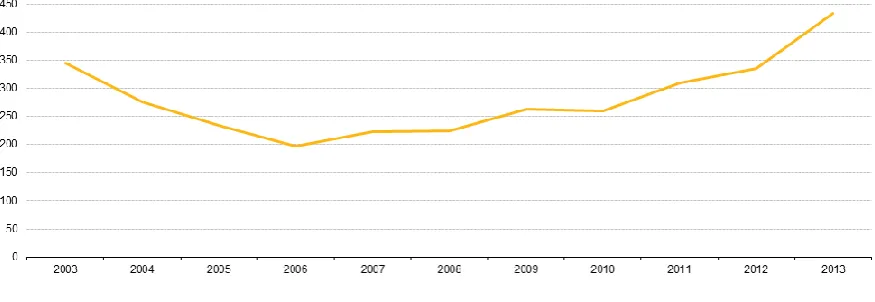
are steadily
6increasing. In 1992, 670.000 asylum applications have been registered from
non-EU countries to the non-EU-15. Respectively in 2001, numbers decreased to 424.000 and only
200.000 in 2006. The highest number of asylum applicants to the EU-28 after the millennium
turn have been noticed in 2013 with 450.000 (Eurostat, 2014). Since 2009, the Charter of
Fundamental Rights and the TFEU entail the EU’s duty on the internal protection of people
fleeing from their home countries as a human right. The reasons for people fleeing are stated
to be persecution, the real risk of suffering serious harm if people have to return to their home
country and reasons such as war, terror or natural catastrophes (European Commission,
2014b) are quoted. The alarming numbers and the adopted duties show that the joint
approaches of the CEAS are urgently needed to be concrete and efficient, and to provide the
member states with means to successfully cope with the many asylum seekers in their
countries.
Next to the high numbers of people seeking refuge in the EU and its commitment to guarantee
international protection and well-being to the people in need, other venues influence asylum
policy, too, making this topic highly relevant. Worldwide, the increase in violent conflicts,
border issues and environmental catastrophes due to the climate change contribute to the high
number of asylum seekers in the EU. It is not possible for politicians to make decisions on the
national level anymore, as these incidents are entangled globally. Thus, the national
politicians call for EU regulations dealing with this complex issue on which they can rely in
order to amend their national policies.
Even though, the establishment of the CEAS and the directives and regulations are a
milestone in EU asylum policy, criticism as from Fekete (2005) has come up arguing that it is
not possible for the EU to objectively assesses whether an asylum seeker is in need of
protection due to war and conflict if there are quotas determining the amount of refugees
admitted and deported. Moreover, they state that the common asylum policy is shifting from
the protection of refugees to the protection of states. Especially those EU countries with
external borders (e.g. to Africa) seem to be overwhelmed with the situation of refugees
arriving at their borders, as reported by the media.
By capturing the thoughts of Guiraudon (2000) and Kaunert & Leonard (2011) and applying
their theoretical approaches to three concrete cases: the national legislations of Austria,
8
Ireland and Germany, one can see how the EU itself and the respective countries are have
dealt with this issue and whether different interpretations exist.
1.2 Thesis Outline
The bachelor thesis is introduced by a historical review of the international developments of
the refugee issue. Since the UN took over responsibilities, the EU grew in its role as the
international framework is binding. As a consistent consequence, the EU established its
Common European Asylum System to assist its member states with means to cope with
asylum seekers and guarantee rights for the persons concerned. Since the CEAS is the core
system in the context of EU asylum policy, its illustration is needed to understand the
proceedings and underlying conditions for the applications of asylum seekers in the EU. As
mentioned before, the main explanation for the shift is called ‘venue-shopping’, presented in
its details in the then following theoretical part. Both contrasting views are highlighted in
order to have a basis for the assessment of the more liberal or more restrictive interpretation
of the Qualification Directive to the national legislations. Ensuing, the methodology part
clarifies the proceeding of the analysis as well as reasons on selection of the Qualification
Directive, German, Austrian and Irish legislation. The subsequent analysis part is the actual
comparison between the Qualification Directive and its implementation into the respective
national legislations concluding with an overview of the results, showing the either more
liberal or restrictive trend of the particular national legislation as well as general similarities
and differences. Finally, the conclusion completes the thesis.
2. Background Information
2.1 A Historical Review of the International Refugee Regime
In order to be able to understand the full scope of the subject matter on refugees and why it is
necessary to consider it on the international level, a review on its history is required. The early
incidents presented lay down the foundation for the EU’s necessity to deal with the issue on
refugees. With the establishment of the CEAS, the EU reacts to the binding international
framework and responds to assist the member states and provide them with efficient and
effective means. In the earlier times, when international political actors understood that the
refugee issue was not a temporary concern, the United Nations (UN) took responsibilities
7.
The General Assembly ratified the right of asylum as a human right in its Universal
Declaration of Human Rights (UDHR), which marked a milestone in asylum policy.
Paragraph 1 and 2 of Article 14 define: “Everyone has the right to seek and enjoy in other
countries asylum from persecution” and “this right may not be invoked in the case of
persecutions genuinely arising from non-political crimes or from acts contrary to the purposes
and principles of the United Nations” (UN General Assembly, 1948).
7
9
In 1950, the United Nations High Commissioner for Refugees (UNHCR
8) came into
existence. The new agencies’ goals were the supply of protection for refugees in an
international setting implying the assistance with their assimilation in the new communities,
facilitate voluntary repatriation and assist governments with relocations and seek permanent
solutions (Feller, 2001; Barnett, 2002). It became an individual permanent body with its main
task to make sure countries operating in compliance with the
United Nations Convention
Relating to the Status of Refugees
, signed in 1951. The Convention sets out the standards of
the proceeding with refugees, grants rights and freedoms and defines the world community’s
responsibilities in the refugee field (Nanda, 1980). Until today, the 1951 Convention
continues to be the only legally binding international instrument in the field of migration and
asylum which has only been amended once. It was criticised as its relatedness only
compromising the refugee movements of the time before 1951 and as being too
individual-oriented. For this reason, the
1967 Protocol Relating to the Status of Refugees
9includes a
more extensive definition on refugees:
“every person who owing to external aggression, occupation, foreign domination, or
seriously disturbing public order in either part or the whole of his country of origin or
nationality, is compelled to leave his place of habitual residence in order to seek refuge in
another place outside his country of origin or nationality” (Protocol Relating to the Status of
Refugees, 1967, Art.1).
The creation of the European Single Market in the 1980s further strengthened problems
concerning refugees as the free movement of goods, services, capital and persons attracted
even more asylum seekers. Contributing to that, the general reasons behind people fleeing
have shifted to protected civil war, communal violence and civil disorder; conflicts are fuelled
by superpower rivalry and aggravated by socioeconomic problems in developing countries.
On the one hand, refugees felt to be threatening the economic and political stability, which led
to increased border controls, harmonization of standards and deportation of refugees has
become the norm (Feller, 2001). However, on the other hand, it further increased the attention
of political actors to rethink policies as the EU was questioned to act due to an international
connectedness and in order to assist their member states.
Especially within the twentieth-century, the European countries were faced with rising
numbers of asylum seekers which resulted in increased measures for the reduction of asylum
claims. Scholars such as Bloch & Schuster (2005) or Fekete (2005) entitle the EU as a
‘deportation machine’. Ever-increasing pressures on states in the early 1990s have rendered
deportation
10, detention
11and dispersal
12as ‘normalized’ actions to manage and control
immigrants. The EU member states defend those actions as provisions to spread costs of
reception and to prevent a dense population of refugees in a certain area (Schuster, 2005).
8 Also referred to as UN Refugee Agency
9Available at http://www.unhcr.org/3b66c2aa10.html
10 Deportation implies the physical removal, the ultimate exclusion of individuals or groups from the territory of
a state (Schuster, 2005). It takes place when border controls failed to prevent unauthorized entry. For more information see Ellermann (2008)
11
Detention means the enclosure in a camp or prison and consequently the exclusion from the receiving society (Schuster, 2005).
10
‘Deportation, detention and dispersal’ are exposed to criticism as the 1951 Convention and
subsequent international law are harmed as they abuse human rights and penalize individuals
(Fekete, 2005; Schuster, 2005).
With the fall of the Berlin Wall in 1989 and the collapse of the Soviet Union (early 1990s), a
growing movement of refugees was noticed again. Therefore, European states more and more
engaged in policy debates on the harmonization on common standards and solutions. This was
where ‘venue-shopping’ became an issue in asylum policies towards more restrictive
measures. Until the creation of a Common European Asylum System in 2004, member states
already initiated visa restrictions, carrier liabilities and fingerprints, which later were inherited
in EU directives implemented under the CEAS between 2003 and 2004 (Schuster, 2005).
Still in operation today, about 60 years after its foundation, the Convention continues to be the
only legally binding international instrument in the field of migration and asylum. Differences
across countries and regions in expulsion, the increasing expansion of trafficking in human
beings and illegal migration contributed to obscure separation between migrants and refugees.
It significantly harms the UNHCR’s tasks to ensure international protection as there are more
people in need than instruments for protection available (Feller, 2001). The development of a
Common European Asylum System and key directives for the determination of procedures
determining rights, procedures and minimum standards is a corollary. As mentioned before,
the dealing with refugees has a long history and is an ever increasing important and complex
issue, as the lines between refugees and migrants are blurry. This required that the status of
refugees is determined for further process. This is the task of the Qualification Directive,
which is in the focus of this thesis. The directive is of vital importance for the EU member
states and the refugee alike.
2.2. The Common European Asylum System
Taking the previous historical review into account, effective asylum policy requires inter-
state co-operation under the 1951 Convention. With regards to the European Union, the issue
became relevant with the approach of the free movement of goods, services and persons
within the Union (Lambert, 2009). As the Treaty of Amsterdam shifted the field of asylum
and migration from the third to the first pillar, it facilitated that harmonized asylum policies
could be set at the European level. Moreover, the Tampere Meeting of 1999 set the basis for a
common area of freedom, security and justice in which the then 15 member states agreed on
the establishment of the Common European Asylum System in 1999. According to Lambert
(2009), the prosperous harmonization is dependent on common legislation in the form of
judicial understandings, principles and norms concerning refugee matters. The European
Commission’s exclusive right to propose legislature marked the beginning of four key
directives and two regulations on matters of asylum in the first stage of the CEAS.
11
access to employment, education, housing, training, subsistence, and health for the reception
of asylum seekers; Dublin II refers to the mechanisms defining the member state responsible
for the process of application
13; the Qualification Directive sets a common set of criteria,
which can be utilized in the definition of refugees and lately the Asylum Procedures Directive
concerning the procedures of asylum claims and the rights to interviews, legal assistance and
appeal. The adoption of these four building blocks is of historical importance to the new
period in decision-making on the CEAS in the second stage (Ackers, 2005).
Hatton (2005), too elaborated on the extent to which these regulations have been adopted to
national legislation. He exemplifies the cases of the UK
14and Germany
15, which succeeded in
introducing them but only in some areas. It is a common phenomenon that standards are
rather ‘levelled down’ as the policies only imply minimum standards and only a few countries
are willing to maintain higher ones (Hatton, 2005). By contrast, Kaunert (2009) testifies that
as the CEAS managed harmonizing effects in national legislations and the agreed minimum
standards to hamper a ‘race to the bottom’, competition on more restrictiveness is not given
anymore as there is no need to lower standards compared to neighbours.
With the events of the terror attacks in the United States in 2001, the CEAS was confronted
with a security issue which further strengthened the need to stop liberalization of asylum and
migration policies (Kaunert, 2009). ‘Venue-shopping’ by national actors promoted the EU
member states’ urgency for increased co-operation with EU institutions. It was used as means
for successful dealing with immigration and asylum not feasible at national level anymore.
Within the second stage of the CEAS, the area of asylum became ‘communitarised’ and
decision-making procedures changed as national sovereignty was transferred to the EU level
(Kaunert, 2009). The Council, now acting under Qualified Majority Voting (QMV), could
avoid any attempts by member states to block policies and together with the European
Parliament under decision. This was a considerable progressive move towards
co-operation with the ‘migrant friendly’ EU institutions resulting in ever more harmonization
was given (Kaunert, 2009). Political actors developed a more fully integrated EU-wide
asylum system with the Green Paper of 2007 being the foundation for the Commission’s
Policy Plan on Asylum (2008) (European Commission, 2014c). The Policy Plan aims to
increase harmonization of national asylum legislations and protection standards, effective
practical co-operation on grounds of shared responsibilities of the EU states with increased
solidarity of EU and non-EU countries (European Commission, 2014c). The initial
directives
161718and regulations
1920have been amended clarifying common high standards,
13 Sustained by EURODAC, a database for fingerprints, and close police co-operation (Hatton, 2005) 14
“The UK government succeeded in introducing the removal of support from asylum seekers who did not apply for asylum in good time without good reason in line with its Nationality, Immigration and Asylum Act of 2002” (Hatton, 2005, p.9).
15 “Germany was successful in establishing a provision to restrict the mobility of asylum seekers within the
country, even though it is the only country that has this as part of its national policy” (Hatton, 2005, p.9).
16 Now, ‘revised Asylum Procedures Directive’: aiming at fairer, quicker and better quality asylum decisions.
Furthermore, asylum seekers with special needs will receive the necessary support to explain their claim and in particular there will be greater protection of unaccompanied minors and victims of torture (European
Commission, 2014a)
17 Now, ‘revised Reception Conditions Directive’: “ensures that there are humane material reception conditions
12
stronger co-operation in order to guarantee that asylum seekers are treaty equally within an
open and fair system (European Commission, 2014a).
3. Theoretical Framework
3.1 A Definition of ‘Venue-Shopping’
In order to answer the research question, it is necessary to define the concept of
‘venue-shopping’. According to Pralle (2003), it refers to the activities of policymakers and advocacy
groups looking for a decision setting where their discrepancies with current policies can be
represented by alternative policy proposals. For many years, to ‘venue shop’ is a key
component forming an integral part in any political strategy when biases are insoluble to
move decision-making to new venues that are more amenable to the policymakers’
preferences (Kaunert & Leonard, 2011; Pralle, 2003). With effective and efficient
‘venue-shopping’, considerable policy changes can be made. Moving to a new policy arena often
signifies a whole new understanding of the issue at stake promoted by the involvement of new
actors and the adoption of new rules. With these words, the first sub-question on how
venue-shopping can be characterized is answered.
With regards to the asylum policy of the European Union, the definition of ‘policy venue’
developed by Baumgartner and Jones (1993), revisited by many scholars such as Pralle
(2003), Kaunert and Léonard (2011 and 2012) or Guiraudon (2000), has to be understood as
‘institutional and legal arrangements governing the pursuit of a given policy goal” (Kaunert &
Léonard, 2012, p.1400). Article 78 of the Treaty on the Functioning of the European Union
defines the corresponding EU asylum policy venue. Aside from that, Baumgartner and Jones
have a more dynamic approach of ‘venue-shopping’ than Lindbolm. Again, with regards to
the European Union, the two state that fundamental changes “alter the system, as new
definitions of a problem take hold, new actors mobilize, and new rules or institutions are
created” (Pralle, 2003, p. 236). This indeed happened to the EU with the introduction of the
new treaties, which had major impacts on the EU asylum policy. With the rising importance
of the refugee issue as an international concern, there has been urgent need for action. The
treaties facilitated the development of the Common European Asylum System (CEAS), an
institution which effective practical co-operation on grounds of shared responsibilities of the
EU states with increased solidarity of EU and non-EU countries (European Commission,
fully respected; it also ensures that detention is only applied as a measure of last resort;” (European Commission, 2014a, p.3)
18 Now, ‘revised Qualification Directive’:“clarifies the grounds for granting international protection and
therefore will make asylum decisions more robust; it will also improve the access to rights and integration measures for beneficiaries of international protection; (European Commission, 2014a, p.3)
19
Now, ‘revised Dublin Regulation‘: “enhances the protection of asylum seekers during the process of establishing the state responsible for examining the application and clarifies the rules governing the relations between states; it creates a system to detect early problems in national asylum or reception systems and address their root causes before they develop into fully fledged crises“(European Commission, 2014a, p.3)
20
13
2014c). The EU
acquis
on asylum encompasses several directives and regulations setting
common standards and rights for the equal treatment of refugees within an open and fair
system (European Commission, 2014a). For the given context, the Asylum Qualification
Directive of 2004 is in the focus comprising minimum standards for the qualification and
status of third country nationals as well as common grounds to grant international protection.
The decision of member states to give their sovereignty to the supranational level is a way of
decision making for why ‘venue-shopping’ is currently the main explanation for the
development of the EU Asylum policy (Guiraudon, 2000; Kaunert & Leonard, 2011).
3.2 ‘Venue-Shopping in the Context of EU Asylum Policy
Revisiting the thoughts of Pralle and Baumgartner & Jones, Guiraudon (2000) transferred
‘venue-shopping’ into the EU context of asylum policy first. She argues that the concept is the
most suitable to illustrate the approach of European co-operation. In the beginnings of the
1980s, this ‘upward shift’ of intergovernmental cooperation was a response to the obstacles
faced at the domestic level (Kaunert & Leonard, 2011). This was mainly due to constraints of
judicial nature, interior ministries or migrant aid-groups impeding policy changes. The
‘judicialisation’ of asylum and migration policy, indicating high national courts as the main
restraining actors in increasing migration controls made it nearly impossible for national
actors to come up with policy changes (Kaunert & Leonard, 2011; Guiraudon, 2000).
According to their views, ‘venue-shopping’ is an adequate way to circumvent those obstacles
shifting to new venues with new actors and new rules to avoid liberal constraints and adopt
more restrictive provisions for asylum policies (Kaunert &Leonard, 2011). Next to judicial
constraints, two further are brought in by Torpey. Firstly, less competition on achieving goals
can be expected, as actors such as NGOs which are organised at the national level have little
influence in supranational venues. Secondly, it is not that complicated to contract alliances
with sending and transit
21countries at the international venues (Torpey, 1998).
Next to the prominent views of Kaunert & Leonard and Guiraudon, Lavenex and Maurer &
Parkes come up with again different views. Both of them being consistent with the definition
given by Guiraudon introduce further notions on the EU asylum policy venue. Contrary to
Guraidon, Lavenex (2006) outlines ‘venue-shopping’ as an outward shift from the national to
the venue of EU foreign relations. This is a new attempt by national political actors of asylum
policies towards more restrictive measures for national asylum legislation and increased
migration controls. The rationale behind this autonomy-generating effect of European
co-operation of this shift is due to the more power of supranational actors within the so-called
‘Community Integration Method’, the first pillar of the European Union.
Thus, ‘venue-shopping’ is a widely known concept used in the existing literature explaining
procedures of national actors within the context of the EU asylum policy to achieve goals by
circumventing national obstacles.
14
3.3 The two contrasting views: Guiraudon versus Kaunert & Léonard
As referred to before, there are two main contrasting views on ‘venue-shopping’ within the
European context on asylum policy. In pursuance of the following analysis, the two notions
are presented to have a valuable foundation for making a reasonable judgement on the
question whether ‘venue-shopping’ does lead to more restrictive or more liberal national
policies. In the article of Guiraudon published in 2000, several arguments are quoted to show
that ‘venue-shopping’ does lead to more restrictive asylum policies. Contrary, Kaunert and
Leonard (2011) outline three opposed reasons to show the trend towards more restrictive
policies. It must be kept in mind that the article of Guiraudon was written in 2000. This means
that no outcomes of the CEAS and its directives are known and that at this time, the
establishment has just been agreed upon. In 2011, when Kaunert and Leonard wrote their
articles, the results of the CEAS’ attempts were already noticeable. Nevertheless, the two
theoretical approaches are interesting to investigate on, it can clearly be seen to what extent
the expectations of the early times could have been realised, what has been forgotten in
former terms and how political actors have to further develop and design the EU asylum
policy venue.
3.3.1 Guiraudon – Vertical Policy making as ‘Venue-Shopping’
Virginie Guiraudon (2000) outlines that internationalization of migration and asylum
gradually emerged with a restrictive regime in a largely intergovernmental framework. It has
not been a process which suddenly arose due to specific developments but rather refers to the
strategic ‘venue-shopping’ of domestic actors believing in the gain from shifting from the
national to the international level. In the new vertical dimension of policy- making, rules,
actors and power distribution are unlike those known from domestic processes. National
ministerial consultants are excluded from negotiation processes as they are rather bypassed by
consultants, liaison officers, experts and non-EU governments now in power in bargaining.
This is attributed to the introduction of the Treaty of Amsterdam and the following
establishment of the ‘Area of Freedom, Security and Justice’, the Schengen Agreement and
the Single Market. Those made a suitable framework for co-operation on immigration and
asylum absolutely essential. The reasonable result is a European co-operation on asylum
matters as ‘multi-level governance’ including actors from any level in the policy-making.
European institutions are function as supranational actors and national ministries and central
agents are working at the sub-national level
22. This is a resulting linkage of the necessity of
compensatory measures in the field of asylum and migration.
According to Guiraudon, these changes lead to a more restrictive migration field in which
civil servants of the Interior and/or justice domain operate in a transnational, but
intergovernmental form of co-operation. The beneficial aspect of this is that the regimes still
remain adaptive affording opt-outs and walk-outs, a secretive negotiation style and flexible
arrangements having a non-binding character, as EU institutions are playing a minor role.
She resumes that a venue if chosen optimal, can constitute policy-makers with a propitious
22
15
environment for negotiations. She refers to venues as “institutional locations where
authoritative decisions are made concerning a given issue” (Guiraudon, 2000, p. 257). It is the
actor’s strategy to find a new environment when institutional constraints at the national level
are unsolvable. She exemplifies that finding new venues with different kinds of actors,
resources and strategies and new instruments and opportunities more in line with the
preferences, are those objectives towards more restrict policies in the context of migration and
asylum. The most important precondition for a well-functioning transnational co-operation is
trustful relations, formal bargains and the adaption of common goals.
For Guiraudon (2000), legal instruments, such as general legal principles and the national
jurisprudence with its domestic constitutional principles, are the constraints to the
implementation of more restrictive policies. As these judicial constraints can be avoided at the
international venue and together with the possibility to reach a new policy field,
‘venue-shopping’ has become the most appropriate process. Since decision-making in the European
Union is still intergovernmental, member states play a larger role than the EU institutions and
partiality and specific tactics are used by the national actors to still keep their influence in
migration and asylum matters.
Guiraudon (2000) follows the argument that ‘venue-shopping’ leads to more restrictive
national asylum policies due to changes within the EU’s system and the national politicians
request for an international setting with new givens.
3.3.2 Kaunert & Léonard – A more liberal Trend in EU Asylum Policy
Contrary to the argument of Guiraudon (2000), Kaunert & Léonard (2011) pursue to reveal
that there is a more liberal trend in the EU asylum policy. The two assume the process of
changes within the EU’s system of venues and the legal instruments developed within the
CEAS to be the main explanations for ‘venue-shopping’ leading to more liberal national
asylum policies. Although the implementation of the CEAS has achieved an improving trend
of international protection standards within the European Union, no member state is required
to lower any standards. Hence, the provisions of the directives and regulations prohibit
national actors contesting for more restrictiveness. To understand this, an analytical
breakdown of the EU asylum and migration policy venue and the taking ‘co-dependencies’
into account is needed.
There is a close interrelation of the asylum, borders and migration venue but still, the relevant
policy actors are all have different goals for each venue to be pursued. These goals are
anchored in the Treaty on the Functioning of the European Union. Exemplary and as
mentioned before, Article 78 of the TFEU states the EU’s goal on asylum
2324. Kaunert and
Leonard explain that the asylum policy venue certainly is dependent on the borders venue
because although policy actors have different aims in mind, measures decided in the venue do
have an impact on the asylum venue. Thus, distinct venues within a single system can all be
23 Article 79 TFEU states the goal of ‘common immigration policy’: “the Union shall develop a common
immigration policy aimed at ensuring efficient management of migration flows, fair treatment of third-country nationals residing legally in Member States, and the prevention of and enhances measures to combat, illegal immigration and trafficking in human beings”
24Article 77 (1c) of the TFEU determines “the gradual introduction of an integrated management system for
16
cohesively affected by changes in the structure of the system itself. All of this is a result of the
introduction of the various treaties starting with the Maastricht Treaty in 1992 through to the
current Lisbon Treaty.
These institutional changes which have taken place in the European Union allow affiliating to
the development of the European Asylum policy and its trend of more restrictive or more
liberal provisions. Kaunert and Leonard come to the conclusion that this increasing
‘communitarisation’ of the asylum field, the growing in roles and presence of the EU
institutions, known to be more ‘migrant-friendly’, are obstacles nearly impossible to
circumvent by national political actors who intend more restrictive asylum policies. These
reinforced roles of the EU institutions, especially of the European Parliament which now has
the possibility to mainly influence policy outcomes and the European Council which has
become an actor in the decision-making process, has led to a degraded role of national Interior
ministers. As a result they testify that more liberal actors are involved in the field of asylum
who adopt less restrictive provisions. And the additional fact of ‘judicialisation’ is further
emphasising the idea of the adoption of more liberal than restrictive measures. With regards to
the EU asylum policy venue, Kaunert and Leonard ascert that the venue has become
unattractive for those actors who want to adopt restrictive measures. Therefore, it is believed
that national policy-makers start to anticipate new policy venues more convenient with their
policy aims.
Kaunert and Leonard follow the ‘more liberal’ argument as, even if EU regulations are given,
no member state is required to lower any standards due to flexible and non-binding
arrangements.
3.3.3 Résumé
17
the inclusion of the EU’s Charter of Fundamental Rights in the European treaties. Thus, the
CEAS itself prohibits liberal policies but promotes more restrictive national asylum policies.
It will be interesting to see what the following analysis can add to this existing literature and
which argument can be confirmed. Either that the outcome of venue-shopping is more liberal
national asylum policies in Austria, Ireland and Germany and or that venue-shopping results
in more restrictive national asylum policies in Austria, Ireland and Germany.
4. Methodology
The intention of the present thesis is to find out what happened to national asylum legislation
after the implementation of the Asylum Qualification Directive. More precisely, it is
investigated whether the national policies of Austria, Germany and Ireland are a more liberal
or more restrictive interpretation of the EU Directive and consequently if the implementation
results in more restrictive or liberal national policies. Accordingly, the research question is
“What are the consequences of the implementation of the Asylum Qualification for national
asylum policies in Austria, Ireland and Germany?” Primary, the thesis presents a comparison
of EU and national legislation. Therefore, it is no examination of member states fulfilling
their duties. In order to answer the research question, this thesis uses a qualitative approach
making use of desk research and a document analysis in which the EU Directive is compared
to the national legislations.
Data Collection
For the document analysis, the national legislations of Austria, the
Asylgesetz
25(AsylG) of
2005, the
Immigration, Residence and Protection Bill
26under the
Refugee Act 1996
of Ireland
and the German
Asylverfahrensgesetz
27(AsylVfG)
of 2008 have been chosen for comparison
with the Directive 2004/83/EC. The Directive is one of the four key directives of the CEAS
and sets out minimum standards for the qualification and status of third country nationals as
well as common grounds to grant international protection. It was chosen as it forms an
integral part of the EU asylum system stipulating essential rules for receiving member states
simultaneously beneficial to arriving refugees. For the analysis, articles 4 to 19 have been
selected. These cover chapters 2 to 6 relating to the assessment of facts and circumstances,
international protection, actors of persecution and protection, the qualification for being a
refugee and for subsidiary protection as well as the conditions for cessation, exclusion and
revocation of status. According to Dr. Hélene Lambert, the Qualification Directive “is the
most ambitious way to combine refugee law and human rights law” (Lambert, 2006, p.162),
because it goes to the centrepiece of the 1951 Convention. The Directive and especially
articles 4 to 19 are unifying beneficiaries of asylum and two forms of protection in an
institutionalizing way towards a common EU definition of persons in need of international
protection (Lambert, 2006). These important articles chosen have been implemented into
25 Available at
https://www.ris.bka.gv.at/GeltendeFassung.wxe?Abfrage=Bundesnormen&Gesetzesnummer=20004240
18
corresponding national legislations by the AsylG of Austria, the Immigration, Residence and
Protection Bill of Ireland and the AsylVfG of Germany.
Case Selection
Authors such as Anckar (2008) and Seawright & Gerring (2008) agree that a valuable
comparative study of this type requires choosing for countries which have similar background
characteristics. Therefore, three Western European Union member states, Austria, Ireland and
Germany, have been chosen. Germany was selected as being one of the most important
members of the European Union facing 202.645 non-EU asylum applications in 2014, which
constitutes the highest number of all EU countries (Eurostat, 2014). Austria
28and Ireland
29are
comparable Western European countries. All of the three are similar in their early EU
accession and in their GDP per capita. Austria, EU member since 1955 has a GDP per capita
of 374.025 US Dollar; the Republic of Ireland has a GDP per capita of 375.807 US Dollar and
joined the EU in 1973; and Germany is one of the founding members 1951 and has a GDP per
capita of 357.234 US Dollar (OECD, 2015). Moreover, their frameworks of asylum policies
seems to be alike as their respective preambles state that the EU’s Qualification Directive and
the 1951 Convention are respected. Therefore, no random selection has been made but a
selection of three cases as similar in a number of specified aspects. This makes it easier to
come to a conclusion.
Data Analysis
For the analysis, first the member states are compared individually to the Directive, by
making use of a table. Articles 4 to 19 of the EU Directive are listed down in the table and are
contrasted to the corresponding articles of the national legislations. In a third column, it is
then indicated with a (+) if the article is sufficiently implemented indicating a more restrictive
interpretation of the Directive, if the implementation is not complete because of missing
details, the article is marked with a (-). An (x) marks the non-implementation of the respective
article. In doing so, a conclusion will be drawn on comparing the similarities and differences
of the three national legislations. Thereby, the second sub-question “what are the similarities
and differences between the national legislations of Austria, Ireland and Germany?” is
answered. Furthermore, the thesis is mainly based on the two contrasting views of Guiruadon
and Kaunert & Léonard. Following the analysis, either the argument of Guiraudon that
‘venue-shopping’ leads to more restrictive national asylum policies or the argument of
Kaunert & Léonard assuming more liberal policies can then be confirmed. It is important to
mention that the national legislations of Austria and Germany are written down in German in
order to avoid translation mistakes. Following this tabular analysis, an overview of the
implementation results is portrayed, which facilitates the comparison of the three Western
countries regarding their asylum policies. It is expected that the three asylum legislations are
quite similar. In particular, the prior discussion on ‘venue-shopping’ is intrinsic in explaining
the assumed similarity of national asylum policies. As a result of ‘venue-shopping’, a deep
conjunction by the EU implicates similar political and economic cultures leading to
19
commitment to EU policies such as the concerned Directive, which is according to preambles,
implemented in all of the three national legislations.
Limitations
It is very important to consider that the thesis does not aim to examine whether
venue-shopping did take place, but that it is investigated on the consequences the implementation of
the Directive has on the national legislations of the three chosen different countries. This leads
to the fact that the study is only valid for these three EU members chosen and that no
generalization is possible. Due to time constraints, it has been decided to focus on only three
cases. As an analysis of national legislations takes a lot of work, it is not possible to apply it to
all the 27 members of the European Union. This would exceed the framework of the thesis.
5. Analysis
For the purpose of the given thesis and in order to clarify to what extent European Member
States are adopting EU legislation to their corresponding national legislation, the following
chapter comprises the analysis. The implementation of the Asylum Qualification Directive is
compared to the national legislations of Austria, Ireland and Germany. The corresponding
national legislations are the
Asylgesetz (AsylG)
of Austria, the
Immigration, Residence and
Protection Bill
of Ireland and the
Asylverfahrensgesetz (Asylvfg)
of Germany.
5.1 The legal documents
5.1.1 The Asylum Qualification Directive
As referred to before, the Asylum Qualification Directive constitutes a part of the EU
acquis
on asylum signed in 2004, which became effective in 2006. The European Union determined
that a person who applies for asylum must be recognized as a refugee or as having a
legitimate claim for subsidiary protection (European Commission, 2014c; ECRE, 2014). In
order to adequately deal with the refugee issue across the European Union, harmonized
standards for the member states to provide subsidiary protection for people at risk of serious
harm were needed. In order to define the status of asylum applicants, the Qualification
Directive was introduced (ECRE, 2014). The Directive 2004/83/EC sets out the minimum
standards for this qualification of third country nationals and stateless persons as refugees.
Moreover, it stipulates those rights that persons qualify for international protection, which is
constituted on common grounds. On the basis of the 1951 Convention and especially with
regards to the principle of
non-refoulement
, the Directive grants rights and access to residence
permits, employment, integration facilities, travel documents, education, social welfare,
healthcare as well as specific provisions for children and vulnerable persons (European
Commission, 2014c).
20
Commission, 2014c). Therefore, the Recast Qualification Directive
30was implemented in
2011. Nevertheless, within the purpose of the given thesis and with regards to Kaunert &
Leonard (2012), the Directive of 2004 is analyzed and compared as it is an essential step
beyond the existing rights for refugees in the Geneva Convention towards increased
protection of refugees compared to earlier variations in national asylum legislations. For the
analysis, it was decided to include articles 4 to 19, as these refer to the assessment of
applications for international protection, the qualification for being a refugee, the refugee
status, the qualification for subsidiary protection and the subsidiary protection status, which
seem to be the most relevant. To include all articles would go beyond the scope of the
bachelor thesis.
5.1.2 The national legislations of Austria, Ireland and Germany
Asylgesetz (AsylG) of Austria
The 1st January 2006 marked an important date for Austrian asylum legislation. The
Fremdenrechtspaket 2005
, a packet of different legislative texts entered into force. It includes
the Alien’s Police Act, the Settlement and Residence Act and the Asylum Act, which are in
the focus for the analysis. The
Fremdenrechtspaket 2005
, a more human-rights oriented
approach
,
is the successor of the
Fremdengesetz 1997,
which was necessary to amend.
Especially with regards to the directives and regulations introduced within the CEAS in this
time, Austria was demanded. Above all, procedural rules have been amended becoming more
efficient by taking peculiarities of asylum law and constitutional principles into account.
Furthermore, the application and qualification procedures are quicker making the granting of
asylum and subsidiary protection easier (Marth, Doskozil & Bruckner, 2005). The Asylum
Act regulates the conditions for the granting of international protection including the
recognition as a refugee within the meaning of the 1951 Convention of the EU Qualification
Directive and the granting of subsidiary protection under the principle of
non-refoulement
.
Moreover, deportation and procedures regarding families are included but these are not part of
the analysis.
By virtue of this, one would expect an Austrian asylum act which is within the meaning of the
Qualification Directive. However, the direct comparison shows the opposite. Austrian law
only fully converges with the Directive in seven out of sixteen articles. Definitions on the
actors of protection, the rules on excluding persons from being a refugee or from being
eligible for subsidiary protection and on the revocation of refugee or subsidiary protection
status are mentioned within a meaning diverging from the EU Directive. It is conspicuously
that there is no article determining actors of protection, regulating the exclusion from being a
refugee and from being eligible for subsidiary protection, and on the revocation of refugee
and subsidiary protection status at all. This is not the case with the legislations of Ireland and
Germany.
30 Available at http://eur-lex.europa.eu/LexUriServ/LexUriServ.do?uri=OJ:L:2011:337:0009:0026:EN:PDF
21
One can clearly see that there is a shift towards more restrictive national asylum legislations
over time as Austria changed its legislation within the meaning of the EU Directive and the
1951 Convention. But still, when compared to the two other legislations, the implementation
was very liberal, which is indicated by the only six convergent articles. In the next part, the
three legislations are opposed which makes this first conclusion more evident.
Immigration, Residence and Protection Bill
of Ireland
In 1956 and 1968, the Republic of Ireland laid the foundation for its asylum policy when
acceding to the 1951 Convention and the Protocol on the Status of Refugees, coincidently
committing to adopt the provisions into national legislation (UNHCR, 2012). In 2000, the
Refugee Act 1996 entered into force which is the current Irish asylum law on which bills and
statutory instruments are based (HWWI, 2012). It established the Refugee Applications
Commissioner (ORAC) responsible for asylum applications and the Refugee Appeals
Tribunal taking account of appeals and asylum decisions (Migration Policy Institute, 2009).
Ireland is constantly anxious in amending its legislation by improving several sections across
time. With the establishment of the CEAS and the linked duty of EU member states to
transpose the legislation on free movement and asylum into domestic legislation, the Republic
of Ireland was compelled to led international treaties come into operation and apply to them
domestically (Stanley, 2011).
This marked the commencing of the Immigration, Residence and Protection Bill of 2008, a
milestone for Irish immigration and asylum law. It brings about major changes, rather
substituting the present legislation. The new framework is an integrated statutory process
ministering clarity and transparency (INIS, 2008). With introducing measures to determine
refugee or long-term residence status; enhanced mechanisms for developing regular migration
as well as for illegal immigration; explicit rules on visa application procedures; a modernized
deportation system; Ireland manages to come up with legislative and organizational
amendments INIS, 2008). This is not only beneficial to the State itself, but forms the basis for
complying with international law, too. The bill of 2008 is one of the single Irish legislative
texts implementing EU law. As it is known, Ireland is no member of the
European Schengen
Area,
as it is more oriented and connected with the United Kingdom and its Travel Area. For
this reason, it still has border controls with the rest of the EU countries (MPI, 2009).
However, Ireland accepted to implement several EU directives such as the Qualification
Directive. The comparison showed that Ireland surprisingly was the country with the highest
amount of convergence. The Republic only missed to implement article 19 which was not
implemented by any of the other two countries, too. Therefore, it can be concluded that
Ireland follows a more restrictive trend of asylum legislations over time, fully complying with
EU law.
Asylverfahrensgesetz (AsylVfG) of Germany
22
protection of refugees is under international law now and rejection was prohibited under the
principle of non-refoulement
. As a member of the European Union, the EU’s regulations and
directives are relevant for Germany. Eleven EU Directives have successfully been
implemented to German law; especially the Qualification and Procedures Directive implicated
major changes. Core elements of the Qualification Directive implemented refer to refugees
who are now recognized when persecuted by non-state actors or because of gender. Moreover,
there are provisions on exclusion in case of an asylum seeker with subsidiary protection status
becoming criminal. Subsidiary protection means that the application is not valid under
German law but the refugee cannot return to his or her country of origin, because he fears
death penalty or other existential risks. Furthermore, amendments have been made relating to
the preconditions of granting refugee status, internal protection and subsidiary protection.
Herein, matters of inhuman, humiliating treatment or punishment and arbitrary violence in
armed conflicts (BAMF, 2015).
23
5.2 Comparison of the Implementation
5.2.1 The Asylum Qualification Directive compared to the AsylG of Austria
The Asylum Qualification Directive
Asylgesetz (AsylG) of Austria
Composition
Chapter II: Assessment of Applications for international protection:
Article 4: Assessment of facts and circumstances
1. Member States may consider it the duty of the applicant to submit as soon as possible all elements needed to substantiate the application for international protection. In cooperation with the applicant it is the duty of the Member State to assess the relevant elements of the application.
2. The elements referred to in of paragraph 1 consist of the applicant's statements and all documentation at the applicants disposal regarding the applicant's age, background, including that of relevant relatives, identity, nationality(ies), country(ies) and place(s) of previous residence, previous asylum applications, travel routes, identity and travel documents and the reasons for applying for international protection.
3. The assessment of an application for international protection is to be carried out on an individual basis and includes taking into account.
Country of origin, statements and documentation, information on whether the applicant has been or may be subject to persecution or serious harm; individual position and personal circumstances, background, gender, age; applicant’s activities since leaving the country of origin;
3. Hauptstück: Rechte und Pflichten der Asylwerber 2. Abschnitt: Mitwirkungs- und Meldepflichten
§ 15.Mitwirkungspflichten von Asylbewerbern im
Verfahren (1) Ein Asylwerber hat am Verfahren nach diesem Bundesgesetz mitzuwirken; insbesondere hat er 1. ohne unnötigen Aufschub seinen Antrag zu begründen und alle zur Begründung des Antrags auf internationalen Schutz erforderlichen Anhaltspunkte über Nachfrage wahrheitsgemäß darzulegen; 3. Zu den in Abs. 1 Z 1 genannten Anhaltspunkten gehören insbesondere:
Der Name des Asylbewerbers; alle bisher in Verfahren
verwendeten Namen samt Aliasnamen; das
Geburtsdatum; die Staatsangehörigkeit, im Falle der Staatenlosigkeit der Herkunftsstaat; Staaten des früheren Aufenthaltes; der Reiseweg nach Österreich; frühere Asylanträge und frühere Anträge auf internationalen Schutz, auch in anderen Staaten; Angaben zu familiären und sozialen Verhältnissen; Angaben über den Verbleib nicht mehr vorhandener
Dokumente; Gründe, die zum Antrag auf
internationalen Schutz geführt haben, und; Gründe und Tatsachen, nach denen das Bundesamt oder das Bundesverwaltungsgericht ausdrücklich fragt, soweit sie für das Verfahren von Bedeutung sind.
Article 4 is strictly fulfilled.
24
(4) Der Asylbewerber ist zu Beginn des Verfahrens auf seine Mitwirkungspflichten und die Folge einer allfälligen Verletzung dieser nachweislich hinzuweisen.
Article 5: International protection needs arising sur place
1. A well-founded fear of being persecuted or a real risk of suffering serious harm may be based on events which have taken
place since the applicant left the country of origin. 2. A well-founded fear of being persecuted or a real risk of
suffering serious harm may be based on activities which have been engaged in by the applicant since he left the country of origin, in particular where it is established that the activities relied upon constitute the expression and continuation of convictions or orientations held in the country of origin.
3. Without prejudice to the Geneva Convention, Member States may determine that an applicant who files a subsequent application shall normally not be granted refugee status, if the risk of persecution is based on circumstances which the applicant has created by his own decision since leaving the country of origin.
2. Hauptstück: Status des Asylberechtigten und des subsidiär Schutzberechtigten
1. Abschnitt: Status des Asylberechtigten
§3. Status des Asylberechtigten (2) Die Verfolgung kann auch auf Ereignissen beruhen, die eingetreten sind, nachdem der Fremde seinen Herkunftsstaat verlassen hat (objektive Nachfluchtgründe) oder auf Aktivitäten des Fremden beruhen, die dieser seit Verlassen des Herkunftsstaates gesetzt hat, die insbesondere Ausdruck und Fortsetzung einer bereits im Herkunftsstaat bestehenden Überzeugung sind (subjektive Nachfluchtgründe). Einem Fremden, der einen Folgeantrag (§ 2 Abs. 1 Z 23) stellt, wird in der Regel nicht der Status des Asylberechtigten zuerkannt, wenn die Verfolgungsgefahr auf Umständen beruht, die der Fremde nach Verlassen seines Herkunftsstaates selbst geschaffen hat, es sei denn es handelt sich um in Österreich erlaubte Aktivitäten, die nachweislich Ausdruck und Fortsetzung einer bereits im Herkunftsstaat bestehenden Überzeugung sind.
Article 5 is fully implemented; Austria adds that refugee status
is granted if the concerned activities are
provably an expression and continuation of
already existing convictions in the country of origin.
+
Article 6: Actors of persecution or serious harm
Actors of persecution or serious harm include: (a) The State,
(b) Parties or organizations controlling the State or a substantial part of the territory of the State;
(c) Non-State actors, if it can be demonstrated that the actors mentioned in (a) and (b), including international organisations, are unable or unwilling to provide protection against persecution or serious harm as defined in Article 7