A Thesis Submitted for the Degree of PhD at the University of Warwick
http://go.warwick.ac.uk/wrap/36672
This thesis is made available online and is protected by original copyright. Please scroll down to view the document itself.
Perceptual Categorization Neil Stewart
Thesis submitted for the degree of Doctor of Philosophy
Department of Psychology University of Warwick
Table of Contents
List of Figures
List of Tables
Acknowledgements
Declaration
Abstract
Contents
11
v
x xu
Xlll
Contents n ..
Table of Contents
Chapter 1: Introduction 1
Exemplar Models of Categorization 4
Parametric Models of Categorization 9
Empirical Evidence for Exemplar and Parametric Models of 17 Categorization
The Relationship between Exemplar and Parametric Models of 24 Classification
Conclusions
26
Summary of Remaining Chapters 27
Chapter 2: The Effect of Variability in Perceptual Categorization 29
Abstract 30
The Effect of Category Variability in Perceptual Categorization 31
Modeling Sensitivity of Category Variability 39
Experiment 1 48
Experiment 2 52
Experiment 3 55
Experiment 4
66
Experiment 5 71
General Discussion 75
Appendix 80
Chapter 3: Identification and Categorization of Simple Perceptual Stimuli: A 81
Abstract
Difficulty in Determining Absolute Magnitudes
What Information is Used in Categorization?
The Memory and Contrast Strategy Modeling
Overview of Experiments
Experiment 6
Experiment 7
Experiment 8
General Discussion
Chapter 4: Feature Creation in Perceptual Categorization
Abstract
Feature Creation in Perceptual Categorization
Evidence for the Creation of New Functional Features
Evidence that New Functional Features Qualitatively Change
Perception
Overview of Experiments
Experiment 9
Experiment 10
Experiment 11
Experiment 12
Experiment 13
Contents v
List of Figures
Figure 1. The stimuli and the five category structures used by Ashby & 20 Maddox (1992).
Figure 2. The four category structures used by Nosofsky (1986). 21
Figure 3. The four category structures used by Nosofsky (1989). 21
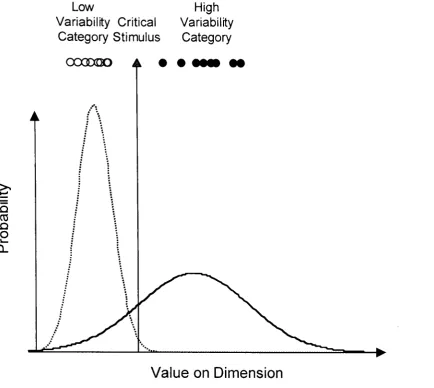
Figure 4. A one dimensional example of two categories differing in 31
variability.
Figure 5. The probability of a high variability category response as a 41 function of the position of the stimulus on either dimension for normal GRT.
Figure 6. The probability of a high variability category response plotted as a 42
function of the position of the stimulus on the dimension for GCM (g=2).
Figure 7. The arrangement of examples for the 1:2 pair of categories. 43 Figure 8. The arrangement of examples for the 1:4 pair of categories. 43
Figure 9. The probability of a high variability category response for an 44
example on the line Y=K-plotted against the X value of the absolute position
of the example for normal GRT for two categories (pair 1 :2), one twice as
variable than the other.
Figure 10. The probability of a high variability category response for an 44
example on the line Y K-plotted against the X value of the absolute position
of the example for normal GRT ~= 1 0) for two pairs of categories, pair 1:2
and pair 1 :4.
Figure 11. The probability of a high variability category response for an 44
to the nearest neighbor of the low variability category for normal GRT
(~= 10) for the 1:2 and 1:4 pairs of categories.
Figure 12. The probability of a high variability category response for an 45
example on the line y K..plotted against the K value of the absolute position of the example for the GCM (g=2, [=2, ~=0.05) for two category pairs 1:2 and 1:4.
Figure 13. The probability of a high variability category response for an 45
example on the line y K..plotted against the K value of the example relative the nearest neighbor of the low variability category for the GCM (g=2, r=2,
~=0.05) for category pairs 1:2 and 1 :4.
Figure 14. The arrangement of examples for the 1:2 expanded pair of 46 categories.
Figure 15. The probability of a high variability category response for an 46 example on the line y K..plotted against the K value of the absolute position
of the example for the GCM (g=2, [=2, ~=0.05) for two pairs of categories
1:2 and 1:2 expanded.
Figure 16. The probability of a high variability category response for an 47
example on the line y K..plotted against the K value of the absolute position of the example for the GRT ~= 10) for two pairs of categories 1:2 and 1:2
expanded.
Figure 17. The generalization gradients obtained from Experiment 3 for the 62
pairs of categories 1:2 and 1 :4.
Contents \11
pairs of categories 1:2 and 1 :4. The relative position is measured relative to
the nearest exemplar of the low variability category.
Figure 19. The generalization gradients obtained from Experiment 4 for the 69 pairs of categories 1:2 and 1:2 expanded.
Figure 20. Ten stimuli distributed evenly along a single psychological 87
dimension, divided into two categories.
Figure 21. The predictions for the MAC model for the simple category 89 structure illustrated in Figure 20. Accuracy for a stimulus on trial n is plotted
as a function of the stimulus on trial n-l.
Figure 22. The predictions for the GCM for the simple category structure 90 illustrated in Figure 20. Accuracy for a stimulus on trial n is plotted as a
function of the stimulus on trial n-l.
Figure 23. The proportion of correct responses for same category tone pairs 94
(1 ~5 and 1 0~6) and different category pairs (1 ~6 and 1 0~5) for
Experiment 6.
Figure 24. The stimulus structure used in Experiment 7 compared to
Nosofsky's (1985) stimulus structure.
97
Figure 25. The proportion of correct responses for same category stimulus 98
pairs (1 ~5 and 1 0~6) and different category pairs (1 ~6 and 1 0~5) for
Experiment 7.
Figure 26. The proportion of correct responses for same category tone pairs 102
(1 ~5 and 1 0~6) and different category pairs (1 ~6 and 1 0~5) for the
Figure 27. The average error on identification trials plotted as a function of 103 the preceding stimulus for Experiment 8.
Figure 28. The Martian cell stimuli used in the learning and verification 126 phases of Experiment 9.
Figure 29. The Martian cell snapshot stimuli used in the transfer phase of 127 Experiment 9.
Figure 30. The Martian cell stimuli used in the learning and verification 131 phases of Experiment 10.
Figure 31. The Martian cell snapshot stimuli used in the transfer phase of 131 Experiment 10.
Figure 32. The lines stimuli used in the training phase of Experiment 11. (a) 136
The two elements. (b) Examples of training stimuli.
Figure 33. The lines stimuli used in the transfer phases of Experiment 11. 136 Figure 34. The proportion of type AB responses for the single transfer 141
stimulus A'B as a function of the awareness that the compound is made from
the parts for Experiment 11.
Figure 35. The proportion of type AB responses for the single transfer 141
stimulus A-B as a function of the awareness that the compound is made from
the parts for Experiment 11.
Figure 36. The proportion of type AB responses for the single transfer 141
stimulus A'-B as a function of the awareness that the compound is made
from the parts for Experiment 11.
Contents IX
Figure 38. An example stimulus set from Experiment 12 (generated from the 144
prototypes in Figure 37).
Figure 39. The mean proportion of correct responses for the transfer stimuli 157 in Experiment 14. (Error bars are standard error of the mean.)
Figure 40. The mean proportion of correct responses for the transfer stimuli 165
in Experiment 16. (Error bars are standard error of the mean.)
Figure 41. The mean proportion of correct responses on trial
n
as a function 178 of whether the distant stimulus on trialn-1
came from the same category orthe opposite category for Experiment 3.
Figure 42. The mean proportion of correct responses on trial
n
as a function 178of whether the distant stimulus on trial
n-l
came from the same category orthe opposite category for Experiment 4.
Figure 43. Two separable categories, where one category is more variable 179
than the other.
Figure 44. The probability of a correct response as a function of the value of 180
the stimulus on the single dimension.
Figure 45. The mean probability of a correct responses on trial
n
as a 182function of whether the distant stimulus on trial
n-l
came from the samecategory or the opposite category.
Figure 46. Two conditions where the spacing of trials varies.
Figure 47. Displays controlling for the location of features across two
conditions of the proposed Study 6: within object and between object.
189
List of Tables
Table 1. Means across all three blocks for Experiment 1.
Table 2. Means across all three blocks for Experiment 2.
51
54 Table 3. Mean proportion of high variability responses across all participants 61
for Experiment 3, split by variability condition.
Table 4. Mean proportion of high variability responses across all participants 68
for Experiment 4, split by variability condition.
Table 5. Stress and
r2
values for the INDSCAL MDS solutions obtained for 73the three different category structures.
Table 6. The mean inter-stimulus distance within a category derived from 73
the MDS solution.
Table 7. The GCM's predictions for summed similarity for different f 74
parameters.
Table 8. Mean proportion of responses for the transfer block of Experiment 130
9.
Table 9. Mean proportion of responses for the transfer block of Experiment 130
9 for those participants performing significantly above chance on types A, B
and AB in the transfer phase.
Table 10. Mean proportion of responses for the transfer block of Experiment 132
10.
Table 11. Transfer stimuli from Experiment 11. (a represents element a, b 136
represents element b, a' represents the mirror image of element a, b'
Contents Xl
were added to the stimulus. - is used to represent two stimuli being displayed
simultaneously, ---7 is used to represent two stimuli, the first displayed before
the second.)
Table 12. Mean proportion of responses for the single stimuli transfer stage 139
of Experiment 11 for participants significantly above chance on types A, B
and AB in transfer.
Table 13. Mean proportion of responses for the pairs transfer set from 139
Experiment 11 for participants significantly above chance on types A, B and
AB in transfer.
Table 14. Proportion of "yes" responses in the sequential pairs transfer stage 141
indicating the latter stimuli is contained as a mirror image in the former for
participants significantly above change on types A, Band AB in the single
and pairs transfer stages in Experiment 11.
Table 15. The design of Experiment 12. 145
Table 16. Mean number of trials to criteria in each of the training blocks for 147
Experiment 12.
Table 17. Mean proportion of responses in the transfer stage of Experiment 147
12.
Table 18. Mean number of trials to criteria in each of the training blocks for 150
Experiment 13.
Table 19. Mean proportion of responses in transfer for Experiment 13. 150
Table 20. Predicted similarities during visual search with categorization 198
Acknowledgements
I would like to thank Nick Chater and Evan Heit for their supportive supervision
of this thesis. Their advice and comments were invaluable. I am also grateful to the
other members of the Psychology Department at Warwick for their help. Particular
thanks are to rightfully be given to Gordon Brown, with whom I have spent many hours
discussing the ideas presented here. Thanks also go to Suzanna Bootle, Lewis Bott, Jon
Brock, Eoghan Clarkson, Koen Lamberts and Derrick Watson. Philippe Schyns and
Annie Archambault of the University of Glasgow also deserve thanks for supplying the
stimuli used in Experiment 9, and providing helpful comments on how to make the experiment work! Discussion with Stian Reimers of the University of Cambridge at the
Star Burger conferences held in Coventry and Cambridge has played a crucial role
supporting the development of ideas in this thesis.
I was supported financially by a University of Warwick Graduate Assistantship.
Additional funds for testing participants came from a BBSRC grant held by Evan Heit,
and from the Department of Psychology.
Contents Xlll
Declaration
I hereby declare that the research reported in this thesis is my own work unless otherwise stated. No part of this thesis has been submitted for a degree at another
university.
Chapter 2 was written in collaboration with Nick Chater. Chapter 3 was written in collaboration with Gordon Brown and Nick Chater. The "memory and contrast"
model described in Chapter 3 was developed by myself and Gordon Brown. Two
experiments in Chapter 3 (Experiments 6 and 8) were run by Suzanna BootIe. Both chapters have been submitted to the Journal of Experimental Psychology: Learning,
Memory and Cognition. Suggestions for further work in Chapter 5 are based on two grant proposals written in collaboration with Gordon Brown, Nick Chater and Koen
Lamberts, and Derrick Watson.
Abstract
The categorization of external stimuli lies at the heart of cognitive science.
Existing models of perceptual categorization assume (a) information about the absolute
magnitude of a stimulus is used in the categorization decision, and (b) the representation
of a stimulus does not change with experience. The three experimental programs presented here challenge these two assumptions. The experiments in Chapter 2
demonstrate that existing models of categorization are unable to predict the
classification of items intermediate between two categories. Chapter 3 provides empirical evidence that categorization responses are heavily influenced by the
immediately preceding context, consistent with evidence from absolute identification showing people have very poor access to absolute magnitude information. A memory
and contrast model is presented where each categorization decision is based on the
perceived difference between the current stimulus and immediately preceding stimuli. This model is shown to account for the data from Chapters 2 and 3. Chapter 4 explores
the claim that new features may be created on experience with novel stimuli, and that
these features serve to alter the representation of stimuli to facilitate new categorization
tasks. An alternative account is offered for existing feature creation evidence. However,
experimental work re-establishes a feature creation effect. Consideration is given as to how feature creation and memory and contrast accounts of categorization may be
Chapter 1 Introduction
Perceptual categorization involves the grouping of individual, discriminable items together. Novel items may be judged members of these categories, and
properties of category members generalized to these novel items. A distinction may
be drawn between how categories are represented, and how the representations are
used to classify novel items. The distinction then is between information availability and information use. Theories of categorization have been instantiated as
mathematical models of categorization that make explicit the assumptions about both
representation and process. However, much of the literature focuses on the nature of the representation. This issue lies at the heart of cognitive science, for it is central to the link between perception and cognition. The development of theories of
categorization is therefore largely concerned with the representation of categories. This chapter provides a review of existing models of perceptual categorization, and related experimental evidence.
The classical theory of categorization (so named by Bruner, Goodnow, & Austin, 1956; Smith & Medin, 1981) states that items are categorized into groups on the basis of a list of necessary and sufficient features or attributes. If an item
possesses all the attributes in the category's list then it is said to be a category
member. Wittgenstein (1958) pointed out that for many natural categories exemplars
do not all share the same common attribute or property. Further, if necessary and
sufficient features are to be the basis for categorization, the classical viewpoint
suggests that all exemplars of a category should be equally good examples of that
category.
However, not all exemplars are judged to be equally good examples of their
category. Rosch (1976) found that people were faster to verify category membership
Chapter 1 Introduction 3
people are faster to verify "a canary is a bird" than "an emu is a bird". This typicality
effect is also true of categories of novel or artificial stimuli. For example, unseen
prototypes can be categorized more accurately than the original training stimuli
(Estes, 1986; Hintzman, 1986; Homa, Sterling, & Trepel, 1981; Lamberts, 1996; Medin & Schaffer, 1978). Category membership may then be better considered in terms of family resemblance (Rosch & Mervis, 1975). This idea prompted the
development of prototype models of categorization (e.g., Homa et aI., 1981; Posner
& Keele, 1968; Posner & Keele, 1970; Reed, 1972; Rosch, 1973; Rosch et aI., 1976).
In prototype theories category membership is a matter of degree, and is based on an exemplar's similarity to the average category member or central tendency of the category.
The prototype account does not rest easily with other empirical findings. A
large number of experiments have demonstrated that performance in categorization
tasks can be influenced by exemplars other than the category prototype (e.g., Ashby & Gott, 1988; Brooks, 1978; Medin & Schaffer, 1978; Whittlesea, 1987). Old
training stimuli can be categorized faster than new, previously unseen stimuli equally
similar to the prototype (Jacoby & Brooks, 1984). Malt (1989) showed that the categorization of an old exemplar could be primed by prior presentation of a similar
new exemplar, compared to prior presentation of a dissimilar new exemplar. This
suggests information about old exemplars other than the prototype was retrieved in
categorization of the new exemplar. According to prototype theory, categorization of
both prior exemplars should cause the prototype to be retrieved, and therefore equal
priming should have been observed for both stimuli, which was not the case.
Similarly, all of the old exemplars were not retrieved for each categorization, as if
condition where participants were required to make a perceptual judgement about the
new exemplar, Malt failed to obtain a priming effect. Thus a perceptual enhancement
account of the priming seems unlikely.) People are sensitive to correlation
information about different features within a category (Ashby & Gott, 1988; Ashby & Maddox, 1992; Medin, Altom, Edelson, & Freko, 1982) that would be lost if they
retained only a prototype. Medin and Schwanenflugel (1981) demonstrated that in some cases participants can classify non-linearly separable stimuli at least as easily
as linearly separable stimuli, a finding which cannot be explained by a prototype model. Together these findings all suggest that the representation of a category
consists of memory for more than just the category prototype. Exemplar Models of Categorization
Exemplar models (Ashby & Maddox, 1993; Brooks, 1978; Estes, 1994; Lamberts, 1994; Medin & Schaffer, 1978; Nosofsky, 1986) assume participants
represent categories by storing every single stimulus encountered, together with its
category label. A novel item is classified by calculating the similarity between the
item and the stored examples. The notion of similarity is rather unconstrained
(Goodman, 1972), and therefore problematic. The models of categorization
described here overcome the criticism that any two items can be similar or
(dissimilar) in an infinite number of ways by specifying over what features or
dimensions similarity is to be considered. With perceptual stimuli, the
implementation of similarity in models differs: some models use a spatial metaphor
(e.g., Ashby & Perrin, 1988; Ashby & Townsend, 1986; Medin & Schaffer, 1978;
Nosofsky, 1984; Nosofsky, 1986), and others use feature matching (Tversky, 1977;
Tversky & Gati, 1982).
Chapter 1 Introduction 5
represented as a precise point in multidimensional psychological space, called an
exemplar. The distance between two points in multidimensional psychological space is related to the similarity between the two exemplars they represent, i.e., the
amount of generalization between the exemplars (Carroll & Wish, 1974b; Shepard, Romney, & Nerlove, 1972). Shepard (1958) showed that the idea that distance in psychological space could be related to similarity could be derived from stimulus
generalization in learning theory (Hull, 1943). Nosofsky (1984) applied the proposal
that distance in psychological space could be related to generalization to the problem of similarity in categorization. The structure of psychological space is often
determined by multidimensional scaling (MDS), whereby pair wise similarity
judgments or identification confusion data uniquely determine the relative
co-ordinates of the stimuli in the space (Shepard, 1974; 1980). To classify a stimulus a participant derives its similarity to each of the stored exemplars. Often, the
probability of classifying a stimulus as a member of a particular category is a
function of the summed similarity to all the category's exemplars and the summed
similarity to all of the possible categories' exemplars. Normally Luce's (1959)
choice rule is used to map the summed similarities for each category onto the
probability of responding with each category label.
Nosofsky's (1986) exemplar model is now described. Other exemplar models
are described in relation to this model, as many of them are either restricted versions
of this model, or are closely related to it.
The Generalized Context Model
The generalized context model (GCM, Nosofsky, 1986) is an extension of the
similarity choice model for predicting identification confusion data (Luce, 1963;
Let Xk= {~p.; n= 1, ... ,
Nk}
be the set of stored category ~ examples. ~!! is avector in multidimensional psychological space (where the superscript
n
denotes thenth trial and is derived from a MDS procedure). The probability that the stimulus
~!!
is classified in category ~ (where different values of the subscript k denote different categories) is given byp(
Cklxn)
=
fkhk(xn) Lf3;h;(xn);=1
where
fu
is a response bias, and hk(~!!) is the summed similarity between ~!! and every stored category Ck example:Nk
hk(x) = Lexp(-c.d(x,xnY1) n=1
where g= 1 yields an exponential function, and g=2 yields a Gaussian function; d(~,~!!) is a measure of the psychological distance from ~ to ~!!. The non-negative
parameter ~ scales the psychological space and can be interpreted as a measure of the
overall stimulus discriminability, or as the amount of generalization between stimuli. The psychological distance g(~,x!!) is computed using a weighted Minkowski r-metric in a d-dimensional space:
where Wi is the proportion of attention allocated to dimension
i.
The exponent rdefines the distance metric: the value r=1 produces the city block metric, r=2
produces the Euclidean metric. A Euclidean distance metric is most appropriate for
stimuli with integral dimensions, and a city block metric for those with separable
dimensions (Garner, 1974; Nosofsky, 1987).
The Relationships Bet\veen Exemplar Models of Classification
The Context Model. Nosofsky (1986) has demonstrated that Medin and
(1)
(2)
Chapter 1 Introduction 7
Schaffer's (1978) context model, hereafter CM, is a special case of the GCM where
the dimensions are binary and g=r=I. Intuitively, in the context model, the similarity between two exemplars is given by ~ raised to the power of the number of features
the two exemplars differ on, where ~ is the similarity between two exemplars differing on only one feature, and 0<~<1.
The Weighted Ratio Model. Lambert's (1994) weighted ratio model has a
different definition of similarity. In the case where all dimension weights are the same, the summed similarity of exemplar ~!l to all the members of {4 is given by
h (x) =
I
(1- t)CF(x, xn )k n=1 (1- t)CF(x, xn )
+
t.DF(x, xn ) (4)where CF(~,~!l) is the number of dimensions or features 25- and ~!l have in common (the number of common features), DF(fi,25-!l) is the number of dimensions 25-and~!l
differ on (the number of different features) and
1
is the relative weight such that 0<1<1. This similarity function is effectively a weighted ratio of the number ofcommon features over the number of common plus number of different features. It differs from the similarity functions for the CM and GCM in that similarity in the
CM and GCM is only a function of the number of different features, rather than the
number of similar and the number of different features. If the number of dimensions,
£, in a given experiment does not vary then the number of different features is a function of the number of common features and same the summed similarity of ~ to
all the members of Ck becomes
(5)
where g(~,25-!l) is distance given by the city block metric in a psychological space \\ith
a binary din1ension representing the presence or absence of each feature.
an extension of Medin and Schaffer's (1978) CM. The probability that a stimulus is classified as belonging to a particular category is a function of the stimulus's
similarity to known category exemplars as in the GCM (Equation 1). The similarity function is exponential, as for the CM and the GCM with g=1 (Equation 2). As dimensions are binary, the similarity between two exemplars on a particular dimension is either unity or ~, where O>p 1.
At the start of category learning, when there are no category exemplars in memory then the parameter ~Q is used to represent the average similarity of any
stimulus to any category. Without this assumption (or with ~Q=O) then there is no effect of repeating trials on categorization performance (see Appendix 3.1 of Estes,
1994). Heit (1994) has demonstrated that a model that explains the effects of prior knowledge by treating prior knowledge as initial exemplars in the new concepts
provides a good fit to empirical data, lending support to this assumption.
Each presented exemplar has a probability, 12, of being encoded. Each
encoded exemplar has a probability, I-a, of being forgotten on a particular trial. (Typically once
a
has been included in the model, including 12 has little effect on thegoodness of fit to empirical data.) Estes included the
a
parameter to account forre-learning at virtually identical rates after either an early or late change in category
assignments for re-presented exemplars (Estes, 1989).
The Deterministic Exemplar Model. The deterministic exemplar model
(Ashby & Maddox, 1993), hereafter DEM, contains the GCM as a special case.
There are two main differences between the exemplar models discussed here, and the
parametric models discussed later. First, they make different assumptions about how
a category is represented. Second, they make different assumptions about how this
Chapter 1 Introduction 9
same representational assumptions as the exemplar models, but, rather than using a
probabilistic decision rule, a deterministic decision rule and a decision bound is used:
respond A if log( h A (X) ) - log( h8 (X) ) < 8
+
e; otherwise respond B (6)where the participant is biased against category B if
Q<O,
~ is the noise in thedecision, and hA(~) is the summed similarity of exemplar ~ to each exemplar of category A (Equation 2).
Ashby and Maddox (1993) show that using this noisy deterministic decision rule is equivalent to using this probabilistic decision rule
(7)
where
n
e
YY=--
and/3=---f3(J
1+
eYand the noise, ~, has a logistic distribution of mean
°
and variance cr. The DEM canbe thought of as the GCM with one additional parameter, y.. Depending on the value
ofy'responding is either more or less variable than the GCM predicts. Nosofsky
(1991) also produced a deterministic exemplar model, but it does not contain the
GCM as a special case - Luce's (1959) choice rule is abandoned in favor of a winner
take all deterministic rule, where the category associated with the highest summed
similarity is always given in response.
Parametric Models of Classification
An alternative approach to including information other than the category
prototype in the representation of a category is given by parametric models of
theory (Ashby & Townsend, 1986), prototype models (e.g., Homa et aL 1981; Posner & Keele, 1968; Posner & Keele, 1970; Reed, 1972; Rosch, 1973; Rosch et
aI., 1976), general linear classifiers (e.g., Medin & Schwanenflugel, 1981; Morrison, 1990; Nilsson, 1965; Townsend & Landon, 1983), optimal decision rules (e.g.,
Fukunaga, 1972; Green & Swets, 1966; Noreen, 1981; Townsend & Landon, 1983) and the category density model (Fried & Holyoak, 1984). Parametric approaches assume that a specific functional form can represent the density of category members in multidimensional psychological space. The form chosen depends on the particular
model, but is often a multivariate normal distribution.
There are three main reasons why a normal distribution is often used to approximate natural categories: (a) Normally distributed categories share several features in common with natural categories. Both contain a very large number of
potential exemplars (although this is also true of almost any other probability density
function). The dimensions of both natural and normally distributed categories are
continuous-valued. Many natural categories overlap, as normally distributed
categories can. Many researchers (e.g., Ashby, 1992) have used these common
properties to justify their choice of category structure. (b) Participants enter a category learning task assuming the categories are roughly uni-modal and
symmetric. Flannagan, Fried and Holyoak (1986) have shown that normally
distributed categories can be learned faster than multi-modal categories, and that in
the early stages of learning a multi-modal category participants respond as if the
category were uni-modal. Participants can be facilitated in learning a multi-modal
category if the previously learned structure was not normally distributed. These
findings do not, however, rule out other uni-modal representations. (c) If memory is
Chapter 1 Introduction 11
solution in terms of maximum entropy if only the mean and covariance matrix are
known (Myung, 1994). These three reasons certainly do not compel the use of a
normal distribution as a category representation, but this choice is commonly used.
Once the form used to approximate the category is chosen, building a representation of the category reduces to estimating the functional form's free parameters. The
value of the category density function at a particular point in psychological space for
each category is used to compute the classification response for the stimulus represented by that particular point.
Ashby's (1986) general recognition theory is now described. Other
parametric models of categorization are described with reference to this model, as
with the exception of Fried and Holyoak's (1984) category density model, they are
all special cases of general recognition theory.
General Recognition Theory
General recognition theory (GRT, Ashby & Townsend, 1986) is a
multidimensional generalization of signal detection theory (Green & Swets, 1966; Swets, Tanner, & Birdsall, 1961). Thus a stimulus, li!!, is represented by a vector in
multidimensional psychological space, li!! 12' where the subscript 12 means perceived. GRT assumes there to be noise in the perceptual system, ~!!12' and therefore repeated
presentation of the same stimulus, ~!!, does not always lead to the same perceptual
• n
representatIon, li-12'
(8)
Typically, the noise is assumed to be multivariate normal, with covariance matrix ~!!12' i.e., ~!!12=N(Q, ~!!~. The perceptual effects of each example of a category
can be represented by a multivariate normal distribution
The perceptual representation of a category is a probability mixture of the
individual example distributions. IfXk={~!!; n=l, ... ,
lli}
is the set of stored category Ck examples then the probability density function associated with this category isgiven by
Nk
p(xlck)
=
LP(xnICk)N(xn,L;)
n=!
where P~!!
I
~J is the probability that stimulus ?S.!! is presented as a member of category Ck.By constraining the covariance matrix ~!!Q special cases of GRT can be
derived. The stimulus invariant GRT assumes that ~!!Q ~ for all n. The un-correlated
GRT assumes ~ is diagonal and the simple GRT assumes that ~Q-d 12
1.
(Ashby & Maddox, 1993.)Once the percept ~!!Q of a stimulus is formed, response selection in the GRT is a deterministic process - the category for which the probability of the data, given the category, is maximized is chosen as category label. It is assumed that a participant
divides perceptual space into distinct category regions and responds according to
which region the percept falls into. The border of each of these regions is called a
decision bound. Stimuli that fall on the decision bound are therefore equally likely to
be classified into either category. The decision bound can be computed as
where g{k,l}(~) is the decision bound between category ~ and category
Q.
The valueof the decision bound function determines which region of space the percept falls
into:
> 0 respond Ck if d{J...I} (x) = 0 guess
< 0 respond C,
(10)
(11 )
Chapter 1 Introduction 13
As this decision bound is the one that maximizes overall categorization
accuracy this decision bound is called the GRT optimal classifier (Duda & Hart, 1973). Intuitively, this corresponds to classifying a stimulus into the category it is most likely to belong to, according to the inferred category probability density
functions. The perceptual noise turns this deterministic process into a probabilistic one.
If the examples are normally distributed within the category then the category density function P(~
I
~J can be rewritten as(13)
where J!l2k and ~l2k denote the perceived category ~ mean vector and covariance
matrix respectively. This model is called the normal or Gaussian GRT. Ashby (1992) makes the strong assumption that a category can be represented by a multivariate
normal probability density function even when the true example distribution within the category is not normally distributed. A subject using a normal GRT classifier
will always have a quadratic decision bound (unless the two category covariance
matrices are equal, then the boundary will be linear).
The version of the GRT used in this thesis is a further constrained version of
the normal GRT. The further constrain is that the variance-covariance matrix ~ is
constrained to be diagonal and to have equal variance for each dimension.
~ - 2 I
~pk - G'pk (14)
Thus, only two free parameters must be estimated for each category, the
mean and the variance.
Normal GRT is very similar to decision bound theory. Normal GRT and
decision bound theory predict the same categorization decision and accuracy for
parameters for the probability density function for each category, which uniquely
determine the decision bound's parameters. In decision bound theory participants are
assumed to directly estimate the free parameters of the decision bound. Relationships Between Parametric Models of Categorization
Prototype Models. Prototype models (e.g., Roma et aI., 1981; Posner & Keele, 1968; Posner & Keele, 1970; Reed, 1972; Rosch, 1973; Rosch et aI., 1976) also use a multidimensional psychological space. The prototype is the central
tendency of the category, and corresponds to the category mean in GRT. A stimulus
is categorized as belonging the category with the most similar prototype, where similarity corresponds to the distance between the stimulus and the prototype in
multidimensional psychological space.
In a binary classification prototype models classify as linear decision bound models, where the bound's slope and intercept are completely determined by the two
category means. Any point on the bound is equidistant from both category means. Prototype models are a special case of the Gaussian GRT where the co-variance
matrix for the each category is constrained to have zero co-variances and equal
variance for each dimension and each category:
Lpk
= cr~IThe General Linear Classifier. The general linear classifier (GLC) (e.g.,
Medin & Schwanenflugel, 1981; Morrison, 1990; Nilsson, 1965; Townsend & Landon, 1983), also uses a linear decision bound. Unlike the prototype models, the
slope and intercept of the decision bound are not constrained, and are varied to provide optimal categorization performance. In other words, participants are
assun1ed to estimate the slope and intercept of the decision bound directly, rather
than deriving then1 fron1 category probability density functions. However. the
Chapter 1 Introduction 15
optimal bound is that predicted by GRT.
The General Quadratic Classifier. The general quadratic classifier (GQC) (e.g., Ashby, 1992; Ashby & Maddox, 1992) uses a quadratic decision bound. When two categories are normally distributed, but have non-equal covariance matrices the
GQC is the optimal decision bound. The GQC makes identical categorization
predictions to the Gaussian GRT, and contains the GLC as a special case. As for the
general linear classifier, participants are assumed to estimate the free parameters of the decision bound directly, but the optimal values are those predicted by GRT.
Optimal Decision Rules. The optimal decision rule or bound (e.g., Fukunaga, 1972; Green & Swets, 1966; Noreen, 1981; Townsend & Landon, 1983) is the one
that maximizes accuracy of categorization, and is therefore not necessarily linear or
quadratic. In the two category case every stimulus represented by a point on the decision bound is equally likely to belong to either category. Unless assumptions are
made about the density function for each category then it is hard to say anything
about the shape of the bound. If normality is assumed then categorization accuracy is
as the Gaussian GRT or the GQC.
The Category Density Model. Fried and Holyoak's (1984) category density
model uses the same representational assumptions as Gaussian GRT, with the caveat
that category covariance matrices are constrained to be diagonal. (A surface of
equi-probability for a category is therefore constrained to be a sphere.) In addition, the
model uses a tally of the frequency of occurrence of each category. Luce's (1959)
choice rule is used to calculate the probability that exemplar ?i!! is considered to be a
member of category ~
(16)
where
fu
is a decision bias for each category, K is the number of alternativecategories and Bayes' theorem is used to give the subjective probability that the decision maker considers item xn to be a member of category ~
( n) _
p(
xn ICk)P(
Ck ) lfI k X --K;;--'---'--~-L
p(
xnICi
)p(
CJ
(17) i=l
where P(~!! I ~J is the subjective conditional probability of item ~ occurring given
category Ck, and P(~J is the subjective prior probability of~. Fried and Holyoak refer to Equations 16 and 17 together as the relative likelihood decision rule. (Note
how similar this decision rule is to that of the GCM: the similarity to a category function has been replaced by a probability of belonging to a category function.)
The category density model was proposed as a model of category learning. An algorithm is provided whereby learning may take place in the absence of feedback, and even in the absence of knowledge of the number of categories to be
learnt. With feedback, the first exemplar of a category provides the category mean. The first and second exemplars together with initial parameters representing the
learner's prior expectations of the variance of the category along each dimension are
used to estimate the diagonal elements of the covariance matrix. In the absence of
feedback category, means and variances are estimated after the first ~ exemplars,
where ~>K. (~represents the size of the short term memory buffer.) Initially ~ groups
are defined, each containing one of the ~ exemplars so far. A clustering algorithm is
used to divide the ~ exemplars into K groups, by repeatedly grouping together the groups with the closest centroids. The mean of each resulting group then becomes
the mean of each category, and the initial variances for each dimension for each
category are constructed by pooling an arbitrarily large value with the variance of
Chapter 1 Introduction 17
All that remains now to complete the model is to give an account of how the
means, variances, and frequencies for each category are updated with each new
exemplar. In the feedback condition, the value of ~ at time 1,
_ {I, if x" is labelled as a member of Ck
lI'i,t - 0, otherwise
In the no feedback condition Equation 17 for time 1-1 is used to calculate ~,!.
Now depending on the magnitude of.Y[!,! the mean and covariance vectors for each
category are updated using standard procedures for revising running means,
frequencies and variances (Raiffa & Schlaifer, 1961). Two additional bias
parameters are included in the model. One reflects the degree to which participants
believe each category is equally frequent, and the other reflects the degree to which
participants believe the variances on each dimension are equal across categories.
Empirical Evidence for Exemplar and Parametric Models of Categorization
In the introduction to this chapter, evidence was presented that could not be
explained by a simple prototype theory. The discussion here begins with how, in
principle, exemplar and parametric accounts of categorization are able to account for
these data. Work is then reviewed which contrast the fits of exemplar and parametric
models to human categorization performance.
Three main empirical results were mentioned in the introduction. First
mentioned was the typicality effect, where some members of a category are rated as
better or worse examples of the category than others. In applying an exemplar model
it is assumed typicality judgments and associated measures such as verification time
are based on the summed similarity of the probe exelnplar with all members of the
category. Exemplar accounts are able to accommodate the typicality effect result
because of the way MDS is used to derive the stimulus space. Items that are
particularly distinctive and not confusable are placed in the extreme regions of
multidimensional psychological space. Thus atypical exemplars are of minimal summed similarity to all the other category members because they are distant from
the other category members. Therefore will be rated as less typical, than typical exemplars which will be in the central regions of each category. For parametric
models the probability of category membership is derived from the category density
function. For reaction time measures, the distance of the exemplar from category
boundaries is assumed to determine categorization latency (Ashby, Boynton, & Lee, 1994). Because distinctive atypical exemplars are less close together in physical
space, the category density associated with that region of space will be low, and therefore parametric models predict that these items will be rated as less typical than items from areas of space associated with a higher category density.
The second type of finding described was cases where there is evidence that
information from a specific, old exemplar influences performance. Exemplar models
can, not surprisingly, accommodate all of these cases. Parametric models struggle to
account for many of these specific exemplar effects. Two problematic experiments
are discussed here. Homa, Stirling and Trepel (1981) showed that old exemplars can
be classified more accurately than new exemplars equidistant from the prototype. If
the category probability density function used is, for example, normal, then the
probability of category membership is equal for the old and new exemplars for
Homa, Stirling and Trepel's (1981) stimulus structure. Thus without resorting to a
complicated probability density function a parametric account is unable to account
for these results. Perhaps less challenging for the parametric models is Malt's (1989)
priming experiment which provided evidence for the retrieval of individual
Chapter 1 Introduction 19
of a new exemplar could possibly be explained by claiming that looking up or
calculating the value of the PDF for one exemplar will facilitate the process for a similar exemplar more than a dissimilar exemplar. However this explanation is not
very satisfactory. (It is interesting to note that both these problematic experiments involved repeated presentation of a small set of exemplars. This point is taken up below.)
The final finding discussed was that people are sensitive to the correlation
between features or dimensions of stimuli. An exemplar model is able to predict this
because memory for each individual exemplar maintains the correlation information in the representation. Many parametric models are also able to account for the
results. Those models, where the covariance matrix used to represent each category (e.g., normal GRT) is not constrained to have equal elements on the diagonal, and
non-zero covariances, maintain the correlation information in the covariance matrix
for each category. Thus surfaces of equi-probability will be ellipsoids, with the correlation indicated by the orientation of the major axis.
To summarize so far, exemplar and parametric models are able to provide accounts of the main findings problematic for classical theory and prototype models.
Parametric models struggle to account for data supporting episodic retrieval of
specific exemplars. Examination of one popular category structure reveals that
exemplar models only outperform prototype models because they reproduce accurate
performance on old training items better than parametric models (Smith & Minda,
2000). In other words, the assumption that participants access memories of each
training example is not necessary to explain their generalization to novel test items.
When prototype luodels of categorization are granted with the ability to predict
models. In other words, ignoring performance on training items, both exemplar and
distributional models provide equally good accounts of the data. Comparison of
parametric and exemplar models fits to other empirical data will now be considered.
Maddox and Ashby (1993) compared the performance of the OEM, the GCM
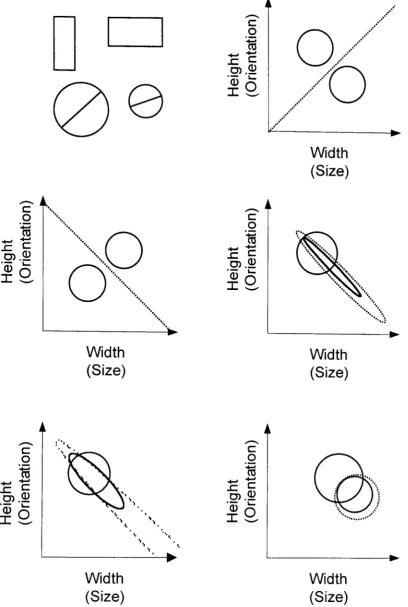
and decision bound models on a variety of data sets. The first five data sets are taken from Ashby and Maddox (1992). These data sets all involve normally distributed
categories and are illustrated in Figure 1 together with examples of the stimuli used
in the experiments. (Because of the very large number of exemplars participants were exposed to, MDS solutions could not be derived for the stimuli, as is normal in
the fitting of the GCM.) Participants were asked to classify rectangles that could vary
in height and width. These dimensions have been shown to be integral (e.g., Garner,
1974; Wiener-Erlich, 1978). Different participants classified circles that could vary in size, with diameters that could vary in orientation. These dimensions have been
found to be separable (e.g., Garner & Felfoldy, 1970; Shepard, 1964).
The category structures for the first two data sets involved two categories
with identical covariance matrices. The variance elements were all identical and the
co-variance elements were all zero, thus the optimal decision bound is linear.
Participants were given a large number of trials. The models were fit to single
participant data. The OEM provided the best fit for 3 participants. The GCM
provided the best fit for 1 participant. The remaining 8 participants' data were best fit by the decision bound model (the general linear classifier), although only slightly
better than the OEM.
The next three data sets also involved two normally distributed categories,
but with unequal co-variance matrices. The optimal decision bounds will therefore
-
c:o
ro
+-' +-'
..c c:
0> .ID . -
L-IDO
I _-
c: oro
+-' +-'..c c:
0> .ID . -
L-IDO
I _
'. ".
'.
'. '.". ".
'.
". '. '.".
··0···,·,·,·,·0
".
Width (Size) Width (Size) '. '.'.
".".
-
c: oro
+-' +-'..c c:
0> .ID . -
L-IDO
I _-
c: oro
+-' +-'..c c:
0> .ID ' -
L-IDO
I _ ....-c: oro
+-' +-'..c c: O>.~
. -
L-IDO
I _ .' .....
' .'Chapter 1 Introduction
O
..
..
'.'
... .
'..
' .' .' ··0···..
'..
'.'
..
' .'..
' .'.'
..
' Width (Size) Width (Size)co····
"'\ [image:36.680.96.505.70.678.2]: } ... / Width (Size)
..
' .' ....Figure 1. The stimuli and the five category structures used by Ashby & Maddox
(1992). The top left panel shows two examples of rectangle stimuli and two
examples of the circular stimuli. The remaining panels show the contours of equal
likelihood (solid lines) and optimal decision bounds (dashed lines) for five category
structures used. For the circular stimuli the labels height and width should be
the 24 participants tested exceeded the maximum accuracy possible predicted from a
linear decision bound. Most participants failed to reach the level of performance that
would be predicted if they were perfectly using the optimal quadratic decision
bound. The decision bound model, the DEM and the GCM were applied to data from
the first and last training sessions. For the first training session the decision bound
model (the general quadratic classifier) best fit data from 16 participants, the DEM
best fit in 4 participants, and the GCM best fit in the remaining 4 participants. For
data from the last training session the decision bound model best fit the data from 16 participants, the DEM from 5 participants and the GCM from the remaining 3
participants.
So, modeling individual participant data from participants tested with
normally distributed categories, the GCM was outperformed by the DEM, which in turn was out performed by the relevant decision bound model. Maddox and Ashby (1993) also compared the GCM, the D EM and the decision bound model's fit of data
when participants categorized examples from non-normally distributed categories
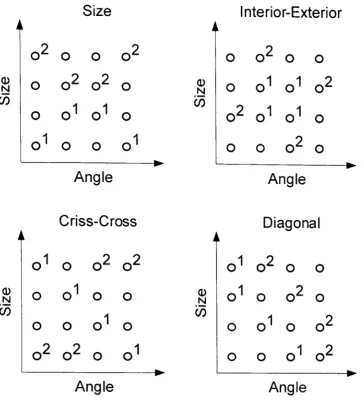
using Nosofsky's (1986; 1989) data. The stimuli are the same as the circles with
diameters as described before, except the bottom half of the stimulus is missing. The
category structure used for these data sets is shown in Figures 2 and 3.
The first data set with non-normally distributed categories (Nosofsky, 1986)
consists of data from two participants who participated in a large number of identification trials for the 16 possible exemplars, so that a MDS solution of the
psychological space representation could be calculated for each participant for the data set. Each participant then took part in four categorization sessions. Each session
began with a training phase, where participants were presented with repeated
Chapter 1 Introduction
Size Interior-Exterior
0
2
0 0 02
0 02
0 0<L>
0 0
2
02
0 <L> 0 01
01
02
.N N
(j)
0
1
01
C/)
0
2
0 0 0
1
01
00
1
0 0 01
0 0 02
0Angle Angle
Criss-Cross Diagonal
0
1
0 02
02
01
02
0 0<L> 0 0
1
0 0 <L> 0
1
0 02
0.N .!:::!
C/)
0
1
C/)
0
1
02
0 0 0 0 0
0
2
02
0 01
0 0 01
02
Angle Angle
Figure 2. The four category structures used by Nosofsky (1986). The circles
correspond to exemplars. Numbered circles are training exemplars, and the
numbers correspond to the category assignment. The remaining exemplars were
[image:38.680.103.468.68.472.2]Size Angle
0 0
2
0 0 0 0 02
0Q)
0 0 0
2
02
Q) 01
0 02
N .N 0
(j)
0
1
01
0 1(j)
0 0 0
1
02
00
1
01
0 0 0 01
02
0Angle Angle
Criss-Cross Diagonal
0
1
0 02
02
0 02
02
0Q)
0 0
1
0 0 Q) 0 02
0 01
N .~
(j)
0
1
(j)
0
2
01
0 0 0 0 0
0
2
02
0 01
0 01
01
0Angle Angle
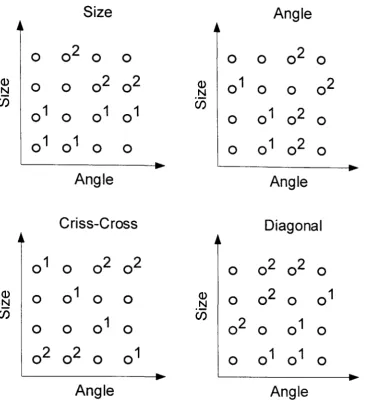
Figure 3. The four category structures used by Nosofsky (1989). The circles
correspond to exemplars. Numbered circles are training exemplars, and the
numbers correspond to the category assignment. The remaining exemplars were
[image:39.682.101.473.66.474.2]Chapter 1 Introduction 22
In the subsequent transfer task all exemplars were repeatedly, sequentially presented for categorization with feedback given only when a training exemplar was presented.
There were four conditions: two conditions (size and diagonal) where the optimal decision bound is approximately linear and two conditions the optimal decision
bound is non-linear. Maddox and Ashby (1993) fitted the DEM, the GCM and two
decision bound models (the general linear classifier and the general quadratic
classifier). In the two conditions when the best fitting decision bound was
approximately linear there was little difference between the fits of the two exemplar and the two decision bound models. For the conditions where the best fitting
decision bound is non-linear the general quadratic classifier fitted the data
substantially better than the two exemplar models. Ashby and Lee (1992) fitted the optimal decision bound model, and although it did perform better than the GCM it
performed more poorly than the general quadratic classifier, suggesting participants
used a non-optimal classification strategy.
The second data set from non-normally distributed categories (Nosofsky,
1989) differs from the above set in four ways. First, a much larger number of
participants was run. Separate participants were used to derive the MDS solution.
The two dimensional MDS solutions looked much like the arrangement of the
stimuli in physical space shown in (Figure 3). Four new sets of participants took part
in one condition of the categorization stage of the experiment, each set in a different
condition. Second, data was averaged across participants, a procedure which
disadvantages the decision bound models (Maddox, 1999). Third, participants were
given a smaller amount of training before the transfer phase. Finally, one of the
conditions where the best fitting decision bound was non-linear was replaced with a
As a test of the attention-optimization hypothesis (N osofsky, 1986) three
versions of the GCM were fitted to this data set (see also Nosofsky, 1987; Nosofsky, 1989; Nosofsky, 1991). The idea is that selective attention on dimensions in the
psychological space will operate to optimize categorization performance. One of the
versions of the GCM fitted is unconstrained, as described above. The other two
versions are constrained in some way. The equal attention GCM assumes that the
values of Wi in Equation 3 are equal for all
g
dimensions. The equal bias GCMassumes that the values of
fu
are equal for allk
categories. The unconstrained GCMcould not be rejected for any of the categorization conditions. The equal attention
GCM fitted the data significantly worse in all four conditions. Some critical transfer stimuli were designed so changes in the relative weighting of the dimensions would
change their probability of assignment to a given category. Observation showed that
the equal attention GCM failed to account for the probability, but the unconstrained GCM did. These results support the idea that the attention weightings for the
dimensions was different in the identification and categorization tasks. The equal
bias GCM fitted the data almost as well as the unconstrained GCM, suggesting that
these results could not be explained by response bias. Lamberts and Chong (1999)
provide further evidence that this phenomena is indeed an attention shift, by showing
that categorization performance changes as a result of verbal instructions directing
attention to particular stimulus dimensions.
The importance of attention shifts may seem problematic for parametric
models, given that they do not incorporate attentional parameters to modify the
perceptual space. However, even without assuming that the perceptual space is
n10dified across the four conditions, decision bound models can account for the
Chapter 1 Introduction 24 and two decision bound models (the general linear classifier and the general
quadratic classifier). The GCM provided the best fit in two conditions (criss-cross
and diagonal), and the general linear classifier provided the best fit in the other two conditions (size and angle). It should be noted that the difference between the
goodness of fits is very small. Further, the GCM fits the averaged participant data
better than the single participant data. That the general linear classifier better fits the two conditions where only one dimension is needed to make the categorization than
the GCM suggests that shifts in decision bounds may be more important than shifts in selective attention. Certainly though, the parametric model is able to account for the "attention shift" phenomena better than the exemplar model.
To summarize the results from data sets from non-normally distributed categories, when modeling individual participants' data after extensive training the
decision bound models provided excellent accounts of the data. However when
modeling data collapsed across participants after a shorter period of training the
difference between the fits of exemplar and decision bound models was smaller. Overall we have seen that exemplar models like the GCM and parametric decision
bound models are able to provide a very good account of empirical data. Decision
bound models outperformed the GCM when category structures were normally
distributed. However with non-normally distributed categories where a smaller
number of exemplars were used, the both models performed about equally.
The Relationship between Exemplar and Parametric Models of Classification
Exemplar and parametric or distributional models can be though of as lying
at opposite ends of a continuum of finite mixture models, where the number of
Rosseel, 1996). Also contained in this continuum are back propagation networks
with sigmoidal activation functions (Rumelhart, Hinton, & Williams, 1986) and
radial basis functions (Moody & Darken, 1989). With small numbers of hidden units (and hence small numbers of free parameters in relation to the size of the data to be
modeled), neural networks are analogous to distributional models, because they can
only learn data with a particular distributional structure. But if the number of hidden
units is large in relation to the amount of data to be learned, then the neural network
becomes analogous to an exemplar model, in that any data set can be modeled,
whatever its structure, simply learning each piece of data (each example) by rote.
The relationship between exemplar and parametric models can be described
formally using Rosseel' s (1998) mixture model of category representation. The
model makes three assumptions. First, following GRT, it is assumed that the
presentation of the same stimulus does not always lead to the same perceptual effect.
The perception of a stimulus is represented as a random vector in multidimensional
psychological space
(19)
where ~!l 12 is a random vector with zero mean representing perceptual noise. ~!l 12 is
multivariate normal with zero mean and co-variance matrix ~!l12. Normally the noise
is assumed to be stimulus invariant and is adequately described by ~.
Second, the probability density function for the whole set of exemplars for all
K categories is modeled as a finite mixture distribution (McLachlan & Basford,
1988; Titterington, 1984): J
p(x)
=
LP(j)p(x/j) (20)j=l
Chapter 1 Introduction 26 denotes the mixture proportions and satisfy the constraint
J
L
P(j)=
1 and 0::; Pc}) ::; 1 ,j=i (21 )
and I2(?5,
I
i) is a multivariate normal distribution with meanlli
and variance ~.Third, this probability density function is shared by each of the K categories. Category
i4
is modeled by the same set of mixture components I2(?5, I i) as theunconditional mixture distribution I2(~).
J
p(xIC
k )=
LPUlk)p(xlJ)
(22)j=i
where
PG.I
k) denotes the class-conditional mixture proportions.The category representation of the finite mixture model contains the category
representations of exemplar and decision bound models (Ashby & Alfonso-Reese, 1995; Rosseel, 1996). The category representation of the Gaussian GRT is
equivalent to a finite mixture model with one multivariate normal mixture
component. Rosseel (1998) has shown that the category representation of the GeM
using a Gaussian similarity function and a Euclidean distance metric is equivalent to
a finite mixture model with multivariate normal mixture components for each
category exemplar. Further, Rosseel showed that the category representation of the
GCM using an exponential similarity function and a city block distance metric is
equivalent to a finite mixture model with multivariate Laplacian mixture components
for each category exemplar. Thus by altering the number of mixture components,
L
the mixture model can take on the representation assumptions of the GCM (when
I
equals the total number of exemplars across all categories), or Gaussian GRT (when
I
equals the number of categories).Conclusions
prototype theories of categorization has been presented. The two current accounts of
categorization - exemplar theories and parametric or distributional theories - have
been described in detail. The relationship between various instantiations of each
theory have been described. Empirical evidence collected with the intent of discriminating between these two accounts has been presented. However, it was
concluded that exemplar and distributional approaches both provided good accounts
of the data. Finally the relationship between exemplar and distributional views was formalized using a finite mixture model framework.
Summary of Remaining Chapters
The experiments presented in Chapter 2 of this thesis investigate
generalization to novel items between two categories that differ in variability. It is shown that exemplar and parametric accounts make qualitatively different
predictions for the pattern of generalization. Thus the experiments are designed to
discriminate between the use of exemplar based representations and distributional representations.
The experiments in Chapter 3 of this thesis challenge the assumption that participants have access to the absolute location of stimuli in physical space, an
assumption common to both exemplar and parametric models of categorization. The
experiments were motivated by evidence from absolute identification and magnitude
estimation paradigms, which demonstrates that participants typically have poor
access to absolute magnitude information. Instead participants rely upon
comparisons with recent stimuli, as evident from the strong effect of preceding
material demonstrated in these paradigms. Here specific sequence effects are
examined in categorization - effects that are not predicted by the use of absolute