Original citation:
Wu, Grace, Wang, Yi-Ming, Yen, Amy, Wong, Jau-Min, Lai, Hsin-Chih, Warwick, Jane
and Chen, Tony. (2006) Cost-effectiveness analysis of colorectal cancer screening with
stool DNA testing in intermediate-incidence countries. BMC Cancer, Volume 6 (Number
1). p. 136. ISSN 1471-2407
Permanent WRAP url:
http://wrap.warwick.ac.uk/63139
Copyright and reuse:
The Warwick Research Archive Portal (WRAP) makes this work of researchers of the
University of Warwick available open access under the following conditions.
This article is made available under the Creative Commons Attribution 2.0 Generic (CC
BY 2.0) license and may be reused according to the conditions of the license. For more
details see:
http://creativecommons.org/licenses/by/2.0/
A note on versions:
The version presented in WRAP is the published version, or, version of record, and may
be cited as it appears here.
Open Access
Research article
Cost-effectiveness analysis of colorectal cancer screening with stool
DNA testing in intermediate-incidence countries
Grace Hui-Min Wu
1,2, Yi-Ming Wang
2, Amy Ming-Fang Yen
2, Jau-Min Wong
3,
Hsin-Chih Lai
4, Jane Warwick
5and Tony Hsiu-Hsi Chen*
2,6Address: 1Graduate Institute of Epidemiology, College of Public Health, National Taiwan University, Taipei, Taiwan, 2Institute of Preventive Medicine, College of Public Health, National Taiwan University, Taipei, Taiwan, 3Department of Internal Medicine, National Taiwan University Hospital, Taipei, Taiwan, 4School of Medical Technology, College of Medicine, National Taiwan University, Taipei, Taiwan, 5Cancer Research UK Department of Epidemiology, Mathematics and Statistics, Wolfson Institute of Preventive Medicine, Queen Mary University of London, UK and 6Division of Biostatistics, Graduate Institute of Epidemiology, College of Public Health, National Taiwan University, Taiwan
Email: Grace Hui-Min Wu - [email protected]; Yi-Ming Wang - [email protected]; Amy Ming-Fang Yen - [email protected]; Jau-Min Wong - [email protected]; Hsin-Chih Lai - [email protected]; Jane Warwick - [email protected]; Tony Hsiu-Hsi Chen* - [email protected]
* Corresponding author
Abstract
Background: The aim of this study is to compare the cost-effectiveness of screening with stool DNA testing with that of screening with other tools (annual fecal occult blood testing, flexible sigmoidoscopy every 5 years, and colonoscopy every 10 years) or not screening at all.
Methods: We developed a Markov model to evaluate the above screening strategies in the general population 50 to 75 years of age in Taiwan. Sensitivity analyses were performed to assess the influence of various parameters on the cost-effectiveness of screening. A third-party payer perspective was adopted and the cost of $13,000 per life-year saved (which is roughly the per capita GNP of Taiwan in 2003) was chosen as the ceiling ratio for assessing whether the program is cost-effective.
Results: Stool DNA testing every three, five, and ten years can reduce colorectal cancer mortality by 22%, 15%, and 9%, respectively. The associated incremental costs were $9,794, $9,335, and $7,717, per life-year saved when compared with no screening. Stool DNA testing strategies were the least cost-effective with the cost per stool DNA test, referral rate with diagnostic colonoscopy, prevalence of large adenoma, and discount rate being the most influential parameters.
Conclusion: In countries with a low or intermediate incidence of colorectal cancer, stool DNA testing is less cost-effective than the other currently recommended strategies for population-based screening, particularly targeting at asymptomatic subjects.
Background
Because of the high incidence, long preclinical period, and availability of treatment which gives a favorable prognosis with early diagnosis, screening for colorectal cancer (CRC)
has been shown to lead to substantial mortality reduc-tions in Western countries; 15–33% with fecal occult blood testing (FOBT), 33% with flexible sigmoidoscopy and 57% with colonoscopy [1-7]. The U.S. Multisociety
Published: 24 May 2006
BMC Cancer 2006, 6:136 doi:10.1186/1471-2407-6-136
Received: 04 November 2005 Accepted: 24 May 2006
This article is available from: http://www.biomedcentral.com/1471-2407/6/136
© 2006 Wu et al; licensee BioMed Central Ltd.
Task Force on Colorectal Cancer has therefore recom-mended multiple options for screening people at average risk of CRC including annual FOBT, flexible sigmoidos-copy every 5 years, and colonossigmoidos-copy every 10 years [8].
Given this choice of effective screening tools, the deciding factor amongst alternatives could be efficacy, performance (sensitivity and specificity), acceptability, feasibility, com-pliance, and clinical capacity. Colonoscopy, for example, has been recommended as one of the screening options in the USA because of high sensitivity and specificity [8]. However, in countries with a shortage of medical endo-scopic manpower the resulting increased demand for colonoscopy may render such a scheme unworkable. In addition, the uptake of colonoscopy is likely to depend upon local social and cultural issues.
Recently, a new method for detecting adenoma and inva-sive CRC, known as stool DNA testing, has been suggested as a potential screening tool [8,9]. It analyzes the DNA contained in stools, through natural exfoliation, and detects alterations. The sensitivity of stool DNA testing, based on symptomatic cases, has been reported as between 36% and 82% for advanced adenoma and between 61% and 100% for invasive cancer, and the spe-cificity has been estimated at between 89% and 100% in clinical studies [10-15]. A recent large prospective study, targeting average-risk, asymptomatic subjects aged 50 years or older, reported more conservative results when using stool DNA testing as a screening tool; sensitivities of 15% and 52% respectively for adenoma and invasive can-cer [16]. Nevertheless, stool DNA testing was found signif-icantly better than the fecal occult blood test [16]. Since the costs associated with stool DNA testing are considera-ble the issue of whether the required expenditure could be offset by future savings (brought about by a reduction in the number of advanced cases needing treatment) must be addressed before stool DNA testing, as a population-based screening tool for average-risk, asymptomatic sub-jects, can be introduced. This is particularly important for countries with a low or intermediate, but nevertheless dra-matically increasing, incidence of CRC.
In Taiwan for instance, CRC has been ranked as the fourth most common cancer and accounted for 11% of cancer cases and 12% of cancer deaths in 2000 [17]. The age-adjusted incidence has increased by 50%, from 19.4 per 100,000 in 1995 to 28.3 per 100,000 in 2000, while the associated mortality has increased from 11.3 to 12.7 per 100,000.
The aim of this study is therefore to perform a decision analysis using a Markov model to compare the effective-ness and cost of stool DNA testing with other conven-tional screening strategies. The cost-effectiveness analysis
compares triennial, five-yearly, and ten-yearly stool DNA
testing (DNA3, DNA5, and DNA10), with no screening (No
Screening), annual FOBT (FOBT1), five-yearly flexible
sig-moidoscopy (SIGM5), and ten-yearly colonoscopy
(COLO10).
Methods
Model specification
We developed a Markov model by using DATA Version 3.5 (TreeAge Software) to consider several screening
strat-egies for CRC, including DNA3, DNA5, DNA10, FOBT1,
SIGM5, COLO10, and No Screening. Subjects at
average-risk of developing CRC were screened from age 50 years until age 75 or death. For each Markov decision, all possi-ble transition states radiated from the decision node with 1-year Markov cycles. Effectiveness was defined as addi-tional life-years gained as a result of screening.
The disease natural history of CRC was simulated by a nine-state Markov model (Figure 1) consisting of normal, small adenoma (adenoma smaller than 1 cm in size), large adenoma (adenoma larger than 1 cm in size), pre-clinical early CRC (prepre-clinical Dukes' stage A and B CRC), preclinical late CRC (preclinical Dukes' stage C and D), clinical early CRC, clinical late CRC, CRC death, and other cause of death. Our model only focuses on modeling ade-noma-carcinoma sequences without considering non-polypoid CRC because information on the sensitivity and specificity of the screening tool for detecting the non-polypoid form is unclear. The progression from each state to the next follows a Markov process that assumes that transition depends only on the current state, i.e. the proc-ess has no memory. The solid arrows represent the direct transition between states, and the dotted ones the transi-tion toward other cause of death. The transitransi-tion rates are
denoted as λ1(t), λ2, ..., λ8, and μ(t) where, for example, λ2
is the annual transition rate from small to large adenoma,
and μ(t) is the annual age-specific mortality rate from
other causes. Note that as the annual incidence rate of small adenoma increases with age we allow it to vary with time according to the Weibull distribution denoted as
λ1(t), i.e. annual incidence rate of small adenoma in
sub-jects aged t. The hazard function for the Weibull distribu-tion is
λ1(t) = λ10γtγ-1
where λ10 and γare the scale and shape parameters
respec-tively. We assume the other transition parameters, λ2-λ8,
are constant over time. The estimated transition rates are shown in Table 1.
convert-ing the transition rates. The Markov model specifyconvert-ing the transitions between states in Figure 1 illustrates the pro-gressive property of model. At any instant a one-step tran-sition from small adenoma to clinical CRC is not allowed but a multi-step transition is possible, although the likeli-hood of transition from small to large adenoma, and from large adenoma to pre-clinical CRC, within a year starts low but increases with time. To build this feature into our model, we allowed multiple-step transitions even within one cycle to be possible although the chance is low. Thus, although small adenoma has only a slim chance of pro-gressing through large adenoma, preclinical early CRC, and then to clinical early CRC chronologically within one cycle but our model nevertheless allows for the possibil-ity. Furthermore, since we wanted to simulate a screening scenario, the initial state may be normal, adenoma, or preclinical CRC with the corresponding prevalences at age 50 years. However, there are still lines emanating from the root Markov node to clinical CRC, CRC death, and other death, but the probabilities of these states at the first cycle (initial probabilities) are all zero.
Description of screening strategies
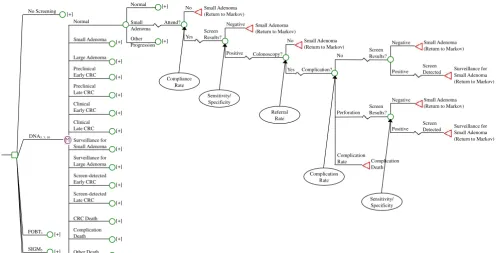
The "No Screening" strategy follows the disease natural history. The screening procedures for other screening strategies are shown in Figure 2. In stool DNA screening strategies, subjects in the normal, adenoma, or preclinical phase of CRC states will be offered screening but may, or may not, take up stool DNA testing. After modeling the
uptake of stool DNA testing, the number of detected cases of adenoma or preclinical CRC is determined by the sen-sitivity and specificity. A proportion of subjects with pos-itive stool DNA test results will undergo further examination (colonoscopy to detect adenoma and pre-clinical CRC) as fixed by the compliance rate. The compli-cations of perforation and death due to colonoscopy are also taken into account. Subjects who do not participate in stool DNA testing, those with false negative results and those who refuse diagnostic colonoscopy will return to the disease natural history. Subjects detected with ade-noma follow the surveillance procedure and screen-detected cases of CRC follow the prognosis of CRC. The Markov decision model for FOBT screening and sig-moidoscopy screening is similar to that for screening by stool DNA testing, but with different values for sensitivity and specificity. With colonoscopy screening, the proce-dure for positive results or the surveillance of adenoma is also similar to that for stool DNA testing screening, except that polyps detected with colonoscopy will be removed directly.
Adenoma detected by screening will be removed by polypectomy during first colonoscopy. In the light of the American Cancer Society guidelines on screening and sur-veillance for the early detection of colorectal adenomas and cancer, the removal of adenoma will be followed up with surveillance [9]. Any recurrence of neoplasm will fol-low the disease natural history. Subjects with small
[image:4.612.62.550.91.279.2]ade-Markov process for disease natural history and prognosis of colorectal cancer (CRC) Figure 1
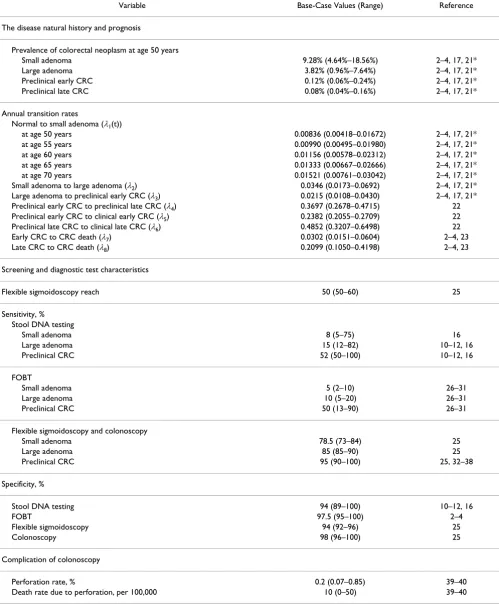
Table 1: Base-case estimates and ranges used in sensitivity analysis
Variable Base-Case Values (Range) Reference
The disease natural history and prognosis
Prevalence of colorectal neoplasm at age 50 years
Small adenoma 9.28% (4.64%–18.56%) 2–4, 17, 21*
Large adenoma 3.82% (0.96%–7.64%) 2–4, 17, 21*
Preclinical early CRC 0.12% (0.06%–0.24%) 2–4, 17, 21*
Preclinical late CRC 0.08% (0.04%–0.16%) 2–4, 17, 21*
Annual transition rates
Normal to small adenoma (λ1(t))
at age 50 years 0.00836 (0.00418–0.01672) 2–4, 17, 21*
at age 55 years 0.00990 (0.00495–0.01980) 2–4, 17, 21*
at age 60 years 0.01156 (0.00578–0.02312) 2–4, 17, 21*
at age 65 years 0.01333 (0.00667–0.02666) 2–4, 17, 21*
at age 70 years 0.01521 (0.00761–0.03042) 2–4, 17, 21*
Small adenoma to large adenoma (λ2) 0.0346 (0.0173–0.0692) 2–4, 17, 21*
Large adenoma to preclinical early CRC (λ3) 0.0215 (0.0108–0.0430) 2–4, 17, 21* Preclinical early CRC to preclinical late CRC (λ4) 0.3697 (0.2678–0.4715) 22 Preclinical early CRC to clinical early CRC (λ5) 0.2382 (0.2055–0.2709) 22
Preclinical late CRC to clinical late CRC (λ6) 0.4852 (0.3207–0.6498) 22 Early CRC to CRC death (λ7) 0.0302 (0.0151–0.0604) 2–4, 23
Late CRC to CRC death (λ8) 0.2099 (0.1050–0.4198) 2–4, 23
Screening and diagnostic test characteristics
Flexible sigmoidoscopy reach 50 (50–60) 25
Sensitivity, % Stool DNA testing
Small adenoma 8 (5–75) 16
Large adenoma 15 (12–82) 10–12, 16
Preclinical CRC 52 (50–100) 10–12, 16
FOBT
Small adenoma 5 (2–10) 26–31
Large adenoma 10 (5–20) 26–31
Preclinical CRC 50 (13–90) 26–31
Flexible sigmoidoscopy and colonoscopy
Small adenoma 78.5 (73–84) 25
Large adenoma 85 (85–90) 25
Preclinical CRC 95 (90–100) 25, 32–38
Specificity, %
Stool DNA testing 94 (89–100) 10–12, 16
FOBT 97.5 (95–100) 2–4
Flexible sigmoidoscopy 94 (92–96) 25
Colonoscopy 98 (96–100) 25
Complication of colonoscopy
Perforation rate, % 0.2 (0.07–0.85) 39–40
Death rate due to perforation, per 100,000 10 (0–50) 39–40
noma will receive colonoscopy after 5 years. Then, if normal, they return to the normal state in the natural his-tory and are screened according to the standard screening strategies. A similar procedure is applied to subjects found to have a large adenoma. They will receive colonoscopy three years after the initial polypectomy and, assuming no adenoma after two repeated colonoscopies, return to the normal state in the natural history mode.
Base-case estimates
Base-case estimates of the disease natural history and prognosis, screening and diagnostic test characteristics, and costs for cost-effectiveness analysis were abstracted from published literature and are listed in Table 1. Note that the base-case estimates of sensitivity and specificity of stool DNA testing were obtained from the Imperiale et al [16] study that has been so far the only one considering average risk asymptomatic subjects aged 50 years.
Transition parameters
Parameters for the disease natural history and prognosis were derived from previous studies [2-4,17,22-24]. The transition rates between various invasive carcinoma states,
λ4-λ6, were obtained from selective screening for CRC, the
Taiwan Multicenter Cancer Screening (TAMCAS) Project [21]. Regarding prevalence rate of adenoma, the preva-lence estimates for large adenoma in previous randomised trials [2-4] and the cumulative risk of 35% at 20 years of carcinoma developing from large adenoma [21] coupled with the age-specific CRC incidence rates in Taiwan in 2000 [17], were used to project the age-specific preclinical
incidence of small adenoma, λ1(t) (assuming a Weibull
distribution), the transition rate from small to large
ade-noma, λ2, (assuming an exponential distribution) and the
transition rate from large adenoma to preclinical early
CRC [22], λ3 (assuming an exponential distribution). The
estimated age-specific preclinical incidences of small ade-noma are shown in Table 1. Assuming survival time fol-lows exponential distribution, the parameters for survival
with clinical CRC, λ7 and λ8, were derived from the
sur-vival probabilities for each stage of CRC [23] after weight-ing the distribution of CRC stage among the control groups according to previous studies [2-4]. Age-specific
mortality, μ(t), for other cause of death, refer to Taiwan's
vital statistics in 2002 [24]. The prevalence of colorectal neoplasm at age 50 years was obtained by converting the transition rates mentioned above and are shown in Table 1.
Test characteristics
The estimated parameters for test characteristics such as sensitivity, specificity, and complication with colonos-copy were derived from previous studies [2-4], [10-14,16,25-40]. This sensitivity is allowed to vary with state. The base-case estimates of sensitivity of stool DNA testing were 8% for small adenoma, 15% for large adenoma and 52% for invasive cancer [16]. The base-case estimate of specificity of stool DNA testing was 94% [16].
Attendance and compliance
In the light of reality from previous study, as compliance rates and referral rate vary with screening tools, 60% of compliance rate was assumed for FOBT referring to evi-dence from several randomised trials [1-4], and 40% of compliance rate was assumed for sigmoidoscopy and colonoscopy in the light of reality from previous studies [41,42]. The compliance with stool DNA testing was assumed to be the same with FOBT. The referral rate to
Screening
Stool DNA testing 44.1 (22.1–88.2) Expert opinion
FOBT 0.6 (0.3–1.2) BNHI
Flexible sigmoidoscopy 35.3 (17.6–70.6) BNHI
Colonoscopy 66.2 (33.1–161.8) BNHI
Treatment and confirmation
Pathological examination 20.6 (10.3–41.2) BNHI
Biopsy 13.2 (6.6–26.5) BNHI
Colonoscopy 66.2 (33.1–161.8) BNHI
Polypectomy 42.4 (21.2–84.7) BNHI
Initial cost for early CRC 3117.6 (1558.8–6235.3) BNHI Initial cost for late CRC 7705.9 (3852.9–15411.8) BNHI
Continuing cost for CRC 176.5 (88.2–352.9) BNHI
Terminal Care for CRC 7647.1 (3823.5–15294.1) BNHI
Complication cost for perforation 1617.6 (808.8–3235.3) BNHI Complication cost for death 2735.3 (1367.6–5470.6) BNHI
Discount rate, % 3 (0–7)
[image:6.612.53.557.91.295.2]Abbreviations: CRC, colorectal cancer; FOBT, fecal occult blood testing; BNHI, Bureau of National Health Insurance. * The estimates were obtained and re-estimated by combining several data sources [2–4, 17, 21].
diagnostic colonoscopy after positive findings with screening was assumed to be 85% according to several randomised trials [1-4].
Costs
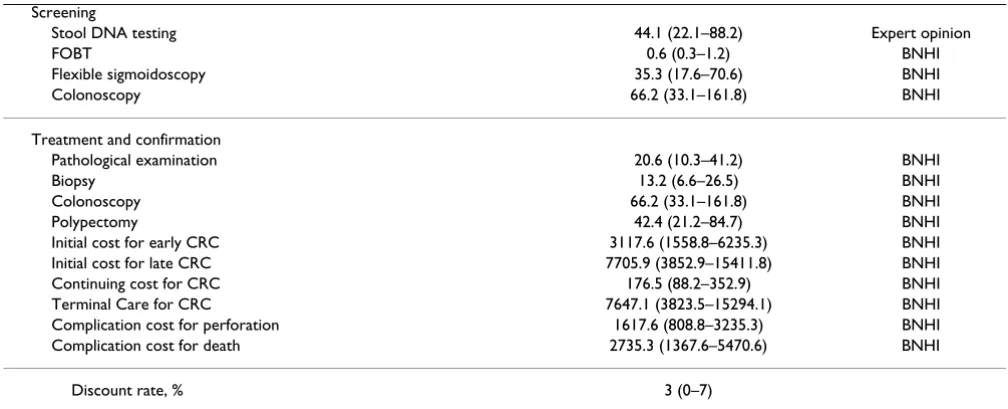
Costs are expressed in US dollars (1 US dollar = 34 New Taiwanese dolloar, exchange rate on the basis of the year 2004). As the cost-effectiveness analysis is carried out from the third-party payer perspective only direct costs were calculated in this study, including those relating to the screening itself, treatment and diagnostic tests (ade-noma and CRC only), complications from colonoscopy and surveillance (adenoma only). All estimates of cost refer to the price mandated by the Bureau of National Health Insurance in 2004 or expert opinion. Screening costs, except for stool DNA testing, are based on Medicare
Payments by the Bureau of National Health Insurance. The cost of stool DNA testing was estimated by experts after considering the cost of the required laboratory man-power and relevant materials in Taiwan. Treatment and confirmation costs, which relate to polypectomy, biopsy, and pathological examination, were acquired from Medi-care Payments by the Bureau of National Health Insur-ance. The lifetime costs for CRC encompass the initial costs regarding surgery, chemotherapy and radiotherapy, the continuing costs of follow-up after potentially curative therapy, and the eventual cost of terminal care. For the purposes of this costing, expenditure on terminal care is only included for those who (in our models) die from CRC. For early CRC, the initial cost includes only surgery. All future costs and life-years were discounted to the present value at an annual rate of 3%.
[image:7.612.58.554.104.357.2]Structure of decision tree model Figure 2
Structure of decision tree model.* * At the beginning of the first Markov cycle, all the probabilities of being in clinical early CRC, clinical late CRC, surveillance for small adenoma, surveillance for large adenoma, detected early CRC, screen-detected late CRC, CRC death, complication death, and other death are zero. Ovals are the chance nodes governed by the probability related to compliance rate, sensitivity, specificity, and referral rate. : Markov cycle. Abbreviations: CRC,
color-ectal cancer; DNA3, stool DNA testing every 3 years; DNA5, stool DNA testing every 5 years; DNA10, stool DNA testing every 10 years; FOBT1, fecal occult blood testing every year; SIGM5, sigmoidoscopy every 5 years; COLO10, colonoscopy every 10 years; Small adenoma, adenoma smaller than 1 cm in size; large adenoma, adenoma larger than 1 cm in size; early CRC, Dukes' stage A and B colorectal cancer; late CRC, Dukes' stage C and D colorectal cancer.
No Screening
DNA3, 5, 10
FOBT1
SIGM5
COLO10
Perforation Small Adenoma (Return to Markov) Small Adenoma
(Return to Markov)
Colonoscopy? Normal Small Adenoma Large Adenoma CRC Death Other Death Complication Death Surveillance for Small Adenoma Surveillance for Large Adenoma Preclinical Late CRC Clinical Early CRC Clinical Late CRC Preclinical Early CRC Screen-detected Early CRC Screen-detected Late CRC
Small Attend? Adenoma Other Progression Normal [+] [+] [+] [+] [+] [+] [+] [+] [+] [+] [+] [+] [+] [+] [+] Screen Results? Small Adenoma (Return to Markov)
Negative Positive No Yes No Complication? Complication Rate Complication Death Negative Positive Small Adenoma (Return to Markov)
Surveillance for Small Adenoma (Return to Markov) No Yes Screen Results? Screen Results? Screen Detected Negative Positive Small Adenoma (Return to Markov)
Cost-effectiveness analysis Incremental cost-effectiveness ratio
The comparisons between the "No Screening" and other screening strategies were first evaluated on the basis of the incremental cost-effectiveness ratio (ICER), which is defined as the difference between the two screening groups in terms of cost divided by the difference between them in terms of effectiveness, i.e. the extra cost required to save additional life-years. The ICERs for stool DNA test-ing as compared to the other screentest-ing strategies were also calculated. A cost of $13,000 per life-year saved, which is approximately equivalent to per capita GNP in Taiwan in 2003, was chosen as the ceiling ratio for assessing whether the program is cost-effective.
Sensitivity analysis
As several parameters are uncertain, including the preva-lence of colorectal neoplasm at age 50 years, transition rates, sensitivity and specificity of screening tool, cost of per unit of stool DNA testing, compliance to screening tool, referral rate to diagnostic colonoscopy, and cost of treatment, a series of one-way sensitivity analyses were performed to assess the influence of changing these parameters on the ICER results. The ranges of variables used in sensitivity analysis are shown in Table 1. Note that improved or worsened sensitivity for small adenoma may lead to changes in sensitivity further down the line, for example, with regard to large adenoma. In this study we assume that any changes in sensitivity to detect small ade-noma are paralleled by an equivalent change in sensitivity to detect large adenoma. Similar assumptions were made regarding early and late invasive cancer.
Furthermore, as the previous studies have rather dissimi-lar estimates for sensitivity and specificity of stool DNA testing, sensitivity analyses were emphasized on the dem-onstration of the influence of sensitivity and specificity regarding stool DNA testing using the moderate case sce-nario in which the sensitivities and specificity were obtained from the meta-analysis based on previous stud-ies [10-13,16], and the best case scenario, in which the sensitivities were mainly based on the estimates from Ahl-quist study [10] except that the sensitivity of small ade-noma was also based on Imperiale study [16]. The sensitivity of stool DNA testing for small adenoma, large adenoma, and colorectal cancer, and the specificity are 8%, 18%, 85%, and 94% in the moderate case scenario. The corresponding estimates in the best case scenario are 8%, 82%, 91%, and 93%, respectively.
As the compliance varies with the screening tool and county, it is important to explore the influence of compli-ance rate to each screening tool. Therefore, a range of val-ues between 10% and 100% were used in the sensitivity
analysis to assess the impact of compliance with each screening tool.
Results
The model predicted that the cumulative incidence of CRC in ages 50 to 75 years, would be 36 per 1,000, which is close to the observed cumulative incidence of CRC in Taiwan (Taiwan Cancer Registry, 37 per 1,000) (Figure 3) [17].
[image:8.612.319.545.509.679.2]Base-case analysis
Table 2 shows the simulated number of total cases of CRC, predicted number of CRC deaths, and perforation related deaths, in a cohort of 100,000 persons sub-classi-fied by screening strategy, given 60% of compliance rate
with FOBT1, DNA3, DNA5, and DNA10, 40% of
compli-ance rate with SIGM5 and COLO10, and 85% of referral
rate after a positive screening results. COLO10 and FOBT1
have similar effect on CRC mortality with 39% reduction which is the greatest one among all the screening
strate-gies. DNA10 is the least effective screening strategy. The
reductions in incidence with screening, compared to no screening, were very similar. However, stool DNA testing and FOBT reduces CRC incidence by far less than CRC mortality because of its poor sensitivity for adenoma.
The ICERs for other screening strategies, as compared to "No Screening" are also listed in Table 2. In this setting,
COLO10 and FOBT1 are both the most cost-effective
strat-egies which are more effective and less costly than No
Screening. The incremental costs for DNA3, DNA5, and
DNA10, respectively, were calculated as $9,794, $9,335,
and $7,717 per life-year saved, which is much less cost-effective than other screening strategies. Stool DNA testing
Comparison of observed and predicted cumulative colorectal cancer incidence
Figure 3
Comparison of observed and predicted cumulative colorectal cancer incidence.
Age, year
50 55 60 65 70 75
C
u
mul
a
ti
v
e
Inci
denc
e,
p
e
r 1,000
0 10 20 30 40 50
strategies were out-performed by all the other screening strategies. However, all screening strategies (including stool DNA testing) are cost-effective compared to No Screening.
Sensitivity analysis
For identifying the influential parameters on ICER for stool DNA testing compared with No Screening, a series of
sensitivity analyses were carried out (see Table 3). When the cost per stool DNA test is larger than $57.1, referral rate with diagnostic colonoscopy is lower than 67%, and prevalence of large adenoma at age 50 years is smaller
than 2.42%, DNA3 was not cost-effective compared to
$13,000 per life-year saved. Similar ICER estimates were
obtained for comparisons between DNA5, DNA10, and No
Screening. Besides, the discount rate also has great
influ-Table 3: One-way sensitivity analysis.
Variables Base- Case Values
Sensitivity Analysis Values
Incremental Cost($)/Life-Year Saved
DNA3 DNA5 DNA10
Range Threshold Range Threshold Range Threshold
Base-case 9,794 9,335 7,717
Sensitivity of DNA for small/large adenoma
8%/15% 75%/82% 11,546 – 1,742 -- 11,122 – 1,030 -- 9,369 – 269
--Sensitivity of DNA for preclinical CRC
52% 50%–100% 9,921 – 7,078 -- 9,454 – 6,752 -- 7,817 – 5,528
--Cost per DNA $44.1 $22.1-$88.1 4,344 – 2,0706 $57.1 4,194 – 19,628 $60.0 3,271 – 1,6618 $70.3 Compliance with DNA 60% 10%–100% 9,070 – 10,423 -- 9,047 – 9,582 -- 7,630 – 7,787
--Referral rate to diagnostic colonoscopy
85% 10%–100% 85,266 – 8,294 67% 83,868 – 7,843 63% 73,826 – 6,396 53%
Prevalence of large adenoma
3.82% 0.96%–7.64% 18,969 – 5,387 2.42% 18,184 – 5,114 2.23% 15,657 – 4,042 1.58%
Discount rate 3% 0%–7% 6,938 – 15,674 -- 6,738 – 14,864 -- 5,107 – 13,281
[image:9.612.54.564.99.306.2]--DNA3, stool DNA testing every 3 years; DNA5, stool DNA testing every 5 years; DNA10, stool DNA testing every 10 years; FOBT1, fecal occult blood testing every two year; SIGM5, sigmoidoscopy every 5 years; COLO10, colonoscopy every 10 years.
Table 2: Simulated results for screening strategies to prevent CRC*
Variable Screening Strategy
No Screening DNA3 DNA5 DNA10 FOBT1 SIGM5 COLO10
Total cases of CRC, n 2,917 2,435 2,654 2,710 2,129 2,253 1,780
CRC deaths, n 1,729 1,345 1,467 1,574 1,059 1,328 1,077
Perforation deaths, n 0 3 2 1 5 3 12
Reduction in CRC incidence, % 0 17 9 7 27 23 39
Reduction in CRC mortality, % 0 22 15 9 39 23 39
Life expectancy, year 15.7337 15.7476 15.7434 15.7400 15.7584 15.7477 15.7590 Total costs, thousand $ 22,022 35,637 31,077 26,856 19,824 24,909 21,843 Incremental life-year saved, year 0 1,390 970 626 2,464 1,383 2,530 Incremental cost, thousand $ 0 13,615 9,054 4,834 -2,198 2,887 -180 Incremental cost ($)/life-years saved compared with no
screening
0 9,794 9,335 7,717 Dominant‡ 2,087 Dominant‡
Incremental cost ($)/life-years saved:
DNA3vs. other screening strategies -- -- -- -- Dominant† Dominant† Dominant† DNA5 vs. other screening strategies -- -- -- -- Dominant† Dominant† Dominant†
DNA10 vs. other screening strategies -- -- -- -- Dominant† Dominant† Dominant†
Abbreviations: CRC, colorectal cancer; DNA3, stool DNA testing every 3 years; DNA5, stool DNA testing every 5 years; DNA10, stool DNA testing every 10 years; FOBT1, fecal occult blood testing every two year; SIGM5, sigmoidoscopy every 5 years; COLO10, colonoscopy every 10 years.
[image:9.612.56.555.505.712.2]ence on the ICER of DNA3, DNA5, and DNA10 compared with No Screening. When the discount rate increases, the
ICER of DNA3, DNA5, and DNA10 increase rapidly.
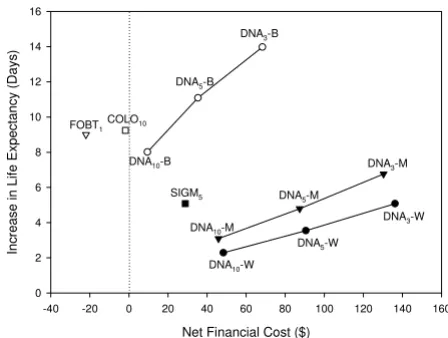
Since the estimates for sensitivity of stool DNA testing vary from study to study, scenario analyses were con-ducted to assess the impact of sensitivity of stool DNA testing strategy (see Figure 4). In the moderate case sce-nario in which the sensitivities and specificity were mainly derived from the meta-analysis based on previous studies [10-13,16], the estimated ICER were similar to the base-case estimates (worst base-case scenario) which based on Impe-riale study [16] (see two bottom curves in Figure 4). The
ICER for DNA3, DNA5, and DNA10 are much less
cost-effective than other screening strategies but still remained cost-effective compared to No Screening. Assuming the best case scenario in which the sensitivities were mainly based on the estimates from Ahlquist study [10], stool DNA testing strategies became comparable with other
screening strategies, and the incremental costs for DNA3,
DNA5, and DNA10, respectively, were calculated as
$3,825, $3,036, and $2,194 per life-year saved. DNA3 and
DNA5 saved more lives than FOBT1 and COLO10, but with
high cost
The results of sensitivity analysis regarding compliance rate to each screening tool are illustrated in Figure 5. The
effectiveness of 100% compliance to FOBT1 is
approxi-mately equivalent to COLO10 with 60% compliance rate.
SIGM5 with 80% compliance is as effective as FOBT1 with
60% compliance and COLO10 with 40% compliance but
with higher cost. DNA3 with 100% compliance has
approximately equivalent effectiveness compared with
FOBT1 with 50% compliance and COLO10 with 30%
com-pliance but with much higher cost. The corresponding
fig-ures were FOBT1 with 30% compliance and COLO10 with
20% compliance for DNA5, and were FOBT1 with 20%
compliance and COLO10 with 15% compliance for
DNA10.
Discussion
The present study is a formal economic evaluation of
DNA3, DNA5, and DNA10 in relation to several
alterna-tives (No Screening, FOBT1, SIGM5, and COLO10) using
Taiwanese data on colorectal cancer incidence and disease natural history, sub-classified by adenoma size and Dukes' stage in invasive carcinoma. The findings from this study suggest that all of the screening strategies are reason-ably cost-effective in relation to No Screening. However, the stool DNA testing strategies were the least
cost-effec-tive. COLO10 and FOBT1 are the most cost-effective
strat-egy. Nevertheless, the feasibility of opting for
[image:10.612.62.286.365.534.2]Sensitivity analysis regarding compliance to screening tool (0.1, 0.2, 0.4, 0.6, 0.8, and 1.0)
Figure 5
Sensitivity analysis regarding compliance to screening tool (0.1, 0.2, 0.4, 0.6, 0.8, and 1.0). Abbreviations: DNA3, stool DNA testing every 3 years; DNA5, stool DNA testing every 5 years; DNA10, stool DNA testing every 10 years; FOBT1, fecal occult blood testing every year; SIGM5, sigmoidoscopy every 5 years; COLO10, colonoscopy every 10 years.
Net Financial Cost ($)
-50 0 50 100 150 200 250
Incr
ease in Lif
e Expec ta ncy ( D ay s) 0 5 10 15 20 25 COLO10 SIGM5 FOBT1 DNA10 DNA3 DNA5 .1 1.0 .8 .6 .4 .2 .1 1.0 .8 .6 .4 .2 .1 1.0 .8 .6 .4 .2 .1 1.0 .8 .6 .4 .2 .1 1.0 .8 .6 .4 .2 .1 1.0 .8 .6 .4 .2
Cost-effectiveness of CRC screening under different scenar-ios
Figure 4
Cost-effectiveness of CRC screening under different scenar-ios. Abbreviations: CRC, colorectal cancer; DNA3, DNA5, and DNA10, stool DNA testing every 3, 5, and 10 years, respectively; -W, under the worst case scenario (the same with the base-case estimates) in which the sensitivity of stool DNA testing for small adenoma, large adenoma, and colorec-tal cancer, and the specificity are 8%, 15%, 52%, and 94% based on Imperiale et al study [10]; -M, under the moderate case scenario in which the corresponding estimates are 8%, 18%, 85%, and 94% based on meta-analysis [10-13, 16]; -B, under the best case scenario in which the corresponding estimates are 8%, 82%, 91%, and 93% based on Ahlquist et al study [10]; FOBT1, fecal occult blood testing every year; SIGM5, sigmoidoscopy every 5 years; COLO10, colonoscopy every 10 years.
Net Financial Cost ($)
-40 -20 0 20 40 60 80 100 120 140 160
Inc re a se i n Li fe Expe ctancy ( D a ys ) 0 2 4 6 8 10 12 14 16 COLO10 FOBT1
DNA3-B
DNA5-B
DNA10-B
SIGM5
DNA3-M
DNA5-M
DNA10-M
DNA10-W
DNA5-W
[image:10.612.318.548.458.631.2]colonoscopy as screening tool for average-risk groups may be questionable due to the shortage of medical endo-scopic manpower and the risk of perforation associated with colonoscopy. Stool DNA testing would be preferable to the other screening strategies if the sensitivity for both adenoma and CRC were high enough, as seen in the best case scenario of sensitivity analysis from the Ahlquist study [10], and if the cost of the test could be lowered through economies of scale like the example of hepatitis B vaccination the price of which has dramatically fallen due to the advent of universal program in 1990s [43]. However, the interpretation of the finding in the best case scenario should be taken with great caution because sub-jects enrolled in Ahlquist study [10] was based on clinical series patients rather than asymptomatic subjects from average-risk population [16].
It should be noted that our focus on this study was to assess whether stool DNA testing was cost-effective pro-vided stool DNA testing can be used as another alternative choice for population-based screening. The incremental cost-effectiveness analysis by pairwise comparison across different screening tools (i.e. colonoscopy vs. stool DNA testing) was therefore not attempted.
Although stool DNA testing has been proposed in recent years its application to mass screening for colorectal can-cer has not been evaluated. The major deterrent has been doubt over the performance of test. Previous studies show a wide range of sensitivities for stool DNA testing, ranging from 15% to 82% for large adenoma and from 50% to 100% for invasive CRC [10-13,16]. This variation may often be attributed to differences in the way asymptomatic subjects or symptomatic cases were selected, although this was not the case in the Imperiale et al study [16]. The larg-est study to focus on asymptomatic subjects (the major target of mass screening) showed 8% sensitivity for small adenoma, 15% for large adenoma and 52% for invasive CRC [16]. False negative cases, as a result of low sensitiv-ity, may lower its effectiveness as a tool for screening asymptomatic subjects in the general population. How-ever, to integrate state-of-world information obtained form previous studies, we used the meta-analysis to obtain the estimate by taking all previous studies into account as the moderate case scenario. However, the esti-mate of sensitivity of adenoma has been largely affected by the Imperial study [16] because it is the largest study up to date on screening for colorectal cancer with stool DNA testing. The estimate based on meta-analysis for the sensi-tivity of cancer has been estimated as 85% by weighting the inverse variance of each study.
It could be argued that stool DNA testing screening is to be more expensive than other screening tools. This may be true at the inception of screening strategy but with
wide-spread use, we might reasonably expect savings due to economies of scale. Genetic epidemiology is still in its infancy but the development of genetic chip technology and DNA testing advances may soon facilitate the devel-opment of simple commercial stool DNA testing kits, which would be considerably cheaper.
Very few studies have addressed the economic aspects of adopting stool DNA testing as screening tool for use in the general population. Only Song et al [44] and Leshno et al [45] have performed a study on cost-effectiveness, com-paring fecal DNA testing with conventional CRC screen-ing. The parameters in the former study are based on Western countries with a high prevalence of CRC, and the parameters in the latter study are based on Israel which also has a high incidence rate of CRC [46]. To the best of our knowledge, no similar studies on stool DNA testing have been conducted in countries with low or intermedi-ate incidence of CRC. Furthermore, the base-case esti-mates of sensitivity and specificity for stool DNA testing may vary across studies. The sensitivity and the specificity used in Leshno study are 70%, 82%, 91%, and 90% for small adenoma, large adenoma, preclinical CRC, and spe-cificity, respectively, which were similar to our best case scenario, and only annual stool DNA testing has been considered [45]. The corresponding estimates in Song study are 40%, 40%, 65%, and 95%, respectively [44]. Compared with the two previous studies [44,45], the base-case estimates in our study are the most conservative ones which only base on the population-based study [16]. However, despite the diversified parameter regarding sen-sitivity and specificity, our findings that stool DNA testing is cost-effective compared to No Screening but inferior to conventional screening methods such as FOBT and colon-oscopy are consistent with Song et al's and Leshno et al's findings [44,45].
The reported ICERs in this study are much lower than that reported in other cost-effectiveness analysis [44,47,48]. This discrepancy can be explained by the low cost of screening tool, and other relevant cost for CRC treatment and diagnosis used in this study which represents the real-ity in Taiwan. When we used the cost based on the West-ern country as our base-case parameters [44], given perfect compliance and perfect referral rate as assumed in the pre-vious studies, the ICERs are comparable with the prepre-vious
studies [44,47,48]. The ICER for FOBT1, SIGM5, and
COLO10 compared with No Screening are estimated as
$2,376, $20,206 and $13,831 per life-year saved, respec-tively. However, all the stool DNA testing strategies are not cost-effective and the ICERs inflate to approximately
$115,000 per life-year saved for DNA10 compared with No
The compliance may have large influence on the cost and the effectiveness of a screening program. Nevertheless, the compliance may vary widely by different screening tool and population [49], therefore, the decision should be made by the preference of each population. Figure 5 has shown the influence of different compliance level of each screening tool on the cost-effectiveness which allows the assessment for various compliance rates to each screening tool. For example, for a population with the compliance
of 40% with FOBT1 and of 20% with SIGM5 and COLO10,
FOBT1would save more lives and less costly than all the
other screening strategies. However, for a population with
the compliance of 50% with FOBT1 and of 40% with
SIGM5 and COLO10, COLO10 would have more life-year
gained than FOBT1 but with higher cost.
As far as the validity of our simulation model is con-cerned, our results obviously depend on the parameters chosen for the natural history part of the model. Three findings lead us to believe that our simulated model is adequate. Firstly, the predicted cumulative incidence of CRC in our study, 34 per 1,000, is close to the observed one, 37 per 1,000 [17]. Secondly, our sensitivity analyses demonstrates that changes to the upper and lower bounds of our estimates do not lead to substantial changes in our results. Thirdly, to check whether our simulated results on the effectiveness of FOBT test are consistent with those reported in several randomized trials [1-4], we applied 60% (56.5%~67%) compliance rate of FOBT and 85% referral rate to diagnostic colonoscopy and identical tran-sition parameters based on base-case parameters, and shortened follow-up year to 10 years as seen in rand-omized trial, the predicted mortality reduction for annual FOBT screening and biennial FOBT screening is 20% and 13%, respectively, the latter of which is close to the find-ings from several randomised trials with two-yearly inter-screening interval, indicating 16%, 21%, and 15% mortal-ity reduction conducted in Burgundy (France) [4], Funen (Denmark) [3], and Nottingham (UK) [2], respectively. For the incidence, the incidence ratio was estimated as 0.80 (annual FOBT) after follow-up for 18 years, which was close to the estimate reported in randomized trial [1].
Since this study was conducted from a third-party payer perspective, we therefore adopted the price mandated by the Bureau of National Health Insurance (95% popula-tion covered) as the cost and only direct costs were included. However, indirect costs such as production loss due to attending to screening or due to disease should be considered from the societal viewpoint. This could be the subject of future studies.
Our study has, however, one limitation as our proposed model assumes an adenoma to carcinoma sequence, which accounts for the majority of CRCs. Non-polypoid
cases are not taken into account. However, as only a frac-tion of CRCs are non-polypoid and the cost-effectiveness analysis addresses the relative comparisons across screen-ing strategies, the incorporation of the occurrence of non-polypoid tissue is unlikely to substantially affect the results.
Conclusion
In conclusion, an economic evaluation of CRC screening with stool DNA testing was performed in a country with an intermediate incidence of CRC. Our results suggest that stool DNA testing is less cost-effective than other currently recommended strategies for population-based average-risk subjects.
Competing interests
The author(s) declare that they have no competing inter-ests.
Authors' contributions
GHMW is responsible for the study design, statistical modeling, data interpretation and drafting of the article. YMW is responsible for collection and assembly of data. AMFY is responsible for statistical expertise. JMW and HCL both make great contribution to critical revision of the article for important intellectual content. JW assisted in interpreting the data and revising the article. THHC makes great contribution to conception and design, criti-cal revision of the article for important intellectual con-tent, statistical expertise, interpreting results, and revising manuscript.
Acknowledgements
The author(s) thank Dr. Chao-Sheng Liao, Shin Kong Wu Ho-Su Memorial Hospital, Taipei, for acquisition of data on cost. This study has not been supported by any research fund.
References
1. Mandel JS, Bond JH, Church TR, Snover DC, Bradley GM, Schuman LM, Ederer F: Reducing mortality from colorectal cancer by screening for fecal occult blood. N Engl J Med 1993, 328:1365-1371.
2. Hardcastle JD, Chamberlain JO, Robinson MH, Moss SM, Amar SS, Balfour TW, James PD, Mangham CM: Randomised controlled trial of faecal-occult-blood screening for colorectal cancer.
Lancet 1996, 348:1472-1477.
3. Kronborg O, Fenger C, Olsen J, Jorgensen OD, Sondergaard O: Ran-domised study of screening for colorectal cancer with faecal-occult-blood test. Lancet 1996, 348:1467-71.
4. Faivre J, Dancourt V, Lejeune C, Tazi MA, Lamour J, Gerard D, Das-sonville F, Bonithon-Kopp C: Reduction in colorectal cancer mortality by fecal occult blood screening in a French control-led study. Gastroenterology 2004, 126:1674-80.
5. Rudy DR, Zdon MJ: Update on colorectal cancer. Am Fam
Physi-cian 2000, 61:1759-1770.
6. Selby JV, Friedman GD, Quesenberry CPJ, Weiss NS: A case-con-trol study of screening sigmoidoscopy and mortality from colorectal cancer. N Engl J Med 1992, 326:653-657.
7. Müller AD, Sonnenberg A: Protection by endoscopy against death from colorectal cancer. A case-control study among veterans. Arch Intern Med 1995, 155:1741-1748.
Gastrointes-tinal Consortium Panel: Colorectal cancer screening and sur-veillance: clinical guidelines and rationale – Update based on new evidence. Gastroenterology 2003, 124:544-560.
9. American Cancer Society: American Cancer Society guidelines on screening and surveillance for the early detection of ade-nomatous polyps and colorectal cancer – update 2001. CA: A
Cancer J for Clinicians 2001, 51:44-54.
10. Ahlquist DA, Skoletsky JE, Boynton KA, Harrington JJ, Mahoney DW, Pierceall WE, Thibodeau SN, Shuber AP: Colorectal cancer screening by detection of altered human DNA in stool: fea-sibility of a multitarget assay panel. Gastroenterology 2000, 119:1219-1227.
11. Tagore KS, Lawson MJ, Yucaitis JA, Gage R, Orr T, Shuber AP, Ross ME: Sensitivity and specificity of a stool DNA multitarget assay panel for the detection of advanced colorectal neopla-sia. Clin Colorectal Cancer 2003, 3:47-53.
12. Loktionov A, O'Neill IK, Silvester KR, Cummings JH, Middleton SJ, Miller R: Quantitation of DNA from exfoliated colonocytes isolated from human stool surface as a novel noninvasive screening test for colorectal cancer. Clin Cancer Res 1998, 4:337-342.
13. Koshiji M, Yonekura Y, Saito T, Yoshioka K: Microsatellite analysis of fecal DNA for colorectal cancer detection. J Surg Oncol 2002, 80:34-40.
14. Dong SM, Traverso G, Johnson C, Geng L, Favis R, Boynton K, Hibi K, Goodman SN, D'Allessio M, Paty P, Hamilton SR, Sidransky D, Barany F, Levin B, Shuber A, Kinzler KW, Vogelstein B, Jen J: Detect-ing colorectal cancer in stool with the use of multiple genetic targets. J Natl Cancer Inst 2001, 93:858-865.
15. Traverso G, Shuber A, Levin B, Johnson C, Olsson L, Schoetz DJ Jr, Hamilton SR, Boynton K, Kinzler KW, Vogelstein B: Detection of APC mutations in fecal DNA from patients with colorectal tumors. N Engl J Med 2002, 346:311-320.
16. Imperiale TF, Ransohoff DF, Itzkowitz SH, Turnbull BA, Ross ME: Fecal DNA versus fecal occult blood for colorectal-cancer screening in an average-risk population. N Engl J Med 2004, 351:2704-2714.
17. Cancer registry annual report Republic of China. Taipei: Department of Health, Republic of China; 2003.
18. Cox DR, Miller HD: The theory of stochastic processes. Meth-uen and Co Ltd; 1965.
19. Duffy SW, Tabar L, Day NE: Estimation of mean sojourn time in breast cancer screening using a Markov chain model of both entry and exit from the preclinical detectable phase. Stat Med 1995, 14:1531-1543.
20. Chen THH, Kuo HS, Yen MF, Lai MS, Tabar L, Duffy SW: Estimation of sojourn time in chronic disease screening without data on interval cases. Biometrics 2000, 56:167-172.
21. Stryker SJ, Wolff BG, Culp CE, Libbe SD, Ilstrup DM, MacCarty RL: Natural history of untreated colonic polyps. Gastroenterology 1987, 93:1009-13.
22. Chen TH, Yen MF, Lai MS, Koong SL, Wang CY, Wong JM, Prevost TC, Duffy SW: Evaluation of a selective screening for colorec-tal carcinoma: the Taiwan Multicenter Cancer Screening (TAMCAS) project. Cancer 1999, 86:1116-1128.
23. O'Connell JB, Maggard MA, Ko CY: Colon cancer survival rates with the new American Joint Committee on Cancer six edi-tion staging. J Nalt Cancer Inst 2004, 96:1420-5.
24. 2002 Health and Vital Statistics. Taipei: Department of Health, Republic of China; 2003.
25. Winawer SJ, Fletcher RH, Miller L, Godlee F, Stolar MH, Mulrow CD, Woolf SH, Glick SN, Ganiats TG, Bond JH, Rosen L, Zapka JG, Olsen SJ, Giardiello FM, Sisk JE, Van Antwerp R, Brown-Davis C, Marciniak DA, Mayer RJ: Colorectal cancer screening: clinical guidelines and rationale. Gastroenterology 1997, 112:594-642.
26. Ahlquist DA, Wieand HS, Moertel CG, McGill DB, Loprinzi CL, O'Connell MJ, Mailliard JA, Gerstner JB, Pandya K, Ellefson RD: Accu-racy of fecal occult blood screening for colorectal neoplasia.
JAMA 1993, 269:1262-1267.
27. Ahlquist DA: Fecal occult blood testing for colorectal cancer: can we afford to do this? Gastroenterol Clin North Am 1997, 26:41-55.
28. Launoy G, Smith TS, Duffy SW, Bouvier V: Colorectal cancer mass-screening: estimation of faecal occult blood test sensi-tivity, taking into account cancer mean sojourn time. Int J
Cancer 1997, 73:220-4.
29. Gyrd-Hansen D, Sogaard J, Kronborg L: Analysis of screening data: colorectal cancer. Int J Epidemiol 1997, 26(6):1172-81. 30. Moss SM, Hardcastle JD, Coleman DA, Robinson MHE, Rodrigues
VC: Interval cancers in a randomized controlled trail of screening for colorectal cancer using a faecal occult blood test. Int J Epidemiol 1999, 28:386-90.
31. Jouve JL, Remontet L, Dancourt V, Lejeune C, Benhamiche AM, Faivre J, Esteve J: Estimation of screening test (Hemoccult) sensitiv-ity in colorectal cancer mass screening. Brit J Cancer 2001, 84(11):1477-81.
32. Foutch PG, Mai H, Pardy K, DiSavio JA, Manne RK, Kerr D: Flexible sigmoidoscopy may be ineffective for secondary prevention of colorectal cancer in asymptomatic, average-risk men. Dig
Dis Sci 1991, 86:946-951.
33. Rex DK, Cutler CS, Lemmel GT, Rahmani EY, Clark DW, Helper DJ, Lehman GA, Mark DG: Colonoscopic miss rates of adenomas determined by back-to back colonoscopies. Gastroenterology 1997, 112:24-28.
34. Hixson LJ, Fennerty MB, Sampliner RE, Garewal HS: Prospective blinded trial of the colonoscopic miss-rate of large colorectal polyps. Gastrointest Endosc 1991, 37:125-127.
35. Rex DK: Colonoscopy: a review of its yield for cancers and adenomas by indication. Am J Gastroenterol 1995, 90:353-365. 36. Castiglione G, Ciatto S, Mazzotta A, Grazzini G: Sensitivity of
screening sigmoidoscopy for proximal colorectal tumors.
Lancet 1995, 345(8951):726-7.
37. Zarchy TM, Erchoff D: Do characteristics of adenomas on flex-ible sigmoidoscopy predict advanced lesions on baseline colonoscopy? Gastroenterology 1994, 106(6):1501-4.
38. Achkar E, Carey W: Small polyps found during fiberoptic sig-moidoscopy in asymptomatic patients. Ann Intern Med 1988, 109:880-883.
39. Pignone M, Saha S, Hoerger T, Mandelblatt J: Cost-effectiveness analyses of colorectal cancer screening: a systematic review for the U.S. Preventive Services Task Force. Ann Intern Med 2002, 137:96-104.
40. Kirschner CG, Davis SJ, Duffy C, Evans D, Hayden D, Jackson JA, Jacobs SJ, Jacobson CA, Kopacz J, Kotowicz GM, O'Heron MR, O'Hara KE, Reyes D: Current Procedural Terminology: CPT. Chicago: American Medical Assoc; 1999.
41. Blom J, Liden A, Jeppsson B, Holmberg L, Pahlman L: Compliance and findings in a Swedish population screened for colorectal cancer with sigmoidoscopy. EJSO 2002, 28:827-31.
42. Pariente A, Milan C, Jafon J, Faivre : Colonoscopic screening in first-degree relatives of patients with 'sporadic' colorectal cancer: a case-control study. Gastroenterology 1998, 115:7-12. 43. World Health Organization: Immunization, vaccines and
biolog-icals. The history of vaccination. [http://www.who.int/vaccines-diseases/history/history.shtml]. Accessed March 1, 2006.
44. Song K, Fendrick AM, Ladabaum U: Fecal DNA testing compared with conventional colorectal cancer screening methods: a decision analysis. Gastroenterology 2004, 126:1270-1279. 45. Leshono M, Halpern Z, Arber N: Cost-effectiveness of colorectal
cancer screening in the average risk population. Health Care
Manag Scien 2003, 6:165-74.
46. Parkin DM, Bray F, Ferlay J, Pisani P: Global cancer statistics, 2002. CA Cancer J Clin 2005, 55:74-108.
47. Sonnenberg A, Delco F, Inadomi JM: Cost-effectiveness of colon-oscopy in screening for colorectal cancer. Ann Intern Med 2003, 133:573-584.
48. Vijan S, Hwang EW, Hofer TP, Hayward RA: Which colon cancer screening test? A comparison of costs, effectiveness, and compliance. Am J Med 2001, 111:593-601.
49. Vernon SW: Participation in colorectal cancer screening: a review. J Natl Cancer Inst 1997, 89:1406-22.
Pre-publication history
The pre-publication history for this paper can be accessed here: