http://wrap.warwick.ac.uk/
Original citation:
Hammond, Simon D., Mudalige, Gihan R., Smith, J. A. and Jarvis, Stephen A., 1970-
(2008) Performance prediction and procurement in practice : assessing the suitability of
commodity cluster components for wavefront codes. In: 24th UK Performance
Engineering Workshop (UKPEW 2008), London, UK, 3-4 July 2008. Published in: 24th
UK Performance Engineering Workshop 3–4 July 2008
Permanent WRAP url:
http://wrap.warwick.ac.uk/60483
Copyright and reuse:
The Warwick Research Archive Portal (WRAP) makes this work by researchers of the
University of Warwick available open access under the following conditions. Copyright ©
and all moral rights to the version of the paper presented here belong to the individual
author(s) and/or other copyright owners. To the extent reasonable and practicable the
material made available in WRAP has been checked for eligibility before being made
available.
Copies of full items can be used for personal research or study, educational, or
not-for-profit purposes without prior permission or charge. Provided that the authors, title and
full bibliographic details are credited, a hyperlink and/or URL is given for the original
metadata page and the content is not changed in any way.
A note on versions:
The version presented in WRAP is the published version or, version of record, and may
be cited as it appears here.For more information, please contact the WRAP Team at:
Performance Prediction and Procurement in
Practice: Assessing the Suitability of
Commodity Cluster Components for
Wavefront Codes
S.D. Hammond, G.R. Mudalige, J.A. Smith, S.A. Jarvis,
High Performance Systems Group,
Department of Computer Science,
University of Warwick,
Coventry, CV4 7AL, UK.
{
sdh, g.r.mudalige, jas, saj
}
@dcs.warwick.ac.uk
Abstract
The cost of state-of-the-art supercomputing resources makes each individual pur-chase an expensive and, in many cases, lengthy process. Often each candidate ar-chitecture will need to be benchmarked using a variety of tools to assess potential performance. However, benchmarking alone often provides only limited insight into the potential scalability and suitability of each architecture for procurement.
In this paper we present a case study applying two recently developed perfor-mance models to the Chimaera benchmarking code written by the United Kingdom Atomic Weapons Establishment (AWE) with a view to analysing how the code will perform and scale on a medium sized, commodity based InfiniBand cluster. Our models are validated with average accuracies of 90% against an existing Infini-Band machine and then used as the basis for predicting code performance on a variety of hardware configurations including changes in the underlying network, faster processors and high core density per processor.
The results of our experimentation with machine performance parameters demon-strate the compute-bound nature of Chimaera and its sensitivity to network latency at increased processor counts. By using these insights we are able to discuss poten-tial strategies which may be employed during the procurement of future mid-range clusters for a wavefront-code rich workload.
1
Introduction
of modern machines and the ever increasing complexity of each system the task of procuring the ‘right’ computing machinery for purpose is fastly becoming a lengthy and intricate process. Pure benchmarking of applications on candidate architectures serves only limited purpose - the results will only highlight the performance of spe-cific codes and often only for spespe-cific inputs. For organisations who want the very best machine performance, a deeper knowledge of code behaviour with respect to each prospective platform is needed.
Performance modelling has been used as a basis for machine comparison [8, 14] and post-installation performance verification [15], and has been shown in a number of examples to address many of the questions which may arise during procurement. Whilst serving as a showcase for many performance modelling techniques, the focus has been on very large emerging architectures and not the small to medium sized com-modity or near-comcom-modity clusters used in a number of research organisations. In these procurement activities similar issues must be addressed but with hardware which may have lower specification, be arranged differently or have alternative behaviour to the expensive components that are common place in supercomputing systems.
In this paper we utilise two recently developed performance models to explore the performance of the Chimaera neutron transport benchmark developed and maintained by the United Kingdom Atomic Weapons Establishment (AWE), targetting a process-ing element count of up to 4096 cores. The direct use and cross-comparison of predic-tions from two performance modelling techniques aids not only in elucidating specific code and machine behaviour but also in increasing the accuracies of our observations. This work is not intended to comment on the respective costs of each strategy but to provide some degree of quantitative exploration of various hardware and application configurations, which can in turn support the queries that may arise during the early stages of a procurement activity. The specific contributions of this work are:
• The presentation of a performance study for the AWE Chimaera benchmark on commodity or near-commodity hardware. This is the first such study for the Chimaera benchmark and is designed to support future procurement activities for mid-range supercomputing resources at AWE. We use two approaches in verifying our predictions: (1) based on analytic methods utilising the recently developed “plug and play” reusable wavefront model [18] and (2) using a new discrete even simulation toolkit. Both approaches show predictive accuracies of over 90% and provide higher confidence in the conclusions obtained from our performance engineering study.
• A quantitative exploration of the key parameters which affect the performance of wavefront codes on modern commodity HPC systems, supporting the explo-ration of prospective machine configuexplo-rations for procurement.
• An exploration of the contention costs arising on a CMP-processor-based cluster when executing Chimaera and the implications for code runtime and machine procurement.
in which we benchmark an existing 11.5 TFLOP/s InfiniBand system and project run-times for a variety of alternative application and machine configurations. Our paper concludes in Section 7 with a summary of the results and a review of the implica-tions for procuring a small to medium size cluster for sustained wavefront-dominated computations.
2
Performance Modelling
Application performance modelling is principally charged with the derivation of mod-els by which code behaviour can be analysed and predicted. In the main, the interest in such models is in analysing how the computational and communication structures in a code will change with respect to an increased processor count or change in applica-tion problem size. By developing a deeper insight of the runtime fluctuaapplica-tions resulting from such changes, an understanding of code bottlenecks, software optimisation and in many cases optimal configuration can be developed.
Current techniques for developing application models predominantly fall into two distinct categories - those based on analytical studies and those based on simulation. Although some conceptual work on a binding of the two is discussed in the POEMS framework [1], there has been little practical demonstration reported in academic litera-ture. Analytical studies [11, 13, 21] which seek to represent code behaviour by a series of mathematical formula, are often developed within some modelling framework or methodology (e.g. LogP[4], LogGP[2] and LoPC[5]). The use of rigid frameworks for modelling helps to alleviate some of the complexity involved in modeling and provide a generic basis upon which code behaviour can be judged. The challenges of using an analytical approach are identifying the key application parameters which affect runtime behaviour and how best to represent each parameter mathematically. The analysis of code for modelling is often based on manual code inspection which, although time con-suming, allows the performance modeller to develop a deeper understanding of specific code behaviour from which further behavioural insights may be garnered.
A brief overview of the recently developed “plug and play” reusable wavefront model [18], which serves as the basis for our analytical exploration of Chimaera, is presented in Section 4.1. Note that the development of a reusable model serves to reduce the time required to model future wavefront codes, since a flexible framework can now be applied to any wavefront application; this approach also permits cross-application comparisons to be made within a highly algorithm-specific framework.
Ny
Ny/n
Nz
Nx
N x / m
Inflows
[image:5.595.197.394.125.236.2]Outflows
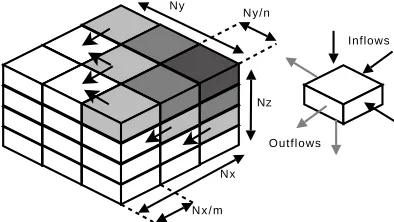
Figure 1: Sweep execution through the data array in Chimaera.
computational timings (as opposed to individual instructions timings) and a ‘layered’ network modelling system, significantly reduce simulation times, whilst providing pre-diction accuracies commensurate with leading analytical models.
3
The Chimaera Benchmark
The Chimaera benchmark is a three-dimensional neutron transport code developed and maintained by the United Kingdom Atomic Weapons Establishment (AWE). On first inspection the code shares a similar structure with the now ubiquitous Sweep3D ap-plication described in numerous analytical performance studies [13, 14, 17]. Unlike Sweep3D, however, the code employs a different internal sweep ordering and utilises a complex convergence criteria to decide when execution is complete. In this section of the paper we present a concise description of the wavefront algorithm employed by both Sweep3D and Chimaera. Our discussion is purposefully brief as a number of existing works describe the behaviour of the wavefront algorithm [16] and a short overview is sufficient to enable an understanding of the key application behaviours.
3.1
The Generic Wavefront Algorithm
The generic three-dimensional wavefront algorithm operates over a data array of size
Nx×Ny×Nz. The data array is decomposed over a two-dimensional processor array sizedm×n. Each processor receives a ‘column’ of data sizedNx/m×Ny/n×Nz. For the purposes of our discussion it helps to consider this column as a stack ofNztiles eachNx/m×Ny/n×1in size. The algorithm proceeds by executing sweeps through the data which pass from one vertex to its opposite. For Chimaera and Sweep3D eight sweeps are used - one for each vertex of the three-dimensional space.
1 2
3 5 8
[image:6.595.240.351.126.246.2]7 46
Figure 2: Starting locations for sweep within the two-dimensional processor array
employed by Chimaera.
visible communications to downstream processors). A full ‘iteration’ of the wavefront algorithm in Chimaera requires all eight sweeps to have completed.
4
Modelling Chimaera
The modelling of Chimaera has been conducted using two approaches - analytical mod-elling based on the “plug and play” reusable model [18] and using the new WARwick Performance Prediction (WARPP) simulation toolkit developed by the University of Warwick.
4.1
Plug and Play Analytical Model
Model Parameter Chimaera Value
Nx, Ny, Nz Input size
Wg measured
Wg,pre 0
Htile(cells) 1
nsweeps 8
nf ull 4
ndiag 2
M essage 8Htile
SizeEW ×#angles
(Bytes) ×Ny/m
M essage 8Htile
SizeN S ×#angles (Bytes) ×Nx/n
Table 1: Reusable Wavefront Model Application Parameters.
[image:6.595.217.376.466.642.2]Wpre=Wg,pre×Htile×Nx/n×Ny/m (r1a)
W =Wg×Htile×Nx/n×Ny/m (r1b)
StartP1,1=Wpre (r2a)
StartPi,j=max(StartPi−1,j+Wi−1,j+T otal commE+ReceiveN,
StartPi,j−1+Wi,j−1+SendE+T otal CommS) (r2b)
Tdiagf ill=StartP1,m (r3a)
Tf ullf ill=StartPn,m (r3b)
Tstack= (ReceiveW +ReceiveN +W+SendE+SendS (r4)
+Wpre)Nz/Htile−Wpre (r4)
[image:7.595.126.467.125.261.2]T ime per iteration=ndiagTdiagf ill+nf ullTf ullf ill (r5) +nsweepsTstack+Tnonwavef ront (r5)
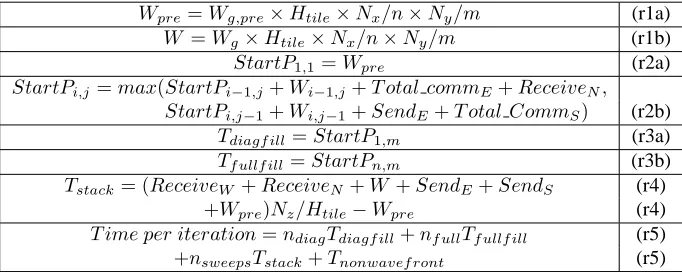
Table 2: Plug-and-play LogGP Model: Single Core Per Node.
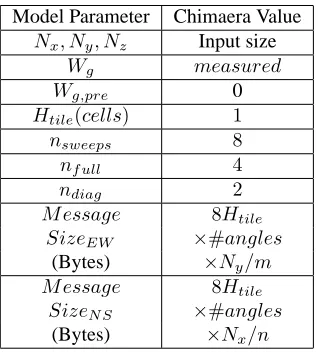
model. The computational time required,Wg, and the computational time per cell prior to the algorithm kernel,Wg,pre, are the only machine specific values for which bench-marking of the application is required.. For our study this was obtained by using a manually instrumented version of the benchmark which times the core computational kernel of the wavefront algorithm. Wg,pre is unused in Chimaera since there are no computational sections in the sweep algorithm prior to the main kernel.
The sweep ordering parameters,nsweeps,nf ullandndiagrepresent the total num-ber of sweeps per iteration, the numnum-ber of full sweeps and the numnum-ber of half sweeps respectively. The concept of ‘full’ and ‘half’ sweeps relates to the ability of sweeps within the application to overlap. Recall the sweep ordering presented in Figure 2. Sweep 2 originates on the processor located in the top right corner of the processor array. Once this sweep has successfully passed through the bottom right (the starting location for sweep 3) the next sweep can begin. If this starts prior to sweep 2 fin-ishing on the bottom left processor, overlapping occurs which serves to increase the efficiency of the code. Overlapping can only occur if sweepifinishes at the starting location for sweepi+ 1whilst other downstream processors are still processing sweep
i. This occurs twice in Chimaera (sweep pairs 2,3 and 6,7) giving anndiagvalue of 2. The full reusable model is presented in Table 2 with the complete equation for runtime given in (r5). Explanations of each sub-equation are given in [18]. Note that in the original paper describing the reusable wavefront model, the authors develop a complex LogGP communications model for the Cray XT4 architecture. In this work we develop a simpler regionalised least squares regression model to obtain times for MPI send and receive operations (these are presented in Section 5.1.1).
4.2
Simulation using the WARPP Toolkit
complexity to modelling activities. With this in mind, the structure of a machine is relayed to the simulator by a series of ‘profiles.’ Each profile has unique performance properties such as network latency, outbound bandwidth etc. When developing a sim-ulation the user is required to specify the respective values for each performance prop-erty and a mapping of MPI processes to profiles for the specific machine configuration being analysed. By providing a generic basis for the description of a machine, arbitrar-ily complex hardware models can be developed enabling the exploration not only of modern machine structures but also future multi-structured computing resources.
Simulations developed using the WARPP toolkit build upon the observation that parallel codes are ordered executions of basic blocks separated by control flow, calls to network transmissions or I/O operations. Like previous simulators we recreate ap-plication behaviour by replaying the code’s control flow, pausing during execution to directly simulate computation, communication and I/O events. Communication be-tween processes are simulated fully ensuring that transmissions bebe-tween nodes block when the transmissive partner is otherwise engaged. Computation is, however, mod-elled quite differently to existing work in that it does not simulate each application instruction directly. Instead, the toolkit jumps over whole basic blocks within the control-flow recording the time that the block requires for execution on the target plat-form. The switch to coarser grained computational timings significantly reduces the time required for individual simulations aiding in improving the scalability of the sim-ulator to considerably higher processor counts than previous toolkits. The issue which arises in moving to coarser grained computational timings is precisely how the time for the block is extracted from the application. To alleviate the manual instrumentation of code to obtain such timings the toolkit includes an automated code analyser which in-jects timing routines into the application source code directly creating an instrumented benchmark version of the code. The analyser also generates a control flow represen-tation of the code detailing where each block can be found and how to identify it’s associated execution time from the instrumented application output.
4.2.1 Developing a Simulation in WARPP
Network Profile Message Size) nl B
(Bytes) (microsec) (GBytes/s)
on-chip ≥0 0.655 2.70
(core to core)
off-processor <2048 0.69 2.80 (processor to processor) ≥2048 0.91 3.83
off-node <2048 2.64 0.46
(node to node) ≥2048 3.63 0.73
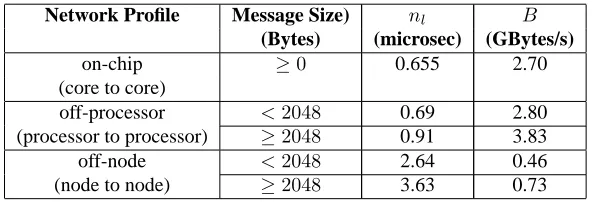
Table 3: Benchmarked Network Performance for the CSC-Francesca Machine
(measurements taken using the Intel MPI benchmarking utility version 3.0 [9]. The Intel C compiler version 10 was used with default system MPI libraries.)
Core Problem Actual Analytical Sim. Analytical Sim.
Count Size Runtime Pred. Pred. Error Error
(sec) (sec) (sec) (%) (%)
32 1203
107.18 88.76 89.58 -17.19 -16.42 64 1203
56.72 47.59 48.75 -16.09 -14.04 128 1203
32.56 28.20 28.98 -13.40 -11.01 81 2403
342.33 326.45 330.46 -4.64 -3.47 96 2403
297.03 268.71 277.56 -9.54 -6.55 100 2403
278.37 243.36 248.32 -12.58 -10.79 128 2403
225.65 205.50 207.18 -8.93 -8.18 169 2403
174.35 174.35 177.09 -0.88 1.57 256 2403
[image:9.595.149.446.124.225.2]129.65 115.58 117.98 -10.85 -9.01
Table 4: Model Validations on the CSC-IBM Francesca Machine - (Compiler - Intel
Fortran 10.0 with-O2optimisation setting, OpenMPI 1.2.5, All runtimes given are wall time for sweeping components in seconds, Negative values indicate
under-predictions)
During a simulation, data relating to the application’s performance and machine utilisation is recorded enabling performance modellers to replay the simulated execu-tion at a later date and analyse where execuexecu-tion time was spent (for example, time spent in communication, computation, idle etc). As our studies into the applications used at AWE deepen we intend to use the simulation data to direct potential improvements in code structure and resource allocation.
5
Modelling Code Performance on a Commodity High
Performance Cluster
for alternative machine configurations that may be considered during a procurement exercise.
5.1
The University of Warwick Centre for Scientific Computing
(Francesca) Machine
The recently installed 11.5 TFLOP/s Centre for Scientific Computing (University of Warwick) IBM supercomputer is typical of a large, sub-Million pound commodity cluster available today. The system comprises of 240 dual-Intel Xeon 5160 dual-core nodes each sharing 8GB of memory (giving 1.92TB in total). Nodes are connected via a QLogic InfiniPath 4X, SDR (raw 10Gb/s, 8Gb/s data) QLE7140 host channel adapters (HCAs) connected to a single 288-port Voltaire ISR 9288 switch. Processor core to HCA ratio is4 : 1. Each compute node runs the SUSE Linux Enterprise Server 10 operating system and has access to the IBM GPFS parallel file system [20]. For our study the Intel C/Fortran 10 compiler suite was used in conjunction with OpenMPI 1.2.5 [6] and the PBS Pro scheduler. By default, jobs launched under PBS are allo-cated ‘freely’ in the system - i.e. to any free core which meets the wall time or memory resources requested by the job. Nodes and processors are shared between jobs unless specifically requested during submission. Runtimes can therefore vary (by as much as 10-15%) between successive runs due to the ‘free’ placement of processes within the machine and the potential sharing of node resources.
5.1.1 Machine Network Benchmarks and Models
The results of machine benchmarking demonstrating raw MPI latency and bandwidths are shown in Table 3. Note that the network benchmarking is partitioned into two regions by message size. The point at which the split in network performance occurs is 2048 bytes, indicating that the InfiniBand management system may be configured for a maximum transmission unit (MTU) size of 2Kbytes (a maximum of 4K is supported by the HCA and switch).
For both performance studies we model the communication time for a message of length xbytes as tsend(x) = (1/B)x+nl with the bandwidth (B) and latency (nl) associated with the appropriate region forx. The time for a receive is mod-elled by: trecv(x) = (1/B)xsince the receiver does not experience the latency re-quired to establish the connection but must spend at least the actual transmission time in a locked state accepting data from the network interconnect. Using these val-ues we can calculate the point at which bandwidth will dominate network transmis-sions as: (2.62×10⁻⁶)/(1(/0.46×10243)) = 1304 bytes (small messages) and
(3.63×10⁻⁶)/(1/(0.73×10243)) = 2846bytes for large messages. In the context of Chimaera these values, where each cell contains 10 angles, each of which is a double floating point value, equate to message sizes of17and36cells respectively. These val-ues indicate the “see-saw” point at which the network operates, giving some indication of whether bandwidth or latency is dominant for each MPI operation.
5.2
Performance Model Validation
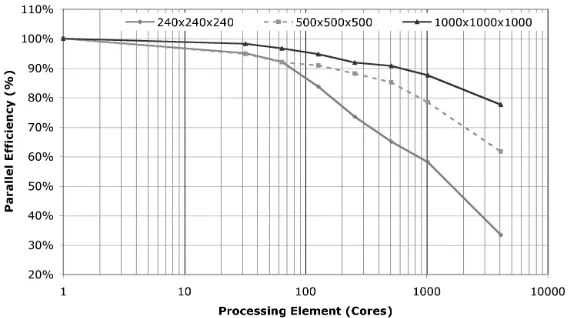
Figure 3: Parallel Efficiency of Large Problem Sizes using the InfiniBand
Interconnect.
Note that the vast majority of the predicted runtimes are below the actual execution time - the principle reason being that both performance models assume as ‘perfect’ allocation of processor cores within the machine, assuming that neighbouring MPI ranks will be allocated as closely as physically possible. In practice, the free placement of processes causes some degree of increased execution time due to the higher network costs experienced. Similarly, the natural load and noise which occurs from shared resources helps to create variation in execution. Additionally, predictions are taken from averaged estimates of machine parameters for which rounding and measurements may also occur.
6
Procurement: Assessing the suitability of machine
components
Following the benchmarking of the CSC-Francesca machine and validation of the per-formance models, we present several sub-studies exploring alternative machine or ap-plication configurations. In the following studies we analyse the effect on code runtime of a change in (1) an increase in problem size, (2) moving to a gigabit ethernet network-ing solution (3) the installation of InfiniBand resources with identical bandwidth but increased latency (4) a change in the performance of individual processor-cores and (5) a doubling of processor-core density.
6.1
Large Problem Sizes
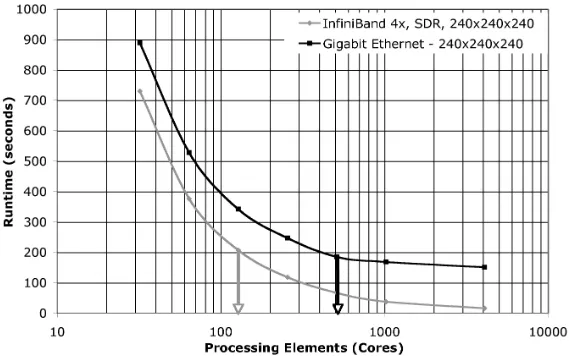
Figure 4: Chimaera Runtime using InfiniBand (4x, SDR) and Gigabit Ethernet
Interconnects.
resulting from decreasing computation time per processor and an increase number of network transmissions in the system as a whole.
The measure of parallel efficiency is of particular interest to AWE since parallel jobs are mandated to be in higher than 50% configurations wherever possible with a number of users specifically choosing PE counts to target this value. For the 2403
problem this point occurs between 1024 and 2048 cores indicating the approximate core count which may be required per job if targeted specifically for a 50% efficiency. Depending on how many simultaneous jobs the organisation wants to execute at this level of efficiency an approximate core count for procurement can be deduced. For larger problem sizes a similar form of analysis is also applicable, however, significantly more cores will be required before the 50% point is reached.
6.2
Choice of Networking Interconnect
For any machine intended to execute high performance parallel codes the choice of interconnect is particularly accute. The precise mix of latency, bandwidth capacity and cost must be balanced to support the compute resources in delivering smooth, consistent performance. At the time of procurement it is common to want to assess not only which interconnect will provide the best raw performance but also what the effect of changing the interconnect or choosing a slightly lower specification will have on overall runtime. We have modelled two such choices - (1) whether to select a Gigabit network over an InfiniBand interconnect and (2) the effect of purchasing an InfiniBand network with identical 4x, SDR bandwidths but 25%, 50% and 75% higher latencies.
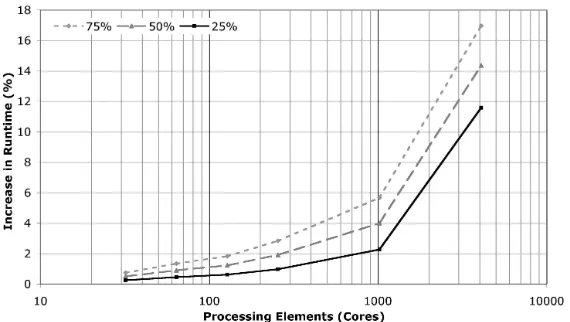
Figure 5: Increase in runtime from a 4x SDR InfiniBand network with varying
increases in latency.
faced in any procurement activity. For the Chimaera benchmark at least, the results demonstrate that between two and four times as many processors will be required to offset the degradation of using a slower interconnect - a significant increase which will in turn make the machine more expensive to run and potentially more difficult to administer. The runtimes marked in Figure 4 present this point for the 128 and 512 core cases.
In Figure 5 we demonstrate predictions for the percentage increase in runtime re-sulting from the use of an 4x SDR InfiniBand interconnect with 25%, 50% and 75% higher latencies. For small processor counts (less than 1000) the increase in runtime is less than 6% in all cases. After this point - where communication begins to become a higher proportion of runtime - the runtime begins to increase rapidly with an increase of at least 10%. In this scenario the purchase of a lower specification system may be acceptable if the intention is to limit the maximum processor count of each job to 1024 cores or less.
We also believe that the use of machine configurations for node counts greater than 288 will cause increases in experienced wire latencies as tree based switch topolo-gies will need to be employed in order to cope with the extra port count. These costs are not included in this work as benchmarked values to support a predictive model are not currently available and work completed in [10] provides some suggestion that contention within InfiniBand switches may be reduced in future systems through the use of advanced routing algorithms. Figure 5 does however help to give indication of how sensitive the structured communication pattern used in Chimaera is to even minor increases in network latency.
6.3
Machine Compute Performance
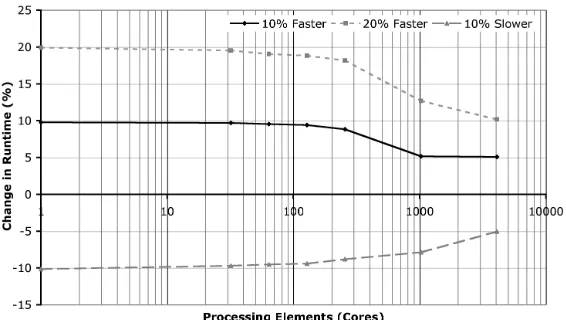
Figure 6: Increase in runtime from a varying changes in individual processor-core
performance.
cache implementations, choosing the ‘right’ processor for an application can be diffi-cult. We present several studies in this section of the paper which attempt to quantify the performance benefit of choosing either 10% or 20% faster processors, 10% slower processors or making the move from the existing dual-core Intel Xeon 5160 proces-sors to quad-core chips with the same per-core performance but high core-density per processor.
6.3.1 Increased Individual Core Performance
Figure 6 presents the predicted change in runtime from using dual core processors with individual core performances of +10%, +20% and -10%. The diminishing returns demonstrate the respective points at which communication begins to dominate runtime. In each case the change in runtime performance is approximately equal to the change in per core performance for small processor counts. As the processor count rises the impact on runtime is reduced due to the increase proportion of runtime accounted for by communication, reducing the contribution of faster computational resources to the runtime. Note that at increased processor counts the impact on runtime of using a slower processor is also reduced. The choice of core performance should therefore be considered in the context of job size - at small job sizes the runtime is improved best by using the fastest processors possible, as the core count in use rises there are diminishing returns from employing faster computational resources.
6.3.2 Increased Core Density - Dual versus Quad Core
With an increasing variety of multi-core processors becoming available including dual, quad and oct-core configurations, a common issue arising in procurement is which core density to select in designing the machine’s compute architecture. On initial consider-ation the economic advantages of higher core densities are consolidconsider-ation and reduced power or cooling demands per core, however, the increasing density often impacts on runtime performance.
(a) Percentage change in time required to complete MPI send operation.
[image:15.595.128.466.188.387.2](b) Percentage change in per-core network bandwidth
Figure 7: Percentage change in time to send and per-core bandwidth when increasing
Total Core Dual Core Quad Core Percentage
Count Runtime (s) Runtime (s) Change (%)
32 729.97 726.19 -0.52
64 376.46 373.62 -0.75
128 207.18 207.92 0.36
256 117.98 118.50 0.44
1024 66.64 66.33 7.88
[image:16.595.173.423.124.225.2]4096 37.29 40.45 8.46
Table 5: Predicted Quad versus Dual Core Performance (The quad-core configuration
is modelled with an increased in time to send and reduced bandwidth to account for contention).
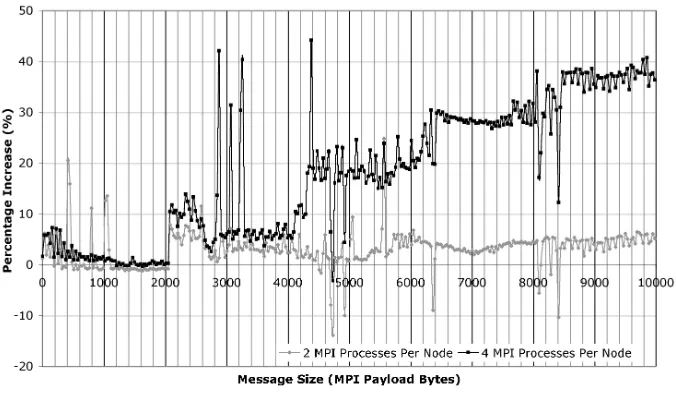
MPI benchmark in three configurations - one, two and four MPI processes per node re-spectively. The increasing number of processes per node (which is the effect of higher core densities) reduces the core network performance. The increased time to per-form an MPI send, and the decreased per core bandwidth, result from high levels of contention for the single InfiniBand HCA per node. Each process must wait longer before having exclusive access to the machine network. If core densities continue to rise then this will continue to impact performance unless the issue of contention is addressed by increasing the number of networking channels per node - the economic effect of this may be a significant addition to procurement cost.
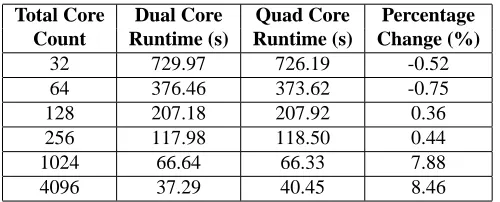
We have modelled the effect on runtimes of replacing each existing dual-core pro-cessor with a quad-core equivalent in which the per-core performance of the chip re-mains identical. The network latency for the InfiniBand network has been left the same for message sizes less than 2048 bytes, increased by 10% for message sizes ranging from 2048 to 4096 bytes and increased by 20% for larger messages. Network band-width has been changed by the same value but decreased. The changes in latency and bandwidth are drawn from the observed values shown in the figures above. Table 5 presents our predicted runtimes for the quad core machine compared with the existing dual core structure. Initially performance is improved since there are more cores utilis-ing the fast core-to-core transmission speeds. Once core counts reach 1024 processors the increased latency and reduced bandwidth create up to an 8% increase in runtime.
7
Conclusions
In this paper we have presented a case study detailing the application of two perfor-mance models - one based on analytical techniques and the other based on simulation - in supporting the procurement of a large, sub-Million pound commodity cluster for a wavefront-code rich workload. The study explores the performance and scalability of the Chimaera benchmark code used by the United Kingdom Atomic Weapons Estab-lishment.
More specifically, this paper shows:
• Quantitative estimates for the parallel efficiency of existing and future problem sizes that are of interest to AWE;
• That a system with a low performance network will require a greater processor count to offset the effect of higher latencies and lower bandwidth. We demon-strate this by projecting the performance of a Gigabit ethernet network in com-parison to a faster InfiniBand system, showing approximately between two and four times as many processors are required by the ethernet system to achieve comparable levels of performance at core counts less than 1024;
• Improving/reducing the latency performance by a factor of 2, results in up to 10% change in overall runtime;
• For small processor counts the overall runtime varies by the factor of improve-ment in per-core performance, but as core counts increase, the contribution of faster per core performance provides diminishing returns;
• Increasing the core density per processor reduces the performance due to con-tention for memory and network resources. We estimate the quantitative degra-dation of overall runtime when doubling core-density from dual to quad core processors to be approximately 8% up to 4096 cores on the commodity Infini-Band system studied.
Our results demonstrate that the selection of machine configuration and processor count should be directed by the average size of jobs the machine is intended to execute. For multiple small jobs, individually faster processors should be prioritised over a faster interconnect, since the code is predominantly compute bound at these points. For larger jobs, the interconnect plays a more significantly role in performance indicating that a more expensive, low latency network should be targetted during procurement.
The predictive models used in this study demonstrate efficient, low-cost and rapid methods to gather quantitative and qualitative insights into questions which arise during procurement for both currently available and future systems. In contrast, traditional approaches such as direct benchmarking require significant and expensive machine execution time and more effort to arrive at a subset of conclusions limited solely to currently available machine configurations.
Acknowledgements
Access to the Chimaera benchmark was provided under grants CDK0660 (The Produc-tion of Predictive Models for Future Computing Requirements) and CDK0724 (AWE Technical Outreach Programme) from the United Kingdom Atomic Weapons Estab-lishment. Access to the CSC-Francesca machine was provided by the Centre for Scien-tific Computing at the University of Warwick with support from the Science Research Investment Fund.
References
End-to-end performance design of large parallel adaptive computational systems. Software Engineering, 26(11):1027–1048, 2000.
[2] A. Alexandrov, M.F. Ionescu, K.E. Schauser, and C. Scheiman. LogGP: Incor-porating long messages into the LogP model for parallel computation. Journal of Parallel and Distributed Computing, 44(1):71–79, 1997.
[3] Eric A. Brewer, Chrysanthos Dellarocas, Adrian Colbrook, and William E. Weihl. PROTEUS: A High-Performance Parallel-Architecture Simulator. In Measure-ment and Modeling of Computer Systems, pages 247–248, 1992.
[4] D.E. Culler, R.M. Karp, D.A. Patterson, A.Sahay, K.E. Schauser, E. Santos, R. Subramonian, and Thorsten von Eicken. LogP: Towards a realistic model of parallel computation. In Principles Practice of Parallel Programming, pages 1–12, 1993.
[5] Matthew Frank, Anant Agarwal, and Mary K. Vernon. LoPC: Modeling Con-tention in Parallel Algorithms. In Principles Practice of Parallel Programming, pages 276–287, 1997.
[6] Edgar Gabriel, Graham E. Fagg, George Bosilca, Thara Angskun, Jack J. Don-garra, Jeffrey M. Squyres, Vishal Sahay, Prabhanjan Kambadur, Brian Barrett, Andrew Lumsdaine, Ralph H. Castain, David J. Daniel, Richard L. Graham, and Timothy S. Woodall. Open MPI: Goals, concept, and design of a next generation MPI implementation. In Proceedings, 11th European PVM/MPI Users’ Group Meeting, pages 97–104, Budapest, Hungary, September 2004.
[7] G.R. Nudd, D.J. Kerbyson, E.Papaefstathiou, J.S. Harper, S.C. Perry and D.V. Wilcox. PACE: A Toolset for the Performance Prediction of Parallel and Dis-tributed Systems. The International Journal of High Performance Computing, 4:228–251, 1999.
[8] A. Hoisie, G. Johnson, D.J. Kerbyson, M. Lang, and S. Pakin. A Performance Comparison through Benchmarking and Modeling of Three Leading Supercom-puters: Blue Gene/L, Red Storm, and Purple. In Proc. IEEE/ACM SuperComput-ing, Tampa, FL, October 2006.
[9] Intel Corp. MPI Benchmark Utility. 2008.
[10] G. Johnson, D.J. Kerbyson, and M. Lang. Optimization of InfiniBand for Scien-tific Applications. In International Parallel and Distributed Processing Sympo-sium 2008 (IPDPS’08), Miami, Florida, USA, April 2008.
[11] Richard M. Karp, Abhijit Sahay, Eunice E. Santos, and Klaus E. Schauser. Opti-mal broadcast and summation in the logp model. In ACM Symposium on Parallel Algorithms and Architectures, pages 142–153, 1993.
[12] D. J. Kerbyson, J. S. Harper, A. Craig, and G. R. Nudd. PACE: A Toolset to Investigate and Predict Performance in Parallel Systems. In European Parallel Tools Meeting, ONERA, Paris, October 1996.
[13] D.J. Kerbyson, A. Hoisie, and S.D. Pautz. Performance Modeling of Determin-istic Transport Computations. In Performance Analysis and Grid Computing, Kluwer, October 2003.
[14] D.J. Kerbyson, A. Hoisie, and H.J. Wasserman. A Comparison between the Earth Simulator and AlphaServer Systems using Predictive Application Performance Models. Computer Architecture News (ACM), December 2002.
[15] D.J. Kerbyson, A. Hoisie, and H.J. Wasserman. Use of Predictive Performance Modeling During Large-Scale System Installation. In Proceedings of PACT-SPDSEC02, Charlottesville, VA., August 2002.
1974.
[17] G.R. Mudalige, S.A. Jarvis, D.P. Spooner, and G.R. Nudd. Predictive Perfor-mance Analysis of a Parallel Pipelined Synchronous Wavefront Application for Commodity Processor Cluster Systems. Cluster 2006, 2006.
[18] G.R. Mudalige, M.K. Vernon, and S.A. Jarvis. A Plug and Play Model for Wave-front Computation. In International Parallel and Distributed Processing Sympo-sium 2008 (IPDPS’08), Miami, Florida, USA, April 2008.
[19] S.K. Reinhardt, M.D. Hill, J.R. Larus, A.R. Lebeck, J.C. Lewis, and D.A. Wood. The Wisconsin Wind Tunnel: Virtual Prototyping of Parallel Computers. In Mea-surement and Modeling of Computer Systems, pages 48–60, 1993.
[20] Frank Schmuck and Roger Haskin. GPFS: A shared-disk file system for large computing clusters. In Proc. of the First Conference on File and Storage Tech-nologies (FAST), pages 231–244, January 2002.
[21] D. Sundaram-Stukel and M.K. Vernon. Predictive Analysis of a Wavefront Appli-cation Using LogGP. In PPoPP ’99: Proceedings of the seventh ACM SIGPLAN Symposium on Principles and Practice of Parallel Programming, pages 141–150, 1999.