Transaction Management and
Concurrency Control
Learning Objectives
In this chapter, you will learn:
About database transactions and their properties
What concurrency control is and what role it plays in maintaining the database’s integrity
What locking methods are and how they work
How stamping methods are used for concurrency control
How optimistic methods are used for concurrency control
How database recovery management is used to maintain database integrity
What is a Transaction?
Logical unit of work that must be entirely completed or aborted
Consists of:
SELECT statement
Series of related UPDATE statements
Series of INSERT statements
Combination of SELECT, UPDATE, and INSERT statements
What is a Transaction?
Consistent database state: All data integrity
constraints are satisfied
Must begin with the database in a known consistent state to ensure consistency
Formed by two or more database requests
Database requests: Equivalent of a single SQL statement in an application program or transaction
Transaction Properties
• Atomicity means all or nothing. Transactions often contain
multiple separate actions. For example, a transaction may insert data into one table, delete from another table, and update a third table. Atomicity ensures that either all of these actions occur or none at all.
Atomicity
• Consistency means that transactions always take the database from one consistent state to another. So, if a transaction violates the databases consistency rules, then the entire transaction will be rolled back.
Consistency
• Data used during transaction cannot be used by second transaction until the first is completed
Isolation
• Ensures that once transactions are committed, they cannot be undone or lost
Durability
• Ensures that the schedule for the concurrent execution of several
Serializability
Transaction Management with SQL
SQL statements that provide transaction support
COMMIT
ROLLBACK
Transaction sequence must continue until:
COMMIT statement is reached
ROLLBACK statement is reached
End of program is reached
Program is abnormally terminated
The Transaction Log
Keeps track of all transactions that update the database
DBMS uses the information stored in a log for:
Recovery requirement triggered by a ROLLBACK statement
A program’s abnormal termination
A system failure
Table 10.1 – A Transaction Log
Concurrency Control
Coordination of the simultaneous transactions execution in a multiuser database system
Objective - Ensures serializability of transactions in a
multiuser database environment
Problems in Concurrency Control
• Occurs in two concurrent transactions when:
• Same data element is updated
• One of the updates is lost
Lost update
• Occurs when:
• Two transactions are executed concurrently
• First transaction is rolled back after the second transaction has already accessed uncommitted data
Uncommitted data
• Occurs when a transaction accesses data before and after one or more other transactions finish working with such data
Inconsistent retrievals
The Scheduler
Establishes the order in which the operations are executed within concurrent transactions
Interleaves the execution of database operations to ensure serializability and isolation of transactions
Based on concurrent control algorithms to determine the appropriate order
Creates serialization schedule
Serializable schedule: Interleaved execution of transactions yields the same results as the serial execution of the transactions
Concurrency Control with Locking Methods
Locking methods - Facilitate isolation of data items used in concurrently executing transactions
Lock: Guarantees exclusive use of a data item to a current transaction
Pessimistic locking: Use of locks based on the assumption that conflict between transactions is likely, example :rows that have been requested by one user or transaction for an operation that could potentially change data state become immediately inaccessible for reading or writing by other users or transactions. In some systems, the entire table becomes
unavailable.
Lock manager: Responsible for assigning and policing the locks used by the transactions
Lock Granularity
Indicates the level of lock use
Levels of locking
Database-level lock
Table-level lock
Page-level lock
Page or diskpage: Directly addressable section of a disk
Row-level lock
Field-level lock
Figure 10.3 - Database-Level Locking
Sequence
Figure 10.4 - An Example of a Table-
Level Lock
Figure 10.5 - An Example of a Page-
Level Lock
Figure 10.6 - An Example of a Row-
Level Lock
Lock Types
• Has two states, locked (1) and unlocked (0)
• If an object is locked by a transaction, no other transaction can use that object
• If an object is unlocked, any transaction can lock the object for its use
Binary lock
• Exists when access is reserved for the transaction that locked the object
Exclusive lock
• Exists when concurrent transactions are granted read access on the basis of a common lock
Shared lock
Problems in Using Locks
Resulting transaction schedule might not be serializable
Schedule might create deadlocks
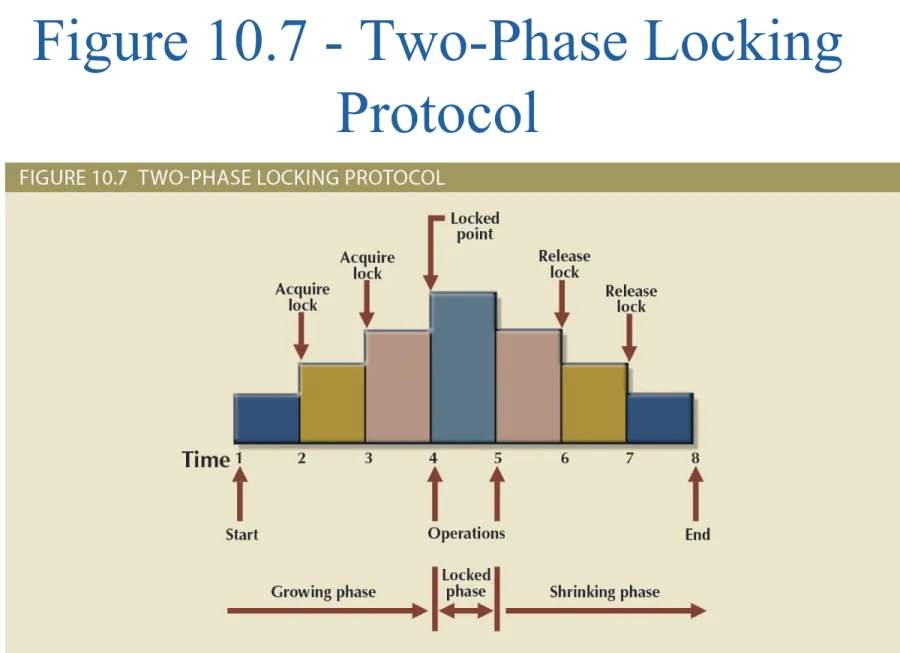
Two-Phase Locking (2PL)
Defines how transactions acquire and relinquish locks
Guarantees serializability but does not prevent deadlocks
Phases
Growing phase - Transaction acquires all required locks without unlocking any data
Shrinking phase - Transaction releases all locks and cannot obtain any new lock
Two-Phase Locking (2PL)
Governing rules
Two transactions cannot have conflicting locks
No unlock operation can precede a lock operation in the same transaction
No data are affected until all locks are obtained
Figure 10.7 - Two-Phase Locking
Protocol
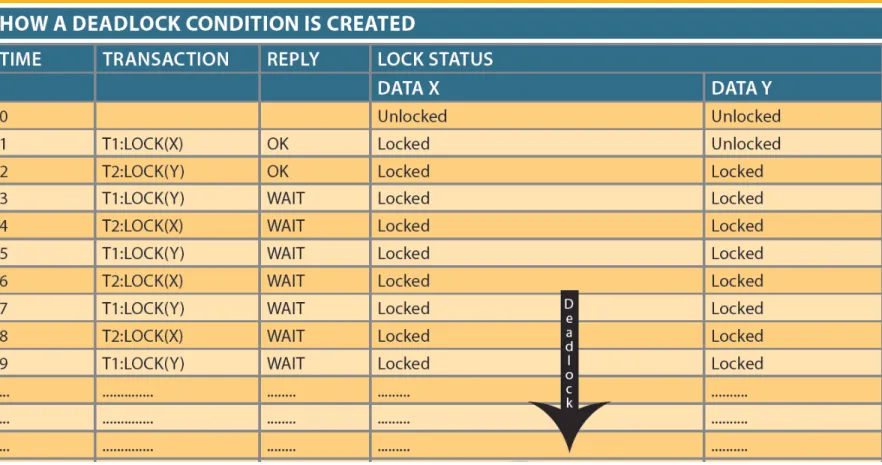
Deadlocks
Occurs when two transactions wait indefinitely for each other to unlock data
Known as deadly embrace
Control techniques
Deadlock prevention
Deadlock detection
Deadlock avoidance
Choice of deadlock control method depends on
database environment
Table 10.13 - How a Deadlock
Condition is Created
Time Stamping
Assigns global, unique time stamp to each transaction
Produces explicit order in which transactions are submitted to DBMS
Properties
Uniqueness: Ensures no equal time stamp values exist
Monotonicity: Ensures time stamp values always increases
Time Stamping
Disadvantages
Each value stored in the database requires two additional stamp fields
Increases memory needs
Increases the database’s processing overhead
Demands a lot of system resources
Table 10.14 - Wait/Die and Wound/Wait
Concurrency Control Schemes
Concurrency Control with Optimistic Methods
Optimistic approach: Based on the assumption that
the majority of database operations do not conflict
Does not require locking or time stamping techniques
Transaction is executed without restrictions until it is committed
Phases of Optimistic Approach
Database Recovery Management
Database recovery: Restores database from a given
state to a previously consistent state
Recovery transactions are based on the atomic transaction property
Atomic transaction property: All portions of a
transaction must be treated as a single logical unit of work
If transaction operation cannot be completed:
Transaction must be aborted
Changes to database must be rolled back
Concepts that Affect Transaction Recovery
Techniques Used in Transaction Recovery
Procedures
Recovery Process in Deferred-Write Technique
Identify the last check point in the transaction log
If transaction was committed before the last check point
Nothing needs to be done
If transaction was committed after the last check point
Transaction log is used to redo the transaction
If transaction had a ROLLBACK operation after the last check point
Nothing needs to be done
Recovery Process in Write-Through Technique
Identify the last checkpoint in the transaction log
If transaction was committed before the last check point
Nothing needs to be done
If transaction was committed after the last checkpoint
Transaction must be redone
If transaction had a ROLLBACK operation after the last check point
Transaction log is used to ROLLBACK the operations