Study and thesis information
Study: Master of Business Administration Track: Marketing and Business Information Title: Changing tenders to construct circular roads Student
H.L (Hein) Oude Hesselink
Institutions
University of Twente Van Gelder
Department: integral Supervisors
Van Gelder ir. M.J. Ypma
Keywords:circular economy, civil engineering, construct circular roads, BPKV, tender, circular roads
Preface
This thesis is the final part of the Master in Business Administration with specialisation Marketing and Business Information at the University of Twente. The assignment and problem statement started at Van Gelder. The title of this thesis is changing tenders to construct circular roads.
I am looking back to an interesting period which broadened my view and interests. I thank my supervisors from the University of Twente dr. A.M. von Raesfeld Meijer and prof. dr. ir. A.G. Dorée for their time, reading, and helpful input to make this Master thesis possible. Next, I thank Mink Jaap Ypma from Van Gelder for our meetings, talking about the topic and giving me helpful input. Furthermore, I thank all my colleagues, fellow students and my family that made my Master thesis possible.
Hein Oude Hesselink
Management summary
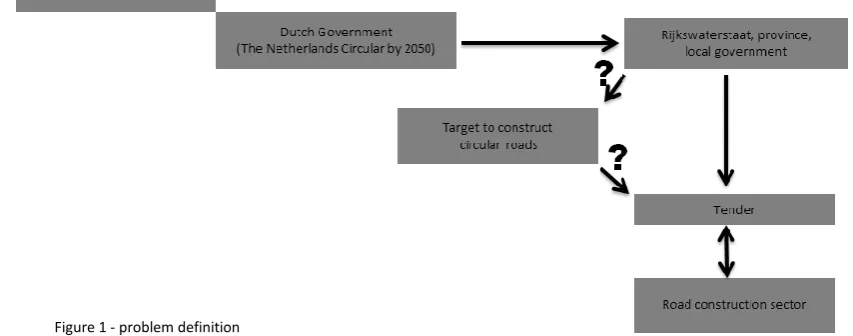
In the last few years circular economy is receiving increasing attention worldwide, which is necessary because of the overconsumption of raw materials. In the circular economy the human consumption has to change from a linear towards a circular way of consuming. In 2015 the European Union developed the Circular Economy Strategy. Based on this documentation the Netherlands developed its own strategy: The Netherlands Circular by 2050. This is a government wide program and has as goal to develop products, services and systems which operate circular. For the road construction sector this is also applicable. Rijkswaterstaat, provinces and local governments have developed their own plan of operating circular, therefore the Dutch tender system should also make it a goal to request circular products. For the road (asphalt) sector it is currently unclear how this will be achieved due to tendering. Based on the problem statement the central research question is: How will tenders be defined in order to achieve the goal of constructing circular roads by 2050?
It is important to realize that the circular transition is an interaction between different facets that is split up into niche, regime, and landscape (Rotmans, Kemp et al. 2000, Elzen, Geels et al. 2004, Geels 2011). Collaboration has to occur to share knowledge. Second, using waste as a resource should be considered as the new standard because it can be cheaper for the tenderer, and third: operating circularly can give competitive advantages.
There are eight general factors of the circular economy: prioritize regenerative resources, preserve and extend what is already made, use waste as a resource, create and rethink (new) business models, design for the future, innovation, collaborate to create a joint venture and transparency. These factor will be investigated by interviews. These eight criteria create a reflective model where the expected criteria of the circular road constructing can be reflect in comparison to the general key criteria of the circular economy.
Twelve professionals were interviewed, who are all familiar with the circular economy and road construction and who are working either for Rijkswaterstaat or the provinces or local government. The interviews have taken place in June and July of 2018. The results of the interviews were analysed based on the eight general factors of the circular economy, the model of Rotmans Kept et al (2000). The conclusion is that, at the moment of writing, it is too early to conclude how circular road constructing will be valued and measured by tendering. This is because purchasers are in the starting phase of the circular transition by defining terms, testing products and developing policies. It is plausible to conclude that the MKI will be an important measurement method for now and in the future. The MKI will be based on the measurement module of DuboCalc. However there are other parties who are currently using and testing other methods of measuring circularity in the road construction, it remains to be seen how this will develop. It is plausible to conclude that the MKI will be used for several years before it will be turned into a hard criteria. And circular solutions are the standard in the road construction sector.
List of content
Preface ... 4
Management summary ... 5
List of acronyms... 7
Introduction ... 8
Circular economy ... 8
Situation ... 8
Case description Van Gelder ... 9
Problem statement... 10
Research goal & question ... 11
Scope of research ... 11
Structure ... 12
Theoretical framework ... 13
Route of circular road construction ... 13
Key elements of circular economy ... 17
Public procurement procedure ... 19
Public procurement and innovation ... 20
Sustainable road ... 23
Conclusion theoretical framework ... 25
Research methodology ... 27
Trustworthiness and authenticity of research ... 28
Trustworthiness ... 28
Authenticity ... 29
Data analysis ... 29
Results ... 31
Discussion and conclusion ... 44
Relevance ... 46
Limitations of research ... 46
References ... 47
Appendices ... 52
Appendix 1 – Circular economy ... 52
Appendix 2 – Lansink’s ladder ... 52
Appendix 3 – Key elements of circular economy ... 53
List of acronyms
ARW (2016): Dutch guideline for tendering and regulation(ARW 2018). Based on the Aanbestedingswet 2012.
BPKV: Best Price-Quality Ratio. Is a way of measuring the quality and the price of the product. The BPKV consist of the criteria which the purchases have set up for a tender (BPKV 2018).
Dubocalc: Calculator for translating the environmental impact of a product into an MKI value. The environmental impact of the product is measured from the mining till demolishing. Dubocalc is based on the CO2 output of product and process (Rijksoverheid 2018).
EcoChain: Module to calculate and measure the environmental impact of a product in CO2. EcoChain is only developed by a private business (Ecochain 2018)
EMVI; (EMAT) Economically Most Advantageous Tender, was the name of the BPKV in the past. Nowadays it is called BPKV with the motivation it should be more related to the quality of the product instead of only the price (EMVI 2018)
LCA: Life-cycle assessment. Is a technique to assess environmental impacts associated with all the stages of a products life from raw material extraction through materials processing, manufacture, distribution, use, repair, and maintenance(LCA 2018). MKI: Milieu Cost Indicator, gives a value to the milieu effect of material from the mining
process till demolishing. Can be measured in impact based on CO2 and scarcity of the product. Will be valuable in euros (MKI 2018).
Introduction
In the introduction of this research you can find the aim of this research and the research question with sub-questions. Also can be found the case description offered by the company. This chapter describes why the research is developed, and gives some further explanation of the definition circular economy which is leading in this research. By analysing the definition of the circular economy, current situation in the road construction sector, case description (of Van Gelder), problem statement, research goal and question, scope of research and discussing the structure of the research provides a well-founded structure for further research. There is chosen for this approach, because it describes and discusses important definitions and reflects how and why this research is conducted.
Circular economy
Circular economy refers to an economy which is restorative and regenerative by design, according to the Ellen MacArthur Foundation(2013). Relying on system-wide innovation, it aims to redefine products and services to minimize waste while minimizing negative impacts. Underpinned by a transition to renewable energy sources, the circular model builds economic, natural and social capital (MacArthur 2013). The model of the circular economy of the Ellen MacArthur foundation can be found in Appendix 1. This model implicates the economy which is transforming from a linear waste model to a circular model. Also, the model displays left-sided biological materials en right-sided technical materials which can be considered as less sustainable. The European Commission (2015) adds to this definition that the value of products and materials should be maintained as long as possible (Commission 2015).
To explain ‘as long as possible’ Lansink and de Vries-in't Veld (2010) develops the ladder of Lansink model to rate the degree of circularity. The model can be found in Appendix 2.
The whole Dutch economy should be circular by 2050: an economy without waste. Targets of being circular in 2050 are a government-wide program and so also applicable to the road constructing industry. The next step should now be made, as stated in the report of ‘The Netherlands circular by 2050’ (Dijksma 2016). The Dutch government, together with social partners has big ambitions and wants to take an intermediate step is developed for 2030: achieving 50% less use of primary raw materials (Dijksma 2016).
The report is interpreted by Rijkswaterstaat, the biggest purchasing institution of road constructing. Rijkswaterstaat has as target to be circular in 2030, so when the whole Dutch economy has to reach an intermediate step, the civil engineering should already be operating circular. Which means that road construction should take place without waste by 2030 (Rijkswaterstaat 2017).
Situation
The situation description gives answer how the tender procedure is currently managed in the road construction sector. It is important to realize how it is currently organized to understand the problem statement and research question. The tender procedure of road construction is regulated by Tender Regulations Operating’s (ARW). The ARW is a law and has as a purpose: fair competition among tenderers (Torvatn and de Boer 2017). It is a standard procedure for tenderer and purchaser. Execution of the ARW procedures depends on the type of project (‘rebuy’) and value of the project (based on the amount if national or European tendering is applicable).
focused on characteristics of the registration. These criteria are focused on price, LCA, quality, and sustainability of the product (road), this can be quantitatively and qualitatively graded. The Milieu, Cost, Indicator (MKI-value) can be a part of the BPKV and made it possible to rate the sustainability asphalt. The RAW is only based on criteria and does not take into account the discount factor of the MKI. The lower the MKI-value, the higher the environmental CO2 impact of the product. Dubocalc and EcoChain are calculating modules of the environmental impact of asphalt based on CO2 (MKI). Dubocalc is a measurement module developed by Rijkswaterstaat and EcoChain by a private business (Rijkswaterstaat 2017). The criteria in the tender and weighted factors for the BPKV can be freely determined by the purchaser.
According to the government-wide program, the complete civil engineering should be operating circular in 2030. How Rijkswaterstaat, provinces and local governments want to establish this is currently unclear. Current tenders are not focused on circular operating and circular products. This research investigates how the tenders will be defined to realize circular roads by 2050.
Case description Van Gelder
Van Gelder is the commissioned business and investigated case in this research. In 1916 Van Gelder was developed by D.Kroeze. It is a multifunctional company specialized in laying cables, pipes, assembly work and constructing roads. Nowadays Van Gelder Group is split up into five departments: Construct, Cable, Pipe and Assembly and Railway and Telecom. The road construction part is split up into three departments, east, west and integral projects. Over 900 employees are working on national projects. The sustainability policy results in the following targets and projects: reducing the CO2 output with 20% by 2020, use of green energy, a sustainable vehicle fleet and FSC® certification for the construct department (Gelder 2018).
Problem statement
Best Price Quality-Ratio(BPKV) and RAW are a way of making criteria in the public procurement measurable and valuable. By making the public procurement measurable it is possible to compare the offers among different tenders. Sustainability and circular constructing roads are a form of value in the BPKV or criteria in the RAW. In 80% of the situations, the BPKV will be used, but the weighing of the criteria are underestimated(Wamelink, 2017). Nowadays most of the tenders do not have circular construction as (main) goal but want to find a cheap and good solution for constructing a road. A government-wide program of the Dutch government taken over by Rijkswaterstaat, provinces and local governments is that road constructing should be circular by 2050. How this target will be achieved by the tender procedure is unclear. The road constructing sector and especially Van Gelder would like to know which instruments, criteria and factors are important for the purchasers of constructing circular roads by 2030.
The gap between constructing circular roads by 2050 and how to achieve this target regulated by tender will be investigated in this research.
[image:10.595.94.521.347.515.2]
Research goal & question
The main aim of this research is to provide strategic information for the road constructing sector, how tendering will most likely change due to the government-wide program of being circular by 2050. This research will be conducted by analyzing literature and interviews which will be held with experts in the sector. More information about how the research will be conducted can be found in the chapter methodology.
Based on the problem statement the central research question is:
How will tenders be defined in order to achieve the goal of constructing circular roads by 2050? To give a substantiated and structured conclusion to the main question, the following sub-questions are conducted.
What will be used in the tenders to construct circular roads?
o What is the relation between public procurement and innovation?
o How will the circular economy be measured and valued in the road construction sector?
o How does the road construction sector perform in comparison to the general key elements of the circular economy?
What extent and in what period is the introduction of criteria based on constructing circular in tenders feasible?
Which actions will purchasers (Rijkswaterstaat, provinces, and local government) perform to construct circular roads by 2050?
Scope of research
Data gatheringData is gathered by interviewing professionals, also called experts, in the sector who are either working for Rijkswaterstaat or the province or local government and have an interface with circularity and public procurement in the road constructing sector. This choice is also made because this target group has an influence on tenders and have knowledge of both topics(circular economy and road constructing, with as intermediate variable public procurement)
Application
Structure
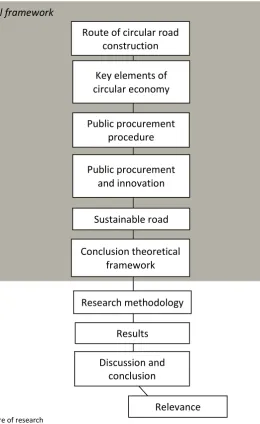
The remainder of this paper is organized as follows. The sub question are based from a general analyses towards more specific information which is applicable to answer the main question. Firstly transition of the circular economy is analysed this is done to develop which levels and organisations are involved in the circular transition in the road construction. This analyses is mostly based on the theories of Rotmans, Kemp et al. (2000), Elzen, Geels et al. (2004). This chapters makes clear which how the different levels of playing field are interacting and changing due the transition. Innovation is important according to the transition theory, this is also an actor of the circular economy which is important to operate circular. To assess circularity in the road construction sector is currently not possible, because there is not a reflection model. In the chapter: key elements of the circular economy are this elements analysed and discussed. After this chapter it is clear which levels are important and which are the key elements are of the circular economy. Subsequently is made an analyses of the public procurement procedure and how innovation will be realized due to the public procurement procedure. Finally is the MKI value in the chapter sustainable road is analysed to give an overview how sustainable asphalt is and how this currently is measured. From all the literature is made a general conclusion wherefrom further research based on interviews is determined. All chapters are a succession of each other, from level of playing field and innovation towards a product specific valuing method (MKI). Wherefrom the interview structure is setup with as last the results and conclusion.
Theoretical framework
Public procurement procedure
Public procurement and innovation Route of circular road
construction Key elements of circular economy
Sustainable road
Conclusion theoretical framework
Research methodology Results
[image:12.595.155.416.354.779.2]Theoretical framework
The theoretical framework gives more information on several topics related towards the research question, based on literature. First route of circular road construction is analysed wherein several levels of playing field are analysed in the road construction sector, followed by the circular economy principles, which is necessary to asses circularity in the road construction sector. As last are the three topics public procurement procedure, public procurement and innovation and sustainable road analyzed. Public procurement (and innovation) are involved due the special innovation development due the public procurement procedure.
Route of circular road construction
Circular economy defined by MacArthur foundation (2017) refers to an economy which is restorative and regenerative by design. Relying on system-wide innovation, it aims to redefine products and services to be designed without waste while minimizing negative impacts. Underpinned by a transition to renewable energy sources, the circular model builds economic, natural and social capital (MacArthur 2013). The European Commission (2015) adds to this definition that the value of products and materials should be maintained as long as possible (Commission 2015).
According to Murray, Skene et al. (2017), Hofman stated in 1848 already that in a circular economy, there is no waste. The circular economy is an interdisciplinary exploration of the concept and applications. The circular economy is not a new phenomenon according to Pauliuk (2018)“the circular economy is not a new concept. It blends the principles of multiple schools of thought.” Murray, Skene et al. (2017) ”a real factory uses its waste”. “Waste is food” according to McDonough and Braungart (2010). Waste can be considered as raw material for new products.
Stahel and Reday-Mulvey (1981) noted about the circular economy that it will have not only benefits to the environment, but it will also create jobs, waste prevention, economic competitiveness and resource savings. Some parties in the industry adopt this and are already developing circular products. An advantage of this can be the reuse of raw materials which will ensure lower cost (Milios 2017). More often the circular product is not market competitive. The only possibility to make the circular product competitive is by focussing on the moral aspect and by mass production (Geng and Doberstein 2010). Another aspect of the circular economy is the efficient use of raw materials: by doing this the cost of raw materials will be lower.
Several researchers have shown that scarcity of raw materials will lead to problems in the economy (Yuan, Bi et al. 2006, Lieder and Rashid 2016). This will lead to problems in the production process. It is important that companies act on this, so products that will be scarce in the near future will be replaced by circular products (MacArthur 2013).
Barriers to the circular economy are currently the policies in most of the situations. According to Geng and Doberstein (2008), there is no unified platform and term for the circular economy. The fragmented regulation system often works against such innovations.
Science and technology are key components of a circular economy (Geng and Doberstein 2008). New academic achievements in environmental science and environmental technologies, such as those which have contributed to the fields of eco-design, cleaner production and life cycle assessment, will help revolutionize the related fields of biotechnology, information technology and materials science (Geng and Doberstein 2008). New business models will ensure longer earnings, by lease or maintenance contracts (Stahel 2016).
Yuan, Bi et al. (2006) explains the Chinese Government uses a top-down structure. In the past decade, they had already issued several laws that are very supportive of the circular economy (Geng and Doberstein 2010). For example, the law ‘Cleaner Production Promotion Law,’ concerning the development of circular economy, is part of China’s growing demand for strict management of solid waste (Yuan, Bi et al. 2006). Nowadays it turns out that China is one of the most important innovators in the field of the circular economy (Murray, Skene et al. 2017).
The theory of Rotmans, Kemp et al. (2000), Elzen, Geels et al. (2004) is a sociotechnical transition theory. It can help to analyse the aspect towards a circular economy in the road constructing sector. The theory defines the levels niche, regime and landscape are central points of transition system management and process. Figure 3 gives an overview of the different levels of the theory.
Where every niche is the process of innovations. A niche is a learning curve from where innovations consecutively will be developed. It is an innovation and experimentation level and part of the market. This level of the total market is less subject to market and regulation influences. This part of the total actors supports the product innovation (Geels 2011).
[image:14.595.137.465.288.505.2]A regime can be seen as the regulations and request of the market according to Geels (2011). It is an explanation of the formation of the technical trajectories. Geels (2011) states radical changes of regime shift are rare because it is the standards of the market based on influences of governments’ regulations, society, and industry. The landscape are all big social changes in the field of political, cultural, natural characteristics and worldviews, which are difficult to influence and difficult to change (Rotmans, Kemp et al. 2000, Elzen, Geels et al. 2004, Geels 2011). Due the changing regimes influences the landscape is going to change and due the changing landscape regimes are changing.
Figure 4 the multi-level perspective of Geels (2011) scenarios should show socio-technical attention towards the different types of actors, strategies, resources and goals of the organization (Elzen, Geels et al. 2004). The interaction between parties is important, to stimulate the transition from niche towards the regime. Rotmans, Kemp et al. (2000) state that linkage and interactiveness are a part of the theory. Transition implies a cycle of the process of vision-building, taking action, evaluating the response to this and subsequently taking new action (Elzen, Geels et al. 2004). Elzen, Geels et al. (2004) state that niches are important for learning and radical alternativeness towards a transition. Smith, Stirling et al. (2005) add that too many niches never break through towards a transition and progress will never be made.
[image:15.595.153.413.50.281.2]Focus (vision building), network, transition policy and motivation will lead towards innovation according to Rotmans, Kemp et al. (2000). Elzen, Geels et al. (2004) state that successful breakthroughs depend upon on-going processes in regimes and landscapes. After a development is successfully introduced by a niche, it should be adopted by the regime to introduce to a broader market (Elzen, Geels et al. 2004). Older products, which are established by a transition, will also be improved by new transitions. Utterback (1994) states that transition can be seen as a consecutive process, where new targets will be consecutively established.
[image:15.595.165.439.557.734.2]The time when a transition takes place depends, according to Elzen, Geels et al. (2004), on several factors: infrastructure, conventional technologies, material conditions and physical plant. The knowledge part of the transition is an important factor: high expertise level, education and well-functioning research systems lead to quick transitions. For organizations, it is important that they are well lead by authority and control, rules, and procedures (Elzen, Geels et al. 2004). Rotmans, Kemp et al. (2000) state that transitions are gradual changes that take a long time, at least one generation. Long-term transitions look like a well-defined line, but in short periods it is small steps which lead together to an improved process and product (figure 5). When companies do not adopt a new successful innovative product they will lose market share. A new technical regime will overtake the market share of the old technical regime as shown in figure 6 - market transition route of Rotmans, Kemp et al.(2000).
[image:16.595.171.431.241.371.2]Yuan, Bi et al. (2006) explains that according to the circular transition that in practice there is a three-layer approach to implement the circular economy for a company. This three-layer approach exists for cleaner production, industrial ecology, and ecological modernization. Ghisellini, Cialani et al. (2016) disagree with this because it relies on the industry and their environment and mostly on the ‘key elements’ of a circular economy. Lieder and Rashid (2016) conclude that joint support of all stakeholders is necessary in order to successfully implement the Circular Economy concept at a large scale. Based on a top-down, as well as a bottom-up approach, where the market can offer a product towards the purchaser (bottom-up) and where the purchasers determine which kind of product it wants (top-down) (Elzen, Geels et al. 2004). Working top-down as well as bottom-up can trigger towards a circular economy.
Key elements of circular economy
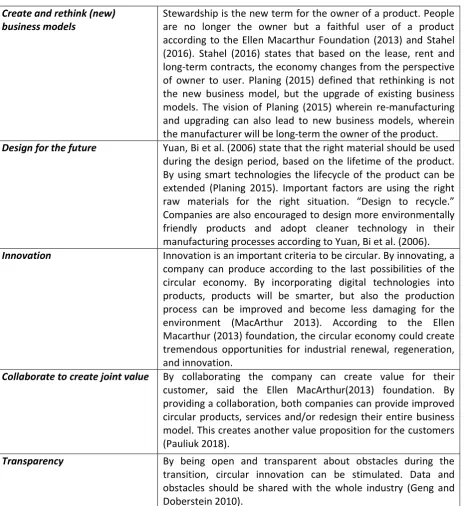
In 2017 the British Standards published the first policy and legislation of the circular economy principles. These six principles are analyzed and collaborate with the seven key elements of Ramkumar (2017) and the five principles of the Ellen MacArthur (2013) foundation. Principles that correspond were merged to one key element. The conclusion is the eight principles of the circular economy. This can be found in the model of Appendix 3. The eight key elements of the circular economy are explained, analyzed and criticized below. The eight key elements of the circular will be used to reflect circularity in the current road construction sector later in this research. Per key element is used literature to discussed the specific element.
Key elements of circular economy discussed by literature
Key element Description
Prioritize regenerative resources Natural energy consumption is not endless. For example, earth products; oil, earth gas, and coal, will exhaust due time. Also, these kind of energy sources are polluting the earth with their CO2 impact says Herzog, Lipman et al. (2001). It is important to use renewable energy sources, with minimal CO2 output. Herzog, Lipman et al. (2001) defined renewable energy sources as biomass, wind, water and sun energy. A disadvantage of biomass energy is the high CO2 output, so it is better to use lower output sources (Martín and Davis 2016). Martin and Davis (2016) defined that important criteria for the choice of energy source depends on the space, place, sources and cost efficiency. The right use of material and production can save 6% – 11% of the raw materials. Also, the use of biobased products is higher, graded by the different foundations who are active in the field of the circular economy (MacArthur 2013).
Preserve and extend what is already made
Preserve and extend what is already made has as main goal to upgrade products to meet the performance requirements after the lifespan (MacArthur 2013). “for the ideal circular
design…. easy to disassemble and upgradeable components (MacArthur 2013).” Appendix 1 shows the circular economy model of the Ellen MacArthur (2013), which shows how the product should return to the economy. Also, the ladder of Lansink and de Vries-in't Veld (2010) is a reflection of how and when the product returns to the economy. The higher products will be reused on the ladder the better this is for the environment. Planing (2015) states that re-manufacturing and upgrading products should be a novel way of creating and capture value.
Create and rethink (new) business models
Stewardship is the new term for the owner of a product. People are no longer the owner but a faithful user of a product according to the Ellen Macarthur Foundation (2013) and Stahel (2016). Stahel (2016) states that based on the lease, rent and long-term contracts, the economy changes from the perspective of owner to user. Planing (2015) defined that rethinking is not the new business model, but the upgrade of existing business models. The vision of Planing (2015) wherein re-manufacturing and upgrading can also lead to new business models, wherein the manufacturer will be long-term the owner of the product. Design for the future Yuan, Bi et al. (2006) state that the right material should be used
during the design period, based on the lifetime of the product. By using smart technologies the lifecycle of the product can be extended (Planing 2015). Important factors are using the right raw materials for the right situation. “Design to recycle.” Companies are also encouraged to design more environmentally friendly products and adopt cleaner technology in their manufacturing processes according to Yuan, Bi et al. (2006). Innovation Innovation is an important criteria to be circular. By innovating, a
company can produce according to the last possibilities of the circular economy. By incorporating digital technologies into products, products will be smarter, but also the production process can be improved and become less damaging for the environment (MacArthur 2013). According to the Ellen Macarthur (2013) foundation, the circular economy could create tremendous opportunities for industrial renewal, regeneration, and innovation.
Collaborate to create joint value By collaborating the company can create value for their customer, said the Ellen MacArthur(2013) foundation. By providing a collaboration, both companies can provide improved circular products, services and/or redesign their entire business model. This creates another value proposition for the customers (Pauliuk 2018).
[image:18.595.69.539.65.572.2]Transparency By being open and transparent about obstacles during the transition, circular innovation can be stimulated. Data and obstacles should be shared with the whole industry (Geng and Doberstein 2010).
Public procurement procedure
Cooperation and a long-term relationship are difficult in sectors that have to deal with public procurement. To stimulate innovation, cooperation is even important, and connect in an early stage of the design process (Chesbrough and Rosenbloom 2002). Also, for the road construction collaboration should be important, because they often involve big, long-term, complex technical projects, state Lenferink, Tillema et al. (2013). When tenderer and purchaser work together in a tender procedure depends on the level of playing field.
The phase of cooperation can be organized into stages. In figure 8 an overview is given of the process where the tenderer joins the process, with an explanation of the specific process. The five stages are plan shaping, contract phase, tendering, realization, and management and maintenance (Pianoo 2018) (Wamelink and Heintz 2007). In these phases, the management of knowledge is a central point and strategy. If the tenderer joins in at an early stage, knowledge, insights, and capacity of the tenderer can be used. If the tenderer joins at a later stage, knowledge of purchaser will be more used (Trionfetti 2001, Wamelink and Heintz 2007).
Level of playing field
Phase Plan shaping Contract phase Tendering Realisation Maintenance and operating
Work description
Based on parties, but province integration plan, destination plan have to be shaped.
Creating a design for the purchasers his project with the
architect and other specialized parties. Purchaser designs requirements and tenderer should come up
to this.
Constructing the road based
on criteria which strictly
given.
To maintenance, the construction and
keep it on track.
Name of cooperation
Knowledge-based
cooperation Building team
Design and
construct RAW
Knowledge use
of tenderer Knowledge use of purchaser
Figure 7 - a public procurement procedure
By collaboration , EU regulations should take in mind; tenderers should get the same possibility to win the tenderer. For purchasers, the goal is to communicate and be transparent to all the tenderers. To prevent unfair competition more tenderers are involved in the procedure. It is still remarkable that in the two first stages of the process, there is no contract form involved (Wamelink and Heintz 2007).
Public procurement and innovation
Public procurement and innovation are an often discussed and debated topic in literature. Public procurement is the term used for public purchasing for any acquisition made by public organizations (Aschhoff and Sofka 2009, Murray, Skene et al. 2017, Torvatn and de Boer 2017). In most developed countries public procurement is the basis of the purchasing strategy of (semi) related government organizations (Torvatn and de Boer 2017). Innovation, according to Garcia and Calantone (2002), is a workable definition of the evolution of the product’s productive system in the view of evolution. Innovation is according to Alam and Kumar (2013) a process to develop new goods or service. The EU member states define innovation as an implementation of new or significantly improved goods or services. Wherein public procurement is a buying strategy which is emphasized to meet different goals. (EU 2017). Challenges for countries in Europe, according to the research of the EU, are “to support the 2020 strategy for smart, sustainable and inclusive growth” (Bolton 2016)
Yearly a massive amount is spent on public procurement. A study by Loader(2015) concluded that on average 12,8% of the total Gross Domestic Product (GDP) in OECD countries is spent by public procurement. The World Trade Organization’s Agreement on public procurement estimated the amount around 1.3 trillion Dollar. According to the EU, it spends averagely around 14% of the GDP on the purchase of works, services, and supplies by public procurement by European countries (EU 2017). A study done by Matthews (2005) is estimated that 20 percent of the GDP is spent by public procurement. While Thai (2008) gives a range between which percentage the institutions spend on public procurement, this is between 10 and 30 percent of the GDP. Based on general data and related to the case of road constructing, the Dutch government, for example, spends around 2,5 to 3 billion euro on constructing and maintaining the Dutch road system. For 2018, the budget has been set on 2,6 billion euro (Rijksoverheid, 2018). However, there is a difference between the percentages and amounts. The overall conclusion can be drawn that the amount of money that is spent on public procurement is massive.
An interesting feature of public procurement is that the procedure contains more guidelines than private purchases (Torvatn and de Boer 2017). Bovis (2012) noticed it is even strictly regulated by law. In Europe, by EU directives and also on a national level, it is obtained by rules and procedures. The rules and regulations regarding to public purchasing are extremely important for the
Overview of advantages and disadvantages of public procurement
Advantage of public procurement Disadvantages of public procurement Transparent, equitable and cost-effective way of
purchasing
Contains more guidelines Instrument of public policy Raises barriers of innovation Between the borders of criteria are a lot of
possibilities of innovative products
Lack of interaction with procuring organizations Due to the procurement procedure interaction
will take place
Specific and prescriptive
Competitive procedures No space for innovation
Stimulate innovation - capacity building - government can function as an
experimental user
[image:20.595.63.536.463.662.2]disturbing relationship-based approaches as co-creation
says public procurement can be seen as an instrument of public policy which is also economically important. Public purchasing is not only economically important but also used consciously as an instrument of public policy.
Public procurement raises barriers against innovation. Research of Uyarra, Edler et al. (2014) states that the most important barrier experienced by companies who have to deal with public procurement are ‘lack of interaction with procuring organizations’. The second important factor is specifications that are too specific and prescriptive (Uyarra, Edler et al. 2014), which lead to specific product specification and no space for innovation according to Torvatn and de Boer (2017). Also, mentioned by Torvatn and de Boer (2017): public procurement is often criticized for hindering and disturbing relationship-based approaches as co-creation. Arnold (2004) makes it clear that innovation policy is to prove effectiveness within the system. Between the borders of criteria are a lot of possibilities of innovative products (Arnold 2004). Also, a benefit of public procurement is that due to the procurement procedure interaction will take place between parties. This communication can establish new criteria for the next tender where innovation is included. Another benefit of the public procurement claimed by Stentoft Arlbjørn and Vagn Freytag (2012) and innovation is that directives are regulated by transparency and by emphasizing competitive procedures.
According to Uyarra and Flanagan (2010) and Edquist and Zabala-Iturriagagoitia (2012), public procurement will stimulate innovation. This is because public procurement will provide capacity building: the public sector will spend more by paying for the premium cost or bear some efficiency losses. Also in some cases, the government can function as an experimental user. Flanagan (1954) and Edquist and Zabala-Iturriagagoitia (2012) describe the barriers of public procurement as weaknesses of the systems, not as a barrier. Between the regulations of procurement can be implemented new innovative products said Flanagan (1954) and Edquist and Zabala-Iturriagagoitia (2012). The step which is made in the field of innovation is negatively related to cost, and product adaptive of the market. Other researchers have described that the effect of purchasing directives solely can create innovative products by public procurement (Aschhoff and Sofka 2009).
Cooperation and long-term relationships are important to stimulate innovation, according to several studies (Spekman 1988, Wamelink and Heintz 2007). Caldwell, Walker et al. (2005) by public procurement due to purchasing directives it is difficult to have a long-term relationship and establish co-creation in the sector with their suppliers. They have to be aware of the law regulations and extremely cautious of contravening competitive legislation. By influencing the public purchaser on their capabilities and knowledge can be dangerous. Keeping on the right side of the law when engaging is tricky(Torvatn and de Boer 2017). Principles of the EU directives of public procurement are transparency, equal treatment and non-discrimination (Torvatn and de Boer 2017). In the research of Torvatn and de Boer (2017) aspects are defined, for instance inflexibility, that occur because of the procurement criteria and processes. Another aspect is the fact that due to the high development cost and the low, competitive pricing the company goes not bankrupt (Torvatn and de Boer 2017). According to Bolton (2016) a way of innovative procurement should be to look at not only the purchase price, but also the life-cycle price. This way, price will be a more holistically aspect, according to Bolton (2016).
(2006). In most of the cases, to make circular products possible, innovation is necessary. Innovation and cooperation are also key elements of the circular economy model.
Boes and Doree (2008) describe in their research that in the Netherlands in 1999 the Innovative procurement (IP) programme was implemented to stimulate innovation in the constructing sector. But this study also showed that in most of the cases, the public procurement goal is actually only based on the lowest price instead of quality. Nevertheless last decade there significant changes were made in the public sector. Based on the international trend of rethinking construction, the national governments are frontrunners for local governments (Boes and Doree 2008). However, it is a difficult discussion point in the literature. In 2005 the competitive dialogue (CD) procedure is introduced by the European government in 2005. The CD procedure has as its main purpose to co-operate among government institutions and the private sector (Lenferink, Tillema et al. 2013) The benefit of CD, according to Lenferink (2013), is that it gives private parties the possibility to gain a better understanding of the public needs and proposed contracts. This results in more creative and innovative products on better grounded and constructible bids. Blomqvist (2002) states that cooperation may lead to increased project quality based on the shared risk and better information management due to the communication channels, and cooperation will in the future establish new joint product development (Blomqvist 2002)
Sustainable road
To understand and review the sustainability and also circularity of a road, in this paragraph road structure and mixtures of asphalt are analyzed followed by an analysis of the sustainability of the road. The information about sustainability can be used later in the research to define a well sustained conclusion of the interviewees their opinion about sustainability and circularity of asphalt.
A road is constructed of several layers. It starts on the sand ground where a sub-foundation will be established. On the sub-foundation the foundation of the road will be realized. The thickness of the road depends on the users of the road (heavy trucks or cars), how often the road will be used, and the ground layer (clay or sand) (Bossche 2014). An overview of the ‘standard’ road layers can be found in Appendix 4. The road exists of asphalt, which is, according to Speight (2015), a black cementing agent and the name given to the collective high-boiling constituents of petroleum. It is also a mixture of raw materials with the purpose to be a stable structure for vehicles (Hofman 2018). The asphalt mixture exists of gravel, bitumen, and sand. There are over a hundred compositions of asphalt mixtures. Every road is developed based on the necessary principles (Hofman 2018). These principles depend on the wishes and requirements of the customers. Most of the time asphalt in roads exists of two or three layers: the underlay, middle, and top layers. The foundation of the road is made of stones, which can be obtained of different granulate types and has the purpose to be a solid underground for the road (Wang and Ma 2017).
The sub-foundation has as main purpose to protect the road against influences from under like freezing weather. Sub-foundations can be made of sand or mixtures of recycled granulate and sand (Bossche 2014, Wang and Ma 2017).
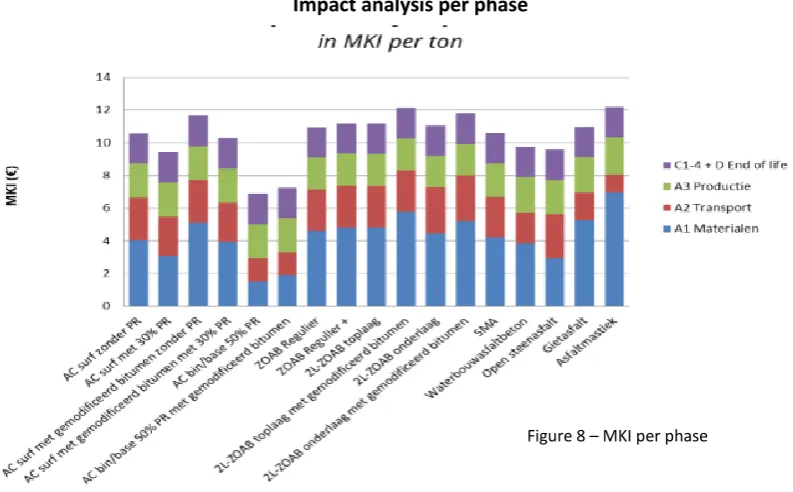
The underlay of the road depends on the natural environment. This can be a broad range of sand types (Bossche 2014). The sustainability of road construction and the process can be measured in the MKI. Both can be a part of the BPKV, depending on the purchasers. The MKI also gives a good indication of how the circular aspect of road constructing can be valued in the future. Therefore the MKI is further explained and analyzed.
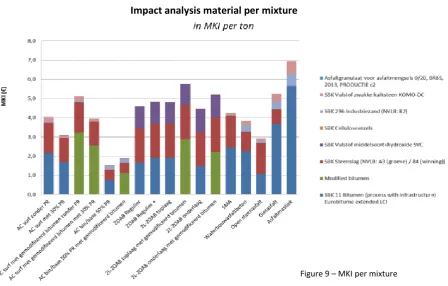
[image:23.595.80.477.473.719.2]In figure 8 the 17 mixtures of asphalt are analysed. Based on every stages is summed up what the impact is for the environment based on the MKI in euros. Concluded can be that materials has the biggest impact on the MKI value. In some situations involves asphalt more than 50% of the MKI value in
Based on figure 8, figure 9 is used. Figure 9 shows that the material has the biggest impact on the MKI indicator therefore the material; asphalt - is more detailed analysed. The Bitumen part of Asphalt has the biggest impact into the MKI indicator. This is split up in Bitumen and Modified Bitumen.
Conclusion theoretical framework
To made the transition possible towards a circular road construction sector there is change needed on different levels op playing field. Not only in the road construction sector, but also by government. The circular transition is an interaction between different levels op playingfield which is split up into niche, regime, and landscape. Wherein the niche is the power or start of the circular transition, which has to involve or overtake the regime and landscape. It is a cycle of interaction which is so called interactiviness. Change has to occur on multiple levels and by different organizations to made innovation possible. Innovation is a process of interaction whereby new products, services and processes constantly will be updated.
Constructing circular roads can not only be seen as a government-wide goal. It also has economic advantages for constructors (tenderers in this situation). Circular operating can be cheaper and save raw materials and it can also improve a company’s image. To change the current business model to a circular business model, it is not always necessary to use a top-down approach. By stimulating the market, a bottom-top approach is also one of the possibilities. If the companies uses its resources in the right manner, they can influence the decision makers to choose their sustainable product. Competition advantages can be created by a bottom-top approach, where the company functions as an advisor with a new product, instead of using policy as the only motivator. The circular economy requires system and product innovation. Innovation is a process to develop a new improved good, system or service; in this research the process from a linear to a circular economy.
Innovation and collaboration is important to operate circular, it is also a part of the circular key criterias. Innovation is just one key criteria. To make it possible to answer the sub-question “how does the road construction sector perform in comparison to the general key elements of the circular economy.” It was necessary to develop the general factors of the circular economy. This criteria are discussed and analyzed by literature so on this are the best criteria of the circular economy. There are eight general factors of the circular economy ar: prioritize regenerative resources, preserve and extend what is already made, use waste as a resource, create and rethink (new) business models, design for the future, innovation, collaborate to create a joint venture and transparency. Whether they are also applicable to the road constructing sector and how important are considered, will be investigated by interviews. These eight criteria create a reflective model where the expected criteria of the circular road constructing can be assessed in comparison to the general key criteria of the circular economy. A reflection model between literature and practice due interviews.
What is the relation between public procurement and innovation? The relation between public procurement and innovation is difficult. It is two sides which exist of advantages and disadvantages. So far attempts have been made to stimulate innovation through public procurement. Results of this were in the first place that public procurement is often a barrier to innovation, due to the lack of interaction with procuring organizations. The second barrier is the specific product specification where there is no space for innovative solutions. Positive results of public procurement are that the public sector will spend more by paying for the premium cost; the government will function as a tester. MKI calculation functions as a discount factor on the total BPKV price, where sustainability, LCA, and CO2 output function as a positive influence which also is related to circularity.
maintained towards the circular circle. So for Rijkswaterstaat, provinces and local government it is useful to collaborate at an earlier stage. For tenderers it is even more interesting to collaborate at an early stage because it can create competitive advantages through knowledge sharing. The negative side of early collaboration is that ‘knowledge-based collaboration’ and ‘building teams’ will take place with more than one tenderer because of the transparency regulations. By sharing information, the other party can use this and the competitive advantage will disappear.
Research methodology
The main purpose of this study is to provide an answer to the question: “How will tenders be defined in order to achieve the goal of constructing circular roads by 2050?” Therefore the aim is to find information based on data gathered by a qualitative research approach. The interviews are semi-structured, which is the most reliable interviewee technique in this case because it allows participants to openly give their opinions based on their life experiences (Butterfield, Borgen et al. 2005). Due to the fact that the qualitative interviews are semi-structured, it is possible to compare the interview data between respondents (Butterfield, Borgen et al. 2005, Galletta 2013). The interview questions are based on the theoretical framework.
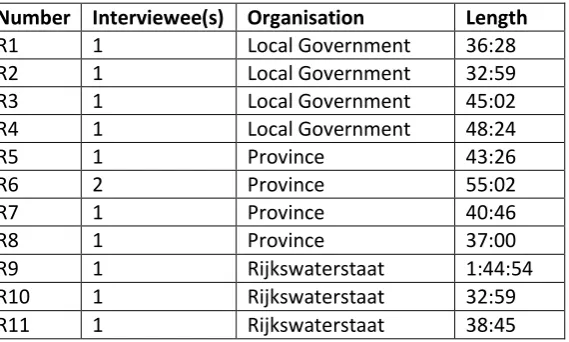
Twelve professionals were interviewed, who are all familiar with the circular economy and road construction and who are working either for Rijkswaterstaat or the provinces or local government. The interviews have taken place in June and July of 2018. Interviews are conducted at the location of the interviewee, as this positively influences the interviewee’s openness and comfort level , as well as the reliability of the gathered data (Galletta 2013).
The semi-structured interviews had the following global structure: introduction about the research, introduction of the interviewee, research questions, retake research question(evaluating and checking), thanking and personal conversation. Considering the semi-structured style, the interviews can differ in structure. In general the main questions were the same for interviewees. In Appendix 5 can be found a global setup of the interviews.
Afterwards, the data was processed anonymously, using ATLAS.IT software. Based on the analysis of this data, the different research questions were answered and the reflective model of the key criteria of the circular economy is valued. The interviews had as purpose to gives answer to the main question and the following sub-questions:
What will be used in the tenders to construct circular roads?
o How will the circular economy be measured and valued in the road construction sector?
o How does the road construction sector perform in comparison to the general key elements of the circular economy?
What extent and in what period is the introduction of criteria based on constructing circular in tenders feasible?
Which actions will purchasers (Rijkswaterstaat, provinces, and local government) perform to construct circular roads by 2050?
Based on the research question the results are split up into: characteristics of the circular economy in the road constructing sector, measurability and valuably of the circular economy and circular in the road constructing in comparison to the key elements of the circular economy.
Number Interviewee(s) Organisation Length
R1 1 Local Government 36:28
R2 1 Local Government 32:59
R3 1 Local Government 45:02
R4 1 Local Government 48:24
R5 1 Province 43:26
R6 2 Province 55:02
R7 1 Province 40:46
R8 1 Province 37:00
R9 1 Rijkswaterstaat 1:44:54
R10 1 Rijkswaterstaat 32:59
[image:27.595.73.358.556.727.2]R11 1 Rijkswaterstaat 38:45
Trustworthiness and authenticity of research
Trustworthiness and authenticity is an alternative of analysing reliability and validity used by quantitative researchers. Guba and Lincoln (1994) specify terms and ways of establishing and assessing the quality of qualitative research which is used to analyse the trustworthiness and authenticity of this research. For this research is chosen to analyse validity and reliability according to the theory of Guba and Lincoln (1994), because this research is conducted by a qualitative method (interviews) and therefore this theory gives a better well-defined overview of criteria which are applied. Trustworthiness exist according to Guba and Lincoln (1994) up of the four criteria: credibility, transferability, dependability, confirmabilty which will be explained in the text. Authenticity exist of the criteria fairness, ontological authenticity, educative authenticity, catalytic authenticity and tactical authenticity.
Trustworthiness
Authenticity
The wider political impact of the research will be explained by the authenticity criteria (Guba and Lincoln 1994). For the interviews are only professional who are familiar with the road construction sector and circular economy interviewed. Missing are project managers, EMVI/BPKV coordinators and engineers, the fairness of the research can be discussed because the opinion of this group of people is missing. Only the “boosters” of the circular economy are interviewed there is a possibility that their opinion is not in line with reality. To understand the situation of the interviewee often is asked about more information, or if the interviewees can explain their opinion. Which is part of the ontological authenticity to understand the social environment of the interviewee. Ontological and educative authenticity is not direct applicable for this research, because they are more applicable for social studies. This study will be openly published and shared which implicates tactical authenticity of the study (Guba and Lincoln 1994).
Data analysis
The qualitative data is processed in several steps. Firstly the data is recorded with a mobile phone. Directly after the interviews, the recoded data is written down by computer. This text document is analyzed by software (Atlas.TI) where the text document can be put into different codes. This process is called open coding. The goal of this is to reduce, interpret en to reconstruct rare data (van Staa and Evers 2010). During the coding process, it was considered that codes should be interpretative or descriptive by nature. The codes where defined towards criteria, processes, actions or products. Not for all the data analyses is used open coding for the key elements of the circular economy model is used manual analysing. For every specific key element is analysed the transcripts of the interviewees if some references are applicable toward the specific key element of the circular economy. Table 4 shows an example of the open coding from the transcript into code – Sharing knowledge (Market <-> Purchaser) The first part of the table implicates the answer of the interviewee the second part is the code of the interviewee (respondent 1, 2, 3, 4 and so on).
Code: Sharing knowledge (Market< –> Purchaser) Respondent
“Important for the circular economy in the road constructing sector is that parties of the market and purchasers are going to collaborate. Not directly collaboration, but sharing knowledge and experiences with each other. Private parties can and will innovate much quicker than we do - government-related organizations.”
R3
“Our knowledge is too minimal in comparison to the market. The market has a lot more knowledge in comparison to us.”
R5
“The market can offer new innovative products.” R11
“We as purchaser should advise market parties, and offer the problem. It is up to the market to find a solution for it. We have to keep each other up-to-date and motivated to challenge each other.”
R5 - R8
“Sharing knowledge is possible with ‘Bouwteams’ and market consultations. This way knowledge can be shared between both parties in an early stage of the process.”
R9
“Sharing knowledge is important for the circular economy” R10
“…. By challenging the market to come with circular solutions and sharing information”
[image:29.595.90.529.454.749.2]The codes were processed anonymously, this was necessary to guarantee the trustworthiness of the research so interviewees can openly give their opinion. The coding process made it possible to translate data into graphs.
Results
[image:31.595.87.533.229.648.2]Overview map of the circular economy aspects in the road construction sector by interviewee Figure 10 gives a structured overview of important aspects of the circular economy. There is chosen to use this overview map, because it give an central overview of all the information which is gathered by the interview. It is a global overview of references by interviewees. Based on the information which is gathered by the semi-structured interviews. This overview shows the different actors of the circular economy in the road constructing sector mentioned by interviewees. How bigger the circle is how more often is referred by interviewees. Some actors are related to each other others are indirect related based on this are the lines drawn.
Figure 10 – overview of circular economy in road construction
Circular economy in the road construction has several main relations according to the interviewees. Knowledge sharing, smart use of material, MKI and tender management are the most referred to and well substantiated by interviewee therefore they are in the first line with the main topic. For example MKI can be based Ecochain, Dubocalc, Ecomat and some interviewees referred to an unknown measurement method. The MKI is LCA based valuing method and therefore this is also included. Tender management is based on the BPKV or RAW and this are again related on several topics who are mentioned by interviewees. Smart use of material is referred often by interviewees, because this is an easy method which can be easily be executed by constructer and purchaser. It has for both parties advantages. Purchaser can be valued more sustainable and constructer will saving cost. Collaboration is also important according the interviewees, because this made innovation possible towards a more sustainable road construction sector. Collaboration can been seen as knowledge sharing between government related organizations, companies and between both (companies and government related organizations). However this research is conducted to conclude how tenders will be defined often is mentioned by interviewees that the procedure is not necessary to change but the standards of the industry have to change. By operating, acting and designing smart can be delivered a circular product which has advantages for both parties.
Characteristics of circular economy in the road construction sector
Graph 1 shows the findings of the interviews and frequencies referred to the specific characteristic of the circular economy in the road constructing sector. When looking for the aspect concerning the characteristic of the circular economy in the road constructing sector, the mention of LCA based, reuse of materials and sharing of knowledge is remarkable. Often is referred to this specific characteristic by interviewees.
Graph 1 shows the findings of the interviews and frequencies referred to the specific characteristic of the circular economy in the road constructing sector. When looking for the aspect concerning the characteristic of the circular economy in the road constructing sector, the mention of LCA based, reuse of materials and sharing of knowledge is remarkable. Often is referred to this specific characteristic by interviewees. There are used five characteristics, because towards this characteristics is mostly referred by interviewees, other were not interested to include in the research, or are not often enough mentioned by interviewees.
LCA based
One of the characteristics of circular economy in the road constructing sector is LCA based. This is mentioned by R2, R8, and R9 is important according to the interviewees because:
“LCA will be important in the future because it gives an overview of impact and lifespan, CO2 output and actually the whole environmental impact of the chain.” R2, R8, and R9
That importance of LCA is clear due to the interviewees. Some named Dubocalc, Ecochain or Dubomat as the possibility to measure the LCA in the road construction sector.
R5, R8, and R6: “A possibility for measuring the LCA is Dubocalc – MKI”. Reuse of material
Reuse of material is important according to the interviewees. R4 and R3 also mentioned that they want to improve the quality of the reused material. Also, interviewees mentioned in general that they want the reuse to take place quicker, smarter and better. It should be a process from recycling towards the reuse of material. This process of reuse is not only interesting for purchaser but also for the tenderer mentioned by R9 and R6.
R4 and R3: “100% reuse of materials is never possible, but we want to increase the reuse of the materials, for the top layers of the road as well.”
R9 and R6: “Reuse is also becoming more and more attractive. Sustainable asphalt is by definition also cheaper. It has not only benefits for the purchaser but also for the contractor”
Reuse of materials is not only focused on the aspect of replacing old asphalt. For the future and by design it is important to take into account that it should be possible for asphalt to be 100% reused over the upcoming years. Nowadays most of the asphalt will already be reused but in the future, but the quality should be increased so old asphalt can be 100% reused in all the layers of the road.
R9 and R6: “By data management asphalt can be better reused in the future.” R7: “100% reuse of asphalt is the goal for the future.”
CO2 based
CO2 is often referred to by interviewees. Actually, the CO2 is part of the MKI(LCA) but due the fact that interviewees referred often individually to CO2 is it separately involved as a code. It is for example mentioned by R3, R5, R7 R8 and R9, mostly according to the measurement possibility of being circular.
R3 and R8: “CO2 will be important in the future to operate circular and measure it.” R5 and R7: “CO2 reduction…”
Sharing knowledge (Government <-> Market)
R3, R5, R11, R9, R10 and R6 mentioned something concerning the code sharing knowledge (government <-> market). Specifically interviewees mentioned the following:
R3: “Important for the circular economy in the road constructing sector is that parties of the market and purchasers are going to collaborate. Not directly collaboration, but sharing knowledge and experiences with each other. Private parties can and will innovate much quicker than we do - government-related organizations. – Be objective”
R3 already noticed that private parties can realize innovation quicker as government-related organizations. R5, R8, and R9 also confirm this.
R5 “Our knowledge is too minimal in comparison to the market. The market has a lot more knowledge..”
In reaction to which role the purchaser should take into the circular transition to the market, interviewees respond with:
R5 and R8: “We as purchasers should advise market parties, and explain the problem. It is up to the market to find a solution for it. We have to keep each other up-to-date and motivated to challenge each other.”
R9: “Sharing knowledge is possible with ‘Bouwteams’ and market consultations. So knowledge can be shared between both parties at an early stage of the process.”
All these characteristics suggest the importance of a chain approach. A part of the interviewees agreed that the circular economy in the road constructing sector should not only be based on product ‘creation’. The chain approach should be used, where everything works smart and collaborating at a specific level.
Sharing knowledge (Among government-related organizations)
R4 and R5 noticed that it is important to share knowledge between institutions. This should be with contractors but also among government organizations. Most of the non Rijkswaterstaat participant mentioned that they gather data and knowledge by Rijkswaterstaat.
R6 and R7 motivated this with: “Sharing knowledge is important among governments’ institutions (purchasers) because one party does not have enough market share and knowledge to realize direct innovation. - Also, knowledge and data sharing can avoid expensive pilots.”
Interviewees said that they collect a lot of data from Rijkswaterstaat due to the power of Rijkswaterstaat:
R7 and R4: “Rijkswaterstaat has a lot of knowledge of the circular economy. They have even more power to collect and create data according to the topic. Therefrom Rijkswaterstaat has an example function for us.”
Code – characteristics of circular economy in the road construction sector
R1 R2 R3 R4 R5 R6 R7 R8 R9 R10 R11
LCA based x x x x x x x x
Reuse of materials x x x x x x x
CO2 based x x x x x x
Sharing knowledge (Government <->
Market) x x x x x x
Sharing knowledge (Among
[image:35.595.69.532.340.470.2]government-related organizations) x x x x x