http://wrap.warwick.ac.uk/
Original citation:
Beynon, Meurig, Harfield, A and Chang, S. (2005) Alternative model-building for the
study of socially interactive robots. In: AISB 2005 Symposium on Robot Companions
Hard Problems and Open Challenges in Human-Robot Interaction, Hatfield, UK, 12-15
Apr 2005
Permanent WRAP url:
http://wrap.warwick.ac.uk/48618
Copyright and reuse:
The Warwick Research Archive Portal (WRAP) makes this work by researchers of the
University of Warwick available open access under the following conditions. Copyright ©
and all moral rights to the version of the paper presented here belong to the individual
author(s) and/or other copyright owners. To the extent reasonable and practicable the
material made available in WRAP has been checked for eligibility before being made
available.
Copies of full items can be used for personal research or study, educational, or
not-for-profit purposes without prior permission or charge. Provided that the authors, title and
full bibliographic details are credited, a hyperlink and/or URL is given for the original
metadata page and the content is not changed in any way.
A note on versions:
Alternative model-building for the study of socially
interactive robots
Meurig Beynon, Antony Harfield, Sunny Chang
Department of Computer Science, University of Warwick, UK
wmb,ant,csvmu @dcs.warwick.ac.uk
Abstract
In this discussion paper, we consider the potential merits of applying an alternative approach to model-building (Empirical Modelling, also known as EM – see http://www.dcs.warwick.ac.uk/modelling) in studying social aspects of human-robot interaction (HRI). The first section of the paper considers issues in modelling for HRI. The second introduces EM principles, outlining their potential application to modelling for HRI and its implications. The final section examines the prospects for applying EM to HRI from a practical perspective with reference to a simple case study and to existing models.
Introduction
The difficulty of dealing effectively with issues re-lating to social intelligence in the design of robots is widely recognised. In discussing this challenge, Fong et al. (2002) identify two approaches to the de-sign of socially intelligent agents, the “biological” and the “functional”. The biological approach aims to draw on understanding of animals and their be-haviour to design robots which exhibit similar prop-erties to their biological counterparts. The functional approach only takes the functionality of such robots into account and is not concerned with the mecha-nisms by which this is achieved. Traditional AI gen-erally takes a functional approach. The biological ap-proach is favoured by those interested in the social sciences and biology.
Whatever the orientation of the robot design, there are major technical and conceptual issues to be ad-dressed in developing robots that are socially respon-sive. It is implausible that such issues can be re-solved by implementing behaviours that are compre-hensively pre-specified by abstract analysis of the op-erating context. Dautenhahn (2004) proposes that the social personality of a robot should grow through a socialisation process similar to that observed in ani-mals such as dogs. Adams et al. (2000) sees robotics as offering “a unique tool for testing models drawn from developmental psychology and cognitive sci-ence”. His approach to building sophisticated robots incrementally, using the concept of a subsumption ar-chitecture (Adams et al., 2000; Brooks, 1991), indi-cates a possible way in which such a socialisation
process might be supported. However, as Dautenhahn (1995) has observed, the role of ‘the social factor’ in the development of intelligence has been little ex-plored in the ‘sciences of the artificial’, and we cannot necessarily expect that techniques for building intelli-gent robots will deal with social aspects. Adaptation to the social environment is likely to be a much more subtle process than adaptation to a physical context, and demands a more intimate interaction between hu-man and automated activities than has been achieved hitherto.
the robot’s capacity to respond to its current situation rather than on extending its current repertoire of be-haviours.
1
Issues in modelling for Human
Robot Interaction
Traditional techniques for modelling have problem-atic aspects in the context of robotics. Closed-world models of robot behaviour may appear to give useful insights in the abstract, but the vagaries of the phys-ical world lead to serious discrepancies between real and virtual behaviours. It is such considerations that prompt Brooks to advocate ‘[using] the world as its own model’ (Brooks, 1991). There is little doubt that problems of this nature will always be an issue, but EM is such a radical alternative to traditional mod-elling approaches (Beynon, 1999, 2003) that there is hope that it can offer new remedies or palliatives.
Our objective is to develop modelling techniques that can be used in direct and live conjunction with researches on actual robots in a laboratory. The aspi-ration is to make models that are sufficiently subtle to address social aspects of the interaction to some de-gree. There are many ways in which empirical study of HRI in the laboratory can potentially be combined with experiments in a virtual environment. We might wish to use virtual models to explore experimental scenarios for which empirical data has been derived, or to connect the behaviour of agents in the physi-cal environment directly to that of their avatars in the virtual world. Possible goals might be formulating new hypotheses, making a virtual record of signifi-cant interactions observed in the laboratory, or iden-tifying new patterns of robot behaviour to be pro-grammed. For these purposes, models need to be suf-ficiently authentic that they can guide the program-ming of robots. Ideally, we would like to be able to direct the modelling activity freely in a variety of dif-ferent ways, corresponding to difdif-ferent modes of ob-serving the HRI, mixing modes of observation and experiment in real and virtual worlds.
In the context of modelling for HRI, we identify the following issues as particularly significant:
having an approach to model development that is incremental, admits highly flexible adaptation through human intervention (because social con-ventions and physical interactions are so sub-tle and difficult to circumscribe), and is holistic (because, for instance, social conventions about personal space (Hall, 1966) and lower-level con-cerns such as navigation are inseparably linked).
developing models that have explanatory power, so as to be able to trace the effects of robot action to their origins, attribute responses to stimuli ap-propriately and account for the fact that the robot does more than can be specified and represented in propositional terms.
interrelating human and machine perspectives intimately so as to be able to exploit the quali-ties of both humans and robots, as is required to program robots to achieve the high degree of at-tentiveness to context that is demanded in social situations without compromising their capabil-ity to act obliviously with superhuman efficiency where appropriate.
Various kinds of relation have a significant impact upon social interaction. These include:
Spatial relations - An agent’s physical location and the surrounding space are likely to affect the behaviour of the agent. Actions in small con-fined spaces are usually different from those in large open spaces.
Temporal relations - Time plays a significant role in human behaviour. When time is at a pre-mium humans are likely to perform tasks differ-ently from when they have plenty of time.
Status relations - The status of human agents af-fects their interaction and expectations. Inter-action with those with whom we are familiar differs from interaction with strangers. Interac-tion within the working environment, families and cultural contexts is likewise differentiated according to the status of the agents with whom we are interacting.
Taking account of such relations in interaction is something that humans typically learn from experi-ence. On this basis, a most important characteristic in modelling for HRI is a capacity to accommodate learning in a dynamic fashion. This has particular relevance for the prospects of applying EM to HRI because EM proceeds by modelling relations as they are encountered in experience.
2
The Empirical Modelling
Approach
2.1
Agents and Observables
Empirical Modelling (EM) approaches the construc-tion of a model of a concurrent system from the per-spective of an external observer trying to make sense of what is being observed (Beynon et al., 1990). If the task is to make a virtual representation of a physical system, the principles of EM can be seen as similar to identifying the situation within the context of familiar ‘scientific’ theory, complemented – where there is no such theory to hand – by the application of the ‘sci-entific method’. In this context, the modeller iden-tifies what they perceive to be the principal agents responsible for state change, and develops hypothe-ses about how their interaction is mediated by observ-ables. This section will introduce EM as it might ap-ply to the scenario of studying the social behaviour of robots, without particular concern for the technical challenges this might present for EM tools and other relevant technologies in their current state of develop-ment. Specific models that indicate the present state of EM development in key aspects will be discussed in the next section.
In the HRI laboratory, the most prominent agents are the robots and the humans who interact with them. Within the scope of the EM model, other elements of the situation are typically also construed as agents. For instance, an item of furniture, a door or a pet might be an agent in so far as its presence and current status influences the state change that takes place. If, moreover, there is some abstract activity in process, such as might be informally described as ‘the robot is going to collect up the empty wine glasses’, this too would naturally be represented by an agent of some kind. Relevant issues to be noted are:
the concept of an observable is intended to em-brace not only what the external observer can di-rectly apprehend, but what the agents within the system are deemed to directly apprehend. For instance, the ‘observables’ relevant to the robot might include information from its distance sen-sor along a particular direction, and information about the status of the current task in hand.
it is generally necessary to take account of the transient nature of observables, so as to reflect the presence or absence of agents in the situa-tion. For instance, when the task of collecting empty wine glasses is accomplished or aborted, the related observables are no longer meaning-ful.
Because the model-building activity serves an ex-planatory function, it is appropriate to characterise
an EM model as a ‘construal’ (cf. the extended dis-cussion of this term in (Gooding, 1990)). Note that, in arriving at a construal, the external observer has to project agency that is human-like on to the non-human agents in the situation. For instance, to explain the behaviour of an automatic door, the modeller may postulate an observable by which the door ‘perceives’ itself as open, and consider the door to be responsible for manipulating its aperture accordingly.
2.2
Dependencies
Agents and observables are complemented by addi-tional features of the situation that are most distinc-tive of EM – dependencies. A dependency is a re-lation between changes to observables that pertains in the view of an agent within the system. In effect, there are latent relationships between those things that an agent is deemed to observe, that are ‘per-ceived’ by the agent to be linked in change in an indi-visible manner. This indivisibility is in general ‘rela-tive to the agent’, and its status depends upon the na-ture of the construal. For instance, in some contexts, the activity of ‘collecting an empty wine glass’ might be viewed by the external observer as an atomic oper-ation that indivisibly reduces the count of empty wine glasses so far accounted for. Where the robot is con-cerned, on the other hand, such an operation would necessarily involve a highly complex and intricate se-quence of sensing and activation steps.
By their nature, the key concepts of EM are de-fined by experience. What is deemed to be an agent, an observable or a dependency is at all times subject to change through observation and experiment on the part of the modeller (cf. the way in which varieties of agency are seen to be socially constructed in (Daut-enhahn, 1998)). The through-and-through empirical nature of these constituents is reflected in the charac-ter of the construal itself, which is conceived and de-veloped quite differently from a traditional computer model.
in-sight of the external observer. In so far as these ob-servables have specific current values, the artefact it-self will serve to represent the current state of the sys-tem to which it refers (cf. the way that a spreadsheet records the current status of a financial account). The atomic changes of state that are possible in this state will be represented by possible redefinitions to which appropriate observables are subject, whose impact is in general to change the values of several observables simultaneously, and perhaps change the pattern of de-pendencies itself. In the HRI laboratory scenario, such an atomic change might typically reflect an ’in-finitesimal’ movement or sensory update on the part of the robot, or a primitive action on the part of a human agent, such as pressing the television remote control. Note that because of the dependencies -a single -action on the p-art of -an -agent m-ay upd-ate several observables simultaneously (as when press-ing the remote switches the television on). There is also the possibility for independent changes of state to occur simultaneously (as when the robot moves, and the human agent presses the remote control at the same time). The modeller can make use of such a construal to trace characteristic system behaviours, though the effect is quite unlike the exercising of stat-ically pre-specified behaviours in a closed-world that is commonplace in conventional computer program-ming. Suppose for example that the robot is pro-grammed to collect the empty wine glasses, but that at some point during this collection process one of the wine glasses is accidentally smashed into pieces. It then becomes necessary to adapt the parameters of the collection activity to take account of the new situ-ation - something which the modeller should be able to cope with dynamically when exercising a good construal of the situation, but would have had to have been within the explicit scope of a programmed be-haviour.
2.3
Developing a construal
As the above discussion highlights, the development of an EM construal is concerned with something less specific than representing any particular set of func-tionalities. For any complex reactive system, the goal of developing a single unifying artefact to re-flect the modeller’s comprehensive understanding is a pipe dream. The quality of a construal is contin-gent upon the degree of familiarity and understand-ing that the modeller has built up through observation and experiment, typically over an extended period of interaction. The true potential and limitations of EM in concurrent systems modelling are best appreciated
by viewing the construal not in some purported final perfected form, but as it evolves in conjunction with the development of the modeller’s understanding. In applications such as HRI modelling, it is plausible that this development should ideally accompany the construction of the real environment from its incep-tion, so that the model grows in subtlety and scope in counterpoint with the understanding of the laboratory technicians and experimenters. To conclude this brief overview of EM principles, it will be helpful to out-line informally how such an incremental process of construal might take place.
Throughout the development process, the represen-tation of the construal has two aspects: the physical artefact as it is realised on a computer, or more pre-cisely using an appropriate suite of computer-based peripherals (cf. the distinction between a musical instrument and an orchestra), and documentation in the form of a textual description of the agents, ob-servables and dependencies and their interrelation-ship within the modeller’s construal. As will be il-lustrated below, in our implementation framework, these two ingredients of the construal are respectively associated with a set of definitive scripts, and a set of LSD accounts of the agents, to be referred to as ‘scripts’ and ‘accounts’ in what follows. An LSD ac-count classifies the observables deemed to shape the behaviour of an agent, with reference to how it per-ceives, acts upon and responds to its environment. To put these ingredients in context, it is quite plausible that, in the HRI scenario, we might have a good grasp of the determinants of the robot behaviour in the ab-stract, and reasonable models for its behaviour in cer-tain idealised scenarios (e.g. robot motion where the floor is level and the coefficient of friction is uniform, and the lighting conditions are favourable). We may also have reliable knowledge of the characteristics of the physical environment where issues such as the location of furniture and the operation of doors and light switches are concerned. Such information pro-vides the basis for developing several ingredients that contribute to a useful construal. These might include:
scripts to represent the principal features of the environment in which the robots and human agents interact.
an account of a robot’s behaviour with reference to the observables that are intrinsically associ-ated with it (such as the current status of its sen-sors, its location and velocity), together with the external observables to which it responds.
inves-tigated experimentally, and interactively adapted through intervention by the modeller.
In this scenario, many more difficult issues remain to be addressed, such as understanding the relation-ship between what the robot sensors record (e.g. the distance from the nearest object in some direction) and how this needs to be interpreted in context (as in ‘the robot is approaching the table on which there is a wine glass’): these will typically require extensive empirical investigation.
By its nature, an EM construal can accommodate partial understanding and support the modeller in gaining further insight. Though there is not typi-cally one unifying script to represent the entire sys-tem comprehensively from an objective external ob-server’s perspective, there will be a collection of sub-scripts associated with those scenarios for which the modeller has sufficiently detailed understanding. As explained in the above discussion, the behaviours that can be exercised using these scripts are open for the modeller to explore and extend in an experimental fashion. What is more, the behavioural interpreta-tion of the construal can be modified by the modeller ‘in-the-stream-of-thought’. This is in sharp contrast to modifying the behaviour of a conventional pro-gram, which entails terminating execution, changing the specification and attempting to reconstruct what – taking the changed specification into account – can only be an approximation to the original situation of use. It is also conceptually easy to exercise scripts representing independent aspects of the same situa-tion in combinasitua-tion, as is appropriate where under-standing of a situation is too partial to support a con-ventional implementation of behaviour, but signifi-cant behaviours can be explored subject to interven-tion by the modeller. Taking in conjuncinterven-tion, scripts and accounts also serve as a powerful way of com-municating understanding between experimenters.
3
Practical Aspects of Empirical
Modelling
This section illustrates how EM techniques can be ap-plied in practice. The scenarios considered relate to interactions between humans and robots that might arise in a house environment. They help to indicate how EM might be used to support the development of a robot that exhibits some degree of social awareness. Our illustrative examples draw upon pre-existing EM models of a house environment, and of various activ-ities that give insight into the potential for effective modelling of human and robot interaction.
3.1
Agent-oriented modelling
Though the term is widely and frequently used, the Artificial Intelligence (AI) community has great dif-ficulty in agreeing on a definition for ‘agent’. As Wooldridge and Jennings (1994) point out: “This need not necessarily be a problem: after all, if many people are successfully developing interesting and useful applications, then it hardly matters that they do not agree on potentially trivial terminological de-tails.”. This point of view is strongly endorsed by EM, where the implementation and interpretation of a specific pattern of activity that is conceptually as-sociated with one and the same agent evolves with the model. In a typical pattern of model evolution, a pattern of behaviour that is initially carried out by a human agent can be progressively more compre-hensively executed automatically, so that eventually it can be exercised without – or more precisely, in what seem to be the only realistic circumstances, without – the intervention of the human agent. What adds par-ticular force to Wooldridge’s observation in this con-text is that it is not appropriate in EM to conceive the evolution of a model in terms of a discrete succession of progressively more expressive models, each with its own distinctive functionality. In so far as it makes sense to speak of the identity of an EM model, it is more appropriate to think of this identity as unchang-ing throughout its development, in the same spirit in which we say that ‘the child is father to the man’.
and sets out to obstruct the robot’s passage. Even where the opponent is benign, there may still be ex-ceptional circumstances in which the familiar parallel side-stepping behaviour arises, when the robot’s for-ward motion may need to be suspended. To overcome this problem, which arises at a rather advanced stage in the modelling, it is in general necessary to com-bine automation of routine aspects of the robot be-haviour with mechanisms for open-ended human in-tervention when singular scenarios arise. Only when these singular scenarios are understood in sufficient detail does full automation become possible. In the transition from an initial model in which the state change for collision avoidance is predominantly sup-plied by the modeller to a final model in which this state change can be carried out autonomously by a programmed agent, the nature of the agent effecting the state change evolves in ways that are liable to sub-vert any but the weakest notion of agency. This is in keeping with the observation by Lind (2000) that, in agent-oriented software engineering, “the concep-tual integrity that is achieved by viewing every inten-tional entity in the system as an agent leads to a much clearer system design”.
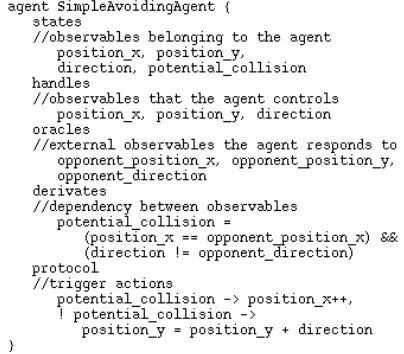
Our illustrative example can be further elaborated with reference to specific practical tools that support EM. To enable the developer to act in the role of the robot, it is first helpful to give an LSD account of the robot’s relationship to its environment (cf. sec-tion 2.3). This involves classifying the observables that affect the behaviour of the robot as an agent. Pro-jecting ourselves into the role of the agent, there are some observations that the agent can make about the environment – these determine the observables that are oracles to the agent. We might assume, for in-stance, that the robot agent has sufficient ’visual’ ca-pability to be able to identify other agents or static objects, to locate the positions of the other agents that are within the field of vision, and to determine in which direction the other agents are moving (the state observables of these agents). We can further suppose that the robot agent has conditionally con-trol over certain observables (its handles), and that there are certain dependencies between observables that can be deemed to apply in the view of the agent (its derivates). It is then possible to describe simple strategies that a robot might employ with reference to the LSD classification of observables. For instance, one simple avoidance strategy is: if an agent is in the direction that one is walking then take a step side-ways. This might be captured in an LSD account as shown in Figure 1.
[image:7.595.316.518.98.275.2]As discussed in section 2.3, there are two aspects
Figure 1: A simple example of an LSD account. The derivate potential collision highlights the situa-tion where a collision may occur and the protocol specifies a change in position x aimed at avoiding a collision.
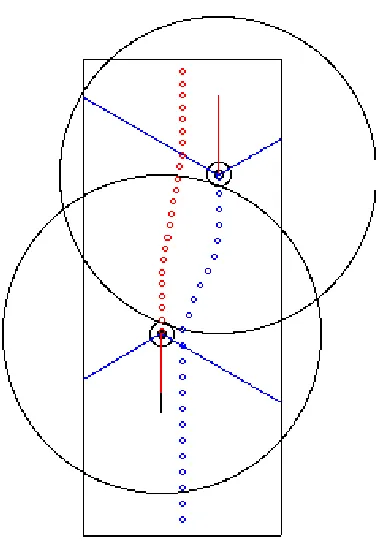
to the development of a construal in EM: the con-struction of a physical artefact on the computer, and the associated documentation of the modeller’s con-strual. The physical artefact is a source of experi-ence for the modeller that metaphorically represents perceptions of the environment by a whole range of agents. Figure 2 for example, is a snapshot from an EM model of collision avoidance developed by War-wick student Chris Martin in his final year project in 2003-4 (see Figure 2). The geometric elements of the figure are lines and circles that represent the paths traced by two agents, their fields of vision and current locations and headings. The perspective associated with the model is that of an external observer moni-toring the behaviour of two people passing each other in a corridor, as if viewed from above. Our EM tools are such that this model could in principle be run in a distributed fashion in conjunction with variants of the model that represent the corridor interaction from the perspectives of the agents themselves. This allows the modeller to investigate through experiment how the roles of agents can be played by human agents or automated.
sensi-Figure 2: Two agents successfully avoiding a colli-sion in a corridor.
tive within 80 degrees of the direction of looking. Be-cause the modeller’s construal is itself to some degree tacit in interaction with the model (cf. Gooding’s ob-servation that a construal must be viewed in conjunc-tion with its associated body of ostensive practices (Gooding, 1990)), it is difficult to appreciate Martin’s model fully without being able to consult him as the model-builder, or to have a dialogue with him about his interaction with the model. An LSD account is a useful adjunct to the computer model that helps to expose the most prominent meaningful interactions with the model. In practice, there is typically much interesting and significant interaction with and within a model that cannot be explicitly captured in an LSD account. For instance, the collision avoidance strate-gies used in the most advanced variants of Martin’s model were never explicitly described by an LSD ac-count, and involve spatial and temporal considera-tions that are too subtle to be conveniently specified in an abstract protocol in isolation from the model.
The above discussion illuminates the context for the development of EM artefacts and LSD accounts in HRI. Model construction and the elaboration of LSD accounts are symbiotic processes that do not fol-low a preconceived pattern, but are mutually
support-ive. Models and accounts can relate to many differ-ent perspectives on agency and modes of observation and construal. Artefact and documentation develop together, and serve complementary purposes both pri-vate to the modeller and in relation to the communi-cation of construals.
The first objective in applying EM to HRI would be to better understand how human capabilities and behaviours and robot capabilities and behaviours can be most effectively concurrently elaborated and inte-grated. As has been illustrated, EM can help us to explore the factors that are significant in determin-ing human behaviour in relation to such tasks as col-lision avoidance. It can also enable us to construct idealised prototype behaviours that are expressed in terms of high-level abstract observables that serve as useful reference models for devising and analysing robot behaviour. A more ambitious goal involves demonstrating that EM can be used in programming robots. A key aspect of this might involve implement-ing theSimpleAvoidingAgent model with ref-erence to a more primitive and explicit account of the vision capability of an actual robot, through progres-sively elaborating its states, oracles, handles and pro-tocol. It is in this connection that the usefulness of models and accounts that are intimately related and synchronised is most evident.
It is through developing and experimenting with models based on such construals that the modeller will be able to recognise and address more subtle fea-tures of problems of HRI. For instance, by playing out the role of a robot agent in collision avoidance, the modeller will be able to highlight the impact of spatial, temporal and status relations in the interac-tion. If the person walking towards you is elderly or infirm then it is appropriate to move out of their way so that they are inconvenienced as little as pos-sible. If time is critical (as when there is a fire in the building) then observing social distances will be less of a priority than getting to the fire exit as quickly as possible. Our prior experience suggests that, pro-vided our underlying construals of the more prosaic aspects of avoidance behaviour have been developed with due regard for EM principles and concepts, it will be possible to adapt models to reflect more so-phisticated behavioural issues in social interaction. A key factor in this is the well-conceived application of modelling with dependency.
3.2
Modelling using dependency
[image:8.595.83.271.95.366.2]re-lationships between characteristics and perceptions of objects that are always maintained. Dependency arises commonly in mechanical systems, where a change to one component directly affects another component in a predictable and indivisible manner. There is no context in which the state of one compo-nent is not synchronised with that of a related com-ponent.
Dependency maintenance is one of the central characteristics of the software tools that we have de-veloped for EM. Our primary modelling tool sup-plies notations within which scripts of definitions can be formulated to express dependencies between the many different kinds of observables that determine the various aspects of the state of an EM artefact (see, for instance, the discussion of modelling situ-ated, explicit, mental and internal aspects of state in (Beynon et al., 2001)). The simple illustrative exam-ple used in this section makes use of elements from one such model, originally developed by the third au-thor in her final year project in modelling an intel-ligent house environment. An important feature of EM, to be elaborated in the next section, is the scope it offers for models to be re-used for different pur-poses, and for relatively complex models to be built up incrementally through assembling and combining simpler components.
Dependency plays a key role in all forms of human-robot interaction. With reference to each agent, there is a dependency between what is observed and what is inferred. With reference to an agent in its environ-ment, there is a dependency between what exists and what is observed. In EM, models of environments are built up from observables and dependency. In mod-elling a house, for instance, the position of a lamp on a table is dependent on the position of the table: if a person moves the table then the lamp also moves, but not vice versa. The illumination of the room is depen-dent on the position of the lamp and also the position of other objects in the room. If a person or robot is obstructing the lamp then it will affect the illumina-tion of the room with potentially undesirable effects. A socially sensitive robot will need to take account of these dependencies.
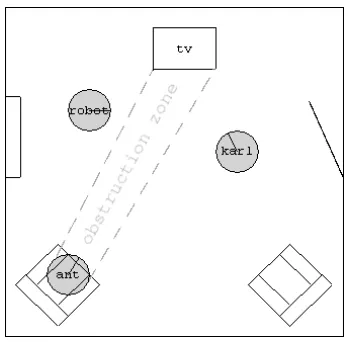
By way of illustration, consider the dependency in-volved in a living room, where there are likely to be people watching television. Clearly, it would be un-desirable for a robot to obstruct someone while they are watching television. As in modelling a potential collision in the corridor (cf. the derivate in Figure 1), we can represent a potential obstruction by devising a system of dependencies. If we work with a 2D model of the living room such as is depicted in
Fig-Figure 3: The living room model. Whether the robot causes an obstruction is dependent on the position of the people and the television.
ure 3 then we can identify certain areas of the room where the presence of a robot agent will cause an ob-struction. Using dependency, these areas can be de-fined in terms of the position of other agents and the television, so that they change dynamically as agents move around. Other issues might also effect whether there is an obstruction. If the television is switched off then the robot can be fairly sure that it is not being watched. The obstruction is then dependent on: the robot being inside the area between the people and the television, and the television being switched on.
[image:9.595.330.505.94.265.2]The way in which these dependencies can be di-rectly modelled using EM models is further illus-trated in Figure 4, which comprises some key defi-nitions drawn from the underlying model depicted in Figure 3.
When model building with dependency, we can ex-plore the effects of altering observables which may have meaning in the environment. For instance, dif-ferent people might have difdif-ferent sensitivities about how much space is unoccupied in the visual field around a television. This would mean that the pos-sible obstruction areas would differ according to who was watching. The dependency in the model would make it possible to adapt the model without making any changes to our models of the living room envi-ronment or the robot.
Figure 4: An extract of definitive script showing that an obstruction is dependent on the positions and sta-tus of other agents in the model.
world from traditional programs. The notion of ‘con-strual’ is categorically different in character from the idea of a program that is based on a functional spec-ification and optimised to meet its specific functional objectives. This has significant implications for the way in which EM artefacts can be developed and combined.
3.3
Evolving the model
In conventional software development methods it is common for a specification to be formalised before any design or implementation has begun. EM in con-trast is of its essence concerned with development that is incremental, at least where the modeller’s con-ception of the artefact is concerned. That is to say, even if the modeller incorporates some pre-existing EM artefact in the development, as has been quite common in practice, the comprehensive understand-ing of the artefact that may be required to exploit it fully in the new context normally involves a corrob-orative process of interaction with the artefact and the external world that is similar in nature if not in scale to the interactions involved in its original con-struction. This corroborative activity is not an all-or-nothing exercise in comprehension such as is typ-ically demanded of the programmer confronted with a formal specification for a requirement or a design, but an active process of becoming familiar through changing the state of the EM artefact in an exper-imental fashion. This is because a construal only serves its function subject to the engagement of the human interpreter, whether or not the interpreter was
also responsible for its development.
In building an EM artefact from scratch, the model-builder takes experimental interaction a step fur-ther than simply experiment-for-confirmation. The model-building is exploratory: it is an exploration in the creation of a model, where there is a place for blind experiment-for-discovery. The model-building can begin with little knowledge of what a final model might embody. It is the job of the modeller to develop understanding through exploration of the model; at all times acquiring knowledge and insight in constant connection with the model. This activity of model-building establishes an intimate relation between the artefact itself and the mental model of the modeller, as expressed in terms of expectations about possible states of the artefact, and reliable patterns of interac-tion with it.
The EM environment goes some way to provid-ing the exploratory power needed to brprovid-ing the model into close alignment with the modeller’s construal of a situation. The interactive nature of the environment enables the modeller to incrementally build artefacts and observe their effects on-the-fly. Some character-istic features of EM can be described with reference to illustrative examples.
Consider a possible development of the living room environment discussed previously. Suppose that we introduce more agents, including one intend-ing to move from one side of the livintend-ing room to the other – perhaps to reach the cocktail cabinet on the far side of the room. The agent will have to observe the avoidance zones in the living room by exploiting de-pendency, and also avoid oncoming agents that may be moving across the room. One way of building a model to represent this situation is to combine the liv-ing room model and the corridor model, and explore the effects of this conjunction. The result of combin-ing two small models with relatively simple actions is a model with a more complex behaviour.
By evolving a model in this way, incrementally building new artefacts and combining them with ex-isting artefacts, is becomes possible to observe new phenomena and gain insight into more complex be-haviours.
It is important to note that EM models never reach a “final” state where the implementation is complete: they are continually refined and exercised in new ways through interaction on the part of many differ-ent agdiffer-ents (e.g. in the role of designer, observer, or interaction partner). That modelling social interac-tion should have this open-ended nature is completely plausible. As we do not fully understand the nature of social conventions (Gilbert, 1995) – even our own – it is unlikely that we will ever want to finalise (or completely formalise) a behavioural model.
It is natural for readers unfamiliar with EM think-ing and practice to question whether our discussion of applying EM principles to HRI engages sufficiently with the hard problems that are the primary focus of the call for papers. The modest content and conserva-tive themes that are represented in our illustraconserva-tive ex-amples may suggest a lack of ambition that is out of keeping with our pretensions to an ‘alternative model-building’ approach. Whilst it is true that our research on applying EM principles to HRI is as yet in its ear-liest stages, and that far more investment is required to evaluate its true potential, we are optimistic about the prospects of fruitful results in the long term. The same cultural influences that associate computation so strongly with specification and optimisation also often lead us to think of difficulty primarily in terms of problems that can be explicitly framed and whose solution we hope to address by dedicated directed ef-fort that is informed – and in some respects limited – by specific goals. In this way, we come to attach great value to targeted specific techniques and solu-tions that take us beyond the commonplace territory of a problem domain, whether or not they can be in-tegrated with other solutions of a similar nature, or usefully related to the more mundane regions of the problem space. This is not a concept of difficulty that is well-suited to interpreting our aspirations for EM.
To put the ambitions of EM in perspective, it is use-ful to contrast having poweruse-ful algorithms to solve specific technical problems in a domain, and having a powerful construal of the key phenomena in a do-main. Gaining the latter is invariably a matter of ac-quiring a large body of experience – even when this experience is guided (as in an established science) by an advanced and comprehensive theory. Since EM is primarily concerned with using the computer to sup-port the development of construals, rather than to im-plement sophisticated algorithms, it is unsurprising that EM has found broad application to many fields, but has yet to contribute conspicuous specific appli-cations to any one. Similar considerations apply at a different level of abstraction when considering the
relationship between ingenious solutions to specific problems in HRI and ways of thinking about the do-main that can promote a general understanding and an integration of what may appear to be separate con-cerns.
The above discussion informs our orientation to-wards applying EM to problem-solving in HRI. Hard problems often come into being because our solutions to the easier problems are too tightly constrained. This is frequently the result of making the simplifi-cations in our models that are necessary to generate solutions that are sufficiently efficient in execution or ingenious in conception to attract attention. Any in-teraction involving a human will inevitably involve a complex model of activity. Exploratory model-building provides a method with which we can start our model-building on a small scale and incremen-tally extend the model to ever increasing complexity. In this context, the hard problem is to integrate the solutions to relatively easy problems without losing conceptual control. This is intimately connected with what this paper highlights as perhaps the most sig-nificant hard problem in modelling: giving dynamic support for situated learning.
Acknowledgements
We are much indebted to Kerstin Dautenhahn and Chrystopher Nehaniv for introducing us to their re-search on socially interactive robots, and to Steve Russ and Chris Martin for their work on applying EM to crowd behaviour.
References
B. Adams, C. Breazeal, R. Brooks, and B. Scassel-lati. Humanoid robots: A new kind of tool. IEEE Intelligent Systems, 15(4):25–31, 2000.
W.M. Beynon. Empirical Modelling and the founda-tions of AI. Computation for Metaphors, Analogy and Agents, Lecture Notes in Artificial Intelligence, 1562:322–364, 1999.
W.M. Beynon. Radical Empiricism, Empirical Mod-elling and the nature of knowing. In Proceedings of the WM 2003 Workshop on Knowledge Manage-ment and Philosophy, Luzern, April 3-4, 2003.
W.M. Beynon, C. Roe, A.T. Ward, and K.T.A. Wong. Interactive situation models for cognitive aspects of user-artefact interaction. In Proceedings of Cog-nitive Technology: Instruments of Mind (CT2001), pages 356–372, 2001.
R. Brooks. Intelligence without representation. Arti-ficial Intelligence, 47:139–159, 1991.
K. Dautenhahn. Getting to know each other— artificial social intelligence for autonomous robots. Robotics and Autonomous Systems, 16:333–356, 1995.
K. Dautenhahn. The art of designing socially intelli-gent aintelli-gents: science, fiction and the human in the loop. Applied Artificial Intelligence Journal, 12(7-8):573–617, 1998.
K. Dautenhahn. Robots we like to live with?! - a developmental perspective on a personalized, life-long robot companion. in Proc IEEE Ro-man 2004, Kurashiki, Okayama, Japan (invited paper), 2004.
T. Fong, I. Nourbakhsh, and K. Dautenhahn. A sur-vey of socially interactive robots. Robotics and Au-tonomous Systems, 42, 2002.
N. Gilbert. Emergence in social simulation. in N. Gilbert, and R. Conte (eds), Artificial Societies, London: UCL Press, pages 144–156, 1995.
D. Gooding. Experiment and the Making of Meaning. Kluwer, 1990.
E.T. Hall. The Hidden Dimension. Doubleday, 1966.
J. Lind. Issues in agent-oriented software engi-neering. In Agent-Oriented Software Engineering, pages 45–58, 2000.