© 2019, IRJET | Impact Factor value: 7.34 | ISO 9001:2008 Certified Journal
| Page 752
Seismic Response of Regular and Irregular Building using Tuned Mass
Damper
Prashanth M
1, Dr. Rajeeva S V
21
P.G. Student, Civil Engineering Student, Sri Jagadguru Balagangadharanatha Institute of Technology,
Bengaluru – 560060, Karnataka, India
2
Professor, Civil Engineering Student, Sri Jagadguru Balagangadharanatha Institute of Technology,
Bengaluru – 560060, Karnataka, India
---***---Abstract –
Damping is a phenomenon in which the energyof system is gradually reduced and finally the vibration of the system is completely eliminated and system is brought to rest. The present study attempted to investigate the effect of tuned mass damper on the performance of G+12 storey for both regular and irregular structures. The modeling was done based on the ETABS software and it was analyzed using non-linear time history analysis by considering Elcentro earthquake data. The performance of structures with and without tuned mass damper with 3% and 5% mass ratio against earthquake damages was considered. The buildings are provided with dampers at the top storey. The results obtained are then compared for storey displacement, storey drift, axial load of column, time period and demand capacity ratio of column for both regular and irregular building. It was seen that by the application of dampers, the displacement, axial load in column was reduced and buildings performed well in the presence of dampers.
Key Words: Tuned mass damper, Regular and Irregular building, Nonlinear time history analysis, Elcentro earthquake data, ETABS.
1. INTRODUCTION
An earthquake can be defined as the sudden vibration in the ground due to the slip on fault without prior notice, hence seismic waves are produced due to the abrupt release of energy in earth’s lithosphere and the seismic waves which travel through the earth surface. Earthquake damage depends upon different conditions which consists of intensity, duration, quality of construction, geological conditions, soil conditions and frequency content of ground motion. The earthquake effects are terrible and disastrous. It causes lot of destruction in the society like people get injured and killed. Many hospitals, buildings and schools are destroyed due to it. It also affects the emotional health and mental health of people. The environmental effects of earthquake are tectonic uplift, soil liquefaction, surface faulting, tsunamis, ground resonance, ground failure and land sliding.
Severity of ground shaking at a given location for the duration of an earthquake can be minor, moderate and strong. The main intention of the design is to make the
structure resistant to earthquake, in such building it resist the effects of ground shaking, although they may get damaged but would not collapse during the strong earthquake. For an earthquake resistant building, particularly the main elements need to be build with ductility in order to sway back and forth during an earthquake.
1.1 Dampers
Tuned mass dampers is also called as seismic damper or harmonic absorber which is a device mounted in structures in order to reducethe amplitude ofmechanical vibrations. TMD canprevent damage, discomforts. They are mainly used in automobiles, power transmission and buildings. It consistsof a spring, mass and damper which is attached to a structureto reducethe dynamicresponse of the structures. The frequency of damper is tuned to a particularstructural frequency sothat when the frequencyis excited, the damper will resonate out of phase with structuralmotion. Energy isdissipated by damperinertia force actingon structure. The tuned mass damper concept was firstapplied by Frahmto reduce the ship hull vibrations and rolling motion of ships. It was later presented by Den Harog and Ormondroyd. Initially this theory was applied only for the undamped single degreeof freedom system which is subjected to sinusoidal force excitation. More research weremade by Warburton, Randall et.aland Tsai andLin.
1.2 Objectives
1. To determine the Demand capacity ratio for column. 2. To determine the displacement, storey drift and axial load for both regular and irregular building for ELCENTRO earthquake ground motion.
3. To determine the time period for regular and irregular building.
4. To compare the performance of buildings with and without damper.
1.3 Methodology
© 2019, IRJET | Impact Factor value: 7.34 | ISO 9001:2008 Certified Journal
| Page 753
2. ETABS software is used for the modeling andanalysis of structure.
3. The performance of structures with and without tuned mass damper with 3% and 5% mass ratio against earthquake damages was considered. 4. Storey displacement, storey drift, axial load of
column, demand capacity ratio for column is calculated for both regular and irregular building.
2. STRUCTURAL MODELING
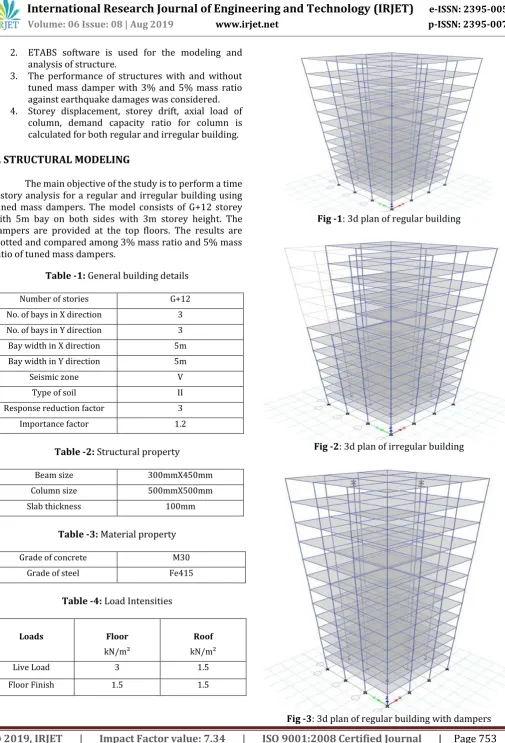
The main objective of the study is to perform a time history analysis for a regular and irregular building using tuned mass dampers. The model consists of G+12 storey with 5m bay on both sides with 3m storey height. The dampers are provided at the top floors. The results are plotted and compared among 3% mass ratio and 5% mass ratio of tuned mass dampers.
Table -1: General building details
Number of stories G+12
No. of bays in X direction 3
No. of bays in Y direction 3
Bay width in X direction 5m
Bay width in Y direction 5m
Seismic zone V
Type of soil II
Response reduction factor 3
Importance factor 1.2
Table -2: Structural property
Beam size 300mmX450mm
Column size 500mmX500mm
Slab thickness 100mm
Table -3: Material property
Grade of concrete M30
Grade of steel Fe415
Table -4: Load Intensities
Loads
Floor
kN/m²
Roof
kN/m²
Live Load 3 1.5
Floor Finish 1.5 1.5
Fig -1: 3d plan of regular building
Fig -2: 3d plan of irregular building
[image:2.595.44.550.47.791.2] [image:2.595.263.548.61.514.2]© 2019, IRJET | Impact Factor value: 7.34 | ISO 9001:2008 Certified Journal
| Page 754
Fig -4: 3d plan of irregular building with dampers3. RESULTS
From the results obtained the comparison was made for the storey displacement, storey drift, time period, column axial load and demand capacity ratio for both regular and irregular building for 3% mass ratio and 5% mass ratio of tuned mass dampers.
3.1 Storey Displacement
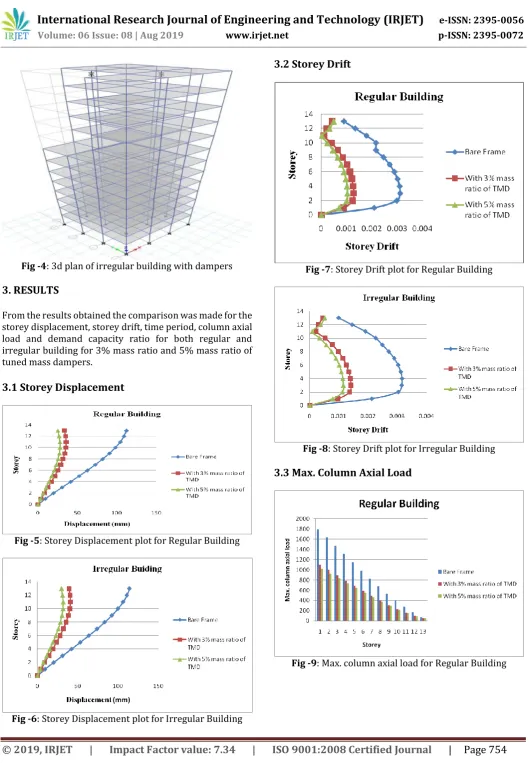
Fig -5: Storey Displacement plot for Regular Building
Fig -6: Storey Displacement plot for Irregular Building
3.2 Storey Drift
Fig -7: Storey Drift plot for Regular Building
Fig -8: Storey Drift plot for Irregular Building
3.3 Max. Column Axial Load
[image:3.595.34.564.36.800.2] [image:3.595.137.553.49.521.2] [image:3.595.41.277.89.291.2] [image:3.595.30.562.372.737.2]© 2019, IRJET | Impact Factor value: 7.34 | ISO 9001:2008 Certified Journal
| Page 755
Fig -10: Max. column axial load for Irregular Building [image:4.595.33.546.43.764.2]3.4 Time period
[image:4.595.35.553.47.267.2]Fig -11: Storey Drift plot for Regular Building
Fig -12: Storey Drift plot for Irregular Building
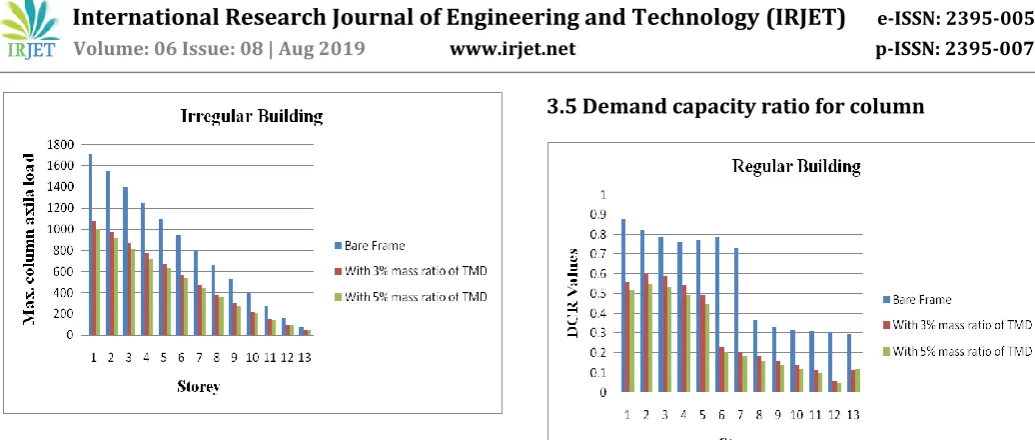
3.5 Demand capacity ratio for column
Fig -13: Demand capacity ratio of column for Regular Building
Fig -14: Demand capacity ratio of column for Irregular Building
4 CONCLUSIONS
1. From the results obtained wecan conclude thatas the storey increases the displacement also increases. The bare frame has more displacement when compared to the damped structures.
2. For Regular building, the average reduction in storey displacement for 3% and 5% mass ratio of tuned mass damper are 62.05% and 64.4% respectively and for irregular building, the average reduction are 57.9% and 66.2% respectively. 3. For Regular building, the average reduction in
[image:4.595.306.561.323.546.2]© 2019, IRJET | Impact Factor value: 7.34 | ISO 9001:2008 Certified Journal
| Page 756
irregular building, the average reduction are63.69% and 69.74% respectively.
4. For Regular building, the average reduction in column axial load for 3% and 5% mass ratio of tuned mass damper are 40.26% and 43.37% respectively and for irregular building, the average reduction are 40.71% and 43.75% respectively. 5. In regular building the time period is less for 5%
mass ratio of tuned mass damper and it is reduced by 4.59% for 5% mass ratio of tuned mass damper. 6. In irregular building the time period is reduced by
4.57% for 5% mass ratio of tuned mass dampers. 7. For both regular and irregular building the demand
capacity ratio is less than one.
REFERENCES
[1] Anushri C and Dr. Shivakumara Swamy B (2016), “Study on Performance of Regular and L-Shape Plan Irregular Building with Dampers, Shear wall and Infill wall”, International Research Journal of Engineering and Technology (IRJET), Volume 3, Issue 10, PP: 616-620.
[2] Balakrishna G S and Jini Jacob, “Seismic Analysis of
Building using Two Types of Passive Energy Dissipation Devices”, Journal of Mechanical and Civil Engineering (IOSR-JMCE), PP: 13-19.
[3] Chaitra H N and Shivakumara Swamy B (2016), “Study on Performance of Regular Building and Vertically Irregular Structure with Dampers, Shear wall and Infill wall”, International Research Journal of Engineering and Technology (IRJET), Volume 3, Issue 10, PP: 592-596.
[4] Ashish Badave, Vijaysinh Deshmukh, Sudhir Kulkarni, Sarang Kokane and Atul Aradhye (2014), “An Overview of Design, Behavior and Applications of Tuned Mass Vibration Absorber”, Journal of Basic and Applied Engineering Research (JBAER), Volume 1, Issue 3, PP: 14-18.
[5] Rupesh Kumar D, Gopal Naik M and Fahimeh
Hoseinzadeh (2015), “A Study on Effect of Water Tanks Modeled As Tuned Mass Dampers on Dynamic Properties of Structures”, American Society of Civil Engineers, PP: 91-110.
[6] Shevale Sandip S, Kadam S. S, Dr. Pise C P, Pawar Y P,
Deshmukh C M and Mohite D D (2017), “ Seismic Performance of Building Frame using Base Isolation and Tuned Mass Dampers”, International Journal of Engineering Science and Computing (IJESC), Volume 7, Issue 2, PP: 4316-4324.
[7] Khemraj S Deore, Dr. Rajashekhar S Talikoti and
Kanhaiya K Tolani (2017), “Analysis of High Rise Structure using Tune Mass Damper”, International Journal for Scientific Research & Development (IJSRD), Volume 5, Issue 5, PP: 1604-1609.
[8] Shamja P P and Krishnachandran V N (2018), “Vibration Control of High -Rise Reinforced Concrete Building Due To Seismic Excitations by Using Tuned Mass Damper”,
International Research Journal of Engineering and Technology (IRJET), Volume 5, Issue 4, PP: 4406-4409.
[9] Ashish A. Mohite and Patil G R (2015), “Earthquake
Analysis of Tall Building with Tuned Mass Damper, Journal of Mechanical and Civil Engineering (IOSR-JMCE), PP: 113-122.
[10]Mohan M. Murudi, Sharadchandra M. Mane (2004),
“Seismic Effectiveness of Tuned Mass Damper (TMD) For Different Ground Motion Parameters”, 13thWorld Conference on Earthquake Engineering, PP: 1-8.
[11]Haitham Mohamed Khalaf and Sandeep Kumar K (2016),
“Analysis and Design of Multi Storied Building for Vertical and Horizontal Loading with and without Dampers using SAP2000”, International Journal of Scientific Engineering and Technology Research (IJSETR), Volume 5, Issue 10, PP: 2079-2089.
[12]Alex Y Tuan and Shang G Q (2014), “Vibration Control in