© 2019, IRJET | Impact Factor value: 7.211 | ISO 9001:2008 Certified Journal
| Page 2012
Experimental Analysis of Partial Replacement of Natural Aggregates
with Recycled Concrete Aggregates
Karthik K B
1, Sathish H S
21
PG Scholar, Department of Civil Engineering, BMS College of Engineering, Bengaluru, Karnataka, India – 560019
2Associate Professor, Department of Civil Engineering, BMS College of Engineering, Bengaluru, Karnataka,
India – 560019
---***---Abstract -
The road network is a mixture of paved roads, unpaved roads and highways. More than 50% of Indian road is of paved roads. However, aggregates form the major portion in the road construction. Aggregates are used in granular sub base, Wet mix macadam, wet bound macadam, dense bound macadam, bituminous concrete layer, in cement concrete and in much other road construction. Aggregate is the natural resource which is of limited quantity and is being depleting as it is used widely in all the construction works. We have to search for the alternatives to get rid of this problem. Though large amount of waste is generating from during construction and demolition of various structures.Key Words:Wet Mixed Macadam, Recycle, Aggregation, Energy Conservation, Eco Friendly Mixes.
1. INTRODUCTION
)The road network of India is greater than 5 million kilometers. India ranks in 3rd position in the world in terms of road
network. The road network is a mixture of paved roads, unpaved roads and highways. More than 50% of Indian road is of paved roads. However, aggregates form the major portion in the road construction. Aggregates are used in granular sub base, Wet mix macadam, wet bound macadam, dense bound macadam [9][11], bituminous concrete layer, in cement concrete and in much other road construction. Aggregate is the natural resource which is of limited quantity and is being depleting as it is used widely in all the construction works. We have to search for the alternatives to get rid of this problem. Thus, large amount of waste is generating from during construction and demolition of various structures. These demolished structures are non-biodegradable and it’s been a quite challenge to dispose it. Also, disposal of this concrete demolished structure is hazardous to environment. With development of Science and technology these construction and demolished structures can be converted into recycled concrete aggregate. These recycled concrete aggregates can be effectively used as an alternative source for natural aggregates which will be not only economical but also economical.
In the present investigation Recycled Concrete Aggregates (RCA) has been produced from the Construction and demolished aggregates. These recycled aggregates are used as a partial replacement for coarse aggregates in bituminous mixes. Investigation has been carried out by replacing 12 mm down natural aggregates and 6 mm down natural aggregates with recycled concrete aggregates. Laboratory investigation has been done to evaluate Marshall Properties and performance study for Bituminous Concrete grade II layer. 7 trial mixes were prepared in which trial 1 is done for conventional mix and remaining trials are done for 10%, 20%, 30%, 40%, and 50% replacement of natural aggregate with recycled aggregate. Investigation Recycled Concrete Aggregates (RSA) [1] in Partial Replacement for Coarse Aggregates in Bituminous Mixes.
1.1 Advantages of Using Recycled Aggregate
Construction of pavement at low cost.
Conservation of energy.© 2019, IRJET | Impact Factor value: 7.211 | ISO 9001:2008 Certified Journal
| Page 2013
1.2 need for the Present Study
Environmental pollution can be reduced by the use of recycled aggregate in bituminous mix.
Dumping is the major problem due to the demolition of buildings which can be reduced by the use of these demolished aggregates.
Depletion of natural aggregates can be reduced with the use of recycled aggregates as a replacement of natural aggregates.
Material cost can be saved by the replacement of natural aggregates with recycled aggregates.1.3 Objectives of Present Study
To characterize the use of recycled concrete aggregates for the use in bituminous concrete layer.
To examine the effect of recycled concrete aggregate as partial replacement for natural aggregates in bituminous concrete (grade –II).
To examine the optimum percentage replacement of recycled aggregates with natural aggregates.
To examine the Indirect Tensile Strength and tensile strength ratios on Bituminous Concrete mix layer before and after replacement of recycled aggregates for Optimum binder content.
To inspect the Fatigue life with and without replacement of recycled aggregates for BC layer for the obtained OBC. To examine the Retained Marshall Stability of the BC mix before and after replacement of recycled aggregates for
Optimum Binder Content.
To justify the amount of cost for bituminous concrete layer with and without replacement recycled aggregates.
2. LITERATURE REVIEW
In most of the studies laboratory investigation of Recycled Concrete Aggregates which are obtained from the construction and demolished waste is investigated. Many studies are conducted for hot mix asphalt for the suitability to use in the base course. Evaluation is done by replacing RCA [1] of 0%, 5%, 10%, 20% and 30% with natural aggregates. 22 mm size was the maximum aggregate size of aggregate used in the test along with 4 % mineral filler was used. Good moisture sensitivity was obtained by using RCA and Construction and Demolished waste. RCA can be used to produce an HMA [2] mix with acceptable abrasion resistance. Deformation found to increase with increase in the percentage of RCA content. Maximum of 30% of RCA can be replaced adequately. Marshall Stability, Rutting properties Fatigue and Indirect tensile strength test given satisfactory results up to 30 % replacement of RCA [4].
Replacement for dacite [12][14] including replacement of coarse aggregate, fine aggregate and filler. Marshall Properties were evaluated by preparing two series of Marshall specimens [2][15][16]. One set of specimens contained various percentage of binder content to evaluate OBC [3][4]. Another series was prepared at OBC to determine the HMA properties. The results concluded that OBC increased with the increase in the percentage of RCA. Bituminous concrete mix using RCA as fine aggregate with dacite as coarse aggregate and filler was found to be the optimal mix. The addition of RCA in fines and filler aggregate increased the Marshall Stability, fatigue and resilient modulus [5][6]
.
It was advisable to use modified bitumen as binders as it seems to increase the bitumen mixtures performance values. Many tests such as Standard proctor compaction test, permeability test, CBR [7][8] test was conducted. The test results concluded that the basic properties were within the limits. By conducting tests on GSB mix and by comparison of the test results it was concluded that Recycled aggregates can be effectively replaced with natural aggregate up to 50%.
3.1 EXPERIMENTAL INVESTIGATIONS
© 2019, IRJET | Impact Factor value: 7.211 | ISO 9001:2008 Certified Journal
| Page 2014
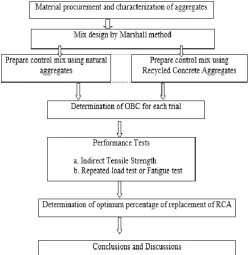
3.1 MethodologyAfter referring the literatures, research work is recognized. Flow chart of methodology on which current investigation is worked out is shown in the Flow chart Fig.1.
Fig - 1: Flow chart of the project
3.2 Test Conducted on Materials
3.2.1 Test on Virgin Aggregates
In pavement structure foremost part is formed by coarse aggregates and this is the key material which is used in the construction of pavement. Load stresses which occur on the pavement have to be taken by these aggregates. Hence the quality, strength of the aggregates is of major importance in the construction of pavement section. The virgin aggregates are procured from the Manjunatha Crushers near Bidadi, Bengaluru. The tests were conducted as per MORTH section 500 5th revision,
[image:3.595.173.424.163.419.2]confirming to the table 500-35 and results are shown in Table-1.
Table – 1: Test Results for Natural Aggregates
Property Test Test Result Specification Test Method
Cleanliness Grain size analysis 3.2 Max 5% passing on 0.075 mm
sieve IS:2386 Part I
Particle shape Combined Flakiness and
Elongation Indices 12% Max 35% IS:2386 Part I
Strength
Los Angeles Abrasion
Value 20.76% Max 30% IS:2386 Part IV
© 2019, IRJET | Impact Factor value: 7.211 | ISO 9001:2008 Certified Journal
| Page 2015
Water
Absorption Water Absorption 0.49% Max 2% IS:2386 Part III
Specific Gravity
20 mm down
12 mm down
6 mm down
Stone dust
2.63
2.65
2.67
2.73 2.5-2.8
IS:2386 Part III
Stripping Coating and Stripping of
Bitumen Aggregate mix 99% Minimum retained coating 95% IS : 6241
3.3.2 Test on Recycled Aggregates
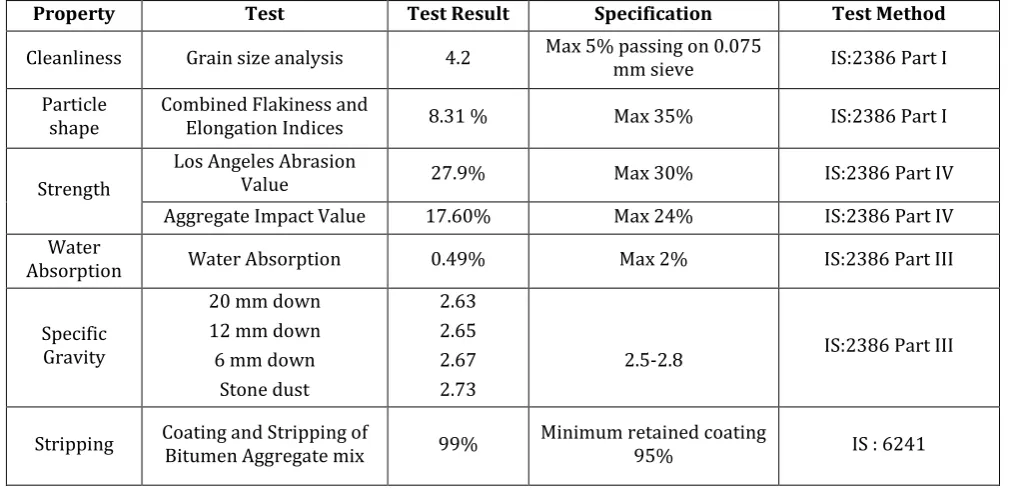
[image:4.595.40.562.47.241.2] [image:4.595.46.551.354.599.2]Construction and Demolished waste aggregates are procured from Rock Crystals, Uttanahalli, Vidyanagar near Yelahanka, Bengaluru. All the tests were conducted as per MORTH section 500, confining to the Table 500-35 and results are shown in Table 2.
Table – 2: Test Results fo Recycled Aggregates
Property Test Test Result Specification Test Method
Cleanliness Grain size analysis 4.2 Max 5% passing on 0.075 mm sieve IS:2386 Part I
Particle
shape Combined Flakiness and Elongation Indices 8.31 % Max 35% IS:2386 Part I
Strength
Los Angeles Abrasion
Value 27.9% Max 30% IS:2386 Part IV
Aggregate Impact Value 17.60% Max 24% IS:2386 Part IV
Water
Absorption Water Absorption 0.49% Max 2% IS:2386 Part III
Specific Gravity
20 mm down 12 mm down 6 mm down
Stone dust
2.63 2.65 2.67 2.73
2.5-2.8 IS:2386 Part III
Stripping Coating and Stripping of Bitumen Aggregate mix 99% Minimum retained coating 95% IS : 6241
3.3.3 Test on Binder
© 2019, IRJET | Impact Factor value: 7.211 | ISO 9001:2008 Certified Journal
| Page 2016
Table – 3: Test Result for Binder – VG 30Test Method Result Specification as per IRC ;SP :53,:2010
Penetration test (mm) at 25 ˚ C IS 1203-1978 68 60-70
Softening point ˚ C, minimum IS 1205-1978 51.2 ˚ 47 ˚ minimum
Specific Gravity IS 1202-1978 1.02 0.97-1.02
Flash Point ˚ C IS 1209-1978 270 220 minimum
3.3.4 Aggregate Gradation
The distribution of particle size is termed as aggregate gradation. Various properties of bituminous mix such as density and stability are dependent on aggregates and gradation of aggregates. Maximum density is obtained by the best gradation. Distribution of particle sizes is expressed as a percentage of total weight.
Aggregates satisfying the physical requirements for bituminous concrete are used for the aggregate gradation. Sieve analysis is done to carry out the aggregate gradation. Aggregate gradation can be done by Rothfuch’s method as well as trial and error method to obtain individual percentages of different aggregate sizes that can be used in the bituminous concrete mix confining to the upper and lower limits specified as per MORTH table 500:17.
About 4000 gm of aggregates were taken to conduct the sieve analysis. 20 mm down size.12 mm down size, 6 mm down size and dust of weight 2 kg, 1 kg, 500 g and 500 g are taken respectively to obtain the proper blend. The gradation was carried out for both conventional mixes and combined mix of virgin aggregates and recycled aggregates. The gradation for combined mix is carried out for various percentage replacements of recycled aggregates.
4. ANALYSIS AND DISCUSSION OF TEST RESULTS
4.1 Marshall Properties
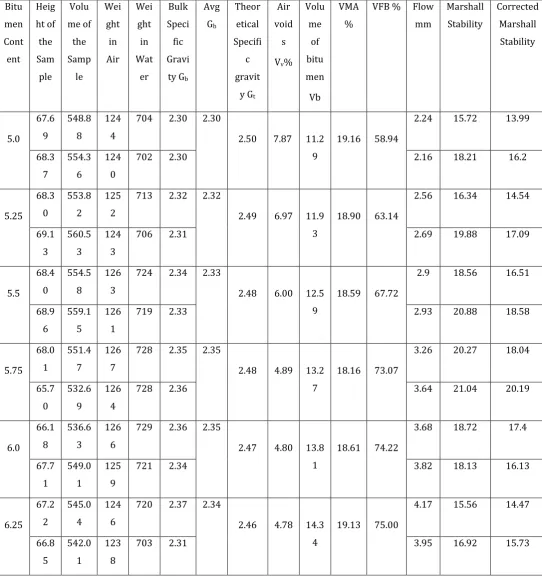
Initially the Marshall Test specimens are prepared and are tested as discussed in the section 3.2. Three number of specimens are prepared for each bitumen content. Marshall Parameters has been calculated for each specimen. Average value of 3 specimens is tabulated. Tests have been conducted on Marshall Specimen to determine optimum binder content for conventional BC mix and mix which has been replaced with recycled aggregates. Later, Marshall Properties are evaluated for both Conventional BC mix and BC mix that has been replaced with recycled aggregates. Thereafter, Water Sensitivity Test and Repeated load test are carried out based the results that are obtained from the previous tests. OBC for each mix is calculated considering average binder content corresponding to maximum stability, mid-range of flow value and maximum density.
4.1.1 Conventional BC Mix
© 2019, IRJET | Impact Factor value: 7.211 | ISO 9001:2008 Certified Journal
| Page 2017
Table – 4: Marshall Properties for conversion MixBitu men Cont ent Heig ht of the Sam ple Volu me of the Samp le Wei ght in Air Wei ght in Wat er Bulk Speci fic Gravi
ty Gb
Avg Gb Theor etical Specifi c gravit
y Gt
Air void s
Vv%
Volu me of bitu men Vb VMA %
VFB % Flow mm Marshall Stability Corrected Marshall Stability 5.0 67.6 9 548.8 8 124 4
704 2.30 2.30
2.50 7.87 11.2 9
19.16 58.94
2.24 15.72 13.99
68.3 7 554.3 6 124 0
702 2.30 2.16 18.21 16.2
5.25 68.3 0 553.8 2 125 2
713 2.32 2.32
2.49 6.97 11.9 3
18.90 63.14
2.56 16.34 14.54
69.1 3 560.5 3 124 3
706 2.31 2.69 19.88 17.09
5.5 68.4 0 554.5 8 126 3
724 2.34 2.33
2.48 6.00 12.5 9
18.59 67.72
2.9 18.56 16.51
68.9 6 559.1 5 126 1
719 2.33 2.93 20.88 18.58
5.75 68.0 1 551.4 7 126 7
728 2.35 2.35
2.48 4.89 13.2 7
18.16 73.07
3.26 20.27 18.04
65.7 0 532.6 9 126 4
728 2.36 3.64 21.04 20.19
6.0 66.1 8 536.6 3 126 6
729 2.36 2.35
2.47 4.80 13.8 1
18.61 74.22
3.68 18.72 17.4
67.7 1 549.0 1 125 9
721 2.34 3.82 18.13 16.13
6.25 67.2 2 545.0 4 124 6
720 2.37 2.34
2.46 4.78 14.3 4
19.13 75.00
4.17 15.56 14.47
66.8 5 542.0 1 123 8
© 2019, IRJET | Impact Factor value: 7.211 | ISO 9001:2008 Certified Journal
| Page 2018
Table - 5: Marshall Properties for BC mix with Recycled Aggregate Concrete replacementMix Design parameters Recycled Concrete Aggregate % MORTH
Requirements
0 10 20 30 40 50
Marshall Stability , KN 20.19 18.89 17.19 16.40 15.89 15.36 Min 9.0 KN
Marshall Flow ,mm 3.64 3.24 3.28 3.22 3.05 2.78 2-4
Bulk Specific gravity 2.35 2.34 2.34 2.31 2.29 2.28
% Air voids 4.89 4.9 4.95 4.98 5.09 5.19 3-5
Voids filled with bitumen, VFB in %
73.07 72.93 72.79 72.74 72.31 72.08 65-75
Binder Content % 5.67 5.73 5.83 5.93 5.96 6.06 Min 5.4
5. COST ANALYSIS
Cost analysis is the methodological approach to evaluate the strengths and flaw of alternatives to determine the option that provides the finest approach to obtain the benefits. In this chapter cost analysis for BC mix is evaluated for both conventional mix and mix with optimized percentage of recycled concrete aggregate. Cost of the materials required for 1 km road with 2 lane of 40 mm thickness BC layer is evaluated.
From the previous chapter Marshall Properties for 40% of recycled aggregate showed better results. Hence an attempt has been made to evaluate the cost of the materials required to for the construction of 1 km road with 2 lane of 40 mm thickness. Later the cost of conventional mix and optimized mix of recycled aggregate for BC mix is compared. Table shows the cost analysis of conventional mix and optimized mix of recycled aggregate.
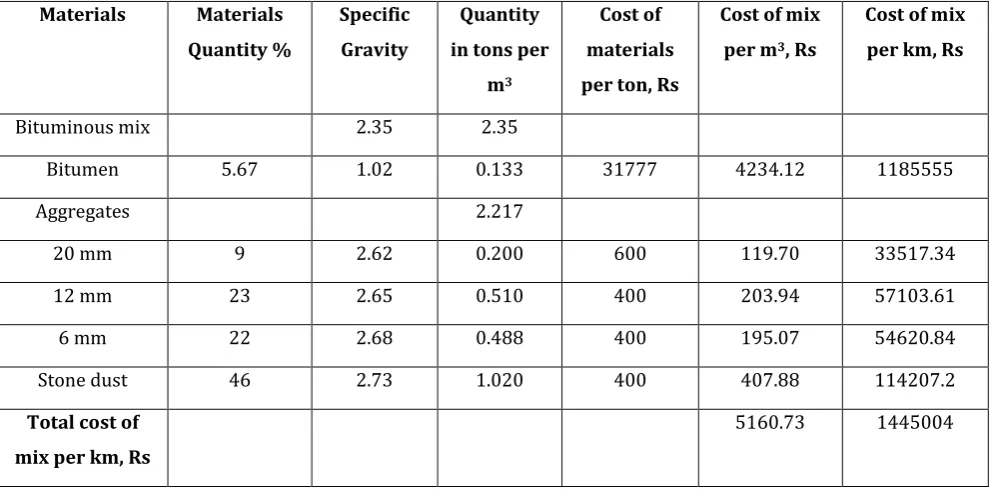
Table - 6: Cost Analysis of Conventional Mix
Materials Materials Quantity %
Specific Gravity
Quantity in tons per
m3
Cost of materials per ton, Rs
Cost of mix per m3, Rs
Cost of mix per km, Rs
Bituminous mix 2.35 2.35
Bitumen 5.67 1.02 0.133 31777 4234.12 1185555
Aggregates 2.217
20 mm 9 2.62 0.200 600 119.70 33517.34
12 mm 23 2.65 0.510 400 203.94 57103.61
6 mm 22 2.68 0.488 400 195.07 54620.84
Stone dust 46 2.73 1.020 400 407.88 114207.2
Total cost of mix per km, Rs
5160.73 1445004
Total cost of materials per m3 is Rs. 5160.73
[image:7.595.51.548.476.722.2]© 2019, IRJET | Impact Factor value: 7.211 | ISO 9001:2008 Certified Journal
| Page 2019
Table – 7:Cost analysis of Optimized 40% RCA mixMaterials Materials Quantity %
Specific Gravity
Quantity in tons per m3
Cost of materials per ton, Rs
Cost of mix per m3, Rs
Cost of mix per km, Rs
Bituminous mix
2.35 2.35
Bitumen 5.96 1.02 0.133 31777 4355.99 1219678
Aggregates 2.217
20 mm 9 2.62 0.195 600 116.79 32703.35
12 mm 23
a)Natural aggregates
60% 2.65 0.298 400 119.39 33430.09
b)Recycled aggregates
40% 4.4 0.199 220 43.77 12257.7
6 mm 22
a)Natural aggregates
60% 2.68 0.286 400 114.20 31976.01
b)Recycled aggregates
40% 2.45 0.190 220 41.87 11724.76
Stone dust 46 2.73 0.995 400 397.97 111433.6
Total cost of mix per km, Rs
5190.01 1453204
Total cost of materials per m3 is Rs. 5190.01
Total cost of materials for 1-km 2-lane road of 40 mm thickness is Rs.14,53,204.
6. CONCLUSIONS
Values of Marshall Parameters for Conventional and Optimized RCA Mix are found to be satisfying the MoRTH Requirements. The effective replacement of Recycled Concrete Aggregate with natural aggregates is found to be 40%.
The ratio of Indirect Tensile Strength of RCA Mix is found to be 83.37% which is more than the required 80%.
Retained Marshall Stability Test is found to be satisfied.
From Fatigue Test it is found that Conventional BC Mix showed higher resistance for cracking than RCA Mix.
Cost Analysis of both mixes indicated almost same cost for materials.
7. REFERENCES
1. A.R. Pasandín, I. Pérez“Laboratory evaluation of hot-mix asphalt containing construction and demolition waste”,
Construction and Building Materials 43 497–505, 2013.
© 2019, IRJET | Impact Factor value: 7.211 | ISO 9001:2008 Certified Journal
| Page 2020
3. Gurukanth, Donal Nixon D’souza, AvinashBabu S, Vivek A and Dr.Srikanth M Naik. “Effect of Use of RCA in BC Surface Course”. Proceeding of International Conference on Advances in Design and Construction of Structures, 2012. 4. M. Arabani , F. MoghadasNejad& A.R. Azarhoosh “Laboratory evaluation of recycled waste concrete into asphalt mixtures”,
International Journal of Pavement Engineering, 2013.
5. M. Cupo-Pagano, A. D'Andrea, C. Giavarini and C. Marro. “Use of Building Demolition Waste for Asphalt Mixes”. Proceedings of 3rd International Congress Caracus-Venezuela, 1994.
6. ParveenBerwal, Dr.PraveenAgarwal, Dr.RajeshGoel-NIT (Kurukshetra). “Use of Recycled Aggregates in Granular Sub Base”. IJIRSET (International Journal of Innovative Research in Science, Engineering and Technology), Vol.3, Issue 10, 2014.
7. V. Tulasi Shiva Kalyan, M.Heeralal, P. Rathish Kumar, Y.V.Rao. (2009). “A Study on the Utilization of Recycled Concrete Aggregates (RCA) in Bituminous Concrete”. IGC 2009, Guntur, India.
8. VereshPratap Singh, Vivek Mishra, N.N. Harry and Y.K. Bind. “Utilization of Recycled Highway Aggregate by replacing it with Natural Aggregate”. Journal of Academia and Industrial Research (JAIR), Volume 3, Issue 6 November 2014. 9. A.C.Freire, J.Neves, A.Roque, I. Martins, M.L.Antunes and G.Faria. “Use of Construction and Demolition Recycled Materials
(C & DRM) in Road Pavements validated on Experimental test Sections”. WASTES-Solutions, Treatments, Opportunities 2nd international conference-2013 Portugal.
10. FatihÖzalp , HalitDils_adYılmaz , Mustafa Kara , Ömer Kaya , AylinS_ahin “Effects of recycled aggregates from construction and demolition wastes on mechanical and permeability properties of paving stone, kerb and concrete pipes”, Construction and Building Materials 110 (2016) 17–23.
11. Jitender Sharma, SandeepSingla. “Study of Recycled Concrete Aggregates”. International Journal of Engineering Trends and Technology (IJETT) – Volume 13 Number 3 – Jul 2014.
12. IRC:111-2009, “Specifications for Dense graded bituminous mixes”, Indian Roads Congress, 2009, New Delhi, India. 13. IS 73:2013, “Paving Bitumen-Specification (Fourth Revision)”, Bureau of Indian Standards, 2013, New Delhi, India. 14. MoRT&H, “Specifications for Roads and Bridge works”, Indian Roads Congress, 5th
Revision, 2013, New Delhi, India.
15. S. Muneera, A. Rupa. “Use of Recycled Aggregate in Concrete”. International Journal of Science and Research (IJSR), Volume 5-Issue 8 August 2016.