RESEARCH ARTICLE
ESTIMATING THE RISK OF DAY SPECIFIC POSITIVE RETURN UNDER THE
INFLUENCE OF FUTURES CONTRACTS
Brijesh P. Singh and Dhananjay Sahu
Department of Statistics, Faculty of Commerce, Banaras Hindu University,
Varanasi-221 005, India
ARTICLE INFO ABSTRACT
The unpredictability of return experienced by any stock market is a pivotal factor to open out the issue which is
part of investors, regulators and policy makers in parlance. The effect of different day implies that the return is not independent. Investment opportunities can therefore turn out to be very complicated due to this abnormal beha
opportunity, specifically on the analysis of the effect of different day on the return of Indian Stock Market under the influence of futures contract. In order to capture the exclusive effect of futures contr introduction, the data on daily price of CNX
from June 1999 to June 2001.The findings indicate that abnormal behavior is present in the returns of the Indian Stock Market. Mean return is found maximum on Wednesday in compari
days. The difference in mean return within the trading days is statistically significant and the introduction of index futures trading does not influence the behavior of day specific positive return. The finding is fruitful particularl
decision regarding the timing of entry and exit from the financial market.
INTRODUCTION
Financial markets have been witnessing calendar anomalies for the last three decades and the ‘day of the week effect’ is significant one that attracted many researchers from different economies to explore the issue. The day of the week effect implies that stock return is not independent of the day of the week in which they are generated. The existence of abnormal behavior in return and volatility is well documented in financial literature
and it is critical on the part of investors to decide about the timing of entry and exit.
of daily data has led to additional research in the financial literature, specifically extending the analysis of seasonal behavior to include the day the week effect, the weekend effect and the bank holiday effects. The financial literature on this topic has offered several justifications for these anomalies: the absence of negotiations during the weekends; Monday availability of information regardin
ISSN:
0975-833X
International Journal of Current Research Vol. 33, Issue, 3, pp.071-07
Key words:
Day specific return, Calendar anomalies, Futures trading, Logistic regression.
Article History:
Received 19th January, 2011
Received in revised form 8th February, 2011
Accepted 27th February, 2011
Published online 13th March, 2011
*Corresponding author: [email protected]
ARTICLE
ESTIMATING THE RISK OF DAY SPECIFIC POSITIVE RETURN UNDER THE
INFLUENCE OF FUTURES CONTRACTS
Brijesh P. Singh and Dhananjay Sahu
of Statistics, Faculty of Commerce, Banaras Hindu University,
221 005, India
The unpredictability of return experienced by any stock market is a pivotal factor to open out the issue which is extremely sensitive on the part of investors, regulators and policy makers in parlance. The effect of different day implies that the return is not independent. Investment opportunities can therefore turn out to be very complicated due to this abnormal behavior. The present study focuses on this type of opportunity, specifically on the analysis of the effect of different day on the return of Indian Stock Market under the influence of futures contract. In order to capture the exclusive effect of futures contracts introduction, the data on daily price of CNX-Nifty Index has been taken from June 1999 to June 2001.The findings indicate that abnormal behavior is present in the returns of the Indian Stock Market. Mean return is found maximum on Wednesday in comparison to other trading days. The difference in mean return within the trading days is statistically significant and the introduction of index futures trading does not influence the behavior of day specific positive return. The finding is fruitful particularly to small investors in relation to their decision regarding the timing of entry and exit from the financial
and it is critical on the part of investors to decide about the timing of entry and exit. The growing use of daily data has led to additional research in the financial literature, specifically extending the analysis of seasonal behavior to include the day of the week effect, the weekend effect and the bank holiday effects. The financial literature on this topic has offered several justifications for these anomalies: the absence of negotiations during the weekends; Monday availability of information regarding responses to generated information ternational Journal of Current Research
076, March, 2011
INTERNATIONAL JOURNAL OF CURRENT RESEARCH
during non-listing days; market transaction payment procedures; effects derived from liquidity etc. This seasonality has been the subject of different studies that detected empirical evidence of abnormal yield distributions based upon the day of the week. The pioneering work was carried out using data from the U.S. market. The following authors, among others, made important contributions: Osborne (1962), Cross (1973), French (1980), Gibbons and Hess (1981), Lakonishok and Levi (1982), Keim and Stambaugh (1984) and Rogalski (1984). This effect has also been analyzed in security markets under an international setting in works by Jaffe and Westerfield (1985a), (1985b), Aggarwal and Rivoli (1989), Solnik and Bousquet (1990), Chang, Pinegar and Ravichandran (1993), Athanassakos and Robinson (1994), Dubois and Louvet (1996) and Kyimaz and Berument (2001). The objective of this paper is to empirically contrast the day of the week effect in Indian stock market from June 1999 to June 2001. French and Roll (1986) propose that the variances for the days following an exchange holiday should be larger than other days. Harvey and Huang (1991) observe higher volatility in the interest rates and foreign exchange futures markets during first trading hours on Thursdays and Fridays. It is important to know whether there are variations in volatility of stock returns by day of the week patterns and whether a high (low) return is associated with a corresponding high (low) return for a given day. Having such knowledge may allow investors to adjust their portfolios by taking into account day of the week variations in volatility. Finding certain patterns in volatility may be useful in several ways, including the use of predicted volatility patterns in hedging and speculative purposes and use of predicted volatility in valuation of certain assets specifically stock index options.
Osborne (1962) and Cross (1973) discovered empirical evidence demonstrating that Monday yields were lower than Friday ones for the S&P 500 Index. Similar results are presented in French (1980), upon comparing Monday, Friday and weekly average returns for the same index. He observed that Friday returns were greater than the average while Monday returns were lesser than the average. Gibbons and Hess (1981) also came to the
conclusion that Mondays resulted in negative returns. Their study was based on a sample of 30 stocks from the Dow Jones Industrial Index. Lakonishok and Levi (1982) have offered market transaction payment procedures as an explanation for the seasonal behavior in the daily yields. Keim and Stambaugh (1984) tried to explain the weekend effect in the American market as being related to the measurement errors in stock prices. These earlier studies of the day of the week effect were based on yield calculations at closing between two dates. Rogalski (1984) approached the problem by dividing yields into non-trading periods (from close to opening) and trading periods (from opening to close). He came to the conclusion that negative Monday returns were generated between the Friday closing and Monday opening, thus not taking into account the differences in average returns on specific days of the week when considering the trading period. These studies were first carried out in U.S. Stock Market and later in other international financial markets. This approach allowed Jaffe and Westerfield (1985a) to obtain evidence of the weekend effect for the markets in Canada, Australia, Japan and the United Kingdom. Negative Tuesday returns were also obtained for the Japanese market (see Jaffe and Westerfield (1985b)). Similar results are presented in Condoyanni, O’Hanlon and Ward, (1987) for the Singapore, Japan and Australia markets. The French and Italian markets are studied by Solnik and Bousquet (1990) and Barone (1990), respectively.
Theodossiou and Lee (1995) and Miralles and Miralles (2000). They observed daily seasonality in London, Paris, Madrid and Milan. Miralles and Miralles (2000) analyzed daily seasonality in the Lisbon Stock Exchange using the same model. Kyimaz and Berument (2001) studied daily seasonality in five international markets. Though substantial literature is available with regard to day of the week effect in the context of developed market, studies pertaining to developing markets are scanty. In particular, the said issue has been overlooked in the context of Indian capital market and that provided us impetus to undertake research on the day of the week effect. The finding is fruitful particularly to small investors in relation to their decision regarding the timing of entry and exit from the financial market.
MATERIALS AND METHODS
The time series of daily price from the S&P CNX Nifty Index of the Indian stock market have been used in this paper. It is worthwhile to mention here that futures contract on index was introduced in India on June 14, 2000 and to capture the exclusive effect of futures contract introduction, the data on daily price of CNX-Nifty Index has been taken from June 14, 1999 to June 12, 2001. The returns have been calculated as first differences in natural logarithms according to the following expression:
1
ln
t t t
p
p
r
where pt and pt-1 are the closing value of the index
for period t and t-1 respectively. These returns are assumed to be independent and the analysis of the day of the week effect was carried out by taking the observations on trading day in continuous manner to avoid possible bias from the loss of information due to holidays. A total of 502 observations were used for the analysis. One of the most common seasonality anomalies is the effect of the different days on the return. This analysis is based on the hypothesis that the return produced by each security is not independent of the different days of the week. An initial approximation that could contrast the different days of the week effect can be carried out with a regression model, similar
to Miralles and Miralles (2000). They included five dummy variables, one for each day of the week.
t
it
D
D
D
D
D
r
1 1
2 2
3 3
4 4
5 5
where
r
itis the daily returnj
D
’s are the dummy variable for the different days of the week (for Monday j=1, Tuesday j=2, Wednesday j=3, Thursday j=4 and Friday j=5)j
’s are the coefficients which represent the average return for the respective day of the weekt
is the error termIt is worth noting that even though the corresponding return on a specific day of the week is significantly different than zero, this does not imply seasonality. Thus it is necessary to perform a means test. This test verifies if the returns are independent of the day of the week that they are produced in, or on the contrary, they are characterized by statistically similar average returns. The rejection of the null hypothesis would imply that a day of the week effect is indeed present. Further, an attempt has been made in this study to analyse the data with another technique after hypothesizing day specific return that it is a dichotomous variable i.e. if return is positive, 1 is assigned and 0 is assigned for negative return. Then, logistic regression techniques have been applied to explore the effect of different trading day on the return. The logit of the probability of return can be modeled as follow:
The basic form of Logistic function is
variable. predictor the is where ; ) exp( 1
) exp( ) exp( 1
1
z z
z z P
Let us suppose that z instead of being a single predictor variable, is a linear combination of a set of predictor variables i.e.
n nx
b x
b x b x b b
z 0 1 1 2 2 3 3...
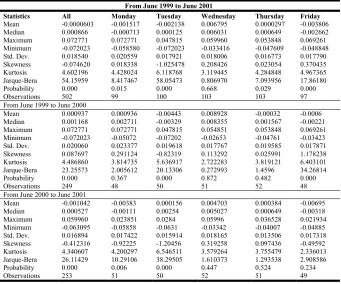
Table 1. Descriptive statistics of S&P CNX NIFTY daily return From June 1999 to June 2001
Statistics All Monday Tuesday Wednesday Thursday Friday Mean -0.0000603 -0.001517 -0.002138 0.006795 0.0000297 -0.003806 Median 0.000866 -0.000713 0.000125 0.006031 0.000649 -0.002662 Maximum 0.072771 0.072771 0.047815 0.059960 0.053848 0.069261 Minimum -0.072023 -0.058580 -0.072023 -0.033416 -0.047609 -0.048848 Std. Dev. 0.018540 0.020559 0.017921 0.018006 0.016773 0.017790 Skewness -0.074620 0.018338 -1.025478 0.208426 0.023054 0.370435 Kurtosis 4.602196 4.428024 6.118768 3.119445 4.284848 4.967365 Jarque-Bera 54.15959 8.417467 58.05473 0.806970 7.093956 17.86180 Probability 0.000 0.015 0.000 0.668 0.029 0.000
Observations 502 99 100 103 103 97
From June 1999 to June 2000
Mean 0.000937 0.000936 -0.00443 0.008928 -0.00032 -0.0006 Median 0.001168 0.002711 -0.00329 0.008355 0.001567 -0.00221 Maximum 0.072771 0.072771 0.047815 0.054851 0.053848 0.069261 Minimum -0.072023 -0.05072 -0.07202 -0.02653 -0.04761 -0.03423 Std. Dev. 0.020060 0.023377 0.019618 0.017767 0.019585 0.017871 Skewness 0.087697 0.291124 -0.82319 0.113292 0.025991 1.178238 Kurtosis 4.486860 3.814735 5.636917 2.722283 3.819121 6.403101 Jarque-Bera 23.25573 2.005612 20.13306 0.272993 1.4596 34.26814 Probability 0.000 0.367 0.000 0.872 0.482 0.000
Observations 249 48 50 51 52 48
From June 2000 to June 2001
Mean -0.001042 -0.00383 0.000156 0.004703 0.000384 -0.00695 Median 0.000527 -0.00111 0.00254 0.005027 0.000649 -0.00318 Maximum 0.059960 0.023851 0.0284 0.05996 0.036528 0.021934 Minimum -0.063095 -0.05858 -0.0631 -0.03342 -0.04007 -0.04885 Std. Dev. 0.016894 0.017422 0.015914 0.018165 0.013506 0.017318 Skewness -0.412316 -0.92225 -1.20456 0.319258 0.097436 -0.49592 Kurtosis 4.340607 4.200297 6.546511 3.579264 3.755479 2.336013 Jarque-Bera 26.11429 10.29106 38.29505 1.610373 1.293538 2.908586 Probability 0.000 0.006 0.000 0.447 0.524 0.234
[image:4.504.114.393.396.467.2]Observations 253 51 50 52 51 49
Table 2. Univariate logistic regression analysis to assess the risk of day specific positive return according to the different characteristics
Characteristics Odds Ratio Standard
Error
Z Value
95% Confidence interval
Futures Contracts 1.031 0.184 0.864 0.726 1.463
Monday 0.790 0.178 0.295 0.509 1.228
Tuesday 0.896 0.200 0.624 0.578 1.389
Wednesday 2.287 0.535 0.000 1.446 1.616
Thursday 1.012 0.223 0.957 0.656 1.561
Friday 0.610 0.139 0.030 0.390 0.954
Table 3. Multivariate logistic regression analysis to assess the risk of day specific positive return according to the different characteristics
Characteristics Model I
Odds Ratio Standard
Error
Z Value 95% Confidence
interval
Monday 0.426 0.124 0.003 0.241 0.755
Tuesday 0.471 0.137 0.010 0.267 0.634
Thursday 0.520 0.150 0.023 0.295 0.915
Friday 0.345 0.102 0.000 0.194 0.615
Futures Contracts - - - - -
-2Log likelihood 679.502
Characteristics Model II
Odds Ratio Standard
Error
Z Value 95% Confidence
interval
Monday 0.426 0.124 0.003 0.240 0.755
Tuesday 0.472 0.137 0.010 0.267 0.834
Thursday 0.520 0.150 0.024 0.295 0.916
Friday 0.345 0.102 0.000 0.194 0.615
Futures Contracts 1.034 0.188 0.856 0.724 1.475
-2Log likelihood 679.470
[image:4.504.115.392.497.650.2])] ... ( exp[ 1 1 3 3 2 2 1 1
0 bx b x bx bnxn
b P so that )] ... ... ... ( exp[ 1 )] ... ... ... ( exp[ 1 3 3 2 2 1 1 0 3 3 2 2 1 1 0 n n n n x b x b x b x b b x b x b x b x b b P Therefore )] ... ... ... ( exp[ 1
1 P b0 b1x1 b2x2 b3x3 bnxn
P odds ] ... ... ...
exp[b0b1x1b2x2b3x3 bnxn
) ... ... ... ( ) (
LnOdds b0b1x1b2x2b3x3 bnxn
. predictors are ... ... , , ,
Where b0 b1 b2 b3 bn
RESULT AND CONCLUSIONS
The study of the effect of the different days of the week in the returns for the S&P CNX Nifty Index that are included in our sample is carried out based on the estimates obtained from the daily returns of the stock market considered. The descriptive statistics of the return for the observed period under study have been presented in the Table 1, which reveals that the mean return is negative on all days except Wednesday and Thursday. But, the return on Wednesday is much higher than the return on Thursday during the period under study.
Further, four dummy variables have been used to account for daily effect in the stock market for each trading day except Wednesday. For this purpose, the univariate and multivariate logistic regression model is used. The meaning of odds ratio for each one of the dummy variables could reveal the presence of a return during a day of the week with respect to that of Wednesday. The obtained results are summarized in Table 2 & 3, which indicate that the day of the week effect is present in the Indian stock market since the return for each day of the week is especially different than that of other days. Further, the return on Wednesday has been found significantly positive in comparison to other days of trading. Table 2 shows that the return on Wednesday is 2.29 times more than other trading day. On Thursday the likelihood of positive return is 12 percent more than other trading day while Monday, Tuesday and Friday
have less chance to have positive return i.e. 21, 10 and 39 percent respectively less chance to have a positive return. The impact of futures contracts on positive return is not significant; the chance of positive return is only 3 percent in case of futures introduction. Table 3 reveals the impact of futures introduction on positive return after controlling all trading days by setting two different models. Model I shows that there is a less chance to get positive return on each trading day in comparison to Wednesday. The chance of having positive return on Monday, Tuesday, Thursday and Friday are 57, 53, 48 and 65 percent respectively significantly less in comparison of positive return on Wednesday. In the Model II, futures contract has been introduced and the odds ratios are found similar to the Model I. Model II disclose that there is no significant impact of futures contract on the positive return on each trading day but it is 3.4 percent more but statistically insignificant. The -2log likelihood for Model II is slightly less than the -2log likelihood for Model I which shows that the Model II is a better model than Model I. This fact tells us that the return for the Indian market is dependent on the different days of the week.
Portugal and the Czech Republic show no changes with regards to the day of the week. The highest return on Wednesday might be due to the fact that Wednesday comes in the middle of the week and naturally provides the highest number of trading days before and after any transaction. On Wednesday, investors have information sets of the last two days and they can develop better investment strategies for the next two days and have more time to inculcate the information.
Calendar anomalies in general and day of the week effect in specific have been well documented in the financial literature. The said issues have been explored extensively in developed market in the world. However, empirical studies are scanty in the context of developing market like that of Indian stock market. The present study in intended to explore the day of the week effect on the return and also analyses any change in the abnormal behavior of day specific return after the introduction of index future trading in India in June, 2000. our analysis focused on an empirical comparison of the day of the week effect in the Indian stock market. The findings indicate that abnormal behavior is present in the returns of the Indian Stock Market. Mean return is found maximum on Wednesday in comparison to other trading days. The difference in mean return within the trading days is statistically significant and the introduction of index futures trading does not influence the behavior of day specific positive return. The finding is fruitful particularly to small investors in relation to their decision regarding the timing of entry and exit from the financial market.
REFERENCES
Aggarwal R. and Rivoli, P. 1989. Seasonal and day of the week effect in four emerging stock markets. Financial
Review, 24: 541-550.
Athanassakos, G. and Robinson, M.J. 1994. The day of the week anomaly: The Toronto stock exchange experience.
Journal of Business Finance and Accounting, 21:
833-856.
Barone, E. 1990. The Italian stock market: Efficiency and calendar anomalies. Journal of Banking and Finance, 14: 483-510.
Chang, E., Pinegar, M. and Ravichandran, R. 1993. International evidence on the robustness of the
dayofthe-week effect. Journal of Financial and Quantitative
Analysis, 28: 497-513.
Condoyanni, I., O’Hanlon, J. and Ward, C. 1987. Day of the Week Effects on Stock Returns: International Evidence. Journal of Business Finance and Accounting,
14 (2): 159-174.
Corhay, A. and Rad, A.T. 1994. Daily returns from European stock markets. Journal of Business and Finance
and Accounting, 21: 271-281.
Cross, F. 1973. The behavior of stock prices on Fridays and Mondays. Financial Analyst Journal, pp. 67-69. Dubois, M. and Louvet, P. 1996. The Day of the Week
Effect: International Evidence. Journal of Banking and Finance, 20:1463-1484.
Engle, R. F. 1982. Autoregressive Conditional Heteroskedasticity with Estimates of the Variance of United Kingdom Inflation. Econometrica, 50: 987-1007. French, K. 1980. Stock returns and the weekend effect.
Journal of Financial Economics, 8: 55-69.
French, K. R., and Roll, R. 1986. Stock Return Variances: The Arrival of Information of the Reaction of Traders.
Journal of Financial Economics, 17: 5-26.
Gibbons, M. and Hess, P. 1981. Day of the week effects and asset returns. Journal of Business, 54: 579- 596. Harvey, C., and Huang, R. 1991. Volatility in Foreign
Exchange Futures Markets. Review of Financial Studies
4: 543-570.
Jaffe, J. and Westerfield, R. 1985a. The week-end effect in common stock returns: The international evidence.
Journal of Finance, 40: 433-454.
Jaffe, J. and Westerfield, R. 1985b. Patterns in Japanese common stock returns. Journal of Financial and
Quantitative Analysis, 20: 261-272.
Keim, D. B. and Stambaugh, F. 1984. A further investigation of weekend effects in stock returns. Journal
of Finance, 39: 819-840.
Kyimaz, H. and Berument, H. 2001. The day of the week effect on Stock Market Volatility”, Journal of Economics
and Finance, 25(2):181-193.
Lakonishok, J. and Levi, M. 1982. Weekend effect in stock return: A note. Journal of Finance, 37: 883- 889. Miralles, J.L. and Miralles, M.M. 2000. An Empirical
Analysis of the Weekday Effect on the Lisbon Stock Market over Trading and Non-Trading Periods. Portuguese Review of Financial Markets, 3(2): 5-14. Osborne, M. 1962. Periodic structure in the brownian
motion of stock prices. Operations Research, 10: 267-290.
Rogalski, R.J. 1984. New findings regarding day of the week returns over trading and nontrading periods: A note.
Journal of Finance,1603-1614.
Solnik, B. and Bousquet, L. 1990. Day of the week effect on the Paris Bourse. Journal of Banking and Finance, 14: 461-468.