ISSN Online: 2327-5960 ISSN Print: 2327-5952
The Causes and Effects of China’s Double
Surplus of Balance of Payments—Based on the
Study of FDI Inflow in 1993-2012
Botao Zhang
Jinan University, Guangzhou, China
Abstract
Double surplus in balance of payments is a surplus of both current account and capital and financial account during the same period. In recent years, substantial scholars have made a thorough study about this topic, but there still exists a big gap between theory and real economy. The existing literatures pay little attention to the current China’s surplus structure, especially from the perspective of FDI inflows. This paper examines the general situation of China’s double surplus in international balance of payments and analyzes its causes. Empirical research on the representative factors that influence the China’s balance of payments suggests foreign direct investment de facto contributes a large portion to the overall surplus in the balance of payments. It accordingly makes further research on the role of FDI presenting how FDI affects double surplus of China’s balance of payments and its influences on China’s econo-my. This paper is organized as follows: Chapter 1 is an introduction; Chapter 2 is general introduction of China’s balance of payments; Chapter 3 is the em-pirical analysis; Chapter 4 is the mechanism analysis of FDI; Chapter 5 is do-mestic influence of China’s international balance of payments surplus; Chap-ter 6 is about policy recommendations for China’s double surplus.
Keywords
Structure of Balance of Payments, Double Surplus, FDI
1. Introduction
The developing country usually has a trade deficit in current accounts and sur-plus in capital and financial accounts. But China holds double sursur-plus in both two types of international balance of payments, which are not beneficial to both internal and external economy. Since the development of reform and opening How to cite this paper: Zhang, B.T. (2017)
The Causes and Effects of China’s Double Surplus of Balance of Payments—Based on the Study of FDI Inflow in 1993-2012. Open Journal of Social Sciences, 5, 1-15. https://doi.org/10.4236/jss.2017.55001
Received: March 13, 2017 Accepted: May 6, 2017 Published: May 9, 2017
Copyright © 2017 by author and Scientific Research Publishing Inc. This work is licensed under the Creative Commons Attribution International License (CC BY 4.0).
up, FDI has shown great influence on China’s international balance of payments, mainly in current accounts trade and direct investment of capital accounts. Scholars from different countries have studied the influence FDI brought to de-veloping countries early on. Baran (1973) [1] first put forward that foreign money comes in for the sake of extracting surplus value of the home country. He believed the outflow of profit and investment revenue will aggravate the interna-tional balance of payments of the home country (usually developing countries) and make it more dependent on foreign trade. During the same period, Samuel-son and Hass (1979) [2] held that there are four stages for a country to realize equilibrium in balance of payments, namely new debtor country, mature debtor country, new creditor country, and finally mature creditor country with corres-ponding investment structure. At the end of 20th century, Dooley (1994) [3] found a higher ratio of FDI will suggest a higher fluctuation in financial crises. Then Reis (2001) [4] improved Baran’s idea from the perspective of economic welfare of the home country. He studied FDI in static and dynamic cases sepa-rately and showed both them can make “creative destruction”, which will lead to the profit gained from FDI flow from home country to the host one, namely from developed country to developing ones, thereby destroying the latter’s in-ternational balance of payments. Woodward (2003) further found the inflow of FDI and other forms of money is to gain profit in essence. As the profit gained from them flowing out, it is difficult for the home country to maintain equili-brium in the balance of international payments, and there may even lay the possible consequence of financial crises.
Later on China’s scholars began to research how FDI influences China’s in-ternational balance of payments at the beginning of 21st century. Yang (2003) [5] discussed the influencing factors of the balance of payments by designing an econometric model and predicted capital accounts may turn into deficit soon. Through applying L-S model, Liu (2005) [6] analyzed the relationship between FDI inflow and international balance of payments and found FDI inflow may bring greater pressure to the home country with the increase of profit remittance ratio and the decline of the reinvestment ratio. Yu (2006) [7] explored various types of FDI and their influence on China’s balance of payments. He showed a large portion of the double surplus is the result of the long term policy of at-tracting foreign investment.
posi-tive correlation between foreign money inflow and China’s double surplus. And he initially proposed the aim of adjusting the structure model of China’s balance of payments and the orientation of policy making.
In view of the existing literature, it seems that most well-disciplined and data- based studies only focus on general situation of developing countries, less atten-tion has not been paid to the situaatten-tion in China. Moreover, the data utilizing by scholars like Zou, X. has not been updated for a decade, during which radical changes have taken place in China. Therefore, this paper is to make full use of the international balance sheet of the late two decades and try to explain the reason, changes and solution for the double surplus in China.
2. General Introduction of China’s Balance of Payments
Double surplus in international balance of payments refers to the continuous and large scale surplus of current accounts capital and financial accounts in the balance sheet. Theoretically, above two types of accounts are complementary and they are not in surplus during the same period. But China is an exception. For current accounts, surplus usually appears at the result of more export than import; for capital and financial accounts, it is caused by more FDI inflow than domestic capital outflow. As discussed above, current accounts are complemen-tary to capital & financial accounts due to the digestion of domestic wealth within domestic market, which is an important factor for the export of com-modity and capital. If the country’s digestive capacity is insufficient, capital will seek a large consumer demand market and form trade and capital expansion, that is, the surplus of current account and the deficit of capital and financial ac-count, like the situation in Japan. If the country’s digestive capacity is higher that productivity, foreign trade and capital will join in, accordingly producing the deficit of current account and the surplus of capital and financial account, like in United States. China has realized the paradoxical double surplus for most of the past twenty years, which attributes to both internal factors (government inter-vention, people’s savings habits, etc.) and external factors (large influx of capi-tal). However, the latter have great uncertainty. The withdrawal of FDI may bring a heavy blow to China’s international balance of payments at any time. Hence, it’s worth studying the causes of China’s international balance of pay-ments mainly considering external factors.bal-ance of payments.
3. The Empirical Analysis
The double surplus situation of China’s international balance of payments has produced many negative effects on China’s economy, and in the context of glob-al economic imbglob-alances, these negative effects glob-also on the rise. So it’s meaning to analyze the causes of the double surplus and take measures to reduce the nega-tive influences. In recent years, FDI has continuously flowed into China as the main source of capital surplus, how does FDI affects double surplus? The fol-lowing will verify their correlation by the empirical framework.
3.1. Research Methods and Analysis
In this paper, I use the method of unit root test, cointegration test and Granger causality test together, to divide the factors that affect the gross spread (DS) of balance of payments into domestic economic policy factors and foreign invest-ment factors. Domestic economic policy factors include domestic Gross Domes-tic Product (GDP) and China’s Tariff (TAX), whereas foreign direct investment (FDI) denotes foreign investment factors. In this paper, the samples are annual data which range from 1993 to 2012. Most of the data comes from the China Na-tional Bureau of Statistics, State Administration of Foreign Exchange and the Chinese Ministry of Finance’s official website. Considering the trend of time se-ries data, natural logarithm of these data is taken to eliminate the heteroscedas-ticity and linearize the trend, which does not change the cointegration relation-ship between variables. The variables DS, GDP, FDI, TAX were taken as natural logarithm, marked as LnDS, LnGDP, LnFDI, LnTAX respectively. EViews7.2 and Stata 13.1 are applied to finish the following statistical analysis.
3.2. Correlation Analysis
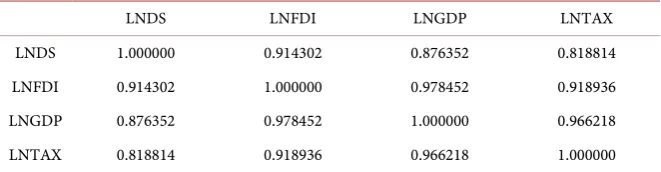
As shown in Table 1, both correlation coefficients of LnDS and LnFDI, LnGDP and LnTAX are all exceed 0.8, and the positive correlation is significant, verify-ing the strong correlation between the variables. From statistical point of view, it seems necessary to establish multiple linear regression models. Thus, time series analysis of the following variables is done at first.
3.3. Time Series Analysis
3.3.1. Unit Root TestTable 1. Correlation coefficient between variables.
LNDS LNFDI LNGDP LNTAX
LNDS 1.000000 0.914302 0.876352 0.818814
LNFDI 0.914302 1.000000 0.978452 0.918936
LNGDP 0.876352 0.978452 1.000000 0.966218
[image:5.595.208.539.208.367.2]LNTAX 0.818814 0.918936 0.966218 1.000000
Table 2. Result of unit root test.
variant Test Type (c, t, p) ADF statistic 1% critical value 5% critical value 10% critical value Result
LnDS (c, t, 4) −2.29 −3.83 −3.03 −2.66 Non-stationary LnFDI (c, t, 4) −1.118 −3.83 −3.03 −2.66 Non-stationary LnGDP (c, t, 4) 1.05 −3.96 −3.08 −2.68 Non-stationary LnTAX (c, t, 4) −0.22 −3.83 −3.03 −2.66 Non-stationary D LnDS (c, 0, 4) −4.32* −3.86 −3.04 −2.66 Stationary D LnFDI (c, 0, 4) −5.24* −3.86 −3.04 −2.66 Stationary D LnGDP (c, 0, 4) −2.76*** −4.00 −3.01 −2.69 Stationary D LnTAX (c, 0, 4) −3.49** −3.92 −3.07 −2.67 Stationary
Note: (c, t, p) represent the intercept term, time trend term and lag intervals in the unit root test model, re-spectively. The superscript *, **, *** represent the significance level of 1%, 5% and 10%, rere-spectively. In addi-tion, optimal lag intervals are selected by EViews7.2 according to minimum AIC principle.
LnGDP, LnTAX are first-order integrated sequences, namely I (1), which meets the premise of co-integration test and the variables can be checked by co-inte- gration test.
3.3.2. Cointegration Test
This paper uses the Max-Eigen method in JJ test to examine LnDS, LnFDI, LnGDP and LnTAX. The variables have a certain trend, so the cointegration eq-uation should include the intercept term. In Table 3, Johanson covariance test results show that LnDS, LnFDI, LnGDP and LnTAX have a cointegration rela-tionship at the 5% level. That is to say, total foreign direct investment (FDI), gross domestic product (GDP) and tariff level (TAX), all reflect a long-term sta-ble relationship with dousta-ble surplus of the balance of payments (DS).
3.3.3. Granger Causality Test
The Cointegration Test shows a long-term stable relationship among the total double surplus of the balance of payments (DS) with foreign direct investment (FDI), gross domestic product (GDP) and tariff level (TAX). Then it should be conducted to know the causality relation. Making Granger causality text on LnDS, LnFDI, LnGDP, LnTAX, and obtaining the results as follows:
Table 3. Cointegration Test Results of DS, FDI, GDP and TAX.
Hypothesized
Eigenvalue Trace 0.05 Prob.**
No. of CE(s) Statistic Critical Value
None * 0.9225 83.3306 63.8761 0.0005
At most 1 0.6185 37.3048 42.9152 0.1626
At most 2 0.4722 19.9577 25.8721 0.2281
At most 3 0.3748 8.4553 12.5180 0.2167
Note: * denotes the hypothesis is rejected at 5% significance level.
Table 4. Granger Causality Test Results of DS, FDI, GDP and TAX.
Original Hypothesis Lag Intervals for Endogenous F statistic Probability Whether Reject the Original Hypothesis
LnFDI is not the Granger
causality of LnDS 2 4.116 0.041 reject
LnFDI is not the Granger
causality of LnDS 2 1.977 0.178 accept
LnFDI is not the Granger
causality of LnDS 2 7.417 0.007 reject
LnFDI is not the Granger
causality of LnDS 2 8.928 0.004 reject
LnFDI is not the Granger
causality of LnDS 2 4.381 0.035 reject
LnFDI is not the Granger
causality of LnDS 2 0.299 0.747 accept
of balance of payments. Thus, a multiple linear regression model can be estab-lished to study its long-term equilibrium relationship. The results are obtained by Stata 13.1.
LnDS= −0.88 2.31LnFDI 0.98LnGDP 0.22LnTAX+ − +
[image:6.595.207.540.238.423.2]influences on double surplus.
4. The Mechanism Analysis of FDI
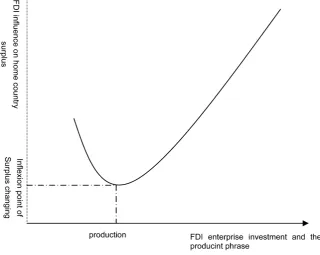
machinery equipment and spare parts that go against the host country’s trade surplus. By the time the invested enterprises get into the production period, the products produced will replace the import and lead to a sharp increase in sur-plus induced by FDI, thus forming a “J-curve” shown in Figure 1, market- oriented FDI will eventually reduce the import and increase trade surplus. Whether the direct effect of foreign direct investment can benefit continuously the surplus on the balance of payments relies on the comparison of net export and profit remittance. If the former exceeds the latter, the foreign investment will have a positive effect on China’s international balance of payments which is the situation in China at present. In reverse, if the net export is less than the profit remittance, it will generate deficit on China’s international balance of payments and this effect may gradually enlarge in the future. In general, the ex-port-oriented foreign enterprises tend to export and have a large effect on the surplus of balance of payments; whereas market-oriented foreign enterprises tend to make domestic sales and can replace the host country’s import behavior, which will also indirectly enlarge surplus of balance of payment in the long term. The indirect effect of foreign direct investment is mainly reflected in the third type of FDI. Chinese enterprises generally invest abroad to learn advanced tech-nology, but few foreign investors invest in China for the same sake. So the indi-rect effect of FDI in China is lacking. But in the long run, China will attract this type of FDI to indirectly affect Chinese enterprises, which is mainly reflected in the following aspects. First, the inflow of foreign direct investment brings Chi-na’s enterprises into the international division system, promoting them to par-ticipate in the production, sales and competition in international markets.
Second, the technology spillover effect and the flow of labor force of foreign- funded enterprises can bring advanced technical and management experience to local enterprises, making local enterprises export technology-intensive products. Thirdly, foreign direct investments enhance the competition intensity in domes-tic market, forcing the domesdomes-tic enterprises adopt advanced technology and management experience in order to expand exports and increase the surplus.
In sum, the host country’s trade surplus to a great extent attributes to foreign direct investment. Specifically, foreign direct investment invested in the primary industry mostly belong to export-oriented enterprise, its direct effect is obvious; investment in the secondary industry is a little complex, but the indirect effect that can promote export development of local enterprises is relatively obvious; because the service products cannot be exported, foreign investment in the ter-tiary industry is difficult to get direct profit. Though its direct effect is quite li-mited, the demonstration effect, as a certain indirect effect, can improve the ex-port of local enterprise.
4.2. The Impact of FDI Inflows on the Surplus of Capital and
Financial Items
The impact of FDI on China’s capital and financial surplus is straightforward and it can be found by calculating the contribution rate of FDI, which is the ratio of net inflow of foreign direct investment and surplus of capital and finance ac-counts. Based on the data from China Statistical Yearbook, the contribution rate of FDI to China’s capital account surplus from 1993 to 2012 is presented in Fig-ure 2.
[image:9.595.212.538.581.704.2]It can be seen from Figure 2, except the data of China’s capital and financial deficit in 1998, the contribution rates of FDI to China’s capital and financial sur-plus are all positive in remaining 19 years, twelve of which are more than 100 % and two of which even above 1000%. On average, the contribution rate of FDI to China’s capital and financial surplus during 1993-2010 is 130.97%. Take capital and financial accounts separately, the former account refers the capital transfer and the sale of non-productive assets. China’s capital account has not yet fully liberalized, so the sum of foreign-related is small; the latter, namely financial ac-counts include direct investment, securities investment and other investments.
Figure 2. Contribution Rate of FDI to China’s Capital and Financial Surplus from
China’s securities investment and other investment have no obvious regularity, positive and negative appears alternately, and the amount is small. Only the di-rect investment account maintains a long-term surplus. For nearly two decades, foreign investment in China is far greater than China’s foreign direct invest-ment. It can be said that China’s capital and financial surplus is mainly derived from FDI, this fact is determined simultaneously by China’s national conditions, the economic policy of opening to the outside world and the changing trend of world economic pattern.
5. Domestic Influence of China’s International Balance of
Payments Surplus
Representative view of domestic scholars think the “double surplus” structure is of great significance in strengthening China’s overall strength and resisting the shock of external adverse factors. Sustained double surplus of international bal-ance of payments can increase China’s foreign exchange reserves, with which China’s overall strength can be enhanced, so that China has enough foreign ex-change to meet international trade requirements, resist foreign debt risk and se-cure a favorable position within the pattern of economic globalization. When fi-nancing in the international market, big foreign exchange reserve can help to obtain various kinds of loans at lower costs, it is conductive to dealing with in-ternational financial risks and improving national economic security, which also explains why the double surplus of China’s balance of payments continues for so many years. But above surplus is not sustainable in the long run, and the cost of accumulating international reserves is really high, which is unfavorable for the healthy development of China’s long-term economy. Among China’s four major economic control objectives, namely promoting economic growth, increasing employment, stabilizing prices and maintaining balance of payments, the last one has become the most prominent issue of macroeconomic regulation and control. In general, the continued double surplus in China arouses a series of problems. It brings excessive domestic liquidity, and then pushes up asset prices, so the central bank has to delivery of a large number of base money. As pointed out by the party’s 18th CPC National Congress, the country is aimed at accele-rating the transformation of foreign economic development, comprehensively improving the level of open economy, and further improving the international balance of payments. As a result of external economic imbalances, the current and future adverse effects of the long-term double surplus of China’s economy are mainly reflected in the following aspects.
5.1. Double Surplus Induces China
’
s Inflation, Weakens the
Independence of Monetary Control of the Central Bank
(The People
’
s Bank of China)
for-eign exchange settlement and sales in China, forfor-eign exchange is only to be bought from the central bank. Therefore, in order to maintain the stability of the exchange rate, the central bank passively put a lot of base money in the market. We use Stata 13.1 to figure out the correlation between foreign exchange stock and base currency stock in terms of the date in last decade from the central bank, it shows that the correlation coefficient between them is as high as 0.98. Such a high relation suggests base money related to foreign exchange has become the main channel for central bank’s base currency. The increase in the base money will lead to multiple expansion of money supply. So in order to effectively con-trol the money supply and ease the pressure on the large amount of money gen-erated by the base currency, the central bank must take hedging operations, withdrawing money from commercial banks to rush off too much liquidity. But in doing so, the government will caught in a dilemma of maintaining exchange rate stability and reducing inflation.
In addition, the huge amount double surplus of balance of payments, by way of settlement of exchange, converses into RMB capital, and then goes into com-mercial banks. Funds outstanding for foreign exchange as base currency launch in market will cause multiple money supply expansions and the rapid improve-ment of market liquidity via money multiplier mechanism. As the scale of depo-sits and loans of commercial banks gradually widening, money market liquidity and other issues began to appear. In the case of capital adequacy, commercial banks may generate credit impulses, and the focus on the use efficiency of funds may be far less concerned compared with the size of the loan. When banks do not pay attention to the use efficiency of capital but grant a large number of loans, it ultimately may lead to the increase in bad or dead debts and the decline in operating capacity for the bank.
In recent years, with the rapid expansion of the foreign exchange reserves owing to the increasing expansion of the double surplus, the gap between foreign exchange increment and monetary base increment is getting bigger and bigger, which make it harder, more complex and costly for the central bank’s hedging operations. Such being the situation, foreign exchange increase by a large margin caused by double surplus poses great challenge to the central bank in aspect of effectiveness and independence of its monetary policy. If China’s balance of payments double surplus continues to maintain and expand, monetary policy will weigh more on hedging off too much liquidity.
5.2. Double Surplus Increases the Appreciation Pressure of CNY
and Intensifies Foreign Trade Friction
or elevate the currency interest rate, which will bring great pressure on the ap-preciation of CNY, and China will also fall into the dilemma of apap-preciation pressure and money supply increase. Since 2003, the international community, especially the United States, Japan and other developed countries, repeatedly claim CNY should appreciate.
The imbalance of international balance of payments is not to last for a long time. In China, continued surplus of balance of payments brings pressure from both internal and external aspects. With the big surplus of China’s international balance of payments and the deficit between some major trading partners, trade frictions are intensifying among them. The long-term surplus of China’s inter-national balance of payments has become the target of trade protectionism’s at-tacks. To the best of my knowledge, China has become the country with the most trade frictions for 17 consecutive years. The double surplus leaves a great negative impact on China’s foreign trade.
5.3. Crowding-out Effect Causes by Double Surplus Limits the
Development of China’s Domestic Economy
For a long time, China adheres to export-oriented trade policy and makes fa-vorable policies to attract foreign investment. Even if faced with limited re-sources, the government always gives export-oriented enterprises many prefe-rential policies than inward-oriented enterprises. So after the allocation of re-sources, inward-oriented enterprises are left with limited chance and room for development, which in turn affects the expansion of China’s domestic demand. By analyzing foreign investment data in past decade, the total investment of China will increase by only 0.75 units for every additional unit of FDI, which al-so indicates FDI has a crowding-out effect on China’s domestic investment. FDI has squeezed out nearly 25% of China’s domestic investment. If the circums-tance continues, it may lead to the structural imbalance of the economic growth in China for a long time, which is not conducive to realize economy shift to-wards domestic demand led pattern.
5.4. High Foreign Exchange Reserves Brought by Double
Surplus is Shrinking and Welfare Losses is Increasing
car-ried out four rounds of quantitative easing policy. So for the US Treasury bonds China bought with huge foreign exchange reserves, the opportunity cost is sur-plus multiplied by the domestic investment profit margins and the return of current account surplus is the surplus multiplied by the US Treasury yield. After the fourth round of quantitative easing (QE4), the US Treasury market interest rate has dropped to a very low level, making profit yielded much lower than do-mestic investment profit margins in China. Consequently, as surplus continues currently in China, it suggests a substantial reduction in national welfare.
6. Policy Recommendations for China’s Double Surplus
Conclusion can be drawn from the above study that China’s double surplus mainly attributes to huge absorption of FDI, and it is structural and hard to be altered in the short run. According to conventional wisdom of international balance of payments, there are two crucial policies including expenditure- changing policy and expenditure-switching policy. The former is to adjust the trade balance by acting on the total expenditure or aggregate demand, thereby affecting the demand for import and export. Expenditure-changing policy mainly includes monetary policy and fiscal policy, that is, through implementing tight monetary policy (raising interest rates or reducing the money supply) to-gether with tight fiscal policy (raising the tax rate or reducing government spending) to lower total social demand, which in turn reducing the import de-mand, price levels and export costs, eventually increasing exports to realize trade balance. Whereas expenditure-switching policy is to adjust the direction of ex-penditure depending on economic policies such as trade policy, exchange rate policy and capital control policy, which avail to improve the current account balance or trade balance. Exchange rate policy mostly used for many developed countries can achieve the improvement of trade balance by way of currency ap-preciation or deap-preciation, while for the trade policy, it mainly rests on tariffs, non-tariff barriers, dumping, etc. In the event of a serious deficit of balance of payments, only the implementation of trade control and capital control policies can be pursued to directly influence the balance of payments in general.Obviously, traditional balance of payments policies deal primarily with dise-quilibrium of balance of payments, especially when the deficit happens, and the mainstream theory focus on how to correct or reduce the extent of the deficit when a trade deficit exists in current account or trade in goods account. This is not consistent with China’s double surplus structure in balance of payments, and with the forecast discussed before, this kind of phenomenon is calling for more targeted measures and policies.
but with the gradual progress of the investment cycle, foreign investors will fi-nally request to export investment profits from China, and the recovery of in-vestment costs, inin-vestment income will sooner or later be remitted. Thus, on the one hand, China needs to maintain the scale of FDI and gradually reduce de-pendence on it; on the other hand, it should change the structure of FDI by in-troducing more technology-oriented FDI, and gradually cutting down market- oriented and export-oriented FDI. At the same time, China should step by step increase its total amount of foreign investment and retake the profits of foreign investment. The report of the 18th National Congress of the Communist Party of China (CPC) pointed out that China should accelerate the transformation of foreign economic development mode, comprehensively improve the level of open economy and further improve the balance of payments by means of weighing on import and export simultaneously, combining policies of “bringing in” and “going out” (introduce foreign capital and encourage Chinese compa-nies to invest overseas), pushing forward the marketization reform of RMB ex-change rate, and strengthening cross-border capital flow regulation preventing international financial risks. The main content of China’s balance of payments policy for the next stage is the formulation and implementation of foreign in-vestment strategies and policies. China is to open two-way securities inin-vestment orderly and progressively, adjust the absorption and use policy of foreign direct investment, keep foreign reserves stable or growing at a low rate, continue to maintain the current account surplus, appropriately releasing domestic funds to invest overseas for the formation of capital and financial projects surplus.
References
[1] Baran, P.A. (1973) The Political Economy of Growth. Modern Reader Paperbacks, New York, 105-113.
[2] Samuelson, P. and Hass, N. (1982) The Economics. 10th Edition, The Commercial Press, Shanghai, 35-36.
[3] Dooley, M.P., Fernandez-Arias, E. and Kletzer, K.M. (1994) Recent Private Capital Inflows to Developing Countries: Is the Debt Crisis History? World Bank Economic Review, 10, 27-50. https://doi.org/10.1093/wber/10.1.27
[4] Reis, A.B. (2001) On the Welfare Effects of Foreign Investment. Journal of Interna-tional Economics, 54, 411-427. https://doi.org/10.1016/S0022-1996(00)00100-8
[5] Yang, L.Y. (2003) Research on the Structure of the Balance of Payments: Theoretical Model, International Comparison and Analysis of China’s Reality. China Financial Publishing House, Beijing.
[6] Liu, Z.L. (2005) FDI and China’s Balance of Payments Research: Negative Effects and Prospects.Contemporary Finance and Economics, 5, 98-102.
[7] Yu, Y.D. and Tan, D.H. (2006) China’s Double Surplus: Nature, Roots and Solu-tions. World Economy, 3, 31-41.
[8] Liu, H.Z. (2001) China’s FDI: Empirical Research and Worldwide Comparison. Fu-dan University Press, Shanghai, 89-94.
[9] Xin, Z. (2006) China’s Balance of Payments Structure: An Analysis Based on For-eign Capital Inflow. China Financial Publishing House, Beijing.
Submit or recommend next manuscript to SCIRP and we will provide best service for you:
Accepting pre-submission inquiries through Email, Facebook, LinkedIn, Twitter, etc. A wide selection of journals (inclusive of 9 subjects, more than 200 journals)
Providing 24-hour high-quality service User-friendly online submission system Fair and swift peer-review system
Efficient typesetting and proofreading procedure
Display of the result of downloads and visits, as well as the number of cited articles Maximum dissemination of your research work
Submit your manuscript at: http://papersubmission.scirp.org/