ISSN Online: 2164-5752 ISSN Print: 2164-5736
DOI: 10.4236/ojopm.2017.73003 Jul. 28, 2017 29 Open Journal of Organic Polymer Materials
Influences of Polyol on the Chemical, Thermal,
and Mechanical Properties of Polyurethane
Elastomers Crosslinked by β-Cyclodextrin
Yingjie Chen
1, An Xie
1, Ming Zhang
2, Shin-Ichi Inoue
11Department of Applied Chemistry, Aichi Institute of Technology, Toyota, Japan 2School of Chemistry and Chemical Engineering, Yangzhou University, Jiangsu, China
Abstract
A series of polyurethane elastomers (PUEs) were synthesized from an aro-matic diisocyanate (4, 4’-diphenylmethane diisocyanate); a polyether polyol (polytetramethylene glycol, molecular weight: 1000), polyester polyol (poly- caprolactonediol, molecular weight: 1000, or polycarbonate diol, molecular weight: 1000); and β-cyclodextrin (β-CD) as a cross-linker. The effect of the polyol on the morphologies and chemical, thermal, and mechanical properties of the resultant β-CD-based PUEs were investigated in this study. The ob-tained films were characterized via solubility and swelling tests (chemical properties), differential scanning calorimetry (crystallinity degree), dynamic mechanical analysis (thermal stability), thermogravimetric analysis (thermal stability), tensile testing (mechanical properties), nuclear magnetic resonance spectroscopy, infrared spectroscopy, atomic force microscopy (morphology), contact angle determination (morphology), and scanning electron microscopy (morphology).
Keywords
Polyurethane Elastomer (PUE), β-Cyclodextrin (β-CD), Polyol (PTMG, PCL, PCD), Morphology, Chemical and Physical Properties
1. Introduction
Polyurethanes (PUs) are versatile engineering materials used in a wide range of applications because their properties can be readily tailored according to the type and composition of their components [1] [2][3]. PUs are used commer-cially in seven major product types [4]-[9]: 1) flexible slabs; 2) flexible molded
How to cite this paper: Chen, Y.J., Xie, A., Zhang, M. and Inoue, S.-I. (2017) Influ-ences of Polyol on the Chemical, Thermal, and Mechanical Properties of Polyurethane Elastomers Crosslinked by β-Cyclodextrin. Open Journal of Organic Polymer Materials, 7, 29-46.
https://doi.org/10.4236/ojopm.2017.73003
Received: January 17, 2017 Accepted: July 25, 2017 Published: July 28, 2017
Copyright © 2017 by authors and Scientific Research Publishing Inc. This work is licensed under the Creative Commons Attribution International License (CC BY 4.0).
http://creativecommons.org/licenses/by/4.0/
DOI: 10.4236/ojopm.2017.73003 30 Open Journal of Organic Polymer Materials foams; 3) rigid foams; 4) solid elastomers; 5) reaction injection molded mate-rials; 6) carpet backings; and 7) one- and two-component formulations for coat-ings, adhesives, and sealants. Considering the wide utilization of PU in daily life, researchers have continued to develop polymer materials with novel functionali-ties. Various studies have used natural products as raw materials [10]-[22], initia-tors [23][24][25], and coating agents [26][27][28]. In addition, polyurethane elastomers (PUEs) containing natural products have been used as biocompatible materials in the medical field [29][30].
In this work, we focus on the synthesis of PUEs containing β-CD as a natural product. PUEs containing β-CD may be used for many purposes, such as heat insulation, tremor insulation, and cases for commercial instruments. We recent-ly synthesized PUEs containing β-CD by the prepolymer method [31][32][33]. Polyaddition of isocyanate and polyol to form PUEs has rarely been applied to prepare PUEs. Hence, the synthesis of PUEs using various polyols via polyaddi-tion remains a challenging subject in polymer chemistry. In this article, we re-port the synthesis of β-CD-containing PUEs using an aromatic isocyanate (4, 4’- diphenylmethane diisocyanate (MDI)), polyether polyol (PTMG1000), and po-lyester polyols (PCL1000 and PCD1000) with β-CD as a cross-linker via the prepolymer method. The morphologies and chemical, thermal, and mechanical properties of the obtained PUEs are then studied.
2. Experimental
2.1. Materials
Polytetramethylene glycol (molecular weight: 1000; PTMG1000) was supplied by Invista Industry, Texas, USA. Polycaprolactonediol (molecular weight: 1000; PCL 1000) and polycarbonate diol (molecular weight: 1000; PCD1000) were supplied by Tosoh Industry, Tokyo, Japan. The polyols were dehydrated in vacuo at 80˚C for 24 h before use. 4, 4’-Diphenylmethane diisocyanate (MDI) was supplied by Tosoh Industry and purified by distillation under reduced pressure (267 - 400 Pa) at 100˚C before use. β-CD was purchased from Nacalai Tesque, Inc., Kyoto, Ja-pan, and dried for 24 h under reduced pressure (267 - 400 Pa) at 80˚C before use. Tetrahydrofuran (THF) and benzene were also purchased from Nacalai and distilled over calcium hydride under an Ar atmosphere. N, N'-Dimethylformamide (DMF) and dimethyl sulfoxide (DMSO) were purchased from Nacalai and stored over 4 Å molecular sieves before use. Hexane and acetone, both obtained from Nacalai, were used as received.
2.2. Synthesis
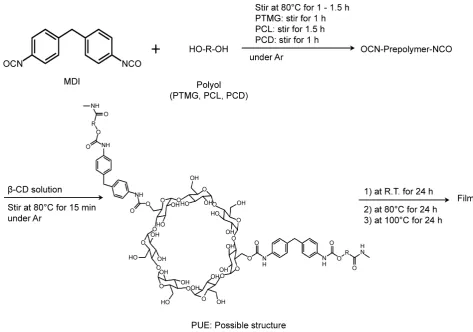
DOI: 10.4236/ojopm.2017.73003 31 Open Journal of Organic Polymer Materials Scheme 1. Synthesis of polyurethane elastomers containing β-Cyclodextrin by prepolymer method.
Table 1. Recipe of PUEs with β-CD.
Sample MDI (mol) PTMG·PCL·PCD (mol) β-CD (×10−3 mol)
PUE-Polyol-CD0 0.020 0.010 -
PUE-Polyol-CD1 0.020 0.010 0.15
PUE-Polyol-CD2 0.020 0.010 0.31
PUE-Polyol-CD3 0.020 0.010 0.46
PUE-Polyol-CD5 0.020 0.010 0.79
DOI: 10.4236/ojopm.2017.73003 32 Open Journal of Organic Polymer Materials min. Thin PUE films (0.7 - 0.8 mm) were obtained by casting the resulting PUE solutions (about 50 mL each) at room temperature (23˚C ± 2˚C) for 24 h, at 50˚C for 24 h, and at 100˚C for 24 h. DMF residues in the films were removed at 80˚C for 6 h in vacuo.
2.3. Characterization
2.3.1. Nuclear Magnetic Resonance (NMR) Spectroscopy
1H nuclear magnetic resonance (NMR; 300 MHz) and 13C NMR (75.4 MHz)
spectra were recorded on a Varian Unity Plus-300 spectrometer by using the solid-state method.
2.3.2. Fourier Transform Infrared (FTIR) Spectroscopy
FTIR spectra were recorded on a JASCO (Tokyo, Japan) FTIR-5300 spectrome-ter equipped with an attenuated total reflection (ATR) system featuring an ATR500/ M attachment and a KRS-5 ATR prism.
2.3.3. Morphological Analyses
Contact angle (CA) measurements were performed on dried films at room tem-perature (23˚C ± 2˚C) in air using an Excimer (Yokohama, Japan) Image Stan-dard 100 system. Samples of 5 μL were dripped.
The dried films were subjected to atomic force microscopy (AFM) at room temperature (23˚C ± 2˚C) in air using an Olympus (Tokyo, Japan) NV2000 sys-tem. Most of the images were obtained in tapping mode (ACAFM) with a silicon nitride cantilever (OMMCL-AC 240TS-C2, Olympus Optical) using a spring con-stant of 15 N/m and a resonating frequency of 20 KHz. The scanning rates were varied from 1 Hz to 2 Hz, and all images presented here were reproduced from images obtained from at least three points on each sample surface.
SEM was used to observe the surface morphology of the PUEs with a Hitachi High-Technologies S-4800 (Tokyo, Japan) system. All micrographs were taken at a magnification of 30 K×.
2.3.4. Chemical Property
Swelling tests were carried out in THF. The PUE films were cut into 10 × 20 mm2 samples. After weighing, the films were placed in a test tube with THF so-lution for 24 h. Thereafter, the films were removed from the tubes, dried, and then weighed once more. The degree of swelling (Rs) was calculated using the formula Rs(%) = W' − W/W × 100, where W and W' refer to the weights of the samples before and after soaking, respectively.
Solubility tests were performed using 15 × 15 mm2 test pieces. Each test piece was soaked in a solvent (benzene, hexane, acetone, THF, DMF, or DMSO; 6 mL) at room temperature (23˚C ± 2˚C) or 100˚C (for DMF and DMSO) for 24 h.
2.3.5. Mechanical Properties
DOI: 10.4236/ojopm.2017.73003 33 Open Journal of Organic Polymer Materials range. The test procedure followed JIS K 6253.
Tensile tests were performed by using an ORIENTEC (Tokyo, Japan) RTC- 1225A universal tensile testing instrument equipped with a U-4300 extensome-ter. Samples were cut into dumbbell-shaped strips following the JIS K 6251-3 standard. Tensile tests were performed at a crosshead speed of 100 mm/min at room temperature (23˚C ± 2˚C).
Dynamic mechanical analyses (DMA) were performed on a Seiko Instruments (Chiba, Japan) DMS 6100 at a heating rate of 5˚C/min from −100˚C to 300˚C and at 20 Hz under a N2 atmosphere.
Thermogravimetric analyses (TGA) were performed on a Seiko Instruments TG/DTA6200 at a heating rate of 10˚C/min from 30˚C to 500˚C under a N2 at-mosphere.
2.3.6. Thermal Properties
Differential scanning calorimetry (DSC) measurements were performed on a Rigaku (Tokyo, Japan) Thermo-Plus DSC-8230 system at a heating rate of 10˚C/min from −120˚C to 200˚C under an Ar atmosphere. Approximately 5 mg of each PUE was weighed and sealed in an aluminum pan. The samples were rapidly cooled to −120˚C and then heated to 200˚C at a rate of 10˚C/min.
3. Results and Discussion
3.1. Nuclear Magnetic Resonance (NMR) Spectroscopy
Solid-state 1H NMR and 13C NMR spectroscopy revealed that the polymers were undoubtedly PUEs containing β-CD and composed of a urethane segment and β-CD. NMR analyses indicated that β-CD was attached to the main PU chain as a cross-linker. For example, the solid-state 1H NMR spectrum of PUE-PTMG- CD1 showed peaks at δ8.54 (1H, CO-NH), 7.31 and 7.08 (1H, -C6H4-), 5.10 - 4.27 (1H, -CH(OH)-), 4.05 and 3.27 (2H, -O-CH2-), 3.78 (2H, -C6H4-CH2-C6H4-), and 1.49 (2H, -CH2-CH2-, -CH(R)-), and its solid-state 13C CP/TOSS NMR spectrum showed peaks at 1δ64.0 - 147.2 (urethane; C=O), (urea, C=O), 129.0 (-C=C-), 118.0 (-C=C-), 70.0 (-O-CH2-), and 20.2 (-CH2-).
3.2. Fourier Transform Infrared (FTIR) Spectroscopy
FTIR measurements were utilized to determine the structure of the PUEs.
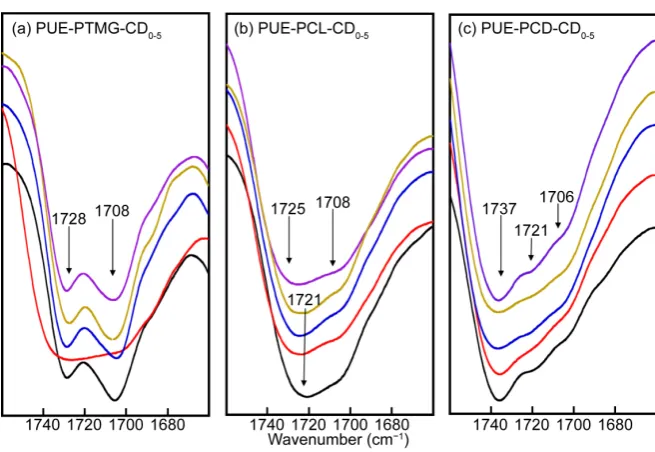
Car-bonyl C=O group absorptions are shown in Figure 1. As PUE-PTMG-CD0-5
DOI: 10.4236/ojopm.2017.73003 34 Open Journal of Organic Polymer Materials Figure 1. FTIR (ATR method) spectra of C=O region of PUEs. (a) PUE-PTMG-CD0-5; (b)
PUE-PCL-CD0-5; (c) PUE-PCD-CD0-5. β-CD content: black = 0 wt%; red = 1 wt%; blue =
2 wt%; yellow = 3 wt%; purple = 5 wt%.
3.3. Morphological Analyses
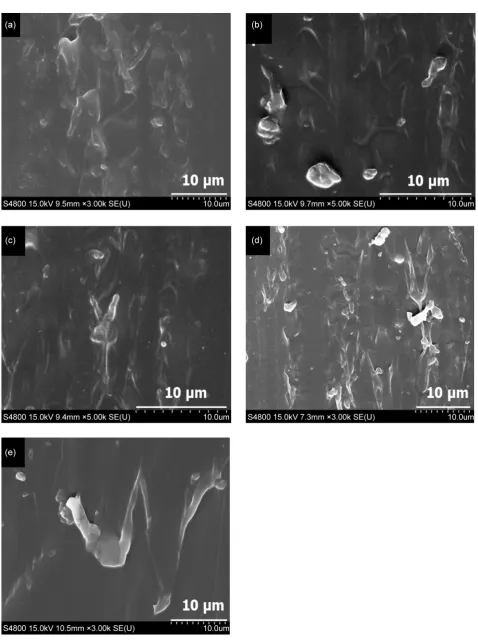
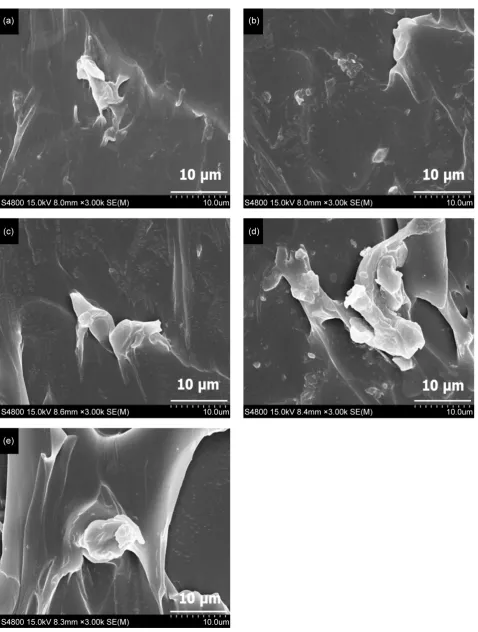
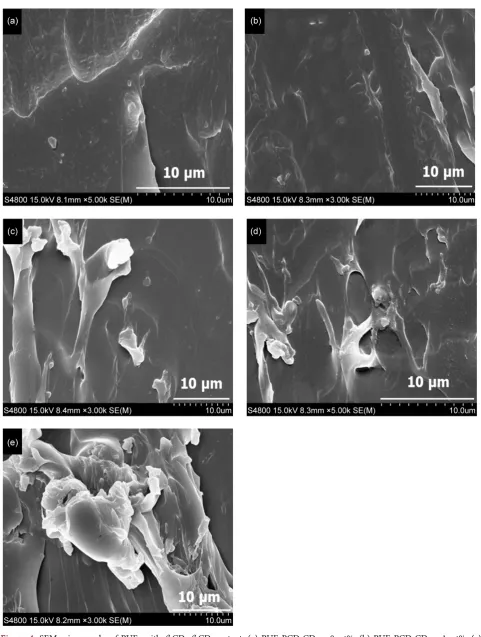
The morphologies of the PUEs obtained were characterized by SEM, and images
of PUE-PTMG-CD0-5, PUE-PCL-CD0-5, and PUE-PCD-CD0-5 are shown in
Fig-ures 2-4, respectively. Phase segregation was observed in all of the images. As the β-CD content increased, the size of hard domains also increased. The sur-faces of PUE-PCL-CD0-5 and PUE-PCD-CD0-5, especially those of PUE-PCL- CD3, PUE-PCL-CD5, and PUE-PCD-CD5, showed obvious agglomerations of hard domains, which is likely related to the structure of the polyol used. The images obtained reveal that PTMG presents a more regular structure than either PCL or PCD and, thus, features greater flexibility. When the PUEs were cros-slinked with β-CD, the flexibility of the molecular chains of the PUEs decreased and the molecular chains of PUEs synthesized from the less-flexible polyols, such as PCL and PCD, become more rigid.
DOI: 10.4236/ojopm.2017.73003 35 Open Journal of Organic Polymer Materials Figure 2. SEM micrographs of PUEs with β-CD. β-CD content: (a) PUE-PTMG-CD0 = 0 wt%; (b) PUE-PTMG-CD1 = 1 wt%; (c)
DOI: 10.4236/ojopm.2017.73003 36 Open Journal of Organic Polymer Materials Figure 3. SEM micrographs of PUEs with β-CD. β-CD content: (a) PUE-PCL-CD0 = 0 wt%; (b) PUE-PCL-CD1 = 1 wt%; (c)
[image:8.595.61.540.63.696.2]DOI: 10.4236/ojopm.2017.73003 37 Open Journal of Organic Polymer Materials Figure 4. SEM micrographs of PUEs with β-CD. β-CD content: (a) PUE-PCD-CD0 = 0 wt%; (b) PUE-PCD-CD1 = 1 wt%; (c)
[image:9.595.56.538.63.701.2]DOI: 10.4236/ojopm.2017.73003 38 Open Journal of Organic Polymer Materials Figure 5. Topographic and three dimensional AFM images of PUEs with β-CD. β-CD content: (a)
PUE-PTMG-CD0 = 0 wt%; (b) PUE-PTMG-CD1 = 1 wt%; (c) PUE-PTMG-CD2 = 2 wt%; (d) PUE-
PTMG-CD3 = 3 wt%; (e) PUE-PTMG-CD5 = 5 wt%.
Figure 6. Topographic and three dimensional AFM images of PUEs with β-CD. β-CD content: (a) PUE-PCL-CD0 = 0 wt%; (b) PUE-PCL-CD1 = 1 wt%; (c) PUE-PCL-CD2 = 2 wt%; (d) PUE-PCL-CD3 = 3
[image:10.595.147.540.70.349.2] [image:10.595.148.540.403.681.2]DOI: 10.4236/ojopm.2017.73003 39 Open Journal of Organic Polymer Materials Figure 7. Topographic and three dimensional AFM images of PUEs with β-CD. β-CD content: (a) PUE-PCD-CD0 = 0 wt%; (b) PUE-PCD-CD1 = 1 wt%; (c) PUE-PCD-CD2 = 2
wt%; (d) PUE-PCD-CD3 = 3 wt%; (e) PUE-PCD-CD5 = 5 wt%.
Light-colored spots representing hard segments were dispersed all over the matrix parts that were formed by the soft segments. Inclusions of hard segments, likely formed by better ordering in the polymer, can be seen in some limited areas.
The CAs of water on the surface of the films were measured at normal tem-perature and pressure, and the obtained results are shown in Figure 8 and Table 2. In particular, Figure 8 shows the CAs of PUE-PTMG-CD0-5. The CAs of the β-CD-based PUEs increased as their β-CD content increased. Similar to PUE- PTMG-CD0-5, the CAs of PUE-PCL-CD0-5 and PUE-PCD-CD0-5 increased as their β-CD content increased (Table 2). Increases in β-CD content could wea-ken the ability of the PUE surface to generate hydrogen bonds with water mole-cules, thereby increasing the surface hydrophobic properties of the resultant PUEs with increasing β-CD content.
3.4. Chemical Properties
[image:11.595.209.539.66.305.2]DOI: 10.4236/ojopm.2017.73003 40 Open Journal of Organic Polymer Materials Figure 8. Contact angle micrographs of a water droplet on PUEs with β-CD. β-CD
con-tent: PUE-PTMG-CD0 = 0 wt%; PUE-PTMG-CD1 =1 wt%; PUE-PTMG-CD2 = 2 wt%;
[image:12.595.205.541.331.416.2]PUE-PTMG-CD3 = 3 wt%; PUE-PTMG-CD5 = 5 wt%.
Table 2. Contact angle micrographs of a water droplet on PUEs with β-CD.
Sample θ (deg) θ (deg) θ (deg)
PUE-PTMG-CD0 100.8 PUE-PCL-CD0 103.6 PUE-PCD-CD0 103.6
PUE-PTMG-CD1 101.2 PUE-PCL-CD1 106.8 PUE-PCD-CD1 103.8
PUE-PTMG-CD2 102.9 PUE-PCL-CD2 107.5 PUE-PCD-CD2 100.5
PUE-PTMG-CD3 105.2 PUE-PCL-CD3 107.3 PUE-PCD-CD3 104.7
PUE-PTMG-CD5 105.7 PUE-PCL-CD5 110.4 PUE-PCD-CD5 105.9
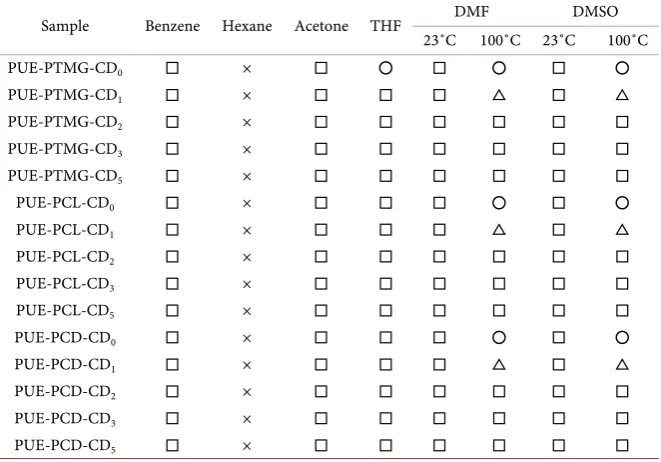
Table 3. Solubilities of PUEs with β-CD.
Sample Benzene Hexane Acetone THF DMF DMSO
23˚C 100˚C 23˚C 100˚C
PUE-PTMG-CD0 □ × □ ○ □ ○ □ ○
PUE-PTMG-CD1 □ × □ □ □ △ □ △
PUE-PTMG-CD2 □ × □ □ □ □ □ □
PUE-PTMG-CD3 □ × □ □ □ □ □ □
PUE-PTMG-CD5 □ × □ □ □ □ □ □
PUE-PCL-CD0 □ × □ □ □ ○ □ ○
PUE-PCL-CD1 □ × □ □ □ △ □ △
PUE-PCL-CD2 □ × □ □ □ □ □ □
PUE-PCL-CD3 □ × □ □ □ □ □ □
PUE-PCL-CD5 □ × □ □ □ □ □ □
PUE-PCD-CD0 □ × □ □ □ ○ □ ○
PUE-PCD-CD1 □ × □ □ □ △ □ △
PUE-PCD-CD2 □ × □ □ □ □ □ □
PUE-PCD-CD3 □ × □ □ □ □ □ □
PUE-PCD-CD5 □ × □ □ □ □ □ □
○: completely dissolved, △: slightly dissolved, □: swelled, ×: undissolved. aPolyol: polyoxytetramethylene
glycol (molecular weight = 1000; PTMG; PCL; PCD). bMeasurement conditions: benzene, hexane, acetone,
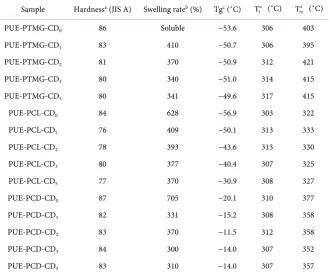
[image:12.595.209.540.451.682.2]DOI: 10.4236/ojopm.2017.73003 41 Open Journal of Organic Polymer Materials Swelling tests were performed to confirm the addition of β-CD as a cross- linker. Table 4 reveals that the swelling rates of PUE-PTMG-CD0-5, PUE-PCL- CD0-5, and PUE-PCD-CD0-5 decreased as their β-CD content increased. This re-sult confirms an increase in crosslinking density with increasing β-CD content. However, the film of PUE-PTMG without β-CD is nearly soluble.
The hardness of the PUEs is shown in Table 4. Crosslinking with β-CD ob-viously decreased the hardness of the PUEs with β-CD. For example, the hard-ness of PUEs-PCD-CD1-5 is apparently higher than those of PUEs-PTMG-CD1-5 and PUEs-PCL-CD1-5. Steric hindrance reduces the mobility of the molecular chains in PUEs-CD-CD1-5 and results in increased hardness and toughness.
3.5. Mechanical Properties
[image:13.595.209.540.394.666.2]The stress-strain curves of the PUEs are shown in Figure 9, and their tensile strength and elongation at break are shown in Table 5. In comparison with the PUEs without β-CD, The PUEs with β-CD showed much lower elongation at break and strength values, corresponding to poorer elasticity. PUEs with 1% β-CD content showed much higher strength than PUEs with higher β-CD con-tents. PUE-PTMG-CD1 revealed a much higher elongation at break and strength than the other β-CD-based PUEs, and PUE-PCD-CD0-5 nearly completely lost its
Table 4. Physical properties of PUEs with β-CD.
Sample Hardnessa (JIS A) Swelling rateb (%) Tgc (˚C) d 5
T (˚C) d
50
T (˚C)
PUE-PTMG-CD0 86 Soluble −53.6 306 403
PUE-PTMG-CD1 83 410 −50.7 306 395
PUE-PTMG-CD2 81 370 −50.9 312 421
PUE-PTMG-CD3 80 340 −51.0 314 415
PUE-PTMG-CD5 80 341 −49.6 317 415
PUE-PCL-CD0 84 628 −56.9 303 322
PUE-PCL-CD1 76 409 −50.1 313 333
PUE-PCL-CD2 78 393 −43.6 313 330
PUE-PCL-CD3 80 377 −40.4 307 325
PUE-PCL-CD5 77 370 −30.9 308 327
PUE-PCD-CD0 87 705 −20.1 310 377
PUE-PCD-CD1 82 331 −15.2 308 358
PUE-PCD-CD2 83 370 −11.5 312 358
PUE-PCD-CD3 84 300 −14.0 307 352
PUE-PCD-CD5 83 310 −14.0 307 357
aMeasurement conditions: JIS A type, total thickness = 6 mm, room temperature (23˚C ± 2˚C). b
Measure-ment condition: THF solvent at room temperature (23˚C ± 2˚C) for 24 h. cDifferential scanning calorimetry
was performed at heating rate of 10˚C/min from −100˚C to 300˚C under an Ar atmosphere. d
DOI: 10.4236/ojopm.2017.73003 42 Open Journal of Organic Polymer Materials Figure 9. Stress-strain curves of PUEs with β-CD. (a) PUE-PTMG; (b) PUE-PCL; (c) PUE-PCD. β-CD content: black = 0 wt%; red = 1 wt%; blue = 2 wt%; yellow = 3 wt%; purple = 5 wt%.
Table 5. Tensile properties of PUEs with β-CD.
Samplea σ10 σ50 σ100 σ200 σ300 σ400 σ
b Ebc
(MPa) (MPa) (MPa) (MPa) (MPa) (MPa) (MPa) (%)
PUE-PTMG-CD 4.43 6.86 7.69 9.46 14.6 32.0 50.5 448
PUE-PTMG-CD1 1.45 4.22 5.74 7.42 10.1 20.9 51.4 587
PUE-PTMG-CD2 1.77 4.62 6.17 8.40 13.7 - 36.5 389
PUE-PTMG-CD3 1.70 4.61 6.34 8.80 14.5 - 30.9 374
PUE-PTMG-CD5 1.86 5.43 7.70 11.2 17.9 - 33.0 368
PUE-PCL-CD0 3.76 6.08 7.15 12.4 35.0 - 48.8 376
PUE-PCL-CD1 1.40 3.79 5.63 9.84 31.1 - 59.2 369
PUE-PCL-CD2 1.95 5.11 7.50 13.1 39.2 - 40.0 329
PUE-PCL-CD3 1.49 4.16 6.10 10.0 24.9 - 38.7 344
PUE-PCL-CD5 0.20 3.77 5.75 10.3 28.6 - 34.2 317
PUE-PCD-CD0 3.87 5.99 6.85 9.87 21.2 - 52.5 273
PUE-PCD-CD1 2.37 6.36 13.4 48.0 - - 64.3 231
PUE-PCD-CD2 2.38 6.16 11.5 39.2 - - 51.8 234
PUE-PCD-CD3 3.47 8.47 16.1 - - - 47.3 183
PUE-PCD-CD5 3.69 8.96 14.9 - - - 30.1 166
aTensile properties measured at room temperature (23˚C ± 2˚C) with stain speed of 100 mm/min. bTensile strength at breaking point. cElongation at
break-ing point.
elasticity. Besides the HS/SS or HD/SD ratio, the balance between stiffness and flexibility must also be controlled when synthesizing PUEs with β-CD.
3.6. Thermal Properties
[image:14.595.61.540.316.607.2]DOI: 10.4236/ojopm.2017.73003 43 Open Journal of Organic Polymer Materials are reported in Table 4. The Tgs of PUEs with β-CD increased in comparison with those of the corresponding PUEs without β-CDas their β-CD content in-creased. The Tgs of the β-CD-based PUEs are influenced by the crosslinking density and chemical structure of the polymer. In general, the Tgs of soft seg-ments increase with increasing hard-segment concentration and the number of crosslinks added, likely because steric hindrance brought about by the formation of physical and chemical crosslinks between molecular chains limits the local motion of polymer segments.
Figure 10 shows the viscoelastic behaviors of the PUEs in terms of storage modulus (E’) and tan δ (tan δ = E"/E'). PUEs without β-CD content, including PUE-PTMG-CD0 and PUE-PCL-CD0, demonstrated a fairly long and tempera-ture-insensitive rubbery plateau extending up to about +150˚C with a modulus of about 1 × 10⁸ Pa. These polymers showed flow between +150˚C and +250˚C. By contrast, PUE-PCD-CD0 revealed a short and temperature-insensitive rub-bery plateau extending up to about +50˚C, with a modulus of about 1 × 10⁸ Pa. The PUEs with β-CD showed highly similar thermomechanical behaviors, indi-cating a strong dependence on hard-segment formation and hydrogen-bond strength. PUE-PTMG-CD1-5 and PUE-PCL-CD1-5 displayed a temperature-in- sensitive rubbery plateau extending to +150˚C with a modulus of about 3 × 10⁷ Pa. The polymers showed fairly good integrity at higher temperatures with mod-ulus values of about 2 × 10⁷ Pa, as well as flow between +150˚C and +250˚C. PUE-PCD-CD1-5 demonstrated a short and temperature-insensitive rubbery pla-teau extending up to about +50˚C, with a modulus of about 1 × 10⁷ Pa; the
DOI: 10.4236/ojopm.2017.73003 44 Open Journal of Organic Polymer Materials polymer also showed flow between +150˚C and +250˚C. These results suggest that the PUEs exhibit much more crosslink structure and their molecular chains could move more easily at a higher temperature than at the glass transition tem-perature (Tg). Previous research [32] indicates that the hydrogen bonding de-creased as temperature increases because the hydrogen bonding is related to the Tg of the hard segments. About 40% of hydrogen bonding persists at 200˚C.
The TGA curves of the PUEs with and without β-CD are shown in Table 4. All of the PUEs were thermally stable up to around 280˚C and began to lose weight at higher temperatures. The 5% weight loss temperatures (T5S) of the β- CD-based PUEs were nearly identical to those of the PUEs without β-CD, and the 50% weight loss temperatures (T50S) of PUE-PTMG-CD1-5 and PUE-PCL- CD1-5 were slightly higher than those of the corresponding PUEs without β-CD. By contrast, the T50s of PUE-PCD-CD1-5 were lower than those of the corres-ponding PUEs without β-CD. In general, as the decomposition of PUE is be-lieved to occur via dissociation of the urethane linkage toisocyanate and alcohol at 200˚C - 300˚C and polyol degradation at above 350˚C, PUEs with β-CD con-tent are clearly more thermal stable than those without.
4. Conclusion
A series of β-CD crosslinked PUEs were synthesized from different polyols. The polyols applied affected the properties of the resultant PUEs to a significant ex-tent. Use of a polyol with comparatively regular molecular chains, such as PTMG, resulted in β-CD-based PUEs with acceptable properties. By contrast, use of a polyol with low chain regularity, such as PCD, led to β-CD-based PUEs with poor elasticity. The PUEs which were crosslinked from β-CD and prepolymer with low regularity are harder and firmer.
Acknowledgements
The authors are grateful to the testing Center of Yangzhou University for pro-viding access to the SEM and AFM instruments.
References
[1] Hapburn, C. (1991) Polyurethane Elastomers. Elsevier, Oxford, 1.
[2] Oertel, G. (1985) Polyurethane Handbook. Hanser Publishers, Munich, 161. [3] Szycher, M. (1999) Szycher’s Handbook of Polyurethanes. CRC Press, New York.
[4] Wirtz, H. and Schulte, K. (1973) Processing of Polyurethane Foam Systems.
Kunststoffe, 63, 726-730.
[5] Avar, G., Meier, W.U., Casselmann, H. and Achten, D. (2012) Polymer Science: A Comprehensive Reference. Polymer Science: A Comprehensive Reference, 10, 411- 441.
[6] Kuehn, A.F. (1986) Polyurethane a Promising Prospect in Roll Coverings. PIMA,
68, 27-28.
[7] Bez, W. and Quack, G. (1983) Polyurethane and Latex Foam Carpet Backing Today.
DOI: 10.4236/ojopm.2017.73003 45 Open Journal of Organic Polymer Materials
[8] Gagro, D. (2010) Polyurethanes Overview of the PUR Market. European Coatings Journal, 10, 9-11.
[9] Hare, C.H. (2000) A Review of Polyurethanes: Formulation Variables and Their Ef-fects on Performance. Journal of Protective Coatings and Linings, 17, 34-44. [10] Walter, R.F. (1969) Sucrose-Ethylene Diamine Polyols and Process for Preparing
Same. US Patent No. 3640997.
[11] Neil, H.N. (1978) Sucrose Based Polyether Polyols. US Patent No. 4230824. [12] Hatakeyama, H., Hirose, S. and Hatakeyama, T. (1995) Biodegradable
Polyure-thanes from Plant Components. Journal of Macromolecular Science, Pure and Ap-plied Chemistry, A32, 743-750.https://doi.org/10.1080/10601329508010285
[13] Asano, Y. and Hatakeyama, H. (2003) Rigid Type Polyurethane Foams Containing Saccharide and Lignin Structures in the Molecular Chain. Memoirs of Fukui Uni-versity of Technology, 33, 275-282.
[14] Hatakeyama, H. and Hatakeyama, T. (2005) Environmentally Compatible Hybrid Type Polyurethane Foams Containing Saccharide and Lignin Components. Ma-cromolecular Symposia, 224, 219-226.https://doi.org/10.1002/masy.200550619
[15] Chen, Q., Li, R., Sun, K., Li, J. and Liu, C. (2011) Preparation of Bio-Degradable Polyurethane Foams from Liquefied Wheat Straw. Advanced Materials Research, 217, 1239-1244.https://doi.org/10.4028/www.scientific.net/AMR.217-218.1239
[16] Wang, G. and Zhou, A. (2011) Soy Protein Based Biodegradable Flexible Polyure-thane Foam. Advanced Materials Research, 152, 1862-1865.
https://doi.org/10.4028/www.scientific.net/AMR.264-265.1862
[17] Garcon, R., Clerk, C., Gesson, J.-P., Bordado, J., Nunes, T., Caroco, S., Gomes, P.T., Minas da Piedade, M.E. and Rauter, A.P. (2001) Synthesis of Novel Polyurethanes from Sugars and 1,6-Hexamethylene Diisocyanate. Carbonhydrateo Polymer, 45, 123-127.
[18] Lim, H., Kim, E.Y. and Kim, B.K. (2010) Polyurethane Foams Blown with Various Types of Environmentally Friendly Blowing Agents. Plastics, Rubber and Compo-sites, 39, 364-369.https://doi.org/10.1179/174328910X12691245469835
[19] Ionescu, M., Mihalache, I., Zugravu, V. and Mihai, S. (1994) Inherently Flame Re-tardant Rigid Polyurethane Foams Based on New Triazinic Polyether Polyols. Cel-lular Polymers, 13, 57-68.
[20] Guo, A., Demydov, D., Zhang, W., Zoran, W. and Petrovie, S. (2002) Polyols and Polyurethanes from Hydroformylation of Soybean Oil. Journal of Polymers and the Environment,10, 49-52.https://doi.org/10.1023/A:1021022123733
[21] Dhanjay, J. and Alain, D. (1997) Sucrose-Based Polymers: Polyurethanes with Su-crose in the Main Chain. European Polymer Journal, 33, 1577-1582.
[22] Foote, J.F., Le, B.L.R. and Marco, W. (1966) US Patent 3265641.
[23] Mir, G., Sadeghi, M., Shamsi, R. and Sayaf, M. (2011) From Aminolysis Product of PET Waste to Novel Biodegradable Polyuretuhanes. Journal of Polymers and the Environment, 19, 522-534.https://doi.org/10.1007/s10924-011-0283-7
[24] Kim, S.H., Lim, H. and Kim, B.K. (2008) Effects of Initiator Type in Rigid Polyure-thane Foams. Polmer Engineering and Science, 48, 1518-1523.
https://doi.org/10.1002/pen.21122
[25] Kim, B.K. and Paik, S.H. (1999) UV-Curable Poly-(ethylene glycol)-Based Polyure-thane Acrylate Hydrogel. Journal of Polymer Science Part A, 37, 2703-2709.
DOI: 10.4236/ojopm.2017.73003 46 Open Journal of Organic Polymer Materials
[26] Laijiu, Z., Bing, D. and Zeshou, H. (2013) Treatment of Wool Scouring Wastewater by Immobilized Chitosan Bio-Membrane. Journal of Engineered Fibers and Fabrics, 8, 1-5.
[27] Pan, X. and Webster, D.C. (2012) New Biobased High Functionality Polyols and Their Use in Polyurethane Coatings. ChemSusChem, 5, 419-429.
https://doi.org/10.1002/cssc.201100415
[28] Deka, H. and Karak, N. (2009) Bio-Based Hyperbranched Polyurethanes for Surface Coating Applications. Progress in Organic Coatings, 66, 192-198.
[29] Hasirci, N. and Aksoy, E.A. (2007) Synthesis and Modifications of Polyurethanes for Biomedical Purposes. High Performance Polymer, 19, 621-637.
https://doi.org/10.1177/0954008307081203
[30] Yeganeh, H., Jamshidi, H. and Jamshidi, S. (2007) Synthesis and Properties of Novel Biodegradable Poly-(-capro-lactone)/Poly(ethylene glycol)-Based Polyurethane Elastomers. Polymer International, 56, 41-49.https://doi.org/10.1002/pi.2107
[31] Xie, A., Zhang, M. and Inoue, S. (2016) Influence of β-Cyclodextrin on Morpholo-gies and Chemical, Thermal, and Mechanical Properties of Non-Chain Extended Polyurethane Elastomers. Journal of Polymer Research,23, 145.
https://doi.org/10.1007/s10965-016-1046-x
[32] Xie, A., Zhang, M. and Inoue, S. (2016) Influence of Diisocyanate on Polyurethane Elastomers which Cross-linked by β-Cyclodextrin. Open Journal of Organic Poly-mer Materials, 6, 99-111.https://doi.org/10.4236/ojopm.2016.63010
[33] Xie, A., Ji, X., Chen, Y., Zhang, M. and Inoue, S. (2016) Nanoindentation Measure-ments of Mechanical Properties of Polyurethane Elastomers Which Cross Linked by
β-Cyclodextrin. Open Journal of Organic Polymer Materials, 6, 112-118.
https://doi.org/10.4236/ojopm.2016.63011
Submit or recommend next manuscript to SCIRP and we will provide best service for you:
Accepting pre-submission inquiries through Email, Facebook, LinkedIn, Twitter, etc. A wide selection of journals (inclusive of 9 subjects, more than 200 journals)
Providing 24-hour high-quality service User-friendly online submission system Fair and swift peer-review system
Efficient typesetting and proofreading procedure
Display of the result of downloads and visits, as well as the number of cited articles Maximum dissemination of your research work