The Finite Element Approximation in Hyperbolic
Equation and Its Application
—The Pollution of the Water in the West of Algeria as an Example
Salah Boulaaras1, Khaled Mahdi2, Hamza Abderrahim3, Ahmed Hamou3,
Sarah Kabli1
1Department of Mathematics, Faculty of Science, University of Mohamed Boudiaf USTO, El’ Monour Oran, Algeria
2Hydrometeorological Institute of Formation and Research, Seddikia, Oran, Algeria 3Laboratory of Polymer Chemistry, Faculty of Sciences, University of Oran, Oran, Algeria
Email: [email protected], [email protected]
Received January 12, 2013; revised February 12, 2013; accepted February 19, 2013
ABSTRACT
Hyperbolic variational equations are discussed and their existence and uniqueness of weak solution is established over in the last six decades. In this paper the hyperbolic equations (strong formula) can be transformed into a Hyperbolic variational equations. In this research, we propose a time-space discretization to show the existence and uniqueness of the discrete solution and how we apply it in the transport problem. The proposed approach stands on a discrete
L∞-stability property with respect to the right-hand side and the boundary conditions of our problem which has been
proposed. Furthermore the numerical example is given for the pollution in the smooth fluid as water and we have taken the pollution of the water in the west of Algeria as an example.
Keywords: Finite Element; Stability Analysis; Pollution
1. Introduction
The construction of a numerical model consists of two distinct stages: the first is to establish a system of equa- tions and strongly coupled nonlinear governing the be- havior of continuous phenomena.
In the late 40’s methods of grid points were used to model the universally large-scale atmospheric flow. Dur- ing recent years, alternative methods have been used, one of these methods is the finite element method finis. In this paper, we present the main tools for implementations of the method more generally belong to family of Galer- kin methods. These are commonly used instead of the finite difference method (considered too simplistic) to treat horizontal and vertical fields in the models.
Galerkin methods, which can solve numerically sys- tems of equations and inequalities PDE (see ref. [1,2]) do not directly use the field values at the points of a grid, but are use of series expansions of functions appropriately chosen, so as to reduce the resolution of a system of or- dinary differential equations. There are two types of me- thods within this process: the finite element method for which the functions are zero, except for a small area where they are equal to the low-order polynomials, and the spec- tral method in which the functions are the functions of a
spatial operator defined on the entire work area.
The finite element method is one of the tools of ap- plied mathematics. It is put in place, using principles in- herited from the variational formulation or weak formu- lation, a discrete mathematical algorithm for finding an approximate solution of a free boundary problem (see [3-7]). It speaks Dirichlet conditions (values at the edges) or Neumann data. The finite element method is different than the spectral method because it is not comprehensive, but rather determined by local values. However, it is dis- tinct approximations the function is defined over the en- tire region and not just the discrete points (see [2]).
2. Finite Element Methods for Hyperbolic
Equations
2.1. The Classic Formulation
Consider the following problem, hyperbolic first order, in the interval =
,
0 in , 0,
, , 0, ,
,0 ,
u u
a a u f Qt T
t x
u t t t T
u x u x x
(1)2.2. The Variational Formulation
The Continuous Problem
We multiply (1) by 1
and integer in 0vH
0
1 0
d d d d
v x v x a uv x fv x
t x
x H
u
u
(2)
1 1
0 , 0
H H v
Using the Green formula we have
0 d d
u u v u
v a a uv x v fv x
t x x
d
0
(3) the problem becomes:
1
0
, ,
b u v l v v H
1 1 ,
e
uH uH u (4)
with
0
, d
and d
u u v
b u v a a uv x
t x x
l f x
To ensure the existence and uniqueness of the solution we must have:
1
2
0 1, min
0 1, 1,
0, 1, 1,
1 .,. is an elliptic :
, min , for > 0 and
2 , max ,
3
b H
b u u a a u a p a
b u v a a u
l f v c
00
(5) According the Lax.Milgram theorem, the problem (3) has a unique solution.
3. The Discrete Problem
The finite element method is a special case of the vari- ational approximation method, also called the method of Rayleigh-Ritz or Galerkin approach which allows the
solution u as follows. We construct a subspace of
finite-dimensional space , then we define the appro- ximate solution h of the solution as the solution to the following problem: Find solution of
h
V V
u u
h V h u
,
, hh h h h
b u l V (6)
where
2 1
1 ,
,
in and 0
h h
h I a b
V v C H
v P u
(7)
3.1. The Space Discretization
We defined the following space:
1 0
1
, : ,
h h h j j j h
V v c v I P I I (8)
1
0 .
h h h
V v H v 0 (9)
we have
0 1
0,
d d
d ,
, ,
0 ,
h h
h h
h h h
h h
h h
u u
v x a a u v x
t x
fv x v V
u t t x
u u
h
(10)
3.2. Existence and Uniqueness of the Solution
We have
0 1
0
d
d ,
en ,
0 .
h h
h h
h h h
h h
h
u u
v a a t u v
t x
f t v x v V
u t t x
u u
h x
(11)
we can set vh uh
t , we get
2
0 d d
h h
h h h
x
u u
u a u a u x f t u
t
,
h x (12)
Then
d 1
2 1
2d2 2
h
h h
u
a x u x a x u a' x u x
x
hThus
d 1
2 1
2d2 2
h
h h
u
a x u x a x u a' x u x
x
h
2
2 2
0
1 d
2
1 1
d
2 2
h
h h
h h
u
a x u x a u
x
a u a' x u
x
d 1
2 1
2d2 2
h
h h
u
a x u x a u a' x u x
x
hEquation (12) becomes
2 2
2 2
0
1 d 1
2 2
1
d d
2
h h
h h
u x a u
t
a t u a' x u x f t u x
h (13)
We set
2 2
2 0
1 1
d
2 2
1
d 2
h h
h
I u x a u
t
a t a' x u x
and
hdII f t u
xWe can write(13)
III (14)
We suppose
0 0
1 0
2
a t a' x
(15)
Using the inequality of young
2 d2 2
h l h
f t u
f t u x
l2(16) we can write
2 2 2
2 0
1 1 d
2 t uh l 2a uh uh x
Iand
2 22 2
2 2
h
l l
f t u
II
Using (15) we have
2 2
2 2 2
0
1 1
2 t uh l 2a uh uh l
I
and
2
22 2
l l
f t f t
II
One integer on
0,t
2 2
2
2 2 2
0
0 2
0
0 0
1 1
, d
2 2
d d d
t
h l h l h
t t
h l
u t u a u
u t f u x
Then
2 2
2
2 2 2
0
0 2
0
0 0
, d
2 2 d d
t
h l h l h
t t
h l
u t u a u
u f u x
thus
2 2
2
2 2 2
0
0 0
2 0 0
2 ,
2 d d
t t
h l h l h
t
h l
u t u a u
f u x u
d
or
2 2
2
2 2 2
0
0 0
2 0 0
2 d ,
2 d d
t t
h l h l h
t
h l
u t u t a u
f u x u
d
implies
2 2
2
2
2 2
0
0 0
2 0 0
2 d ,
2 d d
t t
h l h l h
t
h l
u u a u
f u x u
d
Then
2 2
2
2
2 2
0
0 0
2 0 0
2 d ,
2 d d
t t
h l h l h
t
h l
A
u u a u
f u x u
d
(17)
By Using the inequality of Cauchy Schwarz
2
2
0 0
d d d
t t
h
l l
A f u x f u
Using Young inequality 2
2 , , et
4
n
m n m m n
2
2
2
0
2 2
0
d
d 4
t
h
l l
t
h l
A f u
f u
we put 1 0
2
. Then
2 2 2 2 0 0 0 1 d 2 4 t l h l fA u
(3.12) equivalent
2 2 2 2 22 2 2
0 0 0 2 2 2 0 0 0 0 d , d t t
h l h l h
t
l
h l h l
u t u a u
f u u d
2 2 2 2 2 2 0 0 0 2 2 2 0 0 0 2 d 1, d d
t
h l h l h
t
h l h l
u t u u
a u f x u
2 2 l
thus, we have
2 2
2 2
2 2 2
0 0 0 2 2 0 0 0 d , 1 d t t
h l h l h
t
h l l
u t u a u
f x u
d
in particular cases or f and a0 are null
2
2
2 2
0
h l h l
u t u
which reflects the stability of the energy of the system.
3.3. The Time Discretization
The time discretization of the finite element methods in- troduced in the previous section can be done either by finite differences or by finite elements.
If we choose a finite difference scheme implicit, both methods are unconditionally stable.
For example, using the implicit Euler method for the time discretization of the problem (3.7). The problem can be written, for all n0: find uhnVh
1
0 1
d d
d d
n
n n h
h h h h
n n
h h
u
u u v x a x v x
t x
a v x f v x
(E)with n
n hu et uh0u0h if f 0 and 0,
we set n in (E) we find
h h
v u
1 2 0 1 d d d 0 nn n n h n
h h h h
n n h
u
u u u x a x u x
t x
a u x
(E1)
1 2 0 1 1 d d d 0 nn n n n h n
h h h h h
n n h
u
u u x u u x a x u x
t t x
a u x
d (E1)
2 2 2 2 2 22 1 2
2
( )
2 0
2 1 2
2 ( ) ( )
( )
2 0
2 1 2
( ) ( ) 1 1 2 2 d d 1 1 2 2 d d 1 1 2 2 n n h h n h l n
n n n
h
h h
n n
h l h l
n h l
n
n n n
h
h h
n n
h l h l
n h u u E u t t u
a x u x a u x
x
u u
u
t t
u
a x u x a u x
x u u t t u a x x
2 2 2 02 1 2
( ) ( )
d d
1 1
2 2
n n n
h h
B
n n
h l h l
u x a u x
u u B
t t
calculation of B
2 0d d
n
n n n
h
h h
u
B a x u x a u x
x
thus, we have
2
2 01 1
= d
2 2
n n n
h h
B a u a a x u
xUsing
0 0
1 ,
2
a x t a x
22 2 0 2 2 0 1 1 = 2 2 1 2 n n h h n n
h h l
B a u a a x u
a u u
nThen, we deduce
2 2
2 2 2 1 2 1 0 1 2 0
n n n
h
l l
n l
u u a u
t u (18)
2 2
2
2 2 1 0
1 1
2 m m
m j j
h h
l l
j i
u t u a u u
22
l
In particular, we can conclude that
2 2
2
0 0
m
h l h l
u u m
1
The diagram is clear, however, subject to a stability condition: for example, in the case of the Euler method, the stability condition is This restriction is not as severe as in the case of equation parabolic equa- tion. this is particularly why the explicit schemes are used in the approximation of hyperbolic equation.
.t O x
3.4. Matrix Form
A thorough analysis of the stability and convergence pro- perties of the discontinuous Galerkin method can be found in Thomee (1984), Eriksson, Johnson and Thornee (1985) (see also Dupont (1982)). Let us just recall that the method is formally of order at the nodal points tn, and of order 2
q
1
q in the global interval
0,T ,Now we
1 1 1 0 1 1 0 0 1 d dd d ,
,
,
n n h
h h h h
n n
h h
n n
h h
u
u u v x a v
t x
a u v x f v x
u u u
x (19) thus 1 1 1 1 01 d 1 d
d d ,
n
n n h
h h h h h
n n
h h
u
u v x u v x a v x
t t x
a u v x f v x
d or
1 11 1
,
N N
h h
j j i
j i
v u u i
We can write
1 1
0 0
;
n n
n n
h i i h
i j
u u vji
(1) and we have
1 1 1 1 0 d d d d nn n h
h h h h h
n n
h h h
u
u v x u v x t a x v x
x
t a x u v x t f x v x
d we set
1 1 1 0 1 d d and d and n nh h h h
n n h h h n h
A' u v x u v x
u
B' t a x v x t a x u v dx
x
C' t f x v dx
h j i Using
1 10 0
1 n n n ; n
h i i h
i j
u u v v
1 sup sup 1 1 sup sup 1 1 d d , i j i j n n ni j i
p p
i j
n n
n
i j i
p p
i j
A u v
u v
x x
1 0 sup sup 1 1 1 0 sup sup 1 1 d d i j i j n n ni i j i
p p
i j
n n
n n
i i j i
p p
i i
B t u v a x
x
t a x u v
x x
and
1 sup 1 d j n n j j p jC t f x v
xwith
suppisupp j
if i j 2 we consider
0 constant , a xa x t t
The previous relation becomes
1 1
sup sup sup sup
1 1
d d
i j i j
n
j j
n n
n n
i p p i j i p p
i i
A' v
u x u
i j x
1 sup sup 1 1 1 1 sup sup 1 1 d d , i j i j n n nj i p p i j
j i
n n
n n
j p p i i
j i
B t v u x
t v u x
j
and
1 sup 1 d j n nj p j
i
C v f x
thus the equation AB C
i j x
U
equivalent
1
sup sup
1 1
sup sup
1 1
1
sup sup
1 1
1 1
sup sup
1 1
1 sup
d
d
d
d
d
i j
i j
i j
i j
n n
n
j i p p i j
j j
n n
n
j i p p i j
j i
n n
n
j i p p i j
j i
n n
n n
j i p p i j
j i
n
j p j
v u x
v u x
t v u x
t v u x
v f x x
1 j
n
j
So the above equation to give
1
sup sup sup sup
1 1
1
sup sup 1
1 1
sup sup 1
1 sup sup
d d
d
d
d
i j i j
i j
i j
i j
n n
n n
i p p i j i p p
i i
K n
n
i p p i j
i
R n
n n
i p p i j
i
K n
j
p p
F
u x u
t u x
t u x
f x x
(20) Our system is reflected in the form:
n 1
n 1 nt t
U F
K R K
K
(21) where
-The K
i, j symmetric three-diagonal matrix of dimension
N 1
N1
defined as( )d
i, j
suppi supp j i( ) jK x x
x
-The matrice R
i, j
N
symmetric three-diagonal matrice of dimension 1
N1
defined asx x
,
sup sup
di j
i j p p i j
R x
Calculation of the matrices terms
i, j
, i, j
R K :
1stCase i j
1 1
2
sup sup sup sup
2
1 1
0 2 1 2
1 0
d
d
2
1 d 1 d
3
i j i j
i i
i i
i j i
p p p p
x i x i
x x
Then, we have fori j
sup sup
2 d
3
i j i j
p p
h x
(22) for: i j
2 0
2 10 0
suppi supp j i jd 2 1 2 0 0
h h
x
and fori j
suppi supp j i jd 0
x
(23)2ndCase
We have for j i 1
1
sup sup sup sup
0 1
d d
6
i j i j i j i j
p p x p p x
h
thus we have j i 1
supp i supp j i jd 6 h x
(24)1
0 1
sup sup sup sup
0 1 sup sup
d d
d 2
i j i j i j i j
p p p p
p p
x x
h
h s
Thus, we have for j i 1
supp i supp j i jd 2
h x
(25)3rd Case
1
j i
For
1
0 1
1
sup sup sup sup
0 1 sup sup
d d
d 6
i j i j i j i j
p p p p
p p
x x
h s
supp i supp j i jd 6pour
h 1
x j i
(26)1
sup sup sup sup
0 1 sup sup
d d
d 2
i j i j
i j
i j i j
p p p p
p p
x x
h
h x
and forj i 1
supp i supp j i jd 2 h x
(27)2
d
d
x x
x x x X
x x
h h
h
h s x h s x
4. Application
The dimensional models are developed to assess the phe- nomena of dispersion in the far field zone wherein the concentration of the released product is homogeneous across the section.
ing dispersion phenomena vertical and transverse and longitudinal dispersion. Transport the pollutant is given by the following equation:
0,
C C
u
t x
(28)
with
C: concentration of pollutant (mg/L); U: flow velocity (m/s);
for the application of our model, we chose the site of Wadi EL Meleh (in the west of Algeria).
The watershed of Oued El Maleh is located in the north part of the country in wilaya Ain Témouchent. It is characterized by a Mediterranean climate arid to semi- arid with hot influences the Sahara to the south and cold north and east.
This area is known by low rainfall with an average inter-annual 300 mm/year.
The study watershed is located in north-western Al- geria is approximately (1 9 and 1 2 ) and between longitude ( and 35 ) lati- tude.
'24"
17'22"
6 '17"W
16'37"N
35
It is bordered by the Mediterranean Sea to the north, the mountains of Berkeches south, the mountains of El Sbaa Chioukh South West, Tessala Mountains in the South East, Mlata plain to the east and the basin of Ouled El Kihel West (in the west of Algeria).
4.1. Problematic
Equation (28) is a hyperbolic equation, then it would be wise to use a semi-explicit scheme time discretization. We will use the finite element method for discontinuous Galerkin spatial discretization.
The assumptions are:
*The velocity is constant and independent of time; *The density of the pollutant is equal to that of water; *The pollutant concentrations depend only on time and distance;
*Knowledge of initial conditions and boundary con- ditions.
4.1.1. The Initial Condition
Considering that the concentrations are zero regardless of the distance downstream of the sampling point.
,0 0 for 0.C x x
4.1.2. Boundary Conditions
It is defined by:
*The pollutant is considered conservative or passive, and the principle of conservation of mass is taken into account:
, dA x C x t x M
*Concentrations are considered zero after an infinite distance downstream from the point of sample collection:
, 0 forC t t0
0 when .
C
t x
such that:
A: section of the river (m2);
C: concentration of pollutant (mg/L); M: mass rejection (Kg).
Calculated flow velocity is given by the following for- mula:
UQ S (29)
such that:
S: mesh section (m2); U: flow velocity (m / s);
Q: average daily flow of the river (m3/s).
The choice of using one-dimensional models can be detrimental in terms of the accuracy of predictions since several phenomena have been neglected. However, the interest lies in the small number of data required making a tool in line with the issue of emergency.
Data.
4.1.3. Hydrodynamic Data
Flood discharge (m3/s)—wet section (m2) main flood- length (m)—Raw slope (m/m)—high flood.
(source station hydrology Turgot North ‘Ain Timou- chent).
4.1.4. Choice of Pollutants
Our choice fell on two pollutants: NO2 and NH4 have a large dilution in water, and its harmfulness and toxicity to living beings, in addition to the stream is infected dis- charges from a manufacturing plant detergents. The ma- nufacture of detergents is based on products of this type.
For this, the laboratory service of the National Agency of Water Resources (ANRH) performs measurements of the chemical composition of the water regularly and in different places.
4.1.5. Explanation
Equation for the program you must enter the input para- meters (according to our assumptions):
Insert the U velocity calculated using the formula in Section 4 [u = Q/S].
Insert the AT 10 min and h = 2 m [h = max hi]. these two parameters are chosen arbitrarily (the semi- implicit time discretization scheme) because it is un- conditionally stable. For a maturity de 12 h, we obtain 72 iterations.
pollutant treated to avoid that other phenomenon out- weighs the transportation
for the calculus of quasi-stationary state for the simu- lation of the pollutions concentration for each gaseous. The proposed discretization stands on a discrete L-
stability property with respect to the right-hand side and the boundary conditions of our problem which was pro- posed. Furthermore the numerical application in certain gaseous for our discretization is given and deficient. A future work, we will complete of this research and we will be devoted to the computation and comparison be- tween our discretization and an economic societies data. Read initial data from the file container (The data are
from the original collection of 16 November 2009 to 08: 35 h).
Matrices are calculated discretization of the array for- mula defined before
n1 n.A tUB C AC
The result was a system of equations to be solved, where n1 is the forecast (the unknown).
C
REFERENCES
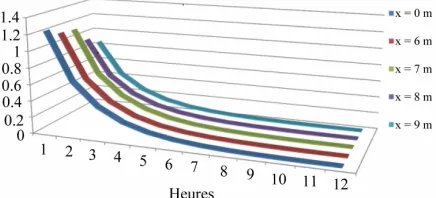
The results of the model are presented in the fol-lowing graphs (Figure 1). [1] A. Quarteroni and A.Valli, “Numerical Approximation of
Partial Differential Equations,” Springer Series in Com- putational Mathematics, Springer, Berlin and Heidelberg, 2008. doi:10.1007/978-3-540-85268-1
4.1.6. Comment
The graphs (see the Figure 1) show the temporal evo-
lution of pollutant concentrations NH4 and NO2 dif- fering distances.
at [2] H. M. Duwairi and A. Rablhi, “Fluid over a Vertical Sur- face,” International Journal of Fluid Mechanics, Vol. 32, No. 1, 2005, pp. 81-87.
doi:10.1615/InterJFluidMechRes.v32.i3.10 We chose a flow velocity of 0.64 m/s because higher
speeds cause greater dilution, and therefore very low
concentrations. [3] J. Z. Jordan, “Network Simulation Method Applied to Radiation and Viscous Dissipation Effects on MHD Un- steady Free Convection over Vertical Porous Plate,” Ap- plied Mathematical Modeling, Vol. 31, No. 9, 2007, pp. 2019-2033. doi:10.1016/j.apm.2006.08.004
Diffusion was eliminated and is interested only in the advection.
5. Conclusion
[4] S. Boulaaras and M. Haiour, “L∞-Asymptotic Behavior for a Finite Element Approximation in Parabolic Quasi- Variational Inequalities Related to Impulse Control Prob- lem,” Applied Mathematics and Computation, Vol. 217, No. 3, 2011, pp. 6443-6450.
doi:10.1016/j.amc.2011.01.025 In this paper, we have a new discretization for the finite
element approximation of the hyperbolic variational equations and we set the transport equation as model. We have established a convergence and the stability of this equations type, using by the semi-implicit time scheme combined with a finite element spatial approximation. this discretization types, which we get here, is important
[5] S. Boulaaras and M. Haiour, “A New Approach to As- ymptotic Behavior for a Finite Element Approximation in Parabolic Variational Inequalities,” ISRN Mathematical Analysis, Vol. 2011, 2011, Article ID: 703670.
doi:10.5402/2011/703670
[6] S. Boulaaras and M. Haiour, “The Finite Element Approxi- mation of Evolutionary Hamilton-Jacobi-Bellman Equa- tions with Nonlinear Source Terms,” Indagationes Mathe- maticae, Vol. 24, No. 1, 2013, pp. 161-173.
doi:10.1016/j.indag.2012.07.005
[image:8.595.64.282.498.597.2][7] M. Haiour and S. Boulaaras, “The Finite Element approxi- mation for a Class of Parabolic Quasi-Variational Inequa- lities with Non Linear Source Terms,” International Jour- nal of Numerical Analysis and Application, Vol. 5, No. 1, 2011, pp. 123-139.