Munich Personal RePEc Archive
Cheap talk with simultaneous versus
sequential messages
Gurdal, Mehmet Y. and Ozdogan, Ayca and Saglam, Ismail
TOBB University of Economics and Technology
1 April 2013
Online at
https://mpra.ub.uni-muenchen.de/45727/
Cheap Talk with Simultaneous versus
Sequential Messages
Mehmet Y. Gurdal
Ayca Ozdogan
Ismail Saglam
∗Department of Economics, TOBB University of Economics and Technology,
Sogutozu Cad. No: 43, Sogutozu 06560 Ankara, Turkey.
Abstract
Recent experimental studies find excessive truth-telling and excessive trust in one sender/one receiver cheap talk games with an essentially unique and babbling equilibrium. We extend this setup by adding a second sender into the play and study the behavior of the players both theoretically and experimentally. We examine games where senders are assumed to communicate with the receiver either simultaneously or sequentially as well as a game where the receiver chooses one of these two communication methods. The theoret-ical predictions for truth-telling, non-conflicting messages observed and trust frequencies are the same for both the simultaneous and sequential plays; however, we observe system-atic differences between the treatments of these plays. While the truth-telling frequencies stay above the theoretical prediction of the one half during all the experiments, the nature of truth-telling seems to differ between sequential and simultaneous plays. Under simul-taneous communication, the messages of senders are non-conflictive more than half of the time, while the non-conflicting messages are significantly more likely to be correct than not. The frequency of non-conflicting messages is lower under sequential plays due to the tendency of the second sender to revert the message of the first sender. We observe that subjects who prefer to get non-conflicting messages prefer simultaneous mode of commu-nication more often. When acting as senders, these subjects also adjust their truth-telling frequencies so as to generate conflictive messages.
Keywords: Strategic information transmission; truth-telling; trust; sender-receiver game.
1
Introduction
A recent experimental literature analyzes information transmission in a class of sender-receiver games in which the only equilibrium is a ‘babbling equilibrium’ where communication is not informative. In this class of games, a sender (or an expert) privately observes Nature’s realization of a conflicting payoff table that could be of two equally likely types. The sender then transmits a message involving the type of the payoff table to the receiver (the decision maker), whose action will in turn determine an outcome in the payoff table chosen by Nature. The possible strategies are telling the truth and lying about the payoff table from the viewpoint of the sender whereas trusting and distrusting from the viewpoint of the receiver. For this class of games, it is known that the sender will optimally not transmit any information in any sequential equilibrium.
shows that subjects who, in the role of the sender, tell the truth excessively are those who, in the role of the receiver, punish the sender frequently after any game history where they were deceived by trusting the message of the sender. This result is more recently supported by Peeters et al (2012), where a baseline sender-receiver game is played both under a sanction-free institution and under a sanctioning institution, where the receiver has the option to reduce the payoffs of both players to zero after observing the outcome of the baseline game. An alternative behavioral explanation for excessive truth-telling is provided by S´anchez-Pag´es and Vorsatz (2009). Using the baseline and punishment games in S´anchez-Pag´es and Vorsatz (2007) with a modification that the sender in the baseline game additionally has a costly option of remaining silent, they show that overcommunication in the baseline game can be attributed to lying aversion and not to a preference for truth-telling.
satz (2007) in a direction to allow for two senders.1
The theoretical literature has studied the multi-sender cheap talk games quite well. For example, Gilligan and Krehbiel (1989), Krishna and Morgan (2001), Gick (2008), and Li (2008) among others extend the basic one sender (and one receiver) model in the seminal paper of Crawford and Sobel (1982) by allowing two perfectly informed senders. Austin-Smith (1990a, 1990b, 1993b) consider the case with two imperfectly informed senders while Austin-Smith (1990b, 1993b) also analyze the effects of alternative commu-nication modes, namely simultaneous and sequential transmission of information. A common feature of these extensions is that the policy space is unidimensional, while Milgrom and Roberts (1986), Austin-Smith (1993a), Battaglini (2002, 2004), and Ambrus and Takashi (2008) consider multi-dimensional models of cheap talk. Very recently, a number of models in this rapidly growing literature were also tested by game-theoretic laboratory experiments (see, for example, Minozzi and Woon, 2011; Vespa and Wilson, 2012a, 2012b, among others). Despite differences in the policy space, the main focus of this literature has been to study the effect of dif-ferent institutions on information transmission or to find conditions which ensure that a fully-revealing equilibrium exists. Thus, it is no coincidence that this litera-ture is currently missing multi-sender extensions of one sender/one receiver models with an ‘essentially’ unique and babbling equilibrium. These basic models of cheap talk, which were pioneered by the work of Gneezy (2005), have drawn attention in the experimental literature, for the essential uniqueness of the equilibria generated by these models enables one to clearly distinguish between the experimental ob-servations and theoretical predictions. Extending a one sender/one receiver model borrowed from this new strand of literature to a multi-sender setup, we aim to ex-perimentally identify the effects of different modes of communication between the senders on the truth-telling of the senders and the trust of the receiver.
In our experimental analysis we consider three different sender-receiver games
1
played by two senders and one receiver, namely the Simultaneous, Sequential, and Choice Game. The informational setup in each game is similar to that in the single sender -receiver game studied by S´anchez-Pag´es and Vorsatz (2007) and others. The receiver only knows the possible payoff tables, whereas the two senders also know the actual payoff table. As usual, each game is also constant-sum; so the receiver and the two senders as a whole have opposing interests. Additionally, we assume that the two senders’ payoffs are always equal in order to isolate the effect of the order of play in the sequential communication of the senders with the receiver. In the Simultaneous Game, the two senders simultaneously transmit a payoff-relevant message (the type of the actual payoff table) to the receiver. In the Sequential Game, the two senders are named by sender 1 and sender 2 with respect to a given order, and then sender 1 transmits a payoff-relevant message that is received by both sender 2 and the receiver. Next, sender 2 transmits a payoff-relevant message to the receiver. Finally, in the Choice Game, the receiver first decides whether the Simultaneous or Sequential Game will be played, and then the chosen game is played accordingly. In each of these three games, the receiver takes an action after observing the message of the senders, and consequently the payoffs of the three players are determined by the actual payoff table chosen by Nature and the action taken by the receiver. Since preferences of the senders and the receiver are not aligned, the theory predicts that rational and self-interested senders will optimally not transmit any information under any mode of communication; and consequently the choice of the game will be immaterial for a rational receiver.
Our experiments yield several results. First, we establish that excessive truth-telling phenomenon, previously observed in sender-receiver games2
that involve a single sender but otherwise similar structures, is robust to the addition of a second sender into the play when the senders communicate with the receiver simultaneously. In particular, senders exhibit excessive truth-telling in the Simultaneous Game by
2
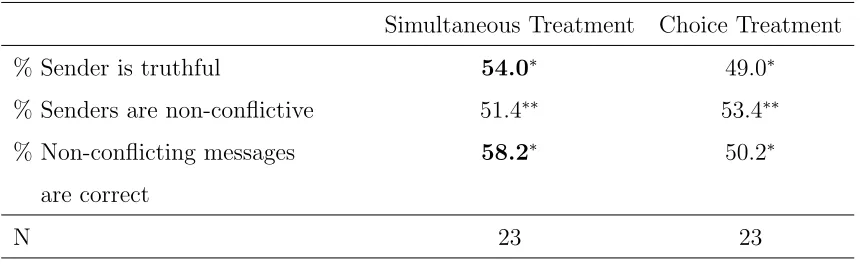
sending truthful messages with a frequency of 54%, significantly higher than the theoretical prediction of the one half. Moreover, non-conflicting messages in the Simultaneous Game are significantly more likely to be truthful than not, with a frequency of 58.2%. On the other hand, the senders almost randomize between truth-telling and lying in the Choice Game (in plays where the receiver prefers simultaneous communication of the senders).
In the Sequential Game, the frequency of truthful messages is 53.3% and non-conflicting messages are truthful with a frequency of 54.5%, Interestingly, the prob-ability that sender 1 is truthful is 0.500 whereas the probprob-ability that sender 2 is truthful given that sender 1 lies is particularly high (0.589) and significantly differ-ent from the one half. This implies that in sequdiffer-ential plays the main contribution to the excessive truth-telling comes from senders playing the second move. Another result is that excessive trust the receiver is found to exhibit in cheap talk games with a single sender is not affected by the presence of a second sender under any type of communication.3
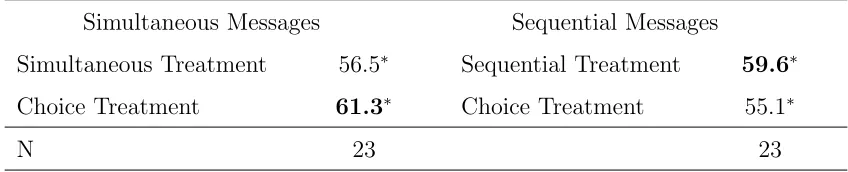
The trust frequencies are 56.5% for the Simultaneous Game and 59.6% for the Sequential Game.
We find that, in the Choice Game receivers prefer simultaneous messages slightly more often than sequential messages. Partitioning the subjects into two groups with respect to the number of times they preferred simultaneous messages as the receiver and then tracking the truth-telling and trust behavior of these two groups separately, we obtain some further conclusions. When acting as senders, subjects that preferred sequential plays more often as the receiver were more truthful in simultaneous plays and had a lower tendency to revert the messages of the other senders in sequential plays. On the other hand, subjects that preferred simultaneous plays more often as the receiver seem to have discovered the tendency of overcommunication in those plays, and thus preferred to act in plays where the two senders are more likely to be
3
non-conflictive and can not condition their messages on the message of each other. This is consistent with their behavior as senders since they have a higher tendency to generate conflicting messages during sequential plays, by reverting the message of the sender moving before them.
The rest of the paper is organized as follows: Section 2 introduces the model and theoretical predictions. Section 3 presents the experimental design and Section 4 reports experimental results. Finally, Section 5 contains some discussion and concluding remarks. (The post-experimental questionairre filled out by the subjects is presented in Appendix A, and the instructions corresponding to the experimental games are presented in Appendix B.)
2
Model
We generalize the sender-receiver game first studied by S´anches-Pag´es and Vorsatz (2007) by adding a second sender to the environment. We denote sender 1, sender 2 and a single receiver by S1, S2 and R, respectively. At the beginning of the game,
[image:8.612.197.416.497.646.2]Nature chooses a payoff table A or B (see Table 1) with equal probability that determines the final payoffs (in TL) of the three players.
Table 1. Payoff Tables
Table A Sender 1 Sender 2 Receiver
Action U 4.5 4.5 1
Action D 0.5 0.5 9
Table B Sender 1 Sender 2 Receiver
Action U 0.5 0.5 9
Action D 4.5 4.5 1
q from the set of messages M ={A, B}. Here, pandq denote the probabilities that the messageAis submitted byS1 andS2, respectively. After observing the messages
submitted by the two senders, the receiver chooses a possibly mixed action r from the set of actions {U, D}, showing the probability that U is played by the receiver. We analyze two games that differ with respect to the mode of communication of the senders with the receiver, namely the Simultaneous and the Sequential Game. In the Simultaneous Game, the two senders simultaneously transmit a message to the receiver after observing the actual state. Then, the receiver takes an action knowing that the senders have not observed each others’ messages. In the Sequential Game, first moves sender 1, transmitting a message. Then, after observing the message of sender 1, sender 2 transmits a message. Knowing that sender 2 has observed the message transmitted by sender 1, the receiver takes an action that determines the payoffs of all three players. The third game we consider is the Choice Game, where the receiver moves first and chooses whether the Simultaneous or the Sequential Game is going to be played, and then the chosen game is played accordingly.
2.1
The Simultaneous Game
In the Simultaneous Game, both senders have two information sets corresponding to the events that the actual payoff table is A or B. When the actual state is A, the strategies of S1 and S2 are pA and qA, respectively denoting the probabilities
that sender 1 and sender 2 choose message Awhen the actual state is A. Similarly, when the actual state is B, the strategies of S1 and S2 are pB and qB, respectively
denoting the probabilities that sender 1 and sender 2 choose message A when the actual state is B. The receiver, on the other hand, has four information sets corresponding to four possible message pairs that can be submitted by the two senders. Here, rAA, rAB, rBA and rBB denote the probabilities that action U is
played corresponding to the observed messages of S1 and S2 (which are denoted
and µBB, each denoting the belief that the actual state is A after observing the
corresponding set of messages by S1 and S2 specified in the subscripts, respectively.
Proposition 1. Any sequential equilibrium of the Simultaneous Game satisfies
pA = pB=p∈[0,1];
qA = qB=q∈[0,1];
with the supporting belief system is µij =
1
2 for every ij = {AA, AB, BA, BB} on the equilibrium path.
This says that no information is revealed in any equilibrium.
Proof. We first calculate the best response of the players at each information set.
The best responses of S1 after table A and B are observed are given by:
pA ∈
{1} if qA(rAA−rBA) + (1−qA)(rAB−rBB)>0
[0,1] if qA(rAA−rBA) + (1−qA)(rAB−rBB) = 0
{0} if qA(rAA−rBA) + (1−qA)(rAB−rBB)<0
pB ∈
{1} if qB(rAA−rBA) + (1−qB)(rAB−rBB)<0
[0,1] if qB(rAA−rBA) + (1−qB)(rAB−rBB) = 0
{0} if qB(rAA−rBA) + (1−qB)(rAB−rBB)>0
as follows:
qA ∈
{1} if pA(rAA−rAB) + (1−pA)(rBA−rBB)>0
[0,1] if pA(rAA−rAB) + (1−pA)(rBA−rBB) = 0
{0} if pA(rAA−rAB) + (1−pA)(rBA−rBB)<0
qB ∈
{1} if pB(rAA−rAB) + (1−pB)(rBA−rBB)<0
[0,1] if pB(rAA−rAB) + (1−pB)(rBA−rBB) = 0
{0} if pB(rAA−rAB) + (1−pB)(rBA−rBB)>0
The receiver’s best response after observing message ij ∈ {AA, AB, BA, BB} de-pends on the beliefs at the corresponding information set and is given by:
rij ∈
{1} if µij <
1 2
[0,1] if µij =
1 2
{0} if µij >
1 2
The beliefs, calculated by Bayes’ rule (whenever possible), are as follows:
µAA =
pAqA
pAqA+pBqB
, µAB =
pA(1−qA)
pA(1−qA) +pB(1−qB)
,
µBA =
(1−pA)qA
(1−pA)qA+ (1−pB)qB
, µBB =
(1−pA)(1−qA)
(1−pA)(1−qA) + (1−pB)(1−qB)
.
We want to show that the senders use the same strategy at the two information sets. To arrive at a contradiction, we consider the following cases: (1) One of the senders uses different strategies, while the other sender uses the same strategy at the two information sets; (2) Both of the senders use different strategies at the two information sets.
q > 0. Without loss of generality, let’s assume pA > pB. Then, the consistency of
beliefs requires µAA >
1
2, µAB > 1
2, µBA < 1
2, and µBB < 1
2. The best responses of
the receiver at each information set under these beliefs become rAA = 0, rAB = 0,
rBA = 1, and rBB = 1. But then, S1’s best responses are pA = 0 and pB = 1,
which contradicts to our hypothesis that pA> pB. Now, without loss of generality,
suppose that pA > pB, while qA = qB = q = 0. With these strategies, the beliefs
become µAB >
1
2 and µBB < 1
2. Having these beliefs, the receiver’s best response
becomes rAB = 0 and rBB = 1. Then, the best responses of S1 are pA = 0 and
pB = 1, again contradicting to our assumption.
Case 2: Suppose that pA 6= pB and qA 6= qB. Without loss of generality, we
assume that pA> pB ≥0 and qA > qB ≥ 0. Then, the beliefs can be calculated as
µAA >
1
2 and µBB < 1
2. The best responses of the receiver at these information sets
become rAA = 0 and rBB = 1. If qA< 1, for pA> 0 to be the best response of S1,
the best responses of the receiver should satisfy rAA =rBA = 0 andrAB =rBB = 1.
But if rAA =rBA = 0 and rAB =rBB = 1, thenqA= 0, which is a contradiction as
qA> qB ≥0, by assumption. If qA = 1, then givenpA >0, the best response of the
receiver should satisfy rAA = rBA = 0. In turn, qA = 1 can be a best response to
these strategies only ifrAB = 0 andpA= 1 (in addition torAA =rBA= 0, rBB = 1).
But, then pB equals to 1 if qB <1 and qB equals to 1 ifpB <1, which is the desired
contradiction (since by assumption pB 6= 1 andqB 6= 1 as pB < pA and qB < qA).
Since the senders are symmetric we exclude the symmetric situations. In all the other cases, we get at least one of the beliefs different than 1
2. The corresponding
best responses of the receiver at such information sets are pure strategies; and, the best responses of the senders against these pure strategies give the desired contradiction unless the senders use the same strategies at each information sets. Also, when pA = pB > 0 and qA = qB > 0, the beliefs can be easily calculated as
µij =
1
Corollary 1. The probability of observing an untruthful message by any of the senders in any sequential equilibrium is 1/2.
Sender 1 plays B when the true state is A with probability (1−pA) and choose
A when the true state is B with probability pB. As each state is equally likely and
pA=pB in any equilibrium, it is straightforward that the receiver expects to see an
untruthful message from S1 with probability one half. The same argument is true
for the messages of sender 2.
Remark: The receiver’s strategies should satisfy the following condition in order to have pA=pB =p > 0 and qA =qB =q >0 as a sequential equilibrium:
p = rBB −rBA
rAA−rAB +rBB−rBA
q = rBB −rAB
rAA−rAB +rBB−rBA
These conditions imply rAA > rAB, rAA > rBA, rBB > rAB and rBB > rBA in any
equilibrium where the senders use completely mixed strategies.4
2.2
The Sequential Game
In the Sequential Game, sender 1 has two information sets, whereas sender 2 has four information sets. The strategies of S1 when the actual state is n = {A, B} is
denoted by pn as before. The strategies of S2 (i.e. the probability that messageA
is chosen) when the actual state is n={A, B} and the sender 1 has communicated message i = {A, B} is denoted by qn(i). The receiver, again, has four information
sets, at which rAA, rAB, rBA and rBB are the probabilities that action U is played
corresponding to the observed messages of S1 and S2, denoted in the subscripts
of r, respectively. The receiver forms the beliefs µij showing the probability that
4
For instance,p= 3 4,q=3
4 andrAA= 1
3,rBB= 1
2,rAB=rBA= 1
the actual state is A after observing the message i = {A, B} from sender 1 and
j ={A, B}from sender 2.
Proposition 2. In any sequential equilibrium of the Sequential Game,
pA = pB =p∈[0,1];
qA(A) = qB(A) =q1 ∈[0,1];
qA(B) = qB(B) =q2 ∈[0,1];
with the supporting belief system µij =
1
2 for ij = {AA, AB, BA, BB} on the equilibrium path.
Proof. We first find the best responses of each player at each of their information sets.
The best response of S1 after table A is observed is as follows:
pA∈
{1} if qA(A)rAA+ (1−qA(A))rAB−qA(B)rBA−(1−qA(B))rBB >0
[0,1] if qA(A)rAA+ (1−qA(A))rAB−qA(B)rBA−(1−qA(B))rBB = 0
{0} if qA(A)rAA+ (1−qA(A))rAB−qA(B)rBA−(1−qA(B))rBB <0
The best response of S1 after table B is observed is as follows:
pB ∈
{1} if qB(A)rAA+ (1−qB(A))rAB−qB(B)rBA−(1−qB(B))rBB <0
[0,1] if qB(A)rAA+ (1−qB(A))rAB−qB(B)rBA−(1−qB(B))rBB = 0
{0} if qB(A)rAA+ (1−qB(A))rAB−qB(B)rBA−(1−qB(B))rBB >0
A is given by:
qA(A)∈
{1} if rAA−rAB >0
[0,1] if rAA−rAB = 0
{0} if rAA−rAB <0
The best response ofS2 when the actual table isAand the sender 1 has sent message
B is given by:
qA(B)∈
{1} if rBA−rBB >0
[0,1] if rBA−rBB = 0
{0} if rBA−rBB <0
The best response ofS2when the actual table isB and the sender 1 has sent message
A is given by:
qB(A)∈
{1} if rAB−rAA >0
[0,1] if rAB−rAA = 0
{0} if rAB−rAA <0
The best response ofS2when the actual table isB and the sender 1 has sent message
B is given by:
qB(B)∈
{1} if rBB−rBA >0
[0,1] if rBB−rBA = 0
{0} if rBB−rBA <0
given by:
rij ∈
{1} if µij <
1 2
[0,1] if µij =
1 2
{0} if µij >
1 2
where the beliefs calculated by the Bayes’ rule (whenever possible) are as follows:
µAA =
pAqA(A)
pAqA(A) +pBqB(A)
, µBB =
(1−pA)(1−qA(B))
(1−pA)(1−qA(B)) + (1−pB)(1−qB(B))
µAB =
pA(1−qA(A))
pA(1−qA(A)) +pB(1−qB(A))
, µBA=
(1−pA)qA(B)
(1−pA)qA(B) + (1−pB)qB(B)
.
We want to first show that S1 uses the same strategy at every information set.
To do that, first, we are going to assume that S2 uses the same strategies at her
information sets; then we will allow for the case in which S2 may use different
strategies.
Case 1. Suppose that S2 uses the same strategy qA(A) = qB(A) and qA(B) =
qB(B).
Case 1.a: Assume for a contradiction, pA 6= pB while qA(A) = qB(A) > 0 and
qA(B) =qB(B)>0. Without loss of generality, suppose that pA > pB. The beliefs
can be calculated as µAA >
1
2, µAB > 1
2, µBA < 1
2, and µBB < 1
2. The associated
best responses of the receiver are rAA = 0, rAB = 0, rBA = 1, and rBB = 1. The
best responses of S1 in turn become pA = 0 and pB = 1, which contradicts to our
hypothesis.
Case 1.b: To get a contradiction, suppose thatpA6=pB whileqA(A) = qB(A) = 0
and qA(B) =qB(B) = 0. Then, the beliefs become µBB <
1
2 andµAB > 1
2. The best
our hypothesis.
Case 1.c: Assume for a contradiction, pA 6= pB while qA(A) = qB(A) = 0
and qA(B) = qB(B) > 0. Then, the beliefs become µBB <
1
2, µBA < 1 2, and
µAB >
1
2. The best responses of the receiver corresponding to these beliefs are
rBB = 1, rBA = 1, and rAB = 0. The best responses of S1 in turn become pA = 0
and pB = 1, which contradicts to our hypothesis.
Case 1.d: Assume for a contradiction, pA 6= pB while qA(A) = qB(A) > 0
and qA(B) = qB(B) = 0. Then, the beliefs become µBB <
1
2, µAA > 1 2, and
µAB >
1
2. The best responses of the receiver corresponding to these beliefs are
rBB = 1, rAA = 0, and rAB = 0. Again, the best responses of S1 in turn become
pA= 0 and pB = 1, which contradicts to our hypothesis.
Case 2. Suppose that S2 uses different strategies; without loss of generality
as-sume that qA(A)> qB(A)≥0 andqA(B)> qB(B)≥0. Assume for a contradiction
that pA > pB ≥ 0. Then, the beliefs can be calculated as µAA >
1
2 and µBB < 1 2.
The corresponding best responses of the receiver at these information sets become
rAA = 0 and rBB = 1. Note that for qA(A)> qB(A) and qA(B)> qB(B) to be part
of an equilibrium, the receiver’s strategies should satisfy rAA ≥rAB andrBA ≥rBB.
As rAA = 0 and rBB = 1, we get rAB = 0 and rBB = 1. Then, the best response of
S1 against the receiver’s strategies become pA= 0 and pB = 1, which is the desired
contradiction.
Now, we want to show that S2 uses the same strategy, i.e. qA(A) =qB(A) = q1
and qA(B) =qB(B) =q2.
Case 3. We first assume that S1 uses the same strategy.
Case 3.a: Suppose that pA=pB >0. Assume for a contradiction that qA(A)>
qB(A). This implies µAA >
1
2 and µAB < 1
2. The best responses of the receiver in
turn becomes rAA = 0 and rAB = 1. The best responses of S2 against the receiver’s
Case 3.b: Suppose that pA = pB = 0. Assume for a contradiction, qA(B) >
qB(B). This implies µBA >
1
2 and µBB < 1
2. The best responses of the receiver in
turn becomes rBB = 1 and rBA= 0. The best responses ofS2 against the receiver’s
strategy is qA(B) = 0 and qB(B) = 1, which contradicts to our hypothesis.
Case 4. We now assume that S1 uses different strategies; and without loss
of generality assume pA > pB ≥ 0. To arrive at a contradiction, without loss of
generality, we assume that qA(A)> qB(A) and qA(B)> qB(B). The beliefs can be
calculated as µAA >
1
2 and µBB < 1
2. The best responses of the receiver in turn
becomes rAA = 0 and rBB = 1. For qA(A) > qB(A) and qA(B) > qB(B) to be a
part of equilibrium, the receiver’s equilibrium strategies should satisfy rAA ≥ rAB
and rBA ≥ rBB. As rAA = 0 and rBB = 1, we get rAB = 0 and rBA = 1. Against
these strategies of the receiver, the best responses of S1 satisfy pA = 0 andpB = 1,
which contradicts to the hypothesis.
Corollary 2. The probability of observing an untruthful message by any of the senders in any sequential equilibrium is 1
2.
As S1 plays B when the true state is A with probability (1−pA) and chooseA
when the true state is B with probability pB, it is straightforward that the receiver
expects to see an untruthful message by S1 with probability one half. The expected
probability of seeing an untruthful message byS2is given by the following expression:
1 2
(1−pA)(1−qA(B)) +pA(1−qA(A))
+ 1 2
pBqB(A) + (1−pB)qB(B)
2.3
The Choice Game
Since the equilibria of the Simultaneous Game and the Sequential Game induce the same expected payoff to the receiver, she should be indifferent choosing between the two games. After the receiver’s choice of the communication mode, one of the equilibria of the chosen game is played according to the requirements of sequential rationality.
3
Experimental Design and Procedures
All experimental sessions were conducted in the Social Sciences Laboratory at TOBB University of Economics and Technology during March 28-30, 2012. We sent a school wide invitation e-mail to undergraduate students informing that for the invited experiment they could register online for a date and time they choose. Those who registered also received reminder e-mails 1 day before the session. In total, the experiment was conducted over 8 sessions, one with 8 subjects the rest with 12 subjects. We had 92 Subjects in total and each session lasted abut 55-60 minutes.
Our design is a modification of the setup used in S´anchez-Pag´es and Vorsatz (2007, 2008) and Peeters et al. (2008). Each session consisted of three treat-ments which we term as the Simultaneous Treatment, the Sequential Treatment and the Choice Treatment. The order of these treatments during a session could be either Simultaneous-Sequential-Choice or Sequential-Simultaneous-Choice. Each treatment lasted 12 periods. Before the experiment began, subjects were randomly assigned to groups of 4. At the start of each period, two of these 4 subjects were assigned sender roles, one was assigned the receiver role and one was assigned the observer role. During the 12 periods in a given treatment, each subject played 6 times as a sender, 3 times as a receiver and 3 times as an observer. The order of role assignments was randomly determined.
period: First subjects learned about their role assignments for that period which could either be sender 1, sender 2, the receiver or the observer. Afterwards, sender 1 and sender 2 were informed about the true state (the payoff table being played) which could be either “Table A” or “Table B”. Following this, sender 1 and sender 2 simultaneously and without seeing each other’s decision, decided on the message they want to send to the receiver. The messages could be either “The payoff table is A” or “The payoff table is B”. The observer, on the other hand, was also informed about the payoff table and chose one of the following guesses: “The receiver will earn 9 and sender 1 and sender 2 will each earn 0.5” or “The receiver will earn 1 and sender 1 and sender 2 will each earn 4.5”. Next, the receiver was informed about the messages of sender 1 and sender 2 on the same screen and was asked which payoff table she thinks is more likely to be the correct one. Then the receiver choose among two possible actions: “U” or “D”. After this choice of action, the payoffs were realized accordingly and a summary of the period was shown to the senders, the receiver and the observer. For the senders and the receiver, this summary includes information about the true state, the signals sent, the belief of the receiver, the action chosen by the receiver and the payoffs to the senders and to the receiver. For the observer the summary includes her guess, the earnings of the receiver and the senders and her own earning. If her guess was correct, the observer earned 5 TL for that period and if not 0 TL.
about their choices during the experiment. Following this, payments were displayed on the subject’s screen. Each subject was paid the sum of her average earnings in the Simultaneous Treatment, average earnings in the Sequential Treatment and average earnings in the Choice Treatment plus a participation fee of 5 TL. Average total earnings (including the participation fee) were 14.26 TL and at the time of the experiment, 1 TL corresponded to 0.6325 USD.
4
Results
92 subjects in our experiment constituted 23 distinct groups. In the following three subsections (4.1, 4.2, and 4.3) we calculate the percentage of the variables of in-terest (truth-telling, trust, non-conflicting messages, truthfulness of non-conflicting messages etc.) for all distinct groups and use these independent observations in our analysis. Below, we start with describing the sender behavior.
4.1
Senders
We first look at the general frequency that a sender acts truthfully. The mean percentage of truthful messages per group is close to 53%, which is significantly above the theoretical prediction of 50% (p-value is 0.057 in a Wilcoxon signed-rank test). This is consonant with the previous studies finding that subjects in general tell the truth more often than predicted, a phenomenon termed as overcommunication (see Dickhaut et al. (1995), Gneezy (2005), Cai and Wang (2006), and S´anches-Pag´es and Vorsatz (2007), among others.)
In Table 2, we summarize the behavior of senders in plays where they act si-multaneously. The two columns respectively show sender behavior under all plays in the Simultaneous Treatment and plays in the Choice Treatment where receivers preferred the senders to play simultaneously.5
Senders exhibit excessive truth-telling
5
in the Simultaneous Treatment (p-value is 0.083 in a Wilcoxon signed-rank test) by sending truthful messages with a frequency of 54% and nearly randomize between truth and lie in the Choice Treatment (in plays where the receiver prefers simultane-ous messages). With simultanesimultane-ous messages, the two senders’ agreement frequency is above 50%.6
[image:22.612.93.523.290.422.2]Furthermore, with a frequency of 58.2%, the non-conflicting mes-sages in the Simultaneous Treatment are significantly more likely to be truthful than the theoretical prediction of 50% (p-value is 0.054 in a Wilcoxon signed-rank test).
Table 2. Sender Behavior with Simultaneous Messagesa
Simultaneous Treatment Choice Treatment % Sender is truthful 54.0∗ 49.0∗
% Senders are non-conflictive 51.4∗∗ 53.4∗∗
% Non-conflicting messages 58.2∗ 50.2∗
are correct
N 23 23
a
Observations under the Choice Treatment only includes cases where receivers preferred the senders to act simultaneously. The values that significantly differ from %50 are given in bold.
∗ The theoretical prediction is 50.
∗∗ The theoretical prediction is arbitrary in [0,100].
Sender behavior when the two senders act sequentially is summarized in Table 3.7
Here, the first column reports sender behavior under all plays in the Sequential Treatment, the second column reports plays in the Choice Treatment where receivers
6
The theoretical predictions for the probabilities in the first and last rows are 1/2, whereas the theoretical prediction for the probability that the two sender’s messages are non-conflictive in simultaneous plays ispAqA+ (1−pA)(1−qA)∈[0,1].
7
preferred the senders to play sequentially. Noting that the probability with which sender 2 is truthful given that sender 1 lies is well above 0.5 (p-value 0.083 in a Wilcoxon signed-rank test), we see that a major contribution to the excessive truth-telling in all sequential plays comes from players in the role of sender 2.
Table 3. Sender Behavior with Sequential Messagesa
Sequential Treatment Choice Treatment % Sender is truthful 53.3∗ 52.3∗
% Sender 1 is truthful 50.0∗ 51.6∗
% Sender 2 is truthful when 54.0∗∗ 51.1∗∗
sender 1 is truthful
% Sender 2 is truthful when 58.9∗∗ 63.0∗∗
sender 1 lies
% Senders are non-conflictive 46.4∗∗ 45.9∗∗
% Non-conflicting messages 54.5∗ 62.5∗
are correct
N 23 23
a Observations under the Choice Treatment only includes cases where receivers preferred the
senders to act sequentially. The values that significantly differ from %50 are given in bold.
∗ The theoretical prediction is 50.
∗∗ The theoretical prediction is arbitrary in [0,100].
On the other side, we see non-conflicting messages more frequently in simultaneous plays, since none of the two senders in a simultaneous play is able to condition her act on the act of the other sender and subjects are more likely to send truthful messages than to randomize between truth and lie.
4.2
Receivers
[image:24.612.92.519.523.594.2]Prior to choosing their action, receivers in our experiment were asked to state their beliefs. This belief elicitation stage wasn’t incentivized and each receiver was asked which payoff table she thinks is more likely to be the correct one (answering A, B, or equally likely). We focus on the cases where the messages by two senders are non-conflictive, and in Table 4 we present the frequency of beliefs that are in line with non-conflictive messages. The theoretical prediction for this frequency is 50% in all treatments. As Table 4 shows, this prediction holds true in the Sequential Treatment as well as in the Choice Treatment (with sequential or simultaneous messages). However, in the Simultaneous Treatment, the stated beliefs agree with the non-conflictive messages of senders 59.2% of the time and this frequency is significantly above 50%.
Table 4. Frequency of Beliefs in Line with Non-Conflicting Messages(%)a
Simultaneous Messages Sequential Messages Simultaneous Treatment 59.2∗ Sequential Treatment 52.3∗
Choice Treatment 50.7∗ Choice Treatment 48.6∗
N 23 23
a
A variable of particular interest is the receivers’ trust frequency when the mes-sages of the senders are non-conflictive. In the context of the game subjects played in the experiment, we define trust as choosing the optimal action by assuming that the non-conflictive messages of two senders is truthful. This corresponds to choosing action D when both senders claim that the payoff table is A and choosing action
U when both senders claim that the payoff table is B. The theoretical predictions for the frequencies of these two actions are respectively represented by 1−rAA and
rBB in all games we consider and found to be arbitrary in [0%,100%]. On the other
[image:25.612.93.517.343.429.2]hand, our experimental results in Table 5 show that the receiver’s trust frequency is generally above 50% regardless of the way messages were sent.
Table 5. Receiver Trust Frequency (%)a
Simultaneous Messages Sequential Messages
Simultaneous Treatment 56.5∗ Sequential Treatment 59.6∗
Choice Treatment 61.3∗ Choice Treatment 55.1∗
N 23 23
a In the first and second columns, observations under the Choice Treatment only include cases
where receivers preferred the senders to act simultaneously and sequentially, respectively. The values that are significantly different from 50% are given in bold.
∗ The theoretical prediction is arbitrary in [0,100].
The decline (rise) in the frequency that receivers trusted non-conflicting messages during plays in the Choice Treatment where the receiver preferred sequential (si-multaneous) messages is likely to be caused by a selection effect which we explain in more detail further in this section.
4.3
Observers
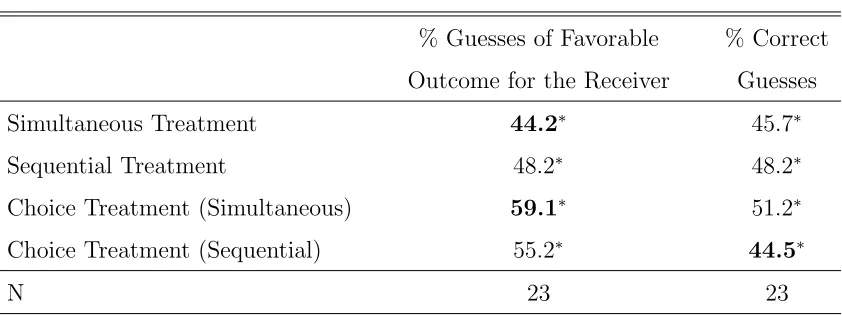
[image:26.612.97.518.354.512.2]We summarize the behavior of observers in Table 6, which presents the mean fraction of guesses per group that the outcome of the play will be favorable for the receiver (i.e., the receiver earns 9 TL and senders earn 0.5 TL each) as well the mean fraction of correct guesses per group.
Table 6. Observer Behaviora
% Guesses of Favorable % Correct Outcome for the Receiver Guesses Simultaneous Treatment 44.2∗ 45.7∗
Sequential Treatment 48.2∗ 48.2∗
Choice Treatment (Simultaneous) 59.1∗ 51.2∗
Choice Treatment (Sequential) 55.2∗ 44.5∗
N 23 23
a
The values that are significantly different from 50% are given in bold.
∗ The theoretical prediction is 50.
Subjects’ guesses are significantly more likely to be wrong than correct during plays in the Choice Treatment where the receiver preferred sequential messages (p-value is 0.075 in a Wilcoxon signed-rank test).
4.4
Preferences over Simultaneous and Sequential Plays
and Behavioral Differences
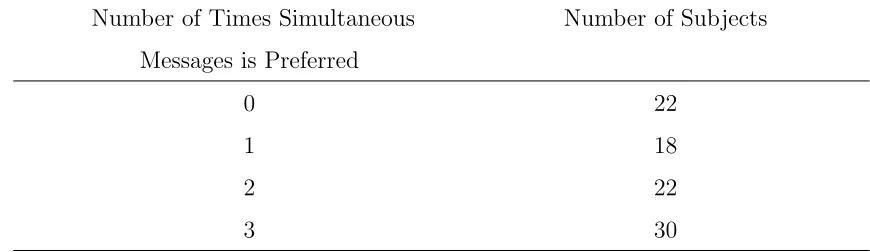
[image:27.612.87.522.348.474.2]In the below table, we partition the set of subjects with respect to the number of times they preferred a simultaneous play out of three plays in which they acted as the receiver in the Choice Treatment.
Table 7. Receiver Behavior in the Choice Treatment
Number of Times Simultaneous Number of Subjects Messages is Preferred
0 22
1 18
2 22
3 30
Based on the partition in Table 7, we call those (40) subjects who preferred simultaneous plays at most once Group A, and the rest of the subjects Group B.8
Below, we describe the behavioral differences observed for these two groups of subjects when they played in the roles of a sender, the receiver and the observer in the Simultaneous and Sequential Treatments.
Subjects in the role of a sender: When acting as senders, subjects in Group A lied significantly less often in the Simultaneous Treatment compared to those in
8
Group B. The respective truth-telling frequencies are 59.2% for Group A and 50 % for Group B, which turn out to be significantly different in a two-sided test of proportions (p-value is 0.032). In particular, subjects in Group B made the exact choices predicted by the theory. On the other hand, the two groups of subjects have very similar truth-telling frequencies as senders in the Sequential Treatment (53.3% for Group A and 53.2% for Group B). Note that these frequencies are obtained without consideration of role assignments (sender 1 and sender 2). When we restrict the observations to those acting as sender 1 in the Sequential Treatment, we again see that Group A and Group B have similar truth-telling frequencies (51.3% and 49%, respectively). However, the behavior of these groups differ when they act as sender 2. In particular, when they observe that sender 1 told the truth, Group A subjects also do so 56.6% of the time and when they observe the opposite they tell the truth 54.4% of the time. That is, they do not seem to condition truth-telling on the behavior of sender 1. Contrary to this, upon observing that sender 1 told the truth, Group B subjects do the same 50.6% of the time and when they observe the opposite they tell the truth 65.7% of the time, which is significantly above 50% (p-value is 0.011 in a two-sided binomial test).
Treatment. For Group A subjects, we focus on sequential plays whereas for Group B subjects we do the opposite.9
We observe a decline in the trust frequency of Group A during the Choice Treatment where the subjects in this group trust a non-conflicting message pair with an average frequency of 46.8% while the trust frequency for Group B is 56%.
Subjects in the role of the observer: The frequency with which subjects in Group A guess that receivers will have an advantage is 52.5% and 47.5% for the Simultaneous and Sequential Treatments, respectively. The same frequencies are 37.8% and 48.7% for Group B subjects, where the first value is significantly below 0.5 (p-value is 0.002). We observe that the differences in beliefs of subjects in Group A and Group B during the Choice Treatment become more prominent. In this treatment, the frequency with which subjects in Group A guess that receivers will have an advantage is 63.3% for sequential plays and 52.1% for simultaneous plays, where the first value is significantly above 0.5 (p-value is 0.085). Contrary to this, the frequency with which subjects in Group B guess that receivers will have an advantage is 66.7% for simultaneous plays and 49.3% for sequential plays, where the first value is again significantly above 0.5 (p-value is 0.003). These results indicate that the guesses of the two group of subjects in the Choice Treat-ment are coherent with their own preferences over simultaneous and sequential plays.
Questionnaire Answers: The two groups of subjects also differ in the distribution of their answers to questions 1 and 3 in our post-experimental survey in Appendix A (p-value being 0.001 for question 1 and less than 0.000 for question 3 in a chi-2 test). For question 1, dealing with the receiver behavior in the Simultaneous Treatment, the fraction of the subjects stating that they felt more comfortable (decided with greater confidence) when the messages of the two senders were non-conflictive is
9
higher for Group B than for Group A. On the other hand, for question 3, dealing with the receiver behavior in plays where the messages of the senders are non-conflictive, the fraction of the subjects stating that they felt more comfortable in the Sequential Treatment than in the Simultaneous Treatment is higher for Group A than for Group B.
5
Discussion and Concluding Remarks
In general, truth-telling frequencies stay above 0.5 during the experiment, however the nature of truth-telling seems to differ between sequential and simultaneous plays. With sequential messages, we observe that a substantial fraction of senders acting as sender 2 deliberately try to revert the messages of sender 1. In particular, they have much higher truth-telling frequencies in cases where sender 1 lied compared to the cases where sender 1 was truthful. This effect generates a higher frequency of non-conflicting sender messages during the Simultaneous Treatment compared to the Sequential Treatment. The reason is that when two senders act simultaneously, none of them can condition her message on the message of the other. In our study, we also observe that in both of the Simultaneous and Sequential Treatments, when a pair of messages by the two senders is non-conflictive, it is more likely to be truthful than being non-informative. This is reminiscent of overcommunication phenomenon observed in the previous experimental studies studying games with one sender and one receiver.
tial and simultaneous plays at the last treatment of the experiment, we see that a slight majority is more likely to prefer simultaneous plays. The behavior of these subjects in the preceding treatments and their beliefs provide us clues underlying these preferences.
Based on these preferences, we observe that two different groups emerge in the experiment regarding their beliefs about the game and their preferences over mes-sage types, which are also coherent with these beliefs. The beliefs and behavior of subjects who constitute the larger group (Group B), shows that as receivers they felt most comfortable in cases where senders have no chance of coordinating to transmit identical messages. Regardless of the ability of senders to coordinate, the subjects in Group B trusted the non-conflicting messages with frequencies larger than those in Group A. When acting as sender 2 in the Sequential Treatment, the actions of Group B subjects differed from other subjects in a way that they deliberately reduced the frequency of the agreement between their messages and the message of the other sender. The smaller group subjects (Group A) on the other hand had higher truth-telling frequencies on average and seemed to avoid (simultaneous) plays where they would observe the agreement of senders’ messages when acting as receivers. When acting as sender 2 in the Sequential Treatment, their truth-telling frequencies did not seem to be affected by the message of sender 1.
and acted in a way so that senders are more likely to observe jammed messages in the Sequential Treatment.
To summarize, even though the theoretical predictions for truth-telling, non-conflicting messages and trust frequencies are the same for the simultaneous and sequential plays, we observe systematic differences between the treatments of these plays. Sequential messages generate a lower frequency of non-conflicting messages since some subjects as a sender condition their behavior on the behavior of sender acting before them. On the other hand, subjects develop different preferences be-tween sequential and simultaneous messages, with more strategic subjects preferring simultaneous messages.
References
[1] Ambrus, A., Takahashi, S., (2008). Multi-sender cheap talk with restricted state spaces, Theoretical Economics, 3, 1-27.
[2] Austen-Smith, D., (1990a). Information transmission in debate, American Journal of Political Science, 34(1), 124-152.
[3] Austen-Smith, D., (1990b). Credible debate equilibria,Social Choice and Wel-fare, 7, 75-93.
[4] Austen-Smith, D., (1993a). Information acquisition and orthogonal argument, in Political Economy: Institutions Competition and Representation, proceed-ings of the seventh international symposium in economic theory and economet-rics, eds. Barnet, W. A., Melvin. H., J. and N. Schofield. Cambridge; New York and Melbourne: Cambridge University Press, pages 407-36.
[6] Battaglini, M., (2002). Multiple referrals and multidimensional cheap talk,
Econometrica, 70, 1379-1401.
[7] Battaglini, M., (2004). Policy advice with imperfectly informed experts, Ad-vanced Theoretical Economics, 4, Article 1.
[8] Crawford, V., Sobel, J., (1982). Strategic information transmission, Economet-rica, 50(6), 1431-1451.
[9] Fischbacher, U., (2007). Z-Tree – Zurich toolbox for readymade economic ex-periments, Experimental Economics, 10, 171-178.
[10] Gick, W., (2008). Cheap talk equilibria - a note on two senders, Mimeo, Harvard University.
[11] Gilligan, T., Krehbiel, K., (1989). Asymmetric information and legislative rules with a heterogeneous committee, American Journal of Political Science, 33, 459- 490.
[12] Gneezy, U., (2005). Deception: the role of consequences, American Economic Review, 95, 384-394.
[13] Gurdal, M.Y., Ozdogan, A., Saglam, I., (2011). Truth-telling and trust in sender-receiver games with intervention, Working Papers 1106, TOBB Uni-versity of Economics and Technology, Department of Economics.
[14] Hurkens, S., Kartik, N., (2009). Would I lie to you? On social preferences and lying aversion, Experimental Economics, 12(2), 180-192.
[15] Kreps D., Wilson, R., (1982). Sequential Equilibrium, Econometrica, 50, 863-894.
[17] Li, M., (2008). Two (talking) heads are not better than one, Economics Bul-letin, 3(63), 1-8.
[18] Milgrom P., Roberts, J., (1986). Relying on information of interested parties,
Rand Journal of Economics, 17(1), 18-32.
[19] Minozzi, W., Woon, J., (2011). Competition, preference uncertainty, and jam-ming: a strategic communication experiment, mimeo, University of Pittsburgh.
[20] Peeters, R., Vorsatz, M., Walz, M., (2008). Rewards in an experimental sender-receiver game, Economics Letters, 101(2), 148-150.
[21] Peeters, R., Vorsatz, M., Walz, M., (2012). Truth, trust, and sanctions: On institutional selection in sender-receiver games, Scandinavian Journal of Eco-nomics, forthcoming.
[22] S´anchez-Pag´es, S., Vorsatz, M., (2007). An experimental study of truth-telling in a sender receiver game, Games and Economic Behavior, 61, 86-112.
[23] S´anchez-Pag´es, S., Vorsatz, M., (2009). Enjoy the silence: an experiment on truth-telling, Experimental Economics, 12, 220-241.
[24] Sutter, M., (2009). Deception through telling the truth?! Experimental evi-dence from individuals and teams, Economic Journal, 12, 220-241.
[25] Vespa, E., Wilson, A.J., (2012a). Communication with multiple senders: an experiment, mimeo.
Appendix A. Post-Experimental Questionairre
1) When you played as the receiver and Sender 1 and Sender 2 sent their messages simultaneously, in which one of the following cases you made your decision more comfortably?
a) When Sender 1 and Sender 2 sent the same message.
b) When Sender 1 and Sender 2 sent different messages.
c) I was equally comfortable in both of the cases above.
2) When you played as the receiver and Sender 1 and Sender 2 sent their messages sequentially, in which one of the following cases you made your decision more com-fortably?
a) When Sender 1 and Sender 2 sent the same message.
b) When Sender 1 and Sender 2 sent different messages.
c) I was equally comfortable in both of the cases above.
3) When you played as the receiver and Sender 1 and Sender 2 sent the same mes-sage, in which one of the following cases you made your decision more comfortably?
a) When Sender 1 and Sender 2 sent their messages simultaneously.
b) When Sender 1 and Sender 2 sent their messages sequentially.
c) I was equally comfortable in both of the cases above.
4) When you played as the receiver and Sender 1 and Sender 2 sent different mes-sages, in which one of the following cases you made your decision more comfortably?
a) When Sender 1 and Sender 2 sent their messages simultaneously.
b) When Sender 1 and Sender 2 sent their messages sequentially.
c) I was equally comfortable in both of the cases above.
5) When you played as Sender 2 and the messages were sent sequentially, did you take into account Sender 1’s message?
b) No.
c) Sometimes.
6) When you played as Sender 1, in which one of the following cases did you send more truthful messages?
a) When messages were sent simultaneously.
b) When messages were sent sequentially.
c) I sent truthful messages with similar frequencies in both of the cases above.
Appendix B. Instructions
Welcome!
Thank you for your participation. The aim of this study is to understand how people decide in certain situations. From now on, talking to each other is prohibited. Violation of this rule requires immediate termination of the experiment. Please raise your hand to ask questions. This way, everybody will hear your question and our answer.
The experiment will be conducted through the computer and you will make all your decisions using the computer. Your earnings depend on your decisions as well as the decisions of other participants. These earnings and your participation fee will be paid to you in cash at the end of the experiment. The experiment consists of 3 different parts. We start with describing Part 1.
Part 1
In the beginning of each period, 2 participants in your group will be assigned the sender roles, 1 participant will be assigned the receiver role and 1 participant will be assigned the observer role. At the end of 12 periods, each of you will have played 6 times as a sender, 3 times as a receiver and 3 times as an observer. The order of these role assignments is random.
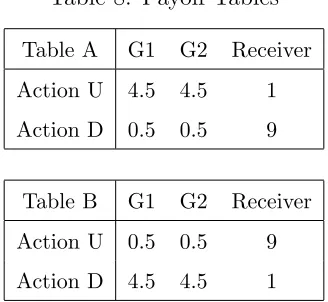
[image:37.612.224.388.306.457.2]During each period, after role assignments have been made, the system will choose one of the following: Table A or Table B. It is equally likely for the system to choose Table A or Table B. The earnings in that period will depend on the table chosen by the system and the choice of action U or action D by the receiver.
Table 8. Payoff Tables
Table A G1 G2 Receiver
Action U 4.5 4.5 1
Action D 0.5 0.5 9
Table B G1 G2 Receiver
Action U 0.5 0.5 9
Action D 4.5 4.5 1
At each period, one of the senders in the group will be named as G1 and the other will be named as G2. These roles will be randomly assigned and G1 and G2 will earn the same amount for that period. For example, if the system chooses Table A and the receiver chooses action U, both G1 and G2 will earn 4.5 TL and the receiver will earn 1 TL for that period.
Senders’ task
going to be sent simultaneously, no sender will get to know the message of the other sender. The senders are free to decide whether their messages are correct or not.
Receiver’s task
The receiver will first see the messages of G1 and G2, but will not know the table chosen by the system. At the screen that the receiver observes these messages, she will be asked her belief about the actual table that will determine the payoffs for that round.
In the next screen, the receiver will choose action U or action D.
After the receiver makes her choice, the earnings will be determined based on the actual table chosen by the system and the choice of the receiver.
Observer’s task
The observer will guess what the earnings of the senders and the receiver will be in a given period. Due to the structure of the game, her guess could be one of the two types:
1) Receiver: 9 TL; G1 and G2: 0.5 TL. 2) Receiver: 1 TL; G1 and G2: 4.5 TL.
If her guess is correct, the observer will earn 5 TL for that period and 0 TL otherwise. At the end of each period, a summary screen will provide information about the choices in that period and the earnings.
Payment
Based on your earnings for each period, your average earnings per period will be calculated. You can see this amount at the bottom of the summary screen. The average earnings at the end of period 12 will be your earnings from part 1 of the experiment.
Part 2
Now, we will start part 2 of the experiment. In this part of the experiment, you will play a game that will last for 12 periods. Your group and the payoff tables in this part will be the same as in the first part of the experiment.
The new game is similar to the game used in the previous part of the experiment, but it has the following differences:
In this game, the sender chosen as G1 will first choose her message to the receiver and the other sender, G2, will see this message and then choose her own message. The receiver will see the messages of G1 and G2, and again she will not know the real payoff table chosen by the system.
The rest of the game is the same as in the previous part. The assignment of the roles G1 and G2 will be random as before.
Part 3
Now, we will start part 3 of the experiment. In this part of the experiment, you will play a game that will last for 12 periods. Your group and the payoff tables in this part will be the same as in the first part of the experiment.
But, during each period in this part of the experiment, the receiver will choose the way that the senders will convey their messages. In other words, the receiver will decide whether the senders will send their messages simultaneously or sequentially. As you may remember, these are the methods for sending messages used in the two parts of the experiment.
To summarize,
- If the receiver decides the messages to be sent simultaneously, both G1 and G2 will choose their messages at the same time, without seeing each other’s messages.
- If the receiver decides the messages to be sent sequentially, first G1 will choose her message and then G2 will observe this message and choose her message.