Data-based decision making in primary education: An exploratory case study
Keywords: Data team method, primary education
Author: W.B. (Wilma) Kippers
S1199277
Component: Master thesis
Faculty of Behavioral Sciences
Department of Educational Science and Technology University of Twente: Project ‘Data teams‘
Graduation Committee: First supervisor:K. Schildkamp Second supervisor: M.D. Hubers
Table of contents
Preface
3
Summary
4
1. Introduction
5
2. Theoretical framework
7
2.1 Data-based decision making
7
2.2 The data team method
7
2.3 School organizational factors
10
2.3.1 Leadership
11
2.3.2 School culture
12
2.3.3 Innovation attitude
13
2.3.4 Data expert
14
3. Method
15
3.1 Research description
15
3.2 Respondents
16
3.2.1 Case A
17
3.2.2 Case B
17
3.2.3 Case C
17
3.3 Data collection and instrumentation
17
3.3.1 Observations
17
3.3.2 Focus-group interviews
18
3.3.3 Individual interviews
18
3.4 Data analysis
19
3.5 Procedures
19
4. Results: Within-case analysis
21
4.1 Results case A
21
4.1.2 School organizational characteristics
23
4.2 Results case B
28
4.2.1 The comprehensibility, usefulness and added value of the data team method
28
4.2.2 School organizational characteristics
30
4.3 Results case C
34
4.3.1 The comprehensibility, usefulness and added value of the data team method
34
4.3.2 School organizational characteristics
36
5. Results: Cross-case analysis
41
5.1: The comprehensibility, usefulness and added value of the data team method
41
5.2: School organizational characteristics
43
6. Conclusion
52
6.1 The comprehensibility, usefulness and added value of the data team method
52
6.2 School organizational characteristics
53
7. Discussion
57
7.1 Limitations of this study
57
7.2 Theory and practice
59
8. Reference list
59
9. Appendices
62
9.1 Observation scheme
62
9.2 Focus-group interview scheme
64
9.3 Individual interview scheme
65
Preface
This thesis was written under the supervision of the University of Twente and concluded my master program in Educational Science and Technology. It describes the perception of school leaders, data experts and teachers whether the data team method can be used in primary education and the school organizational characteristics for working with the method in primary education. During the final stages of my master program, I received great support from several people. This preface will be used to thank them.
First, my deepest thanks go to Ms. Schildkamp, my first supervisor, for her great guidance and feedback. Her enthusiasm and optimism stimulated me in writing this master thesis. She also took part in the workshop for the second primary school as a trainer, which deepened the knowledge and skills of the participants.
Second, I would like to thank Ms. Hubers, my second supervisor, for her time spent on my thesis and the moments of feedback, which made it possible to enrich this research.
Third, I give special thanks to Mr. Gelderblom, who took part in the workshops for the three primary schools as a trainer. His knowledge and skills about data-based decision making and primary schools ensured that he could train the school teams during the workshops about the data team method. The communication between him and me was always pleasant, and I appreciate his openness.
At last, I would like to thank my parents, my sisters and brother, my boyfriend, and my friends. They encouraged me to further educate myself and enroll in this program. They supported me in all possible ways in giving time to complete my research. I will always be grateful for this.
Wilma Kippers
Summary
Teachers and school leaders make a lot of decisions about the education they provide, which influences the effectiveness of the education at their school. Schools can improve their effectiveness by making data-based decisions. This means that school leaders and teachers analyze data and base their decisions on data. Data can be used to provide evidence for the effectiveness of their education, because data show whether student learning needs are addressed and teaching should be adapted.
In order to support schools in secondary education with the use of data for decision making, the data team method was developed. A data team consists of five to eight teachers and school leaders that use the data team method to try to solve an educational problem within the school. This can lead to educational improvement and professional development.
This present study describes an exploratory case study. The perception of school leaders, data experts and teachers about the comprehensibility, usefulness, and added value of the data team method for the use in primary education are studied. In addition, the school organizational characteristics for working with the data team method in primary education are studied. Therefore, workshops were given to three primary schools by a trainer of the University of Twente. By giving workshops, the data team method was explored in the primary schools and the school organizational characteristics of the primary schools were studied by using observations, focus-group interviews, and individual interviews as data collection.
The results of this study are positive towards the use of the data team method in primary education.
According to the respondents, the method was found comprehensible, useful and added valued to be used in the primary schools. However, it is important that trainers guide data team members in depth in formulating a concrete and measurable hypothesis (step 2), in understanding and applying the concepts reliability and validity to check the quality of data (step 4), and in analyzing data (step 5). Time given by trainers and school leaders to data team members is also essential. When starting with a pilot of primary schools next school year, it is important that the role of the school leader, the data expert and the coordinator in data teams in primary education will be studied in depth, because their role might be different compared to their role in data teams in secondary education. The results of this study showed that the school leader might not need to participate in data teams in primary education, but should facilitate and discuss the progress of the data team. Data experts and coordinators might have an important role in guiding and teaching data teams next to the guidance of trainers. The results about the school organizational characteristics ‘school culture’, ‘innovation attitude’ and
‘prioritizations’ are consistent with using the data team method in secondary education.
1. Introduction
Teachers and school leaders make a lot of decisions about the education they provide that impacts student learning. It is important that school leaders and teachers make informed decisions, because these decisions influence the effectiveness of the education at their school. School leaders and teachers should use data in making these decisions, because data enables them to adapt their teaching to address student learning needs (Schildkamp & Lai, 2013).
According to Carlson, Borman and Robinson (2011), schools can improve their effectiveness by data-based decision making, hereafter called data use. This means that school leaders and teachers analyze data and base their decisions on these data. When they use data, this can lead to improvement in student achievement and professional development of school leaders and teachers, because school leaders and teachers can continually monitor the impact of their practices on student learning and monitor if goals are being reached and problems are being solved (Earl & Katz, 2006; Ledoux, Blok, Boogaard, & Krüger, 2009; McNaughton, Lai, & Hsiao, 2012; Schildkamp & Lai, 2013; Timperley, Wilson, Barrar, & Fung, 2007).
However, teachers and school leaders often do not use data for decision making (Schildkamp & Lai, 2013). 40 percent of the decisions of teachers are based on their beliefs, experiences or intuition (Ingram, Louis, & Schroeder, 2004). Moreover, several teachers and school leaders do not have the skills to use and analyze data (Ikemoto & Marsh, 2007; Inspectie van het Onderwijs, 2013; Marsh, Pane, & Hamilton, 2006; Murray, 2013; Schildkamp & Kuiper, 2010). Therefore, school leaders and teachers need support in the use of data for decision making.
Because of this lack of data use in education, Schildkamp and Handelzalts (2011) developed a method in order to support schools in secondary education with the use of data: the data team method. Several studies have shown that the use of the data team method in secondary education can lead to educational improvement and professional development (Schildkamp & Ehren, 2012; Schildkamp & Handelzalts, 2011; Schildkamp, Poortman, & Handelzalts, 2013a).
So far, this method has only been implemented in secondary education, which differs in organization from primary education (Verloop, 2003). Teachers in secondary education mainly use data about their own teaching subject and they teach a lot of different groups of children during the school year, for example, differences in age. In addition, the school timetable of teachers in secondary education differs every school day and secondary schools are often located outside the residential area. Also, teachers in secondary education often give students homework. However, teachers in primary education use data about different kind of teaching subjects, because they teach different subjects, and they mainly teach one group of children during the school year. In addition, the school timetable of teachers in primary education is mainly equal every school day and primary schools are often located in the residential area. Also, teachers in primary education give students only sometimes
homework.
there are, for example, team leaders in secondary education and coordinators in primary education. It is essential to study the school organizational characteristics of primary education, because they might influence the use of data in primary schools, and whether the method can be used in primary education. Leadership, school culture, innovation attitude, and data expert are essential school organizational characteristics for primary education (Datnow, Park, & Kennedy-Lewis, 2013; Ingram et al., 2004; Murray, 2013; Schildkamp, Ehren, & Lai, 2012a; Schildkamp & Poortman, 2013). These school organizational characteristics will be explained more in depth in the theoretical framework.
Furthermore, it is essential to study whether the data team method can be used in primary education so the quality of the method can be evaluated and therefore, three criteria are important in this study. The perception of school leaders, data experts and teachers about whether the method is comprehensible, such as studying the questions asked by respondents about vocabulary related to the data team method. Furthermore, the perception of school leaders, data experts and teachers about whether the method is useful, such as studying the participants when working on the eight steps in the workshop. In addition, the perception of school leaders, data experts and teachers about whether the method has an added value, such as studying advantages of the method for using data described by participants of the workshop. These criteria will be explained more in depth in the theoretical framework.
Studying the criteria for using the data team method in primary education, and the school organizational characteristics for working with the data team method in primary education, leads to two questions: 1. What is the perception of school leaders, data experts and teachers about the comprehensibility,
usefulness, and added value of the data team method for the use in primary education?
2. Theoretical framework
2.1 Data-based decision making
The definition of data in the context of schools is: ‘Information that is collected and organized to represent some aspects of schools’ (Lai & Schildkamp, 2013, p.10). In primary schools, the word ‘information’ can be interpreted in a broad sense. Not only assessments, such as mathematic tests of pupils in 5th Grade, but also observations, such as observations of teachers teaching in 3rd Grade, and questionnaires, such as questionnaires for parents about a new timetable, can be used for collecting data (Murray, 2013; Wayman, Jimerson, & Cho, 2012).
Ikemoto and Marsh (2007) identify four types of data: context data, input data, process data and outcome data. Context data are data about the policy of the school and finances. For example, the school provides resources to develop new writing materials. Input data are data about the characteristics of teachers and pupils. For instance, which certificates teachers in primary education have. Process data are data about instructions and assessments. For instance, the instruction time of one mathematics lesson in the 8th Grade in a primary school. Finally, outcome data are data about pupil achievement or pupil’s well-being in primary schools. For example, the results of pupils in primary education on a survey about how they feel in the classroom with other pupils.
The definition of data-based decision making, which will be used in this study, is: ‘Schools make decisions about students, about instruction, and about school and system functioning based on a broad range of evidence, such as scores on students’ assessments and observations of classroom teaching’ (Schildkamp & Lai, 2013, p.1). This specific definition is chosen, because this in-depth description of data-based decision making is consistent with how primary schools will learn to make data-based decisions by using the data team method in order to improve education in schools and develop professionalism of school leaders, data experts, and teachers.
2.2 The data team method
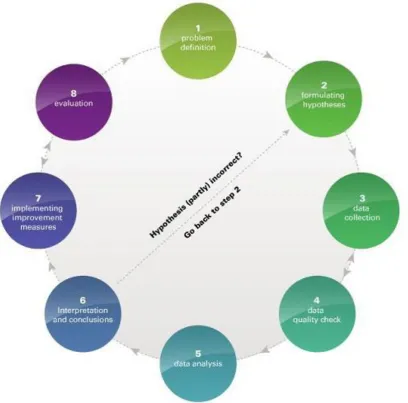
The Eight steps of the data team procedure
1. Problem definition: the team decides on which educational problem and goals they want to focus their efforts. For example, if the data team decides to focus on grade retention, the first thing the team has to do in this step is collect data on grade retention (e.g. how many grade repeaters does the school have in each grade).
2. Formulating hypotheses: the team develops hypotheses (for example on what causes grade retention). 3. Data collection: the team collects data to either confirm or reject the hypotheses. Several types of data can be
collected (e.g. assessment data, inspection reports, and examination results). 4. Data quality check. Are the collected data valid and reliable?
5. Data analysis (e.g. summarizing, calculating, comparing). This can involve simple data analyses (e.g. descriptive analyses, summarizing interview data) as well as more sophisticated analyses (e.g. correlational and regression analyses). For example, a data team in one of the studies (Schildkamp & Handelzalts, 2011) had the hypothesis that the policy of the school to still promote students with five insufficient marks on their report card to the next grade caused grade retention in the following grade. The data team collected report card data and retention data and found out that students who were promoted with five insufficient marks on their report card did not have to repeat the following grade. The hypotheses turned out to be false.
6. Interpretation and conclusion: If hypotheses turn out to be false, new hypotheses need be investigated. The data team needs to collect additional data (back to step 2). If hypotheses are correct, the team draws conclusions based on the collected data.
7. Implementing improvement measures. The team describes the measures needed to solve the problem, and the goals that go with these measures. The team makes team members responsible for implementing the actions, and determines which resources are available for implementing the actions. The team also thinks of ways to monitor the implementation of the actions, sets deadlines, and determines which data are needed to establish the effectiveness of the implemented actions.
Figure 1. The data team procedure. Schildkamp & Ehren, 2012, p. 56-57.
Data teams consist of four to six teachers and one to two school leaders. They collaborate with each other and use the data team procedure to solve the educational problem in their school (Schildkamp & Handelzalts, 2011; Schildkamp & Poortman, 2013). Data teams are trained by a trainer from the University of Twente. In secondary education, the trainer meets the school every two to three weeks over a period of two years. In every meeting, the data team and the trainer work on the eight steps of the data team procedure (Schildkamp & Poortman, 2013). For example, in a meeting, the focus is on step two of the procedure in which possible hypotheses about the cause of the problem in the school are being discussed with the use of a worksheet and a final, concrete and measurable hypothesis is formulated.
It is important that school leaders and teachers collaborate in this training, because they are more apt to implement changes in practice when they collaborate. Schildkamp and Handelzalts (2011) also state that collaboration in the data team helps teachers and school leaders to learn from each other. For example, when one teacher has an idea about which data should be used to solve the problem about the number of pupils leaving the school, another teacher can supplement ideas about other relevant hypotheses.
2011; Schildkamp et al., 2013a). The study of data teams in secondary education showed that the data teams did solve problems within the school which is positive for improving education. Furthermore, the members in the data team learn how to use data for solving problems and reaching goals which is positive for professional development of school leaders and teachers (Schildkamp & Handelzalts, 2011; Schildkamp et al., 2013).
When studying the perception of school leaders, data experts, and teachers about the use of the data team method in primary education, three criteria are important to guarantee the quality of the data team method (Van der Meij & Carroll, 1998).
First, the data team method should be comprehensible. The content of the method should be easy to
understand by school leaders, data experts, and teachers. In this study, their understanding is explored by asking respondents to give a description of the method, because in this way, it can be controlled whether they are able to reproduce important content of the method. This can provide information about the comprehensibility of the method by school teams in primary education. In addition, the used vocabulary should be in line with the vocabulary used in primary education. Studying the questions asked by participants of the workshop about the vocabulary related to the data team method provide essential information.
Second, the data team method should be useful. The eight steps of the data team procedure should work in practice. In this study, the usefulness is explored by observing the participants in working on the eight steps in a workshop. Furthermore, studying the questions asked by participants about the eight steps of the data team method also provides essential information. In addition, the opinions of the school leaders, data experts, and teachers about the usefulness of the method are asked which provides important information.
Third, the data team method should have an added value. The method has an added value when advantages of the method for using data are described by teachers, data experts, and school leaders in primary education. Studying the added values described by participants of the workshop provides important information. Examples of possible added values of the method are the development of knowledge and skills to use data, and a less use of intuition when using the data team method.
2.3 School organizational factors
Data use can be influenced by different factors. Primary education and secondary education are different school organizations (Verloop, 2003). Therefore, it is crucial to study which organizational characteristics influence the use of data in primary education. Leadership, school culture, innovation attitude, and data expert are essential organizational characteristics for primary education (Datnow, Park, & Kennedy-Lewis, 2013; Ingram et al., 2004; Schildkamp, Ehren, & Lai, 2012a; Schildkamp & Poortman, 2013). These factors will be described as separate factors, but these factors are related to each other, even overlap to some extent, and influence each other. The consequence of this is that when influencing one factor, other factors will be
2.3.1 Leadership
School leadership is important to support data use in the school (Cohen-Vogel & Harrison, 2013; Datnow & Hubbard, 2014; Datnow et al., 2013; Schildkamp et al., 2012a; Moolenaar, Daly, & Sleegers, 2010; Schildkamp & Poortman, 2013; Schildkamp, Rekers-Mombarg, & Harms, 2012b; Wayman, Jimerson, & Cho, 2012). Because school leaders have an important role in data teams in secondary education, it is essential to study the role of school leaders in data teams in primary education.
First, research of data teams in secondary education showed that the school leader must be part of the data team, because they have different perspectives on data use than teachers (Schildkamp et al., 2013a). For example, the management of the school, including the school leader, focuses more on the performance of teachers themselves while teachers focus more on the students and the school-level factors than on themselves. The participation of the school leader in the data team can influence whether the data team method can be used in primary education.
Second, the school leader should involve teachers in formulating goals which meet the needs of the school (Levin & Datnow, 2012). Shared vision and goals in the data team is essential for effective use of the data method, because in step 1, a problem should be chosen on which the data team should focus during the whole data team procedure. This problem should be shared by the whole school team to stimulate the commitment to use the method to reach the desired goals of the school (Earl & Katz, 2006; Murray, 2013; Schildkamp & Poortman, 2013; Wayman et al., 2012). For example, a shared vision of the data team that using data will lead to educational improvement and a shared goal of the data team to reduce the number of repeaters in the 5th Grade. For the use of the data team method in primary education, this means that the school leader should formulate goals together with teachers at the start of the first step of the data team method.
Third, the school leader should focus on distributed leadership for data use (Algozzine, Friend, McRae, & Seifert; 2011; Supovitz & Tognatta, 2013). The school leader should give teachers and data experts the
autonomy to make certain decisions based on data, because this will increase the motivation of the whole school team to use data. Datnow et al. (2013) mention that the school leader need to ensure that teachers and data experts have the flexibility to actually make decisions about classroom instruction based on data. When using the data team method in primary education, the school leaders, data experts, and teachers should all make certain decisions based on collected data, because this leads to the engagement of all school team members and an increase in the commitment to the method.
Fourth, the school leader should structure time in the use of data to support the data team, because time is needed for the data team to go through the eight steps of the method during the school year (Datnow & Hubbard, 2014; Datnow et al., 2013; Levin & Datnow, 2012; McCann & Cohen Kabaker, 2013). The school leader must organize meetings and give time for collaboration between teachers, data experts, and school leaders. Teachers should feel they have the time to discuss and collaborate with each other and have the time to engage in the reform (Marsh et al., 2006; Van Veen & Sleegers, 2006). This means, that the school leader should structure time in using the data team method in primary education during the school year.
team (Datnow & Hubbard, 2014). According to Earl and Katz (2006), a school leader with data literacy should be able to think about the goals of using data, should check the quality of data, should have knowledge about how to analyze data, should have knowledge about how to interpret data and should pay attention to report the outcomes. However, some school leaders have a lack of data literacy. They feel insecure about their role in leading data use in the school (Levin & Datnow, 2012; Murray, 2013). Whether the school leader has data literacy can influence whether the data team method can be used in primary education.
Sixth, the school leader should be a model for teachers and data experts in using data, so that teachers and data experts can first observe what is expected of them and feel more comfortable in engaging in this new method. Modeling might lead to an increase in the ability of teachers and data experts to analyze data (Levin & Datnow, 2012; Schildkamp et al., 2012b).The school leader should actively use data in the school (Marsh et al., 2006) and support teachers and data experts in the use of data by indicating how important data use is and by being enthusiastic about data use (Datnow et al., 2013; Schildkamp & Poortman, 2013). For the use of the data team method in primary education, this means that the school leader should model the use of the data team method and support teachers and data experts in using this.
Seventh, the school leader should teach teachers and data experts how to use data, because when the whole school team is able to use data and are able to go through the eight steps during the school year, the
sustainability of the method in the school will be enlarged for the following school years (Levin & Datnow, 2012). The school leader should teach teachers how to use, for example, observations of their teaching to identify instructional strategies. However, many school leaders have not had adequate training in analyzing and interpreting data and they have difficulties to teach teachers and data experts how to use data (Datnow et al., 2013). Whether the school leader teaches data experts and teachers how to use the data team method can influence the use of the data team method in primary education.
2.3.2 School culture
In addition to the school leader, a school culture is also an important school organizational factor (Datnow et al., 2013; Schildkamp et al., 2012b). It is essential to study the school culture of primary schools in this study, because a school culture characterizes the identity of schools which can influence the use of the data team method in primary education. Four aspects are essential to contribute to a school culture in which school leaders, data experts and teachers use the data team method.
First, datause in the school team is essential. The definition of a school team who focus on data use, which will be used in this study, is: ‘The way in which school leaders, data experts, and teachers take great care to promote thoughtful use of data, to promote a positive and collective orientation toward data use, and to provide tools that would help teachers meet the intended goals of data use’ (Datnow et al., 2013, p. 357). It is important to study whether the primary schools in this study focus on data use, because it determines how teachers use data and which types of data are used. Furthermore, data use influences the way in which decisions based on data are made (Ingram et al., 2004).
essential to study the collaboration in the data teams, because by collaborating, the teacher capacity and the team effort can be increased by together analyzing causes of problems based on data and solve these problems. Whether teachers, data experts and school leaders collaborate, might influence the use of the data team method in primary education.
Third, trust between school leaders, data experts and teachers is important to study, because with trust in a school team, data can be discussed in an open way, and the whole data team relies on each other (Algozzine et al., 2011; Datnow et al., 2013). Thereby, the data team will feel comfortable in coming to meetings to share data. In addition, the whole school team is interdependent, because, for example, the conclusions of the data team should be translated into concrete actions whereby there is a possibility that all school leaders, data experts, and teachers in the whole school should be involved. So, when using the data team method in primary education, teachers, data experts, and school leaders should trust each other.
Fourth, explicit expectations and norms regarding data use throughout the school are important (Cohen-Vogel & Harrison, 2013; Datnow & Hubbard, 2014; Datnow et al., 2013). It is essential to study whether expectations and norms regarding data use are expressed in primary schools, because when the school team is accustomed to use data in the school because using data in the school is already a norm, teachers are less likely to return to old routines of making decisions based on intuition which promotes the use of the data team method in the school. In addition, setting high expectations, such as norms for the conversations in the meeting and what materials teachers are expected to bring to meetings, will lead to professional accountability among the teachers. For the use of the data team method in primary education, this means that in the school, there should be set expectations and norms regarding data use.
2.3.3 Innovation attitude
Next to the school leader and school culture, an innovation attitude is also an important school organizational factor. The definition of innovation attitude in the context of primary schools, which will be used in this study, is: ‘The extent to which teachers have a positive attitude towards developing new knowledge, generating new practices and trying new ideas’ (Moolenaar et al., 2010, p. 638). In this study, it is essential to study the
innovation attitude in primary schools, because the attitude of teachers towards the data team method influences the way training or support is received which influences the use of the method in primary education (Moolenaar et al., 2010). According to Marsh et al. (2006), a positive attitude towards data use is beneficial for the way training will be received. Three aspects are important in considering how school leaders, data experts and teachers experience training about data use (Marsh et al., 2006).
First, whether or not school leaders, data experts, and teachers feel an obligation to use data should be studied, because it can have an impact on how training about the data team method will be received
(Schildkamp & Poortman, 2013). Educational changes in the school can only be reached when teachers feel they have the voluntariness to participate in training about data use and not by providing a mandatory training
Second, the willingness of school leader, data experts and teachers to use data is very important to study, because these findings indicate whether they are willing to use the data team method in primary schools. Teacher resistance is an everlasting phenomenon which all school reforms in the past have had to deal with and some teachers are also resistant to data use. For example, when teachers believe that there is no need to change their own practices because others are responsible (Datnow & Hubbard, 2014; Van Veen & Sleegers, 2006). When using the data team method in primary education, school leaders, data experts, and teachers should be willing to use the method.
Third, emotions of school leaders, data experts and teachers are involved in the interaction between them and the data team method (Van Veen, Sleegers, & Van de Ven; 2005). In this study, it is essential to study the emotions of teachers, data experts, and school leaders, because their emotions show whether they appreciate data use, which might influence the use of the data team method in their primary school, because in the data team method, analyzing data in depth is the most important characteristic. Negative emotions are, for example, anger and shame, and positive emotions are, for example, enthusiasm and happiness. For the use of the data team method in primary education, this means that school leaders, data experts, and teachers should show positive emotions and appreciate data use. However, showing negative emotions, such as insecurity, might also be beneficial for the use of the method in primary education, because by feeling insecure, they might understand that they can influence student results, for example, by changing their instruction, instead of believing that others are responsible.
2.3.4 Data expert
3. Method
3.1 Research description
An embedded, multiple-case study design of three cases was used to contribute to theories about teachers, data experts, and school leaders of primary schools in the use of data (Miles, Huberman, & Saldaña, 2013; Swanborn, 2013; Yin, 2003). This case study enabled the use of different instruments and respondents, and the data provided details and thick descriptions which generated deeper insights (Dooley, 2001; Swanborn,
2013).This case study was exploratory and qualitative. It was used to explore and gain deeper insights in which school organizational characteristics are important for working with the data team method in primary education, and the comprehensibility, usefulness and added value of the data team method for the use in primary education (Miles et al., 2013; Yin, 2003).
In studying the use of the data team method and the school organizational characteristics in primary schools, workshops were given to the three primary schools by trainers of the University of Twente. In this workshop, it was possible to observe the comprehensibility and the usefulness of the method. Also, aspects of the school organizational characteristics leadership, data expert, school culture, and innovation attitude were possible to observe. How these aspects are observed is explained in chapter 3.3.1 and the observation scheme can be found in the appendices. The use of a workshop for this study is relevant, because by observing how school leaders, data experts, and teachers work on assignments about the eight steps, the use of the data team method in primary education can be studied. The information found is useful for studies about data-based decision making in primary education, and for primary schools that would like to use the method in the future. The workshop took two hours and was given to one primary school at a time. A PowerPoint-presentation was developed and in every workshop, the trainer introduced the workshop by providing information about data-based decision making and about the data team method. Furthermore, it was explained that a case of a fictitious primary school would be used to teach the participants how to use the data team method.
In the three primary schools, step 1 of the method (problem definition) was explained and a definite problem definition was already given by the trainers. Also, step 2 (formulating hypotheses) was explained. The
participants were divided in small groups and got an assignment in which they should brainstorm about possible hypotheses. After brainstorming, one hypothesis should be chosen and formulated concrete and measurable. A moment of feedback took place after working on this assignment. The workshop proceeded with a hypothesis which was already formulated by the trainers in order to guarantee that the workshop could be continued and step 3 (data collection) was explained by showing data to the participants. Steps 4, 5 and 6 (data quality check, data analysis, interpretation and conclusion) were also explained, but thereafter, the participants were again divided in the same small groups, and got the assignment to check the quality of the data, analyze the data, and conclude whether the hypothesis is correct. A moment of feedback took place after working on this assignment. At the end, steps 7 and 8 (implementing improvement measures, evaluation) were explained. After the
3.2 Respondents
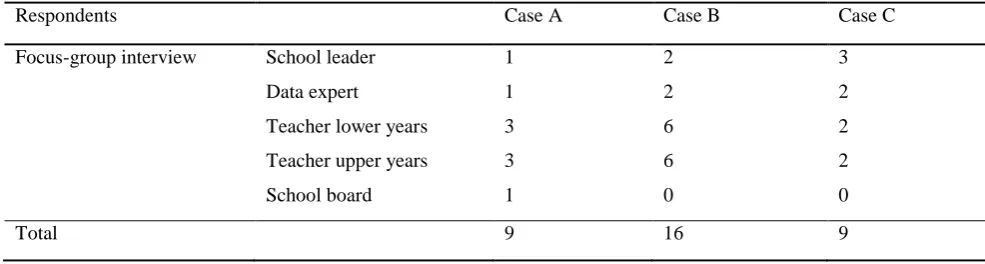
By using a self-built network of schools in the Netherlands, three primary schools were selected through ‘convenience sampling’, because of the pragmatic reason that in this first study about the data team method in primary education, the schools only had to be selected based on the stage of education (Creswell, 2009; Miles et al., 2013; Onwuegbuzie & Leech, 2007; Swanborn, 2013). The respondents of the workshop also took part in focus-group interviews, see table 1 and 2. This will be explained more in depth in paragraph 3.3.
[image:17.595.48.543.361.491.2]Homogenous sampling was used to select the respondents for the individual interviews (Miles et al., 2013; Onwuegbuzie & Leech, 2007). From the workshop participants, one school leader, one data expert, one teacher who teaches in the lower years and one teacher who teaches in the upper years were selected for the individual interviews and therefore, they had to participate in the workshops next to other school leaders and teachers, see table 3. This selection is based on the theoretical framework and the characteristics of the respondents, because they are all part of the school team in primary schools and are all involved in a data team when using the data team method.
Table 1.
Number of Respondents in Workshop.
Respondents Case A Case B Case C
Workshop members School leader Data expert
Teacher lower years Teacher upper years School board 1 1 3 3 1 2 2 6 6 0 3 2 2 2 0
[image:17.595.49.542.548.680.2]Total 9 16 9
Table 2.
Number of Respondents in Focus-group Interview.
Respondents Case A Case B Case C
Focus-group interview School leader Data expert
Teacher lower years Teacher upper years School board 1 1 3 3 1 2 2 6 6 0 3 2 2 2 0
Table 3.
Number of Respondents in Individual Interview.
Respondents Case A Case B Case C
Individual interview School leader Data expert
Teacher lower years Teacher upper years
1 1 1 1
1 1 1 1
1 1 1 1
Total 4 4 4
3.2.1 Case A
The first participating school (A) is a small primary school with approximately 70 children. The school is located in a village and has four classrooms to teach. The school uses combinations of Grades to teach, namely Grades 1/2, Grades 3/4, Grades 5/6, Grades 7/8. The school has a total of eight teachers, including the school leader and data expert, because they also teach children next to their own function.
3.2.2 Case B
The second participating school (B) is an average primary school with approximately 240 children. The school is located in a city and has eight classrooms to teach, namely for Grade 1 until Grade 8. The school has two school leaders, two data-experts and twelve teachers.
3.2.3 Case C
The third participating school (C) is a large primary school with approximately 520 children. The school is located in a city and has nineteen classrooms to teach, for Grade 1 until Grade 8. The school has three school leaders, two data-experts, and twenty-six teachers.
3.3 Data collection and instrumentation
3.3.1 Observations
The reactions of the workshop participants on the data team method were observed (Kallenberg, Koster, Onstenk, & Scheepsma, 2011). The observations took two hours. Data were collected by video recording the workshops and using an observation scheme. With regard to the first research question, for example, it was observed whether questions were asked by participants about vocabulary related to the data team method, and whether the participants worked on the assignment of step two of the data team procedure. With respect to the second research question, for example, it was observed whether the school leader and data-expert were present at the workshop and what the collaboration between the participants looked like when working on the
3.3.2 Focus-group interviews
After the workshop, interviews were conducted. In this study, focus-group interviews and individual interviews were used (Baarda, De Goede, & Van der Meer-Middelburg, 2007; Dooley, 2001; Kallenberg et al., 2011). The focus-group consisted of all the teachers, data experts and school leaders in each primary school who participated in the workshop (Owuegbuzie & Leech, 2007; Krueger, 2000). The focus-group interviews took place immediately after the workshop and were video-recorded. Relating to the first research question, for example, it was asked: ‘what do you think of the used vocabulary in the method?’ and ‘what is your opinion about the usefulness of the steps of the data team procedure?’ With regard to the second research question, for example, it was asked: ‘what needs the school to use the data team method successfully?’ and ‘what factors hinder working with the data team method in primary education?’
3.3.3 Individual interviews
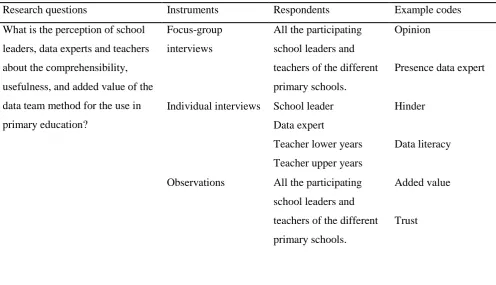
[image:19.595.54.551.491.776.2]The individual interviews were taken with one school leader, one data expert, one teacher who teaches the lower years and one teacher who teaches the upper years in each primary school and were audio-recorded (Creswell, 2009). With respect to the first research question, for example, it was asked: ‘what is your opinion about the used vocabulary in the data team method?’ and ‘can you explain whether you see an added value of the data team method?’ With regard to the second research question, for example, it was asked: ‘how did you experience the role of the school leader in the workshop?’ and ‘can you explain whether your school uses data for making decisions?’ In table 4, an overview is given of the instruments, respondents and codes used to answer the research questions.
Table 4.
Relation between Research questions, Instruments and Respondents.
Research questions Instruments Respondents Example codes
What is the perception of school leaders, data experts and teachers about the comprehensibility, usefulness, and added value of the data team method for the use in primary education?
Focus-group interviews
All the participating school leaders and teachers of the different primary schools.
Opinion
Presence data expert
Individual interviews School leader Data expert
Teacher lower years Teacher upper years
Hinder
Data literacy
Observations All the participating school leaders and teachers of the different primary schools.
Added value
Which school organizational characteristics are important for working with the data team method in primary education?
Focus-group interviews
All the participating school leaders and teachers of the different primary schools.
Voluntary
Collaboration
Individual interviews School leader Data expert
Teacher lower years Teacher upper years
Data attitude
Data use
Observations All the participating school leaders and teachers of the different primary schools.
Comprehensibility
Usefulness
3.4 Data analysis
The observation data and the interview data were transcribed verbatim. The program Atlas.ti was used for coding the transcripts, relating the coded fragments to each other, and comparing the codes of different schools and respondents, within and across cases (Boeije, 2002). A coding schedule was applied, based on the
theoretical framework and research questions: ‘What is the perception of school leaders, data experts and teachers about the comprehensibility, usefulness, and added value of the data team method for the use in primary education’ and ‘Which school organizational characteristics are important for working with the data team method in primary education?’ This coding schedule can be found in the appendices. With regard to the first research question, codes were, for example: ‘comments about the content of the data team method’ and ‘whether the participants work on the assignments of step 2 (formulating hypotheses) of the data team method’. Relating to the second question, codes were, for example: ‘description of the role of the school leader in the team during the workshop about the data team method’ and ‘the data expert is present at the workshop’. For each of the schools, a within-case analysis was conducted, followed by a cross-case analysis comparing the primary schools on each element of the coding schedule. This case-oriented approach was used to identify the similarities and differences of the primary schools that provided further insight in the theory about the use of the data team method in primary education and the school organizational characteristics that impact the use of the method in primary education (Miles et al., 2013).
3.5 Procedures
A systematized approach for data collection was followed in order to compare the results between
characteristics for working with the data team method in primary education were studied thoroughly by using observations and interviews for data collection. The instruments were based on the theoretical framework. The instrument ‘individual interview’ was tested with one teacher from a primary school from the Netherlands to ensure reliability and to get information about the duration of the interview.
Construct validity was ensured by using data from observations of the workshop, focus-group interviews and individual interviews which led to the establishment of a chain of evidence, and by letting other educational researchers review the research for feedback, such as the first and second supervisor (Poortman & Schildkamp, 2011; Yin, 2003). The observational data were triangulated with the interview data (Boeije, 2002). Triangulation took place at the level of the respondents and at the level of the instruments (Dooley, 2001). School leaders, data experts and teachers are observed and interviewed. Observations, focus-group interviews and individual
interviews are used as instrumentation. Approximately ten percent of all the items of the instrumentation were coded by two researchers for calculating the inter-rater reliability. A satisfactory Cohen’s Kappa of 0.898 was found (Dooley, 2001).
Internal validity was enhanced by highlighting major patterns of similarities and differences between respondents’ experiences and beliefs based on the aspects of the theoretical framework (Miles et al., 2013; Schildkamp & Poortman, 2013; Swanborn, 2013). For example, the role of the data expert in a data team is in all cases described. Those descriptions were context-rich, meaningful and thick.
External validity was ensured by providing case-specific and cross-case thick analyses (also including citations of respondents), and describing the congruence with the theoretical framework by using the same structure for describing important aspects (Creswell, 2009; Schildkamp & Poortman, 2013; Yin, 2003). This led to findings of the study which were generalizable to theoretical propositions, which gained insight into the two research questions. The use of the data team method in primary education should be studied more in depth in other researches (Miles et al., 2013). The workshops and focus-group interviews were videotaped and the individual interviews were audiotaped, which allowed for thorough analyses (Poortman & Schildkamp, 2011). As all workshops and interviews were given in the Netherlands, the citations were translated into English to be used for this thesis.
4. Results: Within-case analysis
In this paragraph, each case will be described in detail. The perception of school leaders, data experts and teachers about the comprehensibility, usefulness, and added value of the data team method for the use in primary education, and the school organizational characteristics for working with the data team method in primary education, are summarized.
4.1 Results case A
4.1.1 The comprehensibility, usefulness and added value of the data team method
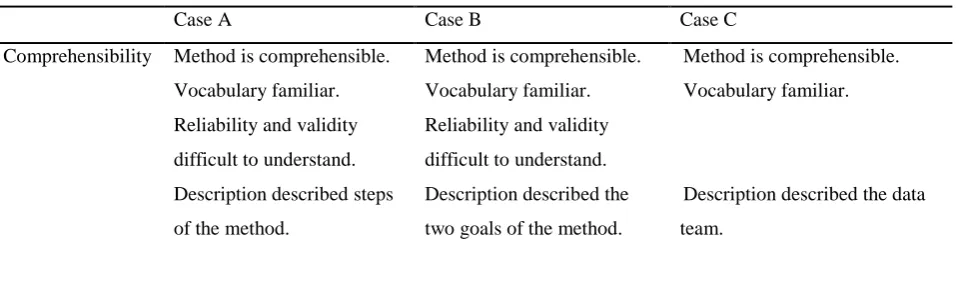
Comprehensibility data team method
In the individual interview, all respondents described that the used concepts in the method are familiar to them. The school leader stated: ‘The content and used words in the method are clear, organized and
comprehensible for us in primary education.’ However, in the focus-group interview, the teacher who teaches the lower years stated that the concepts reliability and validity are difficult to understand, but that all other content of the method is easy to understand. Furthermore, a question is asked about vocabulary during the workshop in this school. The school leader asked the trainer to explain the concepts reliability and validity. In the individual interview, the school leader explained that she thinks these are difficult to comprehend for teachers. So, these perceptions are positive for the use of the method in primary education, because the results show that the content and vocabulary are easy to comprehend in this primary school. Still, results also showed that the concepts reliability and validity might be difficult to understand.
In addition, the respondents of the individual interviews and the focus-group interviews were all able to give a description of the data team method. The data expert described: ‘Formulating a hypothesis about a problem, collecting data, such as observations and tests, control whether these data are reliable, and study whether the hypothesis is wrong or correct before implementing actions’. The teacher who teaches the upper years
described: ‘By using data, possible causes will be studied and when the causes are correct, a solution should be found, and actions should be implemented.’ All respondents reproduced important content of the method in their description, so their ability to reproduce important content of the method is controlled, which is positive for the comprehensibility of the method in this primary school.
Usefulness data team method
complete the fourth step. This group of participants did not comprehend the concepts reliability and validity, which was needed to complete step 4. During the moment of feedback with all the participants and the trainer, this group mentioned that when the trainer would guide them in working on step 4; it would be less difficult to complete the steps. Both groups of workshop participants asked questions during the completion of step 2 and steps 4-5-6 which showed their use of the steps of the data team method, for example: ’So we must actually study what is wrong with the current method instead of searching for other new methods when we define our hypothesis?’ These results of the observation show that participants in this primary school were able to work on assignments about the data team method, which is a positive result regarding the usefulness of the method for primary education. However, these results also show that working on assignments about steps 4-5-6 requires high level knowledge and skills of the data team.
Furthermore, all four respondents expressed positive opinions regarding the data team method. They found the eight steps useful, clear, and organized. In the individual interview, the school leader stated: ‘Our school can work with this method and it is applicable for the teachers to use in practice, because the eight steps describe which actions should be taken next and the trainer guides the data team during the school year.’ The data expert stated that the steps are of a high-level and statistic knowledge is needed to complete the steps, for example to formulate a measurable hypothesis. In addition, she mentioned that teachers might think the eight steps are not work-related, because the procedure often focuses on overarching problems instead of studying, for example, the subject mathematics in the own class. The teacher who teaches the upper years described: ‘We did not always understand how we could complete the task, because we are not used to analyze data so thoroughly.’ The member of the school board argued: ‘I want to discuss with other school board members and with the school leader whether the method can get a place within the strategic policy of the school.’ He stated that this method definitely can be used in practice in primary education, because schools are willing to improve student results and with the guidance of trainers and the use of data of the own school, this can be achieved. These results show that in this primary school, the respondents think the method is useful for their school and in other primary schools which is beneficial for the use of the method in primary education. However, the results also show that some respondents think the eight steps are of a high level which is consistent with the results of the observation of the workshop participants in working on the steps.
Added value data team method
teaches the lower years stated that an advantage of this method is that data team members learn that intuitions about causes and problems are often not correct. The teacher who teaches the upper years and the teacher who teaches the lower years both stated they think the manual of the data team method is an added value, because it can be used as a reference to guide the teachers. The teacher who teaches the upper years described: ‘The manual entails information to read, but also schemes which should be completed, so the method is theoretical and practical for us as teachers. ’The teachers who teach in the lower years also described the collaboration in the team as an added value of the data team method. ‘I find it so valuable that we can discuss together our problems and hypotheses, so that everybody is much more focused and to-the-point, because at this moment, the school leader and data expert mainly discuss problems in the school.’ These results show that many advantages of the method are described by the participants in this primary school. All those perceptions about the
advantages of the method show the added value of the method. The added value of the method described in this primary school is positive for the use of the method in primary education.
4.1.2School organizational characteristics for working with the data team method in primary education
Leadership
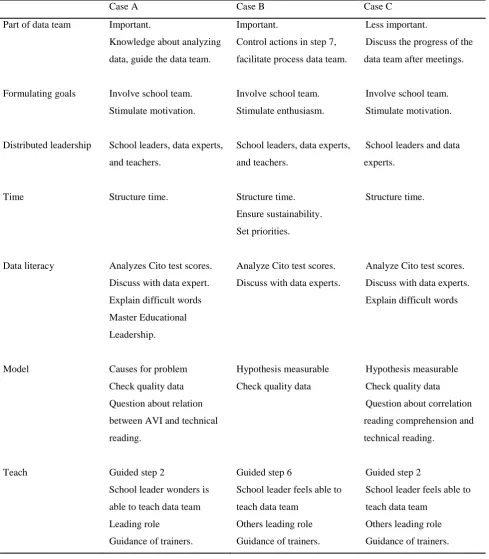
First, the school leader was part of the data team, because she was present at the workshop about the data team method. All four respondents described that the participation of the school leader in the data team is essential for implementing the method in primary education, because she has knowledge about analyzing data and can guide the data team members next to the trainers. For example, by giving concrete examples about which types of tests can be collected in their primary school when data should be collected in step 3 of the method.
Second, in the workshop about the method, it is not showed whether the school leader involved teachers and data experts in formulating goals, because a case of a fictitious primary school was used in which step 1 of the method (problem definition and formulation goals) was already given by the trainers, because otherwise, the workshop would take too much time. However, in the individual interview, the school leader described she wants to involve the whole school team in deciding on which problem and goals the data team is going to focus, to stimulate their motivation. For example, by sharing in meetings which problems arise in the school and discuss which problem should get attention first.
All four respondents described in the individual interviews, that during the workshop, the school leader acted as an equal part of the team and let others also make decisions. So, the results of this observation and of the interviews show that the school leader in this primary school tries to focus on distributed leadership, which is positive, because this might increase the engagement of all school team members to use the method.
Fourth, in the focus-group interviews, the respondents described that the school leader should structure time in using the data team method in primary education. Time to use the method is seen as a possible hindering factor, because many other aspects in the school also need time in addition to the time which is needed for going through the data team procedure. Therefore, the respondents described that when the method would be
implemented in their school, the data team should get enough time, which is structured by the school leader, to complete each step in order to solve problems and meet goals. For example, when implementing the method in primary education, 45 minutes must be scheduled free every week by the school leader to let the data team members work with each other in completing the steps in addition to structuring time for the meetings with the trainer once in every three weeks.
Fifth, the school leader showed characteristics of data literacy. In the individual interview, the school leader mentioned that she has more experience with research and data than other colleagues in the school, because of her Master Educational Leadership. In the workshop, she explained the definition of reliability and validity. Also, according to the data expert, the school leader is able to analyze data and thereby, controls the progress of results. However, they both stated that the school leader always consults the data expert in data-based decision making. The data expert makes analyses of data of the whole school and the school leader has the responsibility to control the analyses to get an overview of the results in the school.
Sixth, the school leader also was a model forthe data expert and teachers in using the data team method in the workshop. She used data to define the problem of the case, and checked the quality of the collected data by, for example, noticing that a G score was entered in the student monitoring system. Furthermore, she made conclusions based on the collected data. In addition, she asked: ‘Can you relate the insufficient level of the test of AVI to the percentage of inadequate technical reading?’
Seventh, in the workshop, the school leader showed characteristics of teaching teachers and data experts how to use the data team method, because she sometimes taught how the assignments had to be completed. For example, in completing step 2 of the method, she taught a teacher that motivation of learners to read can be measured. However, in the individual interview, the school leader described: ‘I have the capability to
understand the data team method and I can guide colleagues, but I am not able to teach and train the teachers and data expert.’ Apparently, the school leader feels she is not able to teach the data team how to use the method, but in the workshop, it is observed that she was able to teach certain aspects. In the individual
School culture
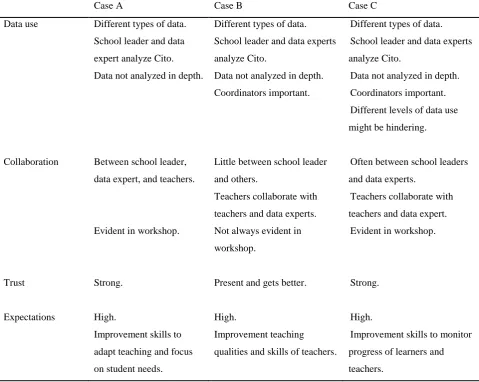
First, a focus on data use by the school team is shown in this primary school, because the school uses different types of data and base decisions on these data. In the individual interviews, all four respondents described that Cito scores are mainly used in analyzing data. In addition, the school leader stated: ‘We use data about Cito scores, observations, social-emotional tests, and tests of, for example, mathematics and reading,’ However, in the focus-group interview, all respondents described that in the school, actions are taken too fast, intuition is used too often, and data are not analyzed in-depth. In addition, in the individual interview, the teacher who teaches the upper years explained: ‘What is missing in our school is a clear continuous line which leads you from the problem to taking considered actions.’ So, in this primary school, there is a focus on data use in which different types of data are used, for example, to monitor results, but still data are not analyzed in depth and actions are taken too fast.
Second, results showed that collaboration takes place between the school leader, data expert, and teachers. In the individual interviews, all respondents stated that the school leader always collaborates with the data expert in making decisions based on data, and also collaborates with teachers in team meetings by giving opportunities to express opinions. The teacher who teaches the upper years stated: ‘It is pleasant that the door of the office of the school leader is often open, because this makes it easier to discuss difficulties or share improvements of learners, which stimulates the collaboration.’ The teacher who teaches the lower years and the data expert described the importance of collaboration between data team members and non-data team members, because data should be shared. In the workshop about the data team method, the participants collaborated in working on the assignments of the steps. They discussed possible causes of the problem, and the quality of data, asked each other questions, and filled in the answers of the assignments together. Every participant has said something during the collaboration and they let each other finish their sentences. So, in this primary school, the school leader, data expert, and teachers collaborate with each other, which might be beneficial for the use of the data team method, because in a data team, the members should also collaborate by together analyzing causes of problems based on data in order to solve these problems.
Third, all four respondents described in the individual interviews that the trust in each other is very strong and stimulated by sharing opinions in organized team meetings. The trust is seen by them as very important for implementing the method in their school, because the whole school team should be involved to solve problems and implement solutions, for example, by sharing data of the learners in the own grade. In the individual interview, all respondents described that the school leader meets teachers to discuss together how the teachers could professionalize, and that she asks teachers work-related questions, but also questions about their personal life. The school leader stated: ‘A positive attitude to each other, sharing opinions, and focusing on the talents of each other to reach goals stimulates the trust.’ So, these results show that in this primary school, the school team has trust in each other which might promote the implementation of the method in their school, because in a data team, trust is also essential because data should be shared and actions should be implemented in the school.
gives the opportunity and responsibility to set own boundaries. The school leader stated: ‘Setting high goals and expectations for using data leads to an improvement of our education in the school, because teachers learn to adapt their teaching based on the data and to focus on the needs of students.’ These results show that the school team is accustomed to use data in the school because using data is already a norm. Therefore, teachers are less likely to return to old routines of making decisions based on intuition, which might promote the use of the data team method in their school.
Innovation attitude
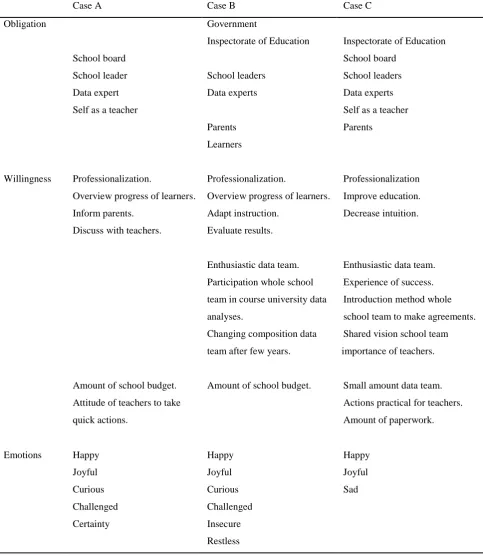
First, in the individual interviews, all respondents stated they feel the school is obliged to use data. The school leader and data expert stated they feel obliged, because the results of the school have to be accounted by the local network of schools. The data expert mentioned: ‘The use of the student monitoring system to collect data is an example of our agreements.’ The teacher who teaches the upper years and the teacher who teaches the lower years both stated that they want to have an overview of the results of children for themselves as a teacher in order to follow their progress, but that the data expert and the school leader also oblige the use of data. So, these results show that in this primary school, the respondents feel obliged to use data by several persons which might influence the use of the data team method in this school, because whether or not school leaders, data experts, and teachers feel anobligationto use data can have an impact on how training about the data team method will be received.
Second, in this primary school, results showed the willingness of respondents to use data. In the focus-group interview, the respondents mentioned that the willingness of the school team to use data and to use the data team method is essential for implementing the method, because their willingness is needed, for example, to
implement actions, such as, adapting teaching strategies of teachers or changing the timetable of the school. In addition, they explained that data is important to get an overview of the progress of the individual learner, groups of learners, and the whole school, and that data can be used in meetings with parents or in discussions with other teachers. The data expert thinks that using data leads to professionalization as a data expert, but that it is very important to study data, for example, about how children learn, next to data about tests. In the individual interview, the school leader described: ‘I am willing to use data in the school, because with data I am able to, for example, control whether learning results have improved and compare those results between different grades in the school.’ However, he stated that a hindering factor is that teachers are used to take quick actions instead of going through a long process of analyzing. The teacher who teaches the upper years emphasized that the amount of budget of the school should be considered. These results showed that in this primary school, the respondents are willing to use the method, for example, to control learning results and to professionalize. However, hindering factors are also mentioned, such as the attitude of teachers of taking quick actions.
Third, in the individual interviews, the four respondents all expressed the positive emotion happy to use data in their school. The school leader also feels joyful and curious, because she feels that she develops her
because I can control whether the results of the learners have increased.’ The teacher who teaches the lower years described that data give her certainty, because she can use data to inform parents about the processes of her learners. So, in this primary school, positive emotions regarding data use are expressed, which might be beneficial for the use of the data team method in their primary school, because analyzing data in depth is the most important characteristic of the data team method.
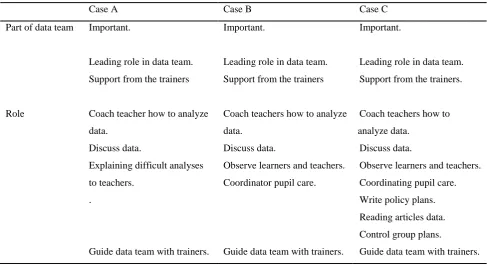
Data expert
The development and training of the capacity of the school team in using data is essential in establishing effective data use in schools and training can be facilitated through internal support, for example by the data expert of the school itself. In this primary school, results showed that the data expert was part of the data team, because she was present at the workshop about the data team method. In the individual interviews, all four respondents described the role of the data expert as coaching the teachers in analyzing data, and discussing data in order to develop group plans to increase the results of children. The teacher who teaches the lower years described that she likes the supporting role of the data expert in analyzing data. ‘The data expert explains difficult analyses in the student monitoring system and collaborates with teachers.’ The data expert explained that she gets much support from a network of other data experts, and from the school leader. In addition, she described: ‘I am not able to guide the data team by myself, but with support from the trainers I would be able to guide the data team in this process.’ The teacher who teaches the upper years stated that the data expert could have a leading role in guiding the data team instead of the school leader. ‘The data expert has more knowledge and skills with regard to data use compared to the school leader.’ The presence of the data expert in the data team is mentioned as important for implementing the method, because the respondents think she has the skills to explain difficulties between meetings. So, these results showed that in this primary school, the data expert can have an important role in guiding the data team in analyzing data, because she has knowledge and skills about using data, and already coaches the teachers often. However, in addition to the data expert, trainers are needed.
Prioritization
4.2 Results case B
4.2.1 The comprehensibility, usefulness and added value of the data team method
Comprehensibility data team method
In the focus-group interview, the four respondents stated that the vocabulary is familiar. In the individual interview, the school leader described: ‘The vocabulary was easy to understand and the content of the method is clear.’ However, the data expert wonders whether all the teachers understand certain concepts such as
reliability, but likes the explanation of the words in the manual of the data team method. The teacher who teaches the lower years also stated that certain vocabulary is difficult to apply. ‘I understand the concept reliability when I read the explanation in the manual, but I still find it difficult to check the reliability of a test.’
The teacher who teaches the upper years explained: ‘The content of the method is easy to understand, and in the workshop I did not need to ask for clarification of certain vocabulary.’ Furthermore, in this primary school, no questions are asked about the vocabulary of the method, which provides positive information about the
comprehensibility of the method in this primary school. So, in this primary school, it is mentioned that the concepts reliability and validity might be difficult to understand, but that all other content and vocabulary are easy to comprehend. These findings influence the possibility to use the method in primary education.
In addition, the respondents of the individual interviews and the focus-group interviews were all able to give a description of the data team method. The teacher who teaches the lower years described: ‘A data team consists of teachers who teach in different grades, a data expert, a school leader, and a trainer. This team will analyze a problem, formulate and study hypotheses by using data to consider which actions should be taken. All eight steps should be taken once or more often before a problem can be solved and a new problem can be analyzed.’
The school leader explained: ‘It is a procedure which can be used in the school to professionalize the school team, but also to improve student results in your own school by analyzing causes of problem in depth on school level, group level and individual level before taking actions immediately.’ The respondents reproduced
important content of the method in their description, which is positive for the comprehensibility of the method in this primary school, and thereby is positive for the use of the method in primary education.
Usefulness data team method
In the workshop about the data team method, all groups of participants were able to complete the assignment about step 2 (formulating hypotheses). One group of participants mentioned, for example, motivation of