THE FIRST DIRICHLET EIGENVALUE OF THE LAPLACIAN IN A CLASS OF
DOUBLY CONNECTED DOMAINS IN COMPLEX PROJECTIVE SPACE
Akanksha V. Rane and A. R. Aithal
Department of Mathematics, University of Mumbai, Vidyanagari, Mumbai 400 098, India
e-mails: avrane [email protected]; [email protected]
(Received 22 June 2017; after final revision 20 January 2018; accepted 1 March 2018)
LetB1 be an open ball of radiusr1in the complex projective space. LetB0 be a smaller open
ball inside it. It is shown that first Dirichlet eigenvalue of the Laplacian onB1\B0is maximal if
and only if the balls are concentric.
Key words : Laplace-Beltrami operator; extremum of first Dirichlet eigenvalues; maximum-principles.
1. INTRODUCTION ANDSTATEMENT OFMAINRESULT
The complex projective space CPn is the set of all complex lines through origin in Cn+1. It is a complex manifold of dimension n with the Fubini-Study metric h·,·i (see § 2). Let ∆ be the Laplace-Beltrami operator ofCPn.LetΩbe an open subset ofCPnsuch thatΩ¯ is a smooth compact
submanifold ofCPnwith smooth boundary.
Consider the following Dirichlet eigenvalue problem onΩ :
−∆u=λu onΩ,
u= 0 on∂Ω )
(1.1)
By Theorem 4.4, p.105 of [4], the eigenvalues of the Laplace-Beltrami operator−∆are strictly
positive. The eigenfunctions corresponding to the first eigenvalueλ1are proportional, they belong to C∞( ¯Ω)and they are strictly positive or strictly negative onΩ.Moreover,
Lety1 :=y1(Ω)be the unique solution of (1.1) corresponding to the first eigenvalueλ1(=λ1(Ω)) characterized byy1 >0onΩand
R
y12dV = 1.
Fix two real numbersr0 andr1 such that0 < r0 < r1 < π2.LetB0 andB1 be arbitrary balls of radiir0andr1respectively inCPnsuch thatB¯0 ⊆B1.Consider the familyF ={Ω :=B1\B¯0}of domains inCPn.We study the maxima of the first eigenvalueλ
1(Ω)overF.
We state the main result: PutΩ0 :=B(p, r1)\B(p, r0)for anyp∈CPnfixed arbitrarily.
Theorem — The first Dirichlet eigenvalueλ1(Ω)on F attains its maximum atΩif and only if Ω = Ω0(i.e. the balls are concentric).
Similar problems for Euclidean space, Space forms, rank-1 symmetric spaces of non-compact
type were solved in the research papers [1-3] respectively.
2. GEOMETRY OFCPn
The standard Hermitian inner product on Cn+1 is denoted by h·,·iCn+1. We identify Cn+1 with
R2n+2.The real part ofh·,·iCn+1 is the Euclidean inner product of R2n+2,denoted by h·,·iR2n+2.
LetS2n+1={(z0, z1,··, zn)∈Cn+1 |
Pn
j=0|zj|2= 1}denote the unit sphere ofR2n+2.
Let S1 denote the multiplicative group of complex numbers of absolute value 1. Consider the
natural action ofS1on the unit sphereS2n+1defined as follows:∀λ∈S1 and ∀(z0, z1,· · ·, zn)∈
S2n+1
λ(z0, z1,· · · , zn) = (λz0, λz1,· · ·, λzn).
This action ofS1 defines an equivalence relation onS2n+1 andCPncan be viewed as the resulting quotient space of S2n+1.Let [(z
0, z1,· · · , zn)] denote the equivalence class of(z0, z1,· · ·, zn) ∈
S2n+1.Consider the quotient mapπ :S2n+1 −→CPndefined by
π(z0, z1,· · · , zn) = [(z0, z1,· · ·, zn)], ((z0, z1,· · · , zn)∈S2n+1).
Letq∈CPnandq˜∈π−1(q)be arbitrary. The tangent space ofπ−1(q)atq˜is called the vertical space atq˜, denoted byV˜q,i.e. Vq˜={t(iq˜)|t∈ R}.LetHq˜={v ∈Cn+1 :hv,q˜iCn+1 = 0}.Thus
we have an orthogonal decomposition
Tq˜S2n+1=Hq˜⊕ Vq˜
and any vectorv ∈ Hq˜is called a horizontal tangent vector of S2n+1 atq.˜ Note that dπ : Hq˜ −→
dπ( ˜w) =w.Then the Fubini-Study metrich·,·ionCPnis defined by
hv, wi=hv,˜ w˜iR2n+2.
Thus the mapπ:S2n+1−→CPnis a Riemannian submersion.
IfXis a tangent vector field onCPnthen there is a unique tangent vector fieldX˜ onS2n+1such thatdπz( ˜X(z)) =X(π(z)) & ˜X(z)∈ Hz ∀z∈S2n+1.The vector fieldX˜ is called the horizontal
lift ofX.Let∇¯,∇be the Levi-Civita connections onS2n+1andCPnrespectively. Then
∇X˜Y˜ =∇^XY +1 2[ ˜X,Y˜]
v
where[ ˜X,Y˜]v denotes the vertical part the vector[ ˜X,Y˜].Hence
(∇XY)(q) =dπq˜ ³
(∇X˜Y˜)(˜q) ´
∀q∈CPn,∀q˜∈π−1(q).
The Riemannian manifoldCPnis complete and its injectivity radius isπ2.
For any two points p, q ∈ CPn, d(p, q) denotes the distance between them in CPn. Then
d(p, q) ≤ π
2.For any two points z, w ∈ S2n+1, dS2n+1(z, w) denotes the distance between them inS2n+1.
Definition — A geodesicc(s)inS2n+1such thatc0(s)∈ Hc(s)is called a horizontal geodesic of
S2n+1.
The geodesics ofCPnare described by the following result:
Proposition 2.1 — [6].
(1) Letc: [0,1]−→ S2n+1be a geodesic such that its initial velocity vectorc0(0)∈ Hc(0).Then
c0(s)∈ H
c(s)∀s∈[0,1]and the curveπocis a geodesic ofCPnhaving the same length asc.
(2) Conversely, letσ : [0,1] −→ CPn be any geodesic. Then for any q˜ ∈ π−1(σ(0)), there
exists a unique horizontal geodesic˜σ : [0,1] −→ S2n+1 such thatσ˜(0) = ˜q, dπq˜(˜σ0(0)) =
σ0(0) &π◦σ˜=σ. 2
Example 2.2 : For each0 ≤ j ≤ n,letej = (0,0,··,1,0,··,0)where1occurs in thej+ 1-th
place. Thene0 := (1,0,· · · ,0)∈S2n+1, & ie1 = (0, i,0, . . . ,0)is a horizontal tangent vector of
S2n+1ate
0.Define
c(s) := (coss, isins,0, . . . ,0) (s∈R).
Thencis a horizontal geodesic inS2n+1(withc(0) =e0 &c0(0) =ie1) and henceπ◦cis geodesic
Letq ∈ CPnbe arbitrary and q˜∈ π−1(q)be fixed. Let{v, w} ⊂ TqCPnbe an orthonormal
subset and letP = spanR{v, w} be a plane ofTqCPn. Then the Riemannian sectional curvature
K(P)of the planePisK(P) = 1 + 3 cos2θwherecosθ=hv, iwi.In particular1≤K(P)≤4.2
Lemma 2.3 — Fix any two distinct pointsp1, p2 ofCPn.
(1) Fixp˜1 ∈π−1(p1).Then there existsp˜2 ∈π−1(p2)such thatdS2n+1( ˜p1,p˜2) =d(p1, p2).And
given any such pair ( ˜p1,p˜2) of points inS2n+1, ∃a unique horizontal geodesic ˜σ in S2n+1 joiningp˜1top˜2 having lengthd(p1, p2).
(2) Suppose thatd(p1, p2) < π2.Fix anyp˜1 ∈π−1(p1).Then∃ uniquep˜2 ∈ π−1(p2)such that
dS2n+1( ˜p1,p˜2) =d(p1, p2).
(3) Letz∈π−1(p1)andw∈π−1(p2)be arbitrary. Then
d(p1, p2) = arccos|hz, wiCn+1|. (2.1)
PROOF : Putl := d(p1, p2)(≤ π2).Letσ : [0, l] −→ CPnbe a unit speed geodesic such that
σ(0) = p1 & σ(l) = p2.By proposition 2.1∃unique horizontal geodesic σ˜ : [0, l] −→ S2n+1 of
lengthlsuch that˜σ(0) = ˜p1 &π◦σ˜=σ.Put
˜
v = ˜σ0(0) & ˜p2 := ˜σ(l). (2.2)
Since the injectivity radius ofS2n+1 isπ and length(˜σ) = l < π,σ˜ is the unique geodesic of
lengthlinS2n+1joiningp˜1 top˜2.This proves (1).
Proof of (2) : Letσbe as given in (1). Ifl < π2 thenσis the unique unit speed geodesic of length
linCPnjoiningp1 top2.Letp¯2 ∈π−1(p2)be any point such thatdS2n+1( ˜p1,p¯2) = l.Letcbe the
unique unit speed geodesic of lengthlinS2n+1joiningp˜1top¯2.Thenπ◦cis a distance minimizing
curve inCPnjoiningp1top2,and hence it is a geodesic ofCPn.Since π2 is the injectivity radius of CPnandl < π
2,it follows thatπ◦c =σ.Then by (2) of Proposition 2.1,c = ˜σ&hencep˜2 = ¯p2. The proof (2) is now complete.
Proof of (3): Now by (2.2),p˜2= (cosl) ˜p1+ (sinl)˜v.Hence
hp˜1,p˜2iCn+1 = (cosl)hp˜1,p˜1iCn+1+ (sinl)hp˜1,v˜iCn+1
= cosl (∵˜v∈ Hp˜1)
(2.3)
Thenhp˜2,p˜1iCn+1 = cosl.Hence
Thus
cosl=php˜1,p˜2iCn+1hp˜2,p˜1iCn+1 =|hp˜1,p˜2iCn+1|. (2.4)
Sod(p1, p2) =l= arccos|hp˜1,p˜2iCn+1|.From 2.4, it is clear thatd(p1, p2) = arccos|hz, wiCn+1| ∀ z∈π−1(p
1)andw∈π−1(p2).This proves (3). 2
3. A TANGENTVECTORFIELD OFCPn
Consider the matrix
A=
0 i i 0
inM(n+1,C)where all the entries not shown are zero. ThenA∈u(n+1)andetA ∈U(n+1)∀t∈
R.For eacht∈Rdefine a mapψt:CPn−→CPnby
ψt([(z0, z1,··, zn)]) = [etA((z0, z1,··, zn))],
i.e. ψt([(z0, z1,··, zn)]) = [((cost)z0+i(sint)z1, i(sint)z0+ (cost)z1, z3,· · ·, zn)]
∀ ([(z0, z1,··, zn)]∈CPn.Then eachψ
tis a well-defined map, and it is an isometry ofCPn.
Define a vector field V onCPnbyV([(z0, z1,··, zn)]) = dtdψt([(z0, z1,··, zn)])|t=0.ThenV([(z0, z1,··, zn)]) =
dπz˜(A(˜z)) = dπz˜((iz1, iz0,0,· · ·,0)) wherez˜ := (z0, z1,· · · , zn).The horizontal tangent vector
fieldV˜ onS2n+1corresponding to V is given as follows: At anyz˜= (z0, z1,·,·, zn)∈π−1([(z0, z1,··, zn)]),
˜
V(˜z) =A(˜z)− hA(˜z),z˜iCn+1z.˜
Thus
˜
V(˜z) = (iz1, iz0,0,· · ·,0)−2Re(z0z¯1)(iz˜). (3.5)
Lemma 3.1 — Let µ(s) : [0, l] −→ CPnbe any geodesic in CPn.ThenhV(µ(s)), µ0(s)iis a constant function on[0, l].
PROOF: Letµ˜: [0, l]−→S2n+1be a horizontal geodesic inS2n+1such thatπ◦µ˜=µ.Then
hV(µ(s)), µ0(s)i = hV˜(˜µ(s)),µ˜0(s)iR2n+2
= hA(˜µ(s)),µ˜0(s)iR2n+2.
Hence d
dshV(µ(s)), µ
0(s)i=hA(˜µ0(s)),µ˜0(s)i
4. PROOF OF THEMAINTHEOREM
Put p := π(e0) where e0 = (1,0,· · · ,0) ∈ S2n+1 ⊂ Cn+1. As seen in example 2.2, c(s) = (coss, isins,0,· · · 0)∀0 ≤s ≤ π2 is a horizontal geodesic withc(0) = e0 andc0(0) = ie1.Then
γ:=πocis a geodesic inCPn.
For 0 < r0 < r1 < π2 (c.f§1), fix a real number s0 such that0 ≤ s0 < r1−r0.PutΩs0 :=
[image:6.612.233.467.260.451.2]B(p, r1)\B(γ(s0), r0).LetB0:=B(γ(s0), r0), B1:=B(p, r1)andΩ := Ωs0.See figure 1.
Figure 1:B(p, r1)\B(γ(s0), r0)
Letq ∈ ∂B0be any point. Letn(q)be the outward unit normal ofΩon∂Ωatq ∈∂B0.Letµq
be the unit speed geodesic inB0such thatµq(0) =γ(s0)andµq(r0) =q.Putvq=µ0q(0).Then
µq(s) = expγ(s0)(svq) ∀0≤s≤r0. (4.1)
Then by Gauss’s lemma, the outward unit normal of∂Ωatq∈∂B0is given by
n(q) =− d
dsµq(s)|s=r0. (4.2)
Let
∂B0+={q ∈∂B0|hµq0(0), γ0(s0)i>0}.
Lemma 4.1 —hV(q),n(q)i<0∀q∈∂B0+.
PROOF : Fix any q ∈ ∂B+0.By the Lemma 3.1, hV(µq(s)), µ0q(s)i is a constant function on
[0, r0].NowV(µq(0)) =γ0(s0)andn(q) =−µ0q(r0).Hence
hV(q),n(q)i=−hV(µq(r0)), µ0q(r0)i=−hV(µq(0)), µ0q(0)i=−hγ0(s0), µ0q(0)i.
Fixc(s0) ∈ π−1(γ(s0)).Then by Lemma 2.3,∃uniqueq˜∈ π−1(q)(q˜depends onc(s0)) such thatd(˜q, c(s0)) = r0 and a unique horizontal geodesicµ˜q˜inS2n+1 joining c(s0)toq˜of length r0.
Letveq:= ˜µ0q˜(0).Then
˜
µ˜q(s) = (coss)c(s0) + (sins)veq ∀0≤s≤r0 (4.3)
and
˜
q= (cosr0)c(s0) + (sinr0)veq. (4.4)
Recall thatΩ =B1\B0.For anyz∈B(p, r1) (z6=p), letηzbe the unit speed geodesic joining
ptozwithp=ηz(0).Define
B+(p, r1) :={z∈B(p, r1) :hη0z(0), γ0(0)i>0}.
Lemma 4.2 —d(γ(s0), z)< π2 ∀z∈ B+(p, r1).
PROOF : Fix p˜ = (1,0,· · · ,0) in S2n+1. Then by Lemma 2.3 there exists unique z˜(˜p) in
π−1(z) ⊂ S2n+1 such thatdS2n+1(˜p,z˜(˜p)) = d(p, z)and a unique unit speed horizontal geodesic ˜
ηz˜(˜p)of lengthd(p, z)inS2n+1joiningp˜toz˜(˜p).Leta:=d(p, z).Thena < r1 < π2.
LetdS2n+1(c(s0),z˜(˜p)) =: x.Letu be the velocity vector of the geodesicη˜z˜(˜p) atp.˜ Consider
the spherical triangle[˜p,z˜(˜p), c(s0)]in S2n+1.Let β be the angle of this triangle atp.˜ Since z ∈
B+(p, r 1)
[image:7.612.239.355.491.614.2]cosβ =hu, ie1iR2n+2 =hη0z(0), γ0(0)i>0. (4.5)
Figure 2: Spherical Triangle [˜p,z(˜˜ p), c(s0)] inS2n+1
Thus by cosine rule for spherical triangles,cosx = cosacoss0+ sinasins0cosβ.Since 0 <
a < π2,0< s0< π2 andcosβ >0we get,cosx >0.Hence
0< dS2n+1(c(s0),z˜(˜p)) =x < π
2. (4.6)
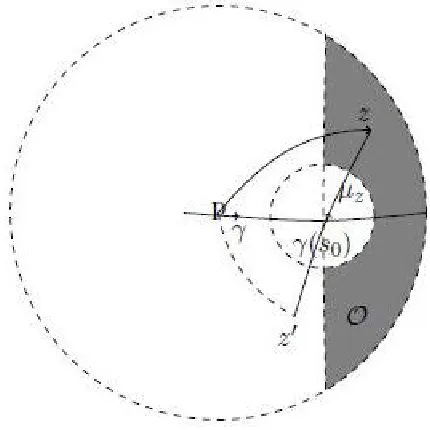
Letz ∈ B+(p, r1)andr := d(γ(s0), z).Then by Lemma 4.2,0 < r < 2π.Letµz : [0, r]−→
B(p, r1)be the unit speed geodesic joiningγ(s0)tozwith initial pointµz(0) =γ(s0)(c.f. 4.1). We
can extendµz as a geodesic defined on whole ofR,and the extended geodesic is again denoted by
µz.Putvz =µ0z(0).
Define
O={z∈Ω∩B+(p, r1) :hµ0z(0), γ0(s0)i>0}.
See figure 3. Letz∈ Oandz=µz(r).By Lemma 2.3,∃z˜∈π−1(z)such thatd(˜z, c(s0)) = r
and a unique horizontal geodesicµ˜z˜: [0, r]−→B(p, r1)inS2n+1joiningc(s0)toz˜of lengthr.Let ˜
vz := ˜µ0
˜
z(0).Then
˜
z= (cosr)c(s0) + (sinr)˜vz (4.7)
Then w.r.t. the basis{c0(s0), e2, e3· · · , en}ofHc(s0)atc(s0),
˜
vz =h˜vz, c0(s0)iCn+1c0(s0) + X
2≤j≤n
hv˜z, ejiCn+1ej
and hence
hz, e˜ 0iCn+1 = cosrcoss0−sinrsinr0hv˜z, c0(s0)iCn+1.
Letz0 :=µz(−r).See figure 3. By Lemma 2.3∃z˜0 ∈π−1(z0)such thatd( ˜z0, c(s0)) =r.Then
˜
[image:8.612.226.441.493.708.2]z0 = cos(−r)c(s0) + sin(−r)˜vz= (cosr)c(s0) + sin(r)(−v˜z).
Lemma 4.3 — Forz∈ O, d(z0, p)< d(z, p).
PROOF: Fixz∈ O.Recall that∃z˜∈π−1(z)such thatd(˜z, c(s0)) =r.Putz˜= (z0, z1,· · · , zn).
Then
hz, c˜ 0(s0)iR2n+2= (sinr)hv˜z, c0(s0)iR2n+2
= sinrhµ0z(0), γ0(s0)i
>0 (∵ sinr >0andz∈ O).
Putbz :=hv˜z, c0(s0)iCn+1.Sincez∈ O,Rebz>0.From Lemma 2.3,
d(z, p) = arccos(|hz, e˜ 0iCn+1|) (∵p1 =π(e0))
= arccos(|cosrcoss0−sinrsins0bz|)
(4.8)
|cosrcoss0+bzsinrsins0|2= (cosrcoss0+Re(bz) sinrsins0)2+ (Im(bz) sinrsins0)2
>(cosrcoss0−Re(bz) sinrsins0)2+ (Im(bz) sinrsins0)2
=|cosrcoss0−bzsinrsins0|2.
(4.9)
Thus
|cosrcoss0+bzsinrsins0|>|cosrcoss0−bzsinrsins0|. (4.10)
Thus
d(z0, p) = arccos|hz˜0, e0i
Cn+1|
= arccos|cosrcoss0+ sinrsins0bz|
<arccos|cosrcoss0−sinrsins0bz|(from4.10)
=d(z, p).
(4.11)
Hence the lemma follows. 2
Lemma 4.4 — For anyq ∈∂B0
hV(q0),n(q0)i=−hV(q),n(q)i ∀q∈∂B0.
PROOF: By Lemma 3.1,hV(µq(s)), µ0q(s))iis a constant function for alls,n(q) =−µ0q(r0)and n(q0) =µ0
A cylindrical symmetry of the domainΩ: Consider the matrix
B := 1
1 −1
. .. −1
inU(n+ 1)where all the entries not shown are zero. Define a mapφB :CPn−→CPnby
φB([(z0, z1, z2· · ·, zn)]) = [B(z0, z1, z2· · · , zn)]∀[(z0, z1,· · · , zn)]∈CPn.
Lemma 4.5 — The mapφBis an isometry ofΩ, φ◦γ =γ andφBreverses any normal geodesic
alongγ.
PROOF : Since B ∈ U(n+ 1), φB is an isometry of CPn.Define TB denote the linear map
ofCn+1 given by left multiplication by the matrixB.Then TB(ej) = ej for j = 0,1 and hence
TB(c(s)) =c(s) ∀s.ThusφBkeeps the geodesicγinvariant. HenceφB(B(p, r1)) = B(p, r1)and
φB(B(γ(s0), r0)) =B(γ(s0), r0).ThusφB(Ω) = ΩandφBis an isometry ofΩ.
Now the constant vector fieldse2,··, en ofCn+1 are horizontal, parallel vector fields ofS2n+1
along the curvec(s).DefineEj(γ(s)) := dπc(s)(ej) (2 ≤ j ≤ n).Then eachEj (2 ≤ j ≤ n) is
a parallel vector field ofCPnalong the geodesicγ.SinceT(ej) =−ej (2≤j ≤n)andφB is an
isometry ofCPn, dφ
B(Ej(γ(s))) =−Ej(γ(s))∀s.HenceφB reverses any normal geodesic along
γ. 2
Now we prove the main theorem.
Consider any two pairs(p, v)and(q, w)where
p, q∈CPn, v∈TpCPn&w∈TqCPn.
Then there exists an isometryf ofCPnsuch thatf(p) =qandDfp(v) =w.Also the
Laplace-Beltrami operator∆ofCPnis invariant under isometries ofCPn.Hence it suffices to study the first Dirichlet eigenvalueλ1(Ω)only on domains
Ωs:=B(p, r1)\B(γ(s), r0); 0≤s < r1−r0.
Defineλ1(s) : (r0−r1, r1−r0)−→Rbyλ1(s) =λ1(Ω(γs)).Fixs0such that0≤s0< r1−r0.
Consider a smooth functionρ:CPn−→Rsatisfyingρ= 1onB(γ(s0), r2)andρ= 0on∂B1. Define a vector fieldWonCPnby
W(q) =ρ(q)V(q)∀q∈CPn (V is defined in§3).
Let{φs}s∈Rbe the one-parameter family of diffeomorphisms ofCPnassociated withW.Then for all|s|sufficiently close to0, φs|B(p,r1) =ψs|B(p,r1)andφs(Ωs0) = Ωs0+s.Henceλ1(s0+s) =
λ1(φs(Ωs0)).By Proposition 3.1 of [2],λ1 is differentiable ats=s0.Asλ1(φs(Ω)) =λ1(φ−s(Ω)),
λ1 is an even function which is differentiable at 0. Thusλ01(0) = 0.PutΩ = Ωs0.Letn be the
outward unit normal field on∂Ω.Then by Hadamard formula stated in Proposition 3.4 of [2] we get,
λ01(s0) =− Z
∂Ω µ
∂y1
∂n
¶2
hW, ni(q)dS
=− Z
∂B0 µ
∂y1
∂n
¶2
hW, ni(q)dS (∵W = 0on∂B1).
SinceW =V onB(γ(s0), r2)we have
λ01(s0) =− Z
∂B0 µ
∂y1 ∂n
¶2
hV, ni(q)dS. (4.12)
LetIγ(s0) be the isometry such thatDIγ(s0) :Tγ(s0)CPn −→ T
γ(s0)CPnis the antipodal map −I.Hence for any geodesic σ such thatσ(0) = γ(s0), we haveIγ(s0)oσ(s) = σ(−s).Forz ∈ O
definez0 :=Iγ(s0)(z).Hencez0:=Iγ(s0)(z) =Iγ(s0)(µz(r)) =µz(−r).
Iγ(s0)(∂B0) =∂B0 (4.13)
d(z, p)< r1for anyz∈ O.Hence by Lemma 4.3
d(z0, p)< d(z, p)< r1.
Thus we have
Iγ(s0)(O)⊂B(p, r1). (4.14)
Letq ∈∂B0+.Then by Lemma 4.1
And from Lemma 4.4 we have
hV(q0), n(q0)i=−hV(q), n(q)i ∀q∈∂B0. (4.16)
Hence from 4.12
λ01(s0) =− Z
∂B0∩∂O (µ
∂y1
∂n(q)
¶2 −
µ
∂y1
∂n(q 0)
¶2)
hV, ni(q)dS. (4.17)
LetP :={z∈B+(p, r1)| hµ0z(0), γ0(0)i= 0}.Thus
Iγ(s0)(P) =P. (4.18)
Also
DIγ(s0)(n(q)) =n(Iγ(s0)(q)) ∀q∈∂B0. (4.19)
The Laplace-Beltrami operator ∆ofCPn is uniformly elliptic. Sincey1 > 0on Ω, by
Hopf-maximum principle
∂y1
∂n(q)<0 ∀q∈∂Ω (4.20)
Puty˜1(z) = (y1oIγ(s0))(z) ∀z∈ O.Then from 4.19 we have
∂y˜1
∂n(q) = ∂y1
∂n(q
0) ∀q∈∂Ω∩∂O. (4.21)
Defineω(z) := y1(z)−y˜1(z)∀z ∈ O.Since∆commutes with the isometryIγ(s0) and using 4.18,ωsatisfies the following:
∆ω+λ1ω= 0 inO
ω= 0 on∂O ∩∂B0
ω= 0 on∂O ∩ P (by lemma4.5)
ω <0 on∂O ∩∂B1.
(4.22)
Defineω+ = max{ω,0}.Sinceω≤0on∂O,ω+∈H01(O).From problem 1.1 and 4.22, we get
0 = Z
O
(−∆ω)ω+dx−λ1(Ω) Z
O
ωω+dx
= Z
O∩{ω≥0}
(−∆ω)ω+dx−λ1(Ω) Z
O∩{ω≥0}
ωω+dx
= Z
O
(k ∇ω+k2 dx−λ1(Ω) Z
O
(ω+)2dx
>
Z
O
(k ∇ω+k2 dx−λ1(O) Z
O
Thus λ1(O) >
R
OR(k∇ω+k)2dx
O(ω+)2dx which is a contradiction. Hence ω
+ ≡ 0. So ω ≤ 0 in O. It
follows that∆ω+λ1ω≥0onO.By generalized maximum principleω <0inO.Then by applying
Hopf-maximum principle∂ω∂n >0a.e.on∂O ∩∂B0.Consequently we get
|∂y1
∂n(q)|<| ∂y1
∂n(q
0)| (from 4.20and4.21).
Hence from 4.17,λ01(s0)<0.
ACKNOWLEDGEMENT
The second author is grateful to M.K. Vemuri for useful discussions on this research topic.
REFERENCES
1. S. Kesavan, On two functionals connected to the Laplacian in a class of doubly connected domains, Proc. R. Soc. Edinburgh, 133A (2003), 617-624.
2. M. H. C. Anisa and A. R. Aithal, On two functionals connected to the Laplacian in a class of doubly connected domains in space-forms, Proc. Indian Acad. Sci., 115(1) (2005), 93-102.
3. M. H. Chorwadwala Anisa and M. K. Vemuri, On two functionals connected to the Laplacian in a class of doubly connected domains of rank one symmetric non-compact type, Geom Dedicata, 167 (2013), 11-21.
4. T. Aubin, Non-linear analysis on manifolds-Monge-Ampere equations, Springer-Verlag, (1982).
5. M. Protter and H. Weinberger, Maximum principles in differential equations, Prentice-Hall Inc., (1967).

![Figure 2: Spherical Triangle [p ,z˜ ( ˜ ˜p ) , c ( s 0 ) ] in S2 n +1](https://thumb-us.123doks.com/thumbv2/123dok_us/9904571.491898/7.612.239.355.491.614/figure-spherical-triangle-s.webp)