Case Study: A Comprehensive Integer Programming Model for
Improving an Educational Timetable
*
Diana Sánchez-Partida
1, José Luis Martínez-Flores
1, Mauricio Cabrera-Rios
2, Elías
Olivares-Benitez
1Logistics and Supply Chain Management Department, UPAEP University, 72410
Puebla, México
1Applied Optimization Group,
Industrial Engineering Department, University of Puerto Rico at Mayagüez, PR 00681,
USA
2e-mail: [email protected]
1, [email protected]
1,
[email protected]
2, [email protected]
1Tel: +52 (222) 229 9400 ext. 7009
* corresponding author
Abstract. This paper summarizes our work towards developing a solution to the Curriculum Based Timetabling Problem (CB-TTP) at a Mexican university and providing significant insights into timetable processing. We first, identified a data structure using a Mediation Software (MS). This software can read, analyze, and organize data from different institutional log files. Additionally, the MS makes groups of courses without interference in the curricula in order to eliminate this constraint of the Integer Programming (IP) model. Then, we present a comprehensive IP model, which use a set of complex constraints, e.g., professor’s availability, consider the course modality in order to assign an appropriate room, consecutive and isolated period of the courses, among others. Also, consider the constraint that ensures do not cancel courses of interest due to parallel assignments of the mandatory courses. With this methodology was possible to assign 2101 lectures and improve the efficiency of the current scheduling process.
Keywords: Timetabling Problem, Resource Allocation, Mediation Software, Integer Programming model.
1
. Introduction
Many researchers have investigated the practice and theory of automated timetable scheduling, focusing on education, transport, business, sports, and health. The scheduling is an activity that occurs under any planning scheme and resource allocation process. There are many publications that have provided knowledge and diverse methods for solving the educational timetabling problem (TTP) some example are [1, 2, 3, 4].
Some characteristics that add complexity to the problem is the special request of courses in certain timeslot, precedence in the curricula, consecutive or single periods, periods of variable length along the week, unavailability of professors for certain periods, specific rooms that are required for some courses, and the capacities expressed in terms of the number of available seats. Additionally, the university gives students a large amount of freedom about the courses they may choose. More information about this problem is described below:
Course. The courses can be mandatory or optional and belong to specific curricula. The courses have a professor assigned.
Lecture. The lecture is a course-conforming set of teaching events.
Modality. The courses can be taught in three ways: face-to-face, the traditional way where students are physically present in class; videoconference or mixed modality, where there is a mix of students that are either physically present or synchronously linked through technology; and virtual, where students are remotely linked synchronously with the professor. In addition, this term is used too for the kind of program on offer, i.e., quarterly graduate programs or quarterly undergraduate programs.
Periods. The period is composed of day and timeslot. These are the segments of one hour of time, which may be available for course allocation, i.e., 7:00 – 8:00 or 21:00 – 22:00 on Monday or Friday.
Timeslot. This are composed of weekly periods, i.e., the periods from 7:00 – 9:00 on Monday through Friday, are considered as timeslots.
Rooms. The classification of these rooms was made based on the physical structure. These rooms are classified as normal rooms, laboratories, and special rooms.
In this research is proposed a solution based on the following methodology. The first is the MS, which searches and organizes the data based on curricula maps and log files; also, the MS makes groups of courses respecting the curricula eliminating this constraint in the IP model. The assignments guaranty that the group of courses belongs to the curricula have been taken in adequate precedence by students; besides, guaranty that the courses have been scheduled in the same timeslot. This information will be the input. The problem is modeled as IP model and solved with Branch and Bound Method (B&B). The mainly goal of this paper was to summarize our work and offer a solution for the whole university. We also provide significant insights into the timetabling process. For this research, the data were collected from the information system considering quarterly spring period of 2014, when the university ran approximately 2650 courses.
The remainder of the paper is as follows. Section 2 contains a review of the relevant literature. In Section 3, we describe the proposed institutional model and the sets of parameters. In Sections 4 and 5, we present our results and some important insights. Finally, Section 6 contains our conclusions.
2. Literature review
The TTP has been tackled since various decades. Several exact programmingmethods have been applied to real problems. The models are made only for representing the problem for a particular university due to their own requirements. However, currently, the researchers simplify their specific problem removing particularities in order to provide different approaches for solving the TTP. For example, Bonutti [10] developed an important web application that contains all the necessary infrastructures for benchmarking: validators, data formats, instances, reference scores, lower bounds, solutions, and visualizers (http://tabu.diegm.uniud.it/ctt/ or http://satt.diegm.uniud.it/ctt).
The benchmarking is important for measurability, as well as the development of methods that produce real solutions [11, 12]. Therefore, our research has the advantage of giving a solution to real problem, comparing the impacts of the different considerations, and assessing the results obtained.
variable length, the unavailability of professors, capacity, or room type, which meant that the solution was relatively easy to find.
The TTP is known to be a highly constrained combinatorial optimization problem [15] and in many cases, obtaining a feasible solution is the most difficult part of the optimization process. Hence, many authors decided to test hybrid models or meta-heuristics, especially for the CB-TTP. For example, Murray [16] presented solutions of multiple sub-problems with very different characteristics using constraint satisfaction. Rudová [8] tackled the same problems using a generic iterative forward search with conflict-based statistics. They then used B&B to find a solution for almost 900 courses and 55 rooms, and individually timetabled approximately 70 departmental problems. Other researchers [17, 2, 9, 3, 18] used meta-heuristics to propose a solution to the problem within a reasonable time.
3. Building the Institutional Model
The timetable construction process can be broken down into the following series of information and problem modelling steps.
3.1 Creating instances with a Mediation Software
Our research was based on quarterly modality belonging to undergraduate, graduate, and professional education programs. The undergraduate area is composed of Faculties coving fields such as Medicine, Biology, Accounting Management, Public Accounting, etc.; the graduate area is composed of masters and doctorate programs; and the professional education area is composed of extracurricular courses on specialized training. This modality represents 80% of the total courses offered by the entire institution. The university uses a system that stores raw data, but it does not effectively exploit. This information contains valuable information about professors, courses, and rooms. Therefore, we implement a MS that reads, analyzes, and organizes the data from different institutional log files. Additionally, this software forms groups of courses that can be taken by students without the problem of precedence.
Because the timetabling process always involves significant human interaction, we programmed the MS in Visual Basic (VB), so that the environment is suitable for the administrative staff.
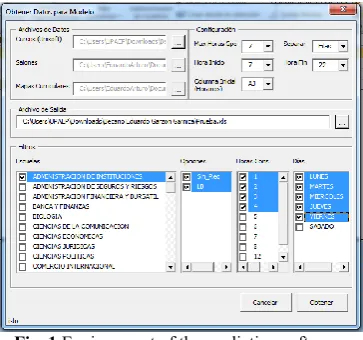
Fig. 1 Environment of the mediation software.
The Fig. 1 shows that the administrative staff can select the institutional log files that contain the raw data, select the maximum hours that each group of students can take each day, and the initial and finish hours to be considered. They can also filter according to the faculty, courses that require rooms with special features, the total hours per week for each course, and the weekday. This is used to produce a new file that will call instance and will contain selected courses of different faculties that share the same teaching space. The administrative staff will give support in making the selection decision. The instance will be the parameters in the IP model.
[image:3.595.207.389.461.631.2]smaller combinations of variables, and subsequently to obtain solutions with low computational costs. The UPAEP University TTP is decomposed into a centrally timetabled large CB-TTP (with approximately 499 courses, 1719 lectures, 82 rooms, and 75 periods) as well as other individually TTP.
3.2 Integer Programming Model 1
The first model is based on the current process for demonstrating that lacks integration in preparing scheduling results in inefficient timetables. In this case, the coordinators assigned their own courses to the periods without verifies the feasibility schedule. Then we modeled the rest of problem in order to assign these junctions (courses-periods) to an adequate room. The rooms are available 100% in the start quarterly. The variable sets and subsets are as follows:
Parameter sets for Integer Programming Model 1
Sets:{1, 2, ..., I}, I ∈ Z+ is the set of courses that belong to one teaching modality and faculty; these courses have previously been assigned a professor and schedule by the respective coordinator.
{1, 2, ..., J}, J ∈ Z+ is the set of different types of rooms according to with the physical structure. These rooms are classified as normal rooms, laboratories, and special rooms.
{1, 2, ..., K}, K ∈ Z+ is the set of total periods available weekly.
Of these sets, we create subsets in order to have smaller combinations of variables, and subsequently to obtain solutions with low computational costs:
Ksub_dia = {x ∈ {1, 2, . . . , 𝐾}|x where the courses can be scheduled}. Ksub_noreq = {x ∈ {1, 2, . . . , 𝐾}|x where any course cannot run}.
ℎ𝑚𝑖 Daily hours requested in consecutive or single periods for each course i. 𝑎𝑖 Amount of enrolled students for each course i
.
𝑏𝑗 Capacity of the room j (number of seats).
𝐿𝑖 Is the number of lectures that conform a course i, one lecture is equal to one hour.
The model is built on a set of decision variables defined as ∀ i ∈ I; ∀ j ∈ J; ∀ k ∈ Ksub_dia, Ksub_noreq
Xiljk = 1; if the lectures l of course i is scheduled in the room j. = 0, otherwise.
Mathematical Model 1
𝑀𝑎𝑥 = ∑ ∑ ∑ ∑ 𝑥𝑖𝑙𝑗𝑘 𝐾
𝑘=1 𝐽
𝑗=1 𝐼
𝑖=1 𝐿𝑖
𝑙=1
, (1)
subject to
∑ ∑ ∑ 𝑥𝑖𝑙𝑗𝑘 𝑘 ∈ 𝐾𝑠𝑢𝑏_𝑑𝑖𝑎 𝐽
𝑗=1 𝐿𝑖
𝑙=1
≤ ℎ𝑚𝑖 , i = 1, 2, . . . , 𝐼, (2)
∑ ∑ ∑ ∑ 𝑥𝑖𝑙𝑗𝑘 𝑘 ∈ 𝐾𝑠𝑢𝑏_𝑛𝑜𝑟𝑒𝑞 𝐽
𝑗=1 𝐼
𝑖=1 𝐿𝑖
𝑙=1
= 0 , (3)
𝑎𝑖 ∗ 𝑥𝑖𝑙𝑗𝑘 ≤ 𝑏𝑗 , i = 1, 2, . . . , 𝐼, j = 1, 2, . . . , 𝐽, k = 1, 2, . . . , 𝐾, (4)
∑ ∑ 𝑥𝑖𝑙𝑗𝑘 𝐼
𝑖=1 𝐿𝑖
𝑙=1
𝑥𝑖𝑙𝑗𝑘 ∈ {0,1}. (6)
The objective function (1) maximizes the number of lectures of each course assigned to the appropriate room. All courses require a mandatory number of hours in consecutive or single periods (2) and we must restrict the set of unrequired teaching periods (3). Constraint (4) guarantees that the room has adequate capacity for each course, according to the number of enrolled students. Constraint (5) means that there cannot be more than one lecture courseper period in a room. Finally, the last constraint (6) indicates that the variables are binary.
3.2 Integer Programming Model 2
The second model 2 attempts to produce a comprehensive assignment from the course - room – period assignment. We added a group constraint to ensure that mandatory courses are not canceled because of the parallel assignment of optional courses.
Parameters sets for Integer Programming Model 2
Sets:{1, 2, ..., I}, I ∈ Z+ , is the set of courses that belong to one teaching modality and faculty, which have previously been assigned a professor.
{1, 2, ..., J}, J ∈ Z+ , is the set of different types of rooms according with the physical structure. These rooms are classified as normal rooms, laboratories, and special rooms.
{1, 2, ..., K}, K ∈ Z+ , is the set of total periods available weekly.
Of these sets, we create subsets in order to have smaller combinations of variables, and subsequently to obtain solutions with low computational costs:
Isub_cc1 = {x∈ {1, 2, . . . , 𝐼}|x do not require a specific schedule}. Isub_cc2 = {x∈ {1, 2, . . . , 𝐼}|x that require a specific schedule}.
Isub_cat = {x∈ {1, 2, . . . , 𝐼}|x taught by the professors, regardless of the modality course}. Isub_tr = {x∈ {1, 2, . . . , 𝐼}|x that require a type of room.
Isub_group = {x∈ {1, 2, . . . , 𝐼}|x of mandatory and optional courses by groups.
Jsub_req = {x∈ {1, 2, . . . , 𝐽}|x is classified by their properties (normal, special, and laboratory). Jsub_noreq = {x∈ {1, 2, . . . , 𝐽}|x not required for each course.
Ksub_dia = {x∈ {1, 2, . . . , 𝐾}|x where the courses can be scheduled}. Ksub_vtc = {x∈ {1, 2, . . . , 𝐾}|x where professors cannot teach their courses}. Ksub_noreq = {x∈ {1, 2, . . . , 𝐾}|x where any course cannot run}.
ℎ𝑖 Weekly hours requested for the course i.
ℎ𝑚𝑖 Daily hours requested in consecutive or single periods for each course i.
𝑎𝑖 Amount of enrolled students for each course i
.
𝑏𝑗 Capacity of the room j (number of seats).
𝐿𝑖 Is the number of lectures that conform a course i, one lecture is equal to one hour.
The model is built on the following set of decision variables.
∀ i ∈ Isub_cc1, Isub_cc2, Isub_cat, Isub_tr, Isub_group; ∀ j ∈ Jsub_req, Jsub_noreq; ∀ k ∈ Ksub_dia, Ksub_vtc, Ksub_noreq
Mathematical Model 2
𝑀𝑎𝑥 = ∑ ∑ ∑ ∑ 𝑥𝑖𝑙𝑗𝑘 𝐾 𝑘=1 𝐽 𝑗=1 𝐼 𝑖=1 𝐿𝑖 𝑙=1
, (7)
subject to
∑ ∑ ∑ 𝑥𝑖𝑙𝑗𝑘 𝐾 𝑘=1 𝐽 𝑗=1 𝐿𝑖 𝑙=1
= ℎ𝑖 , i = 1, 2, . . . , 𝐼, (8)
∑ ∑ ∑ 𝑥𝑖𝑙𝑗𝑘 𝑘 ∈ 𝐾𝑠𝑢𝑏_𝑑𝑖𝑎 𝐽
𝑗=1 𝐿𝑖
𝑙=1
≤ ℎ𝑚𝑖 , ∀𝑖 ∈ 𝐼𝑠𝑢𝑏𝑐𝑐1, (9)
∑ ∑ ∑ 𝑥𝑖𝑙𝑗𝑘 𝑘 ∈ 𝐾𝑠𝑢𝑏_𝑑𝑖𝑎 𝐽
𝑗=1 𝐿𝑖
𝑙=1
= ℎ𝑚𝑖 , ∀𝑖 ∈ 𝐼𝑠𝑢𝑏𝑐𝑐2, (10)
∑ ∑ ∑ ∑ 𝑥𝑖𝑙𝑗𝑘= 0
𝑘 ∈ 𝐾𝑠𝑢𝑏_𝑛𝑜𝑟𝑒𝑞 𝐽
𝑗=1 𝑖 ∈𝐼𝑠𝑢𝑏_𝑐𝑐1, 𝐼𝑠𝑢𝑏_𝑐𝑐2 𝐿𝑖
𝑙=1
, (11)
𝑎𝑖 ∗ 𝑥𝑖𝑙𝑗𝑘 ≤ 𝑏𝑗 , i = 1, 2, . . . , 𝐼, j = 1, 2, . . . , 𝐽, k = 1, 2, . . . , 𝐾, (12)
∑ 𝑥𝑖𝑙𝑗𝑘 𝑖 ∈ 𝐼𝑠𝑢𝑏_𝑡𝑟
≤ 1 , ∀𝑗 ∈ 𝐽𝑠𝑢𝑏𝑟𝑒𝑞, k = 1, 2, . . . , 𝐾, (13)
∑ ∑ ∑ ∑ 𝑥𝑖𝑙𝑗𝑘 𝑗 ∈ 𝐽𝑠𝑢𝑏_𝑛𝑜𝑟𝑒𝑞 𝐾
𝑘=1 𝑖 ∈ 𝐼𝑠𝑢𝑏_𝑡𝑟 𝐿𝑖
𝑙=1
= 0 , (14)
∑ ∑ ∑ 𝑥𝑖𝑙𝑗𝑘 𝐽
𝑗=1 𝑖 ∈𝐼𝑠𝑢𝑏_𝑐𝑎𝑡 𝐿𝑖
𝑙=1
≤ 1 , k = 1, 2, . . . , 𝐾, (15)
∑ ∑ ∑ ∑ 𝑥𝑖𝑙𝑗𝑘 𝐽
𝑗=1 𝑘 ∈ 𝐾𝑠𝑢𝑏_𝑣𝑡𝑐 𝑖 ∈ 𝑠𝑢𝑏_𝑐𝑎𝑡
𝐿𝑖
𝑙=1
= 0 , (16)
∑ ∑ ∑ 𝑥𝑖𝑙𝑗𝑘 𝐽
𝑗=1 𝑖 ∈𝐼𝑠𝑢𝑏_𝑔𝑟𝑜𝑢𝑝 𝐿𝑖
𝑙=1
≤ 1 , k = 1, 2, . . . , 𝐾, (17)
𝑥𝑖𝑙𝑗𝑘 ∈ {0,1} . (18)
In real-world problems, we must consider if a room is adequate for a course. Constraint (12) guarantees that we find a room with adequate capacity for every course, according to the number of enrolled students. Constraint (13) means that only one lecture course can be held at each period in the room. Constraint (14) avoids unsuitable rooms.
Additionally, we must consider any overlaps of professors. Therefore, constraint (15) considers a courses list by each professor and make the assignments avoiding any overlapping courses, and (16) eliminates periods where professors are unable to teach their course(s). The group constraint (17) prevents any overlapping mandatory and optional courses taken by the same group. Constraint (18) shows that the variables are binary.
Some basic conditions must be satisfied to ensure that the model is feasible. There must be a sufficient number of periods to schedule all the courses, and there must be a sufficient number of rooms.
4. Computational Experiments and Results
In this section, we describe our numerical experiments and results for a number of problems. We used the optimization software LINGO Package by Lindo Systems Inc. 2013. It has a generator memory limit of 1GB, and was installed on a workstation with 4.00 GB RAM, a 1397 GB hard drive, and an Intel (R) Core (TM) i7-3770 3.40GHz CPU processor. The problems were classified using an IP model and were solved using the B&B method.
4.1 Results of IP Model 1
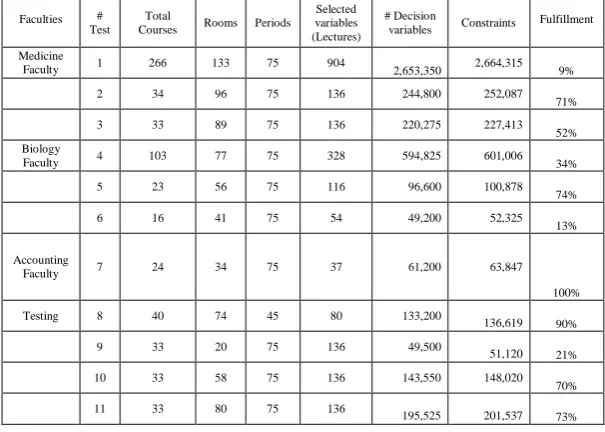
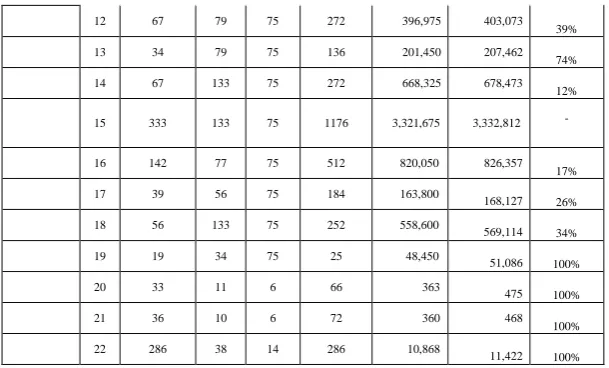
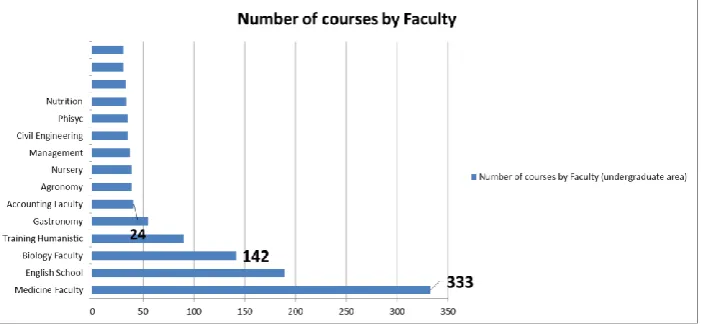
We ran tests using data from the undergraduate programs like Medicine, Biology and Accounting Management Faculties because they are representative in terms of their size. This is verified in Appendix 1. The Faculty of Medicine runs 333 courses, the Faculty of Biology runs 142 courses, and the Accounting Management Faculty run 24 courses. Details for the Faculties are given in Table 1.
These courses are taught in face-to-face modality and share the same teaching space, they consider 75 periods from Monday to Friday, 7:00 to 21:00, and 133 normal rooms belonging to buildings A, B, C, J, and T, all centralized on campus. Some courses require consecutive hours and others require single periods. All courses had variable length periods, and a coordinator assigned the period.
[image:7.595.146.449.552.768.2]The model was applied the Faculties of Medicine and Biology in three tests for, each one considering different starting points for the timeslots. The starting points for the timeslots were 7:00 to 8:00 until 21:00, 7:00 to 9:00 until 21:00, and 8:00 to 10:00 until 20:00. A preliminary experiment demonstrated less suitable conditions due to differently sized of the lectures in each course and different starting points, which increased the difficulty of assigning a contiguous room.
Table 1. Considerations, solution status, and results per faculty for IP Model 1. Faculties #
Test Courses Total Rooms Periods Selected variables (Lectures)
# Decision
variables Constraints Fulfillment
Medicine
Faculty 1 266 133 75 904 2,653,350 2,664,315 9% 2 34 96 75 136 244,800 252,087 71%
3 33 89 75 136 220,275 227,413 52%
Biology
Faculty 4 103 77 75 328 594,825 601,006 34% 5 23 56 75 116 96,600 100,878 74%
6 16 41 75 54 49,200 52,325 13%
Accounting
Faculty 7 24 34 75 37 61,200 63,847 100% Testing 8 40 74 45 80 133,200
136,619 90% 9 33 20 75 136 49,500
51,120 21% 10 33 58 75 136 143,550 148,020 70%
11 33 80 75 136
12 67 79 75 272 396,975 403,073 39%
13 34 79 75 136 201,450 207,462 74%
14 67 133 75 272 668,325 678,473 12%
15 333 133 75 1176 3,321,675 3,332,812 -
16 142 77 75 512 820,050 826,357 17%
17 39 56 75 184 163,800 168,127 26% 18 56 133 75 252 558,600
569,114 34% 19 19 34 75 25 48,450
51,086 100% 20 33 11 6 66 363
475 100% 21 36 10 6 72 360 468 100%
22 286 38 14 286 10,868 11,422 100%
We also ran several tests that considered variations in the number of rooms to investigate the model behavior. The average computational time taken to obtain a global solution was 30 seconds but with a bad performance. With these test is demonstrated that the process that realizes the administrative staff is not the problem in the overlapping courses, but rather the missing of collaboration between coordinators and room schedulers. This individual schedule decision process generates many violations, which motivated the second model.
4.2 Results of the IP Model 2
We implemented the second model using the same undergraduate programs as the first model, so that we could compare the previous results. This is a comprehensive model, which simultaneously considers courses allocation in periods and rooms. Table 2 shows the fulfillment improvements using the second model. The average course allocation in Model 1 was 42%, whereas the average course allocation in Model 2 was 67%. This demonstrates that this comprehensive allocation process improved the solution.
Nevertheless, the problem is Np-hard, the maximum computational time was 6 minutes. In Table 2, Tests 9, 10 and 13 were not solved because the software ran out of memory. However, the Medicine Faculty is the instance with a major number of courses and it was satisfactorily solved. Hence, the rest of the faculties easily can be solved too.
In addition, we applied the model to graduate courses, to ensure that students do not cancel optional course because of parallel mandatory courses assignments. This scheme considered 89 mandatory courses and 35 optional courses, offered by the Professional Education Faculty. The students can enroll optional courses two weeks later because first must ensure the registration of mandatory courses, and optional courses may register later at any free space on their time.
[image:8.595.146.451.80.264.2]There were 60 rooms with different capacities and equipment. We considered the periods from Monday through Friday, 4:00 pm to 10:00 pm, and Saturday 8:00 am to 2:00 pm. Thus, there were 36 hours or periods during the week. The results were satisfactory because we could obtain feasible timetables, the Professional Education Faculty can offer their courses with more likely to be taken by students. The solution was globally optimal assigning up to 382 lectures with a low computational time of 0.6 seconds (Table 2, Test 5). The practical implications of this method are further explored in the following section.
Table 2. Considerations, solution status, and results by faculty, for IP Model 2.
Faculties #
Test Courses Total Rooms Periods
Selected variables
(Lectures) Groups
# Decision
variables Constraints Solution Fulfillment
Medicine
Faculty 1 93 133 75 362 15 927,675 941,425 GLOBAL 75% 2 240 112 75 784 35 2,016,000 2,033,504 GLOBAL 49%
Biology
Faculty 3 142 91 75 497 22 969,150 979,582 GLOBAL 56% Accounting
6 89 26 36 277 3 83,304 85,223 GLOBAL 100%
7 300 74 45 1196 15 999,000 1,004,600 GLOBAL 2%
8 124 74 45 780 15 412,920
417,537 GLOBAL 100%
9 250 74 45 1856 15 832,500 - No feasible solution found -
10 200 74 45 1350 15 666,000 - No feasible solution found - 11 124 100 45 661 15 558,000 541,934 GLOBAL 95%
12 240 133 75 784 35 2,394,000 2,413,079 GLOBAL 53%
13 333 133 75 1146 35 3,321,675 3,343,252
UNKNOWN / RAN OUT
OF
MEMORY - 14 5 78 75 15 4 29,250 35,258 GLOBAL 100%
15 19 76 75 72 6 108,301
114,851 GLOBAL 53%
5. Practical Implications
We must construct solutions that satisfy the constraints of the people involved. On the one hand, the students and professors have preferences known only by the academic coordinators. On the other hand, the academic coordinators and administrative staff operate quite autonomously.
Currently, four administrative staff carry out the timetabling activity for the entire university. They work for approximately 44 hours per week and their main activity is to allocate courses to rooms. The entire timetabling takes approximately six weeks of work for obtaining an acceptable solution. The scheduling process is performed manually with spreadsheet support; turning it into a hard task. Therefore, find a solution is important for the university.
The schedulers have a big challenge related to the comprehension of the problem structure. They must understand the whole (not partial) problem and the methodology proposed because they will implement the tools. Our preliminary results give us important insights to make a more efficient scheduling process. For example, Model 1 demonstrates that each individual decision affects the feasibility of the timetable and can waste time due to rescheduling. Model 2 confirms that a comprehensive assignment is better than an individual assignment. This model can be successfully applied in the rest of the faculties because manage less than 240 courses.
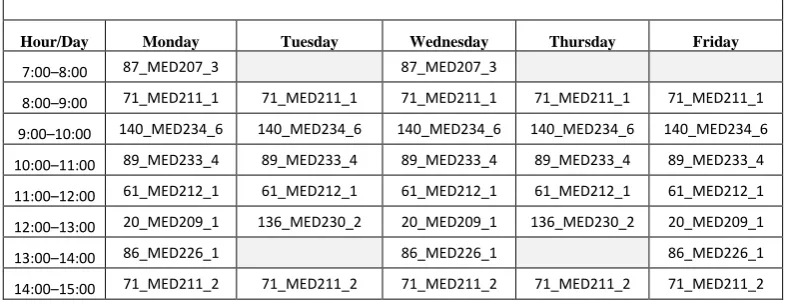
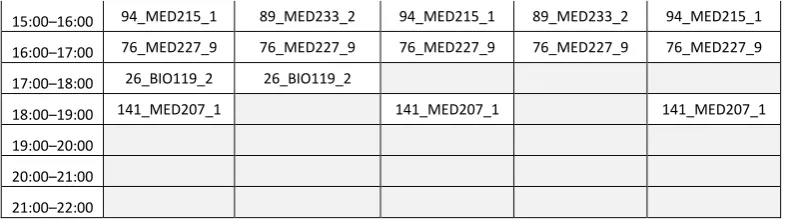
[image:9.595.101.494.619.771.2]We recommend using the second model to comprehensively solve the timetabling problem, but computational resources limit it. If the computational resource is not sufficient, we recommend the two-phase IP model. The advantages of this model are that it can generate a feasible timetable from the beginning and can effectively shares the physical resources. An efficient method for scheduling courses can greatly reduce the costs and labor required to provide a good service to students. Table 3 shows the room timetable obtained by Model 2, and Table 4 contains the remainder of the characteristics.
Table 3. Verification of timetable based on a number of hours required and assigned to each course. Room (T_554 - Capacity 68 students)
Hour/Day Monday Tuesday Wednesday Thursday Friday
7:00–8:00 87_MED207_3 87_MED207_3
8:00–9:00 71_MED211_1 71_MED211_1 71_MED211_1 71_MED211_1 71_MED211_1
9:00–10:00 140_MED234_6 140_MED234_6 140_MED234_6 140_MED234_6 140_MED234_6
10:00–11:00 89_MED233_4 89_MED233_4 89_MED233_4 89_MED233_4 89_MED233_4
11:00–12:00 61_MED212_1 61_MED212_1 61_MED212_1 61_MED212_1 61_MED212_1
12:00–13:00 20_MED209_1 136_MED230_2 20_MED209_1 136_MED230_2 20_MED209_1
13:00–14:00 86_MED226_1 86_MED226_1 86_MED226_1
15:00–16:00 94_MED215_1 89_MED233_2 94_MED215_1 89_MED233_2 94_MED215_1
16:00–17:00 76_MED227_9 76_MED227_9 76_MED227_9 76_MED227_9 76_MED227_9
17:00–18:00 26_BIO119_2 26_BIO119_2
18:00–19:00 141_MED207_1 141_MED207_1 141_MED207_1
19:00–20:00
20:00–21:00
21:00–22:00
[image:10.595.102.497.82.193.2]The first two digits indicate the professor number, and the rest indicate the faculty, course type, and group.
Table 4. Room capacity and a number of enrolled students.
Courses
Students enrolled
Hours required
140_MED234_6 38 5
20_MED209_1 37 3
89_MED233_4 37 5
136_MED230_2 37 2
141_MED207_1 36 3
76_MED227_9 36 5
94_MED215_1 36 3
86_MED226_1 36 3
61_MED212_1 36 5
26_BIO119_2 35 2
89_MED233_2 35 2
71_MED211_2 35 5
71_MED211_1 35 5
87_MED207_3 35 2
We proposed a solution process that ensures individual students could attend all the courses associated with their curriculum. Certainly, this new approach is superior to the method currently used by the university. Moreover, the university should consider fixing the number of the lectures for each course, and eliminate courses of variable length to make uniform blocks of time. These blocks can be easier to assign.
6. Conclusions and Future Work
There were twofold goals to this research. The first is to describe the timetable scheduling research developed in a Mexican University, and the second to generate a resource allocation strategy that simplifies the problem-solving process for the administrative staff. Therefore, we have proposed a formulation for developing and improving the educational timetable. This process encompasses two main aspects the information and problem modelling. Thus, we implemented a MS to create tidy datasets for downstream analyses. The first step was to get, clean, and understand the resulting information producing the instances in a standard format. At the same time, the MS could create groups of courses belong to the same curricula eliminating this constraint in the IP model.
In the future, we will implement these models in the university and thoroughly assess their effectiveness. This will include a mandatory checkup and a training plan.
Acknowledgments
We thank the Associate Editor and reviewers for their comments on an earlier draft of this paper, which resulted in significant improvements. This paper resulted from graduate study financially supported by Consejo Nacional de Ciencia y Tecnología – CONACyT (CV: 371231 register: 250076). The corresponding author would like to express gratitude for the support of each co-author.
References
1. Sarin, C., Wang,Y. and Varadarajan, A.: A university-timetabling problem and its solution using Benders’
partitioning - a case study. Journal of Scheduling, 13, 131–141(2010).
2. Tarawneh, H.Y., Ayob, M. and Ahmad, Z.: A Hybrid Simulated Annealing with Solutions Memory for
Curriculum-based Course Timetabling Problem. Journal of Applied Sciences, 13(2), 262–269(2013).
3. Yunfeng, D.: Reach in Time Table Problem Based on Improved Genetic Algorithm Combined Chaos and Simulate
Annealing Algorithm. Journal of Applied Sciences, 13(15), 2952–2013(2013).
4. Phillip, A., Waterer, H., Ehrgott, M. and Ryan, D.: Integer Programming Methods for Large Scale Practical
Classroom Assignment Problems. Computers & Operations Research,53, 42–53(2015).
5. Avella, P., D’Auria, B., Salerno, S. and Vasil’ev, I.: A computational study of local search algorithms for Italian
high-school timetabling. Journal of Heuristics, 13, 543–556(2007).
6. Schaerf, A.: A Survey of Automated Timetabling. Artificial Intelligence Review, 13, 87–127(1999).
7. Marte, M.: Towards constraint-based school timetabling. Annals of Operations Research, 155, 207–225(2007).
8. Rudová, H., Müller, T., Murray, K.: Complex university course timetabling. Journal of Scheduling, 14, 187–
207(2011).
9. Tarawneh, H.Y. and Ayob, M.: Adaptive Neighbourhoods Structure Selection Mechanism in Simulated Annealing
for Solving University Course Timetabling Problem. Journal of Applied Sciences, 13(7), 1087–1093(2013b).
10.Bonutti, A., Cesco, F., Gaspero, L., Schaerf, A.: Benchmarking curriculum-based course timetabling: formulations,
data formats, instances, validation, visualization, and results. Annals of Operations Research, 194, 59–70(2012).
11.McCollum, B.: A Perspective on Bridging the Gap Between Theory and Practice in University Timetabling. In
Burke, E., Rudová, H. (Eds.) PATAT 2006. LNCS, 3867, 3–23. Springer-Verlag, Berlin Heidelberg (2007).
12.McCollum, B., McMullan, P., Parkes, A.J., Burke, E.K., Qu, R.: New model for automated examination
timetabling, Annals of Operations Research, (2012) doi: 10.1007/s10479-011-0997-x.
13.Van den Broek, J., Hurkens, C., Woeginger, G.: Timetabling Problems at the TU Eidhoven. In Burke, E., Rudová,
H. (Eds.) PATAT 2006. LNCS, 3867, 210–227. Springer-Verlag, Berlin Heidelberg (2007).
14.Birbas, T., Daskalaki, S. and Housos, E.: School timetabling for quality student and teacher schedules. Journal of
Scheduling, 12, 177–197(2009).
15.Papoutsis, K., Valouxis, C. and Housos, E.: A column generation approach for the timetabling problem of Greek
high schools. Journal of the Operational Research Society, 54, 230–238(2003).
16.Murray, K., Müller, T., Rudová, H.: Modeling and Solution of a Complex University Course Timetabling Problem.,
In Burke, E., Rudová, H. (Eds.) PATAT 2006. LNCS, 3867, 189–209. Springer-Verlag, Berlin Heidelberg (2007).
17.Bouffard, V., Ferland, A. and Jacques, A.: Improving simulated annealing with variable neighborhood search to
solve the resource-constrained scheduling problem. Journal of Scheduling, 10, 375–386(2007).
18.Mirrazavi, S.K., Mardle, S.J. and Tamiz, M.: A two-phase multiple objective approach to university timetabling
utilizing optimisation and evolutionary solution methodologies. Journal of the Operational Research Society, 54, 1155–1166(2003).
Appendix
Appendix 1 Selected Tests