ISSN Online: 2158-2750 ISSN Print: 2158-2742
DOI: 10.4236/ajps.2018.94058 Mar. 19, 2018 732 American Journal of Plant Sciences
Preliminary Variations in Physiological
Modules When
sub
1
A
QTL Is under
Soil-Moisture Deficit Stress
Indraneel Saha
1, Arnab Kumar De
1, Arijit Ghosh
1, Bipul Sarkar
1, Narottam Dey
2,
Malay Kumar Adak
1*1Department of Botany, University of Kalyani, Kalyani, India
2Department of Biotechnology, Visva-Bharati University, Santiniketan, India
Abstract
The present investigation embodies with some distinct physiological res-ponses of rice seedlings bearing sub1A allele when cultured under soil mois-ture deficit condition. In order to estimate the extent of variation of sub1A al-lele in cv. Swarna Sub1, few specific responses were recorded. Ongoing days (2, 4 and 8) of water stress, rice seedlings were mostly concerned with regula-tion of root growth through 1.24%, 4.10% and 8.96% as compared to control. When relative growth rate (RGR) of the biomass was considered, it recorded a significant down regulation maximum by 27.27% over non-stressed plants. The light absorbing capacity of foliages in terms of leaf mass ratio (15.62%) and specific leaf weight (8.45%) was also curtailed under stress contiguously with total dry matter accumulation. For light harnessing mechanism, the con-tributing pigments were most significantly (p ≤ 0.05) affected with maximum variation for chlorophyll (31.29%), lycopene (79.31%) and carotenoids (55.31%) over control. NAR was strikingly differed by 32.72% under water stress in average. To support the water stress related depletion of moisture tension, plants recorded RWC with a ranges of 6.62% to 21.57% under stress than control. In balance of cellular dehydration rice seedlings were recorded 6.72% loss of proline, but up-regulated the release of free amino acids by 1.35 fold. In expression of generic potential for sub1A allele, the growth inhibition even under water deficit was evident from carbohydrate depletion by 10.93%, 11.42% and 24.35% through days of treatments. This was supported by deple-tion of apoplastic and cellular invertase activities by 90.90% and 72.91%. The possibility for sub1A in tolerance of deficit water status in rice culture has been discussed in more details.
How to cite this paper: Saha, I., De, A.K., Ghosh, A., Sarkar, B., Dey, N. and Adak, M.K. (2018) Preliminary Variations in Physiological Modules When sub1A QTL Is under Soil-Moisture Deficit Stress. American Journal of Plant Sciences, 9, 732-744. https://doi.org/10.4236/ajps.2018.94058
Received: January 24, 2017 Accepted: March 16, 2018 Published: March 19, 2018
Copyright © 2018 by authors and Scientific Research Publishing Inc. This work is licensed under the Creative Commons Attribution International License (CC BY 4.0).
http://creativecommons.org/licenses/by/4.0/
DOI: 10.4236/ajps.2018.94058 733 American Journal of Plant Sciences
Keywords
sub1A, Rice, Water Deficit, Growth, Metabolism
1. Introduction
DOI: 10.4236/ajps.2018.94058 734 American Journal of Plant Sciences which might support the nature of reaction of sub1A when interacting with soil moisture deficit.
2. Materials and Methods
2.1. Development of Seedlings, Water Stress and Sample
Collection
The entire experiment was conducted in experimental garden and laboratory of Plant Physiology in the department of Botany, University of Kalyani, Kalyani (22˚58'30"N, 88˚26'04"E), West Bengal, India. Seeds of rice (Oryza sativa L.) cul-tivar were used for this study as experimental material. The typical submergence tolerant line cv. Swarna Sub1 was collected from farmers’ field. Sterilised seeds (by immersion in 1% sodium hypochloride solution following repeated rinse) were germinated on moist filter paper for four days at 28˚C ± 2˚C in a growth chamber. Sprouted seeds were placed on a wire net covered with moist cotton in a 1/4th strength of medium [6]. Seven days old seedlings (2 to 3 leaf stage) with
adequate developed roots were transferred in earthen wire pots (20 cm dia) filled with alluvial clay loam of lower Gangetic plain (pH 6.8) soil. The experiment was conducted through induced water stress by withholding the irrigation continued for 10 days. Seedlings @ of 5 to 6 per hill were transplanted by spacing 20 cm apart and 10 cm between hills. Fertilizers were subjected to soil @ 20, 15, 15 kg per hectare in the form of N:P2O5:K2O. The plant was kept for 8 days under the
condition of appropriate light and dark cycle (16L:8D), light intensity of 900 - 1200 µEm−2·S−2 of photon flux density, 85% of relative humidity, 30˚C - 35˚C of
temperature. On preliminary observation the mortality of the plants were rec-orded maximum within 10 days. Thus, sampling at intervals of 2, 4 and 8 days were done to examine plants perceptions and reactions under water stress. A control set was made where watering was throughout the period. The plants were replicated thrice in randomised block design in independent experiment for each period of sampling (2, 4 and 8 days). All the sets were placed in natural open air condition. After treatment the samples from each replication with 5 plants were transferred to storage by freezing in liquid nitrogen at −80˚C for chemical analysis.
2.2. Determination of Growth Parameters
The plants were collected from each treatment at the end of their respective du-ration. The samples for roots and shoots were dried in hot air oven at 80˚C till constant weight. The growth performance was evaluated by different parameters including net assimilation rate (NAR), leaf mass ratio (LMR), relative growth rate (RGR), specific leaf weight (SLW) etc. by computing dry weight basis [7]. The length of primary roots was measured by a centimetre scale properly.
2.3. Determination of Pigments Content
dif-DOI: 10.4236/ajps.2018.94058 735 American Journal of Plant Sciences ferent pigments were analysed by photometry (Cecil, CE7200) using appropriate solvents. For chlorophyll, 100 mg of leaf tissue was extracted in 80% acetone (MB grade, SRL) following purification of other organic matters [8]. The solva-tion of lycopene and carotenoids was done with petroleum ether following sepa-ration in a column. The amount of lycopene and carotenoids were estimated by reading the absorbance at 503 nm and 450 nm respectively with petroleum ether as blank [9]. The amount of pigment was expressed on fresh weight basis.
2.4. Determination of Stress Metabolites
As an index of osmotic stress plants were evaluated on the basis of compatible solutes: proline and free amino acids from tissue. 100 mg fresh tissue was crushed in liquid nitrogen and thoroughly homogenised with 3% aqueous
sul-phosalicylic acid. The aqueous phase recovered through centrifugation was
reacted with acid ninhydrin solution (1.25 g ninhydrin in 30 ml of glacial acetic acid and 20 ml of 6 M phosphoric acid) in warm condition. On boiling the reac-tion was completed and transferred to ice bath to collect the upper phase with saturated toluene. From the clear solution the amount of proline was determined by reading the absorbance at 520 nm as suggested by Bates et al. (1973) [10]. L-proline was used for calibration within range of 0.02 - 0.1 µM per ml. The free amino acids content from hydrolysed sample was determined according to
Mi-sra et al. (1975) [11] in 80% aqueous ethanol. The concentrate fraction of amino
acids was incubated in a reaction mixture of saturated ninhydrin solution (20 g of ninhydrin in 500 ml of methyl cellosolve). The diluents used as equal volume of water and n-propanol. The intensity was measured at 570 nm and expressed on fresh weight basis with standard as leucine.
2.5. Determination of Water Status in Stressed Plants
The hydration status of plants under induced water stress was evaluated by rela-tive water content according to Barrs and Weatherley (1962) [12]. RWC was measured by the equal number of fresh leaves from each treatment and taken fresh weight (FW) immediately. Those were hydrated in distilled water fully submerged for 12 hours to the turgidity weight (TW). On transfer at 80˚C the constant weight was recorded. RWC was computed with the derivation (FW − DW)/(TW − DW) × 100.
2.6. Determination of Carbohydrate Metabolism
boil-DOI: 10.4236/ajps.2018.94058 736 American Journal of Plant Sciences ing water bath was read at 630 nm by using a spectrophotometer. Finally, the es-timation of total carbohydrate was determined by the help of standard curve of glucose and expressed dry weight basis.
Soluble fraction of invertase from leaf extract (100 mM Tris-HCl, pH 4.8; 10 mM MgCl2, 0.1% BSA, 0.1 mM DTT, 0.1 mM PMSF) was partially purified from
80% ammonium sulphate cut. The fraction of purified protein was concentrated and assayed with Bradford reagent taking standard of BSA [14]. In assay mixture of acid invertase activity with 100 µg was reacted with 200 mM sucrose in 20 mM sodium citrate buffer (pH 4.8), incubated at 37˚C for 90 min [15]. Then the reaction was stopped with alkaline solution on boiling water bath for 10 min and the absorbance was read at 510 nm. The wall bound fraction was recovered from pooled residue of proteins from leaf extract. The pellet was repeatedly washed with 5 M NaCl buffer until the Bradford gives any colour. The pellet was dis-solved in 150 µl of sodium acetate on gentle shaking followed by 10,000 ×g at 4˚C for 15 min. The assay mixture of 1 ml consisted of 200 mM sucrose in 20 mM sodium citrate buffer (pH 3.8). The activity was determined in a similar manner as described for soluble fraction.
2.7. Statistical Analysis
Data herein were computed by analysis of variance coupled with student’s t-test (SPSS software IBM, USA). Significance of variance was granted at p ≤ 0.05.
3. Results
3.1. Variations of Growth Attributes of
sub
1
A
under Varying
Durations of Water Stress
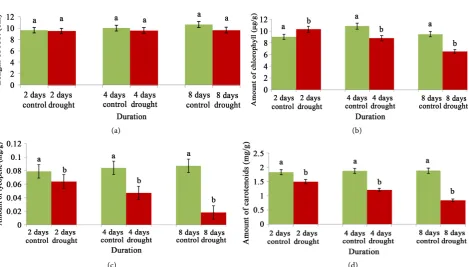
From the course of experimental period the different physiological responses of sub1A QTL were significantly varied encountering the osmotic/water deficit stress. Water stress through varying durations (2, 4, and 8 days) was more cru-cial at the maximum period as recorded from maximum subdued behaviour for almost the physiological attributes. Thus, on initial changes, the root pattern in its length was almost unaffected through the days. Still, at 8 days of stress this was recorded 8.96% less than control but non-significant (p ≤ 0.05) (Figure 1(a)). Unlike root behaviour, changes of chlorophyll with other two pigments (lycopene and carotenoids) were marked reactions for sub1A against water stress. Regardless of duration, chlorophyll, lycopene and carotenoids content were significantly down regulated in a linear manner, still, maximised at 8 days. The variations were significant (p ≤ 0.05) that differed from control and record-ed with the value of 31.29%, 79.31% and 55.31% for chlorophyll, lycopene and carotenoids respectively (Figures 1(b)-(d)).
3.2. Variations of Photosynthetic Related Characters under
Water Stress
DOI: 10.4236/ajps.2018.94058 737 American Journal of Plant Sciences (a) (b)
[image:6.595.67.537.60.327.2]
(c) (d)
Figure 1. Changes of root growth (a), chlorophyll (b), lycopene (c), and carotenoids (d) content of cv. Swarna Sub1 through va-rying days under control and water stress. Data presented in bars with ±SE (n = 3) from independent experimental sets at signi-ficance level p ≤ 0.05 (by student’s t-test). Different letters on bar represent significant difference.
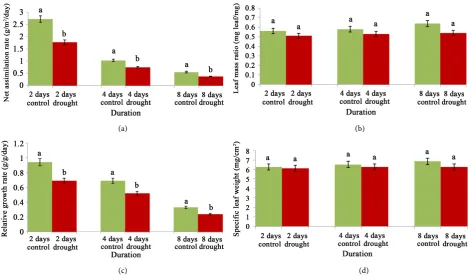
sub1A is characterised preliminary with its behaviour of carbohydrate metabol-ism under water stress through different days. The suppression of growth through regulated photosynthetic carbon assimilation is recorded by a decreasing order of NAR (34.92%, 27.18% and 32.72%) against control at different dura-tions (Figure 2(a)). This may also be corroborated with the ratio of leaf to shoot mass (LMR) in an equivalent trend through 8.92%, 8.62% and 15.62% curtailed under water stress (Figure 2(b)). The conformity of sub1A allele under sub-mergence may be also extrapolated under water stress. This is through total growth with its relative rate (RGR) that is noticed with a significant impairment in the present experiment. Thus, plants have to compromise with its suppressed RGR through the variation of 26.59%, 24.63% and 27.27% under same (Figure 2(c)). In concomitant manner the value of LMR and SLW were also the distin-guishing features for the impact of water stress on sub1A. The ranges for LMR and SLW were appeared to be most sustained and non significant (p ≤ 0.05) in changes of days (Figure 2(b) and Figure 2(d)). Still, at maximum duration of stress the values of LMR and SLW were recorded were 15.62% and 8.45% de-crease as compared to control.
3.3. Response of
sub
1
A
through Osmotic Characters under
Water Stress
DOI: 10.4236/ajps.2018.94058 738 American Journal of Plant Sciences (a) (b)
[image:7.595.64.537.69.345.2](c) (d)
Figure 2. Changes of photosynthetic rate (a), leaf mass ratio (b), relative growth rate (c) and specific leaf weight (d) of cv. Swarna Sub1 through varying days under control and water stress. Data presented in bars with ±SE (n = 3) from independent experimen-tal sets at significance level p ≤ 0.05 (by student’s t-test). Different letters on bar represent significant difference.
DOI: 10.4236/ajps.2018.94058 739 American Journal of Plant Sciences (a) (b)
[image:8.595.70.535.63.345.2](c) (d)
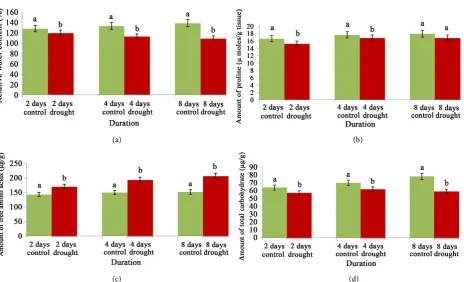
Figure 3. Changes of relative water content (a), proline (b), free amino acids (c) and total carbohydrates (d) content of cv. Swarna Sub1 through varying days under control and water stress. Data presented in bars with ±SE (n = 3) from independent experimen-tal sets at significance level p ≤ 0.05 (by student’s t-test). Different letters on bar represent significant difference.
3.4. Enzymatic Behaviour of Carbohydrate Metabolism of
sub
1
A
under Water Stress
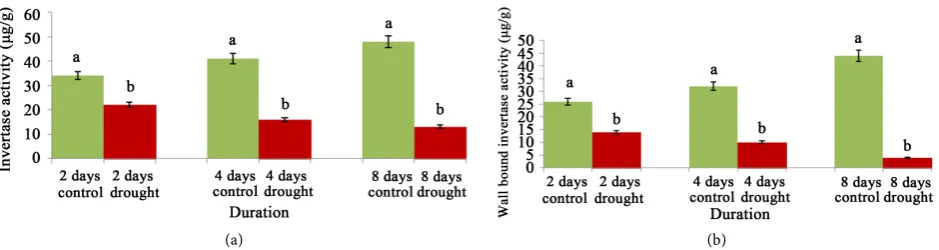
On the other hand, the solubilisation of carbohydrate is also attended with dis-tinct behaviour under same condition of water stress. The activity of soluble in-vertase had the up regulation trend for the variety under control by maximum of 1.41 fold which had the value of 40.90% decline at 8 days of water stress treat-ment (Figure 4(a)). In a similar manner wall bound or apoplastic invertase which is one of the factors for elongation of internodes and leaf sheaths of land races bearing sub1A had the values of 1.69 fold increase and 71.42% decrease under control and water stress treatment respectively at 8 days (Figure 4(b)).
4. Discussion
DOI: 10.4236/ajps.2018.94058 740 American Journal of Plant Sciences
[image:9.595.66.536.68.193.2](a) (b)
Figure 4. Changes of soluble invertase (a) and wall bound invertase (b) activity of cv. Swarna Sub1 through varying days under control and water stress. Data presented in bars with ±SE (n = 3) from independent experimental sets at significance level p ≤ 0.05 (by student’s t-test). Different letters on bar represent significant difference.
leaf biomass. In rice, different ontogenic stages of growth are varied with the ca-pacity of photosynthetic efficiencies by foliages except at the senescence period
DOI: 10.4236/ajps.2018.94058 741 American Journal of Plant Sciences tension. Swarna Sub1 had not been reported earlier with genetic elasticity for root behaviour under the control of quiescence mechanism. This has been ex-pected under soil moisture deficit for regulated root growth as in present expe-riment. There had realised not any significant variation of root growth under water stress in comparison to control. Therefore, for the adaptability of root and its growth more towards higher water potential gradient in soil is failed when Swarna Sub1 is exposed to water stress. In rice, the water stress tolerance is cha-racterized with a QTL that induces more linear growth of root than shoot. The roots consume more photosynthetic solutes to transport basipetally depriving the shoot growth [22]. One of the major mandates of sub1A QTL in rice is to down regulate the carbon metabolism and its allocation to growing tissues re-sulting inhibited growth [23]. Still, this may not be applicable for the fate of sub1A QTL under water stress. The root growth is restricted and might be due to loss of viability or even degeneration of root tips under elevated oxidative status of water stress. Under drought, ethylene accumulation in apical zone of roots can induce earlier abscission following senescence in general [24]. It could also be quite expected sub1A element may have some negative feedback to over express the ethylene on the meristematic tissue of root under induced water stress.
DOI: 10.4236/ajps.2018.94058 742 American Journal of Plant Sciences be anticipated for synthesis of compatible solutes (mostly soluble sugars) from hydrolysis of storage carbohydrate. The down regulation of invertase as com-pared to control signifies the failure of such development of compatible solutes for sub1A and thus moisture stress is established. Therefore, the nature of sub1A locus in rice land races may not be necessarily synergistic in manner when inte-racts with depleted soil moisture instead of water logging or submergence.
5. Conclusion
The resemblance of tolerance mechanism for this allele with submergence is en-sured mostly with restriction of vegetative growth. If sub1A is granted to imple-ment quiescence strategy through suppression of growth (may be for interme-diate period of submergence) the same could be applicable for tissue dehydra-tion. The later requires the regulation of vegetative growth whereby the water loss is minimised vis-a-vis maintenance of turgidity. On that aspect the compat-ible solutes like proline and free amino acids may be a choice for rice seedlings when it experiences tissue dehydration instead of flooding. So, apart from prac-tice of quiescence strategy sub1A locus may be assured or even tried under dep-leted soil moisture tension for its viability following growth and development. Still, the other modalities in cellular responses (mostly the anti-oxidation cas-cades) to adjust the water deficit are yet to decipher with execution of sub1A in rice land races.
Acknowledgements
The work is financially supported by DST-PURSE programme applicable to University of Kalyani. The central instrument facility of University of Kalyani is also acknowledged for partial assistant in execution of chemical analysis.
Conflict of Interest
The authors have no conflict of interest.
References
[1] Adak, M.K., Banerjee, S., Ghosh, N., Mandal, C. and Dey, N. (2015) Plants Re-sponse to Water in Excess: An Overview of Its Molecular Mechanism. Physiological Efficiency for Crop Improvement, 353.
[2] Whitmore, J.S. (2000) Hardy and Drought-Evasive Cereal Crops. In: Whitmore, J.S., Ed., Drought Management on Farmland, Springer, London, 79-97.
https://doi.org/10.1007/978-94-015-9562-9_8
[3] Mackill, D.J., Ismail, A.M., Singh, U.S., Labios, R.V. and Paris, T.R. (2012) 6 Devel-opment and Rapid Adoption of Submergence-Tolerant (Sub1) Rice Varieties. Ad-vances in Agronomy, 115, 299-352.
https://doi.org/10.1016/B978-0-12-394276-0.00006-8
Dynam-DOI: 10.4236/ajps.2018.94058 743 American Journal of Plant Sciences
ics of Cichorium intybus var. Sativum under Water-Limited Conditions. Vadose Zone Journal, 11, 328-343. https://doi.org/10.2136/vzj2012.0005
[6] Murashige, T. and Skoog, F. (1962) A Revised Medium for Rapid Growth and Bio Assays with Tobacco Tissue Cultures. Physiologia Plantarum, 15, 473-497.
https://doi.org/10.1111/j.1399-3054.1962.tb08052.x
[7] Sarkar, R.K. and Bhattacharjee, B. (2011) Rice Genotypes with SUB1 QTL Differ in Submergence Tolerance, Elongation Ability during Submergence and Re-Generation Growth at Re-Emergence. Rice, 5, 7.https://doi.org/10.1007/s12284-011-9065-z [8] Withman, F.H., Blaydes, D.F. and Devlin, R.M. (1971) Experiments in Plant
Physi-ology. Van Nostrand, New York, 245.
[9] Zakaria, M., Simpson, K., Brown, P.R. and Krstulovic, A. (1979) Use of Re-versed-Phase High-Performance Liquid Chromatographic Analysis for the Deter-mination of Provitamin A Carotenes in Tomatoes. Journal of Chromatography A, 176, 109-117.https://doi.org/10.1016/S0021-9673(00)92091-0
[10] Bates, L.S., Waldren, R.P. and Teare, I.D. (1973) Rapid Determination of Free Pro-line for Water-Stress Studies. Plant and Soil, 39, 205-207.
https://doi.org/10.1007/BF00018060
[11] Misra, P.S., Mertz, E.T. and Glover, D.V. (1975) Studies on Corn Proteins. VIII. Free Amino Acid Content of Opaque-2 Double Mutants. Cereal Chemistry, 52, 844-848.
[12] Barrs, H.D. and Weatherley, P.E. (1962) A Re-Examination of the Relative Turgidity Technique for Estimating Water Deficits in Leaves. Australian Journal of Biological Sciences, 15, 413-428.https://doi.org/10.1071/BI9620413
[13] Yoshida, S., Forno, D.A. and Cock, J.H. (1971) Laboratory Manual for Physiological Studies of Rice. Laboratory Manual for Physiological Studies of Rice, The Interna-tional Rice Research Institute, Los Baños, Laguna.
[14] Bradford, M.M. (1976) A Rapid and Sensitive Method for the Quantitation of Mi-crogram Quantities of Protein Utilizing the Principle of Protein-Dye Binding. Ana-lytical Biochemistry, 72, 248-254.https://doi.org/10.1016/0003-2697(76)90527-3 [15] Adak, M.K., Ghosh, N., Dasgupta, D.K. and Gupta, S. (2011) Impeded
Carbohy-drate Metabolism in Rice Plants under Submergence Stress. Rice Science, 18, 116-126.https://doi.org/10.1016/S1672-6308(11)60017-6
[16] Datta, A., Ullah, H. and Ferdous, Z. (2017) Water Management in Rice. In: Chau-han, B.S., Jabran, K. and Mahajan, G., Eds., Rice Production Worldwide, Springer International Publishing, Berlin, 255-277.
https://doi.org/10.1007/978-3-319-47516-5_11
[17] Takai, T., Kondo, M., Yano, M. and Yamamoto, T. (2010) A Quantitative Trait Lo-cus for Chlorophyll Content and Its Association with Leaf Photosynthesis in Rice.
Rice, 3, 172-180.https://doi.org/10.1007/s12284-010-9047-6
[18] Abdallah, M.B., Methenni, K., Nouairi, I., Zarrouk, M. and Youssef, N.B. (2017) Drought Priming Improves Subsequent More Severe Drought in a Drought-Sensitive Cultivar of Olive cv. Chétoui. Scientia Horticulturae, 221, 43-52.
https://doi.org/10.1016/j.scienta.2017.04.021
[19] Kar, M., Mishra, B.K. and Sahu, A.K. (2008) 10 Adaptation of Rice Plants to Drought Prone Environments. Developments in Physiology, Biochemistry and Mo-lecular Biology of Plants, 2, 269.
DOI: 10.4236/ajps.2018.94058 744 American Journal of Plant Sciences
Tropical Grasses Chloris gayana and Panicum coloratum at Seedling Stage. Crop and Pasture Science, 63, 1145-1155.https://doi.org/10.1071/CP12335
[21] Mayoral, C., Pardos, M., Sánchez-González, M., Brendel, O. and Pita, P. (2016) Ecological Implications of Different Water Use Strategies in Three Coexisting Mediterranean Tree Species. Forest Ecology and Management, 382, 76-87. https://doi.org/10.1016/j.foreco.2016.10.002
[22] Sánchez-Calderón, L., Ibarra-Cortés, M.E. and Zepeda-Jazo, I. (2013) Root Devel-opment and Abiotic Stress Adaptation. In: Vahdati, K. and Leslie, C., Eds., Abiotic Stress-Plant Responses and Applications in Agriculture, InTech, London. https://doi.org/10.5772/55043
[23] Ramakrishnan, M., Ceasar, S.A., Vinod, K.K., Duraipandiyan, V., Krishna, T.A., Upadhyaya, H.D., Ignacimuthu, S., et al. (2017) Identification of Putative QTLs for Seedling Stage Phosphorus Starvation Response in Finger Millet (Eleusine coracana
L. Gaertn.) by Association Mapping and Cross Species Synteny Analysis. PLoS ONE, 12, e0183261.https://doi.org/10.1371/journal.pone.0183261
[24] Savada, R.P., Ozga, J.A., Jayasinghege, C.P., Waduthanthri, K.D. and Reinecke, D.M. (2017) Heat Stress Differentially Modifies Ethylene Biosynthesis and Signaling in Pea Floral and Fruit Tissues. Plant Molecular Biology, 95, 313-331.
https://doi.org/10.1007/s11103-017-0653-1
[25] Simova-Stoilova, L., Vassileva, V. and Feller, U. (2016) Selection and Breeding of Suitable Crop Genotypes for Drought and Heat Periods in a Changing Climate: Which Morphological and Physiological Properties Should Be Considered? Agri-culture, 6, 26.https://doi.org/10.3390/agriculture6020026
[26] Li, J., Wu, L., Foster, R. and Ruan, Y.L. (2017) Molecular Regulation of Sucrose Ca-tabolism and Sugar Transport for Development, Defence and Phloem Function.
Journal of Integrative Plant Biology, 59, 322-335.https://doi.org/10.1111/jipb.12539