ASSESSING THE VALIDITY OF THE QUARTILE RISK MODEL FOR PREDICTING DELIBERATE SELF-HARM
A thesis submitted in partial fulfilment of the requirements for the Degree of Master of Arts in Psychology
John M. Carrell
Department of Psychology University of Canterbury
i
Acknowledgements
Finishing this thesis has been a challenging experience, and one that I would have not have been able to achieve without the help of some important people I would like to recognise.
To my primary supervisor, Dr. Martin Dorahy, thank you for all the guidance,
encouragement, and support you provided along this journey. I am incredibly grateful for the time and effort you dedicated to reading my many drafts, as well providing valuable
feedback. I feel very privileged to have had you as a supervisor. To my co-supervisor, Dr. Neil Thompson, thank you for your recommendations and suggestions of relevant literature. I greatly appreciated your input.
I would like to thank all of the participants who gave up their time for this study. I would not have been able to achieve this without your contribution.
I would also like to thank all of my class mates from the University of Canterbury, Clinical Psychology Programme. I am really grateful to have shared this experience with all of you.
To my partner Jessica, thank you for all of your support and reassurance. You have been through the ups and downs of a thesis yourself, and your advice has been invaluable over the last two years.
ii
Table of Contents
Abstract 1
Introduction 2
Deliberate Self-Harm Overview... 3
Functions of Deliberate Self-Harm... 5
Predictors of Deliberate Self-Harm... 9
Deliberate Self-Harm: Shame and Trauma... 13
Shame Overview... 13
Shame and Deliberate Self-Harm... 16
Deliberate Self-Harm: Dissociation and Trauma... 19
Dissociation Overview... 19
Dissociation and Deliberate Self-Harm………... 21
The Proposed Quartile Risk Model for Predicting Deliberate Self-Harm... 23
Overall Summary... 25
The current Study... 26
Method 28 Participants... 28
Measures... 29
The Dissociative Experiences Scale – Second Edition... 30
The Self-Injury Questionnaire... 31
The Experience of Shame Scale... 32
iii
Data Analysis... 34
Results 37 Demographic Descriptive Statistics... 37
Harmful Behaviours and Gender... 38
Test Hypothesis One... 40
Motivations for Deliberate Self-Harm Behaviours... 43
Test of Hypothesis Two... 44
Measures of Trait Shame and Harmful Behaviours... 46
Interactions: Shame, Dissociation, and Deliberate Self-Harm... 47
Discussion 49 Overall Findings... 49
Demographic Descriptive Statistics... 49
Examination of Experimental Conditions and the Quartile Risk Model... 50
Examination of State Shame and Deliberate Self-Harm... 51
Examination of Trait Shame and Deliberate Self-Harm... 53
Moderation Analysis: Shame, Dissociation, and Deliberate Self-Harm... 55
Motivations For Deliberate Self-Harm... 55
Gender Differences and Harmful Behaviours... 57
Practical and Theoretical Implications... 60
Methodological Considerations... 61
Future Research... 62
Conclusion... 64
References... 66
Appendix A: Recruitment... 77
iv
A.2 Recruitment flyer distributed across campus during recruitment... 78
Appendix B: Ethical Approval... 79
Appendix C: Questionnaires... 80
C.1 Demographic questionnaire... 80
C.2 Dissociative Experiences Scale – Second Edition... 81
C.3 Experience of Shame Scale... 84
C.4 Self-Injury Questionnaire... 86
Appendix D: Information sheet... 102
Appendix E: Consent form... 104
v
List of Tables
Table 1………... Demographic Descriptive Statistics
37
Table 2………... Mean Scores for Measures of Harmful Behaviour Across Genders
39
Table 3………... Mean and Standard Deviation Scores for Measures for Low Normative (n = 117), High Normative (n = 72), Low Clinical (n = 35) and High Clinical (n = 23) Quadrants; (N = 247)
41
Table 4………... Descriptive Statistics: SIQ Reason Categories
44
Table 5………... Mean Scores and Pair Correlations for State Shame Before and After Harmful Behaviours
45
Table 6………... Correlation Coefficients for Measures of Shame and Harmful Behaviours
vi
List of Abbreviations
ANOVA Analysis of Variance
DES Dissociative Experiences Scale – Second Edition
DSH Deliberate self-harm
ESS Experience of Shame Scale
MANOVA Multivariate Analysis of Variance PTSD Post-Traumatic Stress Disorder
SD Standard Deviation
SIQ The Self-Injury Questionnaire
Abstract
The physical act of deliberately harming oneself is a particularly unusual behaviour. It is unusual in that it is counterintuitive to basic human preservation instincts (Nock, 2010). However, evidence suggests that deliberate self-harm (DSH) serves other purposes: one of those being the expression of distressing emotion in a physical form as an attempt to manage it (Briere & Gil, 1998; Ford & Gómez, 2015; Laye-Gindhu & Schonert-Reichl, 2005). That is, the behaviour may serve an affect regulation function which modulates distressing emotional experiences (Klonsky, 2009). Given DSH’s strong association with early trauma experiences, it is imperative to explore associated risk factors for the behaviour (Chapman, Gratz, & Brown, 2006; Gratz, 2003, 2006; Gratz, Conrad, & Roemer, 2002; Laye-Gindhu & Schonert-Reichl, 2005).
Shame involves a sense of the self as inferior or defective (Flett, Goldstein, Hewitt, & Wekerle, 2012; Gilbert et al., 2010). It is incredibly harmful to the self-concept and represent a powerful emotional experience with potential psychopathological consequences.
Specifically, perceptions that peers view the self as defective or inferior, and a propensity for self-criticism, represents a potential pathway towards harmful regulatory behaviours such as DSH (Xavier, Pinto Gouveia, & Cunha, 2016). Xavier and colleagues (2016) suggest that DSH may also serve as an attempt to punish the self, in line with negative self-evaluations, as well as regulate negative emotions associated with self-hatred.
This thesis and the following review intends to explore the central features of DSH, shame, and dissociation. The current review examines DSH’s functions and associated developmental risk factors. Furthermore, research on shame and dissociation’s predictive relationship with DSH are presented. Collectively, the current study intends to develop a better understanding of these risk factors and their link to deliberate self-harm, especially with reference to dissociation and shame.
Deliberate Self-Harm: Overview
Within modern culture it is generally acceptable for people to have tattoos, piercings, body enhancing surgery, and/or smoke cigarettes. While these behaviours harm the body, they are generally considered somewhat normal. Yet, the more extreme forms of harmful behaviours such as cutting, burning, or hair pulling are considered pathological. These behaviours are more commonly referred to as DSH. As a reflection of its varying
suicidal intentions, but results in injury severe enough for tissue damage to occur (Gratz, 2003; Gratz et al., 2002; Gratz, Dixon-Gordon, Chapman, & Tull, 2015; Karpel & Jerram, 2015; Klonsky & Olino, 2008; Klonsky, Oltmanns, & Turkheimer, 2003; Laye-Gindhu & Schonert-Reichl, 2005; Nock, 2010).
Although drinking alcohol, eating unhealthy foods, or deliberately cutting oneself share a commonality of altering a physical and affective state, an important point of difference that sets potentially harmful behaviours such as getting a tattoo apart from deliberately cutting and/or burning oneself is the intention to cause harm (Nock, 2010). Consumption of alcohol and/or unhealthy foods carries with it the potential for harm to occur, however, most people engage in these behaviours for pleasure rather than to directly harm themselves. The subsequent harm caused by such behaviours may be considered an indirect consequence. Whereas the harm caused by cutting oneself is the intended purpose of the behaviour (Nock, 2010). Such examples provide insight into DSH’s place on the continuum of harmful behaviours, while also underlining the need for further delineation around its place within psychopathology.
further study (APA, 2013). This placing will allow continued empirical exploration around DSH and its potential diagnostic characteristics and prevalence rates (Zetterqvist, 2015).
Prevalence rates of the more pathological forms of DSH (e.g., cutting & burning) vary substantially across studies, but suggests an increase in prevalence in recent times (Anderson & Crowther, 2012; Gratz et al., 2002; Laye-Gindhu & Schonert-Reichl, 2005). A study conducted by Laye-Gindu and Schonert-Reichl (2005) examined DSH in 424 school-based adolescents. Overall 15% of the sample reported having engaged in a deliberate self-harm behaviour. Of the self-harmers, females (16.9%) were significantly more likely to harm themselves on purpose relative to males (8.5%). Although this may suggest females are more prone to engaging DSH than males, a finding that has fitted with many conceptualisations of the behaviour, this finding is not universal across existing research (Klonsky et al., 2003). Using a sample of 133 undergraduate students, Gratz and colleagues (2002) found no
significant differences between females (41%) and males (36%) who endorsed engagement in DSH. This finding highlights the disparity in the prevalence of DSH within the literature.
These descriptions of DSH provide a basic delineation of the behaviour. However, further explanation of the underlying functions of the behaviour is needed in order to fully grasp why some people resort to such counterintuitive behaviours.
for the proposed functions of DSH. He found the strongest support for that of affect
regulation over and above all other behavioural motivations. There was also strong evidence for the self-punishment function (Klonsky, 2007). The anti-dissociation, sensation-seeking, anti-suicide, and inter-personal influence motivations received modest support (Klonsky, 2007).
The notion of DSH acting as interpersonal-influence remains a contentious
proposition within popular culture. It suggests DSH serves to influence or manipulate those within the self-injurer’s environment (Klonsky, 2007; Linehan, 1993). This motivation is often perceived as attention seeking and selfish (Gratz, 2003; Klonsky, 2007; Linehan, 1993). However, researchers refute this historically popular discourse. Instead, Linehan (1993) proposes that in circumstances where attention is gained or others are influenced by the behaviour, this may be viewed as a secondary consequence. That is, although DSH may influence others this does not mean it represents the conscious intention of the behaviour. Rather, the process of receiving a caring response likely produces an unintended reinforcing outcome (Gratz, 2003). Consistent with this, Briere and Gil (1998) found that although 40% of their sample endorsed inter-personal motivations for DSH, the vast majority of their sample (70%) endorsed the intra-personal functions of self-punishment and relief from distressing emotions as motivations for the behaviour. Thus, the inter-personal motivations can be better conceptualised as a poorly developed ability to overtly communicate distress in an adaptive manner to others, with the hope that the behaviour will elicit a subsequent caring response (Gratz, 2003; Klonsky, 2007; Linehan, 1993).
One of the most common intra-personal explanations for DSH suggests that the behaviour is an expression of anger or a reprimand directed at the self (Klonsky, 2007;
a formative environment characterised by punitive caregiving, and invalidation of emotional experiences have a developmental predisposition to punish and invalidate the self (Linehan, 1993). In line with this, evidence suggests that a developing perception of the self as flawed or defective can lead to harmful behaviours motivated by self-punishment (M. Z. Brown et al., 2009; Xavier, Cunha, & Gouveia, 2015). In her examination of the etiology and functions of DSH, Gratz (2000) found that participants considered DSH an effective method of
externalising internal emotional pain. For some it also functioned to express feelings of self-hatred and associated behavioural motivations of self-punishment. Thus, DSH may satisfy the motivation of self-punishment, as well as effectively self-soothing the individual’s associated emotional distress.
Despite the clear negative consequences of the behaviour, DSH does appear to be relatively functional especially in regards to affect regulation, albeit as a superficial process (Buckholdt et al., 2015; Chapman et al., 2006; Gratz, 2003; Gratz et al., 2016). The most frequently endorsed function of DSH with the strongest evidential base is that of affect-regulation (Buckholdt et al., 2015; Chapman et al., 2006; Gratz, 2000; Gratz et al., 2016; Klonsky, 2007; Laye-Gindhu & Schonert-Reichl, 2005). This approach suggests that DSH is a strategy used to alleviate acutely distressing negative affect (Gratz, 2000, 2003; Klonsky, 2007; Laye-Gindhu & Schonert-Reichl, 2005). Gratz (2000) found that the most common function of DSH in her study, reported by 76% of participants, was to relieve aversive
colleagues (2016) examined the role of emotional relief in the maintenance of DSH. They found that individuals with a recent/recurrent history of DSH endorsed a significantly stronger connection between DSH and relief than those with no history of the behaviour. Furthermore, the strength of the association was also positively associated with several characteristics that have been linked to greater DSH severity. These included the use of multiple methods and more intra-personal, rather than inter-personal, motivations (Buckholdt et al., 2015; Gratz et al., 2016). Collectively, Gratz and colleagues findings suggest that the emotional association, learned through the interaction of DSH and subsequent emotional relief, is likely to play a unique role in the maintenance of the behaviour.
Thus, the majority of those who engage in DSH appear to do so as they possess a diminished ability to implement more skilful strategies of emotion regulation (Briere & Gil, 1998; Buckholdt et al., 2015; Chapman et al., 2006; Gratz et al., 2016; Laye-Gindhu & Schonert-Reichl, 2005; Linehan, 1993). Emotion regulation is a multi-layered phenomenon, one which involves the awareness, understanding and acceptance of emotions (Buckholdt et al., 2015). Healthy emotion regulation involves an ability to tolerate negative emotional experiences, often as a part of pursuing meaningful life activities or goals, and inhibit impulsive behaviours in line with meeting these goals (Buckholdt et al., 2015; Hill, 2015). It also involves individuals using flexible strategies to modulate the intensity or duration of distressing emotions as a means to fit situational or personal demands (Buckholdt et al., 2015; Hill, 2015). This complex cognitive function is an essential part of emotional intelligence. Utilising maladaptive strategies, such as DSH, reflects a break-down in this adaptive emotional processes.
Strosahl, 2016). Experiential avoidance encompasses a broad set of behaviours that function to avoid or escape unwanted internal experiences (Chapman et al., 2006; Hayes et al., 2016). This includes thoughts, feelings, dissociation, somatic complaints, and the triggers that elicit them. Individuals with no, or only limited, abilities to regulate these experiences are
vulnerable to engage in risky behaviours in order to avoid or escape them (Chapman et al., 2006). By utilising experiential avoidance strategies, individuals negatively reinforce maladaptive strategies such as DSH. Accordingly, this serves to increase the likelihood of repeating the behaviour.
As research continues to emerge on why people deliberately harm themselves, the need to examine risk and vulnerability factors for DSH requires attention.
Environmental conditions are known to significantly impact on shaping the
development of individual characteristics such as: secure attachments, emotional intelligence, self-concept, and emotion regulation (Gratz et al., 2002; Linehan, 1993). Equally, the
environment may foster the development of vulnerabilities and subsequent psychopathology (Gratz et al., 2002). For example, an already emotionally and/or temperamentally vulnerable child creates extra environmental demands (Linehan, 1993). Such a child will test and at times strain a parent or caregiver’s ability to respond in a sensitive, patient, and caring manner. When the environmental conditions are not so forgiving for the child, that is the parent or caregiver is unable or unwilling to meet the child’s emotional needs, there is a subsequent risk that the environment will inadvertently nurture the development of individual vulnerabilities (Gratz et al., 2002). Linehan (1993) has examined the potential implications of such environmental conditions, referring to them as invalidating environments.
An invalidating environment is one in which the communication of internal experiences to the immediate environment is met with unpredictable, incongruent, and unnecessarily aversive responses (Linehan, 1993). Linehan (1993) proposes that such environmental conditions may teach poor strategies for coping with emotional distress. A child developing within this environment and/or with a temperament for emotional instability is less likely to be able to adaptively manage their affect (Klonsky, 2007; Linehan, 1993). Ultimately, the child may develop a propensity towards emotion dysregulation with a diminished ability for tolerating distressing experiences. Linehan (1993) proposes that the child will learn to oscillate between emotional inhibition and extreme emotional and behavioural states. Thus, a developmental trajectory towards extreme behavioural expressions, such as DSH, may be fostered within the invalidating environment.
Several lines of research reinforce Linehan’s (1993) theory that formative
Xavier, Cunha, and Gouveia (2015) the researchers examined the association of several environmental features and their predictive association with DSH. Their findings suggest that adolescents who recall feeling threatened, submissive, and undervalued during their
formative years were liable to have more fears of compassion, both for others and
themselves, experience higher levels of negative affect, lower levels of positive affect, and engage in more self-destructive behaviours. Collectively, this finding suggests that when children are subjected to threat and neglect during their early years they are likely to be more threat sensitive, develop self-critical beliefs, and are susceptible to experiences of depression and shame (Xavier et al., 2015). These children may develop limited abilities to self-regulate their affective experience, leaving them vulnerable to the later development of
self-destructive behaviours (Xavier et al., 2015). It appears that children and adolescents who experience abuse and neglect from a core attachment figure(s) may have an inability to direct kindness and compassion towards themselves, and others. Such individuals may represent a particularly vulnerable group who are at risk of engaging in DSH behaviours (Xavier et al., 2015).
based on the small number of men in the study (n = 31) relative to women (n = 102) (Gratz et al., 2002). This particular finding is of interest as it is counterintuitive to existing literature which has placed a large emphasis on the role of sexual abuse and its predictive association with DSH (Baral, Kora, Yüksel, & Sezgin, 1998; Boudewyn & Liem, 1995; Briere & Gil, 1998; Gratz, 2003; Gratz et al., 2002). Thus, it seems that men may be less vulnerable to the effects of sexual abuse than females, but more vulnerable to the loss of the paternal
attachment figure, while females may have particular vulnerabilities in environments where they have a poor paternal relationship and/or their emotional needs are not being met (Gratz, 2003; Gratz et al., 2002). Collectively, this study highlights the importance of the formative environment, with particular emphasis on the caregiver relationship in both its presence and emotional quality, in the development of DSH. It has also revealed an emerging need to examine the unique risk factors associated with males and females separately when investigating the etiology of this behaviour.
Gratz (2006) offered similar findings in her study which examined the role of child maltreatment, emotional inexpressivity, and affect intensity/reactivity in the DSH behaviours of a sample of female university students. Gratz’s (2006) findings were consistent with theoretical and empirical literature which have identified formative environmental conditions as predictors of DSH. Childhood maltreatment consistently distinguished women with
frequent DSH from women without DSH (Gratz, 2006). Further findings suggest that individual differences in emotional responding also distinguish deliberate self-harmers from non-deliberate self-harmers. That is, women in the sample who experienced low positive affect intensity and/or reactivity, or were emotionally inexpressive, had more frequent DSH (Gratz, 2006).
DSH (Gratz et al., 2002). However, environmental factors that contribute to the development of the aforementioned vulnerability factors are not necessarily specific to DSH. Instead, the identified factors nurtures the development of individual vulnerabilities which sets a potential pathway towards DSH (Nock, 2010).
Deliberate Self-Harm: Shame and Trauma
Increasingly, the emotional experience of shame is emerging within the literature as another consequence of early life trauma (Gilbert et al., 2010; Richter, Gilbert, & McEwan, 2009; Stuewig & McCloskey, 2005). It suggests that those who develop within such an environment are prone to forming shame-filled, self-critical, or self-disliking views of
themselves (Irons, Gilbert, Baldwin, Baccus, & Palmer, 2006; Xavier et al., 2015). Further to this, early life trauma and the development of shame tendencies is associated with the risk of engaging in DSH behaviours (Flett et al., 2012; Gilbert et al., 2010; Irons et al., 2006; Milligan & Andrews, 2005; Schoenleber & Berenbaum, 2012; Xavier et al., 2015).
Shame Overview. Shame involves a subjective perception of the self as being flawed, inferior, or deficient (Flett et al., 2012; Gilbert & Andrews, 1998; Gilbert et al., 2010;
one’s ability to meet social expectations and obligations (Gilbert & Andrews, 1998; Gilbert et al., 2010). It comprises beliefs that the self is flawed, defective, or inadequate (Gilbert & Andrews, 1998; Gilbert et al., 2010). External shame results from beliefs that others view the self in a negative manner; such that peers look down upon or degrade the self (Gilbert & Andrews, 1998; Gilbert et al., 2010).
De Hooge, Zeelenberg, and Breugelmans (2010) suggest that shame also activates both restorative and protective behavioural motivations. These motivations interact with the situation to facilitate either approach or defensive based behaviours (De Hooge, Zeelenberg, & Breugelmans, 2010; Nathanson, 1992). Their findings indicate that when experiencing shame, the individual may attempt to fulfil the motive of restoring and protecting a positive self-view by engaging in approach behaviours (De Hooge et al., 2010; De Hooge,
Zeelenberg, & Breugelmans, 2011; Nathanson, 1992). This may include engaging in a social activity or attempting to develop a new skill. However, this motive is often rare (Nathanson, 1992). When opportunities to restore the self are deemed too risky, or the person feels they are unable to redeem the self, a more probable response is a reactionary shift to a defensive behavioural motive (De Hooge et al., 2010, 2011; Nathanson, 1992).
Almost all other affective experiences feel better than shame (Nathanson, 1992). Thus in shifting the aversive experience of shame to something less aversive, the individual learns to develop a set of defensive habits that enable a shift away from that distressing affect (Nathanson, 1992). In the case of shame, Nathanson (1992) suggests that these defensive habits (or what he calls behavioural scripts) fall into four major patterns which he has termed the ‘Compass of Shame’. Each of the four defensive categories represents a set of strategies that an individual has learned to be an effective method of regulating shame affect
One axis of the compass has withdrawal at one end and avoidance at the other. The other pole has attack self at one end and attack other at the other. The withdrawal and attack-self scripts share several important aspects: the conscious recognition of the negative
experience (affective, cognitive and physiological) and the conscious internalisation of shame’s message that the self has wronged and is deficient or flawed (Elison, Lennon, & Pulos, 2006; Nathanson, 1992). An important difference between the two scripts can be seen in their motivations. Individuals prone to the attack-self script are likely to endure a lower social status, and associated shame, in order to maintain a relationship, whereas those who use the method of withdrawal pull away from others to reduce their discomfort (Elison et al., 2006; Nathanson, 1992). The avoidance and attack-others scripts also share several aspects: the individual is unlikely to acknowledge the negative experience and typically denies (or remains unaware of) shame’s message (Elison et al., 2006; Nathanson, 1992). Where the two scripts differ is evident within their motivations. Avoidance is motivated by minimising the experience of shame, or showing oneself to be unaffected by shame, while attack-other involves attempts to make someone else feel bad as a means to boost one’s own self-image and externalise their shame experience (Elison et al., 2006; Nathanson, 1992).
The four poles of the compass model can be conceptualised as a state or trait defense system (Nathanson, 1992). As a state experience, shame’s defensive strategies may act only briefly or for longer periods. Multiple defense methods can be used as a reaction to a singular shame event (Elison et al., 2006; Nathanson, 1992). In its trait form, poles of the compass used, regularity of use, and potential order of use are shaped by the individual over time (Elison et al., 2006; Nathanson, 1992).
time and situation. This means shame may be unique as it renders the individual vulnerable to ever present shame triggers. This is in contrast to similar emotional experiences, such as guilt, which is much more situationally bound and may be much more adaptive. Guilt signals a bad decision or a damaged interpersonal relationship and triggers approach behaviours to restore the damage (Baumeister, Stillwell, & Heatherton, 1994; Schoenleber & Berenbaum, 2012). For example, guilt may result from a poor decision and lead to a subsequent apology. This is an adaptive response designed to repair damage to interpersonal functioning
(Schoenleber & Berenbaum, 2012). In contrast shame signals damage to the self and activates varying responses designed to restore and/or protect the self-view (De Hooge et al., 2010, 2011; Nathanson, 1992).
Research posits that formative environmental conditions characterised by a harsh parenting style are predictive of the development of trait shame (Gilbert et al., 2010; Richter et al., 2009; Stuewig & McCloskey, 2005). Such parenting styles include verbal abuse, sexual and physical abuse, and emotional neglect (Gilbert et al., 2010; Richter et al., 2009; Stuewig & McCloskey, 2005). Given shame’s connection with early life trauma, theories and
evidence regarding shame also suggest that this emotion is uniquely associated with DSH (M. Z. Brown et al., 2009).
individual emotional vulnerability associated with increasing the risk of DSH. As mentioned above, those who use DSH as a mechanism of emotion regulation appear to have a reduced capacity for tolerating distressing emotions (Buckholdt et al., 2015; Chapman et al., 2006; Gratz et al., 2016; Laye-Gindhu & Schonert-Reichl, 2005). Accordingly, M. Z. Brown and colleagues (2009) suggest that typical triggers for shame, such as rejection and/or failure, also represent triggers for acts of DSH.
Recent studies have further cemented discourses of shame’s association with DSH (M. Z. Brown et al., 2009; Flett et al., 2012; Milligan & Andrews, 2005; Xavier et al., 2015). Xavier, Pinto, Gouveia, and Cunha (2016) examined trait shame’s predictive relationship with DSH. Their findings suggest that external and internal shame increases the risk of DSH behaviours. Specifically, individuals who have beliefs that they are seen negatively by peers, who have a tendency for self-criticism, and who have an inability to direct compassion towards the self are at risk of DSH (Xavier et al., 2016). M. Z. Brown and colleagues (2009) examined shame as a prospective predictor of DSH behaviours among persons with
Gil, 1998; Flett et al., 2012; Klonsky, 2009; Laye-Gindhu & Schonert-Reichl, 2005; Milligan & Andrews, 2005; Nock, 2010). While many studies have associated DSH consequences with properties of emotional relief, several studies also discuss the negative consequences of this behaviour (Briere & Gil, 1998; Buckholdt et al., 2015; Chapman et al., 2006; Gratz et al., 2016; Klonsky, 2009; Laye-Gindhu & Schonert-Reichl, 2005). Klonsky (2009) examined the functions and affective states both before and after engagement in DSH behaviours. He utilised structured interviews and self-report measures during this process. His findings suggest that DSH effectively modulates distressing emotional experiences preceding the behaviour. However, his findings also indicate that shame is often a consequence of the behaviour for some individuals (Klonsky, 2009). This finding may be explained by M. Z. Brown and colleague’s (2009) description of shame and DSH behaviours. They suggest that DSH represents a significant social transgression. Accordingly, Brown and colleagues (2009) posit that a common behavioural expression of shame involves hiding or concealing certain characteristic or behaviours. For this reason those who engage in the behaviour are likely to conceal it from others and experience shame as a consequence (Briere & Gil, 1998; M. Z. Brown et al., 2009).
investigation into the relationship between dissociation and DSH (Batey et al., 2010; Briere & Gil, 1998; Gratz et al., 2002; Tolmunen et al., 2008; Zoroglu et al., 2003).
Deliberate Self-Harm: Dissociation and Trauma
Comparative to more established causal risk factors, dissociation appears to have a unique relationship with DSH. Specifically, evidence has suggested that dissociation may precede DSH and that the act of deliberately harming oneself serves to ground the individual from the distressing experience of dissociation (Batey et al., 2010; Bracken, Berman,
McCloskey, & Bullock, 2008; Briere & Gil, 1998; Farber, 2008; Gratz et al., 2002;
Nathanson, 1992). Such individuals may cut or burn themselves until they can feel again, and in general it can be said that many people prefer physical pain to an aversive affective
experience (Nathanson, 1992).
Dissociation Overview. As a basic concept, dissociation refers to a discontinuity or a breakdown in the fluid integration of psychobiological systems (Dell & O'Neil, 2009; Farber, 2002, 2008). It manifests a wide range of symptoms which include absorption, amnesia, identity alterations, and a sense of disconnection from the world and/or oneself (derealisation & depersonalisation) (Tolmunen et al., 2008). As a phenomenon dissociation represents a complex and multi-layered occurrence that affects individuals in ways that vary from normative everyday occurrences through to more pathological experiences. However, one commonality which appears to be associated with those who experience the more
Examples of these include: genetic vulnerabilities, formative environmental conditions, life stress, and psychiatric vulnerabilities.
Trauma itself is an outcome of the nervous system’s response to events which are profoundly distressing (Farber, 2002; Farber, 2008). This process fractures the mind’s ability to collectively organise information into an autobiographical memory narrative (Farber, 2002; Farber, 2008). Consequently, this dissociative response to a traumatic event may result in a failure to integrate the event-specific information. That is, cognitive, affective, and sensory information associated with the traumatic event may not be processed as it normally would be (Farber, 2002; Farber, 2008). In essence, this dissociative process allows the victim to detach their conscious awareness from the trauma event. This serves to shield them from the distress of the event and possibly protect an attachment with a depended-upon but traumatising perpetrator (Farber, 2008; Nijenhuis, Van der Hart, & Steele, 2010; Platt & Freyd, 2015).
Nijenhuis, Van der Hart, and Steele (2010) refer to this trauma induced division of psychological functions as structural dissociation of the personality (Van der Hart, Nijenhuis, & Steele, 2006). Structural dissociation is suggested to be common in survivors of trauma, especially interpersonal trauma, and involve’s a split in aspects of the premorbid personality (Nijenhuis et al., 2010; Van der Hart et al., 2006). The essence of the theory is that traumatic experiences, especially those felt in the formative environment, activate a division in
psychobiological action systems which have been evolutionary developed (Nijenhuis et al., 2010; Van der Hart et al., 2006). The division at its most basic level occurs between action systems associated with daily life functions and action systems associated with defense. Nijenhuis and colleagues (2010) describe the collection of the defense action systems as the emotional part of the personality. This system contains the emotional memory of the
the trauma memory and associated emotions may be activated when this system is triggered (Nijenhuis et al., 2010). The other aspect of the personality, which the researchers named the apparently normal part of the personality, is responsible for day-to-day functionality and survival of the species. Nijenhuis and colleagues (2010) propose that due to the extreme stress associated with this initial division, the two systems remain largely unintegrated. Accordingly, DSH can be used to regulate the dynamic relationship between these dissociative systems, as well as the symptoms that manifest from them.
Dissociation and Deliberate Self-Harm. Dissociation is linked to DSH as a predictor of the behaviour (Batey et al., 2010; Bracken et al., 2008; Briere & Gil, 1998; Farber, 2008; Gratz et al., 2002; Klonsky, 2007; Nijenhuis et al., 2010; Platt & Freyd, 2015; Saxe, Chawla, & Van Der Kolk, 2002; Tolmunen et al., 2008; Zoroglu et al., 2003). It is believed that DSH may serve to terminate distressing dissociative experiences such as absorption,
depersonalisation, or derealisation preceding the behaviour (Batey et al., 2010; Klonsky, 2007; Nathanson, 1992; Platt & Freyd, 2015).
As a precipitant to DSH, dissociation has been theorised to be an automatic response to emotional pain associated with negative intrusive thoughts (Batey et al., 2010; Bracken et al., 2008; Kennerley, 1996). Negative intrusive thoughts are those that seem to occur
reactions may be a conditioned response to negative emotional experiences. That is, certain emotional stimuli may be too aversive to cognitively process, and may instead trigger a conditioned dissociative response (Kennerley, 1996). Kennerley (1996) further suggests that DSH may itself be a conditioned response to the dissociation as it offers a tangible escape from the dissociative experience.
Several lines of research suggest that dissociation may represent a larger risk for females in its relationship with DSH (Bracken et al., 2008; Briere & Gil, 1998; Gratz et al., 2002; Karpel & Jerram, 2015). Laye-Gindhu and Schonert-Reichl (2005) suggest that females are more likely to internalise their distress as well as report higher levels of
emotional distress in comparison to males. Consequently, this tendency for internalisation of distress among females may render them more vulnerable to distressing dissociative
experiences. However, this theory should be interpreted with caution as the majority of studies examining DSH and associated risk factors have predominantly drawn on female samples (Laye-Gindhu & Schonert-Reichl, 2005). Thus, the true extent to which dissociation poses a risk for male engagement in DSH requires further investigation.
clinical, and severely clinical) would represent increasing levels of risk for the behaviour. Counterintuitive to existing research, Karpel and Jerram’s (2015) findings did not support their hypothesis. Their findings were not statistically significant for pathological groups of dissociation and their association with DSH (Karpel & Jerram, 2015). However, normative dissociation was found to be significantly associated with DSH (Karpel & Jerram, 2015). Given prior research that has identified links between dissociation, trauma, and DSH, it was expected that pathological, rather than normative, dissociation would predict DSH. However, the lack of significance found within the pathological dissociation groups may have been due to the low numbers within them (Karpel & Jerram, 2015). Nonetheless, this finding is of clinical importance as it illustrates dissociation’s relationship with DSH is not bound to pathological forms of the phenomena. It suggests that even normative experiences of dissociation may predict engagement in risky behaviours such as DSH.
The Proposed Quartile Risk Model for Predicting Deliberate Self-Harm
As a consequence of Karpel and Jerrams (2015) unexpected findings, the researchers have proposed a new approach to predicting the risk of engagement in DSH based on
experienced levels of dissociation. The quartile risk model was developed to represent the complex layers of dissociation and their relationship to the risk for DSH behaviours. The model is made up of four levels of dissociative severity: low normative, high normative, low clinical, and high clinical. The quartiles represent a broad range of dissociative experiences and are aligned with scores produced by the Dissociative Experiences Scale (DES) (Carlson & Putnam, 1993). The first quartile, low normative dissociation, ranges from 0 to 15 on the DES. It is representative of minimal-to-moderate normative dissociation experienced by an individual. Reflective dissociative experiences within this quartile would likely be
researchers suggested that the first quartile of the model is predictive of low risk for DSH as there is very little distress experienced (Karpel & Jerram, 2015).
The second quartile, high normative dissociation, ranges from 15 to 30 on the DES. It is representative of moderate-to-high normative levels of dissociation (Carlson & Putnam, 1993). Karpel and Jerram (2015) propose this increases the risk for DSH but does not meet clinical levels of dissociation. Dissociative experiences within this quartile may include sustained absorption, feelings of numbness or emptiness, and derealisation/depersonalisation. The researchers suggest that those experiencing significant distress may develop higher rates of normative dissociation than usual, but not enough to adequately buffer the person from their distressing experience (Karpel & Jerram, 2015). Karpel and Jerram (2015) suggest the risk for DSH would increase for those within this quartile as the dissociation would not effectively buffer the impact of the distress.
The third quartile, low clinical dissociation, ranges from scores of 30 to 45 on the DES. This quartile is reflective of low-to-moderate clinical dissociation and represents dissociative experiences such as peri-traumatic amnesia, trauma-related flashbacks and cognitive intrusions. Of note, the researchers suggest that this quartile actually represents a protective factor against the risk of DSH. They suggest that although the individual is likely to experience distress at this level, the dissociative experience would limit the person’s integration of distressing emotional information (Karpel & Jerram, 2015). The result of this may limit the impact of the experience and protect the person from their distress (Karpel & Jerram, 2015).
quartile may be frequent experiences of amnesia, disrupted sense of self, and fragmented experiences. The researchers suggest that this quartile increases the risk of DSH because the individual would have likely experienced extensive and severe childhood trauma (Karpel & Jerram, 2015). They hypothesise that dissociation would not sufficiently buffer someone with long-term distress from the emotional effects and risks associated with that trauma.
Accordingly, Karpel and Jerram (2015) suggest that the experience of dissociative
phenomena in this quartile would actually increase distress and the person may seek DSH as a method to regulate the emotional experience.
In summary, Karpel and Jerram (2015) posit a higher risk of engagement in DSH behaviours for those experiencing levels of dissociation that fit within the second and fourth quartiles of the model. In comparison, they suggest that the first and third quartiles of the model represent a decreased risk of DSH, relative to the second and fourth quartiles.
Overall Summary
DSH is a behaviour that serves many functions, with the greater part of existing evidence reinforcing the function of modulating distressing emotions (Buckholdt et al., 2015; Chapman et al., 2006; Gratz et al., 2016; Klonsky, 2007; Laye-Gindhu & Schonert-Reichl, 2005). That is, DSH may represent a deficient ability to implement more adaptive strategies of emotion regulation (Briere & Gil, 1998; Buckholdt et al., 2015; Chapman et al., 2006; Gratz, 2003; Gratz et al., 2016; Linehan, 1993). Of the risk factors associated with DSH, shame and dissociation are emerging within literature as predictive of the behaviour (Tolmunen et al., 2008; Xavier et al., 2015).
DSH behaviours (M. Z. Brown et al., 2009; Xavier et al., 2015). It appears that the development of trait shame leaves the individual more vulnerable to triggers that activate shame (M. Z. Brown et al., 2009). These triggers are known to be associated with subsequent DSH acts (M. Z. Brown et al., 2009). There is also evidential accounts of shame activation as a consequence of DSH (Briere & Gil, 1998; Klonsky, 2009; Laye-Gindhu & Schonert-Reichl, 2005). As the behaviour represents a breach of many social and cultural norms, those who utilise DSH behaviours may well experience shame as it denotes a social transgression (Briere & Gil, 1998; M. Z. Brown et al., 2009).
Dissociation’s relationship with DSH appears to differ relative to other risk factors. It is believed that DSH may disrupt frightening dissociative experiences (Batey et al., 2010; Klonsky, 2007; Nathanson, 1992; Platt & Freyd, 2015). Evidence suggests that dissociation is an automatic response to distressing affective experiences, such as shame affect, triggered by distressing intrusions (Batey et al., 2010). This dissociative response may be so disconcerting to the individual that they utilise the maladaptive strategy of DSH in order to regulate both shame and dissociation.
The Current Study
1) Participants within the first and third quartiles of dissociation severity would demonstrate lower levels of deliberate self-harm behaviours than those in the second and fourth quartiles.
Method
Participants
Participants were 322 undergraduate students from the University of Canterbury. Of these participants, 60 were excluded due to their non-completion of the survey, a further 15 participants were excluded as a result of their answers to two validity questions, leaving a total of 247 participants in the final analysis. Of the 247 participants, 205 volunteered as part of the first year undergraduate psychology research participation pool, and were rewarded for their participation with course credit. The remaining 42 participants were recruited via emails circulated around the second and third year psychology student population, or by flyers posted around the university campus (see Appendix A). The study was advertised as research validating a new model that predicts the risk of engaging in different behaviours. This
approach was taken in an attempt to prevent a sample predominantly made up of individuals who engage in DSH behaviours. The University of Canterbury Ethics Committee granted ethical approval for the current study prior to the recruitment of participants (see Appendix B).
Measures
Participants were initially presented with a short questionnaire, consisting of six questions, concerning demographic information (age, sex, University of Canterbury undergraduate student confirmation, marital status, mental health history, and psychological medication history) (see Appendix C). Following this, participants were presented with three questionnaires measuring (a) dissociation, (b) shame, and (c) self-harm behaviours. As a means of quality assurance, at the end of the survey participants were asked to indicate how thoroughly they had answered the questions within the survey. Participants did so by choosing from the following three statements: “I have read each question and chose the best possible answer”, “I skimmed the questions and picked an answer that was somewhat right” or “I lost concentration, did not read all the questions properly, and I just picked the answers randomly”. Participants who did not select “I have read each question and chose the best possible answer” were excluded from the final analyses (n = 13).
In addition to this, a test question was included at the end of the shame scale to determine how accurately the participants had read the questionnaire to that point. This question was presented in the following way: “If you have read this question properly, please select ‘Very much’ as your answer”. Respondents were presented with the following answers answers to chose from: “Not at all”, “A little”, “Moderately”, and “Very much”. Participants who did not select “Very much” were excluded from the final analyses (n = 2).
The Dissociative Experiences Scale – Second Edition (DES) (Carlson & Putnam, 1993). The DES was developed to serve as a clinical and research tool to help identify dissociative experiences and symptoms (Carlson & Putnam, 1993). The scale has been conceptualised as a measure of trait dissociation as it enquires about the frequency of dissociative experiences in everyday life (Carlson & Putnam, 1993). It is a brief, 28 item, self-report instrument that measures the frequency of a variety of dissociative phenomena; such as absorption, amnesia, depersonalisation, derealisation, and gaps in awareness.
In addition to this, eight items within the DES have been found to measure clinical forms of dissociation (Carlson & Putnam, 1993; Waller, Putnam, & Carlson, 1996). Specifically, the scale focuses on pathological manifestations of dissociation, such as
reported a Pearson correlation of 0.82 between the DES-II and the Perceptual Alteration Scale (another dissociative measure).
Although the DES can be used for both clinical and non-clinical populations, caution with the interpretation of non-clinical populations is advised (Carlson & Putnam, 1993). This is because non-clinical subjects typically demonstrate small meaningful differences and score in a fairly narrow range, at the lower end of the scale. It was used in this study to measure everyday experiences of trait-based dissociation in both clinical and non-clinical participants.
The Self-Injury Questionnaire (SIQ) (Alexander, 1999). The SIQ is a 32 – item self-report instrument that measures a broad spectrum of behaviours that influence the body, as well as the reasons for engaging in the behaviours. The spectrum of behaviours
encompasses body alterations such as body piercings and tattoos, indirect harmful behaviours such as smoking tobacco and fasting (questions 1 – 19), failure to care for oneself such as engaging in unprotected sex, and overt self-injury (questions 20 – 31) which includes
purposefully cutting or burning the body (Alexander, 1999). A total score for the overall (SIQ Total), indirect (SIQ Indirect), and overt (SIQ Overt) subscales represents the total amount of harmful behaviours that the participant engaged in for that subscale.
Participants are instructed to indicate the most frequent (if at all) they have engaged on purpose in the 32 different behaviours. Participants do this by selecting from a 7-point likert scale in which 1 = never, 2 = once/twice ever, 3 = couple of times a year, 4 = once/twice a month, 5 = once/twice a week, 6 = several times a week, and 7 = daily
(Alexander, 1999). If a participant indicates that they have engaged in any of the 32 harmful behaviours, regardless of the frequency, they are then referred to a list of 30 motivation items explaining that behaviour. Participants are instructed to select all the motivation items
The 30 motivation items in the list fall into 15 overarching reason categories (Alexander, 1999). These categories are broad spectrum, and include neutral explanations (for fun) as well as more emotionally charged reasons (to sight blood, regulation of feelings, and self-punishment) (Alexander, 1999). If none of the motivations explain why the participant has engaged in the behaviour, they can select “other”. In this situation participants would be instructed to detail, in their own words, the reasons for engaging in the harming behaviour. Alexander (1999) verified the measure’s psychometric properties, demonstrating high test-retest reliability (r = 0.91), as well as good face and predictive validities. Similar findings were produced by Mina and colleagues (2006) who found that the measure had strong internal consistency (α = 0.83), as well as significant associations with other standardised self-harm measures (Mina et al., 2006).
A brief measure of state shame was embedded into the Self-Injury Questionnaire as a way to compare self-reported state shame before and after harmful behaviours. When
participants selected that they had engaged in a harmful behaviour, within the self-injury questionnaire, they were then directed to a rating scale measuring state shame before engaging in the selected harmful behaviours. This question was presented in the following way: “Before engaging in this behaviour did you feel worthless, less than others, or ashamed?” Participants selected from one to seven on a rating scale, with one being
equivalent to “none” and seven to “extremely”. The second part of the self-injury question, identifying motivations, was then completed and participants were once again directed to answering another state-shame question. This question measured self-reported state shame as a consequence to the selected harmful behaviour. This question was presented in the
following way: “After engaging in this behaviour did you typically experience any feelings of worthlessness, undesirability, or disgust within yourself?” Participants were then asked to answer this using the same rating scale described above.
Procedure
Participants volunteered for the study by following a website link displayed on the advertising material. The link initially directed participants to the information sheet (see Appendix D) outlining the requirements of the study, followed by the consent process which noted, “By clicking “Next” I agree to participate in this study and I understand what is required of me as part of this” (see Appendix E). If any participant withdrew early from the survey, they could redirect themselves back to the support services on the information sheet by clicking the “back” button, if they needed them. Participants then completed a
Prior to leaving the survey, those recruited through the undergraduate psychology participant pool were required to leave their student ID number in order to receive course credit. Those participants not a part of the first year psychology research pool could go in the draw to win a voucher for their participation. Upon completion of the study, they were required to leave their email addresses to enter the draw. Participants were reminded that their questionnaire responses would not be connected to their personal contact details in any way. Following this, the participants were provided with debrief information (see Appendix F). The debrief form contained information detailing the aims of the research, the measures used, expected findings, and potential clinical and research implications. The form also acknowledged that some of the survey content may have been distressing for some
participants, and further information was provided for contacting support services if needed. Additionally, the researchers contact details were provided, and participants were encouraged to make contact with them if they had any questions or concerns.
Data Analysis
All data gathered was coded and analysed using IBM SPSS (Version 22.0) for
Windows. Statistical significance was set at the p = <.05 level and Games-Howell tests were reported where post hoc comparisons were utilised. This particular post hoc procedure was chosen as it is accurate when sample sizes are unequal (Field, 2013). Initial analysis of demographic data was carried out to determine if any significant differences existed across the dissociation quadrants. A one-way between subjects Analysis of Variance (ANOVA) and Chi-Squared analyses were used to examine differences across groups for demographic variables (e.g., age, gender).
DES. However, Karpel and Jerram’s (2015) proposed model did not specify clear DES cut-off scores between each dissociation group, instead they allowed for a degree of crossover between each quadrant (for example: quadrant one = 0 to 15, quadrant two = 15 to 30). The current study did not utilise this same crossover between groups and instead definitively separated participants into orthogonal quadrants. Thus, scores of 0 to 15 on the DES placed participants within the first quartile (low normative), scores of 16 to 30 placed participants within the second quartile of dissociation (high normative), scores of 31 to 45 placed participants within the third quartile (low clinical), finally scores of 46 and over placed participants within the fourth quartile (high clinical).
For measures of dissociation (DES and DES-T), a one-way Multivariate Analysis of Variance (MANOVA) was conducted across the quadrants. One-way ANOVA’s were used to examine differences for harmful behaviours (SIQ) and shame (ESS).
The proportion that each reason category from the SIQ Overt scale was endorsed was calculated by summing the reasons over all overt harmful behaviours (n = 11), then dividing by the SIQ Overt total score, before finally dividing by the number of motivation items in the specific reason category. These scores were then multiplied by the number of participants who endorsed each reason category to give a weight proportion of endorsement. Descriptive statistics were presented, no further analyses were utilised due to the make up of the data preventing the use of inferential statistics.
Results
Demographic Descriptive Statistics
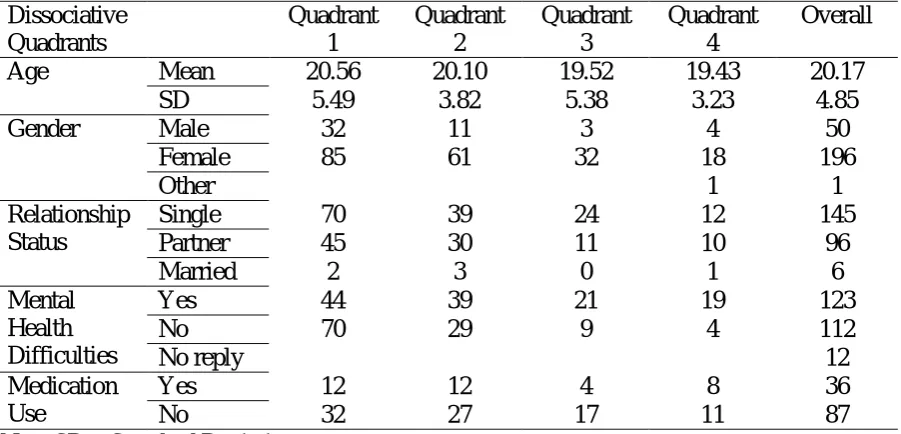
[image:44.595.74.525.505.722.2]Table 1 presents the descriptive statistics across the four dissociation quadrants for age, gender, relationship status, mental health difficulties and medication use.A one-way between subjects ANOVA showed no significant differences across quadrants for age, F(1,3) = 0.64, p = 0.59,
h
p2= .008. With regard to the gender make up across quadrants, only one person identified as ‘other’ and they fell within the high dissociation quadrant. This participant was temporarily removed in order to conduct a Chi-Square analysis on gender across the four quadrants. They were not excluded from the rest of the data analysis. A Chi-Square analysis showed a non-significant trend, 2(3) = 7.75, p = .052. To further explore this trend, six two-by-two Chi-Squared analyses where conducted comparing each quadrant with the other quadrants. Comparisons between quadrants one and two showed a non-significant trend, 2(1) = 3.76, p = .055.Table 1
Demographic Descriptive Statistics.
Note. SD = Standard Deviation Dissociative Quadrants Quadrant 1 Quadrant 2 Quadrant 3 Quadrant 4 Overall
Age Mean 20.56 20.10 19.52 19.43 20.17
SD 5.49 3.82 5.38 3.23 4.85
Gender Male 32 11 3 4 50
Female 85 61 32 18 196
Other 1 1
Relationship Status
Single 70 39 24 12 145
Partner 45 30 11 10 96
Married 2 3 0 1 6
Mental Health Difficulties
Yes 44 39 21 19 123
No 70 29 9 4 112
No reply 12
Medication Use
Yes 12 12 4 8 36
Quadrants one and three showed a significant difference in gender, with the ratio of females to males lower in the normative quadrant compared to the low clinical quadrant, 2(1) = 5.36, p = .021. No other significant differences were found for gender.
With regard to the relationship status across the quadrants, only six participants selected ‘married’, this category was represented in all categories except quadrant 3 (see Table 1.). These participants were temporarily removed in order to conduct a Chi-Square analysis on the other relationship statuses across the four quadrants. They were not excluded from the rest of the data analysis. Analysis showed no significant differences for these relationship statuses, 2(3) = 1.73, p = .63.
In relation to mental health status, a Chi-Square analysis showed significant differences across the quadrants, 2(3) = 21.51, p < .001. Post-hoc Chi-Square analyses showed a greater likelihood of having versus not having mental health difficulty in quadrant two than quadrant one, 2(1) = 6.04, p = .01. Comparisons between quadrants one and three showed a greater probability of having versus not having a mental health problem in quadrant three, 2(1) = 9.46, p = .002. Quadrant four showed a similar pattern of results, when compared to quadrant one, 2(1) = 14.92, p < .001. Finally, a comparison between quadrants two and four showed a greater likelihood of having versus not having mental health difficulty in quadrant four compared to quadrant two, 2(1) = 4.74, p = .029. No other differences were significant. With regard to medication use, analysis showed no significant differences in the proportion of participants who did and did not use medication across the quadrants, 2(3) = 2.71, p = .44. Harmful Behaviours and Gender
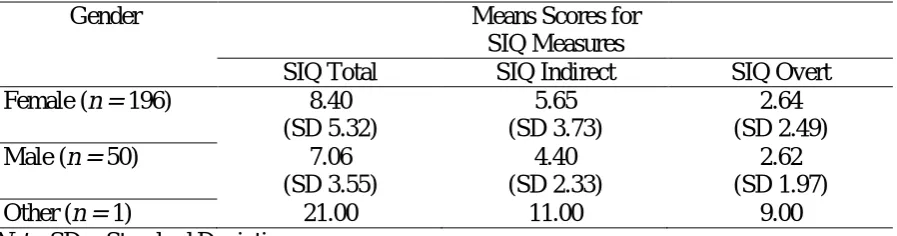
Table 2 presents the average scores for measures of harmful behaviours across genders. The one person who identified as ‘other’ within the sample was temporarily
measures. They were not excluded from the rest of the data analysis and their mean scores are included in table 2. A one way between subjects ANOVA was conducted to determine if any significant differences existed between the males and females for SIQ Total scores. No significant effect was found, F(1,244) = 2.85, p = 0.92,
h
p2= .012. This findings suggests that there was no significant differences between males and females in the SIQ Total scores. A one way between subjects ANOVA showed a main effect for SIQ Indirect across gender,Table 2
Mean Scores for Measures of Harmful Behaviour Across Genders
Gender Means Scores for
SIQ Measures
SIQ Total SIQ Indirect SIQ Overt
Female (n = 196) 8.40
(SD 5.32)
5.65 (SD 3.73)
2.64 (SD 2.49)
Male (n = 50) 7.06
(SD 3.55)
4.40 (SD 2.33)
2.62 (SD 1.97)
Other (n = 1) 21.00 11.00 9.00
Note. SD = Standard Deviation
F(1, 244) = 5.118, p<.025;
h
p2= .021. Significantly more females engaged in indirect forms of harmful behaviours than males. A one-way between subjects ANOVA on SIQ Overt scores across gender showed a non-significant effect, F(1,244) = .004, p = 0.952,h
p2= .000. This finding suggests that there was no significant difference between males and females in the SIQ Overt scores.Test of Hypothesis One - Does the Quartile Risk Model Predict Engagement in Harmful Behaviours, and Assessment of Other Questionnaire Measures
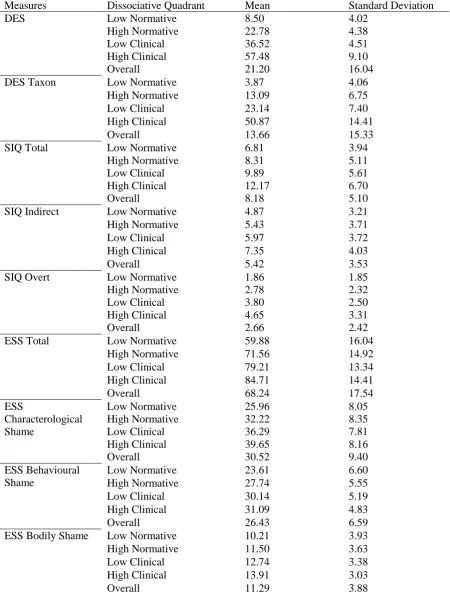
Table 3 presents the average scores for the four dissociative quadrants across measures of dissociation (DES and DES-T), self-injury (SIQ Total, SIQ Indirect, and SIQ Overt), and Shame (ESS Total, ESS Characterological Shame, ESS Behavioural Shame, and ESS Bodily Shame). To ensure the quadrants were statistically differentiating those with different levels of dissociation, a one-way Multivariate Analysis of Variance (MANOVA) was conducted to test whether differences existed across the four quadrants on the
dissociation measures (DES and DES-T). There was a significant multivariate effect, Pillai’s Trace =1.08; F(6,486) = 95.46, p <.001;
h
p2= .541. The univariate ANOVA’s showed that both the DES, F(3,243) = 811.07, p <.001;h
p2=.909, and DES-T, F(3,243) = 323.56, p<.001;h
p2
=.80, scores significantly differed across the dissociation quadrants. A Games-Howell post-hoc procedure was utilised to further explore these findings. As expected, DES scores significantly increased from one quadrant to the next (p<.001). For DES-T scores, all dissociation quadrants progressive increased in scores (p<.001). These results indicate that DES scores significantly differed across the quadrants and increased in a general linear trend.
As a test of hypothesis one, a one-way ANOVA was conducted to examine
Table 3
Mean and Standard Deviation Scores for Measures for Low Normative (n = 117), High Normative (n = 72), Low Clinical (n = 35) and High Clinical (n = 23) Quadrants; (N = 247)
Measures Dissociative Quadrant Mean Standard Deviation
DES Low Normative 8.50 4.02
High Normative 22.78 4.38
Low Clinical 36.52 4.51
High Clinical 57.48 9.10
Overall 21.20 16.04
DES Taxon Low Normative 3.87 4.06
High Normative 13.09 6.75
Low Clinical 23.14 7.40
High Clinical 50.87 14.41
Overall 13.66 15.33
SIQ Total Low Normative 6.81 3.94
High Normative 8.31 5.11
Low Clinical 9.89 5.61
High Clinical 12.17 6.70
Overall 8.18 5.10
SIQ Indirect Low Normative 4.87 3.21
High Normative 5.43 3.71
Low Clinical 5.97 3.72
High Clinical 7.35 4.03
Overall 5.42 3.53
SIQ Overt Low Normative 1.86 1.85
High Normative 2.78 2.32
Low Clinical 3.80 2.50
High Clinical 4.65 3.31
Overall 2.66 2.42
ESS Total Low Normative 59.88 16.04
High Normative 71.56 14.92
Low Clinical 79.21 13.34
High Clinical 84.71 14.41
Overall 68.24 17.54
ESS
Characterological Shame
Low Normative 25.96 8.05
High Normative 32.22 8.35
Low Clinical 36.29 7.81
High Clinical 39.65 8.16
Overall 30.52 9.40
ESS Behavioural Shame
Low Normative 23.61 6.60
High Normative 27.74 5.55
Low Clinical 30.14 5.19
High Clinical 31.09 4.83
Overall 26.43 6.59
ESS Bodily Shame Low Normative 10.21 3.93
High Normative 11.50 3.63
Low Clinical 12.74 3.38
High Clinical 13.91 3.03
for SIQ Indirect scores, F(3,243) = 3.611, p =.01;
hp
2 = .043. Games-Howell post-hoc analysis revealed that the low normative quadrant had significantly less indirect harmful behaviours than the high clinical dissociative quadrant (p =.04). No other significant differences were found. A one-way ANOVA on SIQ Overt scores showed a main effect across the dissociative quadrants, F(3,243) = 13.951, p <.001;hp
2 = .147. Games-Howell post-hoc analysis revealed a general linear increase, with significantly more overt DSH from one quadrant to the next (i.e., low normative to high normative, p =.027; high normative to low clinical quadrant, p =.001; low clinical to high clinical, p =.003). Thus, the current findings do not appear to support hypothesis one.A one-way ANOVA on ESS Total scores across quadrants showed a main effect, F(3, 243) = 28.107, p<.001;
h
p2= .258. Games-Howell analysis further revealed that significant differences existed between almost every quadrant (i.e., low normative to high normative, p <.001; low normative to low clinical, p <.001; low normative to high clinical, p <.001; high normative to low clinical, p =.042; high normative to high clinical, p =.003), except between low clinical and high clinical dissociative quadrants (p =.47). No other significant differences were found. A one-way ANOVA on ESS Characterological Shame scores across thedissociative quadrants showed a main effect for ESS Characterological Shame, F(3,243) = 28.971, p <.001;
h
p2= .263. Games-Howell analyses revealed that the low normativedissociative quadrant was significantly lower than the high normative (p <.001), low clinical (p <.001), and high clinical quadrants (p <.001). High normative was significantly lower than the high clinical quadrant (p =.001). No other significant differences were found. For ESS Behavioural Shame scores a one-way ANOVA revealed a main effect across the quadrants, F(3,243) = 19.049, p <.001;
h
p2= .19. The low normative dissociative quadrant wasclinical quadrants (p <.001). No other significant differences were found. A one-way ANOVA on ESS Bodily Shame across the dissociative quadrants showed a main effect, F(3,243) = 9.036, p <.001;
h
p2= .1. The low normative dissociative quadrant was significantly lower than the low clinical (p <.002), and high clinical quadrants (p <.001). The highnormative quadrant was significantly lower than the high clinical quadrant (p <.015). No other significant differences were found.
These results generally suggest that the different measures of shame displayed a general increase across the four dissociative quadrants. That is, as dissociation increased across the quadrants, the levels of shame increased concurrently.
Motivations for DSH Behaviours
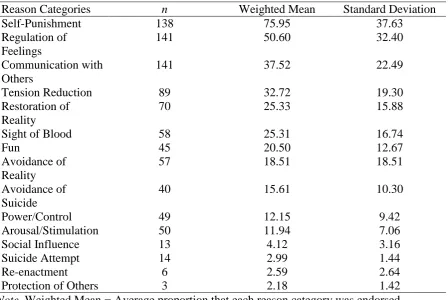
Table 4 presents the descriptive statistics for DSH motivations (reason categories) across the SIQ Overt scale. The table is presented in descending order with the highest weighted average proportional endorsement at the top. The self-punishment and regulation of feelings reason categories had the highest average weighted proportional endorsements, as well as the highest number of participants who endorsed the two categories. Communication with others followed these two categories, but did have the equal highest number of
Table 4
Descriptive Statistics: SIQ Reason Categories
Reason Categories n Weighted Mean Standard Deviation
Self-Punishment 138 75.95 37.63
Regulation of Feelings
141 50.60 32.40
Communication with Others
141 37.52 22.49
Tension Reduction 89 32.72 19.30
Restoration of Reality
70 25.33 15.88
Sight of Blood 58 25.31 16.74
Fun 45 20.50 12.67
Avoidance of Reality
57 18.51 18.51
Avoidance of Suicide
40 15.61 10.30
Power/Control 49 12.15 9.42
Arousal/Stimulation 50 11.94 7.06
Social Influence 13 4.12 3.16
Suicide Attempt 14 2.99 1.44
Re-enactment 6 2.59 2.64
Protection of Others 3 2.18 1.42
Note. Weighted Mean = Average proportion that each reason category was endorsed, weighted by the number of participants who endorsed each reason category; n = Number of participants within each reason category.
Test of Hypothesis Two – Higher Levels of Harmful Behaviours are Associated with Higher Levels of Shame
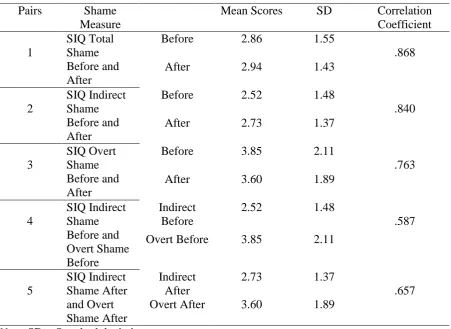
found for pair three (SIQ Overt), t(200) = 2.59, p <.010, and contrary to previous findings it suggests that a greater level of shame is experienced before overt harmful behaviour (DSH) relative to after. In relation to pair four (SIQ Indirect – SIQ Overt before), a significant difference was found, t(194) = -9.91, p <.001. This finding suggests that greater levels of shame are experienced before engaging in overt harmful behaviours relative to indirect forms. Finally, pair five (SIQ Indirect and SIQ Overt after) also demonstrated a significant difference, t(192) = -7.42, p <.001. This finding suggests that those who engage in the overt forms of harmful behaviour are likely to experience greater levels of shame as a consequence to the behaviour relative to those who engage in the indirect forms of the behaviour.
Table 5
Mean Scores and Pair Correlations for State Shame Before and After Harmful Behaviours
Pairs Shame
Measure
Mean Scores SD Correlation Coefficient 1 SIQ Total Shame Before and After
Before 2.86 1.55
.868
After 2.94 1.43
2
SIQ Indirect Shame Before and After
Before 2.52 1.48
.840
After 2.73 1.37
3
SIQ Overt Shame Before and After
Before 3.85 2.11
.763
After 3.60 1.89
4 SIQ Indirect Shame Before and Overt Shame Before Indirect Before
2.52 1.48
.587
Overt Before 3.85 2.11
5 SIQ Indirect Shame After and Overt Shame After Indirect After
2.73 1.37
.657
Overt After 3.60 1.89