ISSN Online: 2167-7751 ISSN Print: 2167-7743
DOI: 10.4236/ojl.2018.71002 Mar. 6, 2018 19 Open Journal of Leadership
A Leader’s Perspective: Using Qualitative
Methodology for Program Evaluation in a
Rural Middle School
Matthew A. Birdwell
Perryton Independent School District,Perryton, TX, USA
Abstract
The purpose of this study was to analyze the male student population at West Texas Middle School in order to determine why the majority of male students at West Texas Middle School do not participate in the athletic gram. This particular study was classified as both a case study and a pro-gram evaluation due to the nature of the study containing elements of both paradigms. The instruments that the researcher used to collect data were student questionnaires, structured interviews, formal observations, and at-tendance/academic data documents. A questionnaire was selected for data collection because of the possibility for collecting rich data straight from the student population. Structured group interviews were conducted in order to capture current and valid data from the coaching staff and the athletic di-rector. Informal observations were conducted in order to gather rich data of interactions between coaches and students. Attendance and academic doc-ument data was collected to compare the effectiveness of athletic programs. Finally, semi structured interviews were utilized to gather opinions and perspectives of the coaches in regards to the athletic program. The findings from data analysis revealed that the male athletic department experienced low participation numbers due to a lack of student’s interest and a harmful climate created by the athletics director and coaching staff. The study re-vealed that the students were heavily involved in extracurricular activities. However, a small percentage of these students were involved in boy’s athlet-ics. The athletic program lacked a clear vision with aligned goals. This, along with the toxic working environment, contributed to the toxic culture of the male athletic program.
Keywords
Rural Schools, Program Evaluation, Administrative Leadership, Culture
How to cite this paper: Birdwell, M. A. (2018). A Leader’s Perspective: Using Qua-litative Methodology for Program Evalua-tion in a Rural Middle School. Open Jour-nal of Leadership, 7, 19-32.
https://doi.org/10.4236/ojl.2018.71002
Received: January 12, 2018 Accepted: March 3, 2018 Published: March 6, 2018
Copyright © 2018 by author and Scientific Research Publishing Inc. This work is licensed under the Creative Commons Attribution International License (CC BY 4.0).
DOI: 10.4236/ojl.2018.71002 20 Open Journal of Leadership
1. Introduction
Researchers frequently compare the profession of education to a “revolving door” (Ingersoll, 2001). Turnover is high, however it is particularly high in teaching fields such as special education, mathematics, science, as well as the coaching arena of rural, isolated schools (Ingersoll, 2001). This can negatively impact the climate of a campus or program, and when climate is low or toxic, student participation can be negatively affected (Scherer, 2005). Program evalua-tion can have the potential to positively impact culture and climate for both stu-dents and teachers. Program evaluation is a practical endeavor and is used to provide information that can be used to improve the operational environment of specific programs (Barker, 2003).
Quite often social service programs are evaluated because of a need to be ac-countable to a sponsoring or funding agency, or because competition for scarce funds requires that only one program can be funded. Program evaluation is needed whenever new interventions are required because there is a perception that a program could be improved. Researchers evaluate on those occasions when it is important to have some objective assessment or feedback about the worth of our social programs (Royse, Thyer, & Padgett, 2010).
Qualitative methods have become central to program evaluation. Qualitative methods are empirical and systematic, relying on careful documentation and analysis grounded in data. The advantage of a qualitative approach is that it al-lows the researcher to examine program morale, executive decision-making, and student perspectives without relying on structured data collection necessitated by quantitative designs (Royse et al., 2010). By digging deeper and more sensi-tively, the chances of discovering unanticipated but meaningful insights into a program’s inner workings are increased significantly.
The purpose of this study was to analyze the male student population at West Texas Middle School in order to determine why the majority of male students at West Texas Middle School do not participate in the athletic program. Due to this challenge within the male athletics program, the goal of this study is to develop an intervention plan that would:
1) Increase participation within the boys’ athletic program;
DOI: 10.4236/ojl.2018.71002 21 Open Journal of Leadership male athletic participation is 52% in the high school. However, there are cur-rently fifteen males in junior high athletics, comprising 68% participation. Due to these unusually low participation percentages, the research questions for this study are:
• Why are male students not participating in athletic programs at West Texas Middle School?
• Does the climate of the male athletic program cultivate and encourage par-ticipation?
2. Literature Review
Litwin & Stringer (1968) defined climate as a set of measurable assets of the or-ganization’s environment that is either directly or indirectly perceived by the employees who work within the organizational environment that influences or motivates their behavior. School climate is the experience that is greater than the individual within a school. A leader’s ability to engage and connect has a positive or negative impact and effectiveness of the organization (Cohen, McCabe, Mi-chelli, & Pickeral, 2009). The climate of an organization is the sum of percep-tions of those who work in the organization. Climate within an organization or program can arouse motivation, causing behavior that results in satisfaction, productivity or performance, and retention. Litwin & Stringer (1968) identified nine characteristics or dimensions of climate defined as: 1). Structure: feelings employees have about constraints, rules, regulations, and procedures; 2). Re-sponsibility: feeling of being your own boss; 3). Reward: feeling of being re-warded for a job well done, perception of fairness; 4). Risk: feeling that is ac-ceptable to be a risk-taker; 5). Warmth: feeling of being well-liked and preva-lence of friendly social and informal social groups; 6). Support: feeling of mutual support from all levels; 7). Standards: feeling represented in decision making and valued for performance; 8). Conflict: feeling of wanting to hear different opi-nions and recognizing problems publicly; 9). Identity: feeling you are a valued team member.
Educators and leaders alike have recognized the significance of school climate for over a century. However, it wasn’t until the 1970s that the topic of school climate began to be a focus of educational research. There is no shared definition for school climate that exists. In fact, a range of terminology is utilized for cli-mate such as atmosphere, feelings, tone, setting, and many other terms. Pepper
& Thomas (2002) defined climate as the environment in which one works and
learns as having an impact on their production. The overall feeling of the pro-gram or organization exists where collaboration between teachers and cowork-ers, development of common goals, mutual support and constructive feedback. Razik & Swanson (2010) described an organizations overall attitude as climate; the attitude of members of the organization is a result of climate.
perfor-DOI: 10.4236/ojl.2018.71002 22 Open Journal of Leadership mance. The school environment, or school climate, is a critical element in our society and has an impact on our society’s future. School environment can have a positive or negative effect on the people who work there, directly having an impact on student learning (Pepper & Thomas, 2002). The organization or pro-gram leader’s means of communication should be one that is defined by the program’s values, and one of which decision making is open for stakeholders. Effective leaders know how to respond to the many complex decisions that have potential to drive stakeholders in many directions ensuring decisions are rooted in the program’s core values (Razik & Swanson, 2010).
Professionals working within a positive climate are engaged and respected by the leader and as a result gain satisfaction from the learning that is fostered. Teachers contribute to the organizational and physical operations of the school. The climate experience goes beyond one’s individual experience to describe the collective phenomenon, which is greater than an individual experience (Cohen, Taylor, Zonta, Vestal, & Schuster, 2007). The phenomenon of a greater individ-ual experience can be compared to a study conducted by Graham & Haidt
(2010) that found individuals involved in religious communities to be happier
due to the sense of community and belonging. The establishment of a sense of community within an organization can improve climate (Graham & Haidt, 2010).
Although the literature is proactive about the impacts of culture on student participation within extracurricular programs, the methodological problems presented with such literature is that research conducted are typically on urban campuses with much larger populations than West Texas Middle School. This discrepancy can produce significantly different results than what we are expect-ing to find. After analyzexpect-ing the literature, my leadexpect-ing question is how such re-search would impact or reflect findings from a rural or isolated school district? However, the findings produce many similarities and differences that will be greatly beneficial to this study.
3. Methodology
da-DOI: 10.4236/ojl.2018.71002 23 Open Journal of Leadership ta collection methods to gather rich, specific data from the participants. These methods of data collection were significantly important in determining whether this theory was trustworthy or unreliable.
The participants that were included in this study were the male student popu-lation in grades seven through twelve and the athletic coaching staff. There are 23 male students in the seventh grade and 25 male students in the eighth grade. The male students participated in the questionnaire and informal observation portions of data collection. The athletic coaching staff currently includes the athletic director, the head football coach, and the head basketball coach. The coaching staff was involved in the structured interviews and the informal obser-vation portions of data collection. The students and coaches were selected be-cause the study focuses on using qualitative methodology as a means for pro-gram evaluation of the male athletic propro-gram.
This particular study was classified as both a case study and a program evalua-tion due to the nature of the study containing elements of both paradigms. A case study, as defined by Shah & Al-Bargi (2013: p. 258), is “an approach that employs in-depth investigation of any social phenomenon, using various sources of data”. Royse, Thyer, & Padgett (2010: p. 2) describe a program evaluation as a mission to provide information that can be used to improve social programs. The researcher, as well as campus administrators, hopes that the methodology used for this study can be replicated and applied to similar research situations on campus.
The instruments that the researcher used to collect data were student ques-tionnaires, structured interviews, formal observations, and attendance/academic data documents. The guiding principle behind the data collection process is that “the information collected should be compelling enough to convince any skep-tic” (Sagor, 1992: p. 28). These methods were selected because of the nature of the study and reliability of the data that can be provided to the researcher.
pat-DOI: 10.4236/ojl.2018.71002 24 Open Journal of Leadership terns within student involvement. In order to ensure trustworthiness, neither the coaching staff nor the athletic director was involved in the creation and admin-istration of the questionnaire to the student athletes. It was the researcher’s belief that their presence would have created an intimidating atmosphere and could have possibly influenced some of the answer choices by the students. The mode of administration helped to ensure the trustworthiness of the data collected from the student questionnaire.
Structured group interviews were conducted in order to capture current and valid data from the coaching staff and the athletic director (See Appendix B for examples of questions from the group interview). Data was collected from a va-riety of individuals, as they had a unique perspective and their own way of con-tributing to the study. The athletic director of the West Texas athletics program has been with the school for six years, however, only two cumulative years as the athletic director and superintendent of the district. He was selected for this study as he made all final decisions in regards to the boys’ and girls’ athletic programs. The boys’ athletic program contains two coaches that assist each other in various sports. The coaches selected for this study were the head football and head bas-ketball coach. The head basbas-ketball coach was an experienced educator with ele-ven years of total experience and two years as a head coach. The head football coach has served as both a head football and head track coach with thirty years of total experience, all of which was served at West Texas Middle School. The interview was recorded and transcribed. A copy of the transcription was elec-tronically mailed to each participant to confirm responses to the questions.
inter-DOI: 10.4236/ojl.2018.71002 25 Open Journal of Leadership view data collected. The researcher reviewed the data and searched for trends that were consistent across figures collected from all four modes.
3.1. Trustworthiness
In order to ensure trustworthiness of the data collected from the methods dis-cussed, triangulation of data was used with the data collection techniques. Tri-angulation ensures that the data and themes developed from the data are credi-ble and dependacredi-ble. A transcription of the group interview were created and electronically mailed to the participants for member checks. The researcher created an audit trail by numbering the lines of the interview transcription and the observation field notes. Yellow and green highlighters were used to code key words and themes found within the transcriptions and observation notes. This confirmed the reliability and trustworthiness of the data and themes that were found.
An obvious strength of the data sources being used was that they all contri-buted in different ways to the study. The student athletes were the active partic-ipants while the coaching staff and athletic director provided their unique per-ceptions and opinions to the study. Another obvious strength was the current number of years of experience that the coaching staff and athletic director have. They brought a variety of experiences and knowledge that significantly contri-buted to the study. A clear weakness of the data sources was that they were fo-cused on one campus of a specific district. This study did not involve other campuses of other school districts. Because this study was very narrow in scope and focused on one campus, a similar study on a different campus may produce different results.
3.2. Researcher Information/Bias
The researcher was the current administrator (principal) of the campus hosting the study. Prior to accepting the administrator position, the researcher was an assistant coach and social studies teacher for four years before becoming the head basketball coach of the athletic program that was analyzed. Even though the researcher had no involvement within the athletic program, his prior history with the program created some bias within the scope of this study. The adminis-trator/researcher was required to attend all athletic events, thus creating bias that the athletic program was successful. However, the researcher has left the campus under study and accepted employment on another campus within a separate school district.
4. Findings
DOI: 10.4236/ojl.2018.71002 26 Open Journal of Leadership of data and confirmability of the themes that emerged.
Two themes emerged from the analyzed data:
1) A lack of interest of the students to participate in the athletic program; and 2) Harmful conduct of the coaching staff within the athletic program.
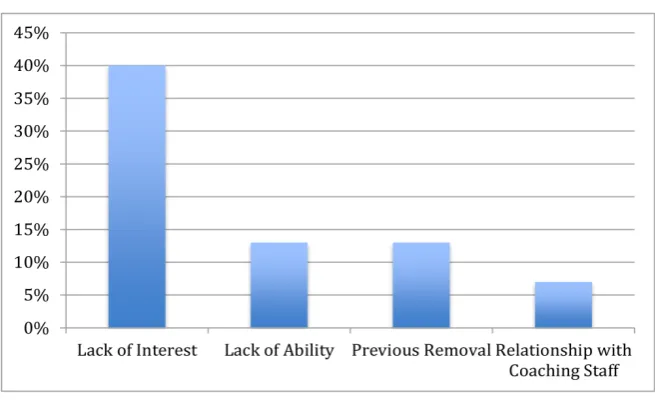
Data collected from the student questionnaire, informal observation, and do-cumentation data aided in developing the first theme. It was found from the student questionnaire that 40% of students that do not participate in athletics listed “lack of interest” as their primary factor (See Figure 1 for the percentage bar graph). This numerical percentage aided in disproving the researcher’s orig-inal theory. The theoretical framework that drove the study was that students do not participate in athletics due to their necessity to work after the school day in order to facilitate income for their household. Data collected from the informal observation also helped develop the first theme. At one point during the practice at the football field, one of the athletes began to walk off the field toward the dressing room. The head coach stopped him and asked, “Where are you going? Why are you leaving? We have not finished with practice.” The student replied, “There is a concert in Lubbock that me and my girlfriend (sic) are going to. I have to go home to get ready.” This clearly shows a lack of interest in participat-ing in the program. It was also observed that a few of the athletes that were standing on the sideline (not participating in a drill being conducted) began discussing other extracurricular activities that they were missing in order to “just stand on the sideline during practice and not do anything”. This caused the re-searcher to wonder how many male students were involved in other extracurri-cular activities, not just boys’ athletics. The researcher then concluded that it was necessary to collect student schedule documentation data instead of atten-dance/academic records. Once this data was collected and analyzed, it was con-cluded that 92% of male students participate in at least one extracurricular activ-ity. However, only 52% are in boys’ athletics. Extracurricular activities on the high school campus include choir, orchestra, electronics, robotics, archery, Civil Air Patrol, chess, University Interscholastic League (UIL) academic competi-tions, cheerleading, agriculture woodworking, and engine repair.
DOI: 10.4236/ojl.2018.71002 27 Open Journal of Leadership Figure 1. Questionnaire themes.
a list of goals posted in the coaches’ office or in the athletes’ locker room. It was also noted that there is not a mission or vision statement present in the coach’s office or athlete’s locker room. Before the staff left the coaches’ office for the practice field, the “Coach C” asked “Coach B” for a copy of the day’s practice schedule. The head coach did not have one available and stated, “Time is a lux-ury that I don’t have.” It was noted that the assistant coach seemed agitated by the response of the head coach.
5. Conclusion
Data revealed that the students were heavily involved in extracurricular activi-ties. However, a small percentage of these students were involved in boy’s ath-letics. Numerically, forty-four of the forty-eight students that were administered the questionnaire were involved in at least one extracurricular activity. The male student population was more involved in extracurricular activities than the na-tional average (Cadwallader, Wagner, & Garza, 2004).
The data also revealed a clear disconnect among the coaching staff. This dis-connect was at the time having a negative impact on the culture and climate of the boy’s athletic program. Deal & Peterson (2009) found that elements of a tox-ic culture and climate include no shared sense of purpose, negative relationships, destructive groups, and no sense of trust or caring. These elements were found within the data that was collected. It is the recommendation of the researcher that the coaching staff collaboratively develop a set of common goals as well as a shared mission and vision statement. By doing this, the coaching staff could im-prove performance by fostering a shared system of norms, folkways, values, and traditions. These infuse the enterprise with passion, purpose, and a sense of spi-rit(Deal & Peterson, 2009).
About the Author
In-DOI: 10.4236/ojl.2018.71002 28 Open Journal of Leadership dependent School District in Perryton, Texas. Mr. Birdwell is a doctoral candi-date in the Department of Curriculum & Instruction at Texas Tech University with plans to graduate in May 2018. The title of his dissertation is A Qualitative Study of Implementation and Sustainability Factors of Professional Learning
Communities on Campus Accountability and Improvement. His research
in-cludes professional learning communities (PLC), job embedding professional development, rural schools and education, school culture and climate, and classroom assessment and instruction models. Mr. Birdwell’s interests include reading, writing, and spending time with his family.
References
Barker, R. (2003). The Social Work Dictionary (5th ed.). Washington, DC: NASW Press. Bastedo, M. (2007). Sociological Frameworks for Higher Education Policy Research.
Bal-timore, MD: Johns Hopkins University Press.
Cadwallader, T., Wagner, M., & Garza, N. (2004). Participation in Extracurricular Activi-ties. National Logitudinal Transition Study, 2.
http://www.nlts2.org/reports/2003_04-2/nlts2_report_2003_04-2_ch4.pdf
Cohen, D. A., Taylor, S. L., Zonta, M., Vestal, K. D., & Schuster, M. A. (2007). Availability of High School Extracurricular Sports Programs and High-Risk Behaviors. Journal of School Health, 77, 80-86.https://doi.org/10.1111/j.1746-1561.2007.00171.x
Cohen, J., McCabe, L., Michelli, N. M., & Pickeral, T. (2009). School Climate: Research, Policy, Practice, and Teacher Education. The Teachers College Record, 111, 180-213. Deal, T., & Peterson, K. (2009). Shaping School Culture: Pitfalls, Paradoxes, and
Promis-es. San Francisco, CA: Jossey-Bass.
Family Educational Rights and Privacy Act (FERPA) (2014). Family Policy Compliance Office. http://www2.ed.gov/policy/gen/guid/fpco/ferpa/index.html
Graham, J., & Haidt, J. (2010). Beyond Beliefs: Religions Bind Individuals into Moral Communities. Personality and Social Psychology Review: An Official Journal of the So-ciety for Personality and Social Psychology, Inc., 14, 140-150.
https://doi.org/10.1177/1088868309353415
Ingersoll, R. M. (2001). How Distributed Leadership Can Make a Difference in Teachers’ Organizational Comment? A Qualitative Study. Teaching and Teacher Education, 26,
565-575.
Litwin, G. H., & Stringer Jr., R. A. (1968). Motivation and Organizational Climate (Vol. VIII, p. 214). Oxford: England Harvard University.
Pepper, K., & Thomas, L. H. (2002). Making a Change: The Effects of the Leadership Role on School Climate. Journal of Education for Business, 84, 2-6.
Razik, T. A., & Swanson, A. D. (2010). Fundamental Concepts of Educational Leadership and Management. Boston, MA: Pearson.
Royse, D., Thyer, B., & Padgett, D. (2010). Program Evaluation: An Introduction. Bel-mont, CA: Wadsworth Cengage Learning.
Sagor, R. (1992). How to Conduct Collaborative Action Research. Alexandria, VA: Asso-ciation for Supervision and Curriculum Development.
Scherer, M. (2005). Keeping Good Teachers. Princeton, NJ: Recording for the Blind & Dyslexic.
Theo-DOI: 10.4236/ojl.2018.71002 29 Open Journal of Leadership
retical Frameworks, and Study Designs. Arab World English Journal, 4, 252-264. United States Census Bureau (2010). Community Facts—Find Popular Facts (Population,
Income, etc.) and Frequently Requested Data about Your Community.
DOI: 10.4236/ojl.2018.71002 30 Open Journal of Leadership
Appendix A
Student Questionnaire (Answer Yes to #2)
1) What grade are you in? A) 7th Grade
B) 8th Grade C) 9th Grade D) 10th Grade E) 11th Grade F) 12th Grade
2) Are you currently in athletics? A) Yes
B) No
3) If yes, what sports do you currently play? (Mark all that apply.) A) Football
B) Basketball C) Track
D) Cross Country E) Tennis F) Golf
4) If you do not play a particular sport, why? A) I do not like the sport.
B) I do not think I am very good at that particular sport. C) I do not have time to practice for that particular sport. D) My parents will not let me play that sport.
E) I do not like the coaching staff. F) Medical (Injuries) Issues. G) Other… Explain… H) Does Not Apply.
5) If you answered (C) on question 3, why do you not have time to prac-tice for that particular sport?
A) Academic (Grade) Issues. B) Employment (Job) Opportunities. C) Home (Family) Issues.
D) Other… Explain…
6) If you answered (E) on question 3, what do you not like about the coaching staff?
A) Conduct (Behavior during the game.)
B) Attitude (Feelings toward individual player or player’s performance.) C) Philosophy (Playing time, coaching strategies, etc.)
(Answer “No” to #2)
2) Are you currently in athletics? A) Yes
DOI: 10.4236/ojl.2018.71002 31 Open Journal of Leadership 3) If no, why do you choose not to participate in athletics?
A) I am not interested.
B) I do not think I am athletic enough to play sports. C) My parents will not let me.
D) Employment (Job) Opportunities. E) Academic (Grades) Issues. F) Medical (Injuries) Issues.
G) I was removed previously from the athletic program. H) I do not like the coaching staff.
I) Other… Explain…
4) If you answered (C) to question #2, why will your parents not let you participate?
A) Because of my grades.
B) Because of my behavior at school. C) Because they want me to work. D) Because they do not like athletics. E) Because they are afraid I might get hurt. F) Because they do not like the coaching staff. G) Other… Explain…
5) If you answered (E) to question #2, what can the coaching staff do to help you with your grades in the classroom?
A) Assign me to tutorial blocks on Fridays after lunch. B) Create tutoring groups within the boy’s athletic program. C) Other… Explain…
6) If you answered (H) to question #2, what do you not like about the coaching staff?
A) Conduct (Behavior during a game.)
B) Attitude (Feelings toward an individual player or player’s performance.) C) Philosophy (Playing time, coaching strategies, etc.)
7) If you answered (G) to question #2, why were you removed from the athletic program?
A) Grades. B) Behavior. C) Drugs.
D) Other… Examples…
8) What changes could be made to the athletic program that would per-suade you to participate?
A) Facilities.
B) Equipment. (Workout gear, uniforms, water bottles, etc.) C) Conduct of the coaching staff.
DOI: 10.4236/ojl.2018.71002 32 Open Journal of Leadership
Appendix B
Interview Questions
1) What do you recall about the current goals of the athletic program? 2) How do you feel about the boy’s athletic staff working toward the goals? 3) What is your opinion of the quality of the boy’s athletic goals?
4) Should the goals be revised? Why?
5) In your opinion, why does the boy’s athletic program have such low partic-ipation numbers?
6) How important do you think a mission or vision statement would be for the athletic program?
7) What things could the coaching staff change to increase numbers in the boy’s athletic program?
8) Ultimately, how does the future look for Lorenzo boy’s athletics?
9) How would you rate the current condition of the boy’s athletic program? Explain.