Knowledge discovery through creating formal contexts
ANDREWS, Simon <http://orcid.org/0000-0003-2094-7456> and
ORPHANIDES, Constantinos
Available from Sheffield Hallam University Research Archive (SHURA) at:
http://shura.shu.ac.uk/3710/
This document is the author deposited version. You are advised to consult the
publisher's version if you wish to cite from it.
Published version
ANDREWS, Simon and ORPHANIDES, Constantinos (2010). Knowledge discovery
through creating formal contexts. In: XHAFA, F, ABRAHAM, A, DEMETRIADIS, S
and CABALLE, S, (eds.) First international workshop on computational intelligence in
networks and systems (CINS 2010). IEEE Computer Society, 455-460.
Copyright and re-use policy
See
http://shura.shu.ac.uk/information.html
Knowledge Discovery through Creating Formal Contexts
Simon Andrews∗ and Constantinos Orphanides†
Conceptual Structures Research Group, Communication and Computing Research Centre Faculty of Arts, Computing, Engineering and Sciences, Sheffield Hallam University, Sheffield, UK
∗[email protected] †[email protected]
Abstract—Knowledge discovery is important for systems that have computational intelligence in helping them learn and adapt to changing environments. By representing, in a formal way, the context in which an intelligent system operates, it is possible to discover knowledge through an emerging data technology called Formal Concept Analysis (FCA). This paper describes a tool called FcaBedrock that converts data into Formal Contexts for FCA. The paper describes how, through a process of guided automation, data preparation techniques such as attribute exclusion and value restriction allow data to be interpreted to meet the re-quirements of the analysis. Creating Formal Contexts using FcaBedrock is shown to be straightforward and versatile. Large data sets are easily converted into a standard FCA format.
Keywords-Formal Context; Formal Concept Analysis; guided automation; visualisation; Concept Lattice
I. INTRODUCTION
Formal Concept Analysis (FCA) was introduced in the 1990s by Rudolf Wille and Bernhard Ganter [17] building on applied lattice and order theory developed by Birkhoff and others in the 1930s and was initially developed as a subsection of Applied Mathematics, based on the mathematisation of concepts and con-cepts hierarchy. The following description of FCA is that used in [4].
AFormal Conceptis constituted by itsextension,
com-prising of all objects which belong to the Concept, and
its intension, comprising of all attributes (properties,
meanings) which apply to all objects in the extension. The set of all objects and attributes together with their relation to each other form aFormal Context, which can be represented by a cross-table.
Airlines
Latin
America
Eur
ope
Canada Asia
Pacific
Middle
East
Africa Mexico Caribbean USA
Air Canada × × × × × × × ×
Air New Zealand × × ×
Nippon Airways × × ×
Ansett Australia ×
Austrian Airlines × × × × × ×
The cross-table above is a Formal Context represent-ing the destinations of five airlines, where the elements on the left are formal objects (airlines) and the elements
at the top are formal attributes (destinations). If an object has a specific attribute, it is indicated by placing a cross in the corresponding cell of the table. An empty cell indicates that the corresponding object does not have the corresponding attribute. In the Airlines Context, Air Canada flies to Latin America but does not fly to Africa.
A central notion of FCA is a duality called a ‘Galois
connection’. This connection is often observed between
two types of items that relate to each other. A Galois connection implies that “if one makes the set of one type larger, they will be related to a smaller set of the other type, and vice versa” [14]. In the airlines example, the combination of destinations, Asia Pacific, Europe and USA, are flown to by four airlines. If Middle East is added to the list of destinations, the number of airlines reduces to two.
The definition of a Formal Concept is extended by the idea of closure: the extension contains all objects that have the attributes in the intension, and the inten-sion contains all attributes shared by the objects in the extension. In the example of the two airlines that fly to Asia Pacific, Europe, USA and the Middle East, it can be seen from the table that Canada is also flown to by the same two airlines. Adding Canada to the list of destinations completes (closes) that particular Formal Concept.
A strength of FCA is that the Galois connections between the Formal Concepts can be visualised in a
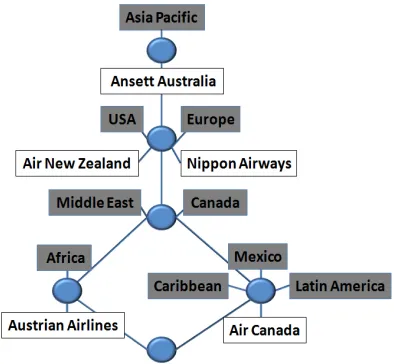
Concept Lattice(Figure 1), which is an intuitive way of
discovering hitherto undiscovered information in data and portraying the natural hierarchy of Concepts that exist in a Formal Context.
Figure 1. A Lattice corresponding to the Airlines Context
as ‘Air New Zealand flies to USA, Europe and Asia Pacific’. Similarly, in order to see which objects have a specific attribute, one heads downwards in the lattice. Any objects one meets along the way are objects which feature that particular attribute. For example, heading downwards from Canada (attribute), one will collect the objects Austrian Airlines and Air Canada. This can be interpreted as ‘Canada is flown to by Austrian Air-lines and Air Canada’. Although the Airline Context is only a small example of FCA, it is evident that the Concept Lattice provides information that is not evi-dent from looking at the table alone. It has been shown that Formal Concept Analysis (FCA) can be usefully applied to large sets of data [9], [10], [16] and that FCA has applications in data mining [6], [15]. Algo-rithms exist that are capable of processing large Formal Contexts in reasonable time [2], [11]. However, data is rarely in a form immediately suitable for FCA tools and applications. Data often exists in the form of flat-file tables of comma separated values (csv). For FCA to be carried out, these data must be converted into Formal Contexts. The existing, typically many-valued, attributes must be converted into Formal Attributes. This can be an involved and time consuming task, usually requiring a programming element. The task is, essentially, a process of discretizing and Booleanizing data; taking each many-valued attribute and convert-ing it into as many Boolean attributes as it has values. The incorporation of many-valued attributes into FCA is well known [7], [18] and continuous data can be used for FCA by being hierarchically scaled [14] or discretized as disjoint ranges of values [10]. However, there is less work describing how these techniques can be applied in an automated, reproducible way.
Dealing with existing data sets raises a number
issues: Free-text data (such as peoples’ names and addresses) is not usually suitable for Booleanizing; missing values are common and must be dealt with in some way; data classes are sometimes included in the original data, but it may be more appropriate to think of theses as sub-contexts rather than attribute values; continuous data can be discretized but the method to use and the boundary values need to be decided; attributes with two values may sometimes be interpreted as being Boolean and thus converted using a single Formal Attribute; attribute values that are unused may be interpreted as not being required in the Formal Context.
The possibility of such diverse interpretation of data can, without careful documentation, lead to inconsis-tent and incomparable analysis. Several analyses may each use a different interpretation of the same original data set. This can also lead to problems in measuring the performance of FCA algorithms [12].
A tool to address these issues was proposed at CSTIW’09 [3] where an early prototype of what follows was demonstrated.
II. FCABEDROCKOVERVIEW
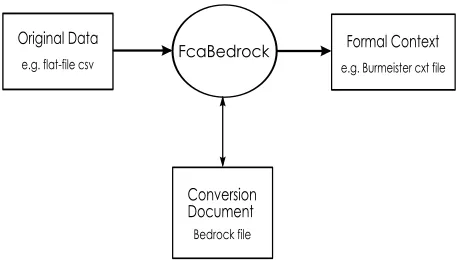
FcaBedrock is an open-source tool for automating the conversion of existing, flat-file csv data sets into Formal Contexts1 (Figure 2)
FcaBedrock uses a process of guided automation. The user supplies the tool with appropriate meta-data for conversion, such as the names of the attributes and their values and with decisions as to what to convert and how to convert it. After reading in the original data file, this meta-data is used by FcaBedrock to create a Formal Context file in a standard format for FCA. The meta-data is stored in a separate text document called a Bedrock file. This can be used for subsequent conversions and acts as a record of the interpretation made of the data set. Bedrock files are loaded into FcaBedrock allowing the reproduction of Context files and allowing changes in the interpretation to be made. Different interpretations can be made and constraints applied to a data set allowing different analyses. Each Formal Context produced can be documented with its corresponding Bedrock file. Multiple data files with the same attributes can be converted using the same Bedrock file.
FcaBedrock currently supports two input data file formats: many column csv and three column csv. FcaBedrock outputs the Formal Context in the widely
Burmeister FCA format.
Many column csv is a traditional flat-file format for many-valued data. Each row represents an instance (object) and each column a many-valued attribute.
Source
Formal Context FcaBedrock
e.g. Burmeister cxt file
Original Data
e.g. flat-file csv
Conversion Document
[image:4.612.61.290.70.203.2]Bedrock file
Figure 2. FcaBedrock Process
The three column format is becoming popular as a standardized format and is the approach used, for example, in the Resource Description Format (RDF) [1], [13].
FcaBedrock assumes that, when reading a three col-umn data file, the first value is a Formal Object, the second is a many-valued attribute and the third is an attribute value. The first values are used by FcaBedrock as object names when outputting a Formal Context in the Burmeister format (see below). If auto-detection is used, the second values are detected as attribute names. The order in which triples appear in a data file is not significant.
The Burmeister Formal Context format (cxt) is a
popular format in FCA. A cxt file begins with the number of objects and number of attributes and then lists the objects followed by the attributes. It then stores the body of the Formal Context as a grid using crosses forTrue values and dots forFalsevalues.
The sections that follow describe how FcaBedrock operates. Examples are given to illustrate how existing data can be interpreted for FCA using public data sets from the UCI Machine Learning Repository [5].
III. ATTRIBUTEVALUES
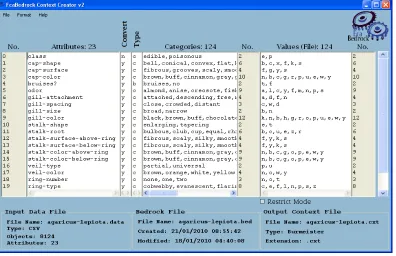
Figure 3 shows FcaBedrock. There are windows for the names and types of the original data attributes, whether they are to be converted or not, their cate-gories and the corresponding category values found in the data file. All these must initially be entered by the user (unless FcaBedrock’s auto-detection feature is being used - see Section VIII), although copy and paste is available and useful if the names of the categories and the category values are the same. This is often but not always the case, so FcaBedrock uses both; the category values are required for the computation but the category names appear in the Context file. The example shown is of the well-known Mushroom data set from UCI [5], where arbitrary letters are used in
the data file to represent attribute categories. The
cap-surface attribute, for example, has four possible
cate-gories, fibrous, grooves, scaly and smooth, represented by the values f, g, y and s, respectively, in the data file. In another UCI example, theAdultdata set [5] has category values in the data file that each contain a lead-ing space character. The spaces are better omitted from the category names but are required for converting the data.
IV. ATTRIBUTETYPES
FcaBedrock uses three types of attribute: categorical, continuous and Boolean. The type is set by the user entering c for categorical, o for continuous or b for Boolean in the Type window.
A. Categorical Attributes
The predominant attribute type is categorical. This is the typical many-valued attribute and is converted by creating one formal attribute for each of the attribute categories. In the conversion process, each row of comma separated values read in from the data file is split into a list of individual values. Each value is compared with the category values listed for the corresponding attribute in the Values (File) window. Attribute zero corresponds to the first column in the data file and so on. A match is recorded as aTruevalue in the Formal Context.
In the Mushroomexample shown in Figure 3, all but one of the attributes are categorical. Thegill-spacing at-tribute, for example has three categories:close,crowded,
anddistant. FcaBedrock will create three corresponding
Formal Attributes and name them by concatenating the attribute and category names, thusgill-spacing-close,
gill-spacing-crowded, and gill-spacing-distant.
B. Boolean Attributes
A Boolean attribute can be interpreted as a single Formal Attribute. Typically, a Boolean attribute in a data set is one that has two categories that represent
Trueand False. In theMushroom example, the Boolean
type is being used for the bruises? attribute. The at-tribute has two categories,bruisesand no, represented in the data file by the values t and f. For a Boolean attribute, FcaBedrock uses the first category value as theTruevalue,tin this example. During the conversion process, it compares the corresponding value read in from the data file with the True value. If they match, this is recorded as aTruevalue in the Formal Context. FcaBedrock names the Formal Attribute using the orig-inal attribute name, without concatenating the name of the True category. So, in this example, the original
Bruises? attribute becomes a single Formal Attribute
Figure 3. FcaBedrock
C. Continuous Attributes
Continuous attributes are dealt with in FcaBedrock by discretizing the data using user defined ranges. Al-though hierarchical scaling (e.g.>0,>10,>20...) is of-ten used in FCA to describe continuous attributes [14], this can lead to dense contexts and, consequently, a large number of large concepts. Hence, in FcaBedrock, a continuous attribute is divided into a number of ranges with disjoint boundaries.
Figure 4 shows the meta-data of the Adultdata set in FcaBedrock. Theage attribute is to be converted as a continuous attribute. The boundaries of the ranges are entered as comma separated values. In this case, the boundaries are <, 20, 40, 60 and >. FcaBedrock will apply these boundaries as the ranges less than 20,
20 to less than 40,40 to less than 60 andgreater than or
equal to 60, giving a total of four ranges (categories)
for the five boundaries. The < and > boundaries are optional; literal end-boundary values will mean that any values outside the overall range will be ignored in the conversion process. The Formal Attribute names are created by concatenating values appropriately; in this caseage<20,age20to<40,age40to<60andage>=60. During the conversion process, FcaBedrock compares a continuous value read in from the data file with the appropriate boundary values, assigning a True value to the corresponding Formal Attribute in the Context. Fractional values are allowed;height1.567to<2.890, for
example, would be possible as a Formal Attribute.
V. GUIDEDAUTOMATION
A. Exclusion of Attributes and Attribute Values
It may be necessary or desirable to exclude attributes from a Formal Context for a number of reasons: the attribute may be unsuitable for conversion (if it is a free-text attribute for example) or it may be that a particular attribute is not of interest in the analysis being undertaken. The user of FcaBedrock can decide which attributes in the data set to include in the Formal Context using the Convert window. Entering a y (for yes) will mean that the corresponding attribute will be included in the conversion. Entering an n (for no) will mean that the corresponding attribute will be excluded from the conversion; no Formal Attributes will be created for this attribute. Individual attribute categories can be excluded from the Formal Context by simply not including them in the list.
Note that these attribute and category exclusions do not exclude objects from the Formal Context; all the rows (objects) of the data file will be included in the conversion.
B. Attribute Value Restriction
Figure 4. Adultmeta-data in FcaBedrock
attributes, the Formal Context will only contain objects which those values. For example, taking the Mush-roomdata set, a sub-context containing only poisonous mushrooms can be created simply by specifying the category value p for the class attribute. This can be repeated for any number of attributes. So, for example, a mushroom sub-context could be created containing only poisonous mushrooms that have brown, buff or cinnamon caps.
C. Missing Values
Data sets often contain missing values. Typically these are interpreted asFalsevalues in FCA, although
missingmore correctly meansunknown. A symbol such
as ? is often used in a data set to indicate a missing value and this symbol can be used in FcaBedrock if missing values are of interest in the analysis. If the missing value symbol is included as a category value of an attribute then a corresponding missing value Formal Attribute will be created.
D. Auto-Detection of Meta-Data
If a data file is read without first loading or creating a Bedrock file, FcaBedrock can detect attribute values and create meta-data automatically. It will assume that all attributes are categorical. It will add each new value it finds in a column in the data file to a correspond-ing list of category values. It will assume that each attribute is to be converted. It will set the category names to the category values. If it finds more than 100 values for an attribute, FcaBedrock will list the first 100 values and indicate that the detection of values for the attribute has been truncated. This is most likely to occur when the attribute being detected is a continuous
one, free-text or some form of ID value. The meta-data obtained through auto-detection can then be edited to provide the required interpretation. If a three-column format input file is being used, attribute names will also be detected.
VI. A MINI-ADULT EXAMPLE
The following is an example adapted from the UCI
Adultdata set. The example uses a data file (see File
1) calledmini-adult.data with just eight instances and five attributes:age, education, employment, sex and
US-citizen. There are two classes indicating a salary
above or below $50k.
39, Bachelors, Clerical, Male, Yes, <=50K 50, Bachelors, Managerial, Female, Yes, <=50K 38, HS-grad, Unskilled, Male, Yes, <=50K 53, 11th, Unskilled, Male, Yes, <=50K
28, Bachelors, Professional, Female, Yes, >50K 37, Masters, Managerial, Female, No, <=50K 49, ?, Clerical, Female, No, <=50K\\ 52, HS-grad, Managerial, Male, Yes, >50K
File 1. mini-adult.data
The mini-adult meta-data in FcaBedrock are shown
in Figure 5. The output Burmeister context file, mini-adult.cxt, is shown in File 2. The Concept Lattice is shown in figure 6, visualised by inputting the cxt file to a tool called Concept Explorer (ConExp) [19]. Note that the object labels refer to the number of the adult instance (row) in the data file.
VII. CONCLUSION
Figure 5. mini-adultmeta-data in FcaBedrock
B education-Bachelors education-Masters
8 education-11th
15 education-HS-grad employment-Clerical 0 employment-Managerial 1 employment-Professional 2 employment-Unskilled
3 sex-Male
4 sex-Female
5 US-citizen
6 .X..X...X...X.X
7 ...XX....X...XX
age<30 .X...X...XX.X age30to<40 ...X..X....XX.X age40to<50 X...X...X..XX age>=50 .X...X...X...X. ..X...X....X. ...X...X.X..X.X
File 2. mini-adult.cxt,Burmeistercontext file.
data set has 8124 objects and around 125 Formal At-tributes (depending on the interpretation). The Adult data set has 32561 objects and around 106 Formal Attributes and theInternet Advertisements data set has 3279 objects and around 1570 Formal Attributes.
FcaBedrock is straightforward to use: the meta-data required is usually easy to obtain (data sets usually come with descriptive documentation) and enter, par-ticularly with the use of the repeat and auto-detection functions. There are only three types of attribute to consider and each type is straightforward to convert.
FcaBedrock is a versatile tool. It currently supports two standard input formats and two popular output formats (the use ofFcaStonemakes other FCA formats possible, too). FcaBedrock gives the user control of the conversion process and freedom to interpret data as seen fit, including the creation of sub-contexts, to suit the needs of analysis. Multiple data sets of the same type (data samples, for example) can easily be con-verted into Formal Contexts for comparative analysis. The Formal Contexts created by FcaBedrock are clearly documented by corresponding Bedrock files. These files allow the reproduction of Formal Contexts.
Different interpretations of the same data are possible though the editing of meta-data in FcaBedrock, with a corresponding Bedrock file being created for each interpretation, if desired.
FcaBedrock is an open source project. It may be developed further to support other input and output formats. Additional functionality may be added, such as auto-creation of ranges for continuous attributes as part of auto-detection, grouping of categories and hi-erarchical scaling of continuous attributes. A more am-bitious goal is to incorporate categorisation of free-text values into formal attributes; capturing similarities in free-text values such as addresses from the same town or names in alphabetical order. Such enhancements to the process of Context creation will open further possibilities for FCA to be carried out on existing data sets.
REFERENCES
[1] Abadi, D.J., Marcus, A., Madden, S.R., Hollenbach, K.: SW-Store: a vertically partitioned DBMS for Semantic Web data management. In: VLDB, vol. 18, pp. 385-406. Springer-Verlag (2009)
[2] Andrews, S.: In-Close, A Fast Algorithm for Computing Formal Concepts. In: Rudolph, S., Dau, F., Kuznetsov, S.O. (eds.) ICCS 2009, http://sunsite.informatik.rwth-aachen.de/ Publications/CEUR-WS/Vol-483/paper1.pdf (2009)
[3] Andrews, S.: Data Conversion and Interoper-ability for FCA. In: CS-TIW 2009, pp. 42-49, http://www.kde.cs.uni-kassel.de/ws/cs-tiw2009/ proceedings\ final\ 15July.pdf (2009)
[4] Andrews, S., Orphanides, C., Polovina, S.: Visualising Computational Intelligence through converting Data into Formal Concepts. In the First International Work-shop on Emerging Data Technologies for Collective Intelligence (EDTCI-2010), to be held in Fukuoka, Japan, Nov. 4-6, 2010. IEEE Conference Publishing Services, in press
[5] Asuncion, A., Newman, D.J.: UCI Machine Learn-ing Repository http://www.ics.uci.edu/$\sim$mlearn/ MLRepository.html. Irvine, CA: University of Califor-nia, School of Information and Computer Science (2007)
[6] Boulicaut, J-F., Besson, J.: Actionability and Formal Con-cepts: A Data Mining Perspective. In: Medina, R., Obied-kov, S. (eds.) ICFCA 2008. LNCS (LNAI), vol. 4933, pp. 14-31. Springer-Verlag, Berlin/Heidelberg (2008)
[7] Ganter, B., Wille, R.: Formal Concept Analysis - Mathe-matical Foundations. Springer-Verlag (1999)
Figure 6. mini-adult Concept Lattice
[9] Ignatov, D.I., Kuznetsov, S.O.: Frequent Itemset Min-ing for ClusterMin-ing Near Duplicate Web Documents. In: Rudolph, S., Dau, F., Kuznetsov, S.O. (eds.) ICCS 2009. LNCS (LNAI), vol. 5662, pp. 185-200. Springer-Verlag, Berlin/Heidelberg (2009)
[10] Kaytoue-Uberall, M., Duplesssis, S., Napoli, A.: Using Formal Concept Analysis for the Extraction of Groups of Co-expressed Genes. In: Le Thi, H.A., Bouvry, P., Pham Dinh, T. (eds.) MCO 2008. CCIS vol. 14, pp. 439-449. Springer-Verlag, Berlin/Heidelberg (2008)
[11] Krajca, P., Outrata, J., Vychodil, V.: Parallel Recursive Algorithm for FCA. In: Belohlavek, R., Kuznetsov, S.O. (eds.) CLA 2008, pp. 71-82. Palacky University, Olomouc (2008)
[12] Kuznetsov, S.O., Obiedkov, S.A.: Comparing Perfor-mance of Algorithms for Generating Concept Lattices. In: Journal of Experimental and Theoretical Artificial Intelligence, vol. 14, pp. 189-216 (2002)
[13] Passin, T. B.: Explorer’s Guide to the Semantic Web. Manning, Greenwich, CT (2004)
[14] Priss, U.: Formal Concept Analysis in Information Sci-ence. In: Cronin, B. (ed.), Annual Review of Information Science and Technology, vol. 40, p. 521-543 (2006)
[15] Rioult, F., Robardet, C., Blachon, S., Cr´emilleux, B., Gandrillon, O., Boulicant, J-F.: Mining concepts from large SAGE gene expression matrices. In: Boulicant, J-F., Dzeroski, S. (eds.) Workshop on Knowledge Discov-ery in Inductive Databases 2003, pp. 107-118. Catat-Dubrovnik, Croatia (2003)
[16] Sawase, K., Nobuhara, H., Bede, B.: Visualizing Huge Image Databases by Formal Concept Analysis. In: Bar-jiela, A., Pedrycz, W. (eds.) Human-Centric Informa-tion Processing Through Granular Modelling. Stud-ies in Computational Intelligence, vol. 182. Springer, Berlin/Heidelberg (2009)
[17] Ganter, B., Wille, R. (1998)Formal Concept Analysis: Math-ematical Foundations, Springer-Verlag, Berlin. Translated by C. Franzke.
[18] Wolff, K.E.: A First Course in Formal Concept Analysis: How to Understand Line Diagrams. In: Faulbaum, F. (ed.) SoftStat 1993. Advances in Statistical Software vol. 4, pp. 429-438 (1993)