Biological movement and the encoding of its motion and
orientation
BENTON, Christopher P, THIRKETTLE, Martin
<http://orcid.org/0000-0002-6200-3130> and SCOTT-SAMUEL, Nicholas E
Available from Sheffield Hallam University Research Archive (SHURA) at:
http://shura.shu.ac.uk/15922/
This document is the author deposited version. You are advised to consult the
publisher's version if you wish to cite from it.
Published version
BENTON, Christopher P, THIRKETTLE, Martin and SCOTT-SAMUEL, Nicholas E
(2016). Biological movement and the encoding of its motion and orientation.
Scientific Reports, 6, p. 22393.
Copyright and re-use policy
See
http://shura.shu.ac.uk/information.html
www.nature.com/scientificreports
Biological movement and the
encoding of its motion and
orientation
Christopher P. Benton
1, Martin Thirkettle
2& Nicholas E Scott-Samuel
1Are you walking at me? Biological movement and the encoding of its motion and orientation. A person’s motion conveys a wealth of information that ranges from the complex, such as intention or emotional state, to the simple, such as direction of locomotion. How we recognise and recover people’s motion is addressed by models of biological motion processing. Single channel models propose that this occurs through the operation of form template neurons which respond to viewpoint dependent snapshots of posture. More controversially, a dual channel approach proposes a second stream containing motion template neurons sensitive to view dependent snapshots of biological movement’s characteristic
local velocity field. We used behavioural adaptation to look for the co-encoding of viewpoint and walker motion, a hallmark of motion template analysis. We show that opposite viewpoint aftereffects
can simultaneously be induced for forwards and reversed walkers. This demonstrates that distinct
populations of neurons encode forwards and reversed walking. To account for such aftereffects, these
units must either be able to inhibit viewpoint-encoding neurons, or they must encode viewpoint
directly. Whereas current single channel models would need extending to incorporate these
characteristics, the idea that walker motion is encoded directly, such that viewpoint and motion are intrinsically interlinked, is a fundamental component of the dual channel model.
Biological motion, the pattern and class of articulated motion that is characteristic of animals and humans, plays a central role in our perception of other actors, underpinning our performance on a range of tasks from predation to an understanding of other’s physical and mental intentions. Models of biological motion processing encapsu-late the current understanding of how our neural systems extract the relevant information from this intriguing stimulus. Amongst such models, there is general agreement that our recovery of biological motion involves the operation of a processing channel which relies initially on an analysis of form1,2. Less widely accepted is the idea that we employ an additional parallel channel which acts directly upon stimulus motion3,4.
Neurons in the form channel are seen to respond to viewpoint dependent snapshots of posture. It is this that determines our perception of body orientation; recognition of direction of motion (forwards/backwards) is then extracted by analysing the sequence of activation of the form snapshot neurons. In contrast, the proposed motion pathway is taken to contain motion template neurons sensitive to view dependent snapshots of biological move-ment’s characteristic local velocity field. This latter refers to the dense map of motion vectors that results from the application of biological models of motion processing to an image sequence5–7. A direct prediction, from the idea of a motion templates for the analysis of biological motion, is that we have neurons that encode both the direction of motion and the orientation of the stimulus relative to the observer. This is because both of these factors clearly determine the pattern of local velocities projected onto an observer’s retinae.
In the current study, we used behavioural adaptation to look for the co-encoding of viewpoint and walker motion. In adaptation, prolonged or repeated viewing of an adapting stimulus affects the perception of a subse-quent test stimulus, this change in perception being termed the aftereffect. The premise underlying adaptation experiments is that adaptation to a particular property taps into the neural processes encoding that property. This is because adaptation is seen to be functional, its purpose being to optimise the use of our neural mechanisms to better encode our perceptual input8,9.
We show that opposite shifts of perceived orientation can simultaneously be induced for forwards and reversed walkers: in other words, our orientation aftereffect was contingent upon whether our walker walked
1School of Experimental Psychology, University of Bristol, 12a Priory Road, Bristol, BS8 1TU, UK. 2Faculty of
Social Sciences, The Open University, Walton Hall, Milton Keynes, MK7 6AA, UK. Correspondence and requests for materials should be addressed to C.P.B. (email: [email protected])
Received: 09 October 2015 Accepted: 11 February 2016
www.nature.com/scientificreports/
forwards or backwards. Such aftereffects are taken to demonstrate that distinct populations of neurons encode the property upon which the aftereffect is contingent. So, for example, figural aftereffects contingent upon face orientation have been used to demonstrate separate neural populations for the encoding of upright and inverted faces10. The logic here is that a single neuron cannot simultaneously be in two different states, so the simultaneous different aftereffects indicate separate neural populations. Our finding therefore demonstrates that separate pop-ulations of neurons encode forwards and reversed walking. This, in turn, has direct implications for our current understanding of models of biological motion processing.
Method
We used motion captured human gait cycle data to animate a computer-generated mannequin. We used a man-nequin as this avoided the depth ambiguity found with the more usual point light walker11. Additionally, we wrapped our mannequin (henceforth walker) in a simple high contrast texture in order to further reduce form ambiguities. Our walker was presented without translation across the ground plane (treadmill walking) in an orthographic projection from the camera, and animation sequences for each viewpoint angle in a − 90° to 90° arc around the mannequin were generated – where 0° indicates the walker directly faced the observer (objectively), and positive angles indicate leftwards rotation. Walker motion, which was either forwards or reversed was manip-ulated by simply reversing frame presentation order.
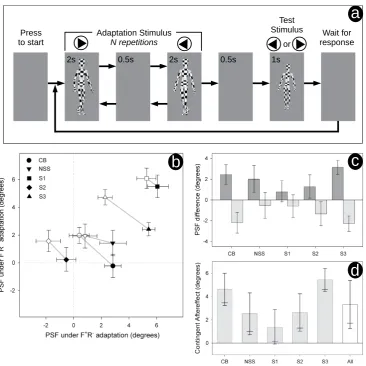
[image:3.595.158.525.41.407.2]We used a standard psychophysical method12 to determine the viewpoint at which forwards and reversed test walkers appeared to face each observer: the point of subjective facing (PSF). The study was conducted in accord-ance with the Declaration of Helsinki, and had ethical approval from the Faculty of Science ethics committee at the University of Bristol; informed consent was gained from all research participants. Observers adapted simul-taneously to +25° forwards motion and − 25° reversed motion (F + R−), being shown short segments of each interleaved together (see Fig. 1a). In separate blocks the same observers adapted simultaneously to − 25° forwards motion and +25° reversed motion (F− R +).
www.nature.com/scientificreports/
Observers each completed 4 runs of 80 trials under each simultaneous adaptation condition. Each trial con-sisted of adaptation followed by a test stimulus. In the first trial, adaptation concon-sisted of 24 repetitions of two adaptors regularly alternating; all adaptors were separated by a 0.5 s blank screen (48 s per adaptor). Adaptation in subsequent trials (top-ups) consisted of 2 repetitions. The test stimulus was either forwards or reversed (40 of each per run), order randomised. Each walker segment was chosen at random from a longer sequence (10 s for adaptors, 5 s for tests). Gait cycle was ~1.36 s (motion captured from author MT). An example movie sequence, showing two top-up trials may be found in our supplementary material.
To minimise low-level retinotopic adaptation, on-screen adaptors were 25% larger than test stimuli13. Viewing distance was ~100 cm, adaptor height was 317 pixels (~6.8°), test height was 253 pixels (~5.4°). Stimuli were presented on a linearised Lacie electron blue IV monitor (1024 × 768 pixels, 75 Hz, mean luminance 61 cd/m2).
Results
Repeated activation typically reduces neural activity; consequently, adaptation biases responses away from the adaptor14. Adaptation to a rightwards facing adaptor therefore leads to a stimulus that would otherwise be judged as directly facing the observer to appear oriented to the left. So in order to now be judged as directly facing, the test stimulus needs to be rotated rightwards (towards the adaptor). Essentially, the standard repulsive effect of adaptation is counter intuitively indexed by a shift of the PSF towards the adaptor. Under F + R− adaptation, if there is a contingent aftereffect, we would expect the PSF of the forwards test to shift positively, whilst that of the reversed test should shift negatively (and vice versa for F− R + adaptation).
Figure 1b plots the PSFs for the forwards (filled symbols) and reversed (open symbols) test stimuli under the two simultaneous adaptation conditions. PSFs were estimated by fitting cumulative normal distributions to our psychometic data15 resulting in two psychometric functions per run (one for forward test stimuli, one for reversed). To assess statistical variability16, we used parametric bootstrapping, generating 10000 bootstrap estimates per PSF17. We then propagated the bootstrap populations through the relevant averaging and differ-encing calculations described below to generate our plotted confidence limits18. These were calculated using the percentile method19.
Compared to the results for the forwards test sequences, results for the reversed are shifted leftwards and upwards. This indicates that under F + R− adaptation (when compared to F− R + adaptation) the PSF for the forwards walking test walker is shifted towards the viewpoint of the forwards walker adaptation walker (F+). Conversely, the PSF of the reversed test is shifted towards the viewpoint of the reversed adaptor (R−). This is made clear in Fig. 1c where we plot the PSF difference between forwards and reversed test walkers under F + R− adaptation (dark bars) and under F− R + adaptation (light bars). The opposite pattern of shifts under the different simultaneous adaptation conditions become self-evident. Figure 1d summarises these opposite shifts by taking the difference to arrive at an overall metric of the contingent aftereffect.
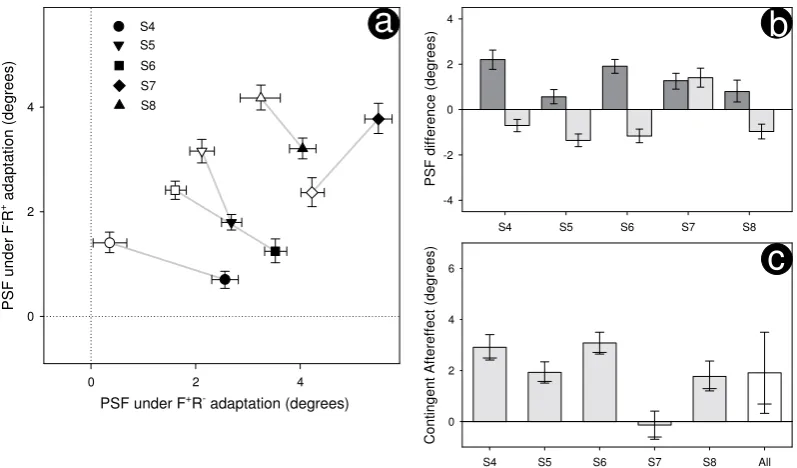
The results that we describe above are based on the responses drawn from two authors and three naïve observers. At the prompting of an anonymous reviewer, we repeated our experiment with 5 additional naïves. To determine the required number of observers we performed a power calculation (1−β = 0.9, α = 0.05) using the contingent adaptation shown by our three naïves (μ = 3.14°, σ = 2.09°) to estimate effect size. For this repetition, all stimuli were displayed on an Iiyama Vision Master Pro 513 monitor (mean luminance 53 cd/m2); all other experimental details were the same. Results are shown in Fig. 2. As with each experiment analysed individually, we find significant contingent adaptation when collapsed across experiments (t(9) = 5.20, p < 0.001).
Discussion
Our results show a clear contingent aftereffect with the perceived orientation of a walker being dependent upon whether the motion of that walker is forwards or reversed. This is evident when collapsed across participants and is generally seen on a participant-by-participant basis (apart from one observer who appears somewhat atypical-see S7 in Fig. 2). This contingent aftereffect can readily be explained by the notion of motion template neurons. Such neurons are necessarily viewpoint-selective because the local image motions to which they respond are viewpoint dependent. Separate viewpoint adaptation would take place within those neurons sensitive to for-wards motion and those sensitive to reversed motion, thereby producing our sequence-contingent viewpoint aftereffect.
Whilst the above provides potentially the most straightforward account, we should also consider whether a form processing stream can reasonably account for our findings. In descriptions of form processing channels, walker orientation and walker sequence direction are processed at different stages: the former is drawn from the population of orientation selective form-template neurons, the latter is determined by second-stage units sensi-tive to the order of form template neuron activation1,2. This arrangement could account for sequence dependent viewpoint adaptation by incorporating inhibitory connections running between second- and first-stage units, with inhibition increasing with correlation. Repeated presentation of a forwards walker, at a particular orienta-tion, would lead to a reduction in neural activity of units tuned to that orientation; but only in response to a for-wards walker. Combining this with adaptation to a reversed walker at a different orientation gives us a mechanism that can generate different viewpoint aftereffects contingent upon walker sequence direction.
www.nature.com/scientificreports/
As currently described, proposals for the form-based analysis of biological motion do not account for our motion-contingent orientation aftereffect. Whilst such approaches can undoubtedly be extended, the idea of motion template neurons, drawn directly from the idea of a motion processing stream for biological motion, provides a ready and straightforward explanation of our finding. This point is strengthened by recent convinc-ing evidence for separate form and motion channels runnconvinc-ing, respectively, through the extrastriate body area and posterior superior temporal sulcus22. This support for a two channel architecture neatly dovetails with our confirmation of a prediction drawn from a critical algorithmic component of that viewpoint: namely, the motion template analysis of biological movement.
References
1. Lange, J. & Lappe, M. A Model of Biological Motion Perception from Configural Form Cues. J. Neurosci.26, 2894–2906 (2006). 2. Theusner, S., Lussanet, M. de & Lappe, M. Action Recognition by Motion Detection in Posture Space. J. Neurosci.34, 909–921 (2014). 3. Giese, M. A. & Poggio, T. Neural mechanisms for the recognition of biological movements. Nat. Rev. Neurosci.4, 179–192 (2003). 4. Thurman, S. M., Giese, M. A. & Grossman, E. D. Perceptual and computational analysis of critical features for biological motion. J.
Vis.10, 15 (2010).
5. Bobick, A. F. & Davis, J. W. The recognition of human movement using temporal templates. IEEE Trans. Pattern Anal. Mach. Intell.
23, 257–267 (2001).
6. Adelson, E. H. & Bergen, J. R. Spatiotemporal energy models for the perception of motion. J Opt Soc Am A2, 284–299 (1985). 7. Johnston, A., McOwan, P. W. & Benton, C. P. Robust velocity computation from a biologically motivated model of motion
perception. Proc R Soc Lond B266, 509–518 (1999).
8. Andrews, D. Error-Correcting Perceptual Mechanisms. Q. J. Exp. Psychol.16, 104–115 (1964).
9. Clifford, C. W. G. et al. Visual adaptation: Neural, psychological and computational aspects. Vision Res.47, 3125–3131 (2007). 10. Rhodes, G. et al. Orientation-contingent face aftereffects and implications for face-coding mechanisms. Curr. Biol.14, 2119–2123
(2004).
11. Jackson, S. & Blake, R. Neural Integration of Information Specifying Human Structure from Form, Motion, and Depth. J. Neurosci.
30, 838–848 (2010).
12. Kontsevich, L. L. & Tyler, C. W. Bayesian adaptive estimation of psychometric slope and threshold. Vision Res.39, 2729–2737 (1999). 13. Lawson, R. P., Clifford, C. W. G. & Calder, A. J. About Turn The Visual Representation of Human Body Orientation Revealed by
Adaptation. Psychol. Sci.20, 363–371 (2009).
14. Thompson, P. & Burr, D. C. Visual aftereffects. Curr. Biol.19, R11–R14 (2009).
15. Wichmann, F. A. & Hill, N. J. The psychometric function: I. Fitting, sampling, and goodness of fit. Percept Psychophys63, 1293–1313 (2001).
16. Cumming, G. & Finch, S. Inference by eye. Am Psychol60, 170–180 (2005).
17. Wichmann, F. A. & Hill, N. J. The psychometric function: II. Bootstrap-based confidence intervals and sampling. Percept Psychophys
63, 1314–1329 (2001).
18. Benton, C. P., Jennings, S. J. & Chatting, D. J. Viewpoint dependence in adaptation to facial identity. Vision Res.46, 3313–3325 (2006).
19. Efron, B. & Tibshirani, R. J. An introduction to the bootstrap. (Chapman & Hall/CRC, 1993). 20. Giese, M. A. In The Oxford Handbook of Perceptual Organisation (Oxford University Press, 2014). 21. Jastorff, J. & Giese, M. A. In Dynamic Perception (Infix, 2004).
22. Vangeneugden, J., Peelen, M. V., Tadin, D. & Battelli, L. Distinct neural mechanisms for body form and body motion discriminations.
[image:5.595.155.554.43.277.2]J. Neurosci.34, 574–585 (2014).
www.nature.com/scientificreports/
Acknowledgements
The work was supported by British Academy Grant SG110865 awarded to C.P.B., M.T. and N.S.S.
Author Contributions
All authors conceived of the study and designed the stimuli. C.P.B. designed the study, carried out the statistical analyses and drafted the manuscript. M.T. created the stimuli. M.T. and N.S.S. helped draft the manuscript.
Additional Information
Competing financial interests: The authors declare no competing financial interests.
How to cite this article: Benton, C. P. et al. Biological movement and the encoding of its motion and orientation. Sci. Rep.6, 22393; doi: 10.1038/srep22393 (2016).