Validating Virtual Reality as an effective Training Medium
in the Security Domain
SAUNDERS, Jonathan, DAVEY, Steffi, BAYERL, Petra and LOHRMANN,
Philipp
Available from Sheffield Hallam University Research Archive (SHURA) at:
http://shura.shu.ac.uk/24562/
This document is the author deposited version. You are advised to consult the
publisher's version if you wish to cite from it.
Published version
SAUNDERS, Jonathan, DAVEY, Steffi, BAYERL, Petra and LOHRMANN, Philipp
(2019). Validating Virtual Reality as an effective Training Medium in the Security
Domain. 2019 IEEE Conference on Virtual Reality and 3D User Interfaces (VR).
Copyright and re-use policy
See
http://shura.shu.ac.uk/information.html
Sheffield Hallam University Research Archive
Validating Virtual Reality as an Effective Training Medium
in the Security Domain
Jonathan Saunders*
CENTRIC Sheffield Hallam UniversityPetra Saskia Bayerl*
CENTRIC Sheffield Hallam UniversitySteffi Davey*
CENTRIC Sheffield Hallam University
Philipp Lohrmann*
ROQAS Solutions LimitedABSTRACT
Virtual Reality (VR) training simulations are an idea which is being explored in numerous industries and professions. However, evidence purporting to the effectiveness of VR technology in relation to standard real-world exercises is still relatively thin. In this paper, we discuss our approach for validating the effectiveness of a VR training for law enforcement professionals in the context of the AUGGMED project, and present results of the validation study. Our study indicates that realistic VR-based trainings, either by themselves or in combination with the traditional hands-on training, can be as effective as highly resource-intensive practical training sessions.
Keywords: Virtual Reality, Training, Evaluation, Police.
1 INTRODUCTION
Trainings for Law Enforcement Agencies (LEAs) and first responders are often expensive to run and require significant resources to plan and manage[1]. Also, often these scenarios are
‘one-shot’, i.e. once the scenario started, it must be completed or stopped altogether. For repeatable scenarios this can result in a lack of standardisation across different groups of trainees and thus reliable training outcomes. Virtual reality (VR) trainings can provide a solution which reduces resource requirements, geographic limitations and continuous investments for both small and large-scale exercises.
However, trainings utilising these new technologies are often untrusted and require further study to identify and understand their key benefits. This is especially important in areas, where inadequate training may lead to danger to or even loss of life, like in medical or safety and security professions. Evaluations are thus crucial to understand their benefits and boundary conditions.
2 RELEVANT WORK
Training simulations of high-reliability tasks have been utilised by industries worldwide to help learners gain knowledge and experience before actively engaging within a role. Most of these industries have relied on paper, classroom or real-world training exercises to achieve this. Some, such as the aviation or medical industries, have gone beyond this approach and started to utilise computing technologies like VR to enhance existing training regimes. This surge of technology-enabled learning has begun to propagate across the global spectrum of industries creating new and novel methods for training individuals and groups.
A range of studies suggest that serious games (SGs), by introducing gaming elements and gaming mechanics that are commonly employed in commercial entertainment games into simulations to engage professional learners using the same techniques, are capable of providing enhanced learning experiences when compared to other modes of teaching [2], [3]. Players are encouraged to learn by trying different strategies, succeeding and failing as they would in an entertainment game. This allows players to learn which strategies are more successful and thus develop their skills [4], [5]. In addition, SGs allow for learning and training in settings that would be impossible, impractical or unsafe to recreate in the real world [6], [7].
Previous studies have shown the benefits of VR as a training medium in existing industries and practices. Alfalah et al. (2017)
identified VR’s capability of enhancing trainee satisfaction rates
versus traditional teaching methods, creating a more efficient and dynamic form of learning [8]. Work carried out by Seymour et al. (2002) explored the benefits of virtual reality for surgical training and found that users made fewer errors throughout a simulated surgery, in some cases by a significant margin [9]. These studies suggest that professional trainings can be fruitfully enhanced by VR. Few studies have, however, directly compared the differences
in learners’ performance with traditional trainings, and where this has happened they have mostly focused on student samples or tested VR against low-fidelity alternatives such as written manuals or safety cards [10], [11], [12]. Our study aimed to investigate the effectiveness of virtual reality trainings compared to traditional training methods in a professional setting, where the traditional training consists of intensive practical, hands-on exercises. We
further included ‘mixed’ training settings to investigate potential
cross-over and sequence effects of training methods. Our study
* [email protected] * [email protected] * [email protected] * [email protected]
indicates that for the acquisition of relevant knowledge VR-based trainings, either by themselves or in combination with the traditional hands-on training, are as effective as the traditional, highly resource-intensive practical training sessions.
3 METHOD
The aim of this study was to examine whether VR training can be as effective as a full-scale live training exercise to train LEAs (Law Enforcement Agencies) and first responders. To do this, a two day training event was organised in collaboration with a large UK police force. Subjects were required to participate in two suspicious package training exercises either in VR or through a traditional live training exercise or a combination of both. The learning outcomes achieved in both environments could then be analysed to determine the efficacy of VR versus the traditional practice-based training method.
3.1 SETTING
The validation study was conducted in a large police training facility in the UK, which contains full-scale models of multiple buildings, including interiors, along with replicas of larger public spaces such a seating area of a sports stadium. As an existing operational training environment this location was selected as the most appropriate setting for the study, allowing the trainees to operate within their natural environment for both the standard and virtual reality exercises.
The study was underpinned by standard police training practices with a number of police force resources integrated within the study’s training simulations. Specifically, VR and real world trainees had access to the resources and facilities available to them in the field including radio communication with team of trained radio operators, briefings, and debriefs.
During the study participants were observed and assessed whilst carrying out a suspicious package scenario within two locations. A location could be either within the public order training arena or within a virtual training environment. Four locations were defined for the study, the first two consisted of a pub and stadium, respectively, within the facility, while the second set consisted of a virtual underground station and a municipal airport in virtual reality.
3.2 PARTICIPANTS AND PROCEDURE
The sample consisted of 80 police officers of mixed ability and experience from a large UK Police Force. Of the total sample 39% were female and 61% male; the average age was 28.3 years (sd = 6.9 years). Tenure in the police force varied considerably from 1
month to 28.75 years, with an average of 1.6 years, indicating that
most participants were younger officers. The participants were randomly assigned into pairs, then divided into four groups, each pre-selected to train within a specified set of real or virtual environments (cp. Table 1). Group 1 performed two live training exercises within the arena at two different locations, one inside a pub and another within a football stadium. This group served as the control group, providing a baseline with the police force’s standard training practice. Group 2 completed two virtual reality exercises, one inside an underground train station and another inside a municipal airport. Additionally, another two groups were created to analyse whether combined learning methods were preferential, and whether the order in which training was administered may have an effect on learning outcomes. Group 3 was prescribed an initial live training exercise within either the pub or stadium, then a second VR exercise within the underground station. Group 4 started with an initial VR exercise within the underground station, followed by the real world exercise within either the pub or stadium. Table 1 displays the training exercises for the four groups.
Exercise 1 Exercise 2
Group 1 Live Live
Group 2 VR VR
Group 3 Live VR
[image:3.612.331.543.298.477.2]Group 4 VR Live
Figure 2 gives an overview of the sequence of events that each trainee participated in. Prior to arrival, participants were required to complete an e-learning module on the subject, ensuring that each participant had the baseline knowledge of the police protocol required to complete the training exercise.
To assess the efficacy of the training, participants were then asked to complete a knowledge check consisting of 20 multiple choice questions. These were administered:
1. Pre-training - to assess baseline knowledge; and
[image:3.612.46.558.609.683.2]Table 1 - Training assignment of groups
Figure 1 - Training procedure
2. Post-training - to form a comparison between these results and the pre-training results and investigate how the different training methods impact the participants learning outcomes.
All training participants using virtual reality were given a standardised training session to familiarise themselves with all aspects of virtual reality. To ensure that they were able to focus on their learning objectives, a script was followed for this training session in order to ensure that all participants received the same instructions and to avoid any related confounds.
Each group was assigned their own assessor, with the assessor adopting the role of an employee in the scenario. They could disseminate additional information to the participants, if they were asked. This information was provided on an information sheet. If the information was not available, assessors would reply with “I’m not sure about that.” The assessor was also responsible for
providing a debrief to their group after training to ensure that any mistakes that were made during the training were identified and rectified.
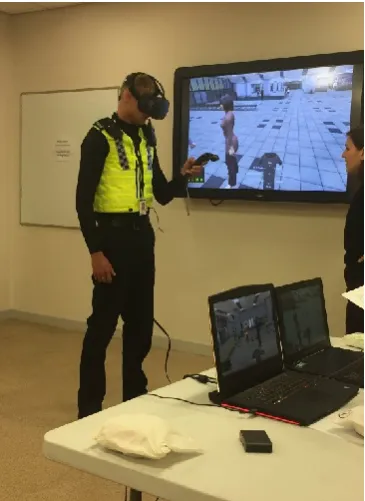
The VR training platform used for this study was AUGGMED,
a serious game used to train LEA’s and first responders (cp. Figure 2). AUGGMED was created as part of a European Union (EU) Horizon 2020 project. The project was carried out over the course of three years (June 2015 - May 2018) and the consortium consisted of 14 partners from industry, academia, and the public sector. Throughout the project, three live pilots were held, introducing
1 To ensure that training groups had the same level of original knowledge before the training sessions, we ran a Kruskal-Wallis test comparing pre-training scores. This test was insignificant with H=4.17, p=.24.
end-users to the virtual reality training pipeline whilst refining the simulation software to meet their training needs. This continuous co-development method enabled the consortium to not only align the AUGGMED platform with evolving end user requirements, but also define a validation method which would identify if, and how, virtual reality training platforms can compare to standard training exercises.
4 RESULTS
To understand whether the training overall was successful in improving the knowledge of participants, we ran Related Samples Wilcoxon Signed Rank Tests, comparing test scores of the pre- and post-test separately for each group. The results indicate that performance increased performance significantly within all training groups (Wlive only=3.18, p<.01; WVR only=3.45, p<.01; Wlive > VR =2.73, p<.01; WVR > live=2.55, p<.05). Comparing training
methods, we further found that the knowledge scores after the training did not differ significantly across groups (Kruskal-Wallis test H=2.99, p=.39). This suggests that knowledge gains were comparable across all trainings methods.1 Our mixed design further
allowed us to compare 'pure' versus 'mixed' training settings, again leading to comparable results (Kruskal-Wallis test H=1.02, p=.31).
5 DISCUSSION
The observation that the training methods did not differ in their effectiveness, is in fact a positive result for AUGGMED. The comparable performance of participants training with virtual reality and those receiving traditional live exercises demonstrates that VR-based training can be as effective as a live training exercise, while encompassing all the benefits that come with virtual reality training, such as ease of access and cost effectivity.
Some limitations need to be noted. While the setup of the evaluation exercise follows best-practice advice on training evaluations, the overall sample size was not extensive enough to confidently test for moderating variables such as age, gender, length of service in the police force or previous experience with virtual reality. Further, long-term effects should be considered, as it is possible that life-like trainings may lead to longer retention of knowledge, especially when it comes to behavioural aspects (i.e., procedural knowledge [13]). In practical terms, we found that validating VR practitioner trainings can be challenging and must be meticulously planned to be as efficient as possible and avoid wasting practitioners' time. This validation study was carried out over two days, allowing very little room for error. It is further vital to ensure that the training taking place in virtual reality is as close to the real world training as possible in order to allow for direct comparison.
6CONCLUSION
[image:4.612.67.250.297.548.2]Results from this study suggest no significant differences when directly comparing the learning outcomes achieved through the different training methods. This is a positive result for the future
uptake of VR as a training platform, as the study shows that VR can be as effective as real world training, yet often offers a more cost effective, practical solution. Our study provides a convincing setup to assess the effectiveness of virtual reality compared to traditional forms of training, allowing a comprehensive investigation into the effect not only of 'pure' training forms, but also of mixed approaches. Our analysis further expands the scant body of empirical research into the viability of virtual reality trainings in professional security settings.
ACKNOWLEDGMENTS
We would like to extend our gratitude to all members of the AUGGMED consortium who worked on creating the AUGGMED training platform, as well as all parties who provided support to the project. We would also like to specifically give thanks to the police force involved in the evaluation for their help in organising this study. Finally, we would like to extend our appreciation for the funding that AUGGMED received from the European Commission Horizon 2020 research and innovation programme under grant agreement No 653590.
REFERENCES
[1] P. Allen, “Simulation Support of Large-Scale Exercises: A
REFORGER case study,” RAND, 1990.
[2] M. B. Carvalho, F. Bellotti, R. Berta, A. De Gloria, C. I.
Sedano, J. B. Hauge, J. Hu and M. Rauterberg, “An
activity theory-based model for serious games analysis
and conceptual design,” Computers & Education, pp. 166-181, 2015.
[3] B. Dalgarno and M. J. Lee, “What are the learning
affordances of 3‐D virtual environments?,” British
Journal of Educational Technology, vol. 41, no. 1, pp.
10-32, 2010.
[4] J. S. Breuer and G. Bente, “Why so serious? On the
relation of serious games and learning,” Journal for
Computer Game Culture, vol. 4, pp. 7-24, 2010.
[5] P. Rooney, “A theoretical framework for serious game
design: Exploring pedagogy, play and fidelity and their
implications for the design process,” International Journal
of Game-Based Learning, vol. 2, no. 4, pp. 41-60, 2012.
[6] J. F. Knight, S. Carley, B. Tregunna, S. Jarvis, R. Smithies, S. de Freitas, I. Dunwell and K.
Mackway-Jones, “Serious gaming technology in major incident
triage training: a pragmatic controlled trial,”
Resuscitation, vol. 81, no. 9, pp. 1175-1179., 2010.
[7] T. Susi, M. Johannesson and P. Backlund, Serious games:
An overview, 2007.
[8] S. F. Alfalah, J. F. Falah, T. Alfalah, M. Elfalah, N.
Muhaidat and O. Falah, “A comparative study between a
virtual reality heart anatomy system and traditional medical teaching modalities.,” Virtual Reality, pp. 1-6, 2017.
[9] N. E. Seymour, A. G. Gallagher, S. A. Roman, M. K.
O’brien, V. K. Bansal, D. K. Andersen and R. M. Satava, “Virtual reality training improves operating room
performance: results of a randomized, double-blinded
study,” Annals of surgery, vol. 236, no. 4, p. 458, 2002.
[10] S. F. Alfalah, “Perceptions toward adopting virtual reality as a teaching aid in information technology.,” Education
and Information Technologies, vol. 23, no. 6, , pp.
2633-2653, 2018.
[11] S. Burigat and L. Chittaro, “Passive and active navigation
of virtual environments vs. traditional printed evacuation
maps: a comparative evaluation in the aviation domain.,”
International Journal of Human-Computer Studies, vol.
87, pp. 92-105, 2016.
[12] C. Li, W. Liang, C. Quigley, Y. Zhao and L. Yu,
“Earthquake safety training through virtual drills,” IEEE Transactions on Visualization and Computer Graphics,
vol. 23, no. 4 , p. 1275–1284, 2017.
[13] K. Szczurowski and M. Smith, ““Woodlands”-a Virtual
Reality Serious Game Supporting Learning of Practical
Road Safety Skills.,” in IEEE Games, Entertainment,