Acta Cryst.(2003). E59, i75±i76 DOI: 10.1107/S1600536803005993 Smith and zur Loye Sr3MgPtO6
i75
inorganic papers
Acta Crystallographica Section E
Structure Reports Online
ISSN 1600-5368
Sr
3MgPtO
6Mark D. Smith and Hans-Conrad zur Loye*
Department of Chemistry and Biochemistry, University of South Carolina, Columbia, South Carolina 29208, USA
Correspondence e-mail: [email protected]
Key indicators
Single-crystal X-ray study
T= 293 K
Mean(Mg±O) = 0.004 AÊ
Rfactor = 0.024
wRfactor = 0.049
Data-to-parameter ratio = 24.5
For details of how these key indicators were automatically derived from the article, see http://journals.iucr.org/e.
#2003 International Union of Crystallography Printed in Great Britain ± all rights reserved
Single crystals of the mixed alkaline earth platinate, tristrontium magnesium platinum hexaoxide, Sr3MgPtO6,
were grown from a KOH ¯ux at 1273 K. The compound adopts the rhombohedral K4CdCl6 structure type, featuring
chains of face-shared, distorted MgO6trigonal prisms (Mg site
symmetry 32) and PtO6 octahedra (Pt site symmetry 3)
surrounded by columns of Sr2+ions (Sr site symmetry 2).
Comment
The structure of Sr3MgPtO6was determined in 1997 (NuÂnÄezet
al., 1997) by powder X-ray diffraction on a polycrystalline sample prepared by conventional sintering techniques, and was shown to adopt the K4CdCl6structure type (Bergerhoff &
Schmitz-Dumont, 1956). This structure type features two crystallographically and chemically distinct K+ positions and
consists of chains along [001] of face-shared, distorted KCl6
trigonal prisms and CdCl6octahedra. The polyhedral chains
are surrounded by spiral columns of K+ions. To date, a large
and compositionally diverse group of oxides adopting this structure type has been reported, typically as polycrystalline materials [reviewed in Stitzeret al.(2001)]. High-temperature ¯ux growth from molten KOH has proven to be an effective oxide crystal growth medium. Single crystals of Sr3MgPtO6
were readily grown from molten KOH at 1273 K, using
Received 26 February 2003 Accepted 14 March 2003 Online 23 April 2003
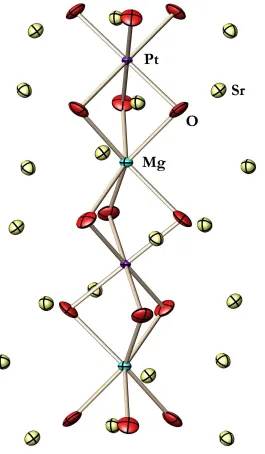
Figure 1
Fragment of the face-shared polyhedral chains in Sr3MgPtO6.
(NH4)2PtCl6as the platinum source. Sr3MgPtO6represents an
Mg-substituted form of the K4CdCl6-type oxide Sr4PtO6
(Randall & Katz, 1959), with Mg ordered in the trigonal prism site (site-symmetry 32, Wyckoff symbol 6a) and Pt4+ in a
rhombohedrally elongated octahedral site (site symmetry 3, Wyckoff symbol 6b). Fig. 1 illustrates the local coordination of these metal centers. The Sr2+ion resides in an irregular
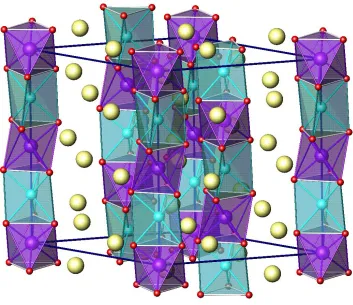
eight-coordinate site (Wyckoff symbol 18e) of site symmetry 2. Fig. 2 shows a view of the polyhedral chains and Sr2+ columns.
Bond lengths and angles from the present single-crystal determination of Sr3MgPtO6 are very close to those derived
from powder data [MgÐO = 2.172 (16) AÊ, PtÐO = 2.011 (16) AÊ and SrÐO = 2.498 (17)±2.742 (17) AÊ]. Re®ne-ment of the site occupancies for Mg and Pt showed no signi®cant deviation from whole occupancy, indicating a stoichiometric compound, and no Sr/Mg mixing on the trigonal prism site.
Experimental
The (NH4)2PtCl6precursor was prepared according to a published
method (Kaufman, 1967). Subsequently, SrCO3 (Alfa, 99.95%),
MgCO3(Alfa, 99.8%), and (NH4)2PtCl6(stoichiometric amounts,ca
1 g total reagent mass) and KOH (Fisher, reagent grade;10 times by mass the total reagent amount) were loaded into a covered alumina crucible. The mixture was heated at 1273 K for 2 h, cooled to 1023 K at a rate of 1 K hÿ1, at which point the furnace was shut off and
allowed to cool to room temperature radiatively. The KOH matrix was dissolved with distilled water, leaving plentiful transparent brown crystals with a rhombohedral habit.
Crystal data
Sr3MgPtO6
Mr= 578.26
Trigonal,R3c
MoKradiation Cell parameters from 1132
re¯ections
Data collection
Bruker SMART APEX CCD diffractometer
!scans
Absorption correction: multi-scan
(SADABS; Bruker, 1999)
Tmin= 0.073,Tmax= 0.239
2412 measured re¯ections
490 independent re¯ections 431 re¯ections withI> 2(I)
Rint= 0.037
max= 36.3
h=ÿ16!7
k=ÿ11!16
l=ÿ18!8
Re®nement
Re®nement onF2
R[F2> 2(F2)] = 0.024
wR(F2) = 0.049
S= 1.01 490 re¯ections 20 parameters
w= 1/[2(F
o2) + (0.0227P)2]
whereP= (Fo2+ 2Fc2)/3
(/)max< 0.001
max= 2.32 e AÊÿ3
min=ÿ3.12 e AÊÿ3
Extinction correction:SHELXL97 Extinction coef®cient: 0.00118 (8)
Table 1
Selected geometric parameters (AÊ).
SrÐO 2.472 (3)
SrÐOi 2.637 (3)
SrÐOii 2.663 (3)
SrÐOiii 2.731 (3)
MgÐO 2.177 (3)
MgÐPt 2.77780 (15)
PtÐO 2.031 (3)
Symmetry codes: (i) 1
3ÿxy;yÿ13;16z; (ii) 23ÿxy;13ÿx;13z; (iii) 2
3y;13ÿxy;13ÿz.
Systematic absences in the dataset con®rmed ac-glide operation, indicating the space groupsR3candR3c. Preliminary powder X-ray diffraction showed the compound to be isostructural with K4CdCl6
(space group R3c); therefore, the expected centrosymmetric space group was chosen and con®rmed by the structure solution. The largest difference peak and hole were located less than 0.8 AÊ from the Pt atom.
Data collection: SMART-NT (Bruker, 1999); cell re®nement:
SAINT-Plus-NT (Bruker, 1999); data reduction: SAINT-Plus-NT; program(s) used to solve structure: SHELXS97 (Sheldrick, 1997); program(s) used to re®ne structure:SHELXL97 (Sheldrick, 1997); molecular graphics:ATOMS(Dowty, 2001); software used to prepare material for publication:SHELXTL(Bruker, 1997).
Funding for this research was provided by the National Science Foundation through grant DMR:0134156. The Bruker SMART APEX diffractometer was purchased using funds provided by the NSF IMR Program through grant DMR:9975623.
References
Bergerhoff, G. & Schmitz-Dumont, O. (1956).Z. Anorg. Allg. Chem.284, 10± 19.
Bruker (1997). SHELXTL. Version 5.1. Bruker AXS Inc., Madison, Wisconsin, USA.
Bruker (1999).SMART-NT(Version 5.611),SAINT-Plus-NT(Versin 6.02a)
andSADABS(Version 1.0). Bruker AXS Inc., Madison, Wisconsin, USA.
Dowty, E. (2001).ATOMS for Windows. Version 5.1. Shape Software, 521 Hidden Valley Road, Kingsport, TN 37663, USA.
Kaufman, G. S. (1967). InInorganic Syntheses, Vol. 9, edited by S. Y. Tyree Jr, pp. 182±185. New York: McGraw-Hill.
NuÂnÄez, P., Trail, S. & zur Loye, H.-C. (1997).J. Solid State Chem.130, 35±41.
Figure 2
Polyhedral view of the unit cell of Sr3MgPtO6, viewed approximately
supporting information
sup-1
Acta Cryst. (2003). E59, i75–i76
supporting information
Acta Cryst. (2003). E59, i75–i76 [doi:10.1107/S1600536803005993]
Sr
3MgPtO
6Mark D. Smith and Hans-Conrad zur Loye
S1. Comment
The structure of Sr3MgPtO6 was determined in 1997 (Nùñez et al., 1997) by powder X-ray diffraction on a polycrystalline
sample prepared by conventional sintering techniques, and was shown to adopt the K4CdCl6 structure type (Bergerhoff &
Schmitz-Dumont, 1956). This structure type features two crystallographically and chemically distinct K+ positions and
consists of chains along [001] of face-shared distorted KCl6 trigonal prisms and CdCl6 octahedra. The polyhedral chains
are surrounded by spiral columns of K+ ions. To date, a large and compositionally diverse group of oxides adopting this
structure type has been reported, typically as polycrystalline materials [reviewed in Stitzer et al. (2001)].
High-temperature flux growth from molten KOH has proven to be an effective oxide crystal growth medium. Single crystals of
Sr3MgPtO6 were readily grown from molten KOH at 1273 K, using (NH4)2PtCl6 as the platinum source. Sr3MgPtO6
represents an Mg-substituted form of the K4CdCl6-type oxide Sr4PtO6 (Randall & Katz, 1959), with Mg ordered in the
trigonal prism site (site-symmetry 32, Wyckoff symbol 6a) and Pt4+ in a rhombohedrally elongated octahedral site (site
symmetry 3, Wyckoff symbol 6 b). Fig. 1 illustrates the local coordination of these metal centers. The Sr2+ ion resides in
an irregular eight coordinate site (Wyckoff symbol 18 e) of site symmetry 2. Fig. 2 shows an off-[110] view of the
polyhedral chains and Sr2+ columns. Bond lengths and angles from the present single-crystal determination of Sr
3MgPtO6
are very close to those derived from powder data [Mg—O = 2.172 (16) Å, Pt—O = 2.011 (16) Å and Sr—O =
2.498 (17)–2.742 (17) Å]. Refinement of the site occupancies for Mg and Pt showed no significant deviation from unity
occupancy, indicating a stoichiometric compound, and no Sr/Mg mixing on the trigonal prism site.
S2. Experimental
The (NH4)2PtCl6 precursor was prepared according to a published method (Kaufman, 1967). Subsequently, SrCO3 (Alfa,
99.95%), MgCO3 (Alfa, 99.8%), and (NH4)2PtCl6 (stoichiometric amounts, ca 1 g total reagent mass) and KOH (Fisher,
reagent grade; approx. 10 times by mass the total reagent amount) were loaded into a covered alumina crucible. The
mixture was heated at 1273 K for 2 h, cooled to 1023 K at a rate of 1 K h−1, at which point the furnace was shut off and
allowed to cool to room temperature radiatively. The KOH matrix was dissolved with distilled water, leaving plentiful
transparent brown crystals with a rhombohedral habit.
S3. Refinement
Systematic absences in the dataset confirmed a c-glide operation, indicating the space groups R3c and R3c. Preliminary
powder X-ray diffraction showed the compound to be isostructural with K4CdCl6 (space group R3c); therefore, the
expected centrosymmetric space group was chosen and confirmed by the solution. The largest difference peak/hole was
Figure 1
Fragment of the face-shared polyhedral chains in Sr3MgPtO6. Displacement ellipsoids are drawn at the 90% probability
supporting information
sup-3
[image:5.610.129.482.69.374.2]Acta Cryst. (2003). E59, i75–i76
Figure 2
Near-[110] polyhedral view of the unit cell of Sr3MgPtO6.
Tristrontium Magnesium Platinum Hexaoxide
Crystal data
Sr3MgPtO6 Mr = 578.26 Trigonal, R3c
Hall symbol: -R 3 2"c
a = 9.6432 (4) Å
c = 11.1112 (6) Å
V = 894.82 (7) Å3 Z = 6
F(000) = 1512
Dx = 6.439 Mg m−3
Mo Kα radiation, λ = 0.71073 Å Cell parameters from 1132 reflections
θ = 4.2–36.3°
µ = 50.13 mm−1 T = 293 K
Rhombohedron, brown 0.11 × 0.05 × 0.04 mm
Data collection
Bruker SMART APEX CCD diffractometer
Radiation source: sealed tube Graphite monochromator
ω scans
Absorption correction: multi-scan (SADABS; Bruker, 1999)
Tmin = 0.073, Tmax = 0.239
2412 measured reflections 490 independent reflections 431 reflections with I > 2σ(I)
Rint = 0.037
θmax = 36.3°, θmin = 4.2°
h = −16→7
k = −11→16
Refinement on F2
Least-squares matrix: full
R[F2 > 2σ(F2)] = 0.024 wR(F2) = 0.049 S = 1.01 490 reflections 20 parameters 0 restraints
Primary atom site location: structure-invariant direct methods
Secondary atom site location: difference Fourier map
w = 1/[σ2(F
o2) + (0.0227P)2]
where P = (Fo2 + 2Fc2)/3
(Δ/σ)max < 0.001
Δρmax = 2.32 e Å−3
Δρmin = −3.12 e Å−3
Extinction correction: SHELXL97, Fc*=kFc[1+0.001xFc2λ3/sin(2θ)]-1/4
Extinction coefficient: 0.00118 (8)
Special details
Geometry. All e.s.d.'s (except the e.s.d. in the dihedral angle between two l.s. planes) are estimated using the full covariance matrix. The cell e.s.d.'s are taken into account individually in the estimation of e.s.d.'s in distances, angles and torsion angles; correlations between e.s.d.'s in cell parameters are only used when they are defined by crystal symmetry. An approximate (isotropic) treatment of cell e.s.d.'s is used for estimating e.s.d.'s involving l.s. planes.
Refinement. Refinement of F2 against ALL reflections. The weighted R-factor wR and goodness of fit S are based on F2,
conventional R-factors R are based on F, with F set to zero for negative F2. The threshold expression of F2 > σ(F2) is used
only for calculating R-factors(gt) etc. and is not relevant to the choice of reflections for refinement. R-factors based on F2
are statistically about twice as large as those based on F, and R- factors based on ALL data will be even larger.
Fractional atomic coordinates and isotropic or equivalent isotropic displacement parameters (Å2)
x y z Uiso*/Ueq
Sr 0.36540 (5) 0.0000 0.2500 0.00375 (12)
Mg 0.0000 0.0000 0.2500 0.0026 (6)
Pt 0.0000 0.0000 0.0000 0.00164 (10)
O 0.1736 (4) 0.0221 (4) 0.1151 (3) 0.0059 (5)
Atomic displacement parameters (Å2)
U11 U22 U33 U12 U13 U23
Sr 0.00374 (18) 0.0039 (2) 0.0036 (2) 0.00197 (11) −0.00030 (8) −0.00060 (16) Mg 0.0030 (8) 0.0030 (8) 0.0017 (13) 0.0015 (4) 0.000 0.000
Pt 0.00186 (12) 0.00186 (12) 0.00122 (14) 0.00093 (6) 0.000 0.000 O 0.0062 (13) 0.0078 (14) 0.0043 (12) 0.0039 (11) −0.0030 (10) −0.0002 (10)
Geometric parameters (Å, º)
Sr—O 2.472 (3) Mg—Ptxi 2.7778 (2)
Sr—Oi 2.472 (3) Mg—Srx 3.5236 (5)
Sr—Oii 2.637 (3) Mg—Srxiii 3.5236 (5)
Sr—Oiii 2.637 (3) Mg—Srxiv 3.5865 (2)
Sr—Oiv 2.663 (3) Pt—Oxv 2.031 (3)
Sr—Ov 2.663 (3) Pt—Oxvi 2.031 (3)
Sr—Ovi 2.731 (3) Pt—Oxiii 2.031 (3)
Sr—Ovii 2.731 (3) Pt—O 2.031 (3)
supporting information
sup-5
Acta Cryst. (2003). E59, i75–i76
Sr—Mg 3.5236 (5) Pt—Mgxv 2.7778 (2)
Sr—Srix 3.5865 (2) Pt—Srxviii 3.2080 (2)
Mg—Ox 2.177 (3) Pt—Srxiv 3.2080 (2)
Mg—Oxi 2.177 (3) Pt—Sriii 3.2080 (2)
Mg—Oi 2.177 (3) Pt—Srxix 3.2080 (2)
Mg—Oxii 2.177 (3) O—Sriii 2.637 (3)
Mg—O 2.177 (3) O—Srxx 2.663 (3)
Mg—Oxiii 2.177 (3) O—Srxiv 2.731 (3)
Mg—Pt 2.7778 (2)
O—Sr—Oi 75.35 (14) Oxii—Mg—O 146.71 (16)
O—Sr—Oii 94.24 (9) Ox—Mg—Oxiii 77.78 (12)
Oi—Sr—Oii 76.37 (11) Oxi—Mg—Oxiii 87.89 (15)
O—Sr—Oiii 76.37 (11) Oi—Mg—Oxiii 146.71 (16)
Oi—Sr—Oiii 94.24 (9) Oxii—Mg—Oxiii 128.62 (16)
Oii—Sr—Oiii 168.27 (13) O—Mg—Oxiii 77.78 (12)
O—Sr—Oiv 131.68 (5) Oxv—Pt—Oxvi 84.59 (13)
Oi—Sr—Oiv 74.68 (12) Oxv—Pt—Oxiii 95.41 (13)
Oii—Sr—Oiv 114.14 (10) Oxvi—Pt—Oxiii 180.0 (2)
Oiii—Sr—Oiv 69.07 (12) Oxv—Pt—O 180.0 (2)
O—Sr—Ov 74.68 (12) Oxvi—Pt—O 95.41 (13)
Oi—Sr—Ov 131.68 (5) Oxiii—Pt—O 84.59 (13)
Oii—Sr—Ov 69.07 (12) Oxv—Pt—Oxvii 84.59 (13)
Oiii—Sr—Ov 114.14 (10) Oxvi—Pt—Oxvii 84.59 (13)
Oiv—Sr—Ov 150.67 (13) Oxiii—Pt—Oxvii 95.41 (13)
O—Sr—Ovi 122.00 (4) O—Pt—Oxvii 95.41 (13)
Oi—Sr—Ovi 140.32 (10) Oxv—Pt—Ox 95.41 (13)
Oii—Sr—Ovi 130.498 (19) Oxvi—Pt—Ox 95.41 (13)
Oiii—Sr—Ovi 61.20 (13) Oxiii—Pt—Ox 84.59 (13)
Oiv—Sr—Ovi 67.69 (11) O—Pt—Ox 84.59 (13)
Ov—Sr—Ovi 87.93 (9) Oxvii—Pt—Ox 180.0 (2)
O—Sr—Ovii 140.32 (10) Pt—O—Mg 82.54 (11)
Oi—Sr—Ovii 122.00 (4) Pt—O—Sr 170.33 (16)
Oii—Sr—Ovii 61.20 (13) Mg—O—Sr 98.38 (11)
Oiii—Sr—Ovii 130.498 (19) Pt—O—Sriii 85.80 (10)
Oiv—Sr—Ovii 87.93 (9) Mg—O—Sriii 95.87 (11)
Ov—Sr—Ovii 67.69 (11) Sr—O—Sriii 103.63 (11)
Ovi—Sr—Ovii 69.64 (13) Pt—O—Srxx 85.08 (10)
Ox—Mg—Oxi 146.71 (16) Mg—O—Srxx 167.47 (14)
Ox—Mg—Oi 128.62 (16) Sr—O—Srxx 93.49 (10)
Oxi—Mg—Oi 77.78 (12) Sriii—O—Srxx 85.18 (9)
Ox—Mg—Oxii 87.89 (15) Pt—O—Srxiv 83.32 (10)
Oxi—Mg—Oxii 77.78 (12) Mg—O—Srxiv 93.22 (10)
Oi—Mg—Oxii 77.78 (12) Sr—O—Srxiv 87.02 (9)
Oi—Mg—O 87.89 (15)