Bridging the age gap in breast cancer: evaluation of
decision support interventions for older women with
operable breast cancer: protocol for a cluster randomised
controlled trial.
COLLINS, Karen <http://orcid.org/0000-0002-4317-142X>, REED, Malcolm, LIFFORD, Kate, BURTON, Maria <http://orcid.org/0000-0002-5411-8181>, EDWARDS, Adrian, RING, Alistair, BRAIN, Katherine, HARDER, Helena, ROBINSON, Thompson, CHEUNG, Kwok Leung, MORGAN, Jenna,
AUDISIO, Riccardo, WARD, Susan, RICHARDS, Paul, MARTIN, Charlene, CHATER, Tim, PEMBERTON, Kirsty, NETTLESHIP, Anthony, MURRAY, Christopher, WALTERS, Stephen, BORTOLAMI, Oscar, ARMITAGE, Fiona, LEONARD, Robert, GATH, Jacqui, REVELL, Deirdre, GREEN, Tracy and WYLD, Lynda
Available from Sheffield Hallam University Research Archive (SHURA) at: http://shura.shu.ac.uk/16510/
This document is the author deposited version. You are advised to consult the publisher's version if you wish to cite from it.
Published version
COLLINS, Karen, REED, Malcolm, LIFFORD, Kate, BURTON, Maria, EDWARDS, Adrian, RING, Alistair, BRAIN, Katherine, HARDER, Helena, ROBINSON,
Thompson, CHEUNG, Kwok Leung, MORGAN, Jenna, AUDISIO, Riccardo, WARD, Susan, RICHARDS, Paul, MARTIN, Charlene, CHATER, Tim, PEMBERTON, Kirsty, NETTLESHIP, Anthony, MURRAY, Christopher, WALTERS, Stephen, BORTOLAMI, Oscar, ARMITAGE, Fiona, LEONARD, Robert, GATH, Jacqui, REVELL, Deirdre, GREEN, Tracy and WYLD, Lynda (2017). Bridging the age gap in breast cancer: evaluation of decision support interventions for older women with operable breast cancer: protocol for a cluster randomised controlled trial. BMJ open, 7 (7), e015133.
Copyright and re-use policy
See http://shura.shu.ac.uk/information.html
TITLE: Bridging the Age Gap in Breast Cancer: Evaluation of decision support
interventions for older women with operable breast cancer: protocol for a cluster randomised
controlled trial.
Corresponding author:
Lynda Wyld,
Department of Oncology & Metabolism
The Medical School
Beech Hill Road
Sheffield
S10 2RX
UK
Email: [email protected]
Tel: +44 (0) 114 2259066
Karen Collins, Centre for Health and Social Care Research, Sheffield Hallam University,
Collegiate Crescent, Sheffield, UK
Malcolm Reed, Brighton and Sussex Medical School, University of Sussex, Falmer, Brighton,
UK.
Kate Lifford, Division of Population Medicine, School of Medicine, Cardiff University,
Neuadd Meirionnydd, Heath Park, Cardiff CF14 4YS, UK
Maria Burton, Centre for Health and Social Care Research, Sheffield Hallam University,
Collegiate Crescent, Sheffield, UK.
Adrian Edwards, Division of Population Medicine, School of Medicine, Cardiff University,
Neuadd Meirionnydd, Heath Park, Cardiff CF14 4YS, UK
Alistair Ring, Royal Marsden Hospital, London.
Katherine Brain, Division of Population Medicine, School of Medicine, Cardiff University,
Neuadd Meirionnydd, Heath Park, Cardiff CF14 4YS, UK
Helena Harder, SHORE-C, University of Sussex, Falmer, Brighton, UK.
Thompson Robinson, Department of Cardiovascular Sciences, Leicester Royal Infirmary,
Infirmary Square, Leicester, LE2 7LX, UK.
Kwok Leung Cheung, School of Medicine, University of Nottingham, Royal Derby Hospital
Centre, Uttoxeter Road, Derby DE22 3DT, UK.
Riccardo Audisio, Department of Surgery, University of Liverpool, St Helens Teaching
Hospital, Marshalls Cross Road, St Helens, WA9 3DA, UK.
Susan Ward, Department of Health Economics and Decision Science, School for Health and
Related Research, University of Sheffield, Sheffield, UK.
Paul Richards, Department of Health Economics and Decision Science, School for Health
and Related Research, University of Sheffield, Sheffield, UK.
Charlene Martin, Department of Oncology and Metabolism, University of Sheffield.
Tim Chater, Clinical Trials Research Unit, School for Health and Related Research,
University of Sheffield, Sheffield, UK.
Kirsty Pemberton, Clinical Trials Research Unit, School for Health and Related Research,
University of Sheffield, Sheffield, UK.
Anthony Nettleship, Epigenesys, School for Health and Related Research, University of
Sheffield, Sheffield, UK.
Christopher Murray,Epigenesys, School for Health and Related Research, University of
Sheffield, Sheffield, UK.
Stephen Walters, Clinical Trials Research Unit, School for Health and Related Research,
University of Sheffield, Sheffield, UK.
Oscar Bortolami, Clinical Trials Research Unit, School for Health and Related Research,
University of Sheffield, Sheffield, UK.
Fiona Armitage, University of Sheffield, UK
Robert Leonard, Imperial College Healthcare NHS Trust, St Mary's Hospital London, UK
Jacqui Gath, Deirdre Revell, Tracy Green, Yorkshire and Humberside (formerly North Trent
Cancer Network)Consumer Research Panel.
Lynda Wyld, Department of Oncology & Metabolism, University of Sheffield, Sheffield, UK.
Keywords: Breast cancer, decision aid, elderly, primary endocrine therapy, surgery,
chemotherapy
ABSTRACT
Introduction
Whilst breast cancer outcomes are improving steadily in younger women due to advances in
screening and improved therapies, there has been little change in outcomes among the older
age group. It is inevitable that co-morbidities/frailty rates are higher, which may increase the
risks of some breast cancer treatments such as surgery and chemotherapy, many older women
are healthy and may benefit from their use. Adjusting treatment regimens appropriately for
age/co-morbidity/frailty is variable and largely non-evidence based, specifically with regard
to rates of surgery for operable oestrogen receptor (ER) positive disease and rates of
chemotherapy for high-risk disease.
Methods and analysis
This multi-centre, parallel group, pragmatic cluster randomised controlled trial (2015-18)
reported here, is nested within a larger ongoing “Age Gap Cohort Study” (2012-18;
RP-PG-1209-10071), aims to evaluate the effectiveness of a complex intervention of decision support
interventions (DESIs) to assist in the treatment decision-making for early breast cancer in
older women. The interventions include two patient decision aids (PtDAs) (primary
endocrine therapy versus surgery/AET and chemotherapy versus no chemotherapy) and a
clinical treatment outcomes algorithm for clinicians.
The primary outcome will be quality of life measured by EORTC QLQ C30. Randomisation
is at breast unit level (53 UK sites), stratified by high/ low primary endocrine therapy and
chemotherapy rates. Women (n=1500) over 70 years with primary operable breast cancer will
be recruited and followed up 6 weeks to 2 years post diagnosis with longer term cancer
Control arm: no change to usual practice. Intervention arm: usual practice plus DESIs
adopted as standard care by clinicians.
ETHICS AND DISSEMINATION
National and local ethics committee approval were obtained for all UK participating sites. Results
from the trial will be submitted for publication in international peer reviewed scientific journals.
IRAS reference: 115550
Trial registration detail/number:
European Union Drug Regulating Authorities Clinical Trials (EudraCT) number 2015-004220-61
Sponsor's Protocol Code Number Sheffield Teaching Hospitals STH17086
ISRCTN 32447*
*The wider Age Gap study commenced as a cohort study in 2012/13, collecting prospective
observational data on older women. At the time there was no requirement for registration on
the ISRCTN database as the trial was approved prior to 2013 and was only a cohort study
therefore the study team made public notification via the Cancer help database and more
recently registered it on the EURDRACT database last year. The trial protocol was changed
late 2015/2016 to convert the study to a cluster RCT and at that point registered the revised
Strengths and limitations of this study
• The two evidence based decision support interventions (DESIs) for women over 70
years diagnosed with breast cancer who are offered a choice of primary endocrine
therapy (PET) or surgery (plus adjuvant endocrine therapy, hereafter termed
surgery/AET) or chemotherapy versus no chemotherapy is, to the best of our
knowledge, the first of its kind worldwide.
• The web based clinical outcomes management algorithm is the first of its kind and
allows patient age, co-morbidities, frailty and cancer characteristics to be considered
in predicting breast cancer survival and cancer outcomes
• A limitations of the trial will potentially be selection bias from recruitment and poor
uptake/utilisation of the DESIs at intervention sites
• A second limitation may be an inability to demonstrate a benefit in terms of cancer
survival rates without at least 5-10 years follow up or an overall survival advantage
INTRODUCTION
Background and rationale
Breast cancer is the most common cancer in women in the UK, with over 53,000 new cases
being diagnosed in the UK each year [1].Of these, 16,000 women will be over the age of 70,
a figure which is rising steadily as the UK population ages[2]. Whilst breast cancer outcomes
are improving steadily in younger women due to advances in screening and improved
therapies, there has been little change in outcomes in this older age group of women. The
UK lags significantly behind other European countries in its outcomes for these women.
There is a wide variation in practice in the management of breast cancer in older women[3].
The gold standard of care for early breast cancer is surgical removal of the primary cancer
(mastectomy or conservation surgery), and diagnostic or therapeutic axillary nodal surgery
followed by stage and immunophenotype appropriate adjuvant therapies (chemotherapy,
trastuzumab, anti-oestrogens and radiotherapy) to reduce the risks of disease recurrence.
There is consistent evidence that older women are less likely to receive surgery,
chemotherapy, radiotherapy and trastuzumab, based on the premise that there is less evidence
of efficacy and a greater risk of treatment morbidity[4]. In the case of surgery, up to 40% of
older women do not undergo surgery for their breast cancer, andtheir treatment is mainly with
anti-oestrogen tablets alone, known as primary endocrine therapy(PET)[5].Whilst it is
inevitable that in older women, co-morbidities and frailty rates are higher, and which will
increase the risks of some breast cancer treatments, such as surgery and chemotherapy, many
older women are healthy and will benefitin terms of breast cancer outcomes, from their use.
Selection of appropriate age, co-morbidity and frailty adjusted treatment regimens is highly
variable, largely non-evidence based, and often fails to adequately consider the needs or
wishes of patients. Two key areas of local practice variation are rates of surgery for
disease. PET rates vary fourfold between UK centres [3] and are not accounted for by case
mix adjustment. Similarly rates of chemotherapy vary 10-fold[4].
Recent reports have advocated the use of PET only in the very old or frail[6]. Current
national guidelines state that patients with operable breast cancer should be treated with
surgery, and not PET, “irrespective of age” unless this is precluded by co-morbidities [7];
whilst the International Society of Geriatric Oncology (SIOG) and European Society of
Breast Cancer Specialists (EUSOMA) recommend that PET should only be offered to
patients with a “short estimated life expectancy (less than 2 to 3 years), who are considered
unfit for surgery… or who refuse surgery”[8]. However, as a large number of older women
are treated with PET in UK and other countries, it is not clear whether this guidance is being
followed consistently. PET is associated with high rates of patient satisfaction and low
treatment morbidity but in the medium and long term some women may need a change of
therapy once anti-oestrogen resistance develops [9]. Randomised trials and a recent Cochrane
review have shown that surgery (plus adjuvant anti-oestrogens herein after termed
surgery/AET) and PET have equivalent overall survival rates [10-11], However, for fitter
women with a longer predicted life expectancy, there is evidence that breast cancer specific
survival rates are inferior with PET [12]. For very frail women where surgery would be
unsafe or poorly tolerated, PET is the clear choice in women with oestrogen sensitive disease
[12].
For women at intermediate or higher risk of surgery complications there is a complex series
of trade-offs to be made for each patient. The decision must balance the risks of surgical
morbidity (pain, risks associated with hospitalisation, surgical complications) but with a
greater certainty of local disease control, against the minimal morbidity with PET but a risk
of later local disease progression and the need for a change of treatment to either surgery or
Chemotherapy utilisation is also very low in women over 70 (14%)[4] and almost
non-existent in women over 80, even in those where high phenotypic risk is present (high grade,
node positive, ER negative, her-2 positive)[4]. Rates of chemotherapy can vary widely
between UK breast units, between 6 and 60% in high risk women[16]. This reflects the fact
that most of the randomised trials have upper age cut offs at age 70 or recruit very poorly in
this age group, meaning there is little evidence of whether it is effective or not. In addition,
there is evidence of an increased risk of significant complications such as neutropenic sepsis
in older women [17]. This clearly suggests that guidelines for best practice are required. The
primary tool used by oncologists to determine the likely benefit of chemotherapy on a patient
level basis is Adjuvant!Online[18],although this has been shown to be inaccurate in older
women[19].The more recently developed PREDICT tool [20] performs better in this age
group but has limited functionality for taking co-morbidity and frailty into account.
This cluster randomised trial will evaluate the implementation of two (“complex”) decision
support interventions (DESIs) designed to be used by both clinicians and patients to assist in
the decision making about treatment for early breast cancer in older women.
The Bridging the Age Gap Study
The Bridging the Age Gap study[21] is a NIHR funded programme of research
(2012-18RP-PG-1209-10071) examining breast cancer management in older women with the ultimate aim
of improving outcomes by providing high quality evidence to support treatment decision
making in this age group.
The study protocol reported here focuses exclusively on the cluster randomised trial part of
the wider Bridging the Age Gap Study [21]. The study group has developed two patient
facing decision support interventions (DESIs) based on a systematic evidence
about informational needs and preferences and extensive user- and field-testing with both
healthy older women and older women who had faced the decision relating to the choice of
surgery/AET or PET in frailer women with ER positive breast cancer, and the decision
regarding use of adjuvant chemotherapy in fitter women with high risk cancers. Each DESI
includes a clinician facing clinical management algorithm and two patient facing decision
aids (PtDAs). The clinician facing management algorithms derive from detailed cancer
registry outcome data linked to treatment related morbidity and patient and cancer
characteristics from the UK cancer registry (2002-2010) for two UK regions (Northern and
Yorkshire and East Midlands) which are representative of the UK population as a whole in
terms of demography, population structure and deprivation. This is a large diverse area,
representing 23% of the UK population [25].. These online algorithms allow patient age,
co-morbidities, frailty and cancer characteristics to be considered by a clinician in predicting
survival and cancer outcomes and to help inform breast cancer management decisions for
older women [25]. The PtDAs are in the form of a booklet and a (brief) option grid for the
clinical decision in question [26,27].
The trial will evaluate these tools in a cluster randomised trial across 53 UK breast units
according to the study schematic (Figure 1).
The aims of this trial is to evaluate if, how and to what extent, the use of the DESIs
embedded as ‘standard of care’ within intervention-arm sites, improves QoL, decision quality
(integrating knowledge, attitudes and decision made), coping, illness representations and
reduces decision regret, thus indicating improved informed decision making of older women
about treatment options for their breast cancer.
To our knowledge this is the first randomised controlled trial to have been undertaken to
Objectives
The objectives are to:
1. To assess the effectiveness of the implementation of DESIs [26][27] in clinical
practice in terms of improving patient QoL, decision quality (integrating knowledge,
attitudes and decision made), coping, illness representations and reducing decision
regret, thus indicating improved informed decision making.
2. To determine if, how, or to what extent, the clinical outcomes management algorithm
impacts on clinical decision making among clinicians (change in PET/surgery rates
and chemotherapy rates).
3. To determine whether the DESIs are effective in improving short, medium and long
term cancer outcomes in this age group of women, (treatment morbidity and overall
and disease specific survival).
4. To assess the utility and uptake of the DESIs from the perspective of both clinicians
and patients by undertaking a formal process evaluation.
Hypotheses
1. Use of the DESIs will improve the quality of life in older women with operable
2. Older women faced with a choice of treatment decisions for their breast cancer will
report an improved decision quality and shared decision-making experience and less
decision regret using DESIs compared to older women who receive usual clinical
decision making support.
3. Use of evidence based DESIs will improve short and longer term outcomes by
improving treatment personalisation to a woman’s health, fitness and cancer
characteristics and by improving the quality of decision making, reduce the
heterogeneity of practice across the UK.
4. Women in the intervention sites will express more positive illness representations (e.g.
increased personal control, positive emotional consequences, less overall threat) and
increased use of engagement coping strategies compared to women from the control
sites.
METHOD
Study design and setting
This protocol follows the CONSORT statement guidelines for cluster trials [28].
This study is a multi-centre, parallel group, pragmatic cluster randomised controlled trial
(2015-18) [29]. It is nested within a larger ongoing Bridging the Age Gap Cohort Study
(2012-18) [21] (Figure 1) which is currently recruiting from 53 breast units within in the UK
(observational cohort study of current UK management of older women with early breast
cancer).
The intervention comprises implementation of a package of two DESIs for the PET versus
surgery/AET, or chemotherapy versus no chemotherapy decisions. Each DESI includes an
online algorithm for treatment outcomes, and two patient decision aids (PtDAs)– a booklet
and a brief option grid [26-27]. Each DESI is a complex intervention, including training for
the clinician (breast surgeon, medical oncologist, breast care nurses) on the use of the
algorithm (surgeons and medical oncologists only) or PtDAs, and the clinician and patient
decide which, if any, of these elements they wish to use to assist the decision making process.
The intention being for the intervention to be used as part of everyday clinical
practice/pathway within the intervention sites.
Each online algorithm includes functionality to adjust outcome prediction according to
patient age, co-morbidity, frailty, tumour stage and ER status and which gives outputs of 2
and 5 year overall and breast cancer specific survival. The algorithms were developed in the
earlier phase of the Age Gap Study [25] and were designed to guide clinicians and their
patients in the treatment of:
(1) frailer older women with ER positive breast cancer to optimise treatment with either PET
or surgery/AET,
or
(2) fitter older women who have already had primary surgery and been found to have high
risk cancer characteristics (e.g. ER negative, Her 2 positive or node positive breast cancer) to
optimise treatment with either adjuvant chemotherapy or no adjuvant chemotherapy (note the
term chemotherapy includes chemotherapy +/- trastuzumab if appropriate).
The algorithm is based on a computer model of predicted outcomes and variance caused by
(Adjuvant! OnLine [19] or PREDICT[20]) which do not have the facility to specify frailty or
comorbidity in detail (or at all), the Age Gap algorithm permits these factors to be taken into
account. The Age Gap tool has been optimised for accuracy in this age group and has been
based on analysis of data from over 20 000 UK women over the age of 70 derived from
cancer registry data.The algorithm has built in educational materials (including several on
line presentations, data sources, FAQs and an animated educational video). The online
algorithm is designed to be used by clinicians to guide treatment decision making and its
outputs can be printed off in a patient facing format that could be used in personalised patient
counselling. The report provides specific survival estimates for each treatment option for an
individual woman based on her personal and cancer characteristics. This works in much the
same way as the print outs from Adjuvant!Online[19] or PREDICT[20] but in this case
developed for the PET versus surgery/AET decision and with more detailed data entry
relating to the woman’s age and fitness level.
Two PtDAs (PET versus surgery/AET[26] and chemotherapy versus no chemotherapy [27])
have been developed during the earlier phase of the study [22-24]. The PtDAs comprise of an
option grid [30] and a booklet for each decision. The option grid is a one page
evidence-based summary of the treatment options alongside patients’ frequently asked questions,
helping patients to differentiate the key features, risks and benefits of treatment options in
relation to their personal values and preferences. The option grid has been designed to be
sufficiently brief for use in clinical encounters and accessible enough to support a better
dialogue between patients and their clinical team [30]. The booklet provides information
about both options including diagrams, side effects and potential risks and benefits. It also
includes a section to guide deliberation and encourage the patient to clarify their preferences
Eligibility criteria
Inclusion criteria
(1) Female
(2) Aged over 70 years of age at the time of diagnosis of cancer
(3) Primary operable (TNM categories V7: T1, T2, T3, N0, N1, M0), ER positive invasive
breast cancer (core biopsy or diagnostic incision biopsy)
(4) Ability to give informed consent and to read English
Exclusion criteria
(1) Disease unsuitable for surgery e.g. inoperable, locally recurrent or metastatic disease.
(2) Previous invasive breast cancer within the last 5 years.
(3) Non-English speakers
Data Collection and Outcomes.
Primary outcome measure
The primary outcome measure for the RCT is global health status/QoL score (questions
29+30 only of The European Organization for Research and Treatment of Cancer QLQ-C30
Reference Manual) (EORTC QLQ-C30) [31]. This primary end point was stipulated by the
funder of the study with the justification being that the EORTC QLQ-C30 is internationally
recognised and well validated QoL measure (as opposed to our original primary endpoint of
An independent data monitoring committee (DMC) comprising of 3 experienced academic
clinicians oversees the study and monitors trial conduct and safety and potential harm and has
access to all study data. The role being to provide recommendations for trial changes (or
closure). Data collection is being undertaken by trained clinical staff within each of the
participating sites. The study data manager and study monitor also undertake regular site
visits to outline the study protocol, ensure protocol adherence and monitor data collection and
completeness. Data collection for the study includes detailed information about the patient
and their cancer at the time of diagnosis: age, comorbidity (Charlson co-morbidity index [32],
frailty- The Barthel Index (ADL) [33] and instrumental activities of daily livingscores (IADL)
[34]), cognitive status (Mini-mental state examination-MMSE) [35], baseline QoL (EORTC
QLQ C30 [31], EORTC breast cancer-specific QoL questionnaire (QLQ-BR23) [36],
EORTC QoL questionnaire module for older people with cancer(QLQ-ELD14) [37],
EuroQol Group EQ-5D[38]), tumour stage, grade and receptor status. Treatment details are
recorded including the type of surgery to the breast and axilla, use of adjuvant therapies
(chemotherapy, radiotherapy, trastuzumab and hormonal therapies), including doses and
adverse effects recorded using the Common Terminology Criteria for Adverse Events
grading system. Follow up is at baseline, 6 weeks, 6, 12, 18 and 24 months after
diagnosis/consent. Cancer outcomes, QoL and adverse events are recorded at each visit and
in the longer term, women are asked to sign a consent form to permit the trial to collect their
Cancer Registry data which will be collected 5 and 10 years following diagnosis and consent
to the study. These data will permit us to look at whether using the DESIs alters patterns of
treatment decision making between control and intervention sites and whether these impact
on long term outcomes. As such this is a uniquely detailed evaluation of such DESIs.
In addition, specific questionnaires relating to patient choice and decision making will be
or chemotherapy versus no chemotherapy and are administered in relation to the time of their
treatment choice. Secondary outcomes measures here include decision regret (Decision
Regret Scale [39], shared decision making (CollaboRATE [40]), patient anxiety (Spielberger
short-form State scale of the State-Trait Anxiety Inventory[41], knowledge and preference
(knowledge,readiness to decide and preference measure[42-43]), illness perceptions (Brief
Illness Perceptions Questionnaire [44]) and Coping(brief COPE)[45]). Original data collected
are entered and kept on file within each of the study sites. This data is entered electronically
and stored securely onto password protected databases within local databases and the main
trial office. All records that contain names or other personal identifiers, such as locator forms
and informed consent forms, are stored separately from study records identified by code
number. Only the study steering and DMC have access to the full trial dataset Errors,
discrepancies or missing data are captured by the computer programme and the study data
manager checks and subsequently follows this up with participating sites.
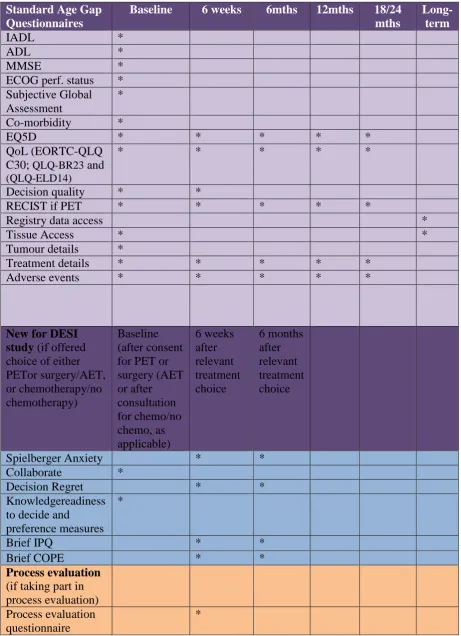
The timescales for each of these are shown in Table 1.
Table 1: Questionnaire Schedule
Standard Age Gap Questionnaires
Baseline 6 weeks 6mths 12mths 18/24
mths
Long-term
IADL *
ADL *
MMSE *
ECOG perf. status * Subjective Global Assessment
*
Co-morbidity *
EQ5D * * * * *
QoL (EORTC-QLQ C30; QLQ-BR23 and
(QLQ-ELD14)
* * * * *
Decision quality * *
RECIST if PET * * * * *
Registry data access *
Tissue Access * *
Tumour details *
Treatment details * * * * *
Adverse events * * * * *
New for DESI study (if offered choice of either PETor surgery/AET, or chemotherapy/no chemotherapy)
Baseline (after consent for PET or surgery (AET or after consultation for chemo/no chemo, as applicable) 6 weeks after relevant treatment choice 6 months after relevant treatment choice
Spielberger Anxiety * *
Collaborate *
Decision Regret * *
Knowledgereadiness to decide and
preference measures *
Brief IPQ * *
Brief COPE * *
Process evaluation (if taking part in process evaluation) Process evaluation questionnaire
Sample size calculation
The primary endpoint will be the global health status/QoL scale (questions 29 and 30 of the
EORTC-QLQ-C30)[31] at 6 months post baseline. Assuming a SD of 21 points for the global
health status/QoL scale and a mean difference of 7 or more points on the global health
status/QoL scale between the groups is of clinical/practical importance (a “small”
standardised effect size of 0.33). With no allowance for clustering; for the PET versus
surgery DESI comparison with 190 eligible women per group we will have a 90% power of
detecting this difference or more as statistically significant between the groups at the 5%
two-sided level. If we assume an intra-class correlation of 0.03 then allowing for the clustered
RCT design we will need to recruit 10 women, eligible for using the decision aids, per
cluster (i.e. 50 clusters x 10 women), 500 in total (this assumes a design effect of 1.3). With a
20% loss to follow-up by 6 months we need to recruit 13 women per cluster (50 clusters x 13
women) or 650 in total (325 per group).
Randomisation
Randomisation is at breast unit level, stratified by high and low PET and chemotherapy rates.
It was therefore not possible to blind the investigators or the study sites to the allocation of
participants. Data for this stratification have been derived from the wider cohort study which
has collected data on treatment rates for both PET versus surgery/AET and chemotherapy
versus no chemotherapy.
Control arm. Usual standard practice for older women (>70 years) diagnosed with breast
Intervention arm. Usual standard practice for older women (>70 years) diagnosed with
breast cancer plus optional clinician and patient access to the package of DESIs which will
have been made available to these units to adopt as their standard of care.
In the run in to the trial period (June–Dec 2015), clinical teams (clinicians, research and
breast nurses) from the participating sites attended a training event to enhance concordance
with the study protocol (control group) and provide additional training on shared decision
making and the use of the DESIs (intervention group). This comprised of a 2 hour practical
workshop which consisted of presentations, demonstrations and discussion based on the
MAGIC programme [46].
Recruitment
Potentially eligible women are identified by clinicians (breast surgeons, medical oncologists
and specialist breast nurses) and research nursing staff within multi disciplinary teams of the
study sites. Study packs are being given to eligible patients either following their clinical
consultation where either PET or surgery/AET options or chemotherapy versus no
chemotherapy options are discussed. Monthly study newsletters are sent to all participating
sites to provide feedback to staff in order to maintain interest and recruitment to the study.
Any modifications to the original study protocol will be discussed with the DMEC and
approvals sought from the funder and the ethics committee. Recruitment for the trial has
now commenced and 750 women have been recruited over the 53 participating sites.
Data analysis
The statistical analyses will be performed on an intention-to-treat basis comparing the DESI
demographic (e.g. age), physical measurements, and health-related QoL data will be assessed
for comparability between the treatment groups. A marginal Generalised Linear Model
(GLM), with coefficients estimated using generalised estimating equations (GEE) with robust
standard errors and an exchangeable auto correlation matrix in STATA will be used to
analyse the outcomes and allow for the clustered nature of the data. The exchangeable
correlation structure corresponds to an equal correlation model, meaning that the correlations
of the outcomes with a cluster, i.e. breast centres, are the same. For continuous outcomes,
such as mean global health status/QoL score (questions 29+30 of EORTC QLQ-C30 [31]) at
6 months post-diagnosis/consent intervention, knowledge score and preference for treatment
score, an identity link with a Normal distribution for the outcome will be used. Estimates for
the treatment group coefficient from this regression model will be reported along with their
associated 95% confidence interval. In the event of differences between the intervention and
control groups with respect to baseline demographic, physical, and health-related QoL
measurements, then these covariates will be used in the GLM to adjust the treatment effect
for these variables. The adjusted regression coefficient estimate for the treatment group
parameter along with its 95% confidence interval (CI) will then be reported.
For the other secondary outcomes, at 6 weeks and 6 months, such as the other dimensions of
the EORTC QLQ C30 [31], the EORTC QLQ-BR23 [36] and EORTC QLQ-ELD14 [37] the
mean QoL dimension scores will be compared between the intervention and control groups,
using similar models.
A series of exploratory sub group analyses using a marginal GLM with coefficients estimated
using GEE with robust standard errors and an exchangeable auto correlation matrix, with the
primary outcome the mean Global health status/QoL score (questions 29+30 of EORTC
QLQ-C30 [31]) at 6-month post-diagnosis/consent randomisation as the response will be
subgroup to directly examine the strength of evidence for the treatment difference between
the treatment groups (Intervention versus Control) varying between subgroups will be
undertaken. Age subgroup (75-79, 80-84, 85-89 and 90+ years) and co-morbidity levels
(based on the modified Charlson co-morbidity score [32]) will be the only a priori defined
sub groups to be considered for interaction test. Sub group analysis will be performed
regardless of the statistical significance on the overall intervention effect (intervention versus
control).
Missing primary outcome data
A sensitivity analysis using a variety of imputation methods, to impute any missing primary
outcome data (6-month EORTC QLQ-C30 [31] global health status/QoL score) will be
performed. The imputation methods will include last observation carried forward, regression
and multiple imputation. The estimates of the treatment effect and its associated confidence
interval, from the various imputation methods, will be graphically displayed alongside the
results for the observed data.
Process Evaluation
Running alongside the main study, a detailed mixed methods process evaluation is being
undertaken at 16 sites to assess the implementation of the DESIs(fidelity to the trial protocol)
to consider the DESIs' usefulness and acceptability and examine the facilitators and barriers
to embedding them into everyday clinical practice. A random selection of breast units was
made stratified by trial arm and recruitment rate to the cohort study (high/low
PET/surgery/chemo rates).
In summary, the Age Gap study [21] aims to improving outcomes of older women diagnosed
in this age group. The two evidence based DESIs each include a clinical management
algorithm and two patient decision aids (PtDAs) in the form of a booklet and a (brief) option
grid for the clinical decision in question. These online algorithms will allow patient age,
co-morbidities, frailty and cancer characteristics to be considered by a clinician in predicting
survival and cancer outcomes and to help inform breast cancer management decisions for
older women.
Acknowledgments
The authors are grateful to all participating sites, and specifically site principal investigators
(PI) who have or who are currently contributing to the RCT
Competing interests: None declared
Funding: This work is supported by National Institute of Health Research Programme Grant
[grant number RP-PG-1209-10071]
Contributors LW, KC and MR were overall project leads. Decision aid development and
testing KL, MB, KC, LW, MR, AE, KB, JG, DR, FA, HH. Trial management: LW, CM, TC,
KP. On line tool development: LW, SW, PR, AN, CM, MB, JM. Statistical advice: SW, OB.
Trial management group: LW, MR, KC, TR, KLC, AR, etc. Chemotherapy advisors: AR,
RL, HH. All authors have contributed to reading and approved the final manuscript.
Provenance and peer review:Not commissioned; externally peer reviewed
Open access:This is an Open Access article distributed in accordance with the Creative
Commons Attribution Non Commercial (CC BY-NC 4.0) license, which permits others to
distribute, remix, adapt, build upon this work non-commercially, and license their derivative
works on different terms, provided the original work is properly cited and the use is
REFERENCES
1. Cancer Research UK breast cancer incidence [accessed 1/11/2016] Available from
http://www.cancerresearchuk.org/health-professional/cancer-statistics/statistics-by-cancer-type/breast-cancer
2. Office for National Statistics. New cases of cancer diagnosed in England, 2014:
selected sites by age group and sex. Office for National Statistics 2010[accessed
1/11/2016]Availablefromhttps://www.ons.gov.uk/peoplepopulationandcommunity/bir
thsdeathsandmarriages/deaths/bulletins/deathsregistrationsummarytables/previousRel
eases
3. Morgan J, Richards P, Ward S et al (2015) Case mix analysis and variation in rates of
non-surgical treatment of older women with operable breast cancer. British Journal of
Surgery. 102 (9), 1056-1063.
4. Ring A, Harder H, Langridge C et al. Adjuvant chemotherapy in elderly women with
breast cancer (AChEW): an observational study identifying MDT perceptions and
barriers to decision making. Ann Oncol. 2013;24(5):1211-9.
5. BCCOM. Breast Cancer Clinical Outcome Measures (BCCOM) Project. Birmingham,
UK; 2007
6. Chakrabarti J, Kenny FS, Syed BM, et al. A randomised trial of mastectomy only
versus tamoxifen for treating elderly patients with operable primary breast
cancer-final results at 20-year follow-up. Crit Rev OncolHematol 2011;78:260-264.
7. NICE. Early and locally advanced breast cancer: full guideline.Cardiff: National
Collaborating Centre for Cancer; 2009.
8. Biganzoli L, Wildiers H, Oakman C. et al. Management of elderly patients with breast
(SIOG) and European Society of Breast Cancer Specialists (EUSOMA). Lancet Oncol
2012;13:e148-e160.
9. Morgan JL, Reed MW, Wyld L. Primary endocrine therapy as a treatment for older
women with operable breast cancer - a comparison of randomised controlled trial and
cohort study findings. Eur J Surg Oncol. 2014;40(6):676-84.
10. Glas de, NA, Jonker JM, Bastiaannet E, et al. Impact of omission of surgery on
survival of older patients with breast cancer. Br J Surg. 2014;101(11):1397-404.
11. Hind D, Wyld L, Reed MW. Surgery, with or without tamoxifen, vs tamoxifen alone
for older women with operable breast cancer: cochrane review. Br J Cancer.
2007;96(7):1025-9.
12. Morgan J, Wyld L, Collins K, et al. Surgery versus primary endocrine therapy for
operable primary breast cancer in elderlywomen (70 years plus). Cochrane Db Syst
Rev 2014;5:CD004272.
13. Audisio RA, Wyld L. No standard is set for older women with breast cancer. Eur J
SurgOncol 2015 May; 41 (5): 607
14. Morgan JL, Reed MW, Wyld L. Primary endocrine therapy as a treatment for older
women with operable breast cancer - a comparison of randomised controlled trial and
cohort study findings. Eur J SurgOncol. 2014;40(6):676-84.
15. Hille U, Soergel P, Länger F, et al. Aromatase inhibitorsas solely treatment in
postmenopausal breast cancer patients. Breast J 2012;18(2):145–50.
16. Elwyn G, Frosch D, Thomson R et al. Shared decision making: a model for clinical
practice. J Gen Intern Med 2012 Oct; 27 (10): 1361-7.
17. NICE Clinical guideline. Neutropenic sepsis: prevention and management in people
18. Ravdin PM, Siminoff LA, Davis GJ, et al. Computer program to assist in making
decisions about adjuvant therapy for women with early breast cancer. J Clin Oncol.
2001;19(4):980-91.
19. deGlas NA, van de Water W, Engelhardt EG, et al. Validity of Adjuvant! Online
program in older patients with breast cancer: a population-based study. Lancet Oncol.
2014;15(7):722-9.
20. Wishart GC, Azzato EM, Greenberg DC, et al. PREDICT: a new UK prognostic
model that predicts survival following surgery for invasive breast cancer.Breast
Cancer Res. 2010; 12(1): R1. Published online 2010 January 6. doi: 10.1186/bcr2464.
PMCID: PMC2880419
21. Wyld L, Reed MWR, Collins K et al .Bridging the Age Gap in Breast Cancer:
Improving outcomes for older women NIHR Programme grant
2012-17RP-PG-1209-10071[Accessed 18/11/ 2016] Available
athttp://www.nihr.ac.uk/funding/funded-research/funded-research.htm?postid=2237.
22. Lifford KJ, Witt J, Burton M, et al. Understanding older women’s decision making
and coping in the context of breast cancer treatment. BMC Medical Informatics &
Decision Making 2015. 15:45.
23. Burton M,Collins K, Caldon LJM et al.Information Needs of Older Women Faced
With a Choice of Primary Endocrine Therapy or Surgery for Early Stage Breast
Cancer: A Literature Review; Current Breast Cancer Reports.2014; 6:235–244.
24. Burton M, Collins K, Lifford K et al.The information and decision support needs of
older women (>75 yrs) facing treatment choices for breast cancer: a qualitative study
25. Richards P, Ward S, Morgan J, et al. The use of surgery in the treatment of ER+ early
stage breast cancer in England: variation by time, age and patient characteristics.
European Journal of Surgical Oncology. 2016; 42(4) 489-96.
26. Deciding about your breast cancer treatment: surgery and hormone-blocking pills or
hormone-blocking pills only. Cardiff University, The University of Sheffield,
Sheffield Hallam University developed as part of the Bridging the Age Gap Study
(RP-PG-1209-10071) August 2015.
27. Deciding about your breast cancer treatment: chemotherapy or no chemotherapy. The
University of Sheffield ,Brighton and Sussex Medical School, Sheffield Hallam
University and Cardiff Universityas part of the Bridging the Age Gap Study
(RP-PG-1209-10071) January 2016.
28. Schulz KF, Altman DG, Moher D, Group C. CONSORT 2010 statement: updated
guidelines for reporting parallel group randomized trials. Ann Intern Med.
2010;152(11):726-32.
29. Wyld L, Reed MWR, Collins K on behalf of the Age Gap study. A multi-centre, parallel
group, pragmatic cluster randomised controlled trial NIHR Programme grant
RP-PG-1209-1007.EUDRACT No:2015-004220-61
30. Marrin k, Brain K, Durand MA, Edwards A et al. . Fast and frugal tools for shared
decsion making: How to develop option grids.European Journal for Person Centered
Health Care. 2013;1(1):240-5.
31. Aaronson NK, Ahmedzai S, Bergman B, et al. The European Organization for
Research and Treatment of Cancer QLQ-C30: a quality-of-life instrument for use in
32. Charlson ME, Pompei P, Ales KL, MacKenzie CR. A new method of classifying
prognostic comorbidity in longitudinal studies: development and validation. J Chronic
Dis. 1987;40(5):373-83.
33. Mahoney FI, Barthel DW. Functional Evaluation: The Barthel Index. Md State Med J.
1965;14:61-5.
34. Lawton MP, Brody EM. Assessment of older people: self-maintaining and
instrumental activities of daily living. Gerontologist. 1969;9(3):179-86.
35. Folstein MF, Folstein SE, McHugh PR. "Mini-mental state". A practical method for
grading the cognitive state of patients for the clinician. J Psychiatr Res.
1975;12(3):189-98.
36. Sprangers MA, Groenvold M, Arraras JI et al. The European Organization for
Research and Treatment of Cancer breast cancer-specific quality-of-life questionnaire
module: first results from a three-country field study. J Clin Oncol.
1996;14(10):2756-68.
37. Johnson C, Fitzsimmons D, Gilbert J et al. Development of the European
Organisation for Research and Treatment of Cancer quality of life questionnaire
module for older people with cancer: The EORTC QLQ-ELD14. Eur J Cancer.
2010;46(12):2242-52.
38. EuroQol Group EuroQol—A new facility for the measurement of health-related
quality of life
39. Health Policy, 16 (1990), pp. 199–208.Brehaut JC, O'Connor AM, Wood TJ, Hack
TF, Siminoff L, Gordon E, et al. Validation of a decision regret scale. Med Decis
40. Barr PJ, Thompson R, Walsh T, et al. The psychometric properties of CollaboRATE:
a fast and frugal patient-reported measure of the shared decision-making process. J
Med Internet Res. 2014;16(1):e2.
41. Marteau TM, Bekker H. The development of a six-item short-form of the state scale
of the Spielberger State-Trait Anxiety Inventory (STAI). Br J Clin Psychol. 1992;31 (
Pt 3):301-6.
42. Sepucha K, Ozanne E, Silvia K, et al. An approach to measuring the quality of breast
cancer decisions. Patient Educ Couns. 2007;65(2):261-9.
43. Sepucha KR, Belkora JK, Chang Y, et al. Measuring decision quality: psychometric
evaluation of a new instrument for breast cancer surgery. BMC Med Inform Decis
Mak. 2012;12:51.
44. Broadbent E, Petrie KJ, Main J, et al. The brief illness perception questionnaire. J
Psychosom Res. 2006;60(6):631-7.
45. Carver CS. You want to measure coping but your protocol’s too long: Consider the
Brief COPE. International Journal of Behavioral Medicine.1997; 4, 92-100. .
46. Lloyd A & Joseph-Williams N. Case Study: Different outcomes from different
approaches – Experience from the Cardiff MAGIC Programme, UK. In Elwyn G,
Edwards A, Thompson R (eds.) Shared Decision Making in Health Care. 3rd edition.